 Скачать презентацию A Review of Biotechnology Education Industry Needs
a4427d92c92a85545b58223bd09bb497.ppt
- Количество слайдов: 66



A Review of Biotechnology Education & Industry Needs in Australia: Implications for Content & Pedagogy
1) Australian Universities Teaching Committee (AUTC) -- Review of Biotechnology Skills & University Teaching in Australia 2001 -2004 Phase 1 and Phase 2 2) Carrick Institute for Learning & Teaching in Higher Education -Biotechnology Cross-Disciplinary Scoping Study 2007 -2008
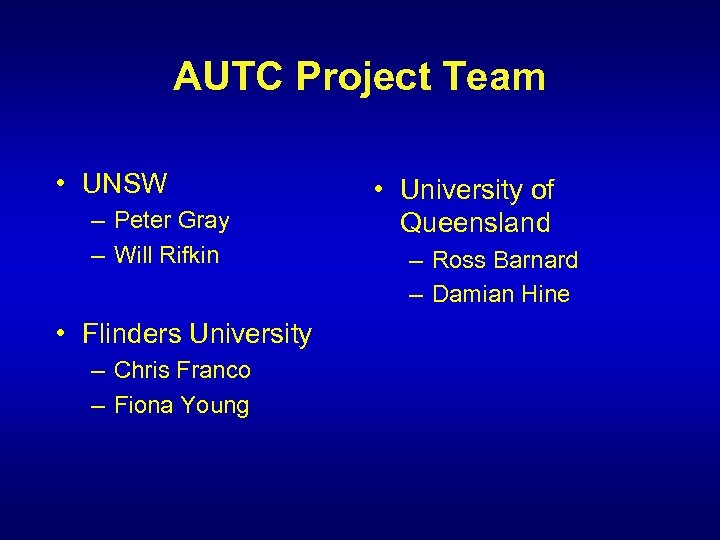
AUTC Project Team • UNSW – Peter Gray – Will Rifkin • Flinders University – Chris Franco – Fiona Young • University of Queensland – Ross Barnard – Damian Hine
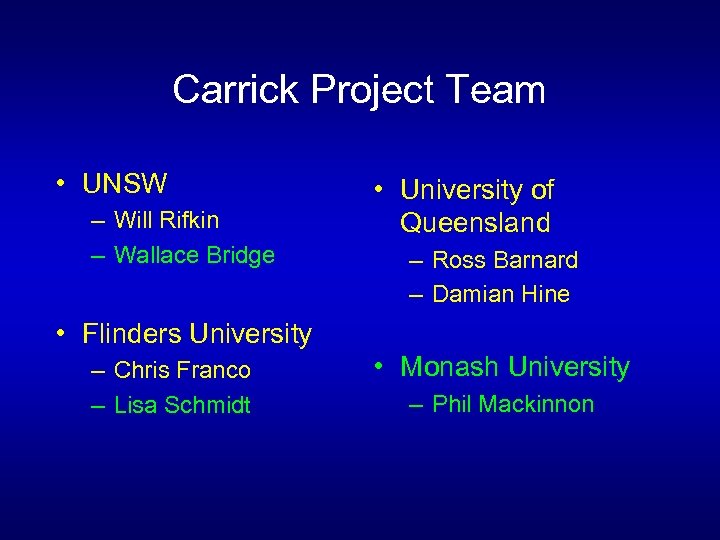
Carrick Project Team • UNSW – Will Rifkin – Wallace Bridge • University of Queensland – Ross Barnard – Damian Hine • Flinders University – Chris Franco – Lisa Schmidt • Monash University – Phil Mackinnon
Context of Project 2001 Industry Universities Wills Report (1999) “virtuous cycle”
Key features of biotechnology • Trans-disciplinary • Rapidly evolving and emerging fields – Nanotech, proteomics, genomics, bioinformatics, PTGS • A very diverse industry • A large number of small companies
Implications for teaching • How should we deliver our teaching, for what seems to be a moving target? – Content? – Teaching methods?
• Are we delivering what industry needs? – Core content knowledge – Generic skills
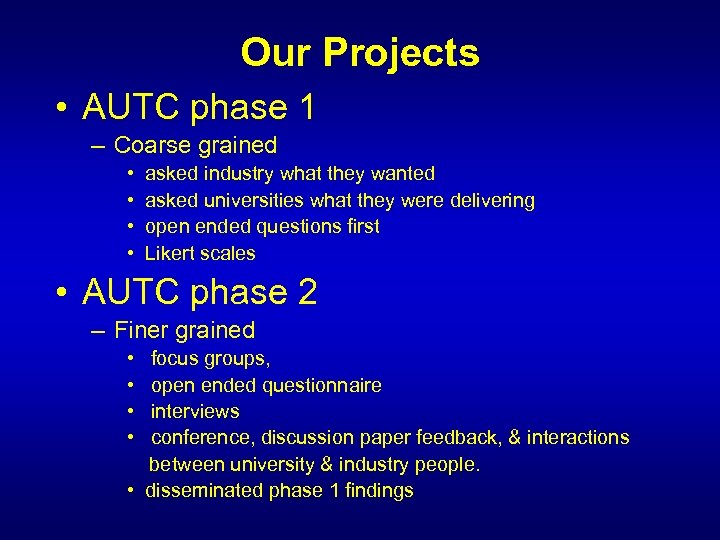
Our Projects • AUTC phase 1 – Coarse grained • • asked industry what they wanted asked universities what they were delivering open ended questions first Likert scales • AUTC phase 2 – Finer grained • • focus groups, open ended questionnaire interviews conference, discussion paper feedback, & interactions between university & industry people. • disseminated phase 1 findings
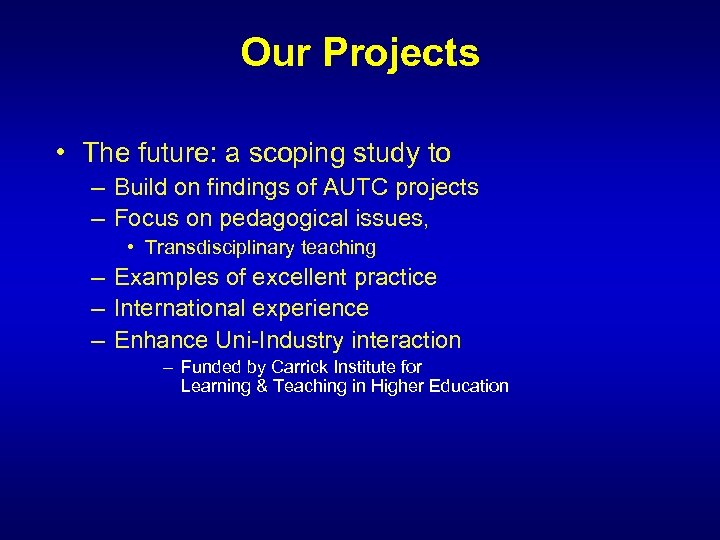
Our Projects • The future: a scoping study to – Build on findings of AUTC projects – Focus on pedagogical issues, • Transdisciplinary teaching – Examples of excellent practice – International experience – Enhance Uni-Industry interaction – Funded by Carrick Institute for Learning & Teaching in Higher Education
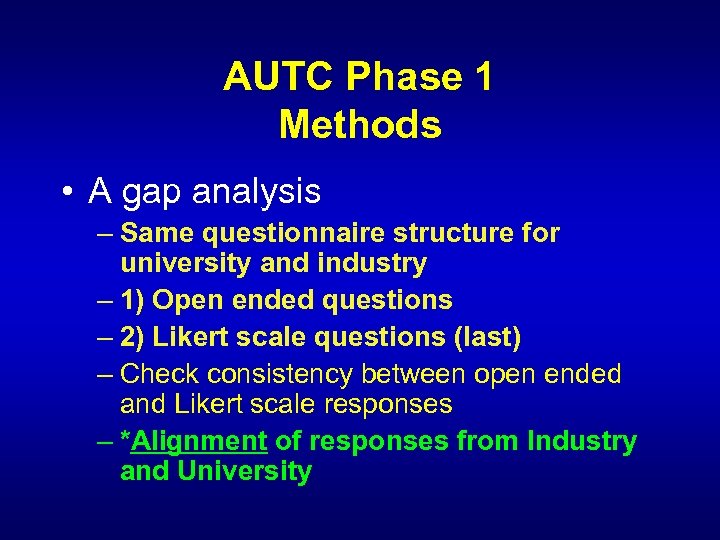
AUTC Phase 1 Methods • A gap analysis – Same questionnaire structure for university and industry – 1) Open ended questions – 2) Likert scale questions (last) – Check consistency between open ended and Likert scale responses – *Alignment of responses from Industry and University
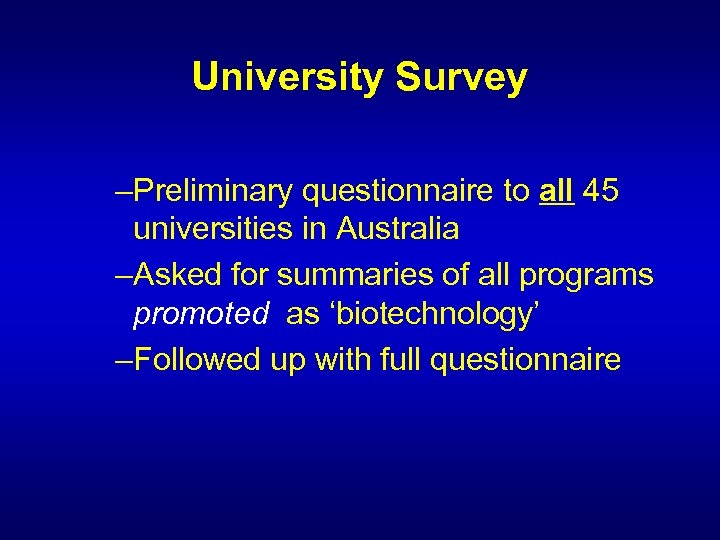
University Survey –Preliminary questionnaire to all 45 universities in Australia –Asked for summaries of all programs promoted as ‘biotechnology’ –Followed up with full questionnaire
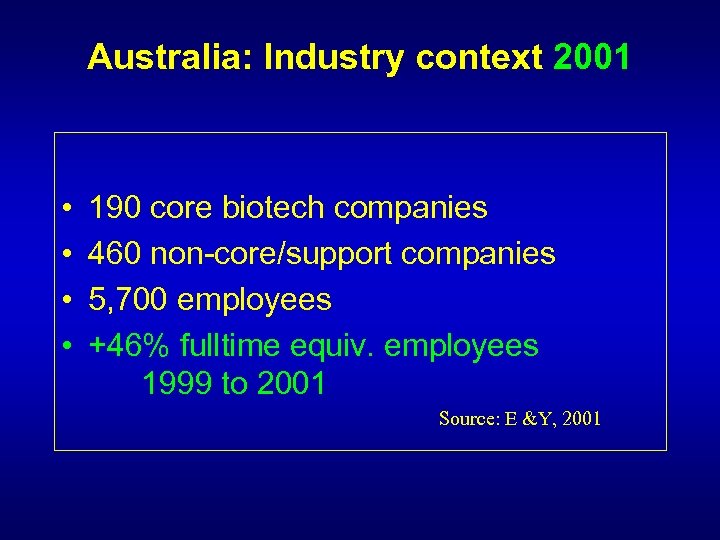
Australia: Industry context 2001 • • 190 core biotech companies 460 non-core/support companies 5, 700 employees +46% fulltime equiv. employees 1999 to 2001 Source: E &Y, 2001
Activity of companies in Australia, 2003 43% R&D and technology dev. 10% clinical/ field trial Source: AUTC/DEST review of Biotech teaching
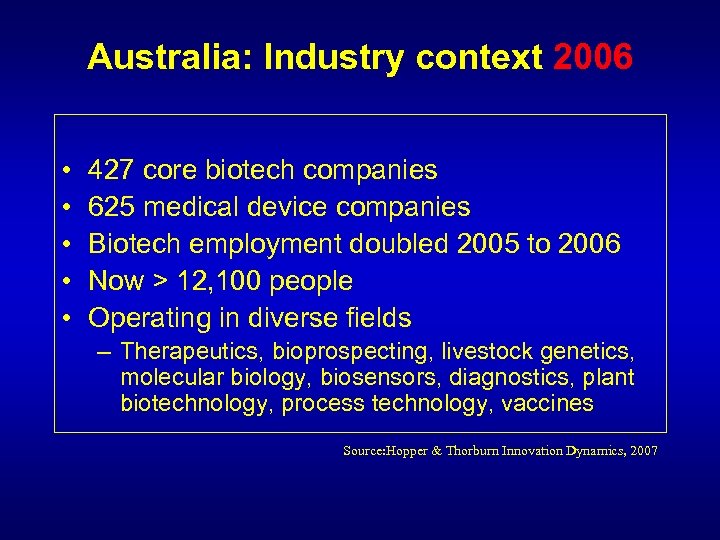
Australia: Industry context 2006 • • • 427 core biotech companies 625 medical device companies Biotech employment doubled 2005 to 2006 Now > 12, 100 people Operating in diverse fields – Therapeutics, bioprospecting, livestock genetics, molecular biology, biosensors, diagnostics, plant biotechnology, process technology, vaccines Source: Hopper & Thorburn Innovation Dynamics, 2007
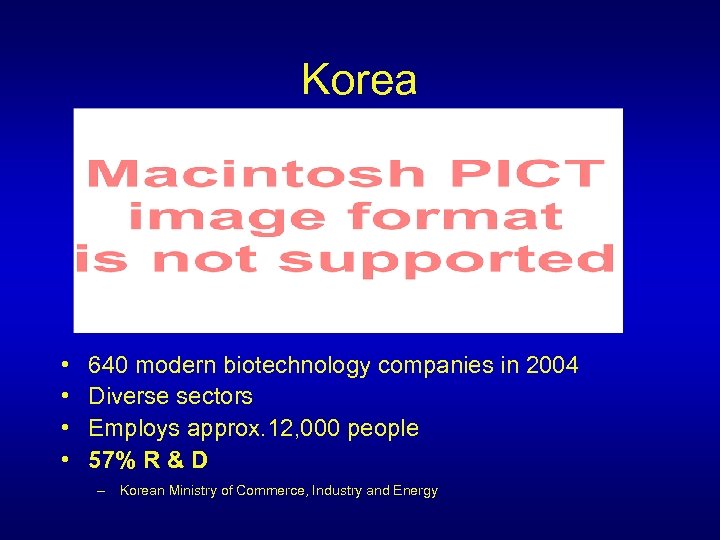
Korea • • 640 modern biotechnology companies in 2004 Diverse sectors Employs approx. 12, 000 people 57% R & D – Korean Ministry of Commerce, Industry and Energy
Australia: recruiting challenges * Source: Ernst & Young biotechnology report 2001
OECD: recruiting challenges * Source: Ernst & Young biotechnology report 2001
Profile of Industry Respondents in AUTC survey • Responses from > 65 companies (50% response rate) -Respondents: predominantly core. -Employees: 2 – 280 (median 18, mean 38) -Expected employ. growth (ave. ): 58%/yr. -Median age of firm: 10 years
Result: AUTC survey Single outlier Age of company 114 yrs old with 2850 employees Total number of employees
Result: AUTC survey Graduates hired in last financial year (ave. )
Result: AUTC survey • Large companies hired a greater proportion of bachelors & masters degree staff • Smaller companies hired a greater proportion of Ph. D graduates

What did we ask?
Asked of industry • 1) What 3 attributes / abilities do you look for in graduates when they commence employment with your company?

* * *
Asked of industry • 2) What 3 attributes / abilities do you look to develop in your graduates once employed in your company?

* * *
Asked of industry • 3) What 3 areas of technical knowledge do you see as most important amongst your scientists?
Technical Knowledge * * *
Asked of industry • 4) List the 3 most important technological developments to directly impact your company in the last 2 years.
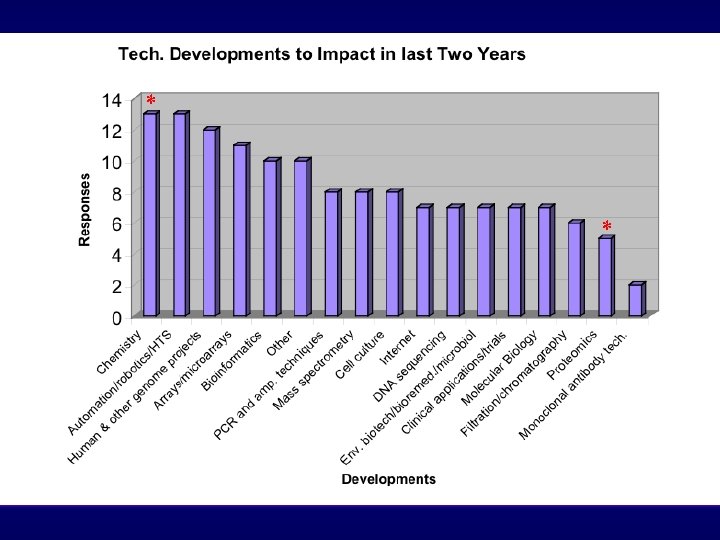
* *
Asked of industry • 5) List the 3 most important technological developments to directly impact your company in the next 2 years.
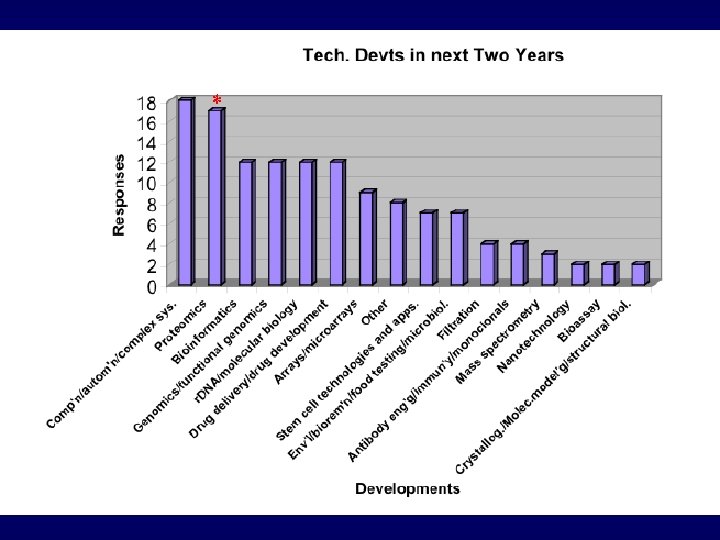
*
Asked of industry • 6) List skills requirements most affected by these technological developments in your company.
*
* * 2002 2004 n. b. scale
* * * 2002 2004 n. b. scale
Conclusions: Knowledge & skills demand • ‘Generic’ skills among biotech graduates will remain in consistent high demand • Specific areas of scientific focus will evolve over time and will depend on focus of the company and technology trends • Strong & persistent preference for core skills in chemistry & molecular biology
Gap analysis • aligning university & industry responses

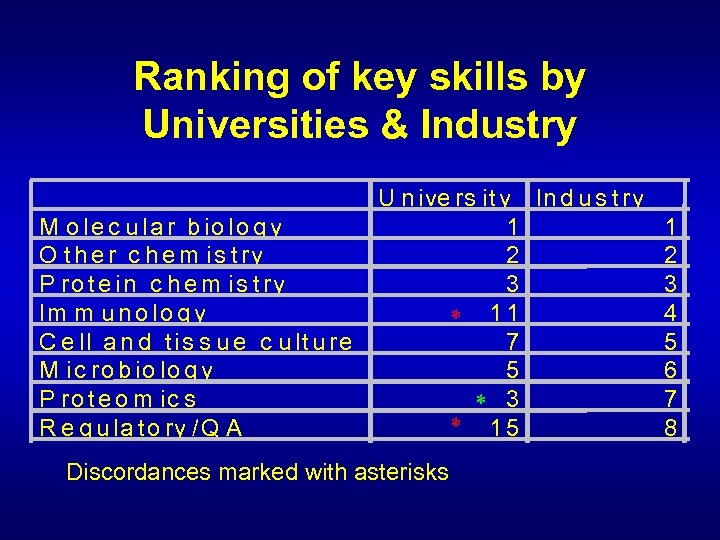
Ranking of key skills by Universities & Industry M o le c u la r b io lo g y O t h e r c h e m is t ry P ro t e in c h e m is t ry Im m u n o lo g y C e ll a n d t is s u e c u lt u re M ic ro b io lo g y P ro t e o m ic s R e g u la t o ry / Q A U n ive rs it y In d u s t ry 1 2 3 * 11 7 5 * 3 * 15 Discordances marked with asterisks 1 2 3 4 5 6 7 8
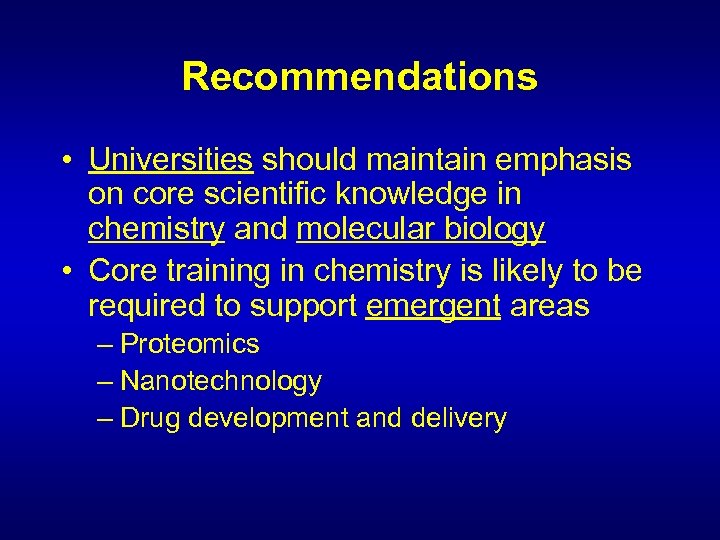
Recommendations • Universities should maintain emphasis on core scientific knowledge in chemistry and molecular biology • Core training in chemistry is likely to be required to support emergent areas – Proteomics – Nanotechnology – Drug development and delivery
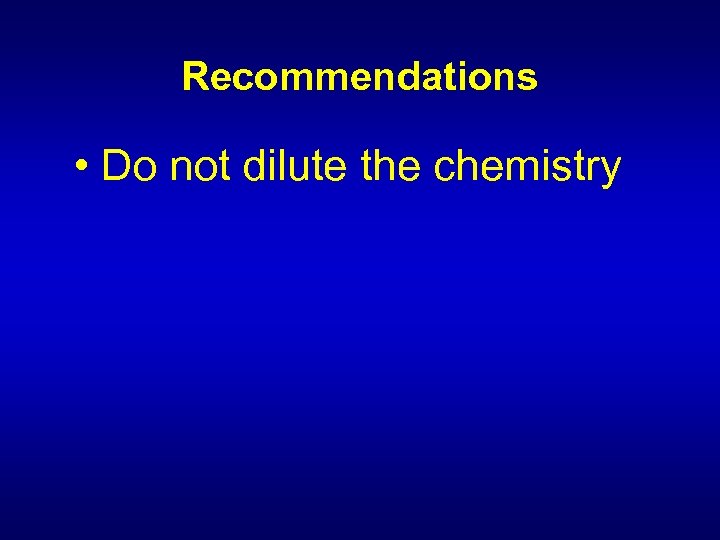
Recommendations • Do not dilute the chemistry
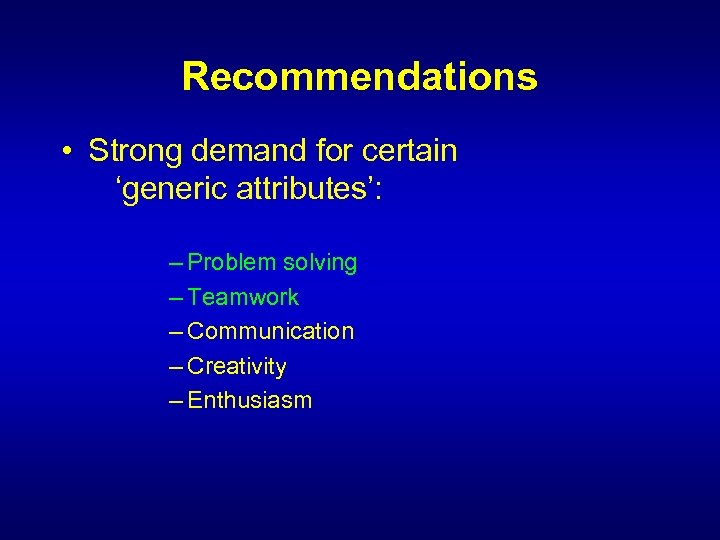
Recommendations • Strong demand for certain ‘generic attributes’: – Problem solving – Teamwork – Communication – Creativity – Enthusiasm
Recommendations • Implications for pedagogy – More problem based learning ? – More team based activities ? – More hands-on, task based application of core knowledge?
Recommendations • Universities could provide students with a core skills and generic attributes profile
University Involvement with Industry? • Universities wanted more industry involvement in: – – – Financial & in-kind support Case material Field trips / site visits Student placements * Career advice
Industry Involvement with Universities? 78% of respondents had one or more forms of involvement with Universities -Staff funded to do postgraduate studies -Hosting undergraduate honours students -Vacation projects / employment -Hosting students on ARC linkage grants
• Phase 2 AUTC project • Set up university-industry focus groups in Brisbane, Sydney, Melbourne and Adelaide • Brought together people from industry and teaching programs
Phase 2 AUTC - Data • “the amount of management / commercialisation / IP suggested to be included in a Biotech degree is misplaced. Students would do far better working on their scientific skills than diluting their degree with such topics. We teach them barely enough as it is of real science. However, I can see the place for a double degree: Biotech-management, or students should just do an MBA, specialising in Technology Management”.
Phase 2 AUTC - Data • “My reading of the US market also tells me that the next biotech boom, which started about a year ago in the US (so should take about 4 more years to get here), is very much pharma driven. This will serve to emphasise chemistry even more as a core skill that employers will require. The days when biotech meant cloning genes are long gone. My involvement in establishing a biotech company (XXXXXXX) of which I am still CSO also points to the need for a full 3 years of Chemistry. If they don't have this, then they are not so useful to us”.
Phase 2 AUTC - Data • ‘Triangulation’ of data • Requirement for chemistry was reinforced by focus groups • Also note our data on outsourcing where chemistry was one of two technical areas commonly outsourced.
The future • Implications of AUTC report for teaching practice ? – pedagogy – content • International practice ? – pedagogy – content
Carrick scoping project Aims: “Scoping” • What is important ? • What is out there, what are people doing well? • What might be desirable and feasible to change?
Carrick scoping project – Survey university ‘excellent practice’ • Nationally and Internationally – Monitor possible change in industry needs – Survey challenges & possible solutions for cross disciplinary teaching – Investigate possible ways to build more effective interaction between universities and industry » Funded by Carrick Institute for Learning & Teaching in Higher Education
Innovation in pedagogy • Phase 1 AUTC results suggest increased use of Problem Based Learning might be appropriate. – Core knowledge versus generic skills • We will investigate this and other options – More team based activities ? – More task based application of core knowledge?
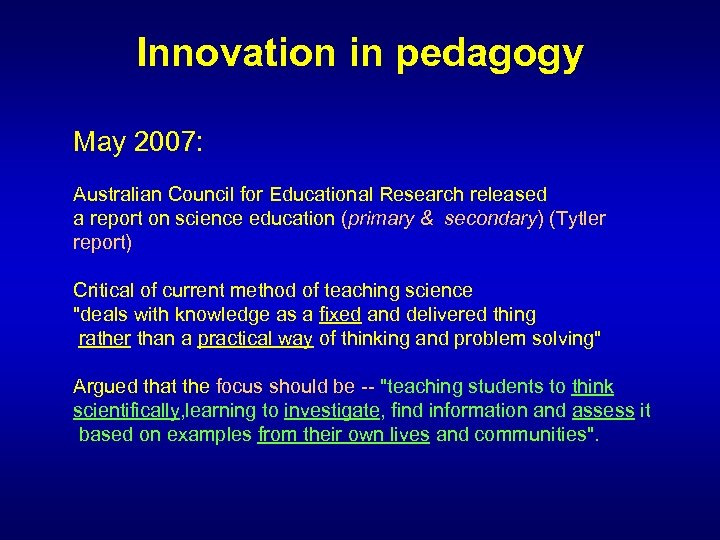
Innovation in pedagogy May 2007: Australian Council for Educational Research released a report on science education (primary & secondary) (Tytler report) Critical of current method of teaching science "deals with knowledge as a fixed and delivered thing rather than a practical way of thinking and problem solving" Argued that the focus should be -- "teaching students to think scientifically, learning to investigate, find information and assess it based on examples from their own lives and communities".
Changes in industry? – Has industry changed over last 3 years? – Change in demand for graduate skills / attributes? – What are major institutional groups evolving in Biotechnology industry?
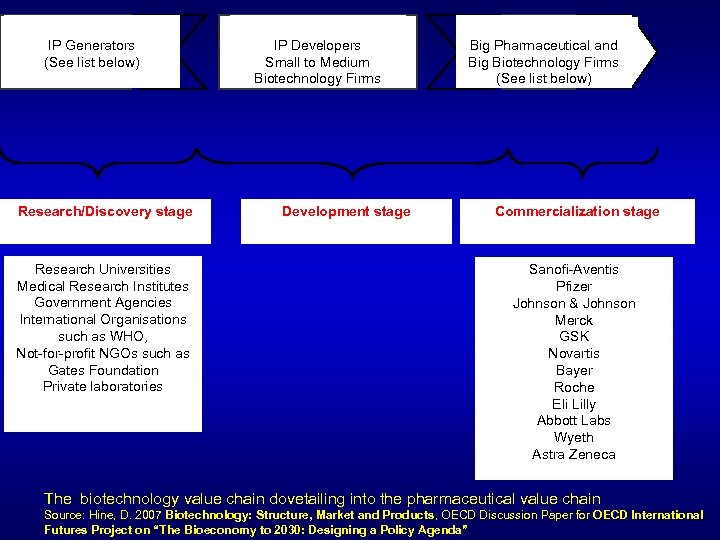
Dev’ Discovery Generators t IP Applied research (See list below) Research/Discovery stage Research Universities Medical Research Institutes Government Agencies International Organisations such as WHO, Not-for-profit NGOs such as Gates Foundation Private laboratories IP Developers Small to Medium Biotechnology Firms Development stage Big Pharmaceutical and Big Biotechnology Firms (See list below) Commercialization stage Sanofi-Aventis Pfizer Johnson & Johnson Merck GSK Novartis Bayer Roche Eli Lilly Abbott Labs Wyeth Astra Zeneca The biotechnology value chain dovetailing into the pharmaceutical value chain Source: Hine, D. 2007 Biotechnology: Structure, Market and Products, OECD Discussion Paper for OECD International Futures Project on “The Bioeconomy to 2030: Designing a Policy Agenda”
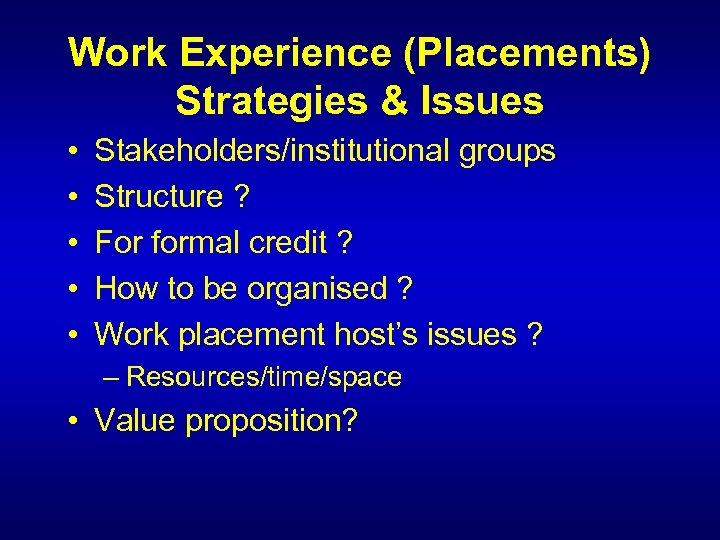
Work Experience (Placements) Strategies & Issues • • • Stakeholders/institutional groups Structure ? For formal credit ? How to be organised ? Work placement host’s issues ? – Resources/time/space • Value proposition?
Work Experience (Placements) Strategies & Issues • Data collection • Survey of placement programs • Collection of stakeholder feedback
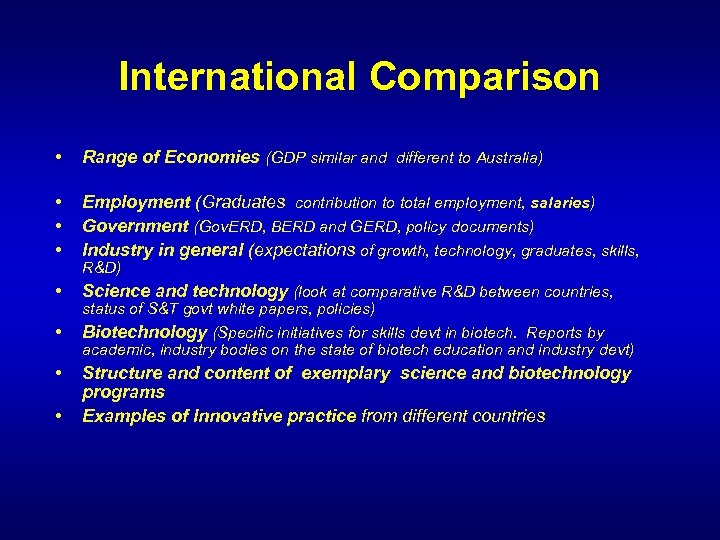
International Comparison • Range of Economies (GDP similar and different to Australia) • • • Employment (Graduates contribution to total employment, salaries) Government (Gov. ERD, BERD and GERD, policy documents) Industry in general (expectations of growth, technology, graduates, skills, • Science and technology (look at comparative R&D between countries, • • • R&D) status of S&T govt white papers, policies) Biotechnology (Specific initiatives for skills devt in biotech. Reports by academic, industry bodies on the state of biotech education and industry devt) Structure and content of exemplary science and biotechnology programs Examples of Innovative practice from different countries
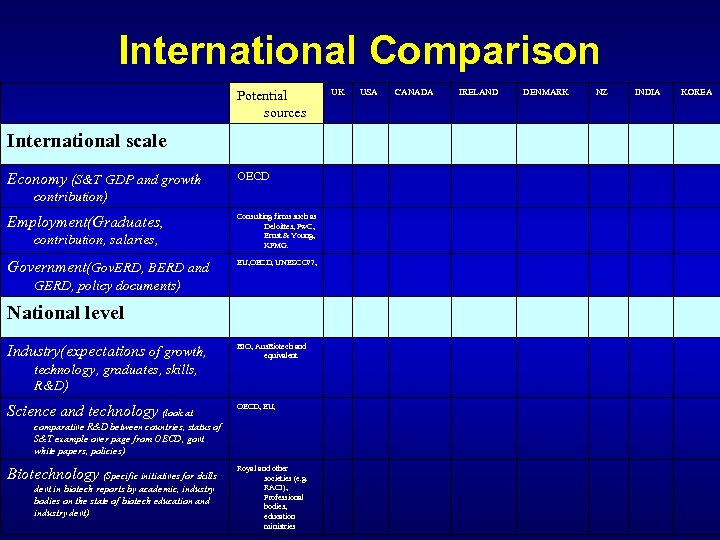
International Comparison Potential sources International scale Economy (S&T GDP and growth OECD contribution) Employment(Graduates, contribution, salaries, Government(Gov. ERD, BERD and Consulting firms such as Deloittes, Pw. C, Ernst & Young, KPMG. EU, OECD, UNESCO? ? , GERD, policy documents) National level Industry(expectations of growth, BIO, Aus. Biotech and equivalent technology, graduates, skills, R&D) Science and technology (look at OECD, EU, comparative R&D between countries, status of S&T example over page from OECD, govt white papers, policies) Biotechnology (Specific initiatives for skills devt in biotech reports by academic, industry bodies on the state of biotech education and industry devt) Royal and other societies (e. g. RACI), Professional bodies, education ministries UK USA CANADA IRELAND DENMARK NZ INDIA KOREA
Solicit International Involvement • We can offer – Survey methodology & instruments – Focus group & interview protocols – Reports – Tools for benchmarking programs – Examples of biotechnology program structures and content
Solicit international involvement • We seek to learn – Structure of your teaching programs? (National & university level) – Content & teaching methods? (innovations, traditions) – Joint survey to compare across countries • Expecting further funding in 2008 to launch full Carrick study based on scoping study.
Thank you & stay tuned
Скачать презентацию A Review of Biotechnology Education Industry Needs
a4427d92c92a85545b58223bd09bb497.ppt