


 Скачать презентацию A review of Anderson s lectures Extract key
0f899a18d80a4175e7254987a55199e9.ppt
- Количество слайдов: 98
 A review of Anderson’s lectures • Extract key points
 Review • • Why study operating systems? What is an operating system? Principles of operating system design History of operating systems
 Why study OS? • Abstraction: OS is a wizard, providing illusion of infinite CPUs, infinite memory, single worldwide computing, etc. • System Design: tradeoffs between performance and simplicity, crosscutting, putting functionality in hardware vs. software, etc. • How computers work: "look under the hood" of computer systems
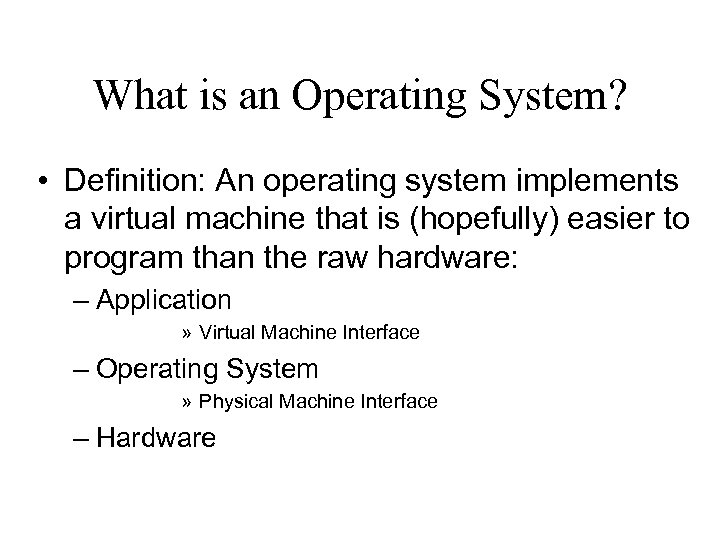 What is an Operating System? • Definition: An operating system implements a virtual machine that is (hopefully) easier to program than the raw hardware: – Application » Virtual Machine Interface – Operating System » Physical Machine Interface – Hardware
 Just a software engineering problem? • In some sense, OS is just a software engineering problem: how do you convert what the hardware gives you into something that the application programmers want?
 Key questions in OS • For any OS area (file systems, virtual memory, networking, CPU scheduling), begin by asking two questions: – what’s the hardware interface? (the physical reality) – what’s the application interface? (the nicer abstraction)
 Same theme at higher levels • what’s the programming language (e. g. Java) interface? (the programming reality) • what’s the application interface? (the nicer abstraction)
 Dual-mode operation • when in the OS, can do anything (kernel -mode) • when in a user program, restricted to only touching that program's memory (user-mode) – don’t need boundary between kernel and application if system is dedicated to a single application.
 Portable operating system • want OS to be portable, so put in a layer that abstracts out differences between different hardware architectures. • OS – portable OS layer – machine dependent OS layer
 Operating systems principles • Meta-principle: OS design tradeoffs change as technology changes.
 History • History Phase 1: hardware expensive, humans cheap • History, Phase 2: hardware cheap, humans expensive • History, Phase 3: hardware very cheap, humans very e x p e n s i v e
 Lecture 2: Concurrency: Threads, Address Spaces and Processes • OS has to coordinate all the activity on a machine -- multiple users, I/O interrupts, etc. • How can it keep all these things straight? • Answer: Decompose hard problem into simpler ones. Instead of dealing with everything going on at once, separate so deal with one at a time.
 Processes • Process: Operating system abstraction to represent what is needed to run a single program (this is the traditional UNIX definition) • Formally, a process is a sequential stream of execution in its own address space.
 Processes • Two parts to a process: – sequential execution: No concurrency inside a process -- everything happens sequentially. – process state: everything that interacts with process. • Process =? Program – More to a process than just a program – Less to a process than a program
 Threads • Thread: a sequential execution stream within a process (concurrency) • Sometimes called: a "lightweight" process. • Address space: all the state needed to run a program (literally, all the addresses that can be touched by the program). • Multithreading: a single program made up of a number of different concurrent activities
 Thread state • Some state shared by all threads in a process/address space: contents of memory (global variables, heap), file system • Some state "private" to each thread -each thread has its own program counter, registers, execution stack • Threads encapsulate concurrency; address spaces encapsulate protection
 Book • Book talks about processes: when this – concerns concurrency, really talking about thread portion of a process; when this – concerns protection, really talking about address space portion of a process.
 Lecture 3: Threads and Dispatching • Each thread has illusion of its own CPU – Thread control block: one per thread execution state: registers, program counter, pointer to stack scheduling information, etc. • Dispatching Loop (scheduler. cc) – LOOP – – Run thread Save state (into thread control block) Choose new thread to run Load its state (into TCB) and loop
 Running a thread • Load its state (registers, PC, stackpointer) into the CPU, and do a jump. • How does dispatcher get control back? Two ways: – Internal events: IO, other thread, yield – External events: Interrupts, timer
 Choosing a thread to run • Dispatcher keeps a list of ready threads -- how does it choose among them? – Zero ready threads -- dispatcher just loops – One ready thread -- easy. – More than one ready thread: • LIFO • FIFO • Priority queue
 Thread states • Each thread can be in one of three states: – Running -- has the CPU – Blocked -- waiting for I/O or synchronization with another thread – Ready to run -- on the ready list, waiting for the CPU
 Lecture 4: Independent vs. cooperating threads • Independent threads: No state shared with other threads Deterministic -- input state determines result, Reproducible, Scheduling order doesn't matter • Cooperating threads: Shared state, Non-deterministic, Non-reproducible
 Why allow cooperating threads? • Speedup • Modularity chop large problem up into simpler pieces • Need: – Atomic operation: operation always runs to completion, or not at all. Indivisible, can't be stopped in the middle.
 Lecture 5: Synchronization: Too Much Milk • Synchronization: using atomic operations to ensure cooperation between threads • Mutual exclusion: ensuring that only one thread does a particular thing at a time. One thread doing it excludes the other, and vice versa. • Critical section: piece of code that only one thread can execute at once. Only one thread at a time will get into the section of code.
 Lecture 5 • Lock: prevents someone from doing something. • Lock before entering critical section, before accessing shared d a t a • unlock when leaving, after done accessing shared data • wait if locked • Key idea -- all synchronization involves waiting.
 Too Much Milk Summary • Have hardware provide better (higherlevel) primitives than atomic load and store. • Use locks as atomic building block and solution becomes easy: – lock->Acquire(); • if (nomilk) buy milk; – lock->Release();
 Lecture 6: Implementing Mutual Exclusion • High level atomic operations (API ) – locks, semaphores, monitors, send&receive • Low level atomic operations (hardware) – load/store, interrupt disable, test&set
 Lecture 7: Semaphores and Bounded Buffer • Writing concurrent programs is hard because you need to worry about multiple concurrent activities writing the same memory; hard because ordering matters. • Synchronization is a way of coordinating multiple concurrent activities that are using shared state. What are the right synchronization abstractions, to make it easy to build correct concurrent programs?
 Definition of Semaphores • Semaphores are a kind of generalized lock, first defined by Dijkstra in the late 60's. Semaphores are the main synchronization primitive used in UNIX. • ATOMIC operations – P = Down, waits for positive, decrements by 1 – V = Up, increments by 1, waking up any waiting P
 Two uses of semaphores • Mutual exclusion – semaphore->P(); – // critical section goes here – semaphore->V(); • Scheduling constraints – semaphores provide a way for a thread to wait for something.
 Motivation for monitors • Semaphores are a huge step up; But problem with semaphores is that they are dual purpose. Used for both mutex and scheduling constraints. • This makes the code hard to read, and hard to get right.
 Monitors • Idea in monitors is to separate these concerns: – use locks for mutual exclusion and – condition variables for scheduling constraints • Monitor: a lock and zero or more condition variables for managing concurrent access to shared data
 Lock • Lock: : Acquire -- wait until lock is free, then grab it • Lock: : Release -- unlock, wake up anyone waiting in Acquire
 condition variables • Key idea with condition variables: make it possible to go to sleep inside critical section, by atomically releasing lock at same time we go to sleep • Condition variable: a queue of threads waiting for something inside a critical section
 Difference between monitors and Java classes • From Solomon: processes. html: First, instead of marking a whole class as monitor, you have to remember to mark each method as synchronized. Every object is potentially a monitor. Second, there are no explicit condition variables. In effect, every monitor has exactly one anonymous condition variable. Instead of writing c. wait() or c. notify(), where c is a condition variable, you simply write wait() or notify()
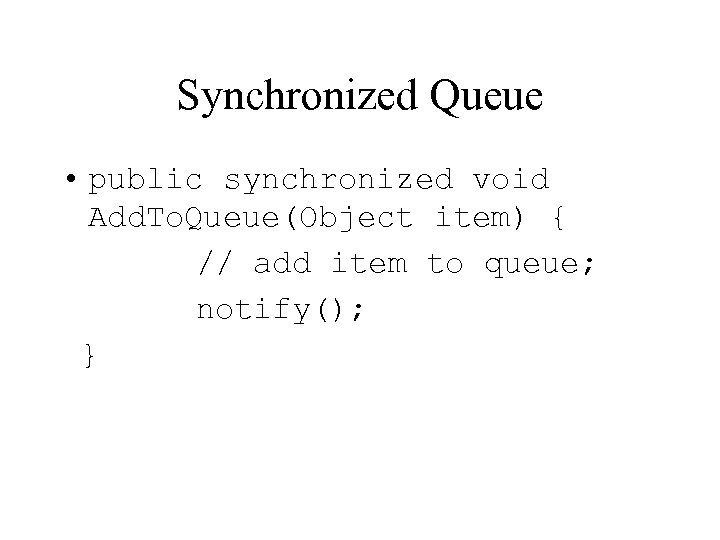 Synchronized Queue • public synchronized void Add. To. Queue(Object item) { // add item to queue; notify(); }
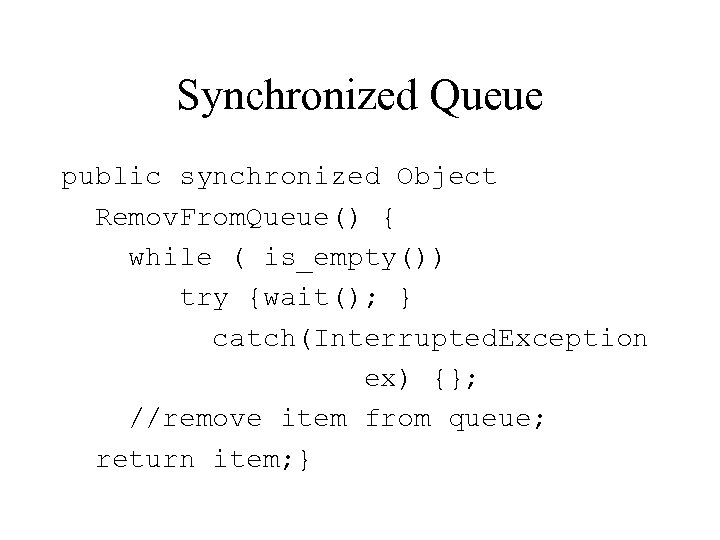 Synchronized Queue public synchronized Object Remov. From. Queue() { while ( is_empty()) try {wait(); } catch(Interrupted. Exception ex) {}; //remove item from queue; return item; }
 Summary Lecture 7 • Monitors represent the logic of the program -- wait if necessary, signal if change something so waiter might need to wake up.
 Synchronization in Java • Monitors • Separate core behavior from synchronization behavior
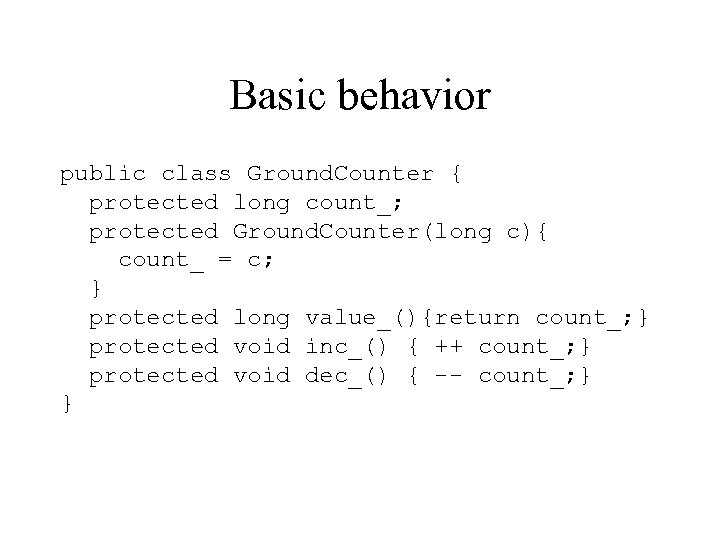 Basic behavior public class Ground. Counter { protected long count_; protected Ground. Counter(long c){ count_ = c; } protected long value_(){return count_; } protected void inc_() { ++ count_; } protected void dec_() { -- count_; } }
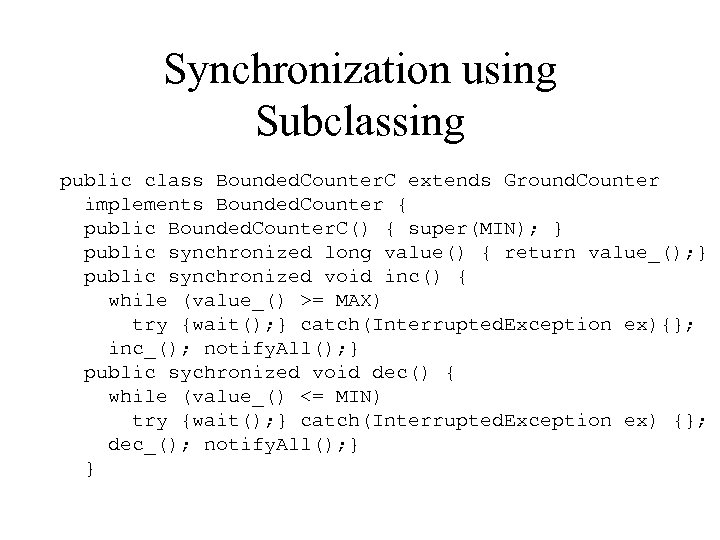 Synchronization using Subclassing public class Bounded. Counter. C extends Ground. Counter implements Bounded. Counter { public Bounded. Counter. C() { super(MIN); } public synchronized long value() { return value_(); } public synchronized void inc() { while (value_() >= MAX) try {wait(); } catch(Interrupted. Exception ex){}; inc_(); notify. All(); } public sychronized void dec() { while (value_() <= MIN) try {wait(); } catch(Interrupted. Exception ex) {}; dec_(); notify. All(); } }
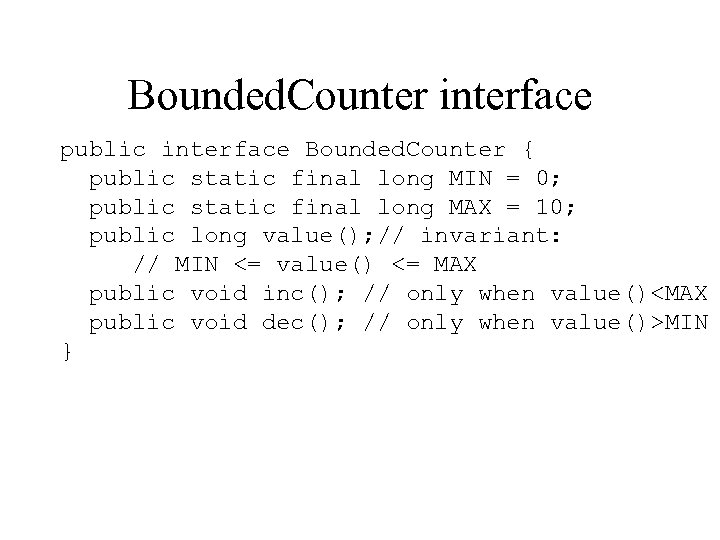 Bounded. Counter interface public interface Bounded. Counter { public static final long MIN = 0; public static final long MAX = 10; public long value(); // invariant: // MIN <= value() <= MAX public void inc(); // only when value()
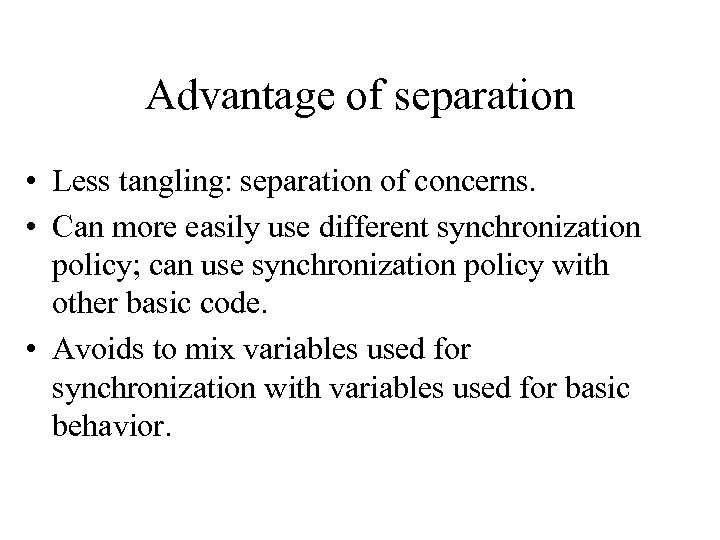 Advantage of separation • Less tangling: separation of concerns. • Can more easily use different synchronization policy; can use synchronization policy with other basic code. • Avoids to mix variables used for synchronization with variables used for basic behavior.
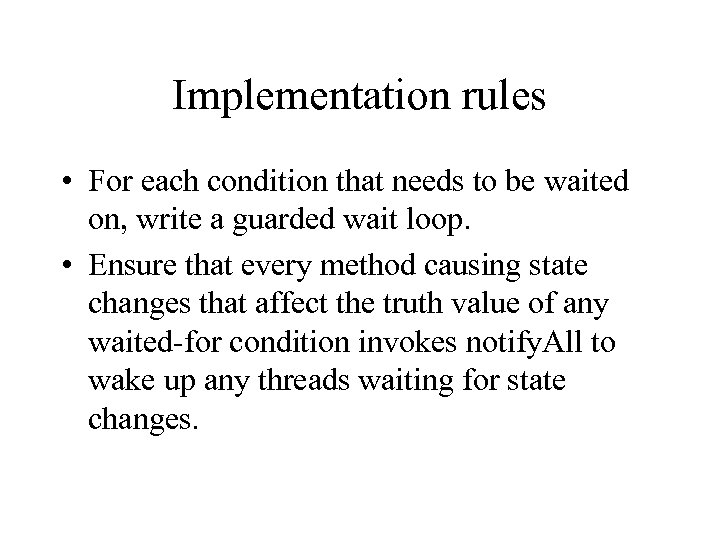 Implementation rules • For each condition that needs to be waited on, write a guarded wait loop. • Ensure that every method causing state changes that affect the truth value of any waited-for condition invokes notify. All to wake up any threads waiting for state changes.
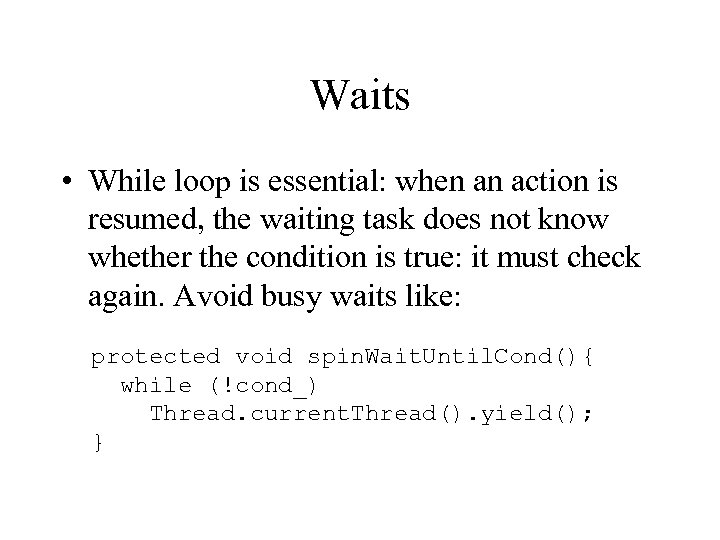 Waits • While loop is essential: when an action is resumed, the waiting task does not know whether the condition is true: it must check again. Avoid busy waits like: protected void spin. Wait. Until. Cond(){ while (!cond_) Thread. current. Thread(). yield(); }
 Notifications • Good to start with blanket notifications using notify. All • notify. All is an expensive operation • optimize later
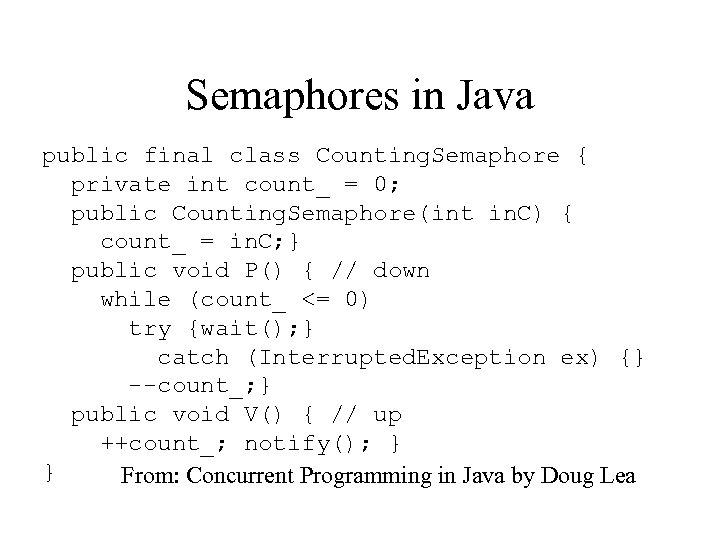 Semaphores in Java public final class Counting. Semaphore { private int count_ = 0; public Counting. Semaphore(int in. C) { count_ = in. C; } public void P() { // down while (count_ <= 0) try {wait(); } catch (Interrupted. Exception ex) {} --count_; } public void V() { // up ++count_; notify(); } } From: Concurrent Programming in Java by Doug Lea
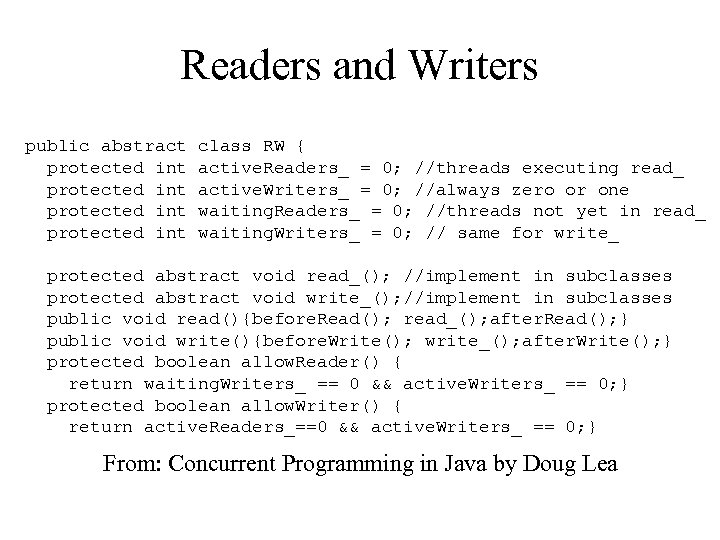 Readers and Writers public abstract protected int class RW { active. Readers_ = 0; //threads executing read_ active. Writers_ = 0; //always zero or one waiting. Readers_ = 0; //threads not yet in read_ waiting. Writers_ = 0; // same for write_ protected abstract void read_(); //implement in subclasses protected abstract void write_(); //implement in subclasses public void read(){before. Read(); read_(); after. Read(); } public void write(){before. Write(); write_(); after. Write(); } protected boolean allow. Reader() { return waiting. Writers_ == 0 && active. Writers_ == 0; } protected boolean allow. Writer() { return active. Readers_==0 && active. Writers_ == 0; } From: Concurrent Programming in Java by Doug Lea
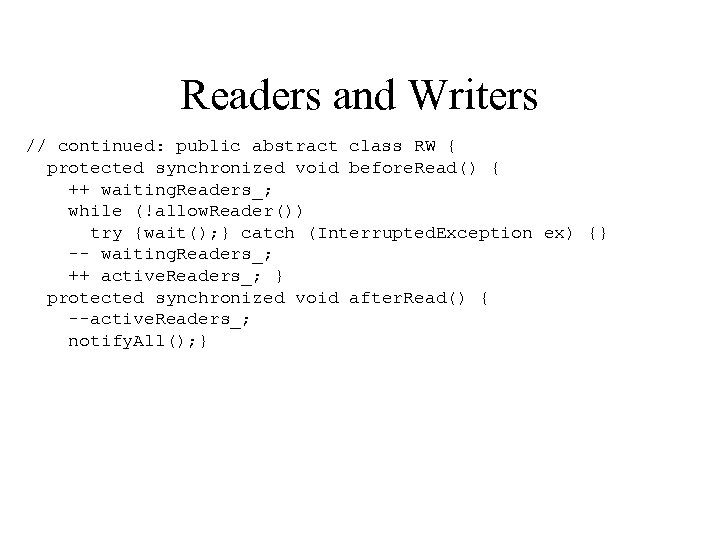 Readers and Writers // continued: public abstract class RW { protected synchronized void before. Read() { ++ waiting. Readers_; while (!allow. Reader()) try {wait(); } catch (Interrupted. Exception ex) {} -- waiting. Readers_; ++ active. Readers_; } protected synchronized void after. Read() { --active. Readers_; notify. All(); }
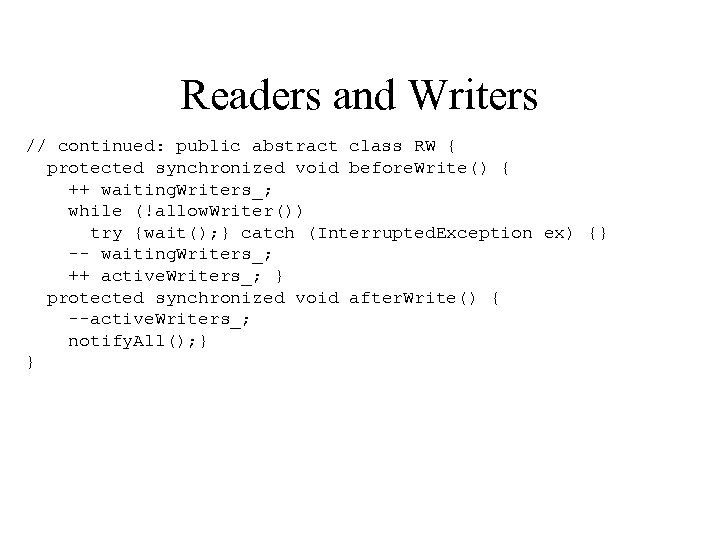 Readers and Writers // continued: public abstract class RW { protected synchronized void before. Write() { ++ waiting. Writers_; while (!allow. Writer()) try {wait(); } catch (Interrupted. Exception ex) {} -- waiting. Writers_; ++ active. Writers_; } protected synchronized void after. Write() { --active. Writers_; notify. All(); } }
 Threads and locks • Java associates a lock with every object. The lock is used to allow only one thread at a time to execute a region of protected code. • The synchronized statement synchronized(e) {b} (1) locks a lock associated with the object returned by e and (2) after executing b, it unlocks the same lock.
 Threads and locks • As a convenience, a method may be synchronized. Such a method behaves as if its method were synchronized in a synchronized statement. synchronized void f(){b} = void f(){ synchronized(this) {b}; }
 Threads and locks • Code in one synchronized method may make selfcalls to another synchronized method in the same object without blocking. • Similarly for calls on other objects for which the current thread has obtained and not yet released a lock. • Synchronization is retained when calling an unsynchronized method from a synchronized one.
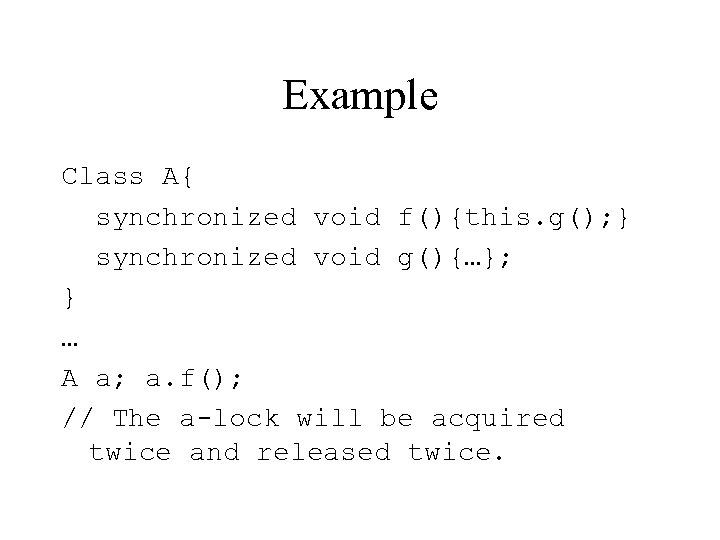 Example Class A{ synchronized void f(){this. g(); } synchronized void g(){…}; } … A a; a. f(); // The a-lock will be acquired twice and released twice.
 Threads and locks • Only one thread at a time is permitted to lay claim on a lock, and moreover a thread may acquire the same lock multiple times and doesn’t relinquish ownership of it until a matching number of unlock actions have been performed. • An unlock action by a thread T on a lock L may occur only if the number of preceding unlock actions by T on L is strictly less than the number of preceding lock action by T on L. (unlock only what it owns)
 Threads and locks • A notify invocation on an object results in the following: – If one exists, an arbitrarily chosen thread, say T, is removed by the Java runtime system from the internal wait queue associated with the target object. – T must re-obtain the synchronization lock for the target object which will always cause it to block at least until the thread calling notify releases the lock. – T is then resumed at the point of its wait.
 HW related viewgraphs • UML class diagram • Law of Demeter
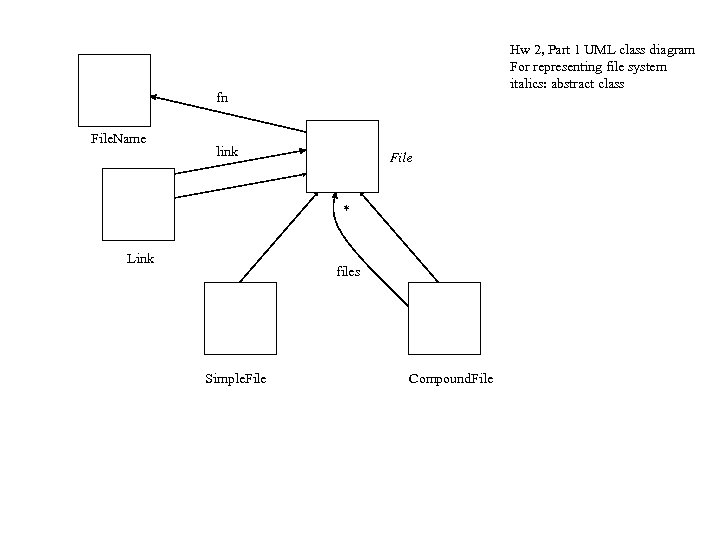 Hw 2, Part 1 UML class diagram For representing file system italics: abstract class fn File. Name link File * Link files Simple. File Compound. File
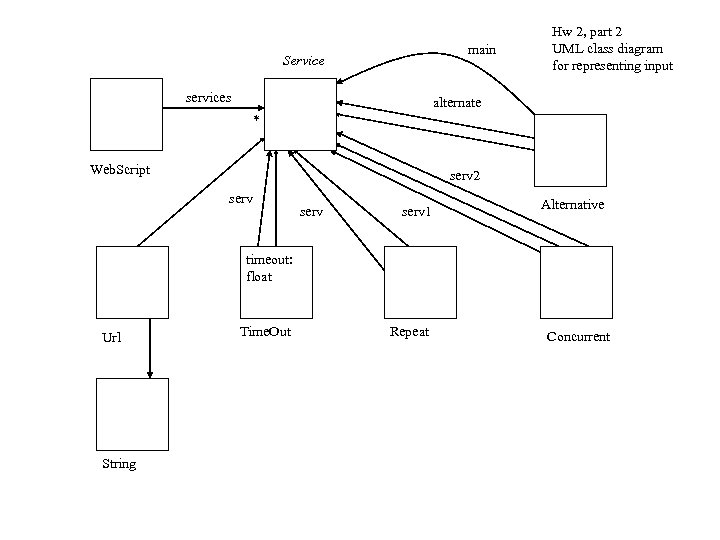 main Service services Hw 2, part 2 UML class diagram for representing input alternate * Web. Script serv 2 serv 1 Alternative timeout: float Url String Time. Out Repeat Concurrent
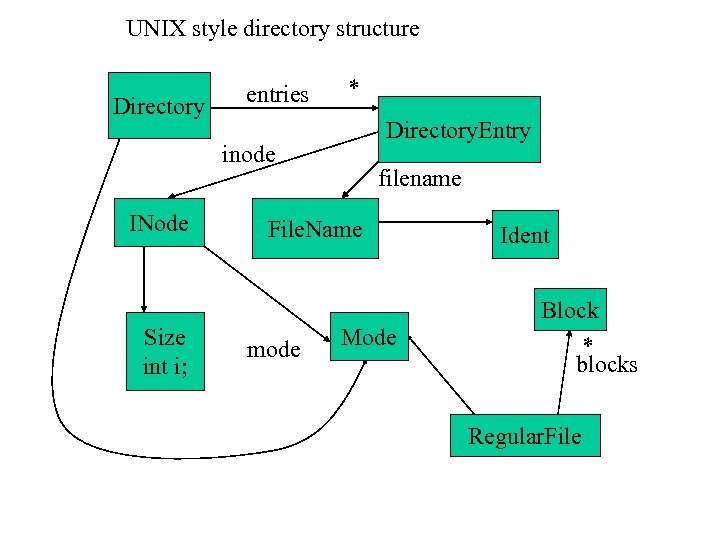 UNIX style directory structure Directory entries * Directory. Entry inode INode filename File. Name Ident Block Size int i; mode Mode * blocks Regular. File
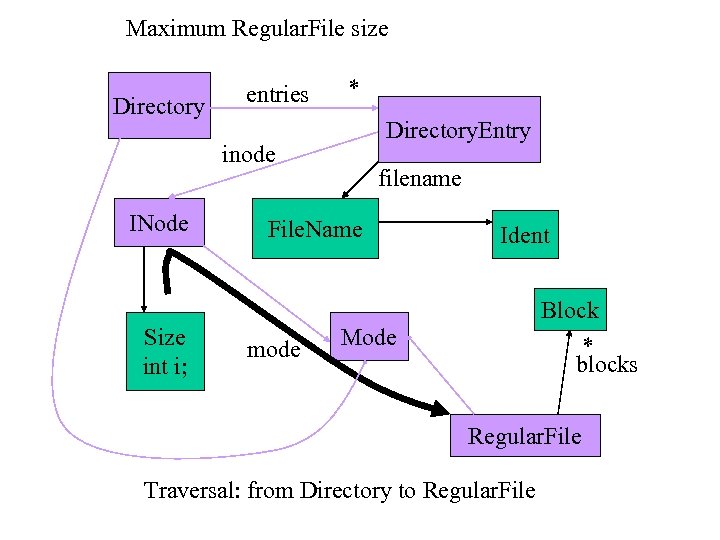 Maximum Regular. File size Directory entries * Directory. Entry inode INode filename File. Name Ident Block Size int i; mode Mode * blocks Regular. File Traversal: from Directory to Regular. File
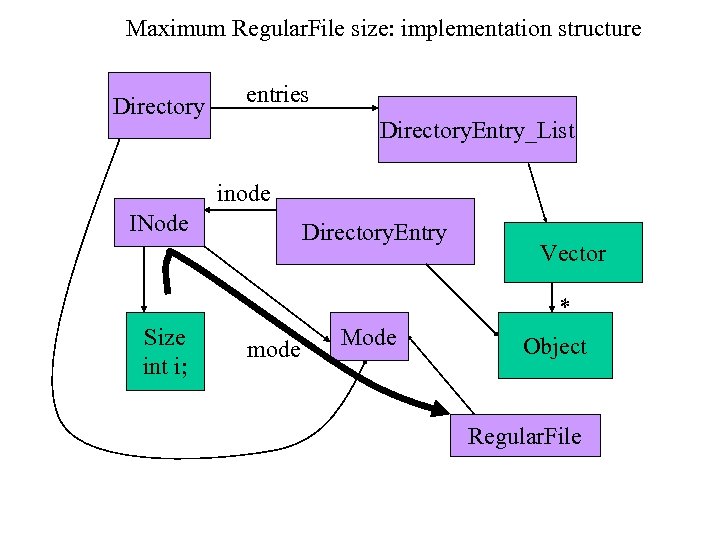 Maximum Regular. File size: implementation structure Directory entries Directory. Entry_List inode INode Directory. Entry Vector * Size int i; mode Mode Object Regular. File
 Law of Demeter Principle • Each unit should only use a limited set of other units: only units “closely” related to the current unit. • “Each unit should only talk to its friends. ” “Don’t talk to strangers. ” • Main Motivation: Control information overload. We can only keep a limited set of items in short-term memory.
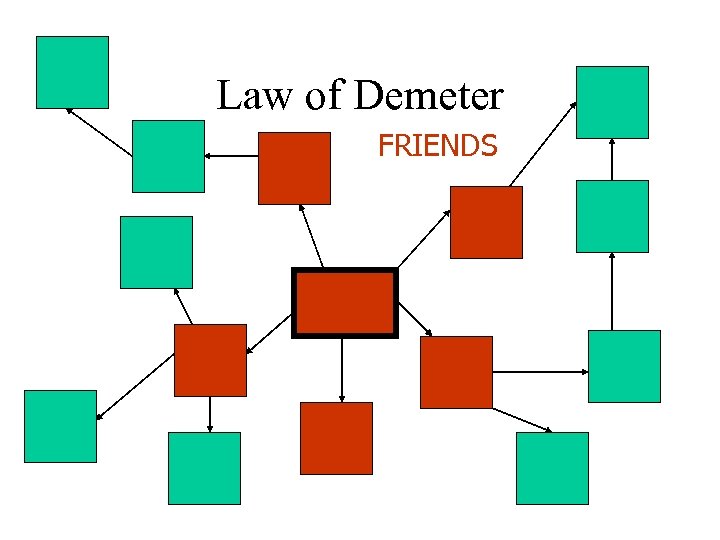 Law of Demeter FRIENDS
 Application to OO • Unit = method – closely related = • methods of class of this/self and other argument classes • methods of immediate part classes (classes that are return types of methods of class of this/self) • In the following we talk about this application of the Law of Demeter Principle to OO: example follows in a few slides.
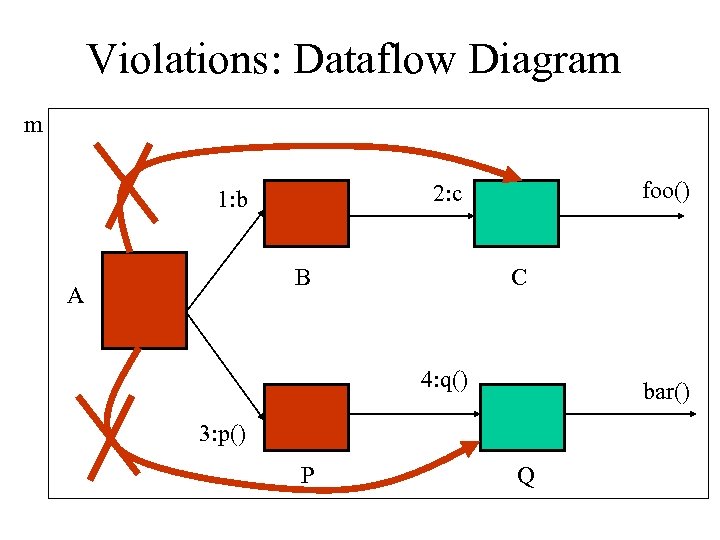 Violations: Dataflow Diagram m B A foo() 2: c 1: b C 4: q() bar() 3: p() P Q
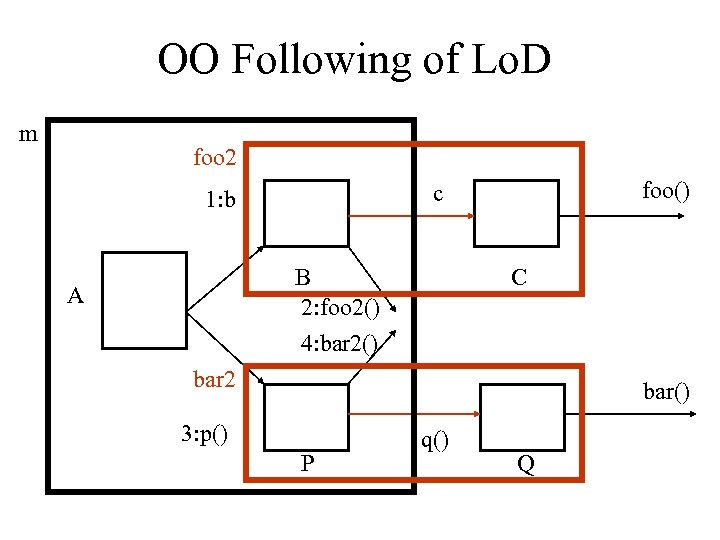 OO Following of Lo. D m foo 2 B 2: foo 2() 4: bar 2() A foo() c 1: b C bar 2 bar() 3: p() P q() Q
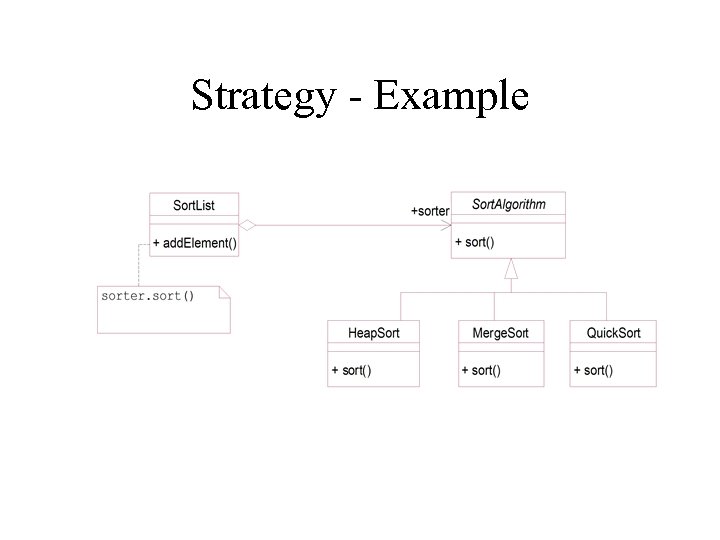 Strategy - Example
 Lecture 9: Concurrency Conclusion • Every major operating system built since 1985 has provided threads -- Mach, OS/2, NT (Microsoft), Solaris (new OS from SUN), OSF (DEC Alphas). Why? Makes it easier to write concurrent programs, from Web servers, to databases, to embedded systems. • Moral: threads are cheap, but they're not free.
 Lecture 10: Deadlock • Necessary conditions: – Limited access (for example: mutex or bounded buffer) – No preemption (if someone has resource, can't take it away) – Multiple independent requests -- "wait while holding" – Circular chain of requests
 Solutions to Deadlock • • Detect deadlock and fix scan graph of threads and resources detect cycles fix them // this is the hard part! – Shoot thread, force it to give up resources. – Roll back actions of deadlocked threads (transactions)
 Solutions to Deadlock • Preventing deadlock – Need to get rid of one of the four conditions – Banker's algorithm: (request can be granted if some sequential ordering of threads is deadlock free)
 Lecture 11: CPU Scheduling • Scheduling Policy Goals: – Minimize response time – Maximize throughput: operations (or jobs) per second – Fair: share CPU among users in some equitable way
 Scheduling Policies • • FIFO Round Robin STCF: shortest time to completion first. SRTCF: shortest remaining time to completion first. Preemptive version of STCF • Multilevel feedback • Lottery scheduling (for fairness)
 Multilevel Feedback Queue • • A process can move between the various queues; aging can be implemented this way. Multilevel-feedback-queue scheduler defined by the following parameters: – number of queues – scheduling algorithm for each queue – method used to determine when to upgrade a process – method used to determine when to demote a process – method used to determine which queue a process will enter when that process needs service
 Lecture 12: Protection: Kernel and Address Spaces • How is protection implemented? • Hardware support: – address translation – dual mode operation: kernel vs. user mode
 Lecture 13: Address Translation • Paging • Allocate physical memory in terms of fixed size chunks of memory, or pages. • allows use of a bitmap. • Operating system controls mapping: any page of virtual memory can go anywhere in physical memory.
 Lecture 14: Caching and TLBs • Cache: copy that can be accessed more quickly than original. Idea is: make frequent case efficient, infrequent path doesn't matter as much. Caching is a fundamental concept used in lots of places in computer systems. It underlies many of the techniques that are used today to make computers go fast
 Caching • Translation Buffer, Translation Lookaside Buffer: – hardware table of frequently used translations, to avoid havingto go through page table lookup in common case. • Thrashing: cache contents tossed out even if still needed
 Writes • Two options: – write-through: update immediately sent through to next level in memory hierarchy – write-back: (delayed write-through) update kept until item is replaced from cache, then sent to next level.
 Localities • Temporal locality: will reference same locations as accessed in the recent past • Spatial locality: will reference locations near those accessed in the recent past • When does caching break down? – Whenever programs don’t exhibit enough spatial or temporal locality
 Coordination aspect • Review of AOP • Summary of threads in Java • COOL (COOrdination Language) – Design decisions – Implementation at Xerox PARC
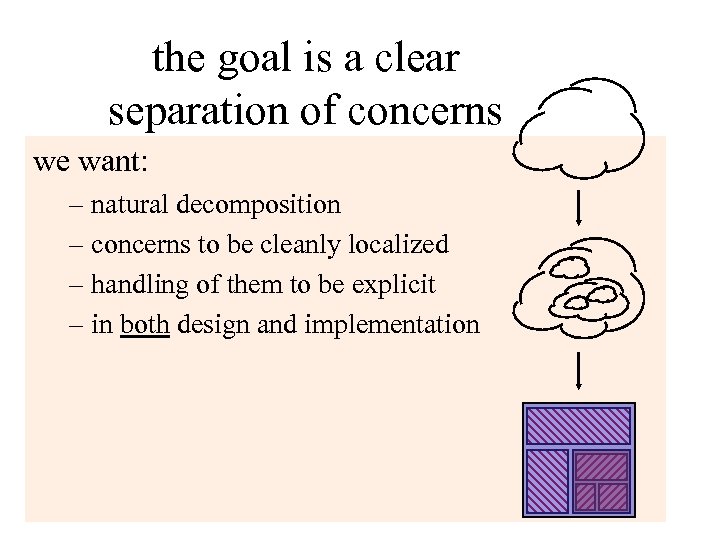 the goal is a clear separation of concerns we want: – natural decomposition – concerns to be cleanly localized – handling of them to be explicit – in both design and implementation
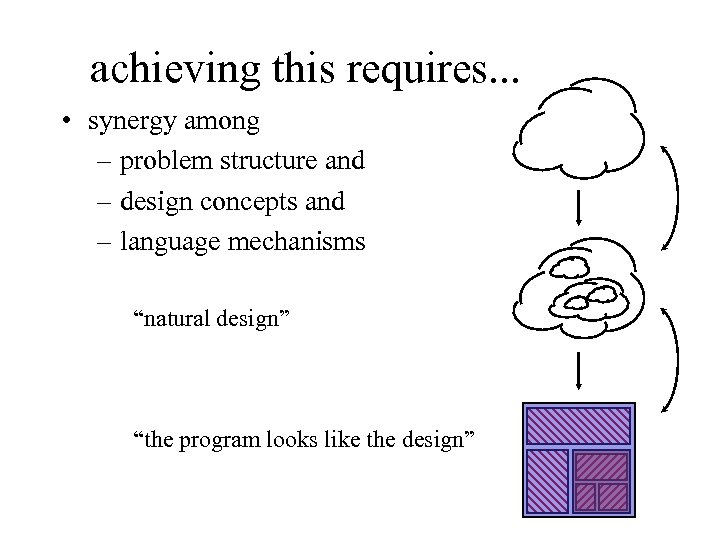 achieving this requires. . . • synergy among – problem structure and – design concepts and – language mechanisms “natural design” “the program looks like the design”
 What is an aspect? • An aspect is a modular unit that cross-cuts the structure of other modular units. • An aspect is a unit that encapsulates state, behavior and behavior enhancements to other units.
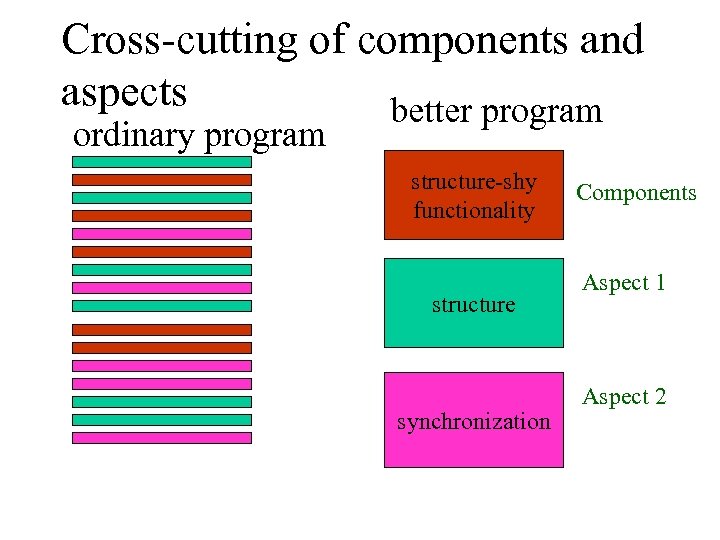 Cross-cutting of components and aspects better program ordinary program structure-shy functionality structure synchronization Components Aspect 1 Aspect 2
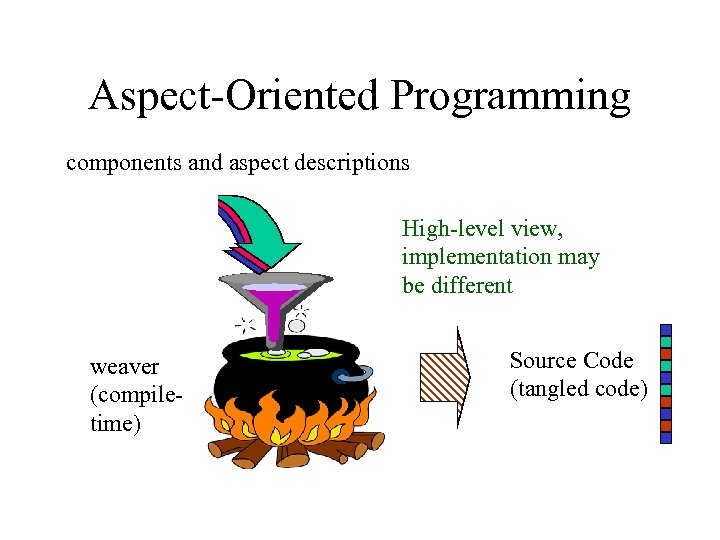 Aspect-Oriented Programming components and aspect descriptions High-level view, implementation may be different weaver (compiletime) Source Code (tangled code)
 Coordination aspect • Put coordination code about thread synchronization in one place. • Threads are synchronized through methods. • Method synchronization – Exclusion sets – Method managers
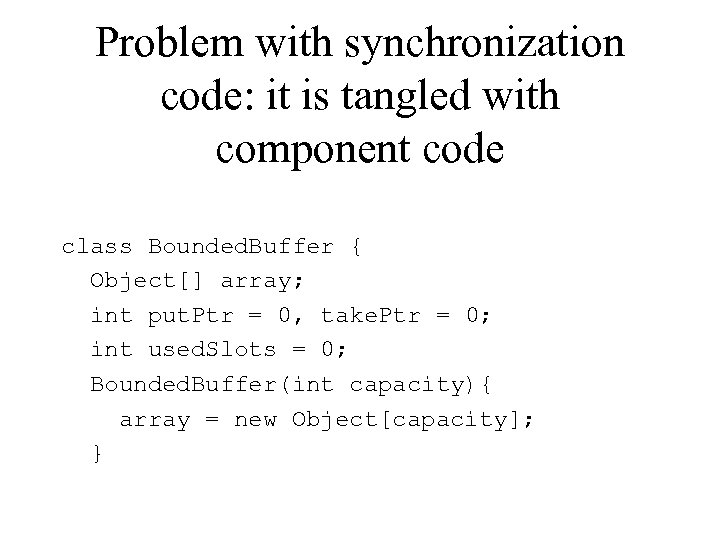 Problem with synchronization code: it is tangled with component code class Bounded. Buffer { Object[] array; int put. Ptr = 0, take. Ptr = 0; int used. Slots = 0; Bounded. Buffer(int capacity){ array = new Object[capacity]; }
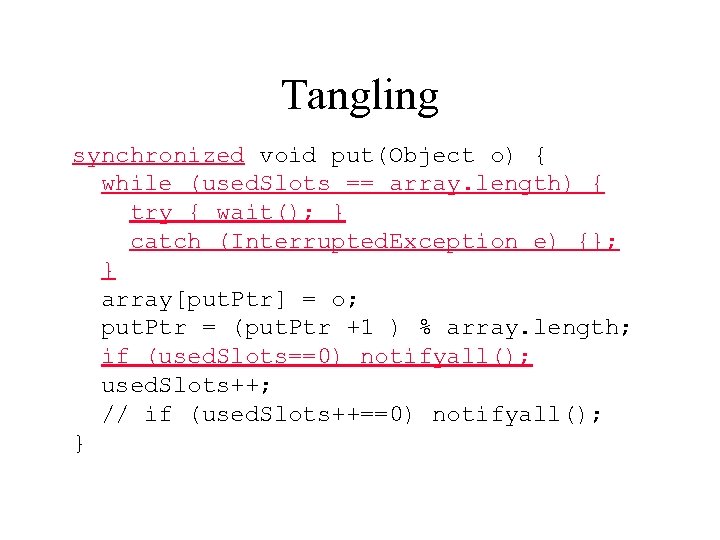 Tangling synchronized void put(Object o) { while (used. Slots == array. length) { try { wait(); } catch (Interrupted. Exception e) {}; } array[put. Ptr] = o; put. Ptr = (put. Ptr +1 ) % array. length; if (used. Slots==0) notifyall(); used. Slots++; // if (used. Slots++==0) notifyall(); }
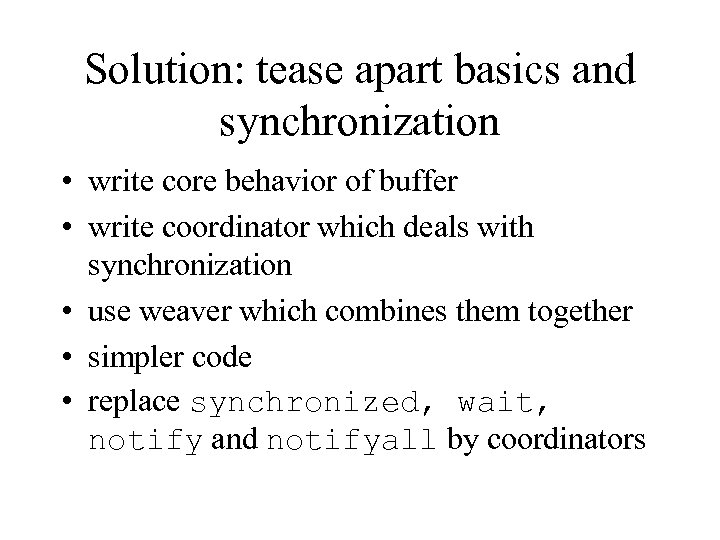 Solution: tease apart basics and synchronization • write core behavior of buffer • write coordinator which deals with synchronization • use weaver which combines them together • simpler code • replace synchronized, wait, notify and notifyall by coordinators
![With coordinator: basics Bounded. Buffer { public void put (Object o) (@ array[put. Ptr]](https://present5.com/presentation/0f899a18d80a4175e7254987a55199e9/image-92.jpg "With coordinator: basics Bounded. Buffer { public void put (Object o) (@ array[put. Ptr]") With coordinator: basics Bounded. Buffer { public void put (Object o) (@ array[put. Ptr] = o; put. Ptr = (put. Ptr+1)%array. length; used. Slots++; @) public Object take() (@ Object old = array[take. Ptr]; array[take. Ptr] = null; take. Ptr = (take. Ptr+1)%array. length; used. Slots--; return old; @)
With coordinator: basics Bounded. Buffer { public void put (Object o) (@ array[put. Ptr] = o; put. Ptr = (put. Ptr+1)%array. length; used. Slots++; @) public Object take() (@ Object old = array[take. Ptr]; array[take. Ptr] = null; take. Ptr = (take. Ptr+1)%array. length; used. Slots--; return old; @)
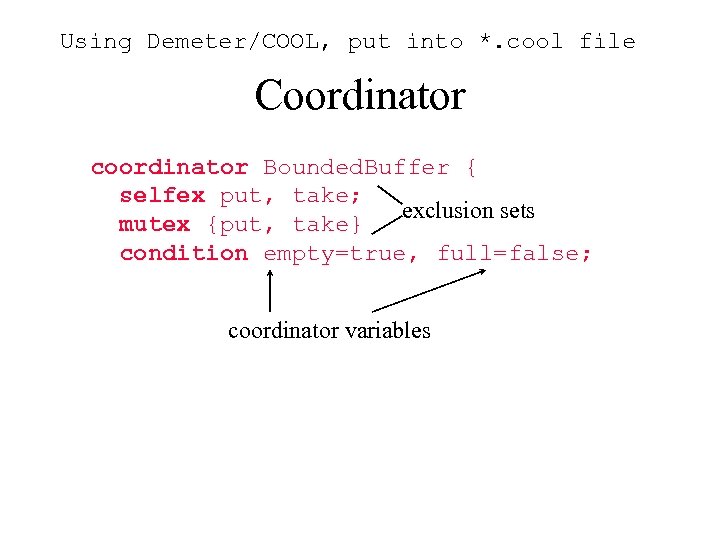 Using Demeter/COOL, put into *. cool file Coordinator coordinator Bounded. Buffer { selfex put, take; exclusion sets mutex {put, take} condition empty=true, full=false; coordinator variables
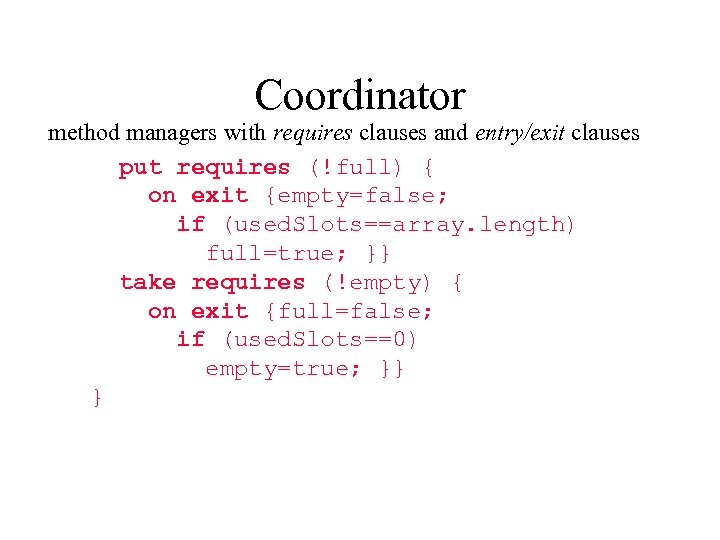 Coordinator method managers with requires clauses and entry/exit clauses put requires (!full) { on exit {empty=false; if (used. Slots==array. length) full=true; }} take requires (!empty) { on exit {full=false; if (used. Slots==0) empty=true; }} }
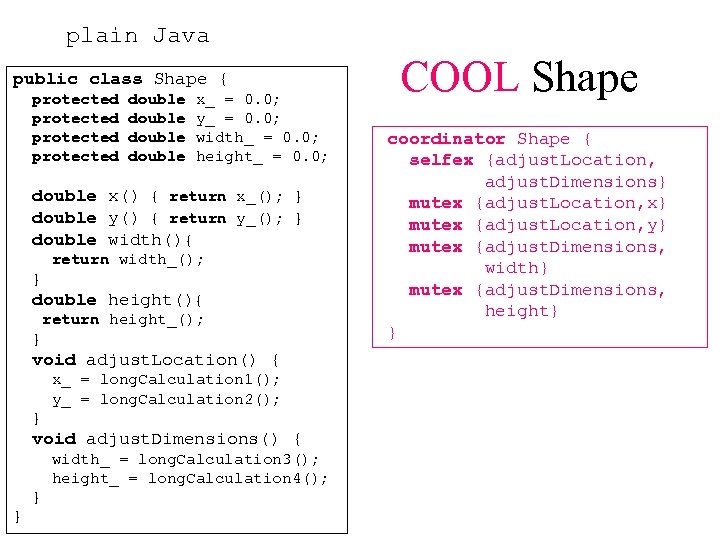 plain Java public class Shape { protected double x_ = 0. 0; y_ = 0. 0; width_ = 0. 0; height_ = 0. 0; double x() { return x_(); } double y() { return y_(); } double width(){ return width_(); } double height(){ return height_(); } void adjust. Location() { x_ = long. Calculation 1(); y_ = long. Calculation 2(); } void adjust. Dimensions() { width_ = long. Calculation 3(); height_ = long. Calculation 4(); } } COOL Shape coordinator Shape { selfex {adjust. Location, adjust. Dimensions} mutex {adjust. Location, x} mutex {adjust. Location, y} mutex {adjust. Dimensions, width} mutex {adjust. Dimensions, height} }
 Remaining Lectures • See original notes
 Some courses in Software Engineering Track • Adaptive Object-Oriented Software Development (COM 3360) • Object-Oriented Design (COM 3230, Professor Lorenz) • Component-Based Programming (COM 3240, Professor Lorenz)
 The End • Nothing lasts … • Everything arises and passes away Hoping to see you in COM 3360