 Скачать презентацию A resilience based approach to mental health needs
f0f81300fa71c3acb189dac0eda2d566.ppt
- Количество слайдов: 26



A resilience based approach to mental health needs in school BETTER THAN EXPECTED OUTCOMES
AIMS • • Outline what a whole school resilience based approach might look like Consider what needs to happen to bring that about Describe ‘Academic Resilience’ Demonstrate that it can be done – by using examples
QUICK QUESTION • What is the purpose of your school? • Purpose: the fundamental reason it exists, the thing without which there would be no reason for it to exist. In the final analysis, what is your school for?
MENTAL HEALTH ‘the strength and capacity of our minds to grow and develop, to be able to overcome difficulties and challenges and to make the most of our abilities and opportunities’ Young. Minds 2006
RESILIENCE CAN BE THOUGHT OF AS • • • Normal development under difficult circumstances. Relative good result despite experiences with situations that have been shown to carry substantial risk for the development of psychopathology (Rutter) Ordinary magic in the minds, brains and bodies of children, in their families and relationships and in their communities (Masten) An emergent property of a hierarchically organised set of protective systems that cumulatively buffer the effects of adversity and can therefore rarely, if ever, be regarded as an intrinsic property of individuals (Roisman et al)
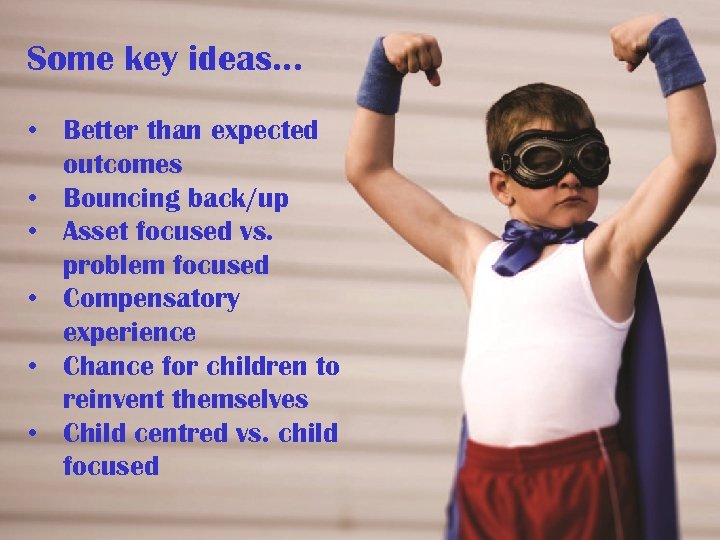
Some key ideas… • Better than expected outcomes • Bouncing back/up • Asset focused vs. problem focused • Compensatory experience • Chance for children to reinvent themselves • Child centred vs. child focused
RESILIENT SCHOOLS • • • Recognize that mental health is core business – it does impact on ‘results’ (attainment, attendance and behaviour) and it is (part of) the purpose of school Think and act systemically and integrate resilience into their normal day to day functioning and their development plans Promote mental health for children, staff and parents/carers and intervene early where there is risk of poor outcomes
WHY EARLY INTERVENTION MATTERS • Half of all lifetime cases of diagnosable mental illnesses begin by age 14 (¾ by mid 20’s) • Less than 50% were treated appropriately at the time • Improved availability of early intervention services for C&YP could prevent 25– 50% of adult mental illness • Economic returns of early childhood intervention programmes exceed cost by an average ratio of 1: 6. • The total annual cost of mental health problems in the UK exceeds £ 100 billion Source: Mental Health Strategy 2011 DH
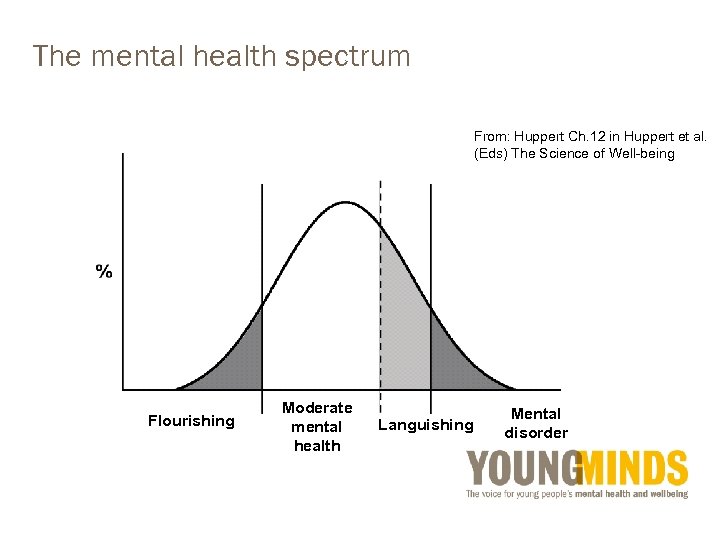
The mental health spectrum From: Huppert Ch. 12 in Huppert et al. (Eds) The Science of Well-being Flourishing Moderate mental health Languishing Mental disorder
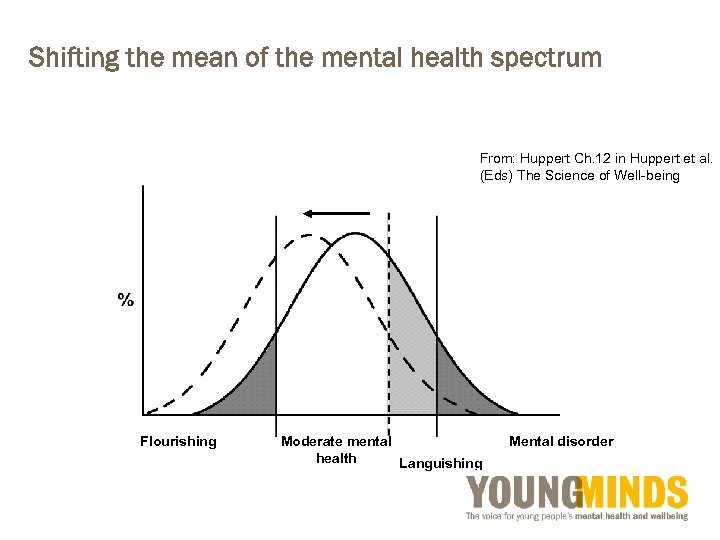
Shifting the mean of the mental health spectrum From: Huppert Ch. 12 in Huppert et al. (Eds) The Science of Well-being Flourishing Moderate mental health Languishing Mental disorder
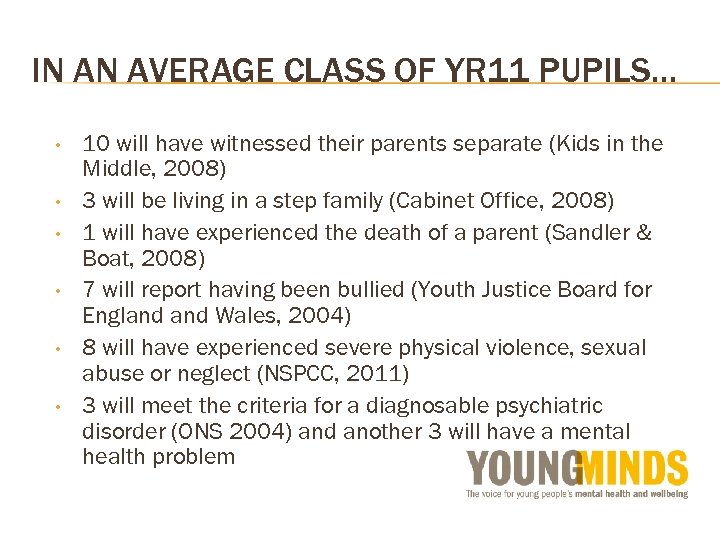
IN AN AVERAGE CLASS OF YR 11 PUPILS… • • • 10 will have witnessed their parents separate (Kids in the Middle, 2008) 3 will be living in a step family (Cabinet Office, 2008) 1 will have experienced the death of a parent (Sandler & Boat, 2008) 7 will report having been bullied (Youth Justice Board for England Wales, 2004) 8 will have experienced severe physical violence, sexual abuse or neglect (NSPCC, 2011) 3 will meet the criteria for a diagnosable psychiatric disorder (ONS 2004) and another 3 will have a mental health problem
NO SHORTAGE OF PROGRAMMES • • • The Allen report includes 24 programmes for primary school age children and 20 for secondary school age young people NICE guidance on Promoting Children’s Social and Emotional Wellbeing in primary (PH 20) and secondary (PH 12) www. nice. org. uk/PH 12 and www. NICE. org. uk/PH 20 Also the Healthy Schools guidance and toolkit – see http: //www. chimat. org. uk/camhs/schools/policy
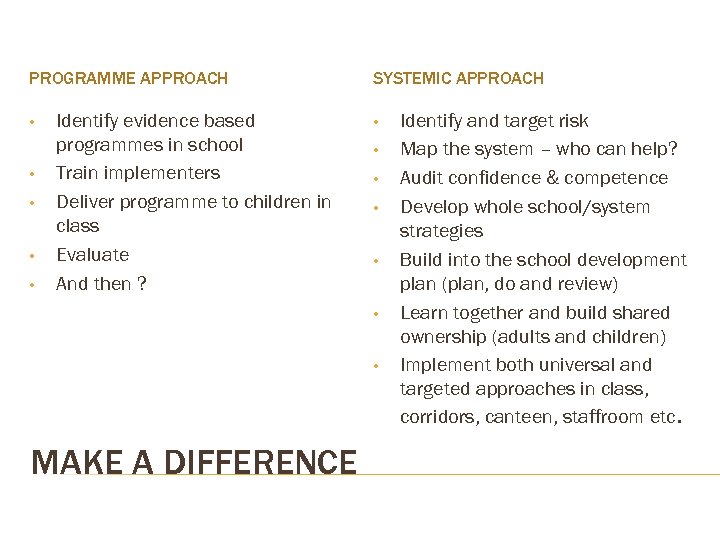
PROGRAMME APPROACH • • • Identify evidence based programmes in school Train implementers Deliver programme to children in class Evaluate And then ? SYSTEMIC APPROACH • • MAKE A DIFFERENCE Identify and target risk Map the system – who can help? Audit confidence & competence Develop whole school/system strategies Build into the school development plan (plan, do and review) Learn together and build shared ownership (adults and children) Implement both universal and targeted approaches in class, corridors, canteen, staffroom etc.
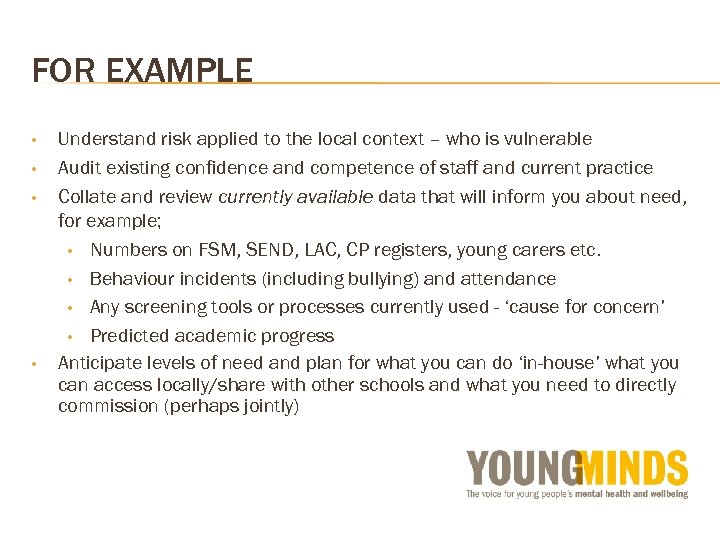
FOR EXAMPLE • • Understand risk applied to the local context – who is vulnerable Audit existing confidence and competence of staff and current practice Collate and review currently available data that will inform you about need, for example; • Numbers on FSM, SEND, LAC, CP registers, young carers etc. • Behaviour incidents (including bullying) and attendance • Any screening tools or processes currently used - ‘cause for concern’ • Predicted academic progress Anticipate levels of need and plan for what you can do ‘in-house’ what you can access locally/share with other schools and what you need to directly commission (perhaps jointly)
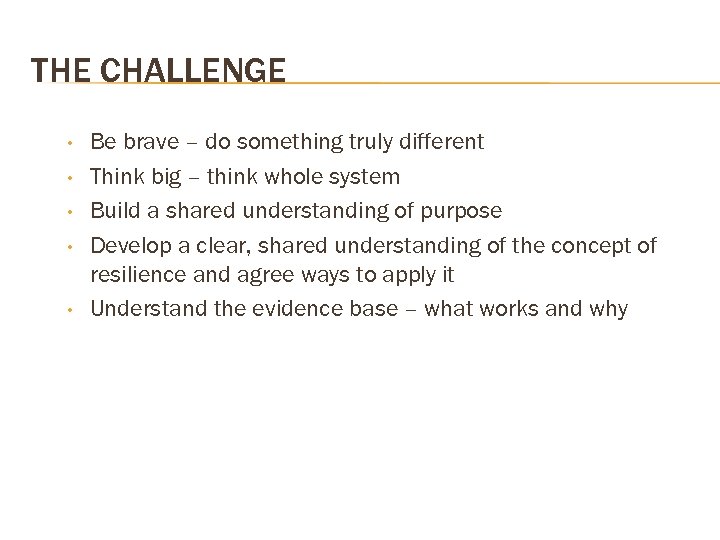
THE CHALLENGE • • • Be brave – do something truly different Think big – think whole system Build a shared understanding of purpose Develop a clear, shared understanding of the concept of resilience and agree ways to apply it Understand the evidence base – what works and why
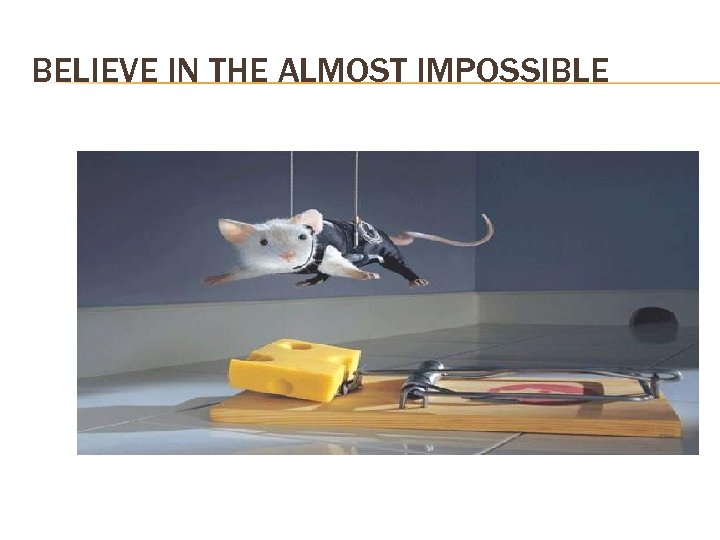
BELIEVE IN THE ALMOST IMPOSSIBLE
ACADEMIC RESILIENCE • Academic resilience means students achieving good educational outcomes despite adversity. For schools, promoting it involves strategic planning and detailed practice involving the whole school community to help vulnerable young people do better than their circumstances might have predicted.
THE EVIDENCE BASE Resilience Framework for children www. boing. org. uk
APPLYING THE EVIDENCE • • At least one trusted adult, with regular access over time, who lets the pupils they ‘hold in mind’ know that they care Preparedness and capacity to help with basics i. e. food, clothing, transport, and even housing Making sure vulnerable pupils actually access activities, hobbies and sports Help to map out a sense of future (hope and aspirations) Help pupils to cope – teach self soothing or management of feelings Support to help others e. g. volunteering, peer mentoring Opportunities for pupils, staff and parents to understand what resilience is and how they might achieve it for individual students and the whole school community
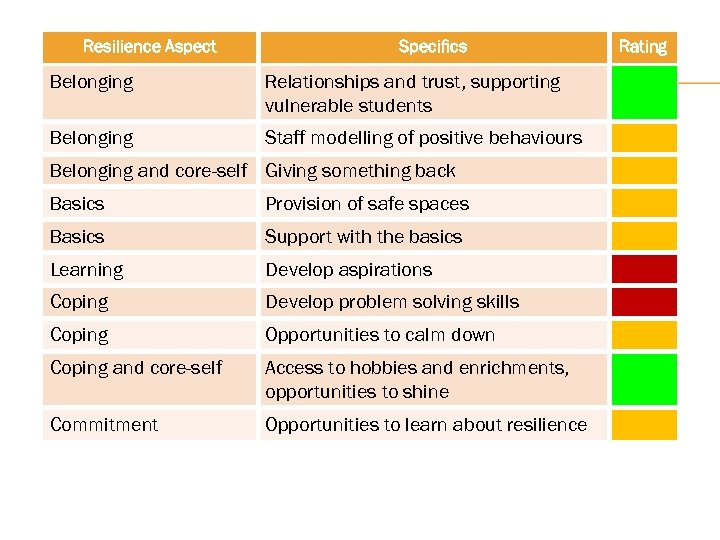
Resilience Aspect Specifics Belonging Relationships and trust, supporting vulnerable students Belonging Staff modelling of positive behaviours Belonging and core-self Giving something back Basics Provision of safe spaces Basics Support with the basics Learning Develop aspirations Coping Develop problem solving skills Coping Opportunities to calm down Coping and core-self Access to hobbies and enrichments, opportunities to shine Commitment Opportunities to learn about resilience Rating
“Our school’s work on Academic Resilience has begun a transformation. . . The work has opened a door that allows staff to genuinely care and nurture …It gave us all the “permission” to show we care. We are now designing and implementing systems that really support the “whole person”. Since October we have launched 26 new initiatives (both small and large) under the resilience banner. Cumulatively, these changes and developments will lead to a bigger and brighter future for the young people in our school. ” Mark Taylor, Dep. Head and lead for the project
ACTIVITIES • • • • 5 times as many enrichments Pyramid of need Year group breakfasts 100 club Kings “Characteristics” Career of the week “Family Lunch” in Exclusion Room Curriculum re-design Tighter focus on academic performance of the vulnerable Action plans for vulnerable students with lead adults Closer links to primary schools Safe spaces at lunch and brunch Wellbeing roles Staff wellbeing activities
SCHOOL CULTURE • • The right combination of: The emotional wellbeing of all school members is placed at the heart of the educational process Genuine participation Autonomy Clarity about discipline, rules and boundaries ‘A critical mass of emotionally literate people – adults and children’ (Weare)
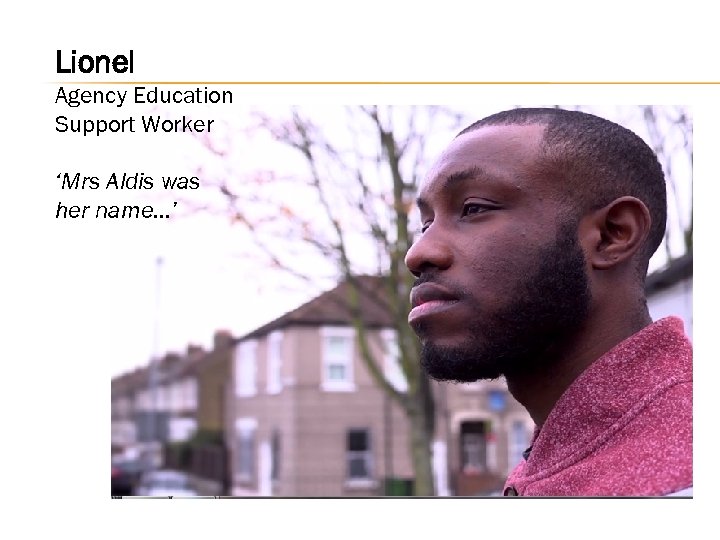
Lionel Agency Education Support Worker ‘Mrs Aldis was her name…’
SYSTEMIC, SUSTAINABLE CHANGE? Mrs. Aldis didn’t need a qualification to take a bike to Lionel on a Saturday– she just needed permission. She worked within a system that enabled her to do it – that empowered her to take up a role consistent with the purpose of the system
THANK YOU Roger Catchpole Young. Minds roger. catchpole@youngminds. org. uk Tel: 07817 979961 www. youngminds. org. uk
Скачать презентацию A resilience based approach to mental health needs
f0f81300fa71c3acb189dac0eda2d566.ppt