


 Скачать презентацию A Research Presentation Prepared for Project Men s
5d8d61452d8b6a74ababce720020aa4a.ppt
- Количество слайдов: 33
 A Research Presentation Prepared for Project : Men's Health Date 1 BPCT/12389 Lpres. ppt/NH : 19 th May 2008
 Order of Presentation l Introduction l Context and key themes l Attitudes towards weight, exercise and health l Evaluation of Weight. Wise l The way forward 2 BPCT/12389 Lpres. ppt/NH
 Background And Objectives Background – Due to above national levels of obesity in men aged 5064 Barnsley PCT have decided to gain a greater understanding of this demographic Business Objective – To halt the year on year rise and encourage a reduction in male obesity levels in men aged 50 -64 in Barnsley – Understand motivational factors that will encourage respondents to take control of their diet – Gain insight into their current relationship with health professionals and their understanding of weight services available – Evaluate previous attempts at maintaining a healthy lifestyle and barriers to keeping their lifestyle healthy – Gain knowledge of the respondents environment, socially, in the workplace and in the home Research Objectives 3 BPCT/12389 Lpres. ppt/NH
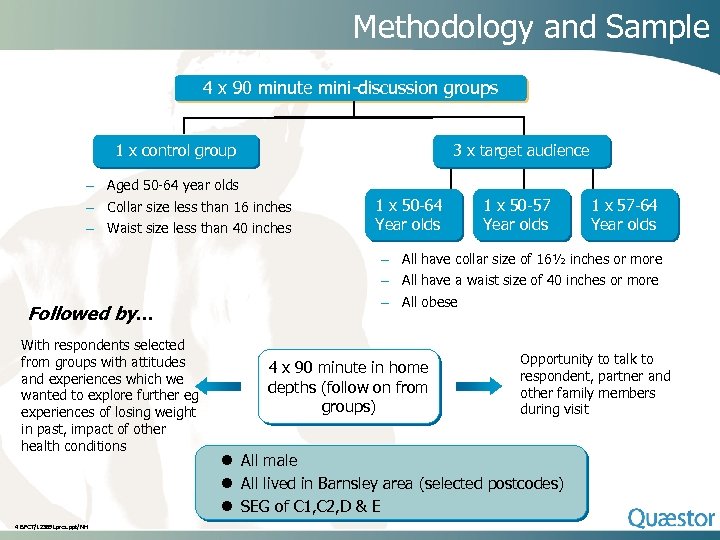 Methodology and Sample 4 x 90 minute mini-discussion groups 1 x control group 3 x target audience - Aged 50 -64 year olds - Collar size less than 16 inches - Waist size less than 40 inches 1 x 50 -64 Year olds 1 x 50 -57 Year olds 1 x 57 -64 Year olds - All have collar size of 16½ inches or more - All have a waist size of 40 inches or more Followed by… With respondents selected from groups with attitudes and experiences which we wanted to explore further eg experiences of losing weight in past, impact of other health conditions 4 BPCT/12389 Lpres. ppt/NH - All obese 4 x 90 minute in home depths (follow on from groups) Opportunity to talk to respondent, partner and other family members during visit l All male l All lived in Barnsley area (selected postcodes) l SEG of C 1, C 2, D & E
 Context & Key Themes 5 BPCT/12389 Lpres. ppt/NH
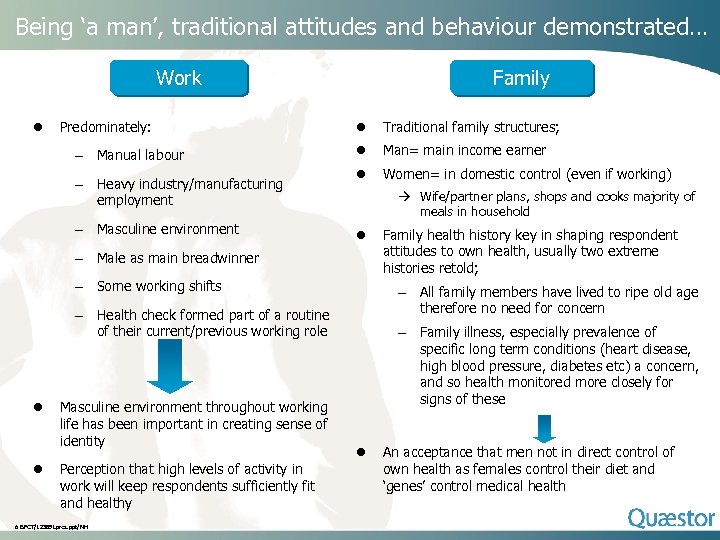 Being ‘a man’, traditional attitudes and behaviour demonstrated… Work l Predominately: - Manual labour - Heavy industry/manufacturing employment - Masculine environment Family l Traditional family structures; l Man= main income earner l Women= in domestic control (even if working) à Wife/partner plans, shops and cooks majority of meals in household l - Male as main breadwinner - Some working shifts - All family members have lived to ripe old age therefore no need for concern - Health check formed part of a routine of their current/previous working role l l Masculine environment throughout working life has been important in creating sense of identity Perception that high levels of activity in work will keep respondents sufficiently fit and healthy 6 BPCT/12389 Lpres. ppt/NH Family health history key in shaping respondent attitudes to own health, usually two extreme histories retold; - Family illness, especially prevalence of specific long term conditions (heart disease, high blood pressure, diabetes etc) a concern, and so health monitored more closely for signs of these l An acceptance that men not in direct control of own health as females control their diet and ‘genes’ control medical health
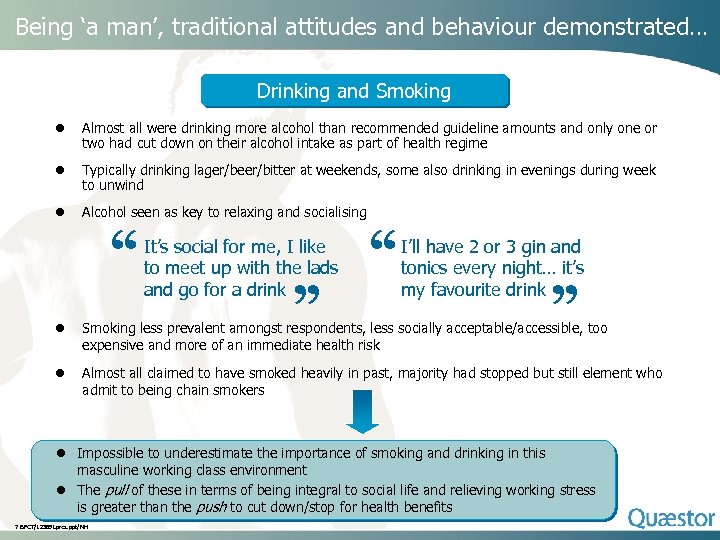 Being ‘a man’, traditional attitudes and behaviour demonstrated… Drinking and Smoking l Almost all were drinking more alcohol than recommended guideline amounts and only one or two had cut down on their alcohol intake as part of health regime l Typically drinking lager/beer/bitter at weekends, some also drinking in evenings during week to unwind l Alcohol seen as key to relaxing and socialising “ I’ll have 2 or 3 gin and tonics every night… it’s my favourite drink “ “ “ It’s social for me, I like to meet up with the lads and go for a drink l Smoking less prevalent amongst respondents, less socially acceptable/accessible, too expensive and more of an immediate health risk l Almost all claimed to have smoked heavily in past, majority had stopped but still element who admit to being chain smokers l Impossible to underestimate the importance of smoking and drinking in this masculine working class environment l The pull of these in terms of being integral to social life and relieving working stress is greater than the push to cut down/stop for health benefits 7 BPCT/12389 Lpres. ppt/NH
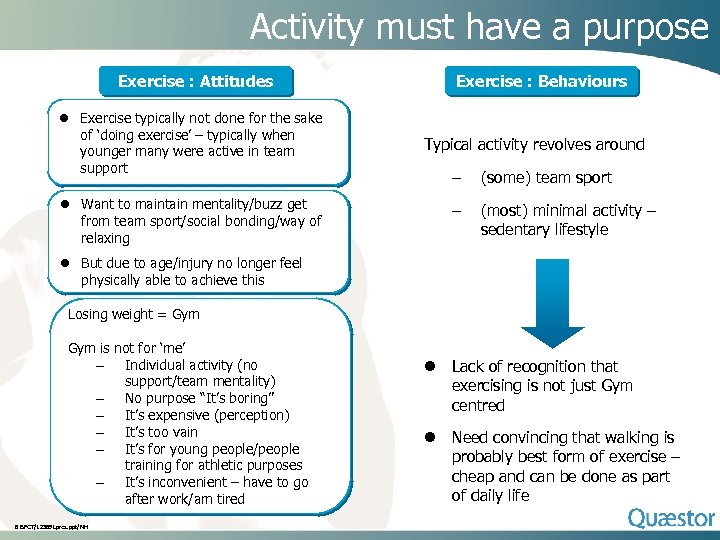 Activity must have a purpose Exercise : Attitudes l Exercise typically not done for the sake of ‘doing exercise’ – typically when younger many were active in team support l Want to maintain mentality/buzz get from team sport/social bonding/way of relaxing Exercise : Behaviours Typical activity revolves around - (some) team sport - (most) minimal activity – sedentary lifestyle l But due to age/injury no longer feel physically able to achieve this Losing weight = Gym is not for ‘me’ - Individual activity (no support/team mentality) - No purpose “It’s boring” - It’s expensive (perception) - It’s too vain - It’s for young people/people training for athletic purposes - It’s inconvenient – have to go after work/am tired 8 BPCT/12389 Lpres. ppt/NH l Lack of recognition that exercising is not just Gym centred l Need convincing that walking is probably best form of exercise – cheap and can be done as part of daily life
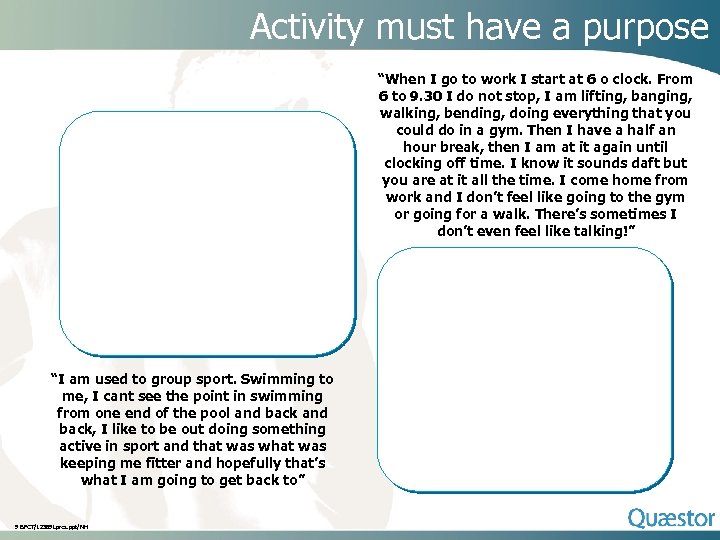 Activity must have a purpose “When I go to work I start at 6 o clock. From 6 to 9. 30 I do not stop, I am lifting, banging, walking, bending, doing everything that you could do in a gym. Then I have a half an hour break, then I am at it again until clocking off time. I know it sounds daft but you are at it all the time. I come home from work and I don’t feel like going to the gym or going for a walk. There’s sometimes I don’t even feel like talking!” “I am used to group sport. Swimming to me, I cant see the point in swimming from one end of the pool and back, I like to be out doing something active in sport and that was what was keeping me fitter and hopefully that’s what I am going to get back to” 9 BPCT/12389 Lpres. ppt/NH
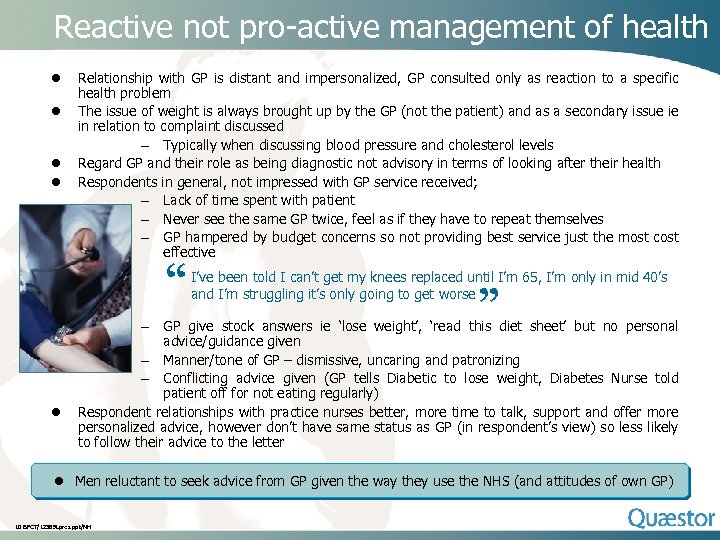 Reactive not pro-active management of health l l l Relationship with GP is distant and impersonalized, GP consulted only as reaction to a specific health problem The issue of weight is always brought up by the GP (not the patient) and as a secondary issue ie in relation to complaint discussed - Typically when discussing blood pressure and cholesterol levels Regard GP and their role as being diagnostic not advisory in terms of looking after their health Respondents in general, not impressed with GP service received; - Lack of time spent with patient - Never see the same GP twice, feel as if they have to repeat themselves - GP hampered by budget concerns so not providing best service just the most cost effective “ “ l I’ve been told I can’t get my knees replaced until I’m 65, I’m only in mid 40’s and I’m struggling it’s only going to get worse - l GP give stock answers ie ‘lose weight’, ‘read this diet sheet’ but no personal advice/guidance given - Manner/tone of GP – dismissive, uncaring and patronizing - Conflicting advice given (GP tells Diabetic to lose weight, Diabetes Nurse told patient off for not eating regularly) Respondent relationships with practice nurses better, more time to talk, support and offer more personalized advice, however don’t have same status as GP (in respondent’s view) so less likely to follow their advice to the letter l Men reluctant to seek advice from GP given the way they use the NHS (and attitudes of own GP) 10 BPCT/12389 Lpres. ppt/NH
 Reactive not pro-active management of health “I don’t think they’ve been helpful at all. I try and keep away from the doctor and will only go to the doctors if there is something specifically wrong with me…and then its always a last resort” “no cos they only say two things at our age: stop smoking and lose 3 stone. Don’t think I am being blasé but that’s what my GP says every time. . And I don’t smoke!” 11 BPCT/12389 Lpres. ppt/NH
 Reactive not pro-active management of health Further exacerbated by…. . l Feel resentment towards the ‘men in grey suits’ telling them what to do l Perception that those in authority have little understanding of their lives ie can’t visit gym due to cost and difficulty in taking part in NHS schemes due to working patterns eg shift work l Switched off by shock health adverts – feel patronised (and scared though would not admit this) l Portrayal of healthy food in media irrelevant, never eaten and too expensive to buy regularly l Feel media targets younger generation in relation to health l Any media messages must acknowledge working class pressures and mentality 12 BPCT/12389 Lpres. ppt/NH
 Lack of joined up thinking Losing weight = Diet or going to the gym or stopping smoking/drinking = Concentrate on 1 activity/element = All or nothing approach = experience of losing weight when younger) l But it is not! l Shift in attitudes required to a more joined up thinking approach where diet, exercise and lifestyle all play an equal role and that small changes if kept up will make a difference 13 BPCT/12389 Lpres. ppt/NH
 Attitudes Towards Weight, Exercise and Health 14 BPCT/12389 Lpres. ppt/NH
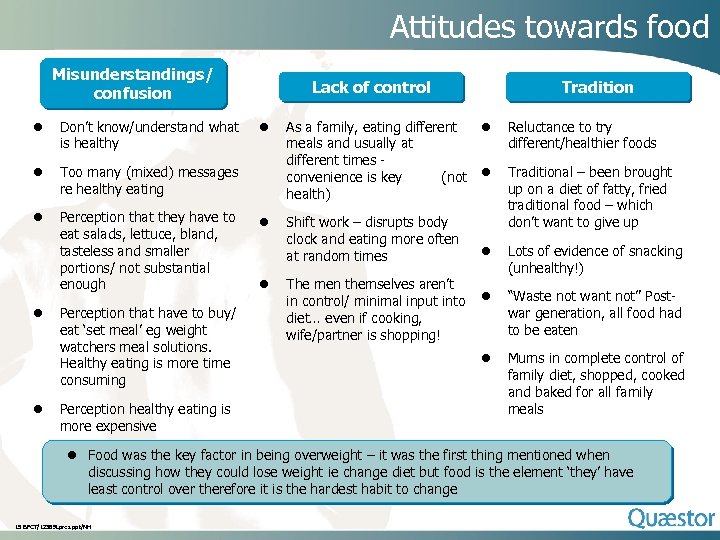 Attitudes towards food Misunderstandings/ confusion l Don’t know/understand what is healthy l Too many (mixed) messages re healthy eating l Perception that they have to eat salads, lettuce, bland, tasteless and smaller portions/ not substantial enough Lack of control l l Perception that have to buy/ eat ‘set meal’ eg weight watchers meal solutions. Healthy eating is more time consuming Perception healthy eating is more expensive l l l Tradition As a family, eating different l meals and usually at different times convenience is key (not l health) Shift work – disrupts body clock and eating more often at random times The men themselves aren’t in control/ minimal input into diet… even if cooking, wife/partner is shopping! Reluctance to try different/healthier foods Traditional – been brought up on a diet of fatty, fried traditional food – which don’t want to give up l Lots of evidence of snacking (unhealthy!) l “Waste not want not” Postwar generation, all food had to be eaten l Mums in complete control of family diet, shopped, cooked and baked for all family meals l Food was the key factor in being overweight – it was the first thing mentioned when discussing how they could lose weight ie change diet but food is the element ‘they’ have least control over therefore it is the hardest habit to change 15 BPCT/12389 Lpres. ppt/NH
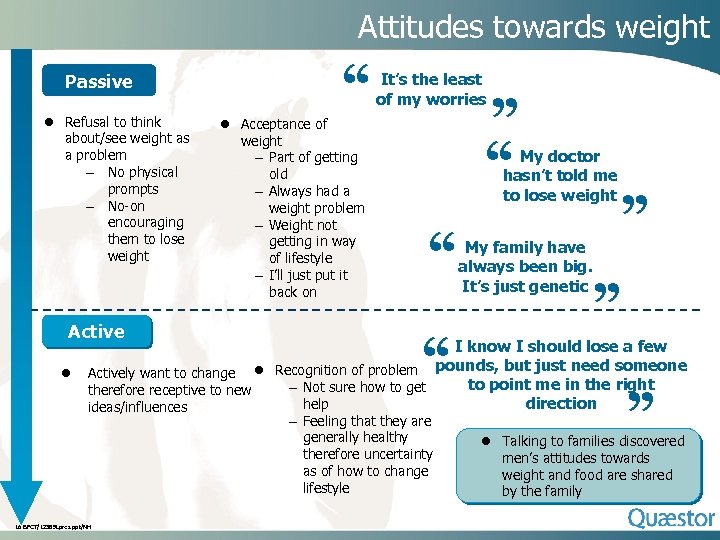 Attitudes towards weight “ “ My family have always been big. It’s just genetic I know I should lose a few pounds, but just need someone Actively want to change l Recognition of problem to point me in the right - Not sure how to get therefore receptive to new help direction ideas/influences - Feeling that they are generally healthy therefore uncertainty as of how to change lifestyle 16 BPCT/12389 Lpres. ppt/NH “ l “ My doctor hasn’t told me to lose weight “ Active l Acceptance of weight - Part of getting old - Always had a weight problem - Weight not getting in way of lifestyle - I’ll just put it back on “ l Refusal to think about/see weight as a problem - No physical prompts - No-on encouraging them to lose weight “ It’s the least of my worries “ Passive l Talking to families discovered men’s attitudes towards weight and food are shared by the family
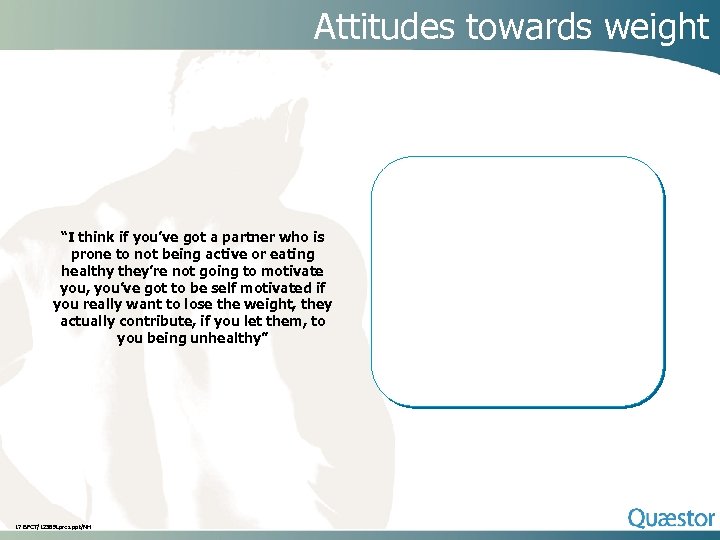 Attitudes towards weight “I think if you’ve got a partner who is prone to not being active or eating healthy they’re not going to motivate you, you’ve got to be self motivated if you really want to lose the weight, they actually contribute, if you let them, to you being unhealthy” 17 BPCT/12389 Lpres. ppt/NH
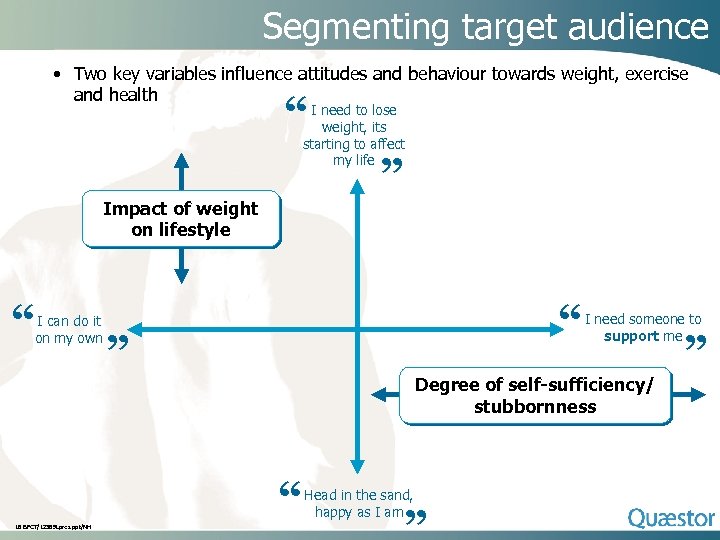 Segmenting target audience • Two key variables influence attitudes and behaviour towards weight, exercise and health “ I need to lose weight, its starting to affect my life “ Impact of weight on lifestyle “ “ I can do it on my own I need someone to support me Degree of self-sufficiency/ stubbornness “ 18 BPCT/12389 Lpres. ppt/NH “ Head in the sand, happy as I am “ “
 Attitudes Towards & Experiences Of Losing Weight 19 BPCT/12389 Lpres. ppt/NH
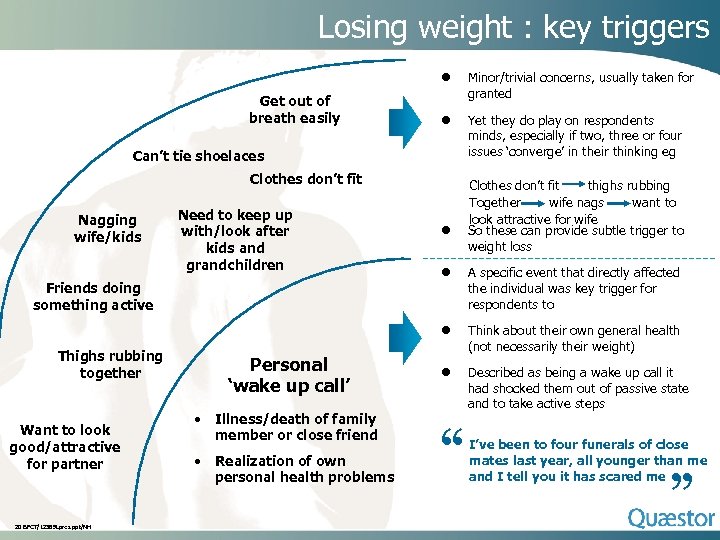 Losing weight : key triggers l Get out of breath easily Minor/trivial concerns, usually taken for granted l Yet they do play on respondents minds, especially if two, three or four issues ‘converge’ in their thinking eg Can’t tie shoelaces Clothes don’t fit Nagging wife/kids Need to keep up with/look after kids and grandchildren l Clothes don’t fit thighs rubbing Together wife nags want to look attractive for wife So these can provide subtle trigger to weight loss Want to look good/attractive for partner 20 BPCT/12389 Lpres. ppt/NH Personal ‘wake up call’ • Illness/death of family member or close friend • Realization of own personal health problems Think about their own general health (not necessarily their weight) l Described as being a wake up call it had shocked them out of passive state and to take active steps “ I’ve been to four funerals of close mates last year, all younger than me and I tell you it has scared me “ Thighs rubbing together A specific event that directly affected the individual was key trigger for respondents to l Friends doing something active l
 Losing weight : key triggers “You’ve still got this thing that your partner is the b all and end all, so you like to look good and feel good you like to be that little bit trimmer” 21 BPCT/12389 Lpres. ppt/NH
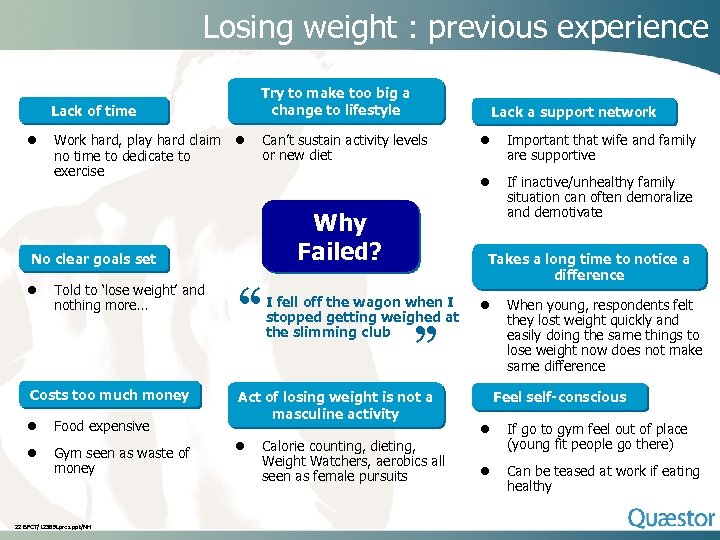 Losing weight : previous experience Try to make too big a change to lifestyle Lack of time Work hard, play hard claim no time to dedicate to exercise Can’t sustain activity levels or new diet Why Failed? No clear goals set l Told to ‘lose weight’ and nothing more… Costs too much money l Food expensive l Gym seen as waste of money 22 BPCT/12389 Lpres. ppt/NH “ Important that wife and family are supportive If inactive/unhealthy family situation can often demoralize and demotivate Takes a long time to notice a difference I fell off the wagon when I stopped getting weighed at the slimming club Act of losing weight is not a masculine activity l l “ l Lack a support network Calorie counting, dieting, Weight Watchers, aerobics all seen as female pursuits l When young, respondents felt they lost weight quickly and easily doing the same things to lose weight now does not make same difference Feel self-conscious l If go to gym feel out of place (young fit people go there) l Can be teased at work if eating healthy
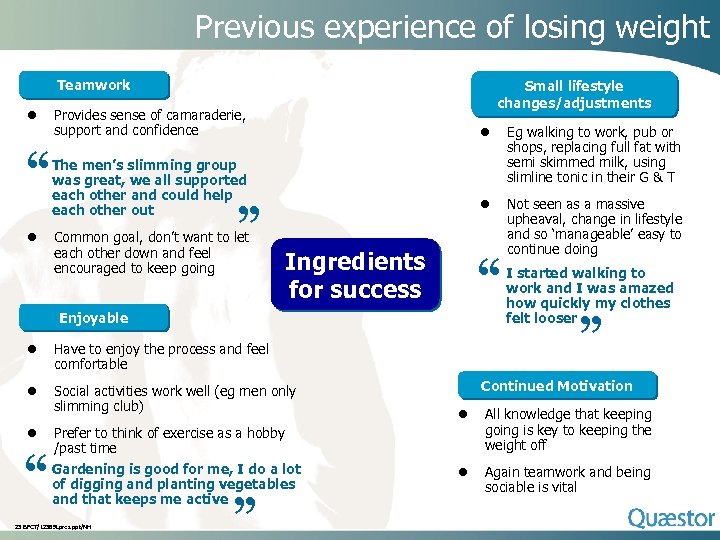 Previous experience of losing weight Teamwork l l The men’s slimming group was great, we all supported each other and could help each other out Eg walking to work, pub or shops, replacing full fat with semi skimmed milk, using slimline tonic in their G & T l Not seen as a massive upheaval, change in lifestyle and so ‘manageable’ easy to continue doing Common goal, don’t want to let each other down and feel encouraged to keep going Ingredients for success “ Enjoyable l Have to enjoy the process and feel comfortable l Social activities work well (eg men only slimming club) “ Continued Motivation l All knowledge that keeping going is key to keeping the weight off l Again teamwork and being sociable is vital Prefer to think of exercise as a hobby /past time Gardening is good for me, I do a lot of digging and planting vegetables and that keeps me active 23 BPCT/12389 Lpres. ppt/NH “ l I started walking to work and I was amazed how quickly my clothes felt looser “ “ Provides sense of camaraderie, support and confidence “ l Small lifestyle changes/adjustments
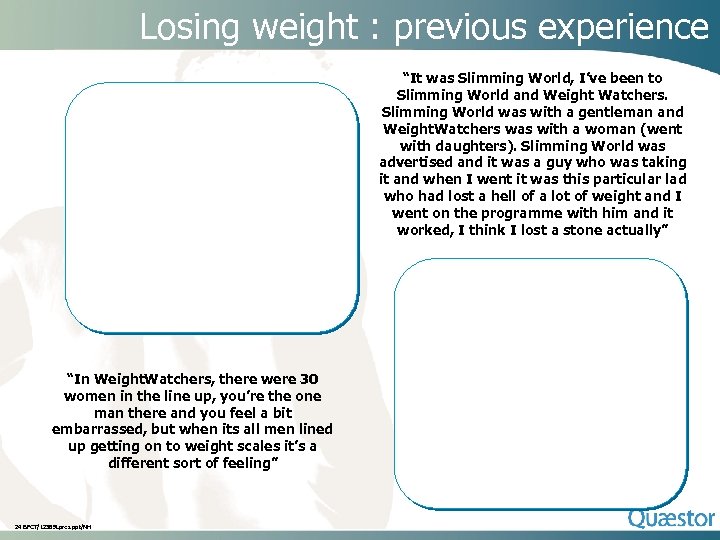 Losing weight : previous experience “It was Slimming World, I’ve been to Slimming World and Weight Watchers. Slimming World was with a gentleman and Weight. Watchers was with a woman (went with daughters). Slimming World was advertised and it was a guy who was taking it and when I went it was this particular lad who had lost a hell of a lot of weight and I went on the programme with him and it worked, I think I lost a stone actually” “In Weight. Watchers, there were 30 women in the line up, you’re the one man there and you feel a bit embarrassed, but when its all men lined up getting on to weight scales it’s a different sort of feeling” 24 BPCT/12389 Lpres. ppt/NH
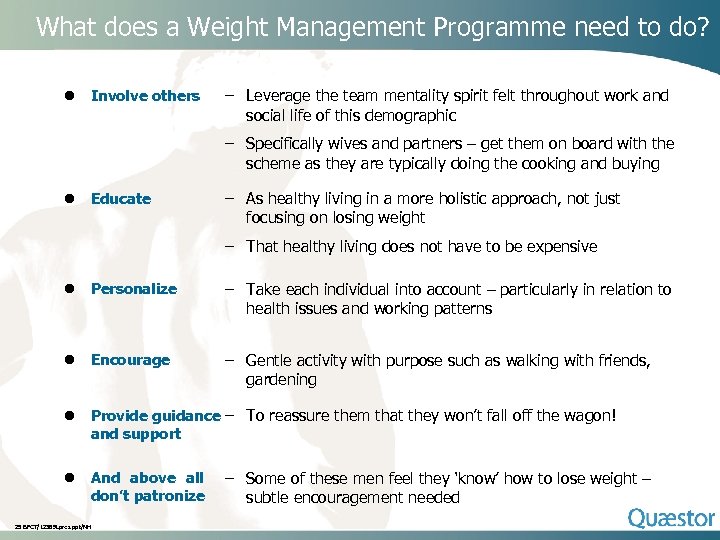 What does a Weight Management Programme need to do? l Involve others – Leverage the team mentality spirit felt throughout work and social life of this demographic – Specifically wives and partners – get them on board with the scheme as they are typically doing the cooking and buying l Educate – As healthy living in a more holistic approach, not just focusing on losing weight – That healthy living does not have to be expensive l Personalize – Take each individual into account – particularly in relation to health issues and working patterns l Encourage – Gentle activity with purpose such as walking with friends, gardening l Provide guidance – To reassure them that they won’t fall off the wagon! and support l And above all don’t patronize 25 BPCT/12389 Lpres. ppt/NH – Some of these men feel they ‘know’ how to lose weight – subtle encouragement needed
 Evaluation Of Weightwise Programme 26 BPCT/12389 Lpres. ppt/NH
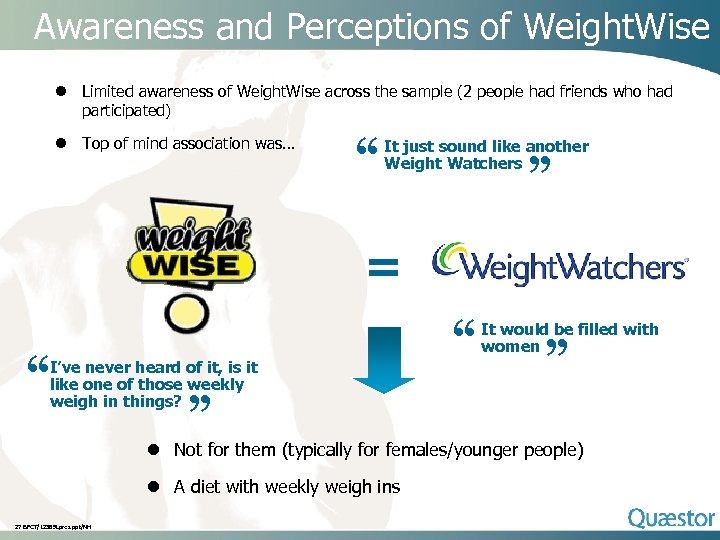 Awareness and Perceptions of Weight. Wise l Limited awareness of Weight. Wise across the sample (2 people had friends who had participated) “ “ l Top of mind association was… It just sound like another Weight Watchers = “ “ I’ve never heard of it, is it like one of those weekly weigh in things? “ It would be filled with women “ l Not for them (typically for females/younger people) l A diet with weekly weigh ins 27 BPCT/12389 Lpres. ppt/NH
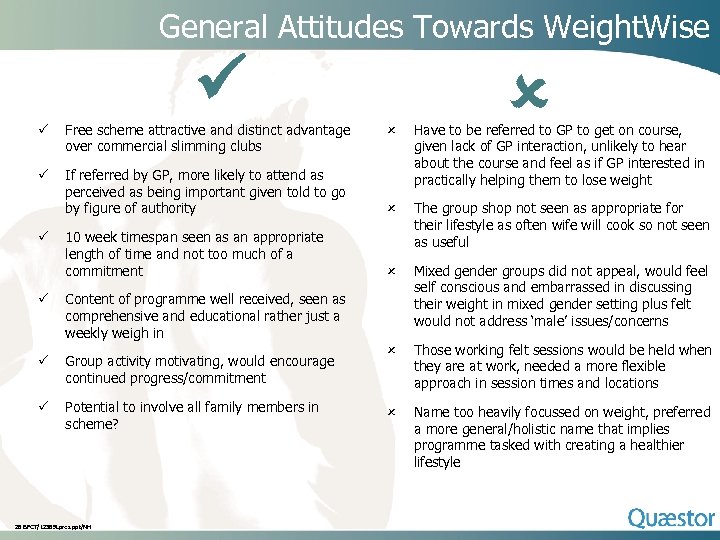 General Attitudes Towards Weight. Wise P Free scheme attractive and distinct advantage over commercial slimming clubs P P O If referred by GP, more likely to attend as perceived as being important given told to go by figure of authority Have to be referred to GP to get on course, given lack of GP interaction, unlikely to hear about the course and feel as if GP interested in practically helping them to lose weight O 10 week timespan seen as an appropriate length of time and not too much of a commitment The group shop not seen as appropriate for their lifestyle as often wife will cook so not seen as useful O Mixed gender groups did not appeal, would feel self conscious and embarrassed in discussing their weight in mixed gender setting plus felt would not address ‘male’ issues/concerns O Those working felt sessions would be held when they are at work, needed a more flexible approach in session times and locations O Name too heavily focussed on weight, preferred a more general/holistic name that implies programme tasked with creating a healthier lifestyle P Content of programme well received, seen as comprehensive and educational rather just a weekly weigh in P Group activity motivating, would encourage continued progress/commitment P Potential to involve all family members in scheme? 28 BPCT/12389 Lpres. ppt/NH
 Perceptions of Weight. Wise “It’s a good package and without being funny, it would attract a lot of people cos its free. When would it be run, at what time, cos if you are working full time you wouldn’t be able to go, there needs to be a later evening session” 29 BPCT/12389 Lpres. ppt/NH
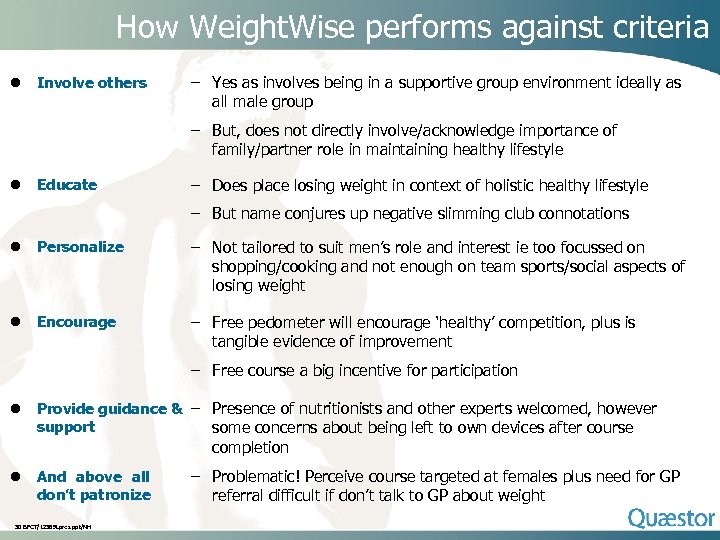 How Weight. Wise performs against criteria l Involve others – Yes as involves being in a supportive group environment ideally as all male group – But, does not directly involve/acknowledge importance of family/partner role in maintaining healthy lifestyle l Educate – Does place losing weight in context of holistic healthy lifestyle – But name conjures up negative slimming club connotations l Personalize – Not tailored to suit men’s role and interest ie too focussed on shopping/cooking and not enough on team sports/social aspects of losing weight l Encourage – Free pedometer will encourage ‘healthy’ competition, plus is tangible evidence of improvement – Free course a big incentive for participation l Provide guidance & – Presence of nutritionists and other experts welcomed, however support some concerns about being left to own devices after course completion l And above all don’t patronize 30 BPCT/12389 Lpres. ppt/NH – Problematic! Perceive course targeted at females plus need for GP referral difficult if don’t talk to GP about weight
 Fit for the Future – note to reader The Way Forward The next slides are recommendations only from the research agency. Please consult your fit for the future contact before adopting any of these methods/interventions. 31 BPCT/12389 Lpres. ppt/NH
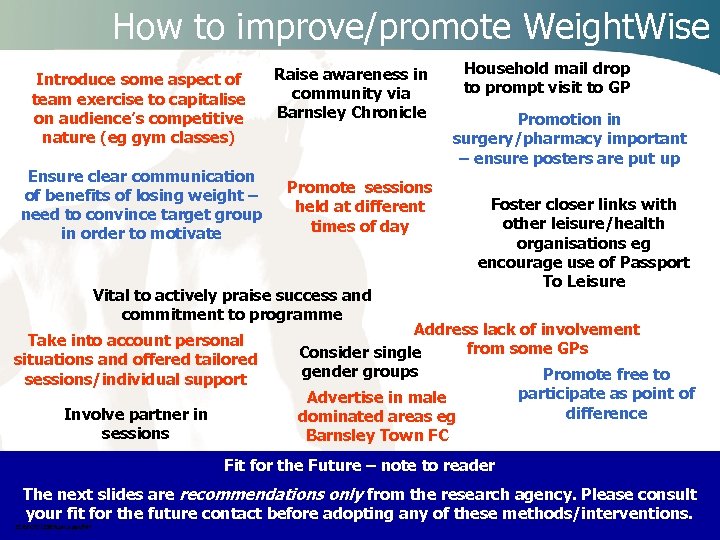 How to improve/promote Weight. Wise Introduce some aspect of team exercise to capitalise on audience’s competitive nature (eg gym classes) Ensure clear communication of benefits of losing weight – need to convince target group in order to motivate Raise awareness in community via Barnsley Chronicle Promote sessions held at different times of day Vital to actively praise success and commitment to programme Take into account personal situations and offered tailored sessions/individual support Involve partner in sessions Household mail drop to prompt visit to GP Promotion in surgery/pharmacy important – ensure posters are put up Foster closer links with other leisure/health organisations eg encourage use of Passport To Leisure Address lack of involvement from some GPs Consider single gender groups Promote free to participate as point of Advertise in male difference dominated areas eg Barnsley Town FC Fit for the Future – note to reader The next slides are recommendations only from the research agency. Please consult your fit for the future contact before adopting any of these methods/interventions. 32 BPCT/12389 Lpres. ppt/NH
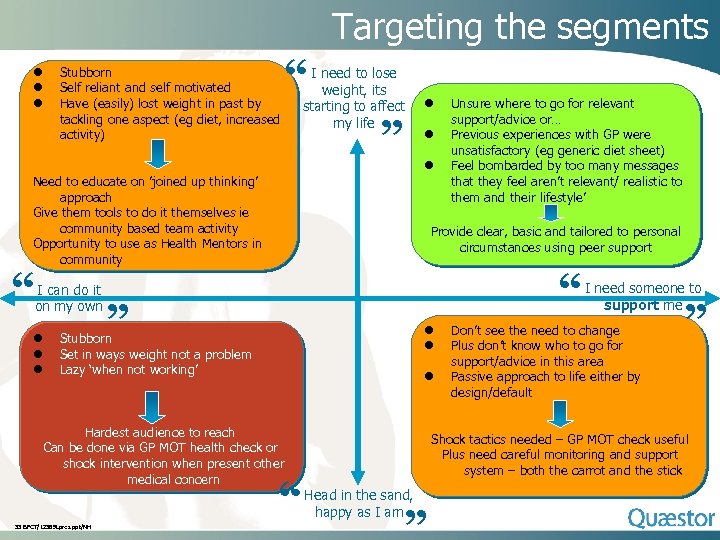 Targeting the segments Stubborn Self reliant and self motivated Have (easily) lost weight in past by tackling one aspect (eg diet, increased activity) “ I need to lose weight, its starting to affect my life “ “ l l Stubborn Set in ways weight not a problem Lazy ‘when not working’ l Hardest audience to reach Can be done via GP MOT health check or shock intervention when present other medical concern 33 BPCT/12389 Lpres. ppt/NH “ I need someone to support me Don’t see the need to change Plus don’t know who to go for support/advice in this area Passive approach to life either by design/default Shock tactics needed – GP MOT check useful Plus need careful monitoring and support system – both the carrot and the stick “ l l l Unsure where to go for relevant support/advice or… Previous experiences with GP were unsatisfactory (eg generic diet sheet) Feel bombarded by too many messages that they feel aren’t relevant/ realistic to them and their lifestyle’ Provide clear, basic and tailored to personal circumstances using peer support “ I can do it on my own l l Need to educate on ’joined up thinking’ approach Give them tools to do it themselves ie community based team activity Opportunity to use as Health Mentors in community “ l l l Head in the sand, happy as I am