


 Скачать презентацию A re — focus on teaching and learning
18f9f53528d6f870e4a5de4bdc0b8ab7.ppt
- Количество слайдов: 30
 A re - focus on teaching and learning, within the International Middle School (within the Middle Kingdom), through Pedagogic Leadership approaches. This presentation aims to graphically support position paper of the same Title to give a useful overview of the issues presented, which in addition is backed by current Leadership Theories. The concept of trying to identifying measures, the intention of seeking improvement through skillful implication, I trust will be of interest to many other organizations where ‘change’ is needed. http: //www. personaltrainercoach. com/wp-content/uploads/2010/03/moom_balance 01. jpg
 A re - focus on learning and teaching within Middle School, through Pedagogic Leadership approaches Existing Situation (my insight): - School is in China and is a Total Authorized IB School i. e with PYP, MYP & Diploma. It’s been around 10+ years. MYP programme, is often over-managed, some staff undervalued in terms of forfilling their potentials. Classically daily routines have been order of the day with leaders over managing & staff feeling undervalued. Bennis & Nanus (1985) http: //www. moneyandyoublog. com/wpcontent/uploads/2009/10/profiling-and-team-building 300 x 300. jpg
 Existing Situation: needs to be more effective In terms of mastering routines & efficiency no real issues , but in terms of effectiveness: some people having ‘timid incapacities’ Bennis & Nanus (1985) http: //www. teambuildingsolut ions. co. uk/img/teambuildingsolutions. gif
 Existing Situation: “iatrogenic” The example of the Doctor causing illness & side affects through inappropriate interventions, similarly I see some managers having been responsible for the cause as well as the cure of the problem. Bennis & Nanus (1985) http: //sophrosyne. radical. r 30. net/wpcontent/uploads/2010/10/Changing-Minds. jpg
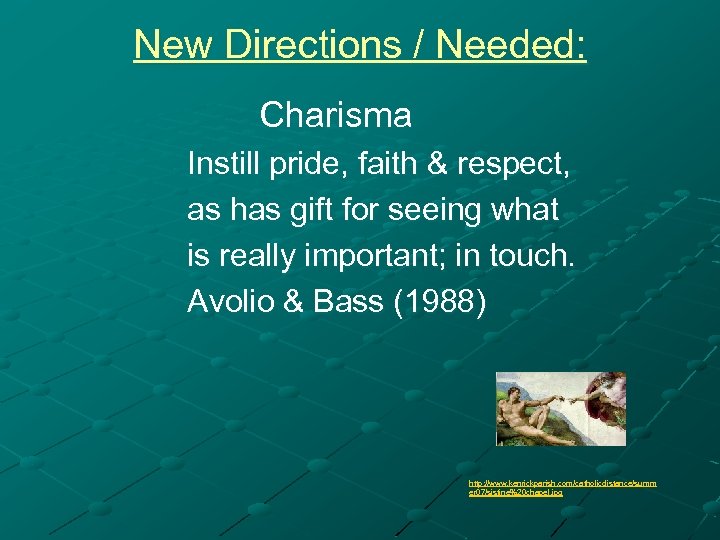 New Directions / Needed: Charisma Instill pride, faith & respect, as has gift for seeing what is really important; in touch. Avolio & Bass (1988) http: //www. kenrickparish. com/catholicdistance/summ er 07/sistine%20 chapel. jpg
 Inspirational & Motivational Increased & heightened motivational that occurs from charismatic leadership if required. Gronn (1995). http: //i. ehow. com/images/a 06/cd/uv/5_minute-team-building-exercises 1. 1 -800 x 800. jpg 8
 Holism & Mission Sharing values, goals & beliefs to win people over, requires skillful balance of transformational & organization wide leadership Limerick, Cunnington & Crowther (1988) http: //www. free-press-release. com/members_pic/200911/img/1259258333. jpg
 Intellectual Stimulation Leaders inspire a followers thinking & imagination Four ‘I’ of TF (Avolio et al. , Bass & Avolio, 1994 b) A) Inspirational leadership: - arousal & heightening of Motivation among followers. B) Individualised Consideration: - Subsequent treatment of Individuals according to their needs. C) Intellectual Stimulation: - Leaders influence on followers thinking & imagination. D) Idealized Influence: - Identifying with leaders mission & value. https: //lh 5. googleusercontent. com/-XRm_w 33 a 71 o/TYcicf. B 49 l. I/AAAADjg/lq. Ofz. JOBOD 0/s 400/Humanism. TP. 001. jpg
 Idealised Influence This culminates from the leaders mission & vision Burns (1978 p. 454) Bass (1990 a, p. 22) http: //blog. helpformylife. org/files/Soaring-bald-eagly-300 x 240. jpg
 ‘Vision orientated’ Leaders viewed themselves as leaders not managers i. e. concerned themselves with organizing the basic purpose & general direction Bennis & Nanus (1985 ) http: //cdn. bleacherreport. net/images_root/slides/photos/000/160/148/95649528. jpg. 21906_display_image. jpg? 1266532927
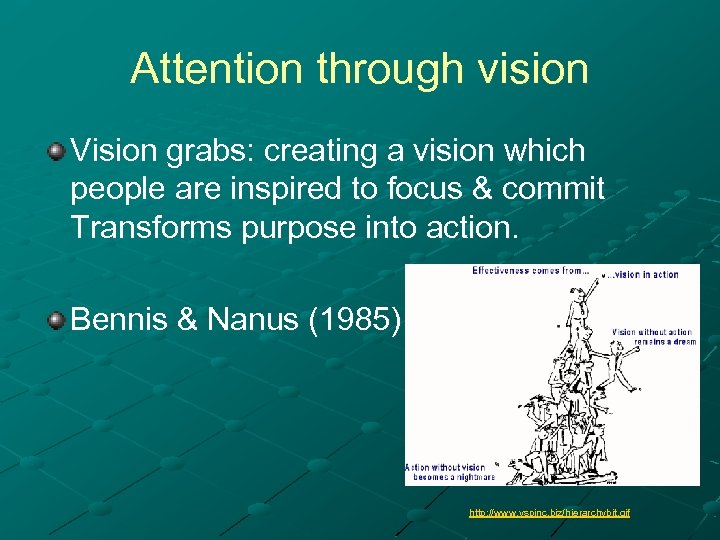 Attention through vision Vision grabs: creating a vision which people are inspired to focus & commit Transforms purpose into action. Bennis & Nanus (1985) http: //www. vspinc. biz/hierarchybit. gif
 Meaning through communication Leaders get people aligned behind new proposals, motivating & articulating clearly through influencing & organizing meaning for members of the organization. Bennis & Nanus (1985) http: //www. mainevents. co. uk/images/team_building_ring. jpg
 Trust through positioning Set up actions necessary to implement vision of the leader. Bennis & Nanus (1985) http: //www. venues 4 u. com/_assets/client/images/collateral/teambuilding. jpg
 Deployment of self through positive self regard Taoist story applicable: Change yourself, so as not to be so vulnerable p. 55. “…arriving at a human contact without enforcing authority” Carlo Maria Gulinip. 55 Bennis & Nanus (1985) http: //blog. thefoundationstone. org/wp-content/uploads/2010/02/empowerment. jpg
 Accepting peoples emotional differences & orientations 5 key skills are mentioned by Bennis: a) accept people as they are, not as you would like them to be & further “enter the skin” of that person, so that you have a better understanding. b) Approach relationships & problems in terms of the present, rather than the past. c) Treat courteously, strangers & casual acquaintances alike. d) Trust in people e) Be concerned with quality of work that emerges rather than whether or not you like them. Bennis & Nanus (1985) http: //www. xtremevortex. co. uk/images/team_building_image. jpg
 Empowerment Making employees feel significant for their organization & for common purpose. “that occasional epiphany which occurs when an exquisitely complicated effort is coordinated & completed well. ” Bennis & Nanus (1985) http: //www. cronyinfotech. com/wp-content/uploads/custom/people. jpg
 Theory Y People will exercise self –control towards an organization goal if he is committed to them. Hodgkinson (1991). http: //professionallearning. typepad. com/photos/uncategorized/2008/08/03/0804 teambuilding_3. jpg
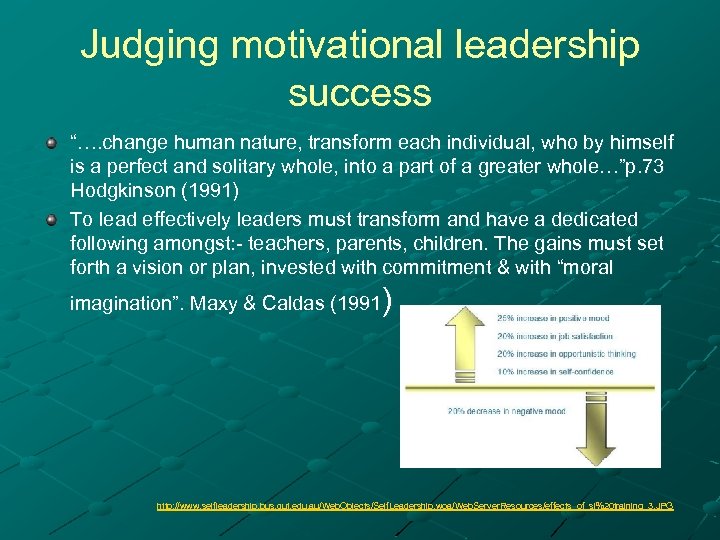 Judging motivational leadership success “…. change human nature, transform each individual, who by himself is a perfect and solitary whole, into a part of a greater whole…”p. 73 Hodgkinson (1991) To lead effectively leaders must transform and have a dedicated following amongst: - teachers, parents, children. The gains must set forth a vision or plan, invested with commitment & with “moral ) imagination”. Maxy & Caldas (1991 http: //www. selfleadership. bus. qut. edu. au/Web. Objects/Self. Leadership. woa/Web. Server. Resources/effects_of_sl%20 training_3. JPG
 Away from influencing towards goal setting & achievement http: //shiftack. com/wp-content/uploads/2009/06/overwork 3. jpg
 Transformation of people from “objects” in the world to active self – determining “subjects” “conscious of themselves as active deciding beings, bearing responsibility for their choices and able to explain them by referring to their own purposes, ideals and beliefs Smyth (1987) Fay (1977) http: //heystudents. com/images/students_motivation. jpg
 Need to penetrate the hidden curriculum Critical pedagogy of schooling in the importance of construction and analysis of meaning in everyday experiences. Giroux (1983) http: //theapple. monster. com/nfs/theapple/attachment_images/0002/8598/shutterstock_9639703_crop 380 w. jpg? 12252
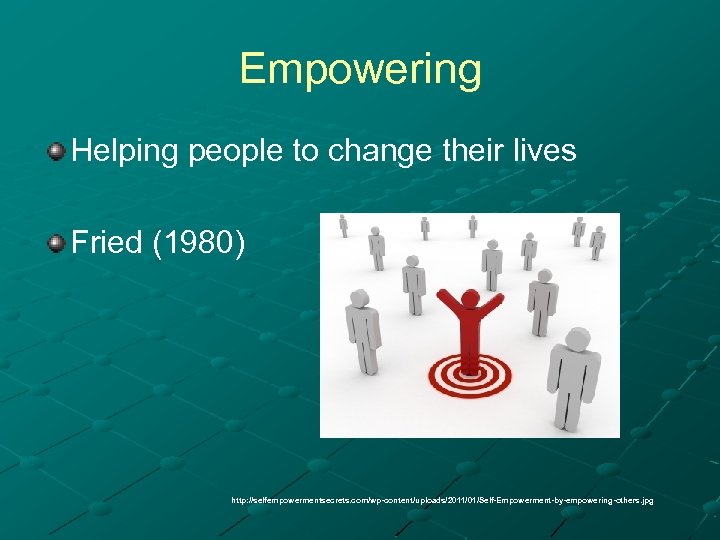 Empowering Helping people to change their lives Fried (1980) http: //selfempowermentsecrets. com/wp-content/uploads/2011/01/Self-Empowerment-by-empowering-others. jpg
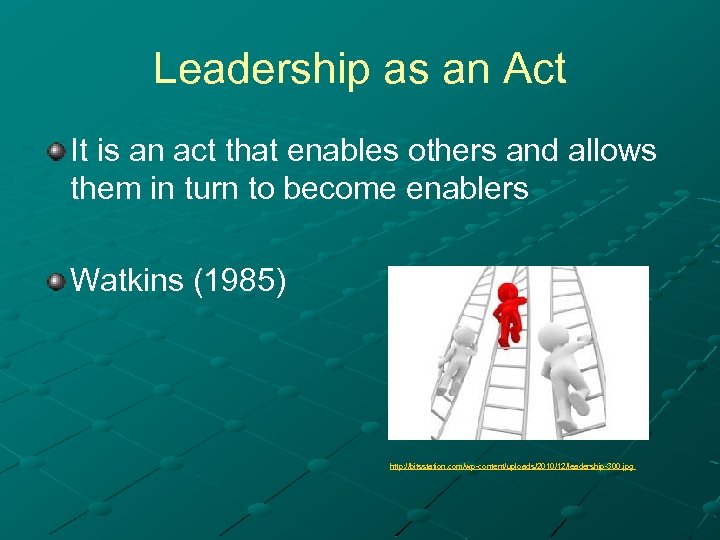 Leadership as an Act It is an act that enables others and allows them in turn to become enablers Watkins (1985) http: //bitsstation. com/wp-content/uploads/2010/12/leadership-300. jpg
 Action By reflecting upon action, individuals and communities acquire knowledge, skills & concepts that empower them to remake & reorder if necessary, the world in which they live. Schon, (1984) http: //im. rediff. com/money/2009/nov/work. jpg
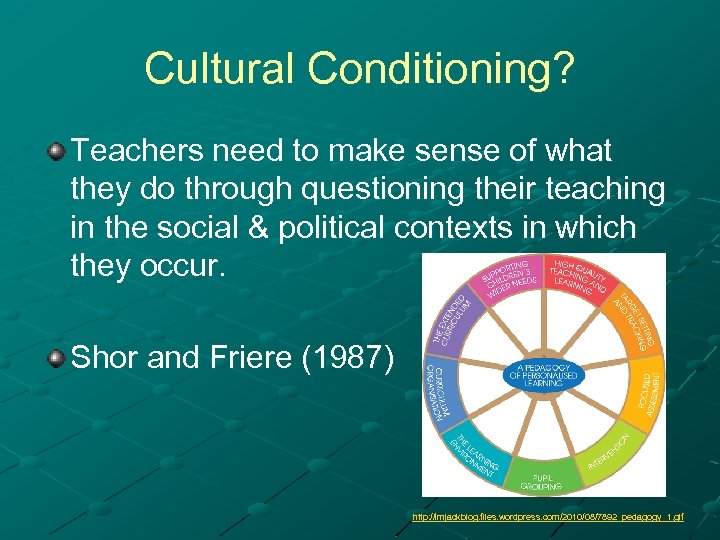 Cultural Conditioning? Teachers need to make sense of what they do through questioning their teaching in the social & political contexts in which they occur. Shor and Friere (1987) http: //imjackblog. files. wordpress. com/2010/08/7892_pedagogy_1. gif
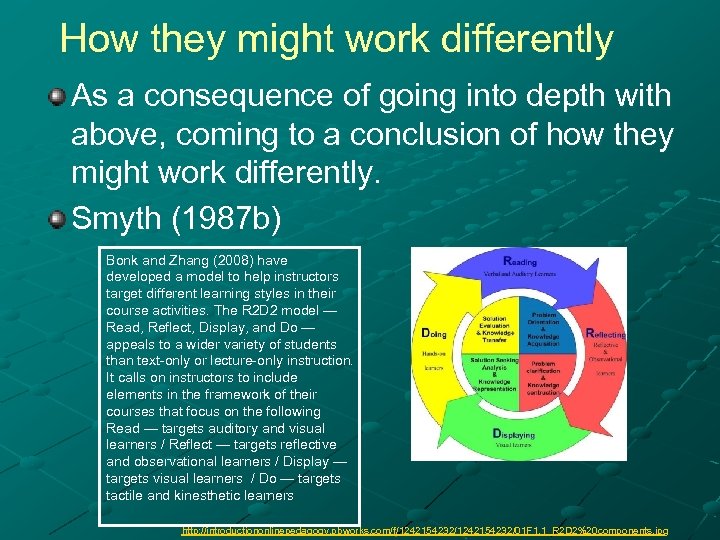 How they might work differently As a consequence of going into depth with above, coming to a conclusion of how they might work differently. Smyth (1987 b) Bonk and Zhang (2008) have developed a model to help instructors target different learning styles in their course activities. The R 2 D 2 model — Read, Reflect, Display, and Do — appeals to a wider variety of students than text-only or lecture-only instruction. It calls on instructors to include elements in the framework of their courses that focus on the following Read — targets auditory and visual learners / Reflect — targets reflective and observational learners / Display — targets visual learners / Do — targets tactile and kinesthetic learners http: //introductiononlinepedagogy. pbworks. com/f/1242154232/01 F 1. 1_R 2 D 2%20 components. jpg
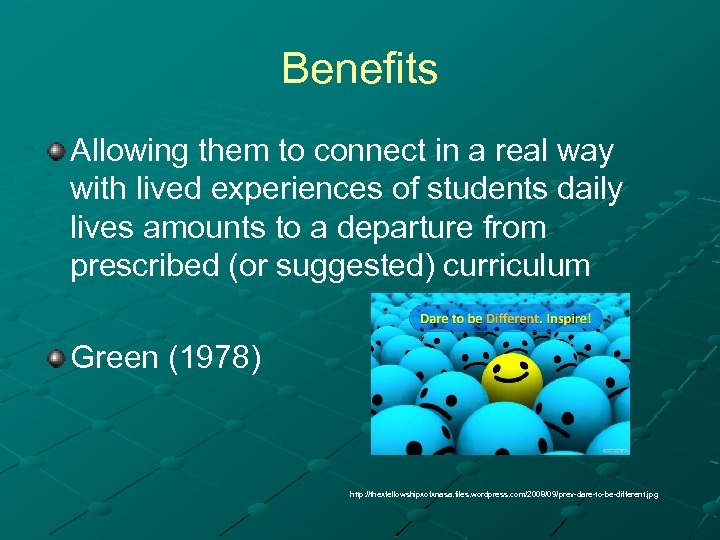 Benefits Allowing them to connect in a real way with lived experiences of students daily lives amounts to a departure from prescribed (or suggested) curriculum Green (1978) http: //thexfellowshipxofxnasa. files. wordpress. com/2008/09/prev-dare-to-be-different. jpg
 Thanks for considering… Reflecting upon these ideals within Leadership style I feel I need to adopt, instill, encourage and foster, I’m conscious that these are ideal traits that should be prevalent in terms of relationship building between Leader and staff to enhance. They are not in themselves seen as action points or in particular order of importance of dominance. Rather I see them as essential elements, characteristics of Leader & follower ideals, in terms of reflective motivated people, with common desire to improve pedgagogies of teaching & learning. http: //www. poimena. com/learninglink/wp-content/uploads/puzzle_key. png
 Bibliography Avolio, B. J. , & Bass, B. M. (1988). Transformational leadership charisma and beyond. In J. G. Hunt (Ed. ), Emerging leadership vistas (pp. 29 -49). Lexington, MASS: Lexington Books. Bass (1990 a, p. 22) Four ‘I’ of TF (Avolio et al. , Bass & Avolio, 1994 b) Bennis, W. G. , & Nanus, B. (1985). Leaders : the strategies for taking charge (pp. 19 -86). New York: Harper and Row. Burns (1978 p. 454) Faye B (1977) How people change themselves: The relationship between critical theory and its audience in T. Ball (Ed) Political Theory and Praxis: New Perspectives, Minneapolis, Minn, University of Minnesota Press pp. 200 -33 Fried, R (1980) Empowerment vs Delivery of Services, Concord, N. H. , New Hampshire Department of Education. Giroux, H (1983) Theory and Resistance in Education: A Pedagogy for the Opposition, South Hadley, Mass. , Bergin and Garvey. Green (1978) Gronn, P. (1995). Greatness re-visited : the current obsession with transformational leadership, Leading and Managing : Journal of the Australian Council for Educational Administration, 1 (1), 14 -27. Contin…
 Contin… Bibliography Hodgkinson, C. (1991). Educational leadership : the moral art (pp. 67 -85). Albany, NEW YORK: State University of New York Press. Limerick, Cunnington & Crowther (1988) Maxcy, S. J. , & Caldas, S. J. (1991). Moral imagination and the philosophy of school leadership, The Journal of Educational Administration, 29 (3), 38 -53. Pondy, L. (1978) Leadership is a language game, in M. Mc. Call and M. Lombardo (Eds) , Leadership : where else can we go? Durham, N. C, University Press Schon, D (1984) Leadership as reflection – in –action, in Sergiovanni and J. Corbally (Eds), Leadership and Organizational Culture: New Perspectives in Administration Theory and Practice, Urbana, 111, University of Illinois Press, pp. 36 - 63 Shor, I and Friere, p. (1987) A Pedagogy for Liberation: Dialogues on Transforming Education, South Hadley, Mass, Bergin and Garvey Smyth, J. (1989). A "pedagogical" and "educative" view of leadership. In J. Smyth (Ed. ), Critical perspectives on educational leadership (pp. 179 -204). London, UK: Falmer Press. Watkins, R (1985) Alternatives to traditional views of organizational leadership: Human agency and practice in the restructuring of education, the Australian Administrator, 6, 3, pp. 1 -4 (All pictures photographs used with links, accessed between May 8 th – 14 th 2011)