


 Скачать презентацию A Quick Introduction to Approximate Query Processing Part
414fa55dee4ebc25a176c6bc300b1a01.ppt
- Количество слайдов: 38
 A Quick Introduction to Approximate Query Processing Part -IV CS 286, Spring’ 2007 Minos Garofalakis
 Logistics… • Draft CS 286 web site is finally up! – http: //db. cs. berkeley. edu/cs 286 sp 07/ • Project list and guidelines being worked on – Please email me & Raghu to discuss your own project ideas… CS 286, Spring’ 07 – Minos Garofalakis # 2
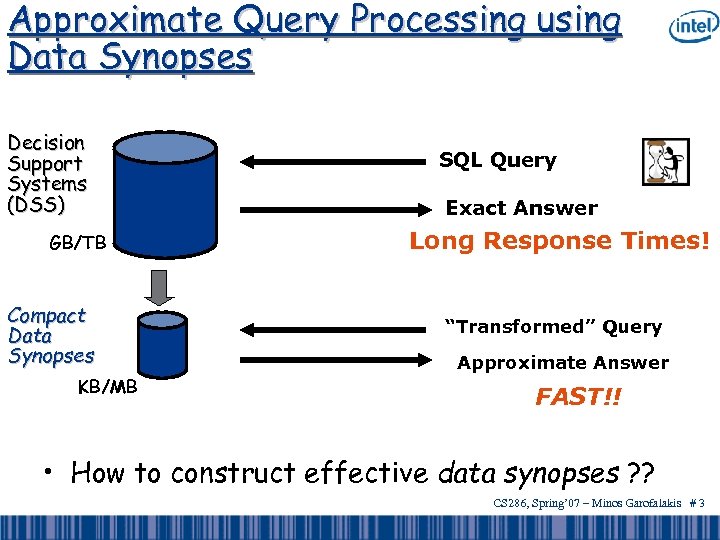 Approximate Query Processing using Data Synopses Decision Support Systems (DSS) GB/TB Compact Data Synopses KB/MB SQL Query Exact Answer Long Response Times! “Transformed” Query Approximate Answer FAST!! • How to construct effective data synopses ? ? CS 286, Spring’ 07 – Minos Garofalakis # 3
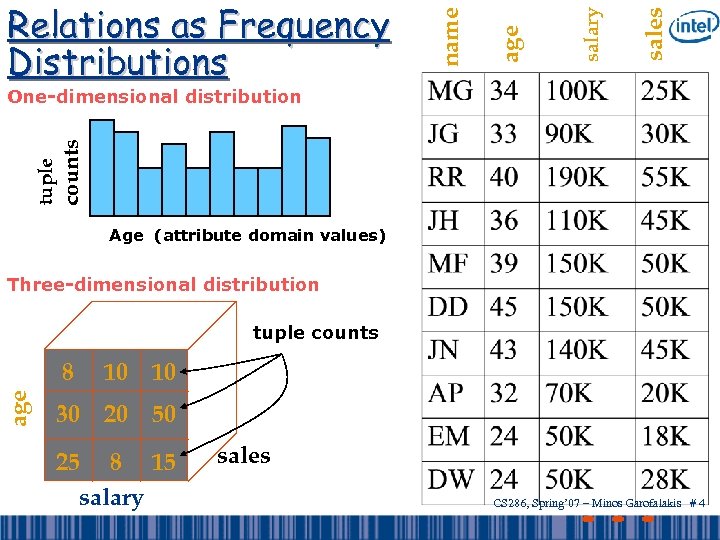 sales salary age name Relations as Frequency Distributions counts tuple One-dimensional distribution Age (attribute domain values) Three-dimensional distribution tuple counts age 8 10 10 30 20 50 25 8 15 salary sales CS 286, Spring’ 07 – Minos Garofalakis # 4
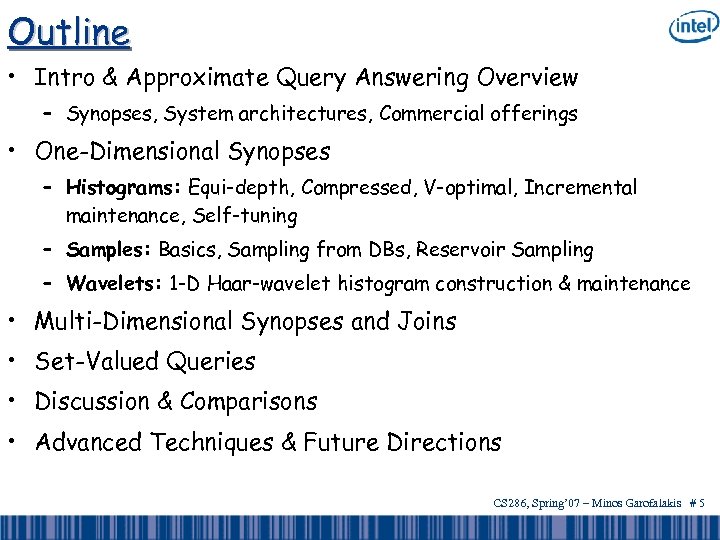 Outline • Intro & Approximate Query Answering Overview – Synopses, System architectures, Commercial offerings • One-Dimensional Synopses – Histograms: Equi-depth, Compressed, V-optimal, Incremental maintenance, Self-tuning – Samples: Basics, Sampling from DBs, Reservoir Sampling – Wavelets: 1 -D Haar-wavelet histogram construction & maintenance • Multi-Dimensional Synopses and Joins • Set-Valued Queries • Discussion & Comparisons • Advanced Techniques & Future Directions CS 286, Spring’ 07 – Minos Garofalakis # 5
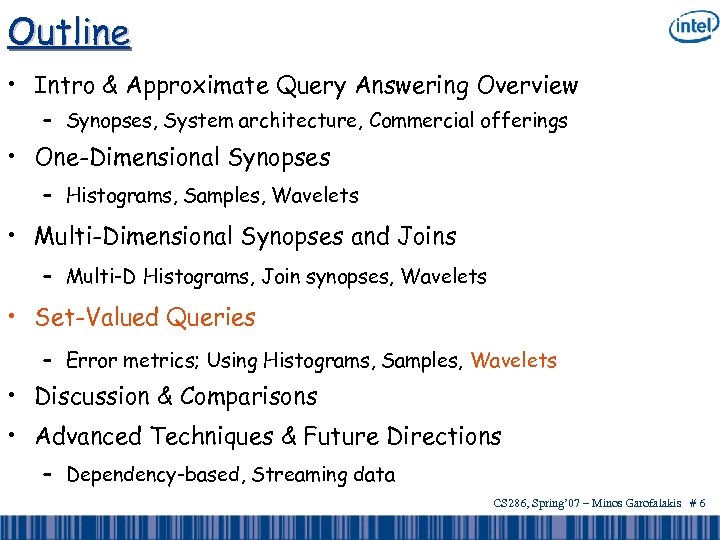 Outline • Intro & Approximate Query Answering Overview – Synopses, System architecture, Commercial offerings • One-Dimensional Synopses – Histograms, Samples, Wavelets • Multi-Dimensional Synopses and Joins – Multi-D Histograms, Join synopses, Wavelets • Set-Valued Queries – Error metrics; Using Histograms, Samples, Wavelets • Discussion & Comparisons • Advanced Techniques & Future Directions – Dependency-based, Streaming data CS 286, Spring’ 07 – Minos Garofalakis # 6
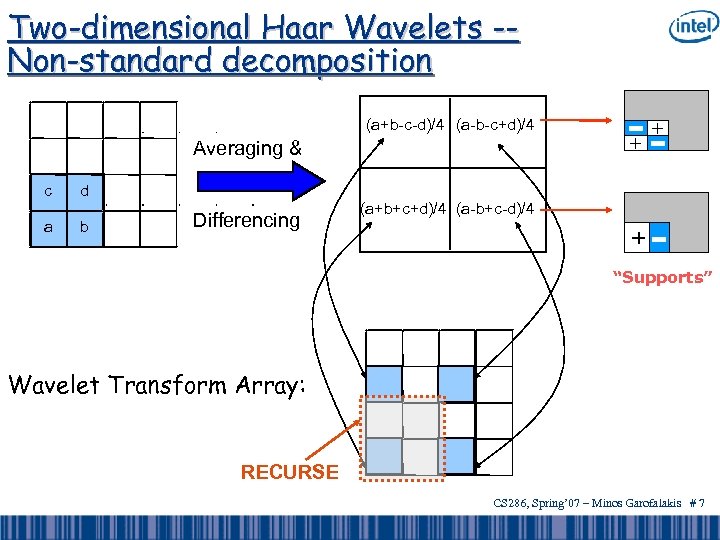 Two-dimensional Haar Wavelets -Non-standard decomposition (a+b-c-d)/4 (a-b-c+d)/4 Averaging & c a + -+ d b Differencing (a+b+c+d)/4 (a-b+c-d)/4 + - “Supports” Wavelet Transform Array: RECURSE CS 286, Spring’ 07 – Minos Garofalakis # 7
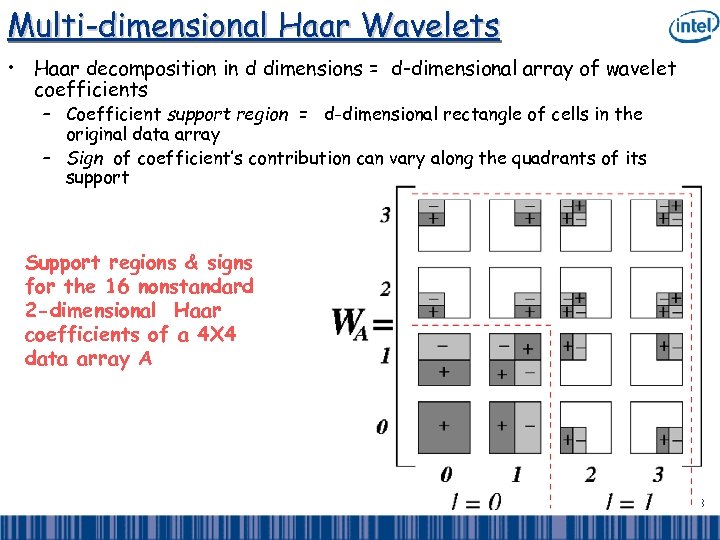 Multi-dimensional Haar Wavelets • Haar decomposition in d dimensions = d-dimensional array of wavelet coefficients – Coefficient support region = d-dimensional rectangle of cells in the original data array – Sign of coefficient’s contribution can vary along the quadrants of its support Support regions & signs for the 16 nonstandard 2 -dimensional Haar coefficients of a 4 X 4 data array A CS 286, Spring’ 07 – Minos Garofalakis # 8
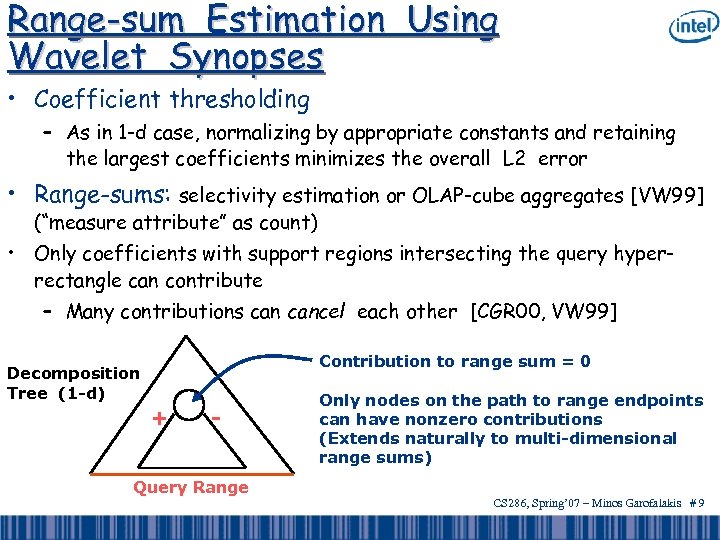 Range-sum Estimation Using Wavelet Synopses • Coefficient thresholding – As in 1 -d case, normalizing by appropriate constants and retaining the largest coefficients minimizes the overall L 2 error • Range-sums: selectivity estimation or OLAP-cube aggregates [VW 99] (“measure attribute” as count) • Only coefficients with support regions intersecting the query hyperrectangle can contribute – Many contributions cancel each other [CGR 00, VW 99] Contribution to range sum = 0 Decomposition Tree (1 -d) + - Query Range Only nodes on the path to range endpoints can have nonzero contributions (Extends naturally to multi-dimensional range sums) CS 286, Spring’ 07 – Minos Garofalakis # 9
![Approximate Query Processing Using Wavelets [CGR 00] • Reduce relations into compact wavelet-coefficient synopses](https://present5.com/presentation/414fa55dee4ebc25a176c6bc300b1a01/image-10.jpg "Approximate Query Processing Using Wavelets [CGR 00] • Reduce relations into compact wavelet-coefficient synopses") Approximate Query Processing Using Wavelets [CGR 00] • Reduce relations into compact wavelet-coefficient synopses Entire query processing in the compressed (wavelet) domain Querying in Wavelet Domain Query Results in Wavelet Domain Render Compressed domain (FAST) Wavelet Synopses Final Approximate Results Relation domain (SLOW) Render Approximate Relations Querying in Relation Domain CS 286, Spring’ 07 – Minos Garofalakis # 10
Approximate Query Processing Using Wavelets [CGR 00] • Reduce relations into compact wavelet-coefficient synopses Entire query processing in the compressed (wavelet) domain Querying in Wavelet Domain Query Results in Wavelet Domain Render Compressed domain (FAST) Wavelet Synopses Final Approximate Results Relation domain (SLOW) Render Approximate Relations Querying in Relation Domain CS 286, Spring’ 07 – Minos Garofalakis # 10
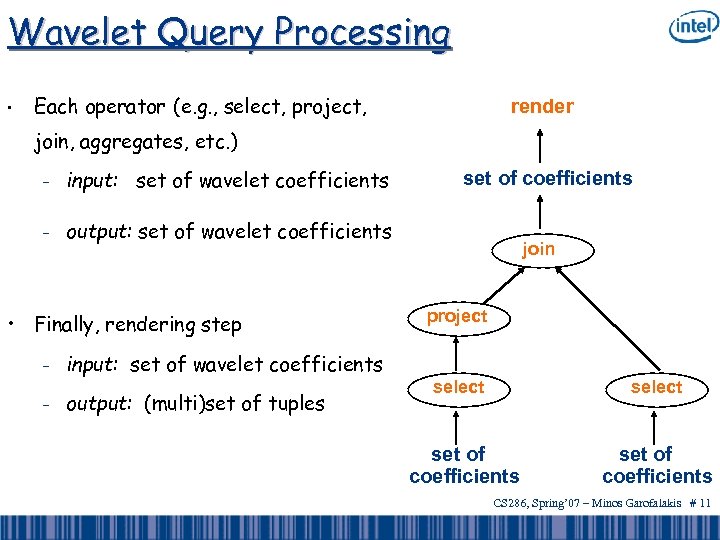 Wavelet Query Processing • Each operator (e. g. , select, project, render join, aggregates, etc. ) – input: set of wavelet coefficients – output: set of wavelet coefficients • Finally, rendering step – – input: set of wavelet coefficients output: (multi)set of tuples set of coefficients join project select set of coefficients CS 286, Spring’ 07 – Minos Garofalakis # 11
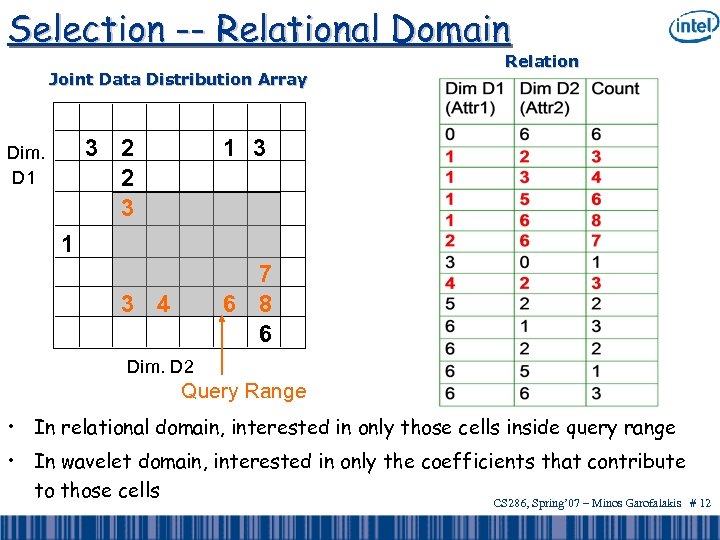 Selection -- Relational Domain Joint Data Distribution Array 3 2 2 3 Dim. D 1 Relation 1 3 1 7 6 8 6 3 4 Dim. D 2 Query Range • In relational domain, interested in only those cells inside query range • In wavelet domain, interested in only the coefficients that contribute to those cells CS 286, Spring’ 07 – Minos Garofalakis # 12
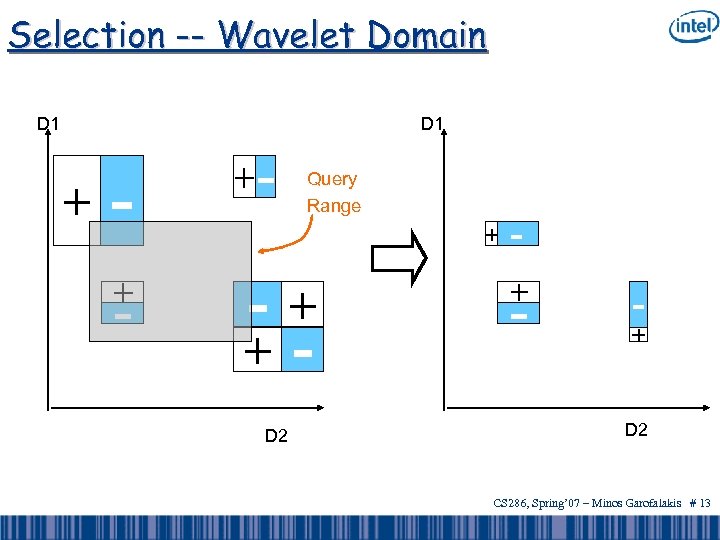 Selection -- Wavelet Domain D 1 + - +- + - - Query Range + + D 2 + - - + D 2 CS 286, Spring’ 07 – Minos Garofalakis # 13
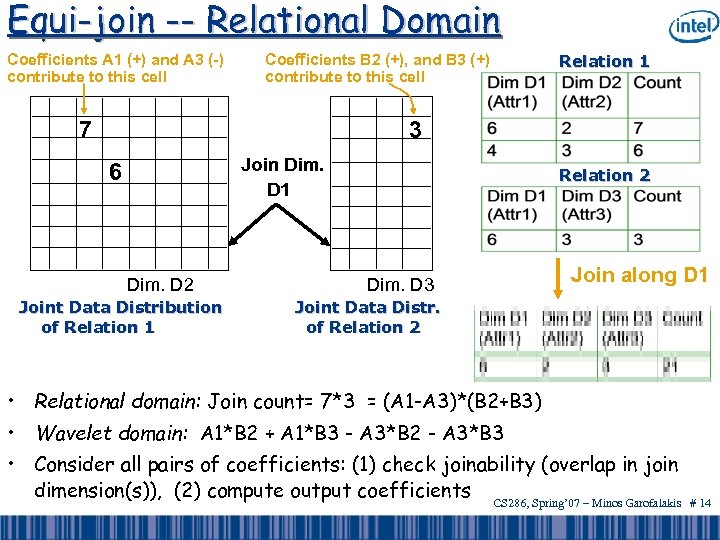 Equi-join -- Relational Domain Coefficients A 1 (+) and A 3 (-) contribute to this cell Coefficients B 2 (+), and B 3 (+) contribute to this cell 7 Relation 1 3 Join Dim. D 1 6 Dim. D 2 Joint Data Distribution of Relation 1 Relation 2 Dim. D 3 Join along D 1 Joint Data Distr. of Relation 2 • Relational domain: Join count= 7*3 = (A 1 -A 3)*(B 2+B 3) • Wavelet domain: A 1*B 2 + A 1*B 3 - A 3*B 2 - A 3*B 3 • Consider all pairs of coefficients: (1) check joinability (overlap in join dimension(s)), (2) compute output coefficients CS 286, Spring’ 07 – Minos Garofalakis # 14
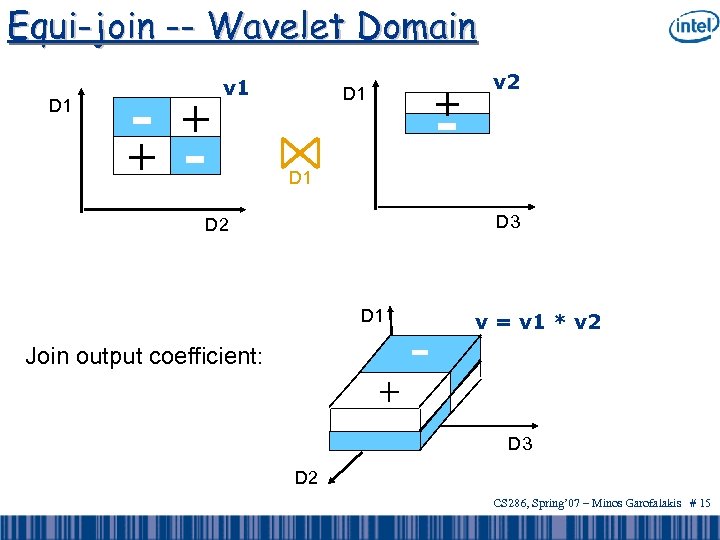 Equi-join -- Wavelet Domain D 1 - + + v 1 - + - D 1 v 2 D 1 D 3 D 2 D 1 Join output coefficient: + - v = v 1 * v 2 D 3 D 2 CS 286, Spring’ 07 – Minos Garofalakis # 15
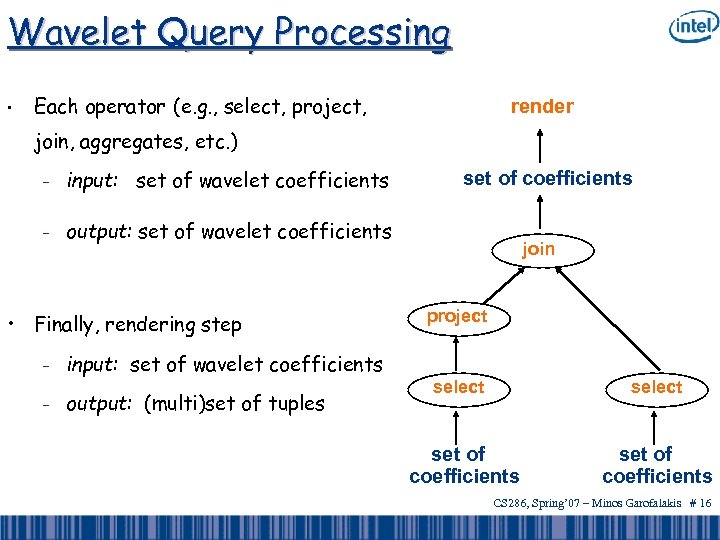 Wavelet Query Processing • Each operator (e. g. , select, project, render join, aggregates, etc. ) – input: set of wavelet coefficients – output: set of wavelet coefficients • Finally, rendering step – – input: set of wavelet coefficients output: (multi)set of tuples set of coefficients join project select set of coefficients CS 286, Spring’ 07 – Minos Garofalakis # 16
 Outline • Intro & Approximate Query Answering Overview • One-Dimensional Synopses • Multi-Dimensional Synopses and Joins • Set-Valued Queries • Discussion & Comparisons • Advanced Techniques & Future Directions • Conclusions CS 286, Spring’ 07 – Minos Garofalakis # 17
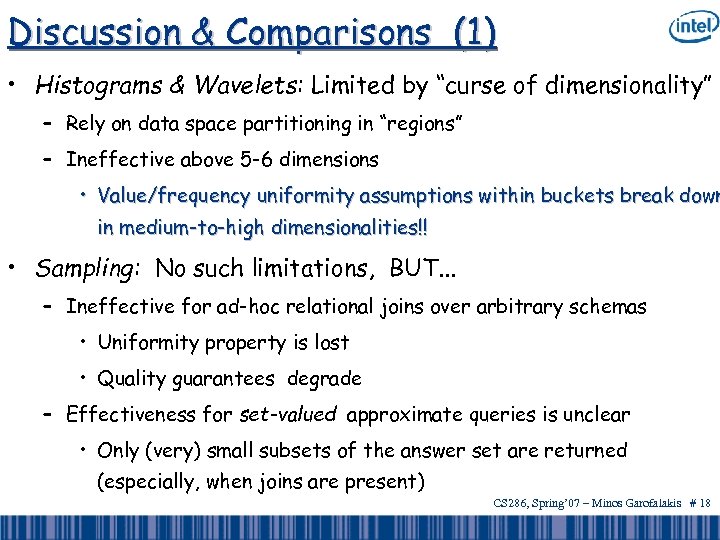 Discussion & Comparisons (1) • Histograms & Wavelets: Limited by “curse of dimensionality” – Rely on data space partitioning in “regions” – Ineffective above 5 -6 dimensions • Value/frequency uniformity assumptions within buckets break down in medium-to-high dimensionalities!! • Sampling: No such limitations, BUT. . . – Ineffective for ad-hoc relational joins over arbitrary schemas • Uniformity property is lost • Quality guarantees degrade – Effectiveness for set-valued approximate queries is unclear • Only (very) small subsets of the answer set are returned (especially, when joins are present) CS 286, Spring’ 07 – Minos Garofalakis # 18
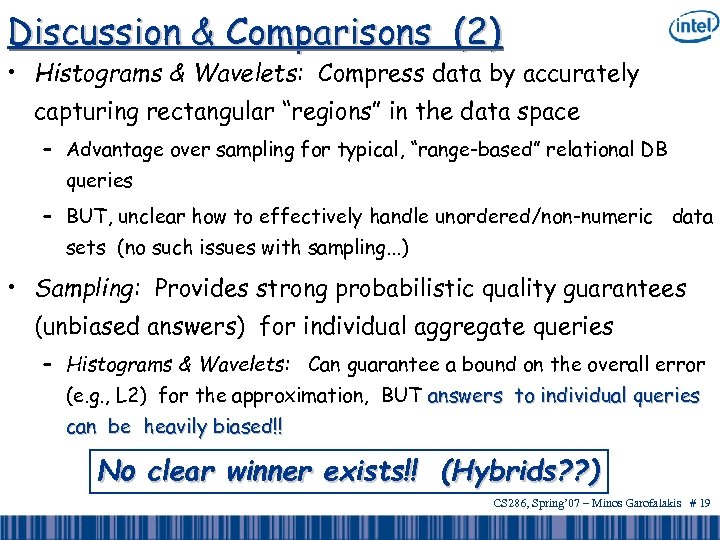 Discussion & Comparisons (2) • Histograms & Wavelets: Compress data by accurately capturing rectangular “regions” in the data space – Advantage over sampling for typical, “range-based” relational DB queries – BUT, unclear how to effectively handle unordered/non-numeric data sets (no such issues with sampling. . . ) • Sampling: Provides strong probabilistic quality guarantees (unbiased answers) for individual aggregate queries – Histograms & Wavelets: Can guarantee a bound on the overall error (e. g. , L 2) for the approximation, BUT answers to individual queries can be heavily biased!! No clear winner exists!! (Hybrids? ? ) CS 286, Spring’ 07 – Minos Garofalakis # 19
 Outline • Intro & Approximate Query Answering Overview • One-Dimensional Synopses • Multi-Dimensional Synopses and Joins • Set-Valued Queries • Discussion & Comparisons • Advanced Techniques & Future Directions – Dependency-based Synopses – Streaming Data – XML Synopses • Conclusions CS 286, Spring’ 07 – Minos Garofalakis # 20
![Dependency-based Histogram Synopses [DGR 01] Attribute Value Independence * simplistic * inaccurate Fully independent](https://present5.com/presentation/414fa55dee4ebc25a176c6bc300b1a01/image-21.jpg "Dependency-based Histogram Synopses [DGR 01] Attribute Value Independence * simplistic * inaccurate Fully independent") Dependency-based Histogram Synopses [DGR 01] Attribute Value Independence * simplistic * inaccurate Fully independent attributes Multi-dimensional histograms on joint data distribution * expensive * ineffective in high dimensions Fully correlated attributes • Extremes in terms of the underlying correlations!! • Dependency-Based Histograms: explore space between extremes • General methodology, also applicable to other synopsis techniques (e. g. , wavelets) CS 286, Spring’ 07 – Minos Garofalakis by explicitly identifying data correlations/independences – Build a statistical interaction model on data attributes – Based on the model, build a collection of low-dimensional histograms – Use this histogram collection to provide approximate answers # 21
Dependency-based Histogram Synopses [DGR 01] Attribute Value Independence * simplistic * inaccurate Fully independent attributes Multi-dimensional histograms on joint data distribution * expensive * ineffective in high dimensions Fully correlated attributes • Extremes in terms of the underlying correlations!! • Dependency-Based Histograms: explore space between extremes • General methodology, also applicable to other synopsis techniques (e. g. , wavelets) CS 286, Spring’ 07 – Minos Garofalakis by explicitly identifying data correlations/independences – Build a statistical interaction model on data attributes – Based on the model, build a collection of low-dimensional histograms – Use this histogram collection to provide approximate answers # 21
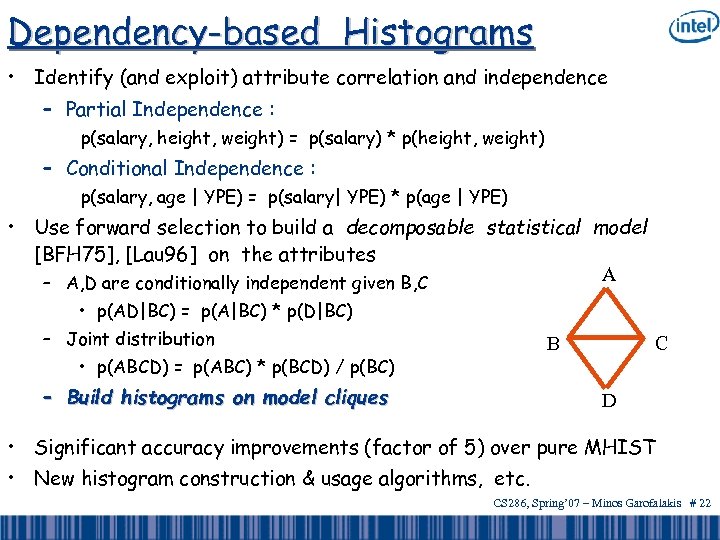 Dependency-based Histograms • Identify (and exploit) attribute correlation and independence – Partial Independence : p(salary, height, weight) = p(salary) * p(height, weight) – Conditional Independence : p(salary, age | YPE) = p(salary| YPE) * p(age | YPE) • Use forward selection to build a decomposable statistical model [BFH 75], [Lau 96] on the attributes A – A, D are conditionally independent given B, C • p(AD|BC) = p(A|BC) * p(D|BC) – Joint distribution C B • p(ABCD) = p(ABC) * p(BCD) / p(BC) – Build histograms on model cliques D • Significant accuracy improvements (factor of 5) over pure MHIST • New histogram construction & usage algorithms, etc. CS 286, Spring’ 07 – Minos Garofalakis # 22
 Data Streams • Data is continually arriving. Collect & maintain synopses on the data. Goal: Highly-accurate approximate answers – State-of-the-art: Good techniques for narrow classes of queries – E. g. , Any one-pass algorithm for collecting & maintaining a synopsis can be used effectively for data streams • Alternative scenario: A collection of data sets. Compute a compact sketch of each data set & then answer queries (approximately) comparing the data sets – E. g. , detecting near-duplicates in a collection of web pages: Altavista – E. g. , estimating join sizes among a collection of tables [AGM 99] CS 286, Spring’ 07 – Minos Garofalakis # 27
 Looking Forward. . . • Optimizing queries for approximation – e. g. , minimize length of confidence interval at the plan root • Exploiting mining-based techniques (e. g. , decision trees) for data reduction and approximate query processing – see, e. g. , [BGR 01], [GTK 01], [JMN 99] • Dynamic maintenance of complex (e. g. , dependency-based [DGR 01] or mining-based [BGR 01]) synopses • Synopses and approximate query processing for richer data models and data streams – e. g. , XPath/XQuery over XML databases CS 286, Spring’ 07 – Minos Garofalakis # 28
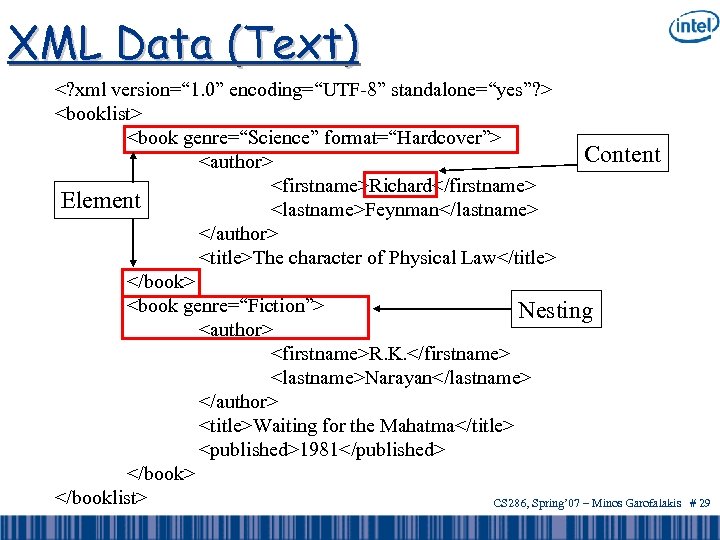 XML Data (Text)
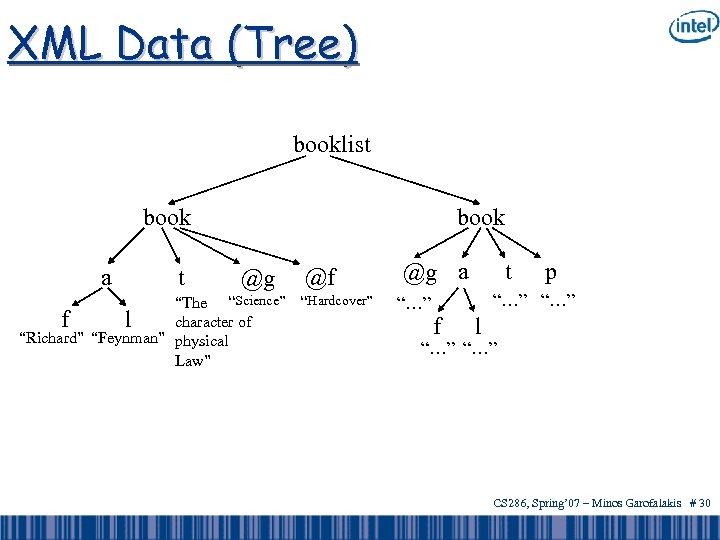 XML Data (Tree) booklist book a t book @g “The “Science” f l character of “Richard” “Feynman” physical Law” @f “Hardcover” @g a “…” t p “…” f l “…” CS 286, Spring’ 07 – Minos Garofalakis # 30
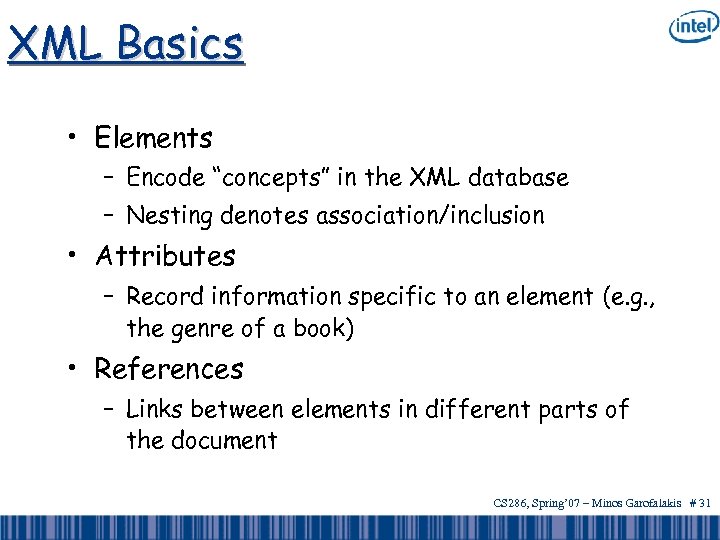 XML Basics • Elements – Encode “concepts” in the XML database – Nesting denotes association/inclusion • Attributes – Record information specific to an element (e. g. , the genre of a book) • References – Links between elements in different parts of the document CS 286, Spring’ 07 – Minos Garofalakis # 31
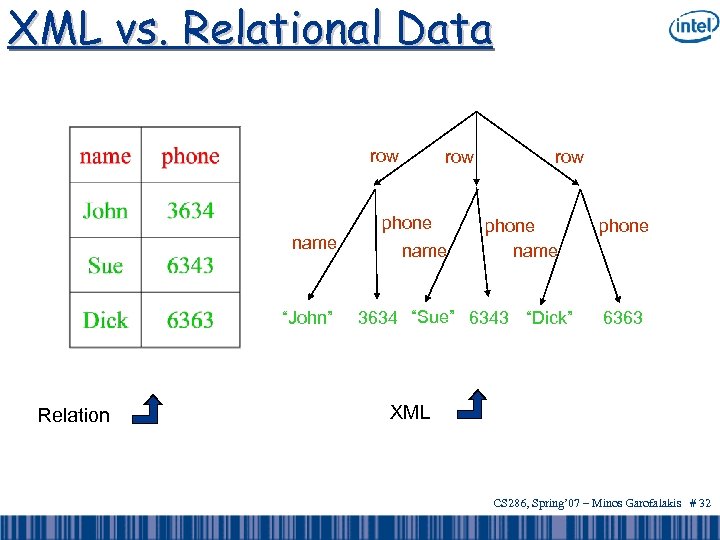 XML vs. Relational Data row phone name “John” Relation name row phone name 3634 “Sue” 6343 “Dick” phone 6363 XML CS 286, Spring’ 07 – Minos Garofalakis # 32
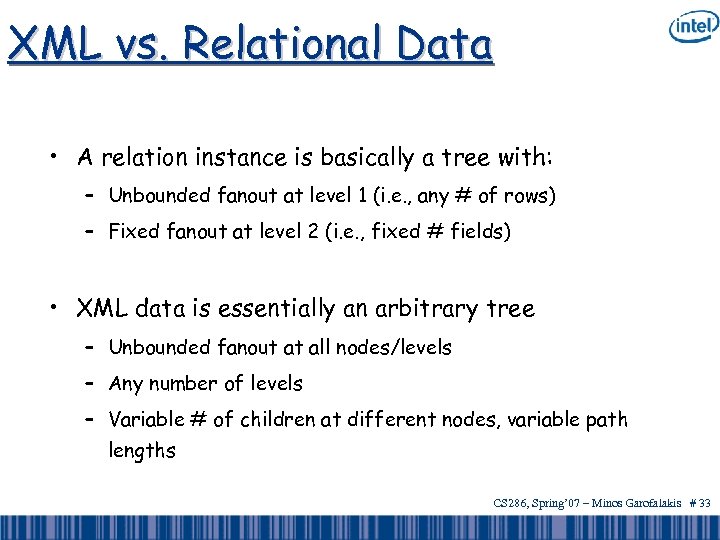 XML vs. Relational Data • A relation instance is basically a tree with: – Unbounded fanout at level 1 (i. e. , any # of rows) – Fixed fanout at level 2 (i. e. , fixed # fields) • XML data is essentially an arbitrary tree – Unbounded fanout at all nodes/levels – Any number of levels – Variable # of children at different nodes, variable path lengths CS 286, Spring’ 07 – Minos Garofalakis # 33
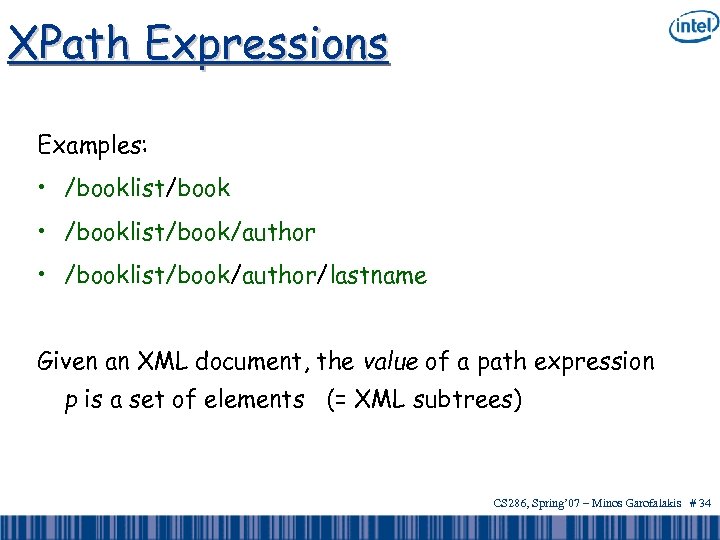 XPath Expressions Examples: • /booklist/book/author/lastname Given an XML document, the value of a path expression p is a set of elements (= XML subtrees) CS 286, Spring’ 07 – Minos Garofalakis # 34
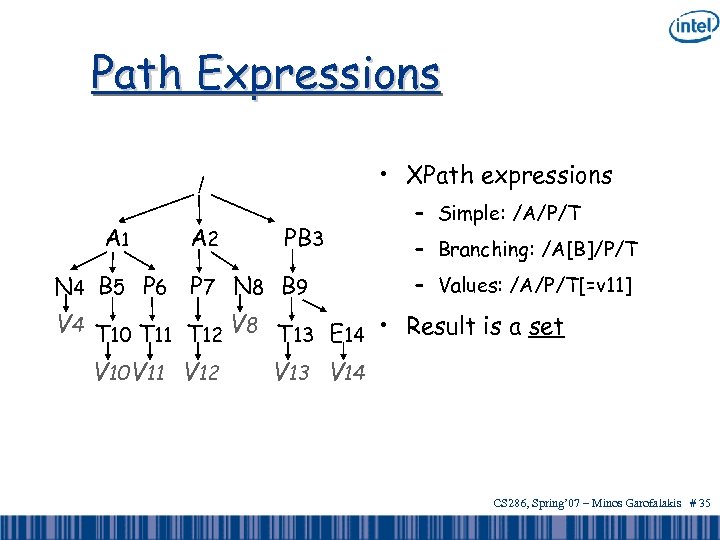 Path Expressions • XPath expressions / A 1 A 2 PB 3 N 4 B 5 P 6 P 7 N 8 B 9 – Simple: /A/P/T – Branching: /A[B]/P/T – Values: /A/P/T[=v 11] V 4 T 10 T 11 T 12 V 8 T 13 E 14 • Result is a set V 10 V 11 V 12 V 13 V 14 CS 286, Spring’ 07 – Minos Garofalakis # 35
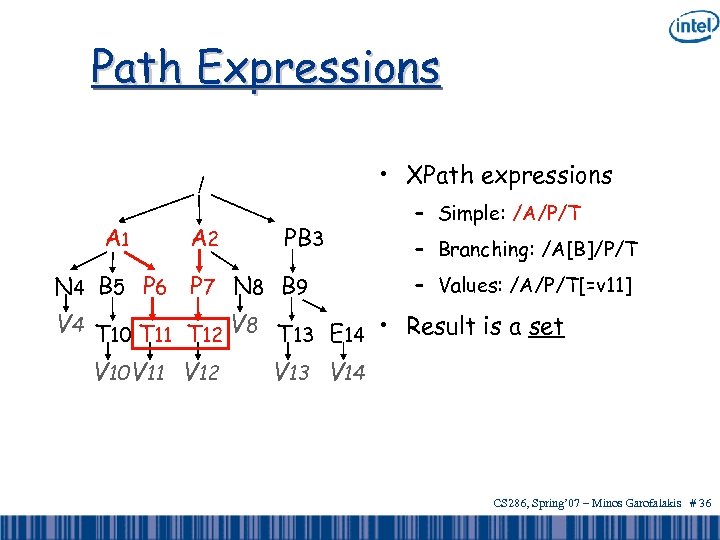 Path Expressions • XPath expressions / A 1 A 2 PB 3 N 4 B 5 P 6 P 7 N 8 B 9 – Simple: /A/P/T – Branching: /A[B]/P/T – Values: /A/P/T[=v 11] V 4 T 10 T 11 T 12 V 8 T 13 E 14 • Result is a set V 10 V 11 V 12 V 13 V 14 CS 286, Spring’ 07 – Minos Garofalakis # 36
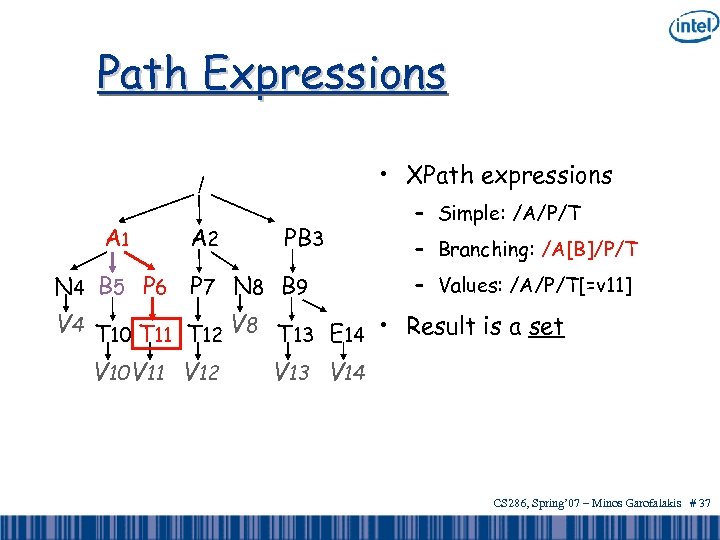 Path Expressions • XPath expressions / A 1 A 2 PB 3 N 4 B 5 P 6 P 7 N 8 B 9 – Simple: /A/P/T – Branching: /A[B]/P/T – Values: /A/P/T[=v 11] V 4 T 10 T 11 T 12 V 8 T 13 E 14 • Result is a set V 10 V 11 V 12 V 13 V 14 CS 286, Spring’ 07 – Minos Garofalakis # 37
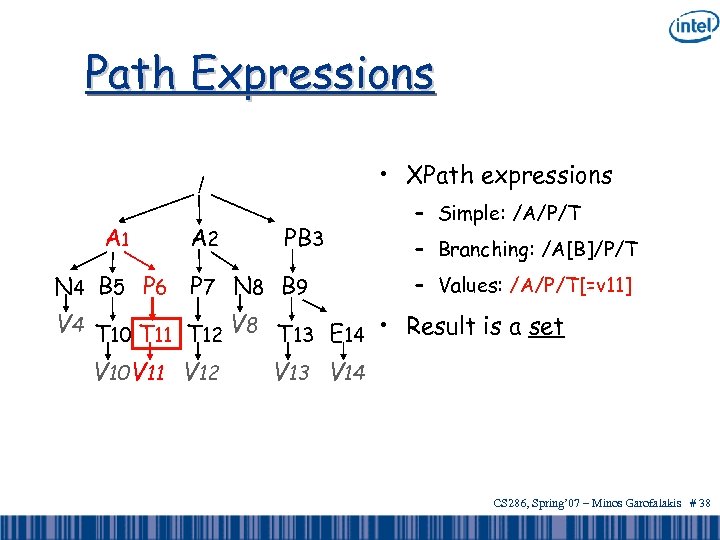 Path Expressions • XPath expressions / A 1 A 2 PB 3 N 4 B 5 P 6 P 7 N 8 B 9 – Simple: /A/P/T – Branching: /A[B]/P/T – Values: /A/P/T[=v 11] V 4 T 10 T 11 T 12 V 8 T 13 E 14 • Result is a set V 10 V 11 V 12 V 13 V 14 CS 286, Spring’ 07 – Minos Garofalakis # 38
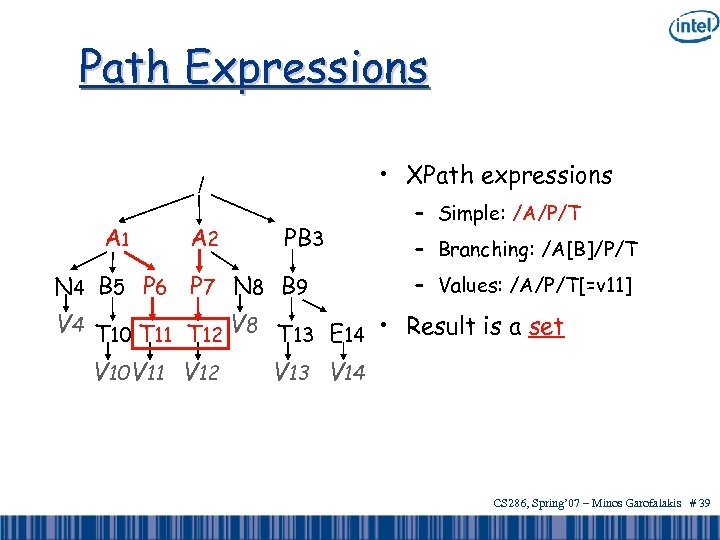 Path Expressions • XPath expressions / A 1 A 2 PB 3 N 4 B 5 P 6 P 7 N 8 B 9 – Simple: /A/P/T – Branching: /A[B]/P/T – Values: /A/P/T[=v 11] V 4 T 10 T 11 T 12 V 8 T 13 E 14 • Result is a set V 10 V 11 V 12 V 13 V 14 CS 286, Spring’ 07 – Minos Garofalakis # 39
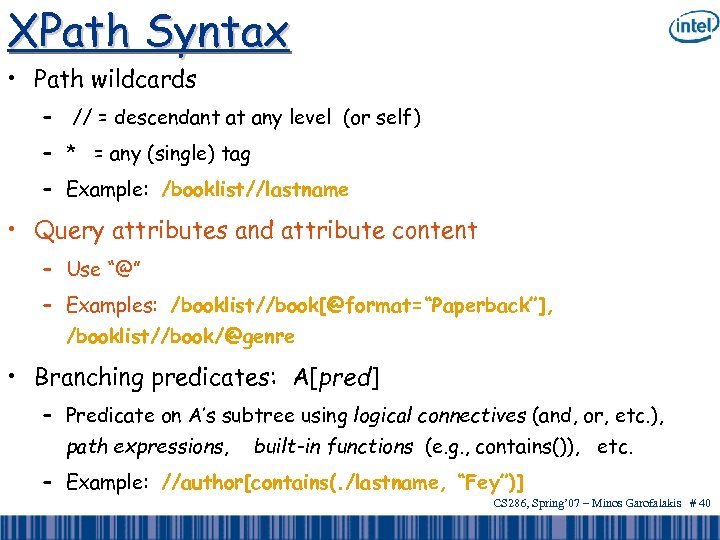 XPath Syntax • Path wildcards – // = descendant at any level (or self) – * = any (single) tag – Example: /booklist//lastname • Query attributes and attribute content – Use “@” – Examples: /booklist//book[@format=“Paperback”], /booklist//book/@genre • Branching predicates: A[pred] – Predicate on A’s subtree using logical connectives (and, or, etc. ), path expressions, built-in functions (e. g. , contains()), etc. – Example: //author[contains(. /lastname, “Fey”)] CS 286, Spring’ 07 – Minos Garofalakis # 40
 Synopses for XML • Summarize labeled tree/graph structure for approximate path navigation queries – Selectivity estimation: How many elements satisfy p? – Approximate answers: Return an approximate XML document as output of an XQuery fragment • Key idea: Build a concise Graph Synopsis that captures the path/branching distribution in limited space – Use appropriate uniformity/independence assumptions to approximate path structure – Refine synopsis in parts of the XML document where assumptions fail – XSketches [SIGMOD’ 02, VLDB’ 02], Tree. Sketches [SIGMOD’ 04] CS 286, Spring’ 07 – Minos Garofalakis # 41
 Conclusions • Commercial data warehouses: approaching several 100’s TB and continuously growing – Demand for high-speed, interactive analysis (click-stream processing, IP traffic analysis) also increasing • Approximate Query Processing – “Tame” these Tera. Bytes and satisfy the need for interactive processing and exploration – Great promise – Commercial acceptance still lagging, but will most probably grow in coming years – Still lots of interesting research to be done!! CS 286, Spring’ 07 – Minos Garofalakis # 42