 Скачать презентацию A proverb to enjoy Roses given fragrance in
ed8cc2c21876694af01912053c1897b5.ppt
- Количество слайдов: 42



A proverb to enjoy Roses given, fragrance in hand. 予人玫瑰, 手有余香。

Unit 4 Sharing Warming up & reading
Warming up 1 Have you ever helped your parents, or other relatives (n. 亲 戚), or your friends? No Would you be called a “ volunteer ”? 2 Have you ever helped people in your community (n. 社区), or people outside your community? Yes Would you be called a “ volunteer ” this time? Who would be called “volunteers”? ? Next
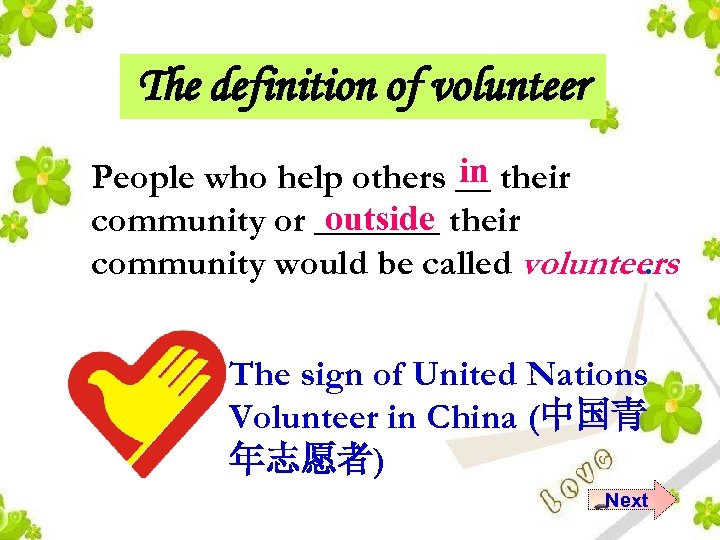
The definition of volunteer in People who help others __ their outside community or _______ their community would be called volunteers. The sign of United Nations Volunteer in China (中国青 年志愿者) Next
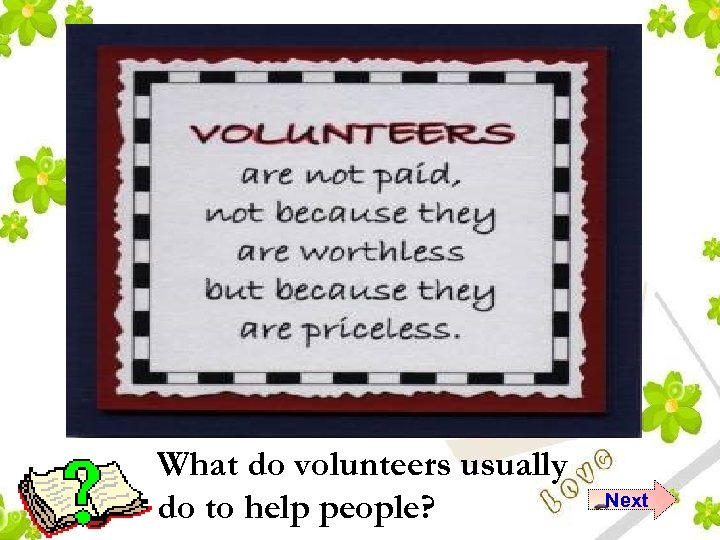
What do volunteers usually do to help people? Next
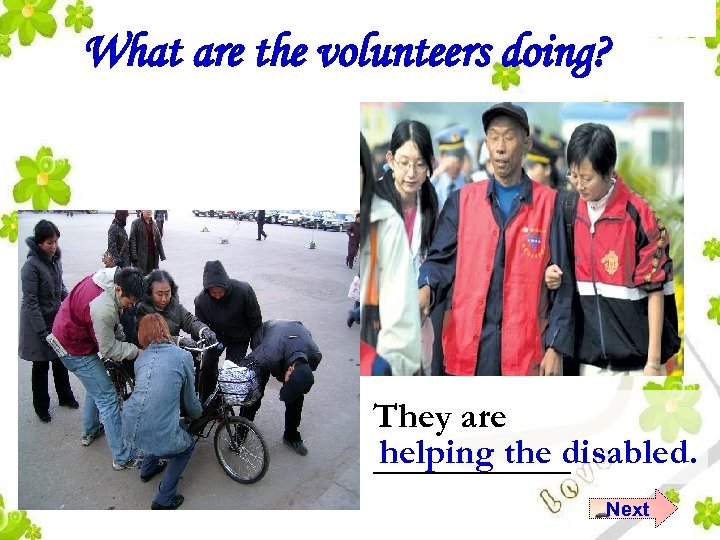
What are the volunteers doing? They are helping the disabled. ______ Next
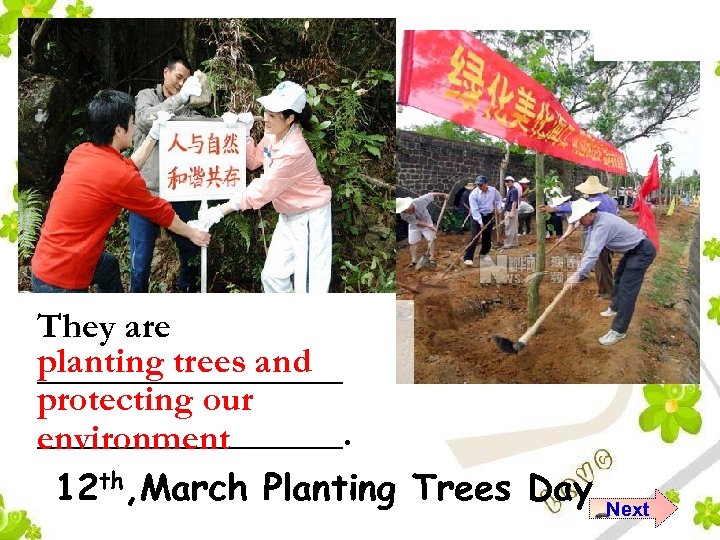
They are planting trees and _________ protecting our _________. environment 12 th, March Planting Trees Day Next
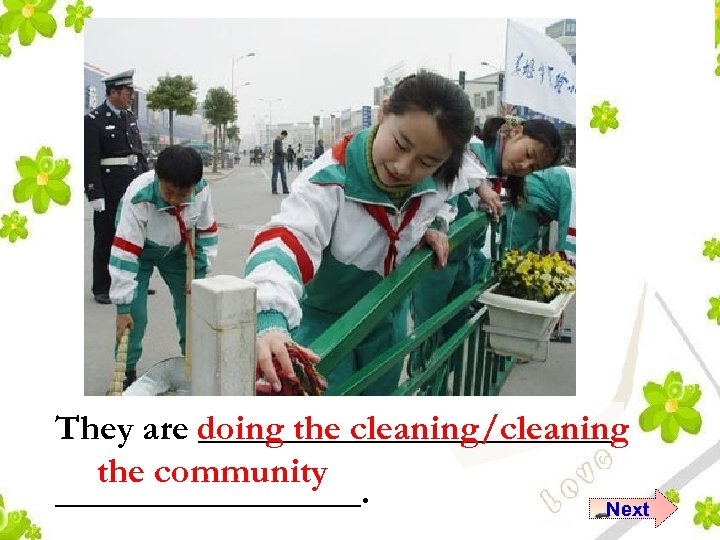
They are doing the cleaning/cleaning ____________ the community _________. Next
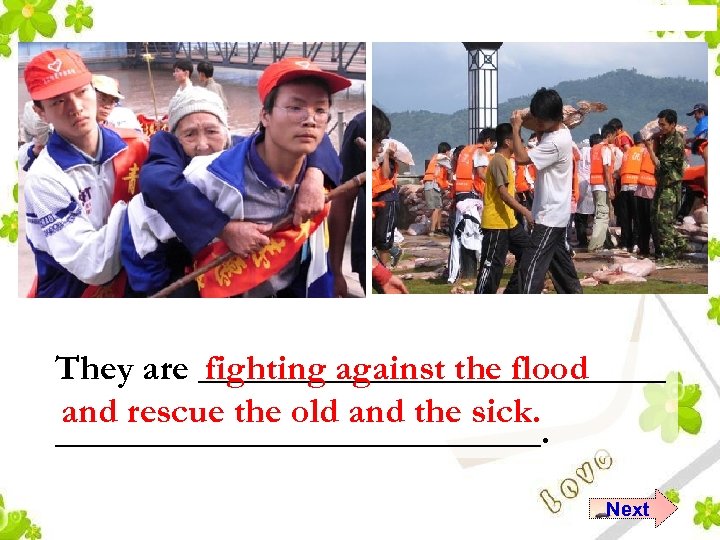
They are _____________ fighting against the flood and rescue the old and the sick. ______________. Next
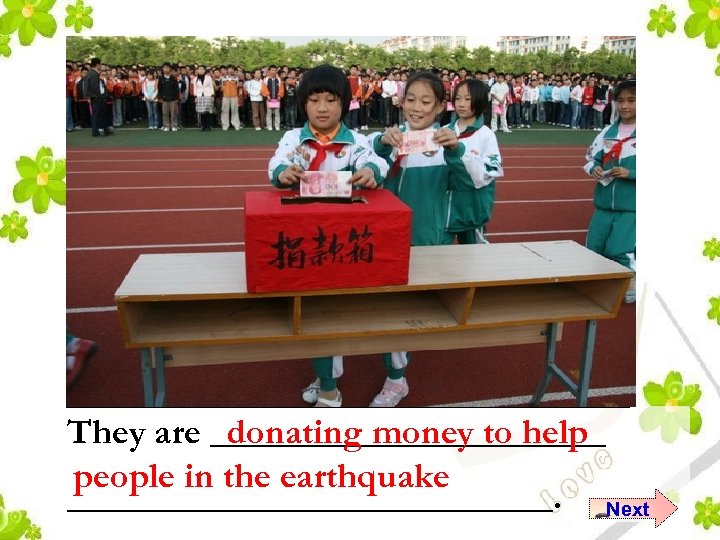
They are ___________ donating money to help people in the earthquake ______________. Next
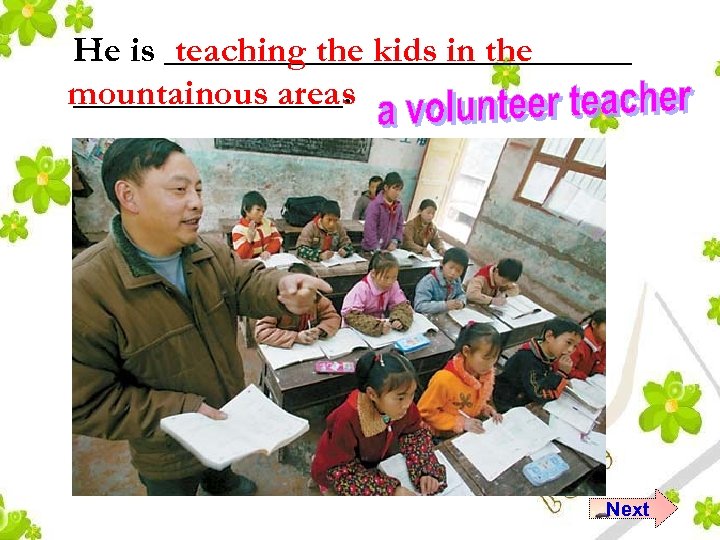
He is _____________ teaching the kids in the mountainous areas ________. Next
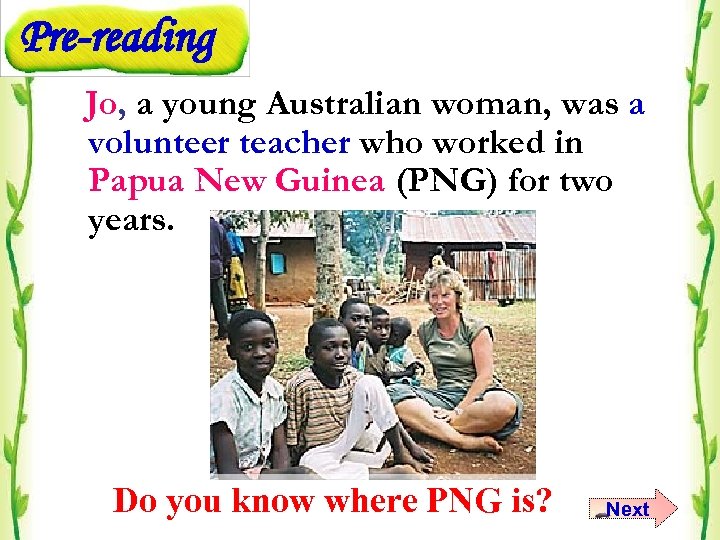
Pre-reading Jo, a young Australian woman, was a volunteer teacher who worked in Papua New Guinea (PNG) for two years. Do you know where PNG is? Next
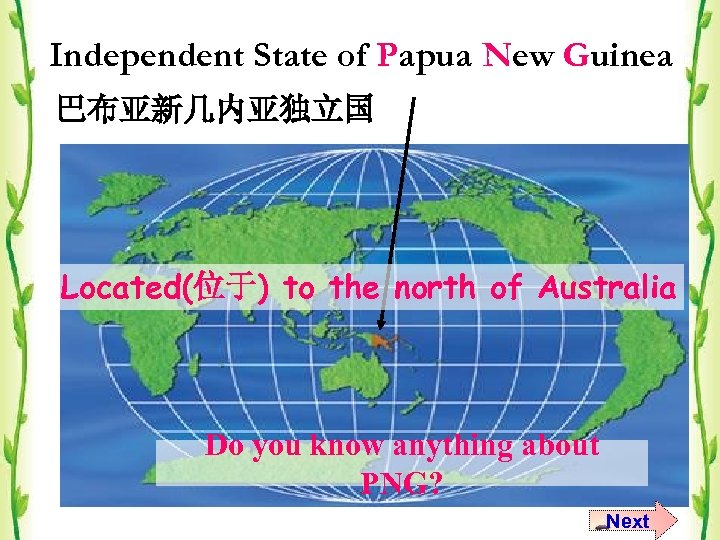
Independent State of Papua New Guinea 巴布亚新几内亚独立国 Located(位于) to the north of Australia Do you know anything about PNG? Next
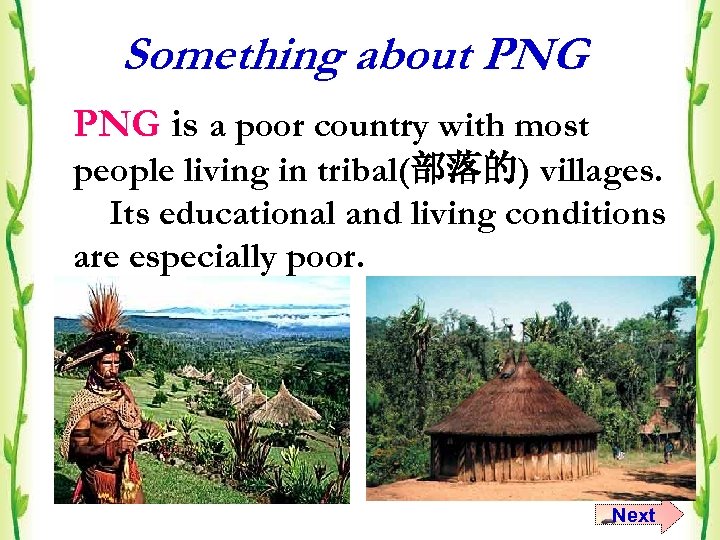
Something about PNG is a poor country with most people living in tribal(部落的) villages. Its educational and living conditions are especially poor. Next
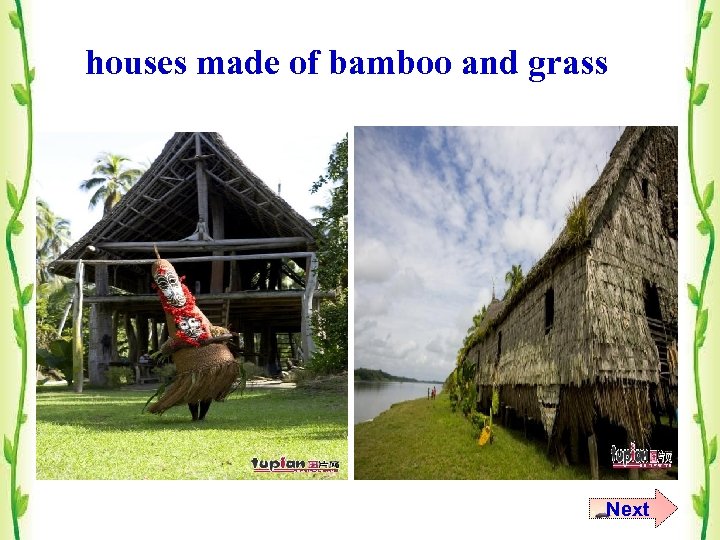
houses made of bamboo and grass Next
This following reading passage is an airmail (n. 航空邮件) from Jo, a volunteer teacher in PNG. Open it! Next
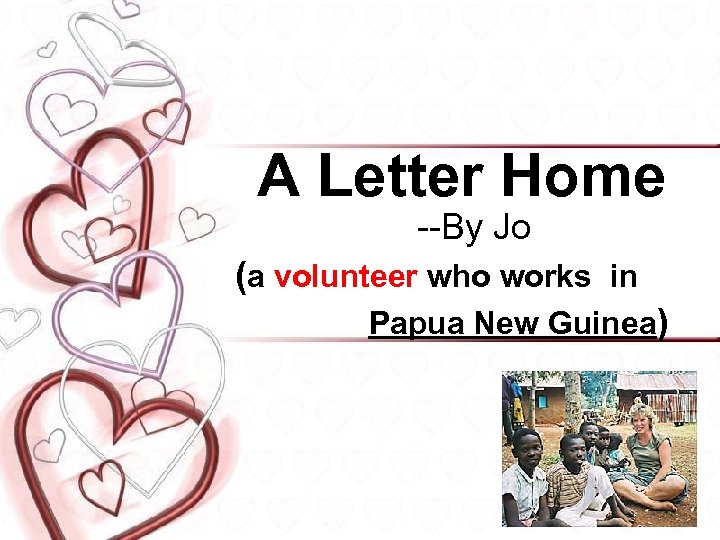
A Letter Home --By Jo (a volunteer who works in Papua New Guinea)
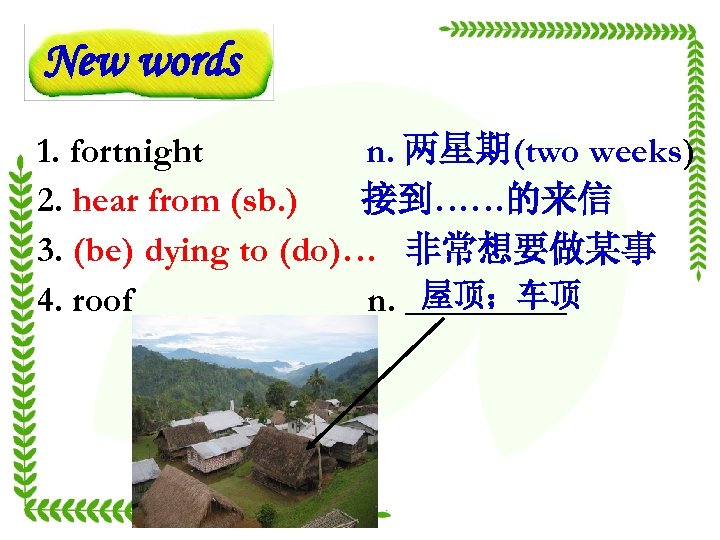
New words 1. fortnight n. 两星期(two weeks) 2. hear from (sb. ) 接到……的来信 3. (be) dying to (do)… 非常想要做某事 屋顶;车顶 4. roof n. _____
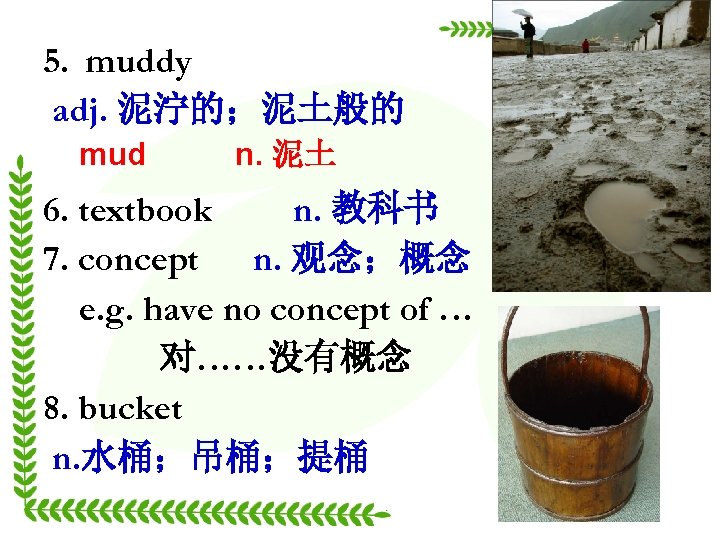
5. muddy adj. 泥泞的;泥土般的 mud n. 泥土 6. textbook n. 教科书 7. concept n. 观念;概念 e. g. have no concept of … 对……没有概念 8. bucket n. 水桶;吊桶;提桶
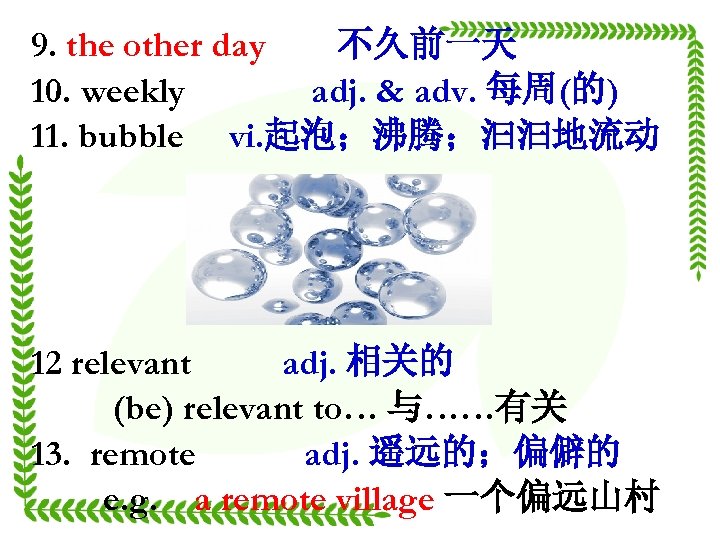
9. the other day 不久前一天 10. weekly adj. & adv. 每周(的) 11. bubble vi. 起泡;沸腾;汩汩地流动 12 relevant adj. 相关的 (be) relevant to… 与……有关 13. remote adj. 遥远的;偏僻的 e. g. a remote village 一个偏远山村
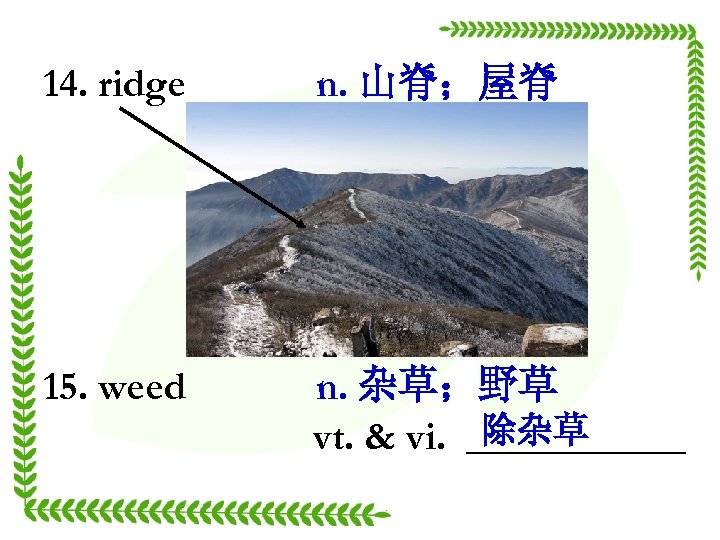
14. ridge n. 山脊;屋脊 15. weed n. 杂草;野草 除杂草 vt. & vi. ______
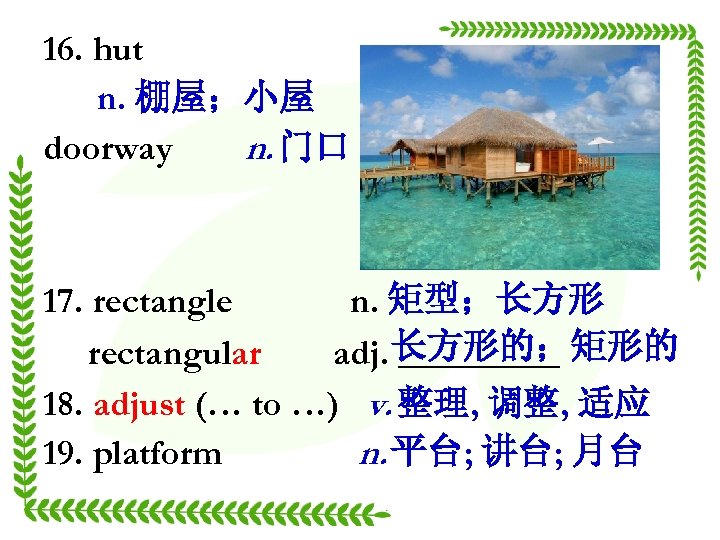
16. hut n. 棚屋;小屋 doorway n. 门口 17. rectangle n. 矩型;长方形 rectangular adj. 长方形的;矩形的 _____ 18. adjust (… to …) v. 整理, 调整, 适应 19. platform n. 平台; 讲台; 月台
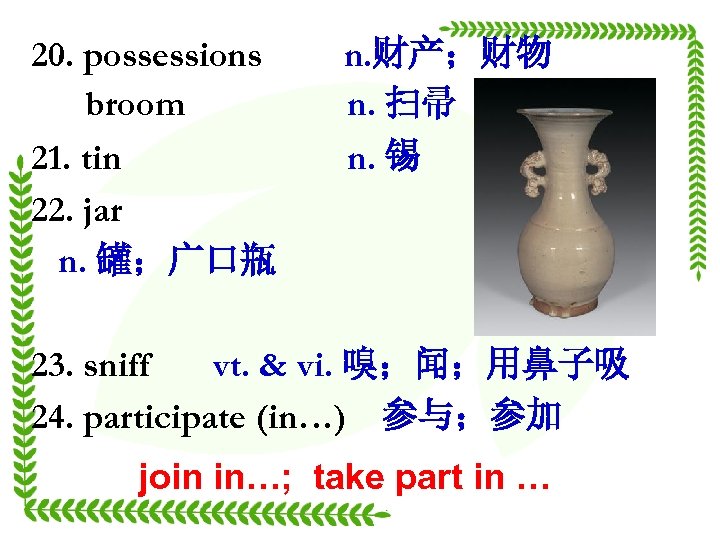
20. possessions broom 21. tin 22. jar n. 罐;广口瓶 n. 财产;财物 n. 扫帚 n. 锡 23. sniff vt. & vi. 嗅;闻;用鼻子吸 24. participate (in…) 参与;参加 join in…; take part in …
25. interpreter n. 作口译的人 26. grill n. 烤架; 大平底锅 27. dry out (使浸水等之物) 完全变干;干透 28. leftover n. 剩余物; 剩饭 29. evil adj. 邪恶的 n. 邪恶;罪恶 e. g. evil spirits 恶灵;妖魔鬼怪
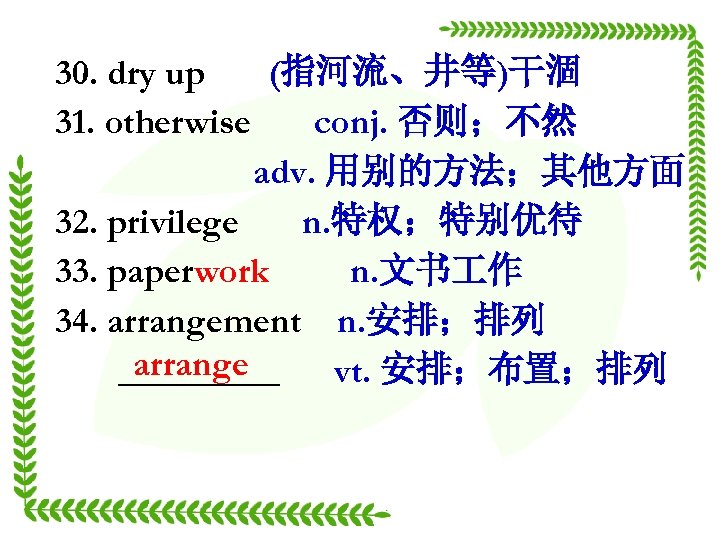
30. dry up (指河流、井等)干涸 31. otherwise conj. 否则;不然 adv. 用别的方法;其他方面 32. privilege n. 特权;特别优待 33. paperwork n. 文书 作 34. arrangement n. 安排;排列 arrange _____ vt. 安排;布置;排列
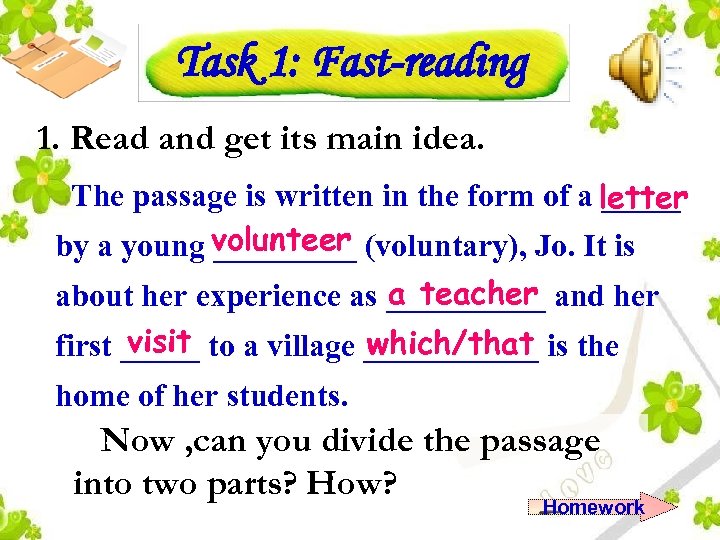
Task 1: Fast-reading 1. Read and get its main idea. The passage is written in the form of a letter _____ by a young volunteer (voluntary), Jo. It is _____ a teacher about her experience as _____ and her visit which/that first _____ to a village ______ is the home of her students. Now , can you divide the passage into two parts? How? Homework
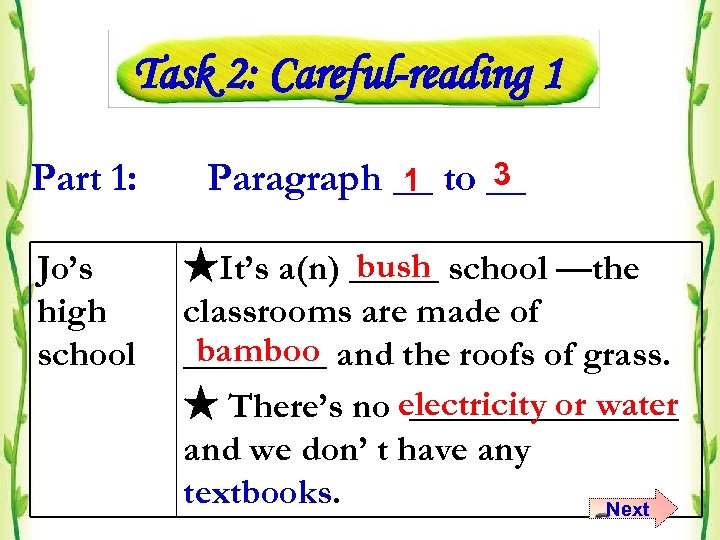
Task 2: Careful-reading 1 Part 1: Jo’s high school 3 Paragraph __ to __ 1 bush ★It’s a(n) _____ school —the classrooms are made of bamboo ____ and the roofs of grass. ★ There’s no electricity or water ________ and we don’ t have any textbooks. Next
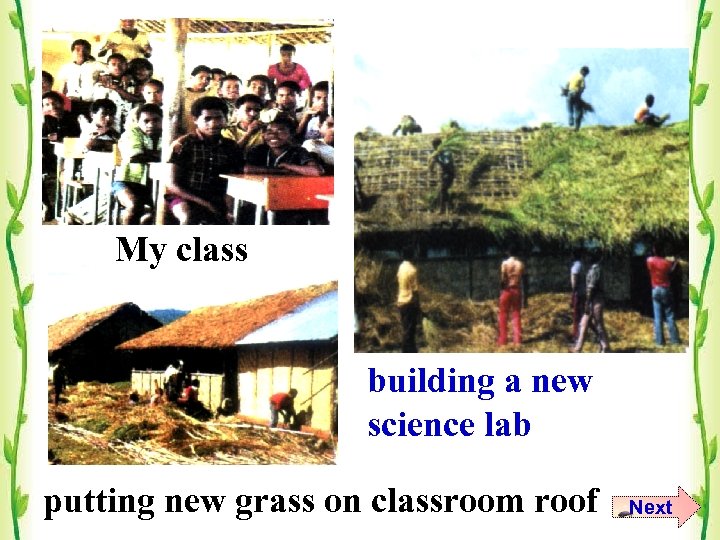
My class building a new science lab putting new grass on classroom roof Next
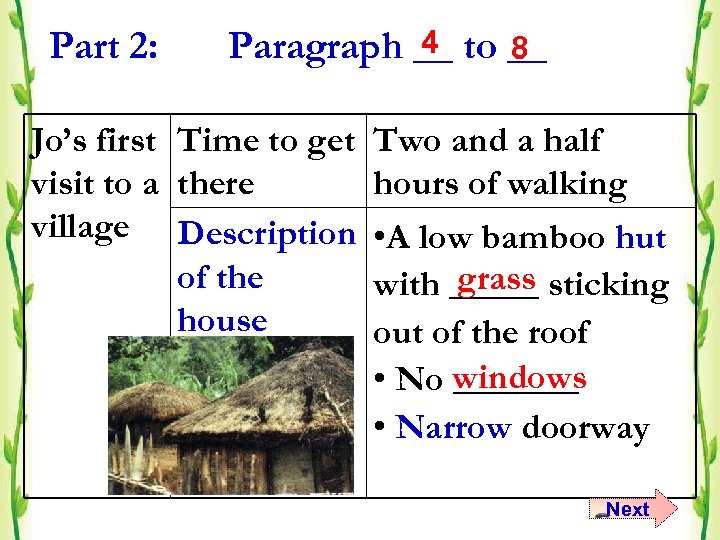
Part 2: 4 Paragraph __ to __ 8 Jo’s first Time to get visit to a there village Description of the house Two and a half hours of walking • A low bamboo hut grass with _____ sticking out of the roof • No windows _______ • Narrow doorway Next
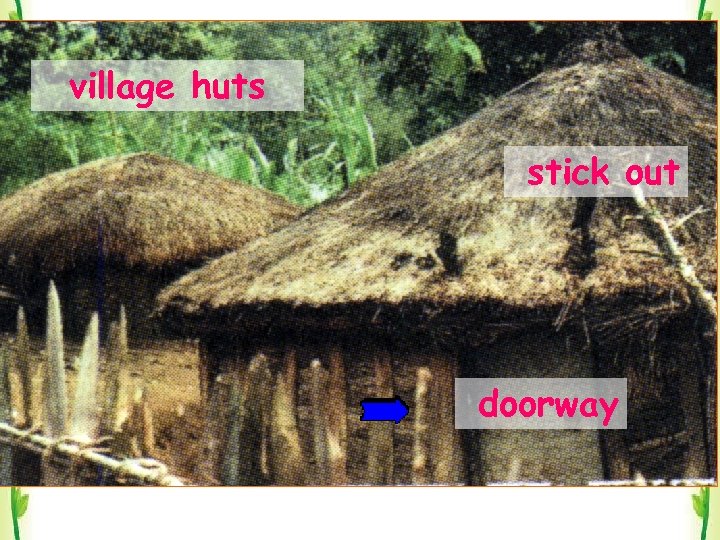
village huts stick out doorway
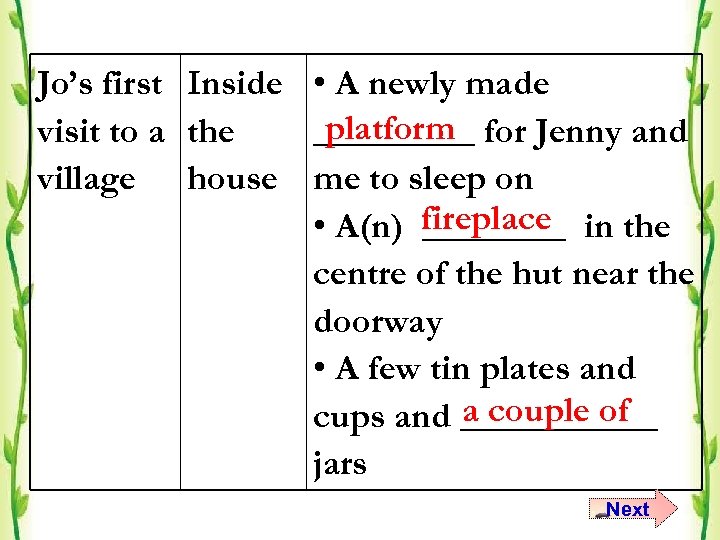
Jo’s first Inside • A newly made platform visit to a the _____ for Jenny and village house me to sleep on • A(n) fireplace in the ____ centre of the hut near the doorway • A few tin plates and a couple of cups and ______ jars Next
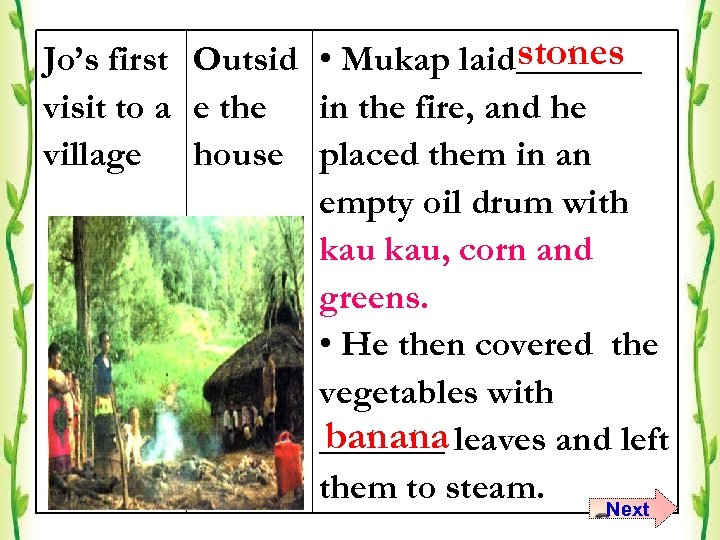
stones Jo’s first Outsid • Mukap laid_______ visit to a e the in the fire, and he village house placed them in an empty oil drum with kau, corn and greens. • He then covered the vegetables with banana _______ leaves and left them to steam. Next
Jo’s first Jo’s • very tired on her way visit to a feelings back home with her aching village muscle ______ and her knees shaking _______. Paragraph 8 • it was a(n) privilege ____ to have spent a day with Tombe’s family. Next
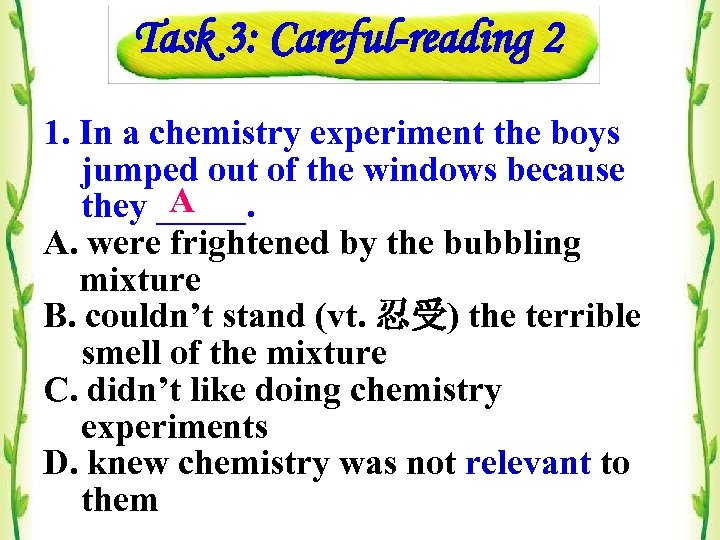
Task 3: Careful-reading 2 1. In a chemistry experiment the boys jumped out of the windows because A they _____. A. were frightened by the bubbling mixture B. couldn’t stand (vt. 忍受) the terrible smell of the mixture C. didn’t like doing chemistry experiments D. knew chemistry was not relevant to them
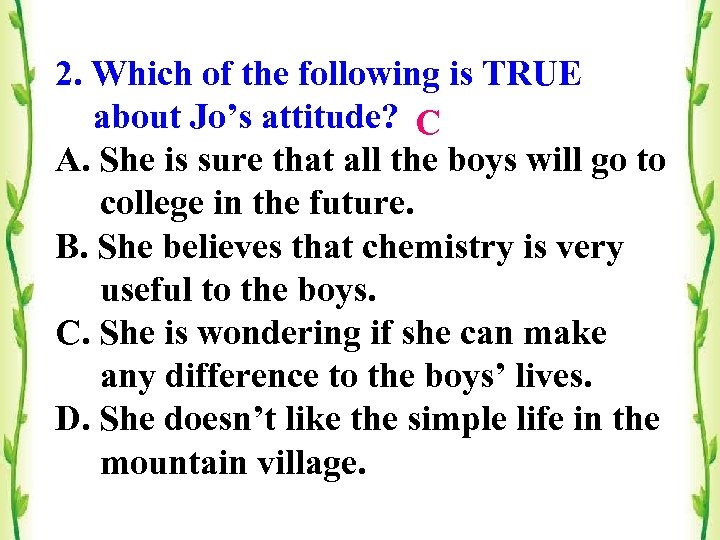
2. Which of the following is TRUE about Jo’s attitude? C A. She is sure that all the boys will go to college in the future. B. She believes that chemistry is very useful to the boys. C. She is wondering if she can make any difference to the boys’ lives. D. She doesn’t like the simple life in the mountain village.
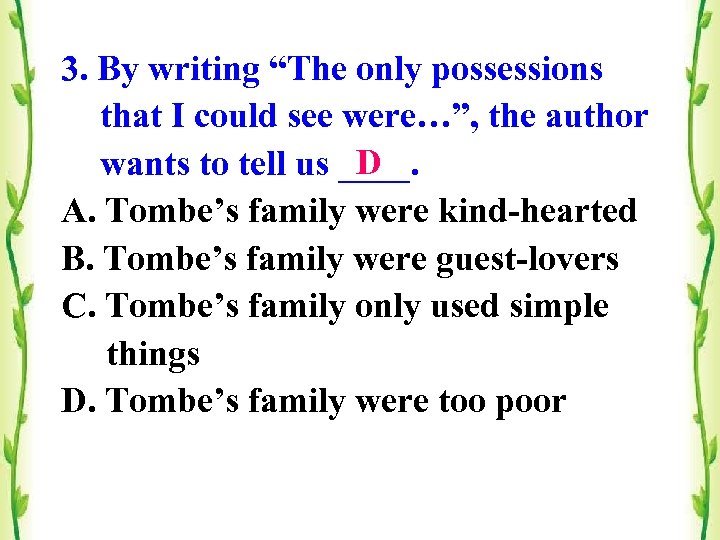
3. By writing “The only possessions that I could see were…”, the author D wants to tell us ____. A. Tombe’s family were kind-hearted B. Tombe’s family were guest-lovers C. Tombe’s family only used simple things D. Tombe’s family were too poor
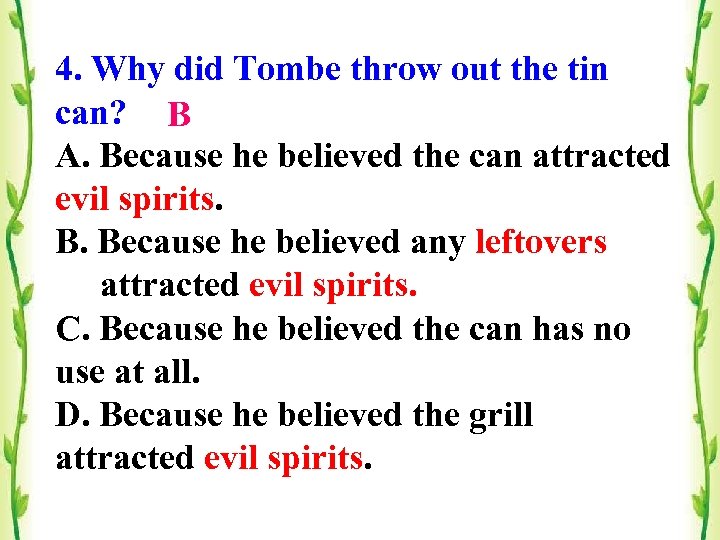
4. Why did Tombe throw out the tin can? B A. Because he believed the can attracted evil spirits. B. Because he believed any leftovers attracted evil spirits. C. Because he believed the can has no use at all. D. Because he believed the grill attracted evil spirits.
5. How did Jo feel after the visit to Tombe’s family? A A. Happy B. Sad C. Worried D. Upset
写作目的题: 6. The purpose that the author wrote the A letter is that ___. A. she wanted to tell Rosemary her B. teaching life in the high school. B. she wanted to tell Rosemary her learning life in the high school. C. she wanted to tell Rosemary that she couldn’t get any money by teaching the poor students D. she wanted to tell Rosemary how happy she was in the small village. Homework
Post-reading Discussion From the text we know that Jo worked as a volunteer teacher in a poor area. Did she enjoy her life there? Q: Would you like to work as a volunteer teacher as Jo ? Why? • Why would you …? • Because I want to share… with others/ … Next • The reason is that …
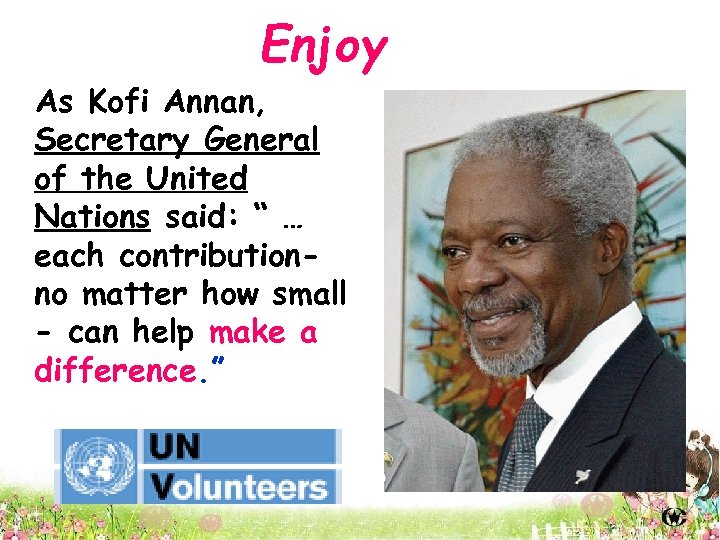
Enjoy As Kofi Annan, Secretary General of the United Nations said: “ … each contributionno matter how small - can help make a difference. ”
Homework 1. Finish Exercise 2 on Page 32. 2. Read the passage again after class and find all the attributive clauses(定 语从句) in it.
Скачать презентацию A proverb to enjoy Roses given fragrance in
ed8cc2c21876694af01912053c1897b5.ppt