


 Скачать презентацию A Prosperous Way Down Principles and Policies
0502611f0a42a4ce16620a47ab8fca9c.ppt
- Количество слайдов: 26
 A Prosperous Way Down Principles and Policies
 Presentation by Betty Odum Gainesville, Florida IV Biennial International Workshop Advances in Energy Studies Ecology-Energy issues in Latin-America Universidade Estadual de Campinas, São Paulo, Brazil June 15 -19, 2004
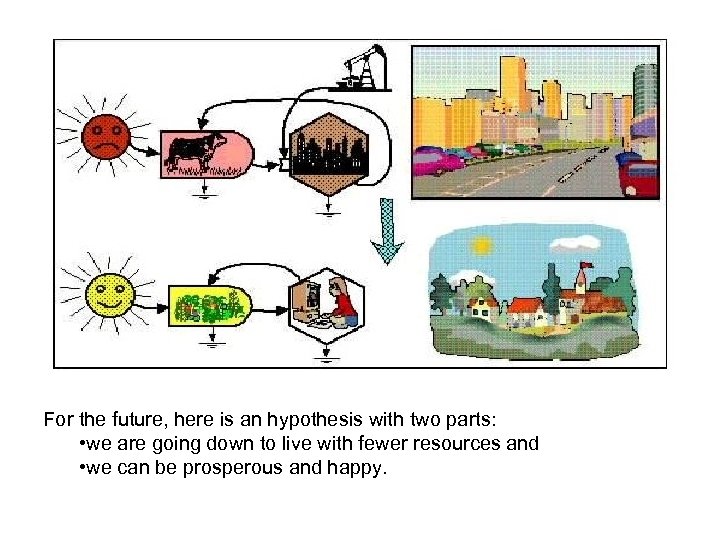 For the future, here is an hypothesis with two parts: • we are going down to live with fewer resources and • we can be prosperous and happy.
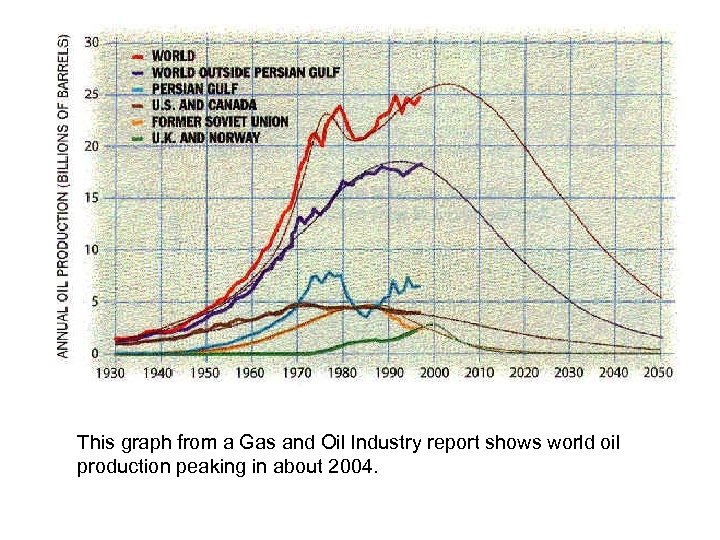 This graph from a Gas and Oil Industry report shows world oil production peaking in about 2004.
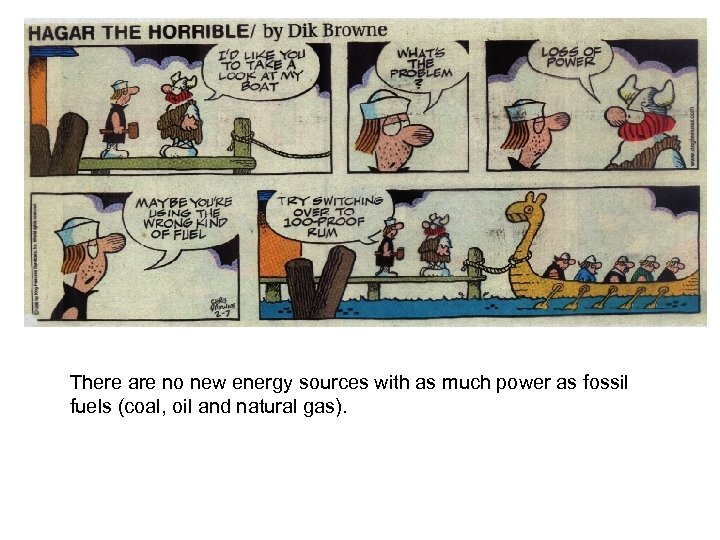 There are no new energy sources with as much power as fossil fuels (coal, oil and natural gas).
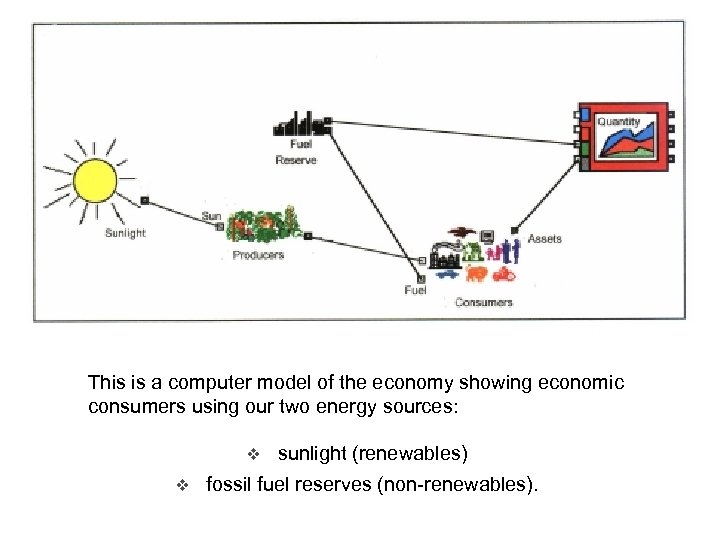 This is a computer model of the economy showing economic consumers using our two energy sources: v sunlight (renewables) v fossil fuel reserves (non-renewables).
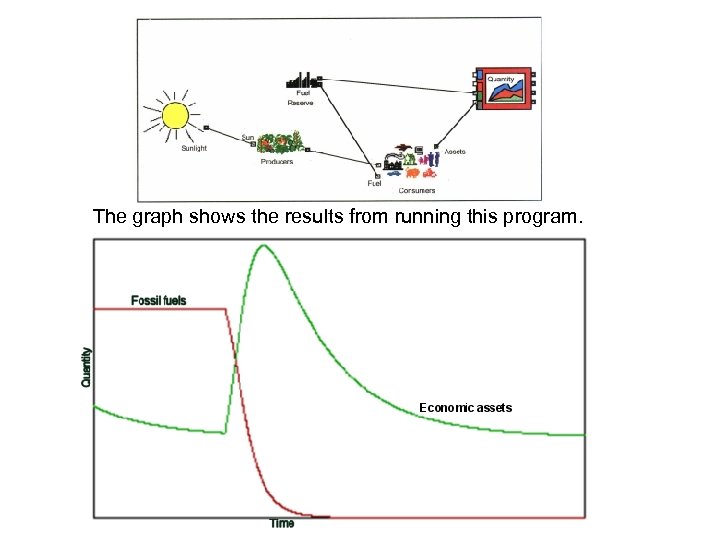 The graph shows the results from running this program.
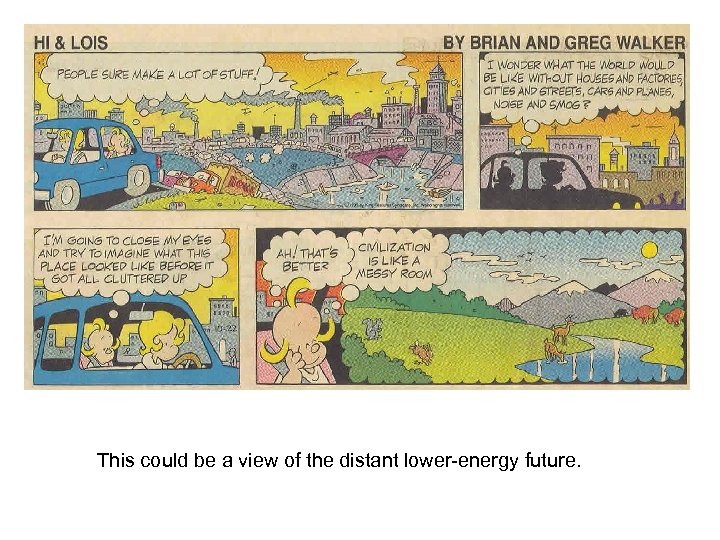 This could be a view of the distant lower-energy future.
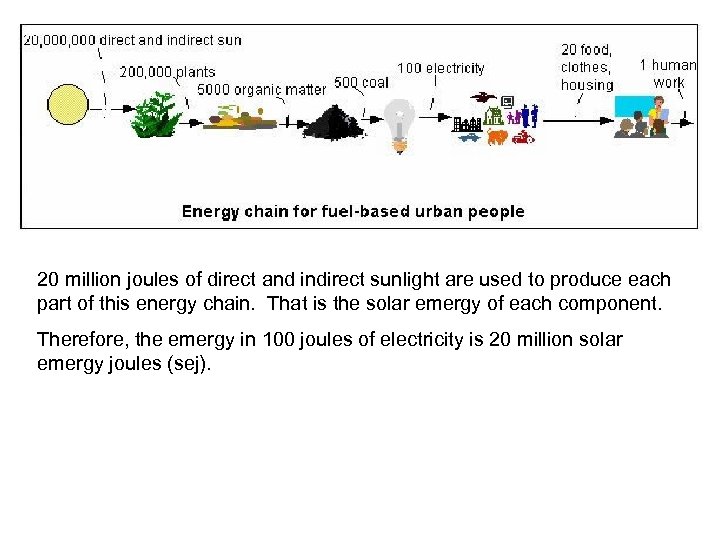 20 million joules of direct and indirect sunlight are used to produce each part of this energy chain. That is the solar emergy of each component. Therefore, the emergy in 100 joules of electricity is 20 million solar emergy joules (sej).
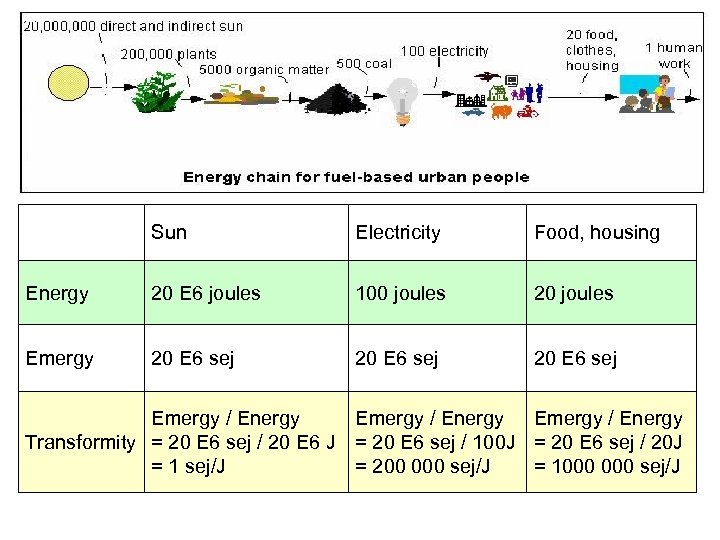 Sun Electricity Food, housing Energy 20 E 6 joules 100 joules 20 joules Emergy 20 E 6 sej Emergy / Energy Transformity = 20 E 6 sej / 20 E 6 J = 20 E 6 sej / 100 J = 20 E 6 sej / 20 J = 1 sej/J = 200 000 sej/J = 1000 sej/J
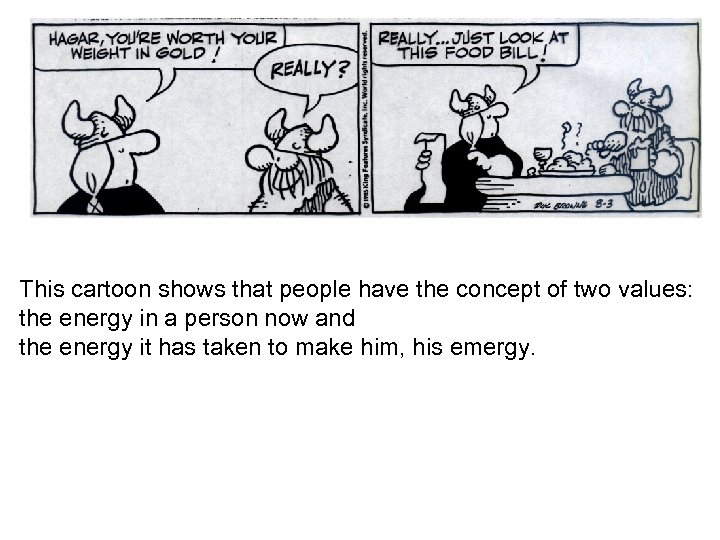 This cartoon shows that people have the concept of two values: the energy in a person now and the energy it has taken to make him, his emergy.
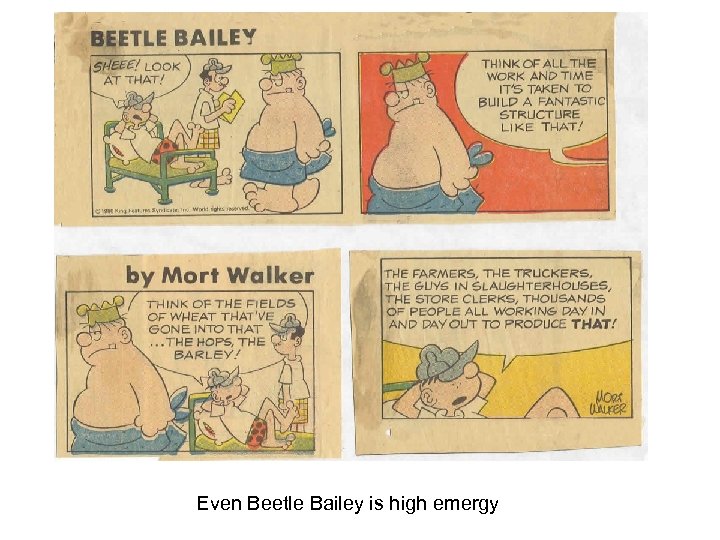 Even Beetle Bailey is high emergy
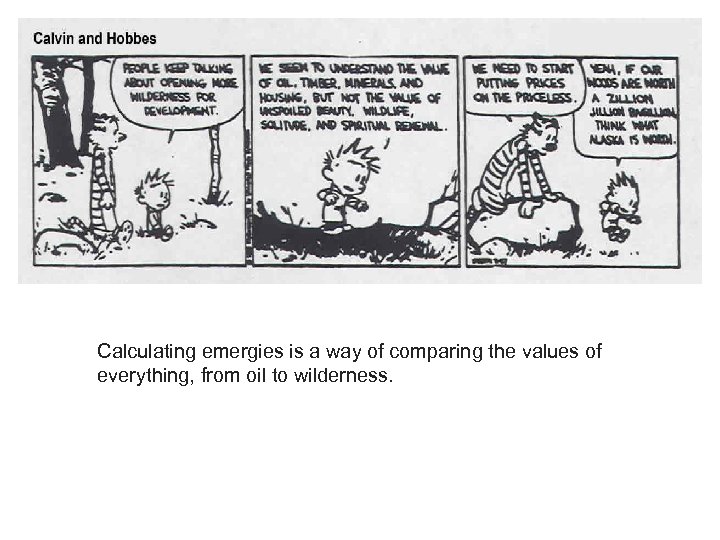 Calculating emergies is a way of comparing the values of everything, from oil to wilderness.
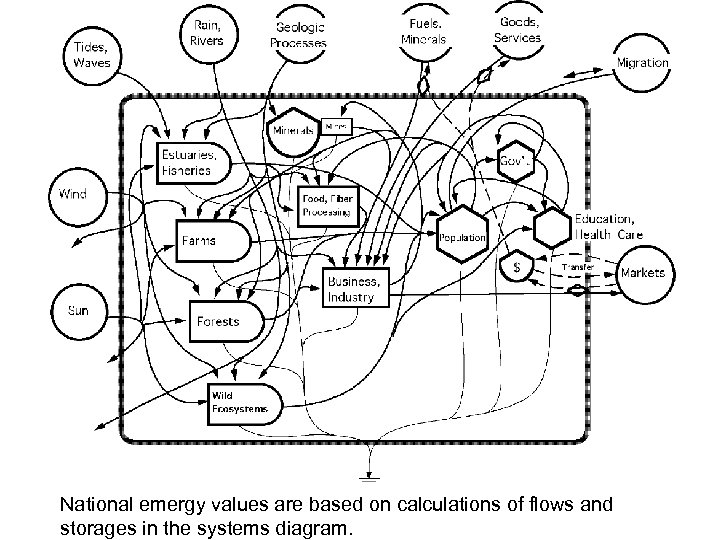 National emergy values are based on calculations of flows and storages in the systems diagram.
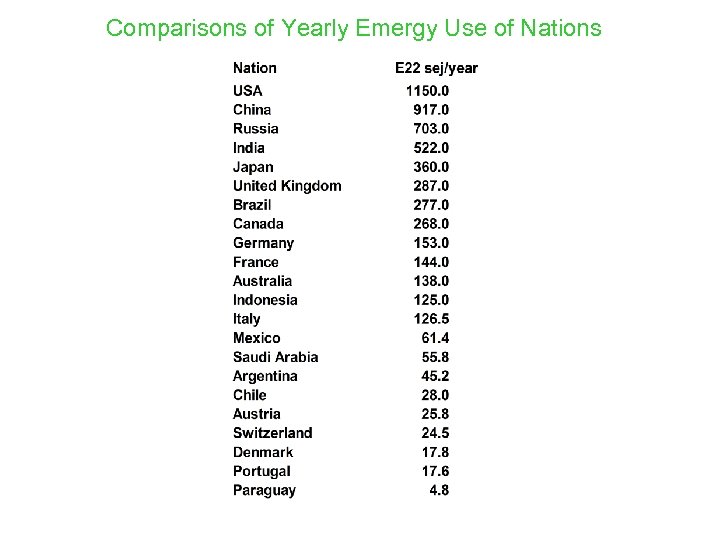 Comparisons of Yearly Emergy Use of Nations
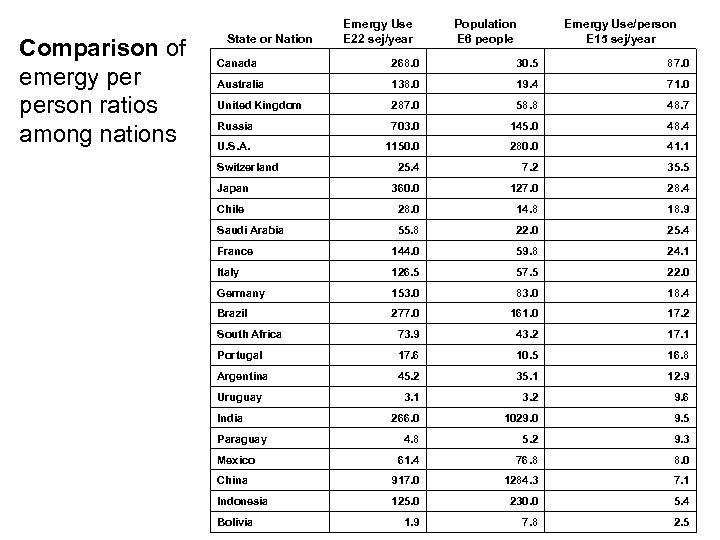 Comparison of emergy person ratios among nations State or Nation Emergy Use E 22 sej/year Population E 6 people Emergy Use/person E 15 sej/year Canada 268. 0 30. 5 87. 0 Australia 138. 0 19. 4 71. 0 United Kingdom 287. 0 58. 8 48. 7 Russia 703. 0 145. 0 48. 4 U. S. A. 1150. 0 280. 0 41. 1 25. 4 7. 2 35. 5 Japan 360. 0 127. 0 28. 4 Chile 28. 0 14. 8 18. 9 Saudi Arabia 55. 8 22. 0 25. 4 France 144. 0 59. 8 24. 1 Italy 126. 5 57. 5 22. 0 Germany 153. 0 83. 0 18. 4 Brazil 277. 0 161. 0 17. 2 South Africa 73. 9 43. 2 17. 1 Portugal 17. 6 10. 5 16. 8 Argentina 45. 2 35. 1 12. 9 3. 1 3. 2 9. 6 266. 0 1029. 0 9. 5 4. 8 5. 2 9. 3 61. 4 76. 8 8. 0 China 917. 0 1284. 3 7. 1 Indonesia 125. 0 230. 0 5. 4 1. 9 7. 8 2. 5 Switzerland Uruguay India Paraguay Mexico Bolivia
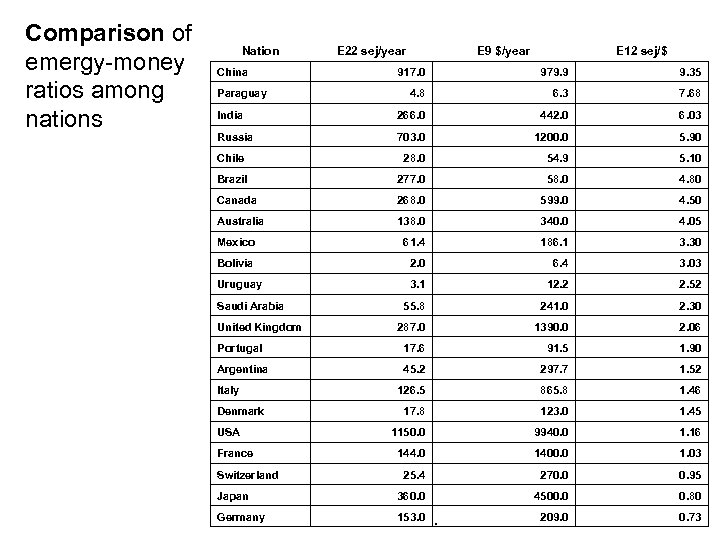 Comparison of emergy-money ratios among nations Nation China E 22 sej/year E 9 $/year E 12 sej/$ 917. 0 979. 9 9. 35 4. 8 6. 3 7. 68 India 266. 0 442. 0 6. 03 Russia 703. 0 1200. 0 5. 90 Chile 28. 0 54. 9 5. 10 Brazil 277. 0 58. 0 4. 80 Canada 268. 0 599. 0 4. 50 Australia 138. 0 340. 0 4. 05 Mexico 61. 4 186. 1 3. 30 Bolivia 2. 0 6. 4 3. 03 Uruguay 3. 1 12. 2 2. 52 55. 8 241. 0 2. 30 287. 0 1390. 0 2. 06 Portugal 17. 6 91. 5 1. 90 Argentina 45. 2 297. 7 1. 52 126. 5 865. 8 1. 46 17. 8 123. 0 1. 45 1150. 0 9940. 0 1. 16 144. 0 1400. 0 1. 03 25. 4 270. 0 0. 95 Japan 360. 0 4500. 0 0. 80 Germany 153. 0 209. 0 0. 73 Paraguay Saudi Arabia United Kingdom Italy Denmark USA France Switzerland . .
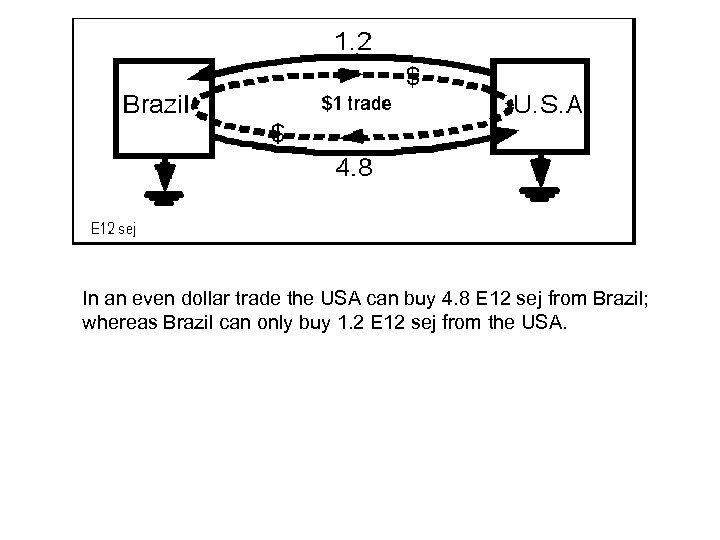 In an even dollar trade the USA can buy 4. 8 E 12 sej from Brazil; whereas Brazil can only buy 1. 2 E 12 sej from the USA.
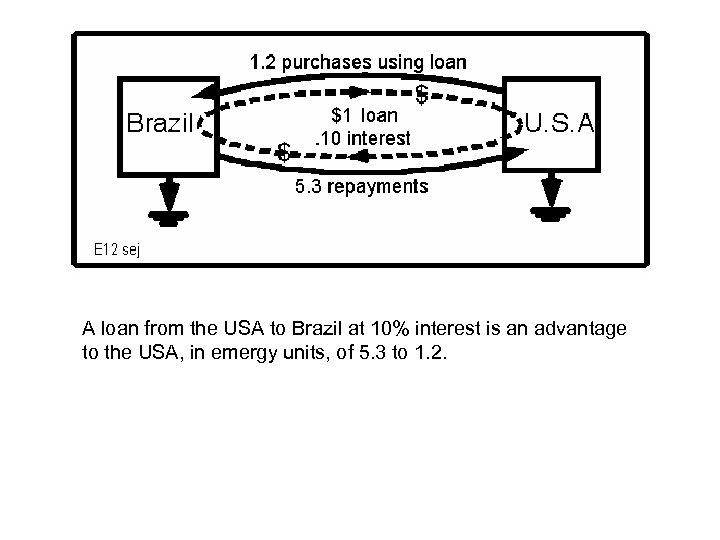 A loan from the USA to Brazil at 10% interest is an advantage to the USA, in emergy units, of 5. 3 to 1. 2.
 How can we achieve equitable world trade?
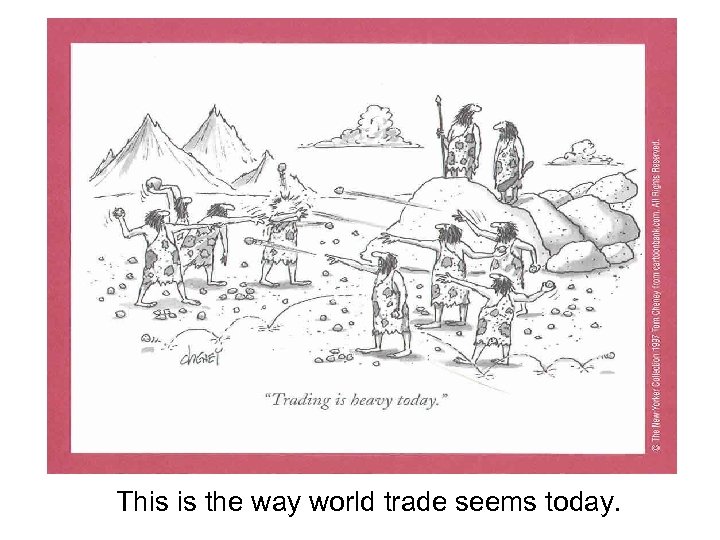 This is the way world trade seems today.
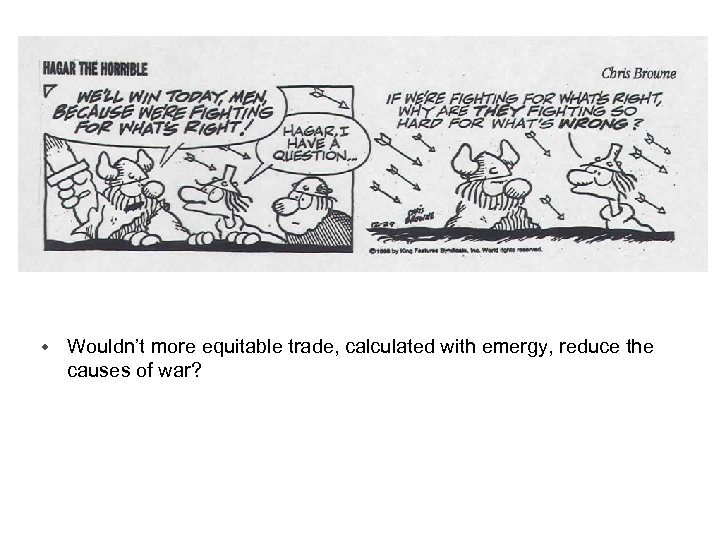 w Wouldn’t more equitable trade, calculated with emergy, reduce the causes of war?
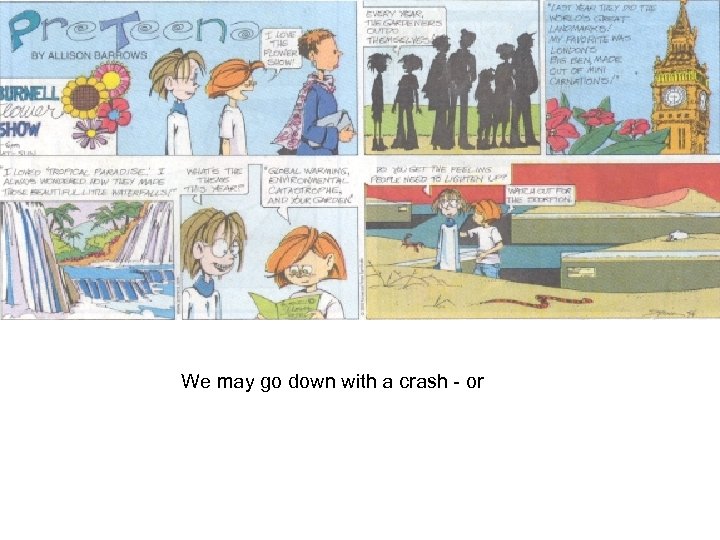 We may go down with a crash - or
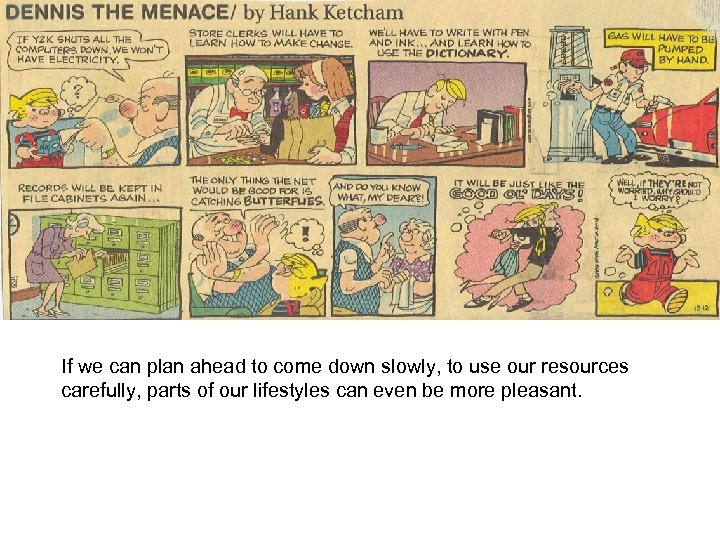 If we can plan ahead to come down slowly, to use our resources carefully, parts of our lifestyles can even be more pleasant.
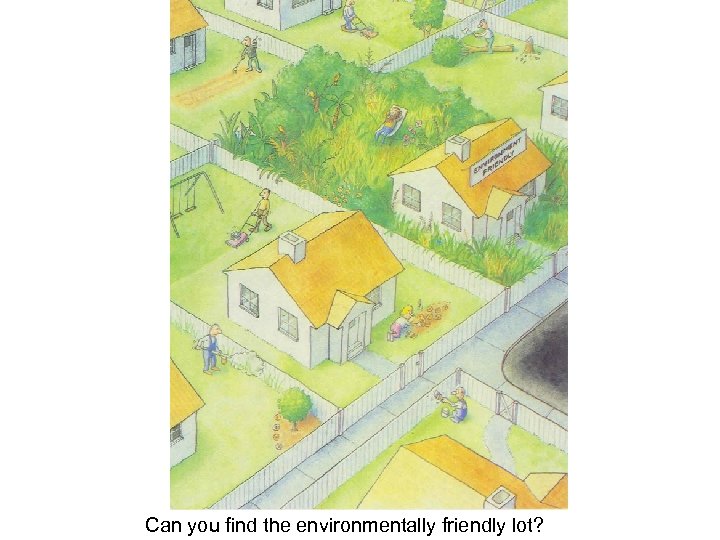 Can you find the environmentally friendly lot?
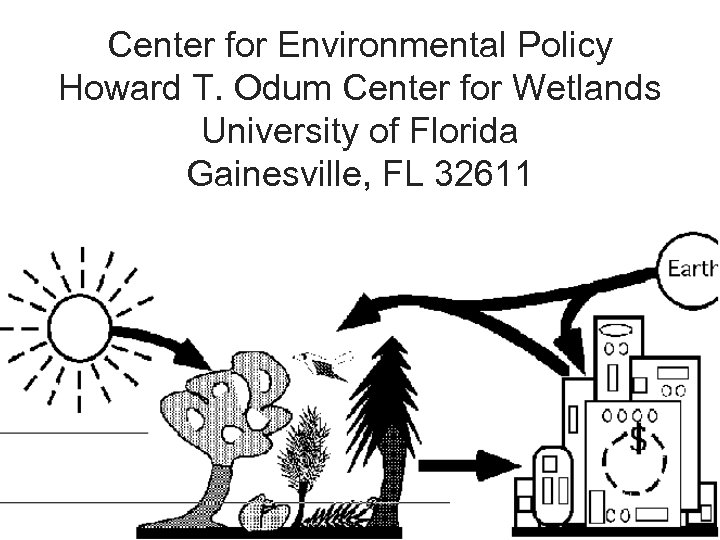 Center for Environmental Policy Howard T. Odum Center for Wetlands University of Florida Gainesville, FL 32611