 Скачать презентацию A Proposal for Caribbean-Wide Land Cover Use Mapping U
f4a840142161db6b3d9ef3a0d1969fad.ppt
- Количество слайдов: 28



A Proposal for Caribbean-Wide Land Cover/Use Mapping U. S. Geological Survey National Mapping Division EROS Data Center
Developing a Regional Planning Framework for Biodiversity Conservation, Disaster Preparedness, and Economic and Agricultural Development In the Insular Caribbean A Proposal funded by the USAID Caribbean Regional Office & supported by FAO, NASA The Nature Conservancy International Conservation Program Conservation Science Department U. S. Forest Service International Institute of Tropical Forestry U. S. Geological Survey EROS Data Center
WHY make Consistent Land Cover/Use Products for the Caribbean? § To respond to Strategic Objective 2 of the Caribbean Regional Program Strategy (USAID, 2000): “Environmental Management – Improved environmental management by public and private entities” § To enable integrated environmental and economic planning by: § providing improved access to information for regional and inregion planners and other stakeholders, § bringing the spatial dimension to the development of best practices, and § developing national capacity and management resources in an integrated and cooperative regional framework.
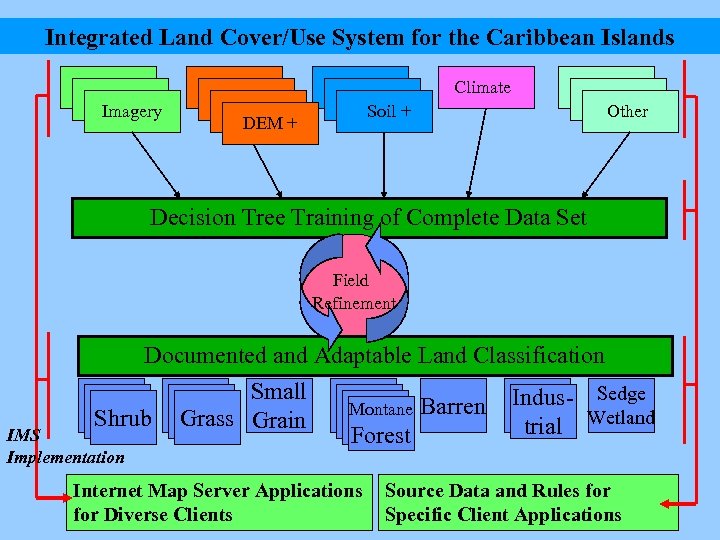
Integrated Land Cover/Use System for the Caribbean Islands DEM Imagery DEM + Soil + Climate Other Decision Tree Training of Complete Data Set Field Refinement Documented and Adaptable Land Classification Shrub IMS Implementation Small Grass Grain Montane Forest Internet Map Server Applications for Diverse Clients Barren Indus- Sedge trial Wetland Source Data and Rules for Specific Client Applications
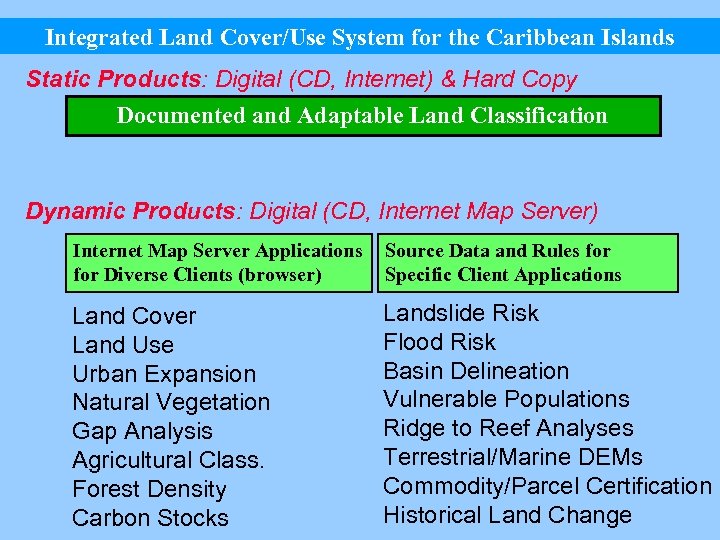
Integrated Land Cover/Use System for the Caribbean Islands Static Products: Digital (CD, Internet) & Hard Copy Documented and Adaptable Land Classification Dynamic Products: Digital (CD, Internet Map Server) Internet Map Server Applications for Diverse Clients (browser) Source Data and Rules for Specific Client Applications Land Cover Land Use Urban Expansion Natural Vegetation Gap Analysis Agricultural Class. Forest Density Carbon Stocks Landslide Risk Flood Risk Basin Delineation Vulnerable Populations Ridge to Reef Analyses Terrestrial/Marine DEMs Commodity/Parcel Certification Historical Land Change
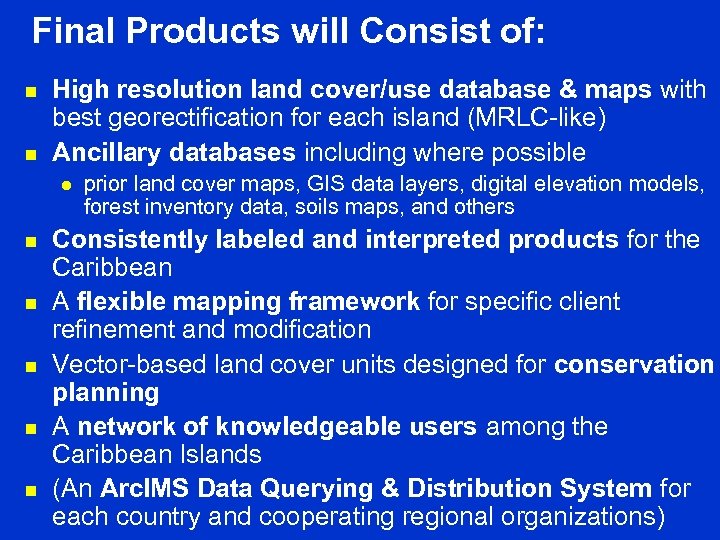
Final Products will Consist of: n n High resolution land cover/use database & maps with best georectification for each island (MRLC-like) Ancillary databases including where possible l n n n prior land cover maps, GIS data layers, digital elevation models, forest inventory data, soils maps, and others Consistently labeled and interpreted products for the Caribbean A flexible mapping framework for specific client refinement and modification Vector-based land cover units designed for conservation planning A network of knowledgeable users among the Caribbean Islands (An Arc. IMS Data Querying & Distribution System for each country and cooperating regional organizations)
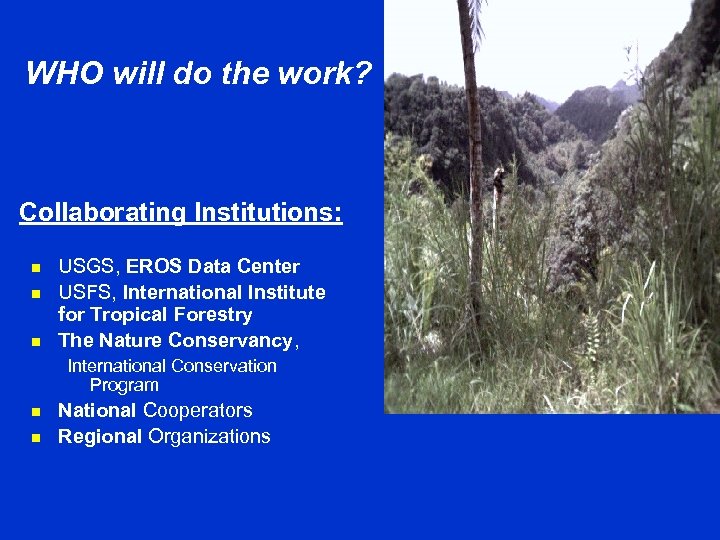
WHO will do the work? Collaborating Institutions: n n n USGS, EROS Data Center USFS, International Institute for Tropical Forestry The Nature Conservancy, International Conservation Program n n National Cooperators Regional Organizations
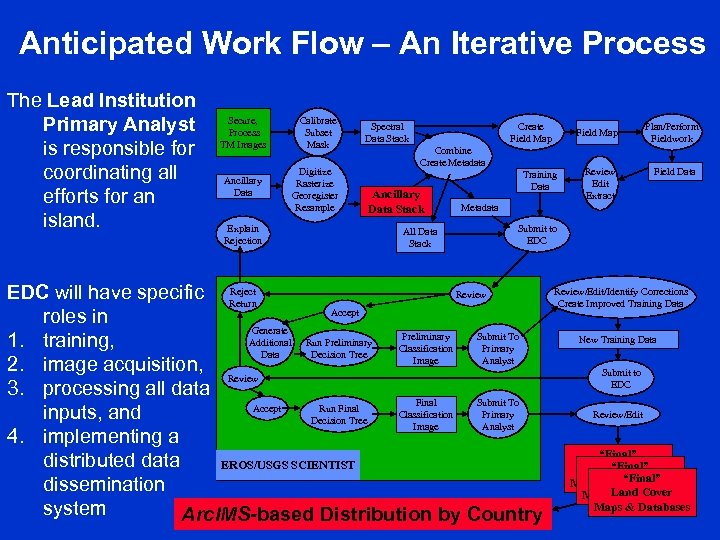
Anticipated Work Flow – An Iterative Process The Lead Institution Primary Analyst is responsible for coordinating all efforts for an island. Secure, Process TM Images Ancillary Data Explain Rejection Calibrate Subset Mask Digitize Rasterize Georegister Resample Create Field Map Spectral Data Stack Field Map Combine Create Metadata Ancillary Data Stack All Data Stack Training Data Review Edit Extract Plan/Perform Fieldwork Field Data Metadata Submit to EDC Reject Review EDC will have specific Return Accept roles in Generate Submit To Preliminary Additional Run Preliminary 1. training, Primary Classification Decision Tree Data Image Analyst 2. image acquisition, Review 3. processing all data Submit To Final Run Final Accept Primary Classification inputs, and Decision Tree Image Analyst 4. implementing a distributed data EROS/USGS SCIENTIST dissemination system Arc. IMS-based Distribution by Country Review/Edit/Identify Corrections Create Improved Training Data New Training Data Submit to EDC Review/Edit “Final” Land Cover “Final” Maps Land Cover & Databases Maps & Databases
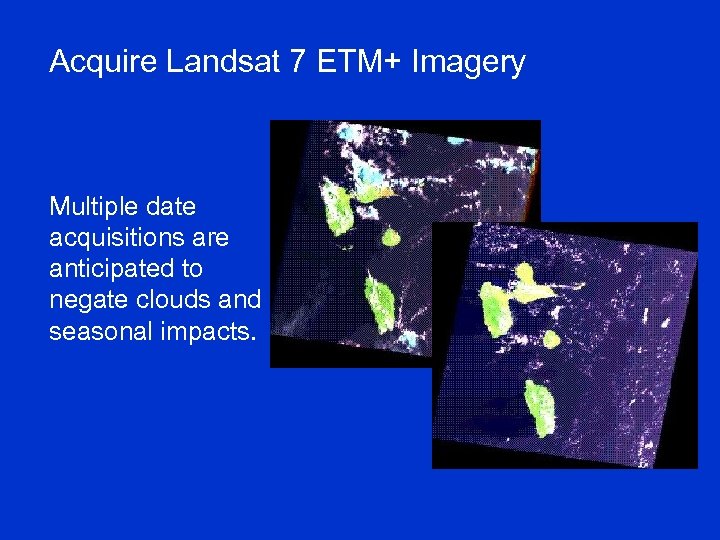
Acquire Landsat 7 ETM+ Imagery Multiple date acquisitions are anticipated to negate clouds and seasonal impacts.
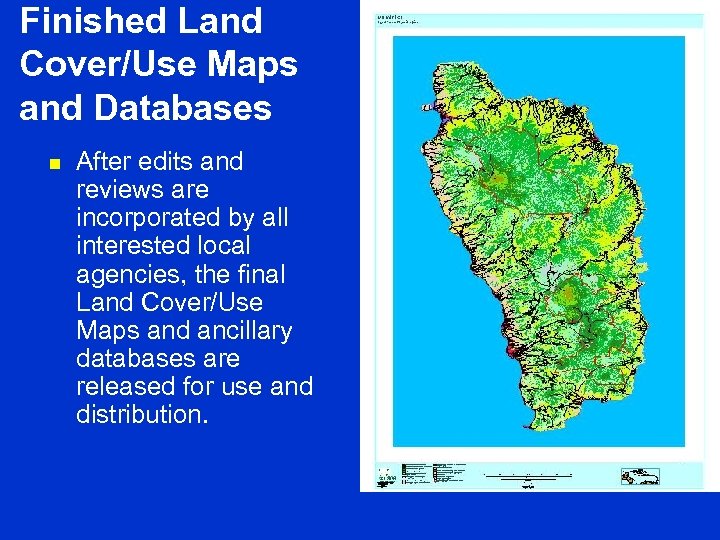
Finished Land Cover/Use Maps and Databases n After edits and reviews are incorporated by all interested local agencies, the final Land Cover/Use Maps and ancillary databases are released for use and distribution.
Distribution of Products n n n Complete data set to collaborators and each island. Digital versions on CDs with convenient interface. A Caribbean web site for information and down load. Data for a Caribbean Digital Atlas. Source data available from web sites, collaborators and others.

Multiple Product Benefits -National Planning/Management -Natural Resource Monitoring -Regional Assessments and Planning -Smallholder Development -Public Relations, Advertising, and Tourism -Personal Networking Premium Value for Banana Certification
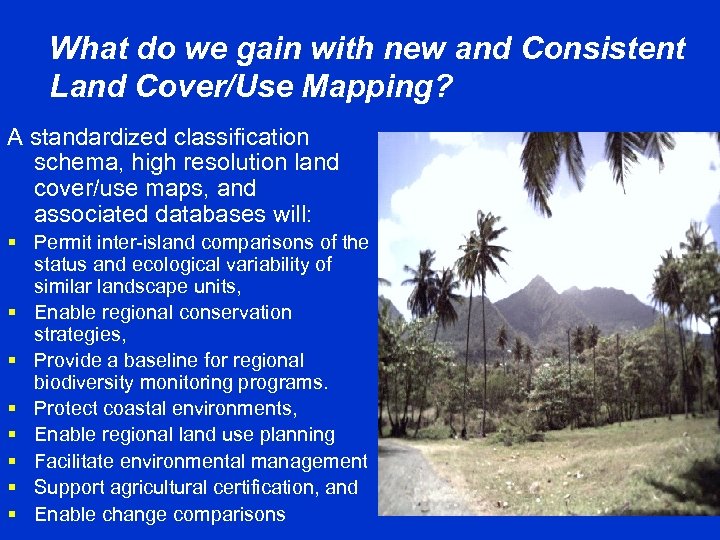
What do we gain with new and Consistent Land Cover/Use Mapping? A standardized classification schema, high resolution land cover/use maps, and associated databases will: § Permit inter-island comparisons of the status and ecological variability of similar landscape units, § Enable regional conservation strategies, § Provide a baseline for regional biodiversity monitoring programs. § Protect coastal environments, § Enable regional land use planning § Facilitate environmental management § Support agricultural certification, and § Enable change comparisons
Don’t Land Cover/Use Maps Already Exist? Although maps of “vegetation” exist for many of the individual Caribbean islands, these are often: § § § out of date, erroneous, lacking information, frequently too coarse, both spatially and in classification, for many practical applications, unsuitable for diverse client needs, i. e. too categoric non-standardized in both classification and methodology, not integrated with ancillary databases, not incorporated in integrated applications, not in a framework that promotes upgrading and refinement not available to a general group of users via browsers, and not integrated into an Internet Mapping System
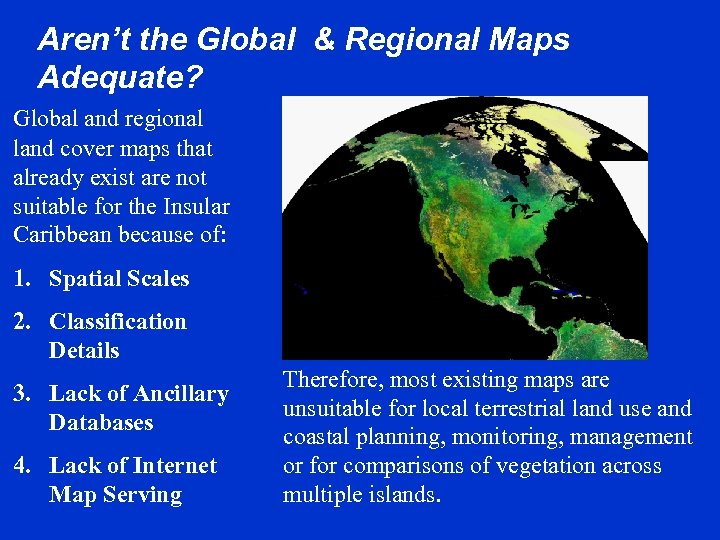
Aren’t the Global & Regional Maps Adequate? Global and regional land cover maps that already exist are not suitable for the Insular Caribbean because of: 1. Spatial Scales 2. Classification Details 3. Lack of Ancillary Databases 4. Lack of Internet Map Serving Therefore, most existing maps are unsuitable for local terrestrial land use and coastal planning, monitoring, management or for comparisons of vegetation across multiple islands.
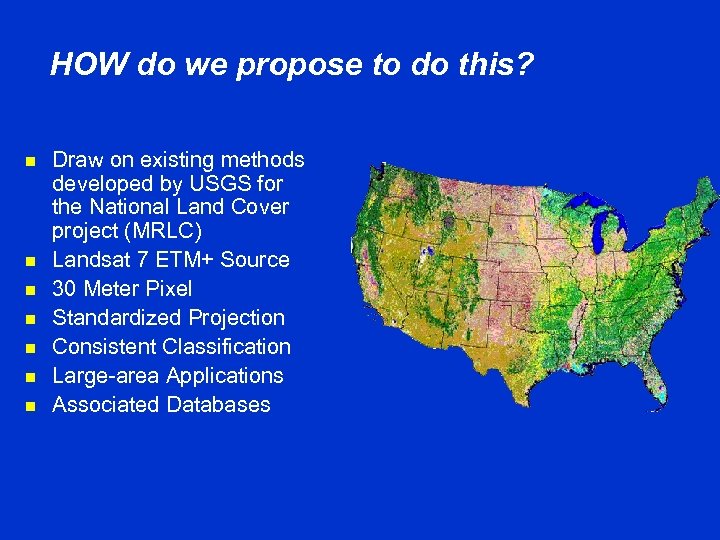
HOW do we propose to do this? n n n n Draw on existing methods developed by USGS for the National Land Cover project (MRLC) Landsat 7 ETM+ Source 30 Meter Pixel Standardized Projection Consistent Classification Large-area Applications Associated Databases
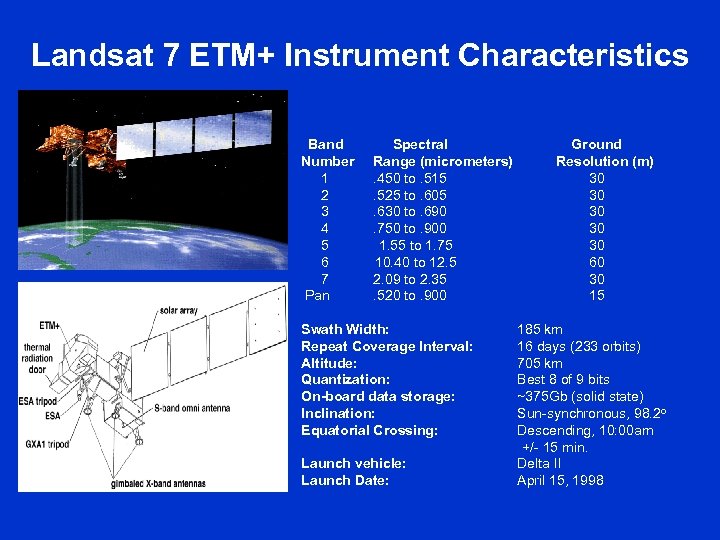
Landsat 7 ETM+ Instrument Characteristics Band Spectral Number Range (micrometers) 1 . 450 to. 515 2. 525 to. 605 3. 630 to. 690 4. 750 to. 900 5 1. 55 to 1. 75 6 10. 40 to 12. 5 7 2. 09 to 2. 35 Pan . 520 to. 900 Ground Resolution (m) 30 30 30 60 30 15 Swath Width: 185 km Repeat Coverage Interval: 16 days (233 orbits) Altitude: 705 km Quantization: Best 8 of 9 bits On-board data storage: ~375 Gb (solid state) Inclination: Sun-synchronous, 98. 2 o Equatorial Crossing: Descending, 10: 00 am +/- 15 min. Launch vehicle: Delta II Launch Date: April 15, 1998
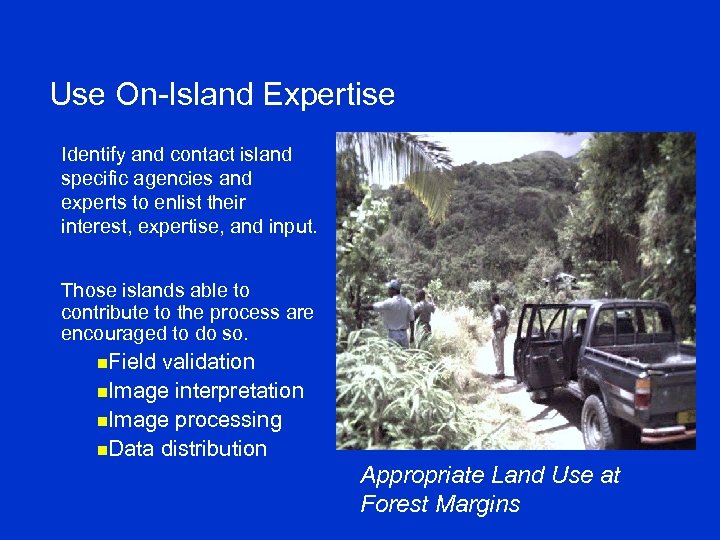
Use On-Island Expertise Identify and contact island specific agencies and experts to enlist their interest, expertise, and input. Those islands able to contribute to the process are encouraged to do so. n. Field validation n. Image interpretation n. Image processing n. Data distribution Appropriate Land Use at Forest Margins
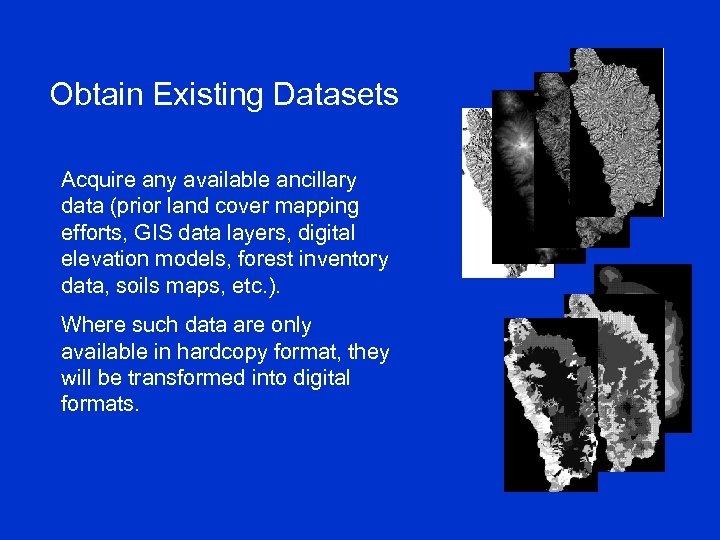
Obtain Existing Datasets Acquire any available ancillary data (prior land cover mapping efforts, GIS data layers, digital elevation models, forest inventory data, soils maps, etc. ). Where such data are only available in hardcopy format, they will be transformed into digital formats.
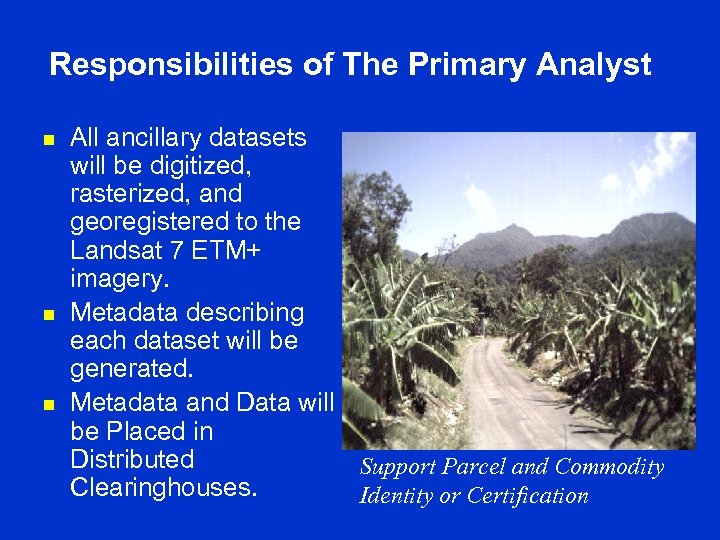
Responsibilities of The Primary Analyst n n n All ancillary datasets will be digitized, rasterized, and georegistered to the Landsat 7 ETM+ imagery. Metadata describing each dataset will be generated. Metadata and Data will be Placed in Distributed Support Parcel and Commodity Clearinghouses. Identity or Certification
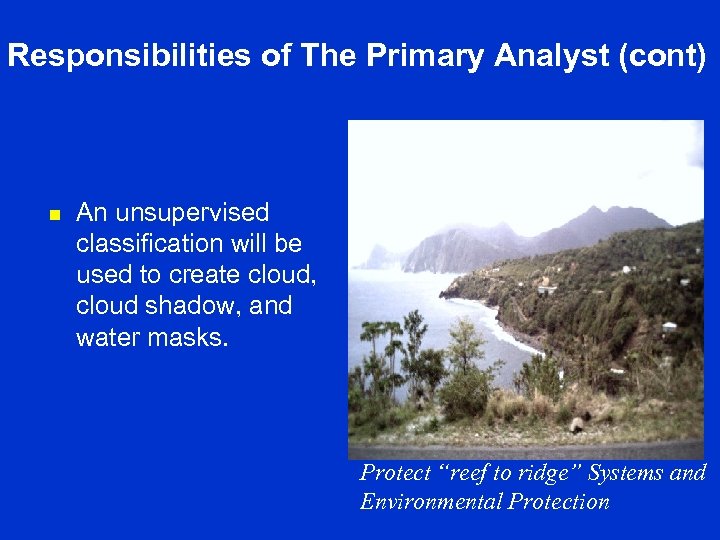
Responsibilities of The Primary Analyst (cont) n An unsupervised classification will be used to create cloud, cloud shadow, and water masks. Protect “reef to ridge” Systems and Environmental Protection
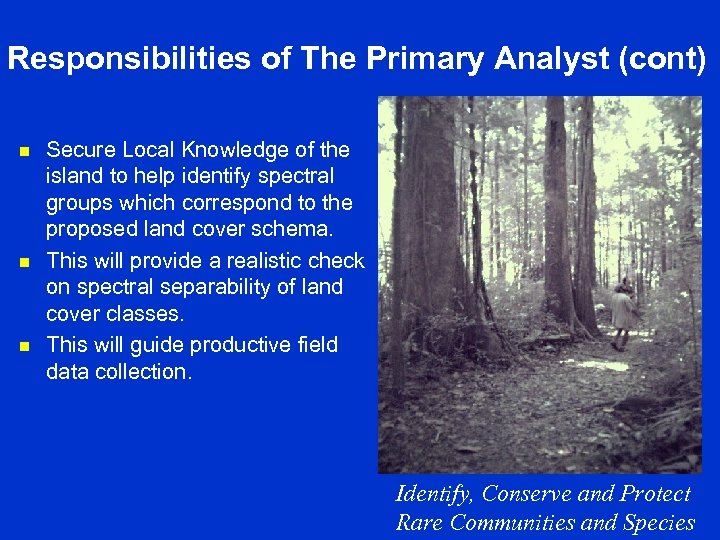
Responsibilities of The Primary Analyst (cont) n n n Secure Local Knowledge of the island to help identify spectral groups which correspond to the proposed land cover schema. This will provide a realistic check on spectral separability of land cover classes. This will guide productive field data collection. Identify, Conserve and Protect Rare Communities and Species
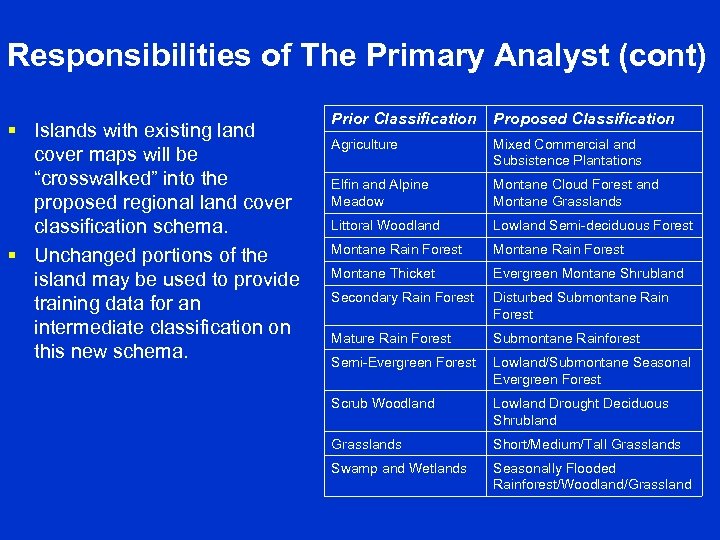
Responsibilities of The Primary Analyst (cont) § Islands with existing land cover maps will be “crosswalked” into the proposed regional land cover classification schema. § Unchanged portions of the island may be used to provide training data for an intermediate classification on this new schema. Prior Classification Proposed Classification Agriculture Mixed Commercial and Subsistence Plantations Elfin and Alpine Meadow Montane Cloud Forest and Montane Grasslands Littoral Woodland Lowland Semi-deciduous Forest Montane Rain Forest Montane Thicket Evergreen Montane Shrubland Secondary Rain Forest Disturbed Submontane Rain Forest Mature Rain Forest Submontane Rainforest Semi-Evergreen Forest Lowland/Submontane Seasonal Evergreen Forest Scrub Woodland Lowland Drought Deciduous Shrubland Grasslands Short/Medium/Tall Grasslands Swamp and Wetlands Seasonally Flooded Rainforest/Woodland/Grassland
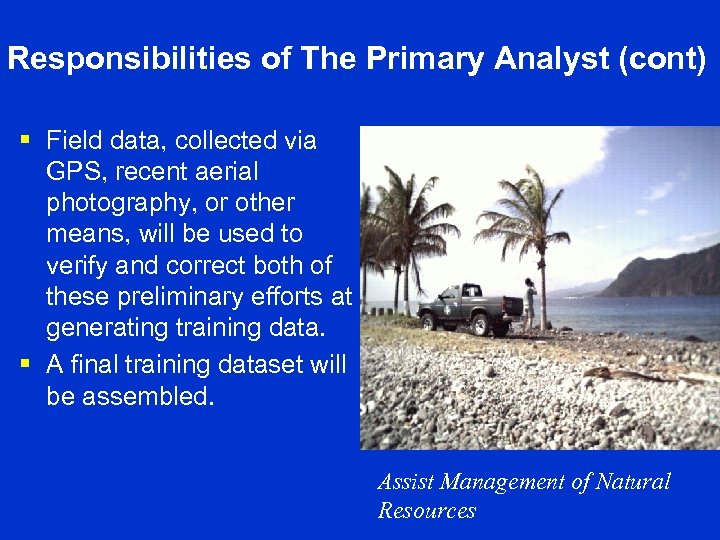
Responsibilities of The Primary Analyst (cont) § Field data, collected via GPS, recent aerial photography, or other means, will be used to verify and correct both of these preliminary efforts at generating training data. § A final training dataset will be assembled. Assist Management of Natural Resources
Responsibilities of The Primary Analyst (cont) n n n Provide all imagery, ancillary data, metadata, and training data for initial EDC processing. EDC prepares a preliminary classification using a “decision tree” linear regression technique. Identify local experts who can take advantage of subregional training as processing is done.
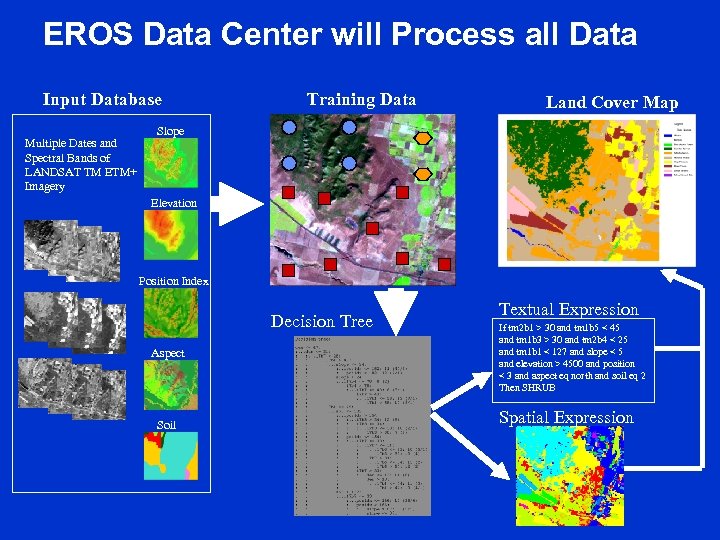
EROS Data Center will Process all Data Input Database Multiple Dates and Spectral Bands of LANDSAT TM ETM+ Imagery Training Data Land Cover Map Slope Elevation Position Index Decision Tree Aspect Soil Textual Expression If tm 2 b 1 > 30 and tm 1 b 5 < 45 and tm 1 b 3 > 30 and tm 2 b 4 < 25 and tm 1 b 1 < 127 and slope < 5 and elevation > 4500 and position < 3 and aspect eq north and soil eq 2 Then SHRUB Spatial Expression
Responsibilities of the Primary Analyst (cont) n n The land cover map resulting from this preliminary classification will be returned to primary analyst and each island for review, edits, and corrections. Corrections will be used to provide improved training data to EDC will use the new training data to run a final classification with the same “decision tree” technique. This land cover map will be the last submission EDC plans to make in the process. Any further classification efforts will be done by more traditional, supervised classification methods, by the Primary Analyst and Island entities.
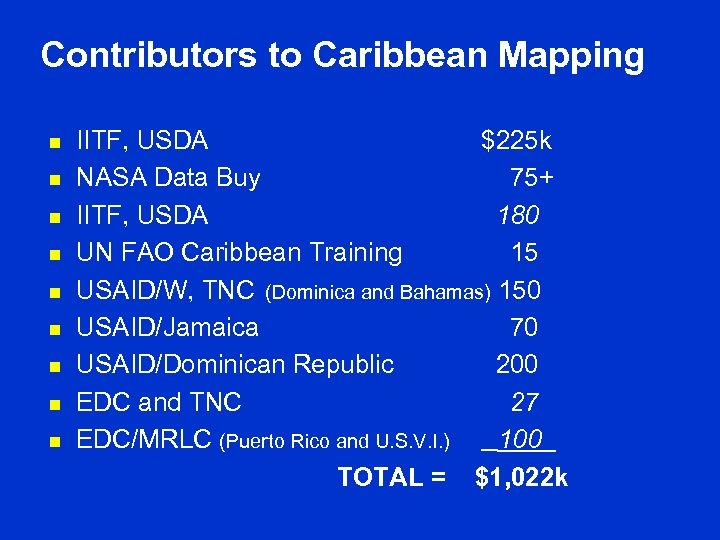
Contributors to Caribbean Mapping n n n n n IITF, USDA $225 k NASA Data Buy 75+ IITF, USDA 180 UN FAO Caribbean Training 15 USAID/W, TNC (Dominica and Bahamas) 150 USAID/Jamaica 70 USAID/Dominican Republic 200 EDC and TNC 27 EDC/MRLC (Puerto Rico and U. S. V. I. ) 100 TOTAL = $1, 022 k
Скачать презентацию A Proposal for Caribbean-Wide Land Cover Use Mapping U
f4a840142161db6b3d9ef3a0d1969fad.ppt