


 Скачать презентацию A Principled Study of Design Tradeoffs for Autonomous
a0e8952bd67341f0a51c480fce2559dc.ppt
- Количество слайдов: 21
 A Principled Study of Design Tradeoffs for Autonomous Trading Agents Ioannis A. Vetsikas Bart Selman Cornell University
 Agents’ Preferences • Bidders have preferences for bundles of items – Complementarities • Combination of goods is valued more than sum of values of individual goods : V({a, b})>V({a})+V({b}) • e. g. having a VCR and a TV together – Substitutability • Combination of goods is valued less than sum of values of individual goods : V({a, b})
 Bidding in Simultaneous Auctions • Goods are traded independently • Different rules for each auction (potentially) • Main issue: Participants need to speculate on behavior of other agents • How aggressively does one bid, when and what for? • Having a plan flexible enough to handle contingencies • Best solution is relative to other players strategies
 Trading Agent Competition (TAC) • General problem capturing several issues of bidding in simultaneous auctions • Provides a universal testbed for researchers • Travel agents – Working on behalf of 8 customers each – Arranging for a trip to Tampa • round-trip flight tickets • hotel accommodations • entertainment tickets – GOAL: Maximize profit
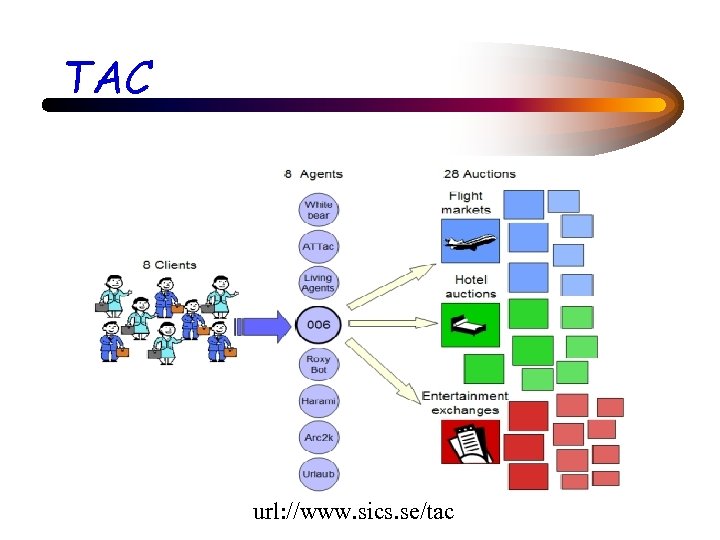 TAC url: //www. sics. se/tac
 White Bear General Architecture Follows the SMPA architecture (loosely) While (not end of game) { Get price quotes Calculate estimates & statistics Planner (Formulate desired plan) Bidder (Bid to implement plan) } Plan : how many goods of each type it is desirable to allocate to each customer
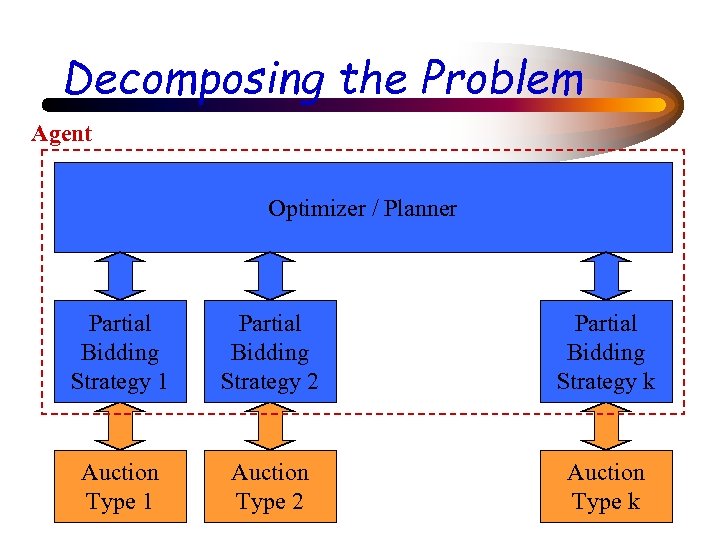 Decomposing the Problem Agent Optimizer / Planner Partial Bidding Strategy 1 Partial Bidding Strategy 2 Partial Bidding Strategy k Auction Type 1 Auction Type 2 Auction Type k
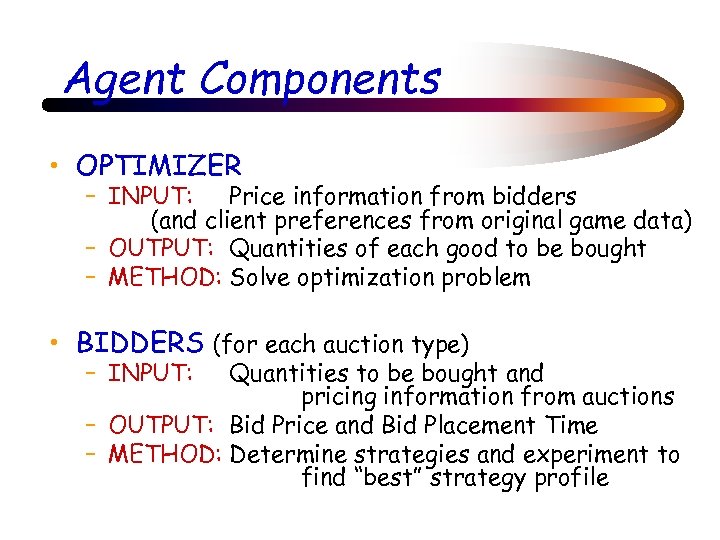 Agent Components • OPTIMIZER – INPUT: Price information from bidders (and client preferences from original game data) – OUTPUT: Quantities of each good to be bought – METHOD: Solve optimization problem • BIDDERS (for each auction type) – INPUT: Quantities to be bought and pricing information from auctions – OUTPUT: Bid Price and Bid Placement Time – METHOD: Determine strategies and experiment to find “best” strategy profile
 Determining Partial Strategies • Determine “boundary strategies” – E. g. minimum and maximum price for the bid, if bid price is the issue • Determine “intermediate strategies” – By modifying boundary strategies – By combining boundary strategies – By using a strategy that constitutes an equilibrium for a simpler but similar game
 Bidding Strategies – Hotels ISSUE: Bid Price Dilemma: • If not aggressive, could get outbid and lose rooms needed – will get outbid by other agents and lose utility for not implementing the plan and for unused resources • If too aggressive, prices will skyrocket and the agent’s score will get hurt more than other agents’ scores – All agents’ scores are hurt – But this hurts the agent more, since rooms it desires will have an increased price
 Bidding Strategies – Hotels (cont. ) 1. Low aggressiveness : (boundary str. ) Ø Bids higher than the current ask price by an increment 2. High aggressiveness : (boundary str. ) Ø Bids for all rooms progressively closer to the marginal utility 3. Medium aggressiveness : (intermediate str. ) Ø Combines two previous strategies Ø For critical rooms (rooms with high marginal utility) the bid is close to the marginal utility Ø For all other rooms it bids an increment above the current price (the increment increases as time passes)
 Bidding – Plane Tickets ISSUE: Time of Bid Placement Dilemma: – To bid early in order to get the cheapest tickets – Or to bid later in order not to limit its options Solution: • Bid for some of the tickets at the beginning • Bids for the rest after some hotel room auctions have closed • Strategies: Which tickets are bought at the beginning
 Bidding – Plane Tickets (cont. ) 1. Late Bidder: (boundary str. ) Ø Buy at the beginning only tickets that are “certain” to be used Ø Buying nothing at the beginning is a clearly inefficient strategy in this setting, so it is not used as a boundary strategy 2. Early Bidder: (boundary str. ) Ø Buy all tickets at the beginning 3. Strategic Bidder : (intermediate str. ) Ø Modifies “Early Bidder” boundary strategy Ø Uses “Strategic Demand Reduction” [Weber ’ 97] Ø Buy all tickets at the beginning, except the ones that are “highly likely not to be used”
 Exploring Strategy Space • Determine the best partial strategy for one particular auction type – Keep all other partial strategies fixed – Use a fixed number of agents using intermediate strategies – Vary the mixture of agents using boundary strategies • Explore strategy space systematically – Use several experiments to evaluate the strategies for different auction types – Use the best partial strategies found in the previous experiments as the strategies that are kept fixed in each experiment – Stop when experiments “converge”
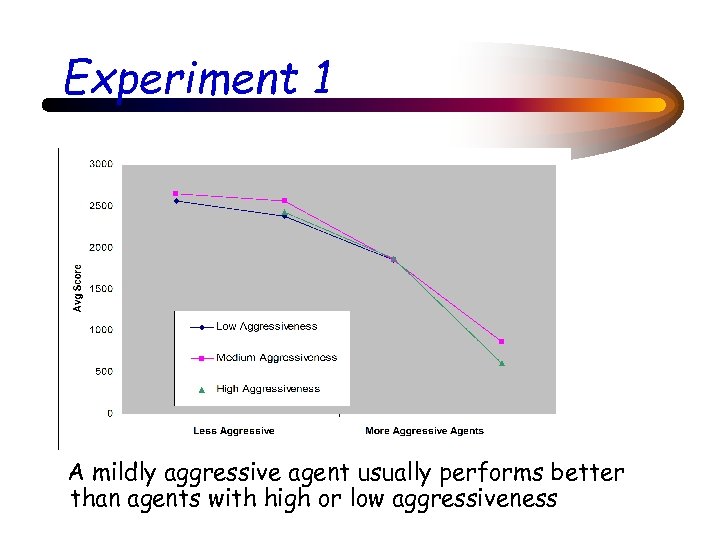 Experiment 1 A mildly aggressive agent usually performs better than agents with high or low aggressiveness
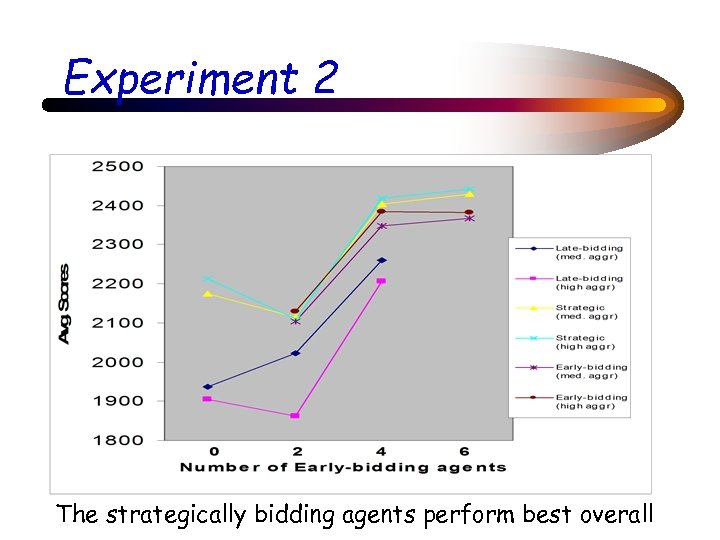 Experiment 2 The strategically bidding agents perform best overall
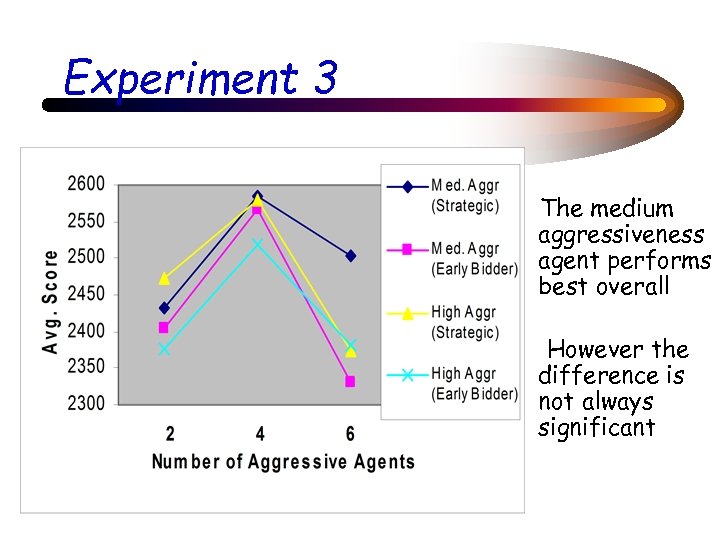 Experiment 3 The medium aggressiveness agent performs best overall However the difference is not always significant
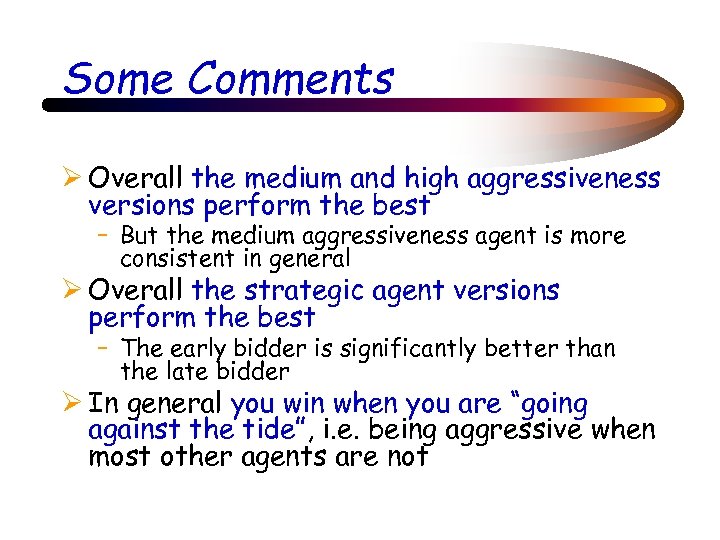 Some Comments Ø Overall the medium and high aggressiveness versions perform the best – But the medium aggressiveness agent is more consistent in general Ø Overall the strategic agent versions perform the best – The early bidder is significantly better than the late bidder Ø In general you win when you are “going against the tide”, i. e. being aggressive when most other agents are not
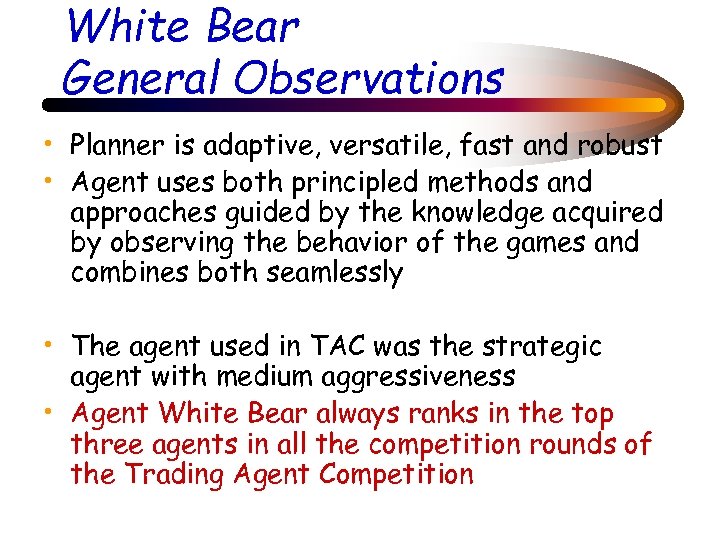 White Bear General Observations • Planner is adaptive, versatile, fast and robust • Agent uses both principled methods and approaches guided by the knowledge acquired by observing the behavior of the games and combines both seamlessly • The agent used in TAC was the strategic agent with medium aggressiveness • Agent White Bear always ranks in the top three agents in all the competition rounds of the Trading Agent Competition
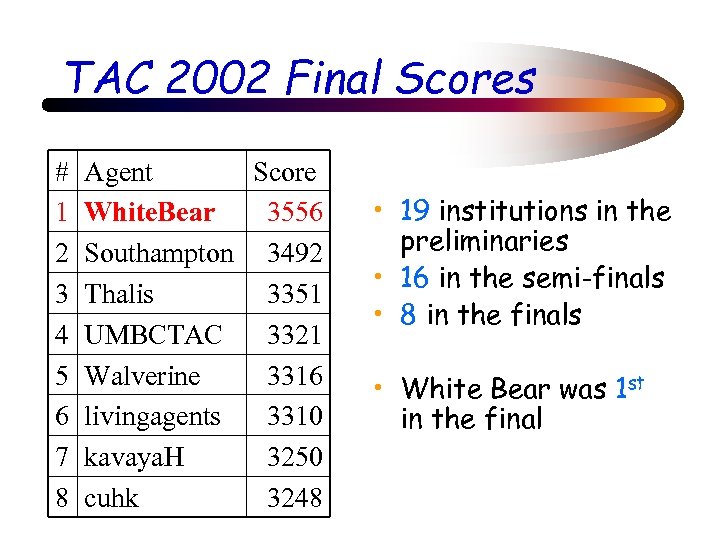 TAC 2002 Final Scores # 1 2 3 4 5 6 7 8 Agent Score White. Bear 3556 Southampton 3492 Thalis 3351 UMBCTAC 3321 Walverine 3316 livingagents 3310 kavaya. H 3250 cuhk 3248 • 19 institutions in the preliminaries • 16 in the semi-finals • 8 in the finals • White Bear was 1 st in the final
 Related Work • Examined the behavior of agents bidding for N similar items in an Nth price auction to find Bayes. Nash equilibria for the bid prices • Examined the effect that better price prediction has on the performance of the agent – Using historical price information definitely improves performance – More intelligent price prediction showed minimal improvement • Examined ways to reduce the number of games per experiment needed in order to derive accurate conclusions