


 Скачать презентацию A Practitioner s experience of designing implementing evaluating
2c67856473b5c9901d7c28583dc8885e.ppt
- Количество слайдов: 24
 A Practitioner’s experience of designing, implementing & evaluating a pilot e. Portfolio project Martha Jones University of Nottingham e-mail: martha. jones@nottingham. ac. uk
 Overview l l l Postgraduate Certificate in Teaching English for Academic Purposes at Nottingham Rationale behind the compilation of an e. Portfolio for teacher development Compilation process Samples of content Positive outcomes and challenges Future directions
 Postgraduate Certificate in Teaching English for Academic Purposes at the University of Nottingham Face to face and Distance Learning l Aimed at experienced teachers of English as a Foreign Language - EAP l Distance programme: F 2 F 2 -week introductory module in July – 3 modules by distance learning l Successful distance learning: learner support & learner autonomy (Peters 1998) l
 Different types of e. Portfolios and their aims l Electronic repositories of individual’s information l Pedagogical tool: l l student reflection on own learning assessment student-student & student-tutor discussion feedback
 Different types of e. Portfolios and their aims (continued) l l learner organisation tools (Sherman 2006) Pre-built package (e. g. Web. CT) – adapted to individual needs OR: built specifically to institution’s requirements
 e. Portfolios and EAP l (2006) Centre for English Language Education approached effective learner support & learner autonomy funding & pedagogical support for e. Portfolio on PGCTEAP course:
 e. Portfolios and EAP (continued) learner support – communication facility re. progress + showcase whole or selections of e. Portfolio – fellow students and tutors l learner autonomy – take control of own learning l professional skills development – record progress + evidence acquisition of skills (job hunting & continued professional development) l
 EAP e. Portfolio: curriculum, tasks and materials Web. CT e. Portfolio: materials development (tasks), induction & piloting materials l Tasks closely linked to key subjects on course l 6 e. Portfolio topics: l l l l EAP teaching skills EAP student needs EAP student autonomy Norms and conventions of academic context Academic discourse Teacher autonomy
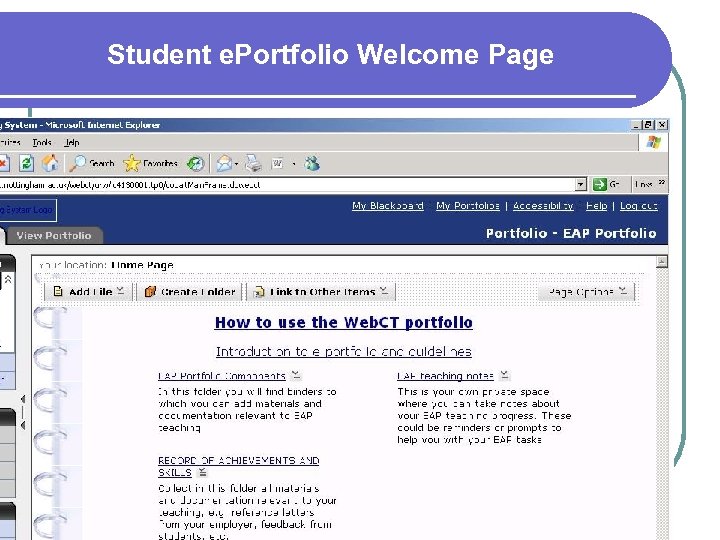 Student e. Portfolio Welcome Page
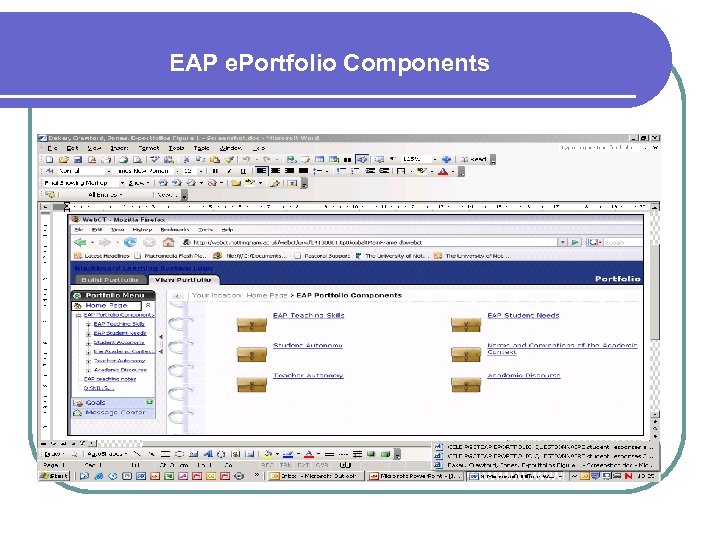 EAP e. Portfolio Components
 Early Stages During F 2 F: Web. CT training + induction (EAP e. Portfolio) l Participants’ initial reactions: mixed feelings, e. g. l l St. 1 concerned re. own experience using technology St. 2 skeptical about functionality and reliability St. 3 positive about potential of learning tool l St. 4 joined at a later stage (instructions sent to her) l l
 e. Portfolio Compilation Process during course l Continued support (e. Portfolio Development Officer, CIL pedagogical advisor, IS, Course Director and Convenors) l Uploading of: l l individual & collaborative reflections lesson plans teaching materials (tasks and description of aims) feedback from peers and convenors
 e. Portfolio Compilation Process during course (continued) l l l individual & collaborative reports threads of discussions teaching philosophy statement
 e. Portfolio Guidelines l l l Definition of an e. Portfolio Aims of EAP e. Portfolio Diagram showing close link between e. Portfolio topics and content of PGCTEAP course Content: types of tasks and material Diagram showing timescales and deadlines for e. Portfolio work + studying + formal assessment
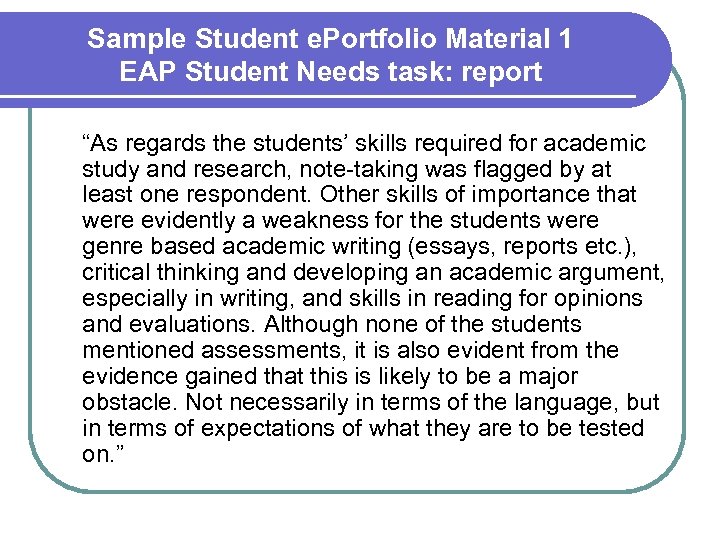 Sample Student e. Portfolio Material 1 EAP Student Needs task: report “As regards the students’ skills required for academic study and research, note-taking was flagged by at least one respondent. Other skills of importance that were evidently a weakness for the students were genre based academic writing (essays, reports etc. ), critical thinking and developing an academic argument, especially in writing, and skills in reading for opinions and evaluations. Although none of the students mentioned assessments, it is also evident from the evidence gained that this is likely to be a major obstacle. Not necessarily in terms of the language, but in terms of expectations of what they are to be tested on. ”
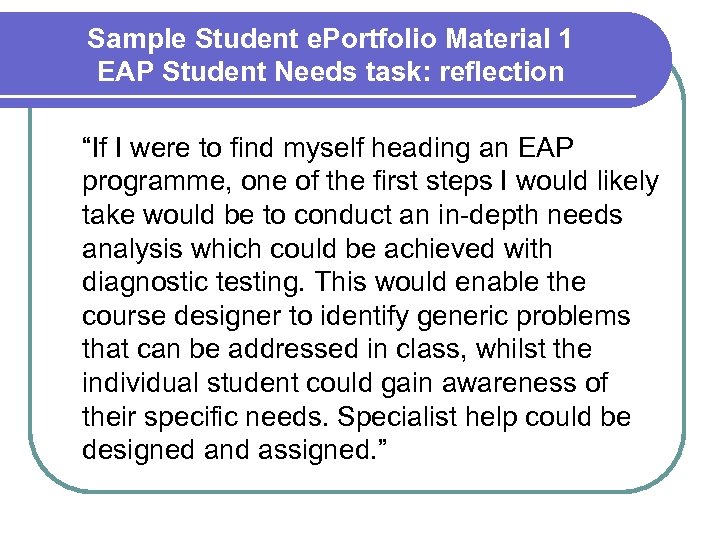 Sample Student e. Portfolio Material 1 EAP Student Needs task: reflection “If I were to find myself heading an EAP programme, one of the first steps I would likely take would be to conduct an in-depth needs analysis which could be achieved with diagnostic testing. This would enable the course designer to identify generic problems that can be addressed in class, whilst the individual student could gain awareness of their specific needs. Specialist help could be designed and assigned. ”
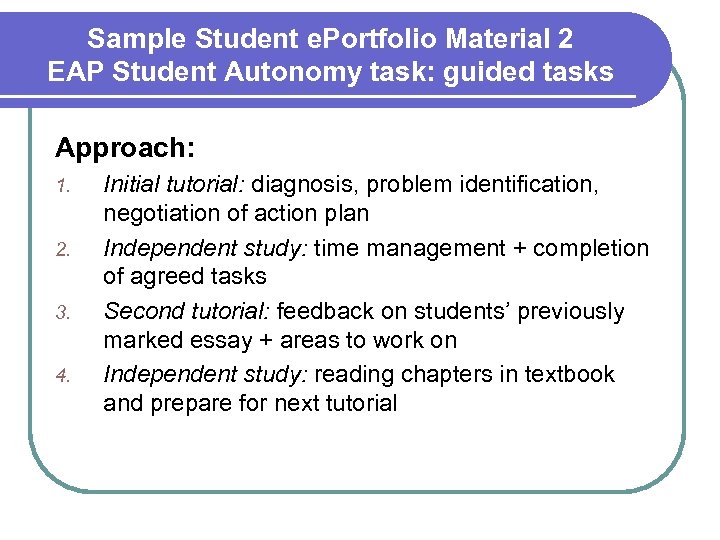 Sample Student e. Portfolio Material 2 EAP Student Autonomy task: guided tasks Approach: 1. 2. 3. 4. Initial tutorial: diagnosis, problem identification, negotiation of action plan Independent study: time management + completion of agreed tasks Second tutorial: feedback on students’ previously marked essay + areas to work on Independent study: reading chapters in textbook and prepare for next tutorial
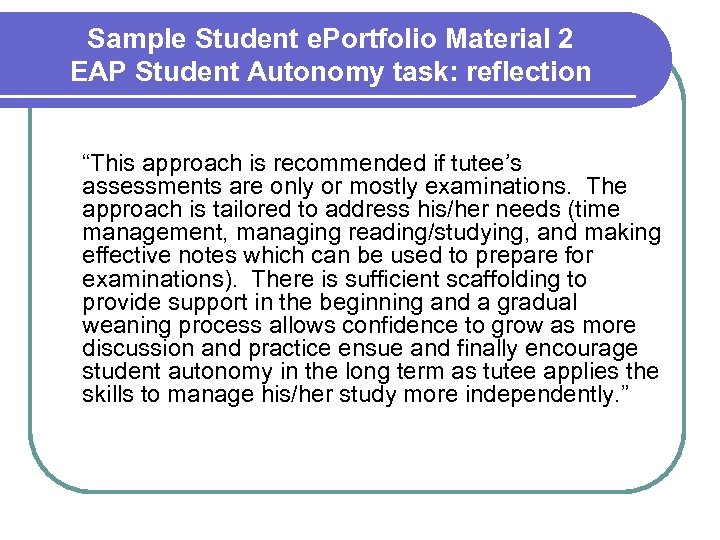 Sample Student e. Portfolio Material 2 EAP Student Autonomy task: reflection “This approach is recommended if tutee’s assessments are only or mostly examinations. The approach is tailored to address his/her needs (time management, managing reading/studying, and making effective notes which can be used to prepare for examinations). There is sufficient scaffolding to provide support in the beginning and a gradual weaning process allows confidence to grow as more discussion and practice ensue and finally encourage student autonomy in the long term as tutee applies the skills to manage his/her study more independently. ”
 Sample Student e. Portfolio Material 3 Academic Discourse: task “The purpose of this analysis is to have a comparison of the aspects of academic discourse found in abstracts of journals from two disciplines to feed into development of EAP teaching materials for international students. The journal abstracts are from International Journal of Computer Applications in Technology and Global Business and Economic Review. These two journals are selected based on the range of undergraduate and postgraduate programmes for Year 2008/9 at the University of Nottingham Ningbo, China. ”
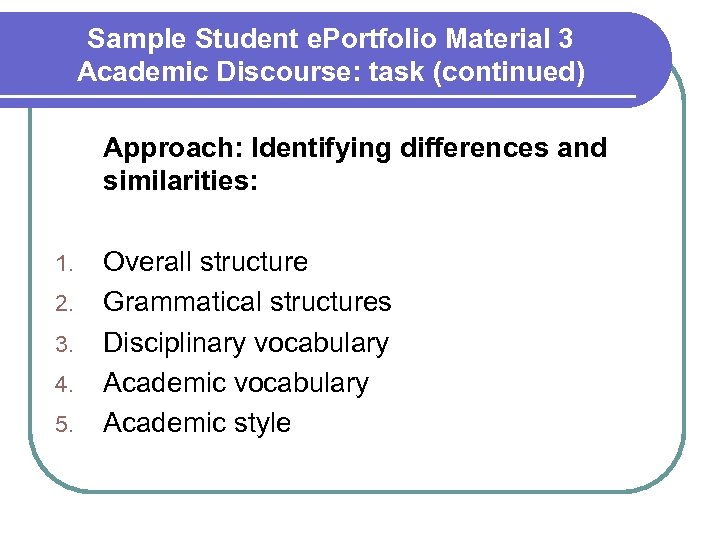 Sample Student e. Portfolio Material 3 Academic Discourse: task (continued) Approach: Identifying differences and similarities: 1. 2. 3. 4. 5. Overall structure Grammatical structures Disciplinary vocabulary Academic style
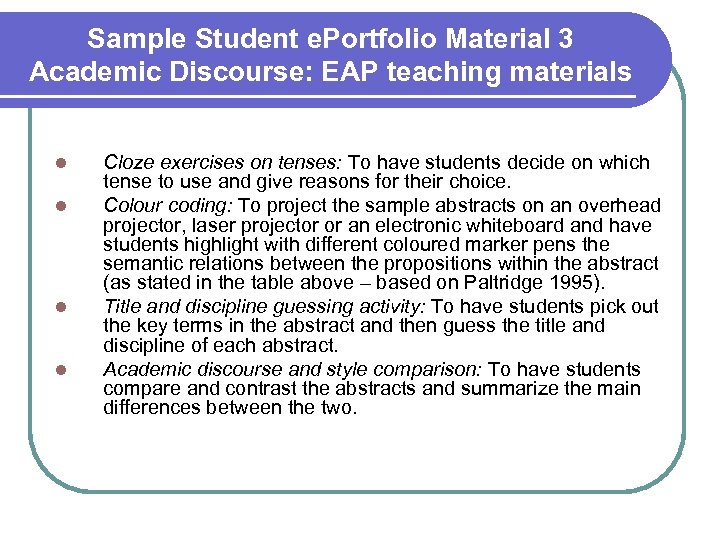 Sample Student e. Portfolio Material 3 Academic Discourse: EAP teaching materials l l Cloze exercises on tenses: To have students decide on which tense to use and give reasons for their choice. Colour coding: To project the sample abstracts on an overhead projector, laser projector or an electronic whiteboard and have students highlight with different coloured marker pens the semantic relations between the propositions within the abstract (as stated in the table above – based on Paltridge 1995). Title and discipline guessing activity: To have students pick out the key terms in the abstract and then guess the title and discipline of each abstract. Academic discourse and style comparison: To have students compare and contrast the abstracts and summarize the main differences between the two.
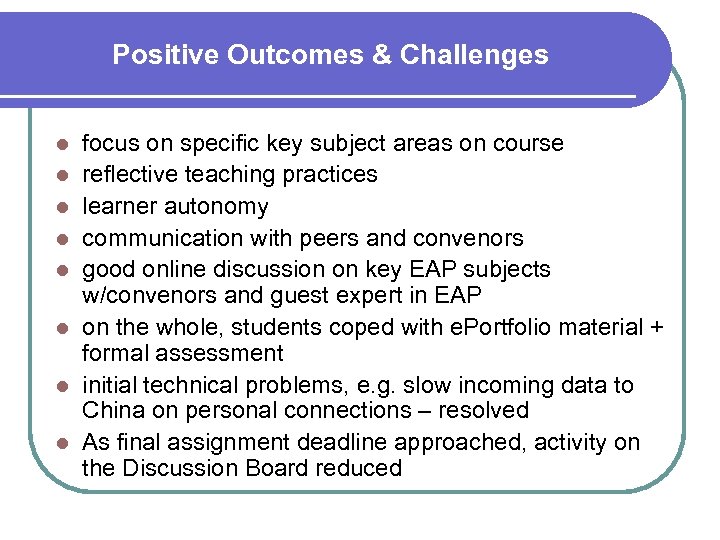 Positive Outcomes & Challenges l l l l focus on specific key subject areas on course reflective teaching practices learner autonomy communication with peers and convenors good online discussion on key EAP subjects w/convenors and guest expert in EAP on the whole, students coped with e. Portfolio material + formal assessment initial technical problems, e. g. slow incoming data to China on personal connections – resolved As final assignment deadline approached, activity on the Discussion Board reduced
 Publications on this e. Portfolio Project Jones, M. (2008) ‘Implementing e-portfolio-based practice: Practitioner Case Study’, in Effective Practice with e-Portfolios: Supporting 21 st century learning. JISC. Baker, G. , Crawford, E. , Jones, M. (forthcoming) ‘Eportfolios for Lifelong Teacher Development’. In Smith, A. & Strong, G. (eds. ) Adult learners: Context and Innovation, part of TESOL’s Classroom Practice series.
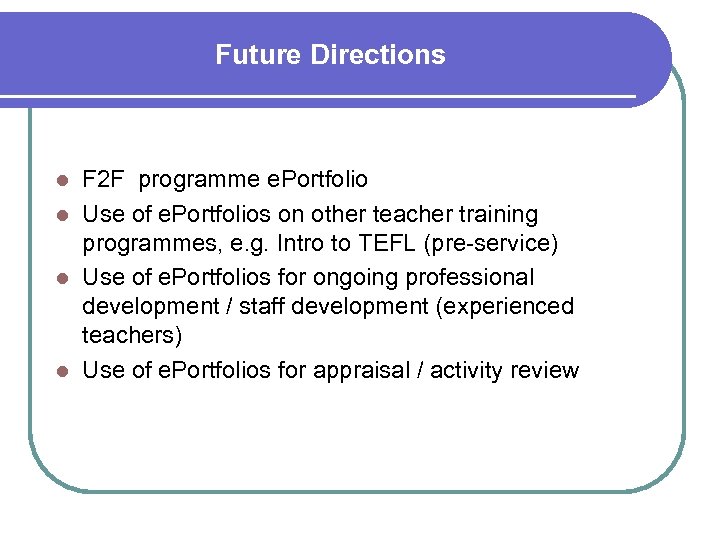 Future Directions F 2 F programme e. Portfolio l Use of e. Portfolios on other teacher training programmes, e. g. Intro to TEFL (pre-service) l Use of e. Portfolios for ongoing professional development / staff development (experienced teachers) l Use of e. Portfolios for appraisal / activity review l