


 Скачать презентацию A plan to develop electrical power Introduction with
6d4be68b068ca1f844af3a432d853128.ppt
- Количество слайдов: 35
 A plan to develop electrical power Introduction with Laser Fusion n ha st les years in 35 John Sethian (NRL) Steve Obenschain (NRL), Camille Bibeau (LLNL), and Steve Payne (LLNL) With lots of help from: D. Weidenheimer, Titan PSD L. Brown and D. Goodin, GA W. Meier, LLNL References Sombrero Power Plant Study National Ignition Facility "2 MJ Laser Facility" by M. W. Mc. Geoch Presented to FESAC Development Path Panel General Atomics January 14, 2003 1
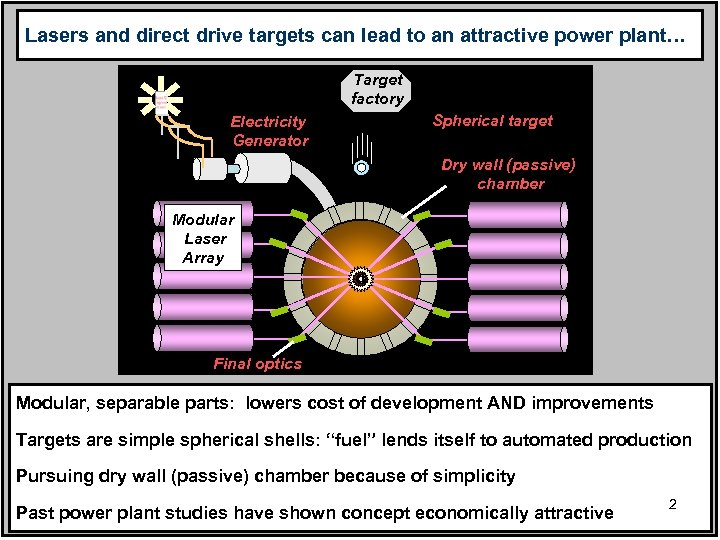 Lasers and direct drive targets can lead to an attractive power plant… Target factory Electricity Generator Spherical target Dry wall (passive) chamber Modular Laser Array Final optics Modular, separable parts: lowers cost of development AND improvements Targets are simple spherical shells: “fuel” lends itself to automated production Pursuing dry wall (passive) chamber because of simplicity Past power plant studies have shown concept economically attractive 2
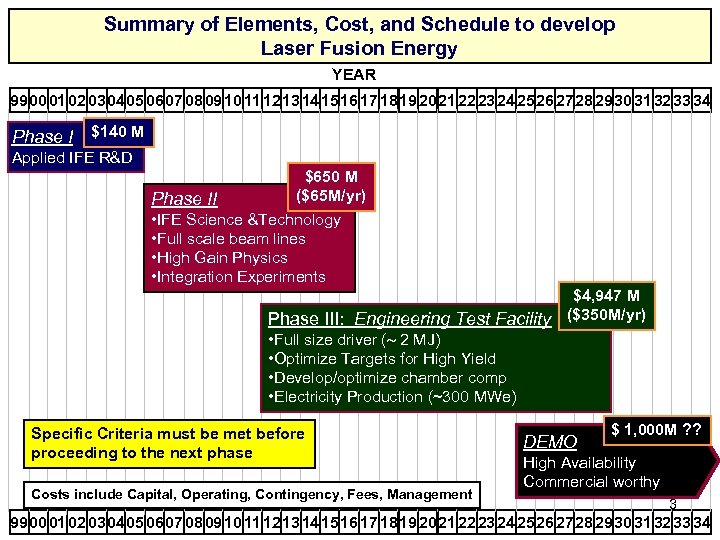 Summary of Elements, Cost, and Schedule to develop Laser Fusion Energy YEAR 99 00 01 02 03 04 05 06 07 08 09 10 11 1213 14 1516 17 18 19 20 21 22 23 24 25 26 27 28 2930 31 32 33 34 Phase I $140 M Applied IFE R&D $650 M ($65 M/yr) Phase II • IFE Science &Technology • Full scale beam lines • High Gain Physics • Integration Experiments $4, 947 M Phase III: Engineering Test Facility ($350 M/yr) • Full size driver ( 2 MJ) • Optimize Targets for High Yield • Develop/optimize chamber comp • Electricity Production (~300 MWe) Specific Criteria must be met before proceeding to the next phase Costs include Capital, Operating, Contingency, Fees, Management DEMO $ 1, 000 M ? ? High Availability Commercial worthy 3 99 00 01 02 03 04 05 06 07 08 09 10 11 1213 14 1516 17 18 19 20 21 22 23 24 25 26 27 28 2930 31 32 33 34
 Phase I: Develop Science and Technology for Laser Fusion Energy as an integrated system. ( 8 Government labs, 7 Universities, 8 Private Industries) Lasers Kr. F: NRL Target factory Titan PSD, SAIC, PPPL, Georgia Tech, Commonwealth Tech DPSSL: LLNL Coherent, Onyx, DEI, Northrup, UR/LLE Target Fabrication GA: Fab, charac, mass production LANL: Adv foams SCHAFER: Dv. B foams Target Injection GA: Injector, injection & tracking LANL: DT mech prop, thermal resp. Direct Drive Target Design NRL: Target design LLNL: Yield spectrum, design UR/LLE: Target Design (DP program) Chambers and Materials Chambers & Materials Final Optics LLNL: X-rays, ions, neutrons UCSD: Laser, debris mitigation WISCONSIN: Yield spectrum / Chambers LLNL: Alt chamber concepts, materials UCSD/ANL/INEEL: Chamber dynamics SNL: Materials response x-rays/ions 4 ORNL/UCLA/UCSB/Wisconsin: Materials
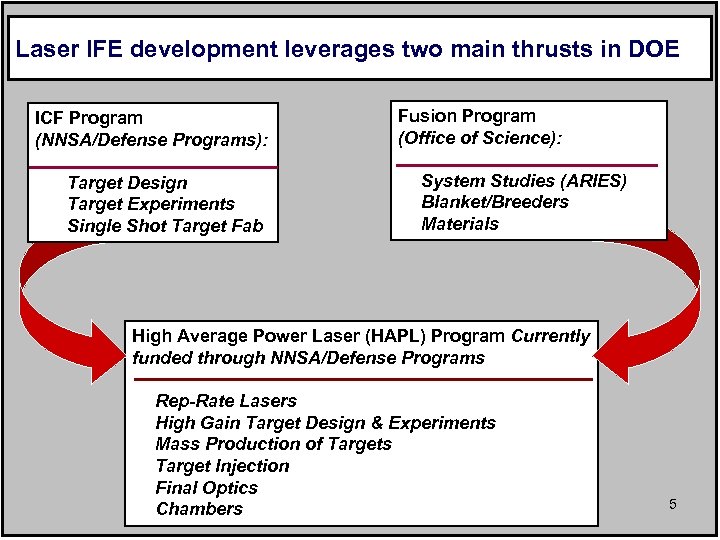 Laser IFE development leverages two main thrusts in DOE ICF Program (NNSA/Defense Programs): Target Design Target Experiments Single Shot Target Fab Fusion Program (Office of Science): System Studies (ARIES) Blanket/Breeders Materials High Average Power Laser (HAPL) Program Currently funded through NNSA/Defense Programs Rep-Rate Lasers High Gain Target Design & Experiments Mass Production of Targets Target Injection Final Optics Chambers 5
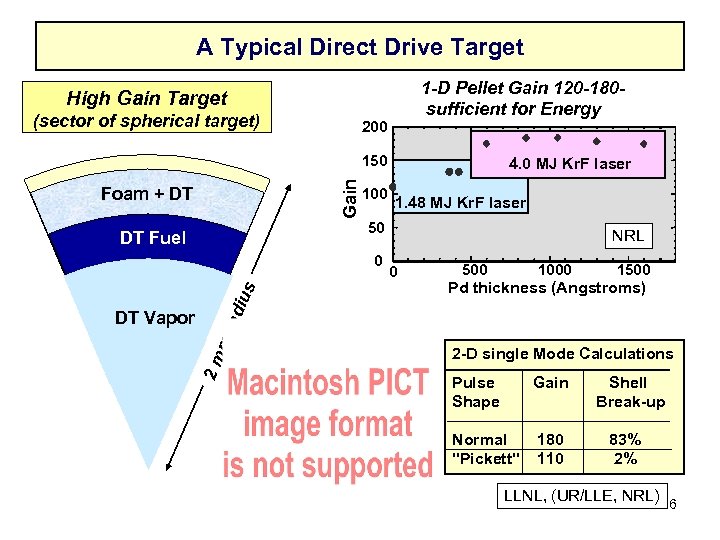 A Typical Direct Drive Target 1 -D Pellet Gain 120 -180 sufficient for Energy High Gain Target (sector of spherical target) 200 Gain 150 Foam + DT 100 1. 48 MJ Kr. F laser 50 DT Fuel NRL 0 0 500 1000 1500 Pd thickness (Angstroms) 2 m mr adi us 0 DT Vapor 4. 0 MJ Kr. F laser 2 -D single Mode Calculations Pulse Shape Gain Normal "Pickett" 180 110 Shell Break-up 83% 2% LLNL, (UR/LLE, NRL) 6
 Two types of lasers are under development for Fusion Energy E-beam Pumped Krypton Fluoride Laser (Kr. F)---- "Electra" at NRL electron beam Kr+F LA gas SER Diode Pumped Solid State Lasers (DPPSL)--- "Mercury" at LLNL Crystal Diodes LA SE R 7 Both lasers recently achieved first light Both have the potential to meet IFE requirements, but have different challenges
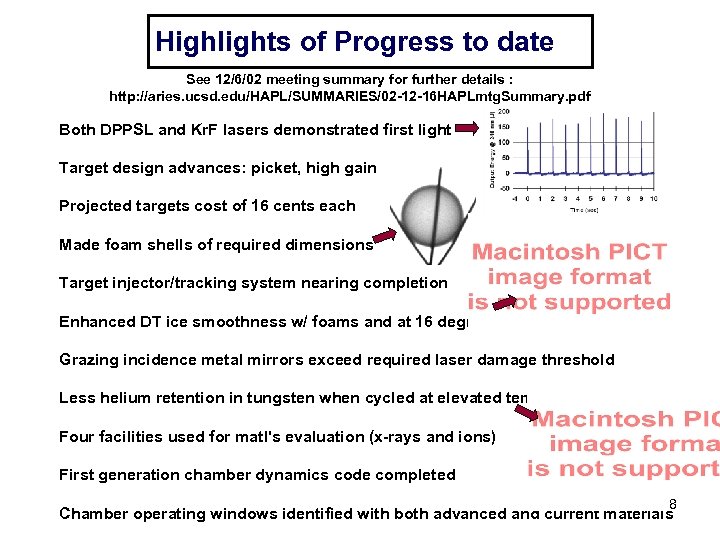 Highlights of Progress to date See 12/6/02 meeting summary for further details : http: //aries. ucsd. edu/HAPL/SUMMARIES/02 -12 -16 HAPLmtg. Summary. pdf Both DPPSL and Kr. F lasers demonstrated first light Target design advances: picket, high gain Projected targets cost of 16 cents each Made foam shells of required dimensions Target injector/tracking system nearing completion Enhanced DT ice smoothness w/ foams and at 16 degrees K Grazing incidence metal mirrors exceed required laser damage threshold Less helium retention in tungsten when cycled at elevated temps Four facilities used for matl's evaluation (x-rays and ions) First generation chamber dynamics code completed 8 Chamber operating windows identified with both advanced and current materials
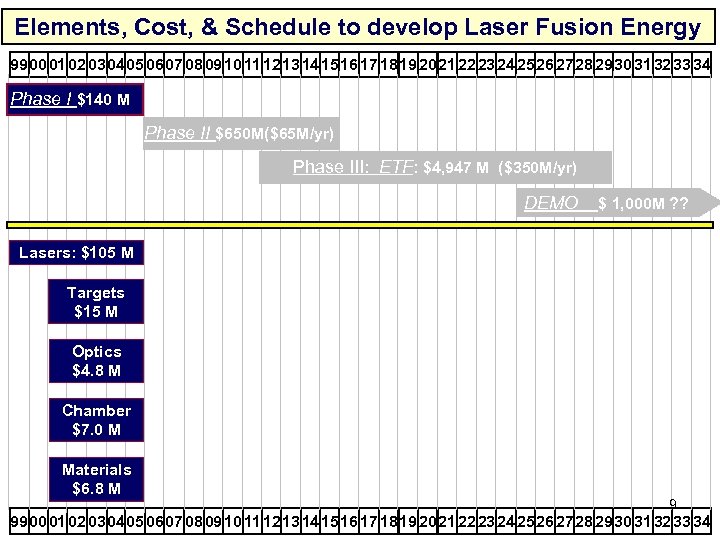 Elements, Cost, & Schedule to develop Laser Fusion Energy 99 00 01 02 03 04 05 06 07 08 09 10 11 1213 14 1516 17 18 19 20 21 22 23 24 25 26 27 28 2930 31 32 33 34 Phase I $140 M Phase II $650 M($65 M/yr) Phase III: ETF: $4, 947 M ($350 M/yr) DEMO $ 1, 000 M ? ? Lasers: $105 M Targets $15 M Optics $4. 8 M Chamber $7. 0 M Materials $6. 8 M 9 99 00 01 02 03 04 05 06 07 08 09 10 11 1213 14 1516 17 18 19 20 21 22 23 24 25 26 27 28 2930 31 32 33 34
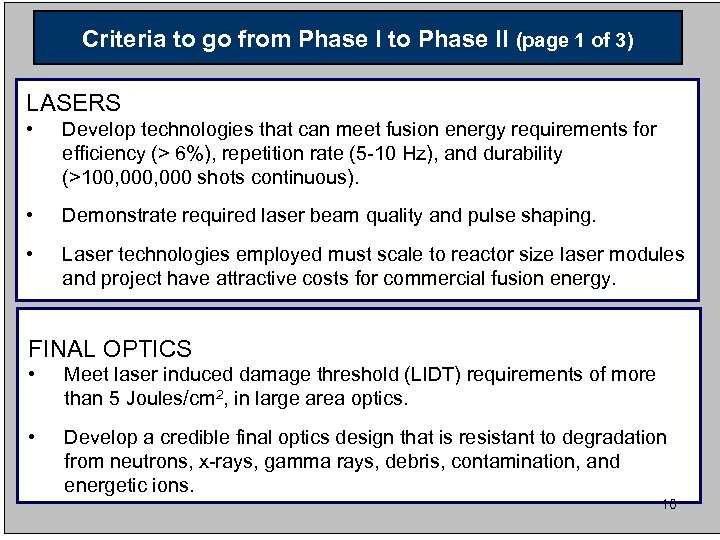 Criteria to go from Phase I to Phase II (page 1 of 3) LASERS • Develop technologies that can meet fusion energy requirements for efficiency (> 6%), repetition rate (5 -10 Hz), and durability (>100, 000 shots continuous). • Demonstrate required laser beam quality and pulse shaping. • Laser technologies employed must scale to reactor size laser modules and project have attractive costs for commercial fusion energy. FINAL OPTICS • Meet laser induced damage threshold (LIDT) requirements of more than 5 Joules/cm 2, in large area optics. • Develop a credible final optics design that is resistant to degradation from neutrons, x-rays, gamma rays, debris, contamination, and energetic ions. 10
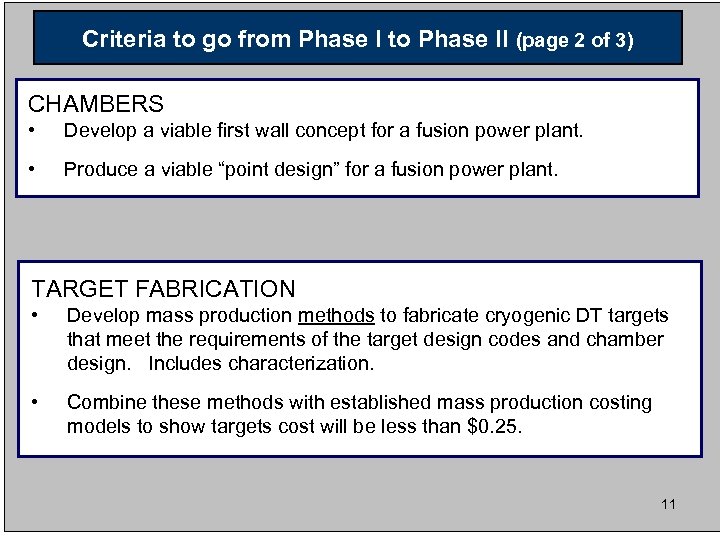 Criteria to go from Phase I to Phase II (page 2 of 3) CHAMBERS • Develop a viable first wall concept for a fusion power plant. • Produce a viable “point design” for a fusion power plant. TARGET FABRICATION • Develop mass production methods to fabricate cryogenic DT targets that meet the requirements of the target design codes and chamber design. Includes characterization. • Combine these methods with established mass production costing models to show targets cost will be less than $0. 25. 11
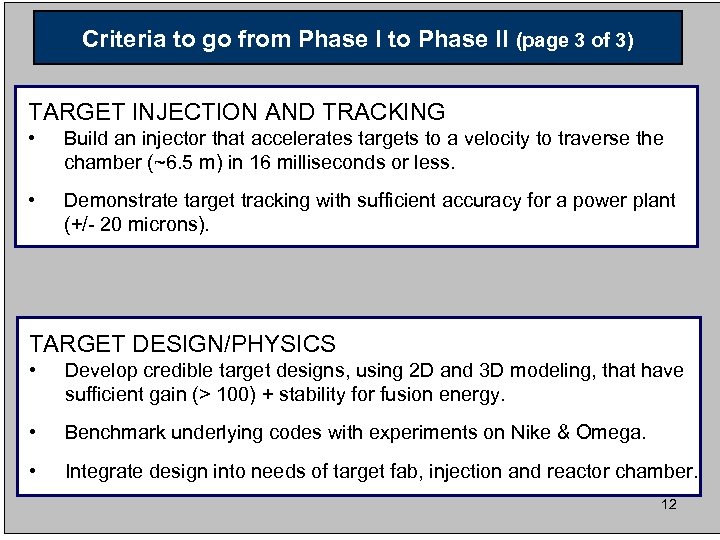 Criteria to go from Phase I to Phase II (page 3 of 3) TARGET INJECTION AND TRACKING • Build an injector that accelerates targets to a velocity to traverse the chamber (~6. 5 m) in 16 milliseconds or less. • Demonstrate target tracking with sufficient accuracy for a power plant (+/- 20 microns). TARGET DESIGN/PHYSICS • Develop credible target designs, using 2 D and 3 D modeling, that have sufficient gain (> 100) + stability for fusion energy. • Benchmark underlying codes with experiments on Nike & Omega. • Integrate design into needs of target fab, injection and reactor chamber. 12
 Description of Phase II (page 1 of 5) Top Level Objective: 1. Establish Science and Technology to build and JUSTIFY the Engineering Test Facility (ETF). 2. Phase II will consist of six components. 1. Laser Facility--primary function Lasers: Build a full-scale (power plant sized) laser beam line using the best laser choice to emerge from Phase I: (Kr. F: 60 k. J) (DPPSL: 6 k. J) Final optics/target injection: Use the above beam line to repetitively hit a target injected into a chamber, with the required precision. Measure optics "Laser Induced Damage Threshold" (LIDT) durability. 13
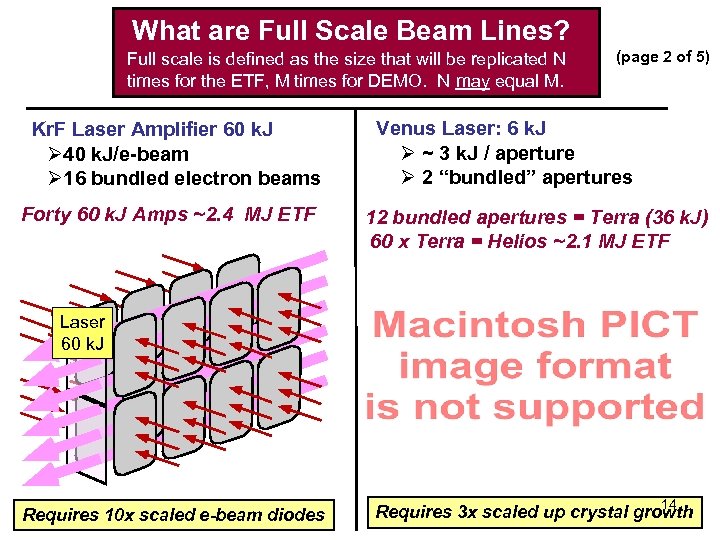 What are Full Scale Beam Lines? Full scale is defined as the size that will be replicated N times for the ETF, M times for DEMO. N may equal M. Kr. F Laser Amplifier 60 k. J Ø 40 k. J/e-beam Ø 16 bundled electron beams Forty 60 k. J Amps ~2. 4 MJ ETF (page 2 of 5) Venus Laser: 6 k. J Ø ~ 3 k. J / aperture Ø 2 “bundled” apertures 12 bundled apertures = Terra (36 k. J) 60 x Terra = Helios ~2. 1 MJ ETF Laser 60 k. J Requires 10 x scaled e-beam diodes 14 Requires 3 x scaled up crystal growth
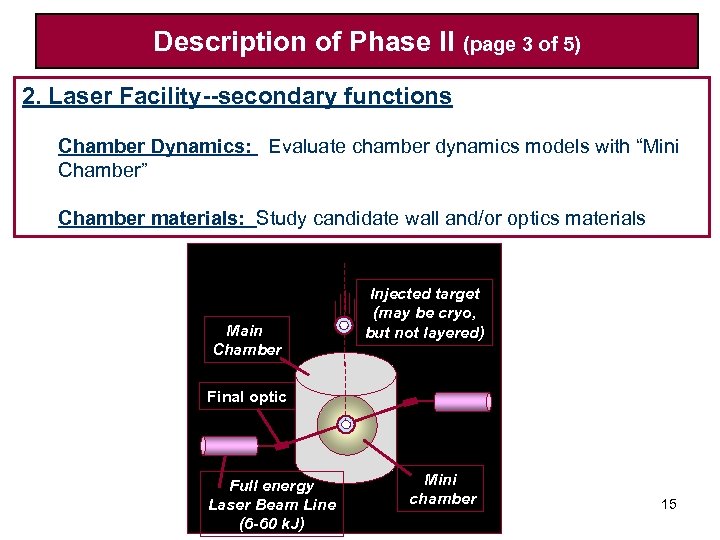 Description of Phase II (page 3 of 5) 2. Laser Facility--secondary functions Chamber Dynamics: Evaluate chamber dynamics models with “Mini Chamber” Chamber materials: Study candidate wall and/or optics materials Main Chamber Injected target (may be cryo, but not layered) Final optic Full energy Laser Beam Line (6 -60 k. J) Mini chamber 15
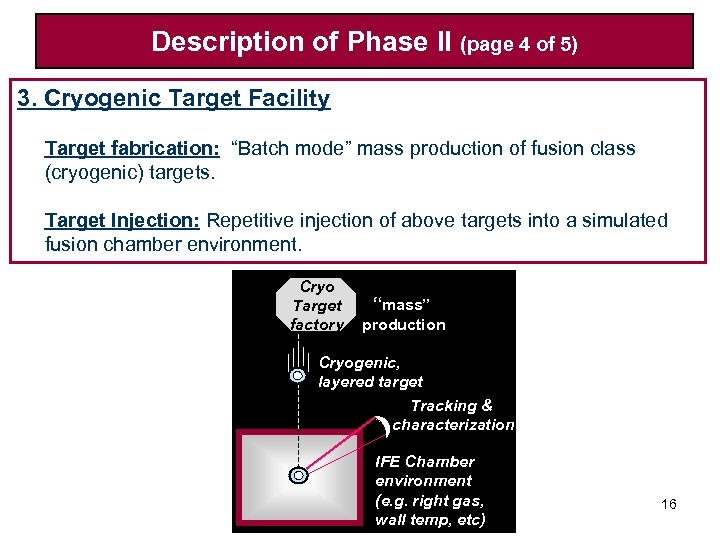 Description of Phase II (page 4 of 5) 3. Cryogenic Target Facility Target fabrication: “Batch mode” mass production of fusion class (cryogenic) targets. Target Injection: Repetitive injection of above targets into a simulated fusion chamber environment. Cryo Target factory “mass” production Cryogenic, layered target Tracking & characterization IFE Chamber environment (e. g. right gas, wall temp, etc) 16
 Description of Phase II (page 5 of 5) 4. Power Plant Design • Produce a credible design for a laser fusion power plant that meets the technical and economic requirements for commercial power. 5. Chamber and final optics materials/structures: • Evaluate candidate materials/structures in a non-fusion environment. 6. Target Physics: • Develop viable, robust high gain targets for fusion energy using integrated high-resolution 3 D target modeling. • Validate design codes with target physics experiments at fusion scale energies, (e. g. on NIF). 17
 Cost Breakdown for Phase II: Kr. F 18
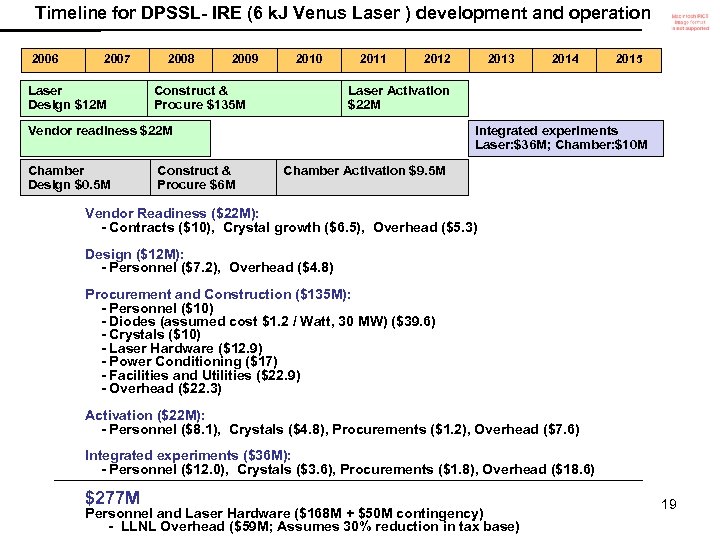 Timeline for DPSSL- IRE (6 k. J Venus Laser ) development and operation Cost Breakdown for Phase II: DPPSL 2006 2007 Laser Design $12 M 2008 2009 2010 Construct & Procure $135 M 2011 2012 Construct & Procure $6 M 2014 2015 Laser Activation $22 M Integrated experiments Laser: $36 M; Chamber: $10 M Vendor readiness $22 M Chamber Design $0. 5 M 2013 Chamber Activation $9. 5 M Vendor Readiness ($22 M): - Contracts ($10), Crystal growth ($6. 5), Overhead ($5. 3) Design ($12 M): - Personnel ($7. 2), Overhead ($4. 8) Procurement and Construction ($135 M): - Personnel ($10) - Diodes (assumed cost $1. 2 / Watt, 30 MW) ($39. 6) - Crystals ($10) - Laser Hardware ($12. 9) - Power Conditioning ($17) - Facilities and Utilities ($22. 9) - Overhead ($22. 3) Activation ($22 M): - Personnel ($8. 1), Crystals ($4. 8), Procurements ($1. 2), Overhead ($7. 6) Integrated experiments ($36 M): - Personnel ($12. 0), Crystals ($3. 6), Procurements ($1. 8), Overhead ($18. 6) $277 M Personnel and Laser Hardware ($168 M + $50 M contingency) - LLNL Overhead ($59 M; Assumes 30% reduction in tax base) 19
 Cost Breakdown for Phase II: Other R & D 20
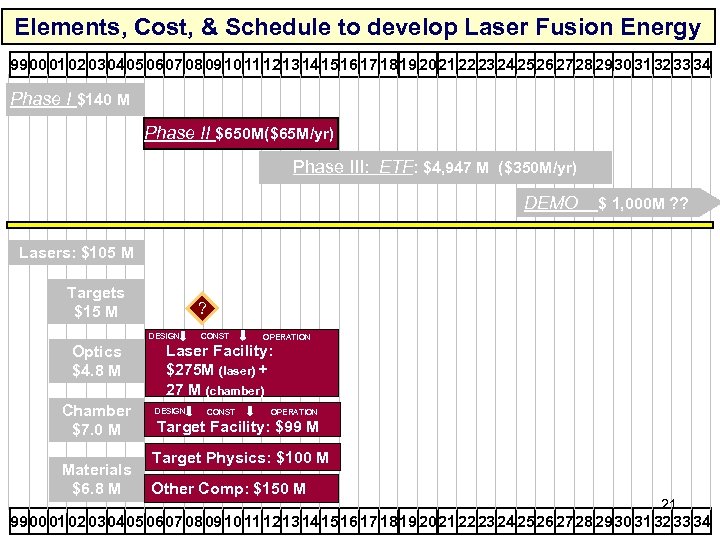 Elements, Cost, & Schedule to develop Laser Fusion Energy 99 00 01 02 03 04 05 06 07 08 09 10 11 1213 14 1516 17 18 19 20 21 22 23 24 25 26 27 28 2930 31 32 33 34 Phase I $140 M Phase II $650 M($65 M/yr) Phase III: ETF: $4, 947 M ($350 M/yr) DEMO $ 1, 000 M ? ? Lasers: $105 M Targets $15 M ? DESIGN Optics $4. 8 M Chamber $7. 0 M Materials $6. 8 M CONST OPERATION Laser Facility: $275 M (laser) + 27 M (chamber) DESIGN CONST OPERATION Target Facility: $99 M Target Physics: $100 M Other Comp: $150 M 21 99 00 01 02 03 04 05 06 07 08 09 10 11 1213 14 1516 17 18 19 20 21 22 23 24 25 26 27 28 2930 31 32 33 34
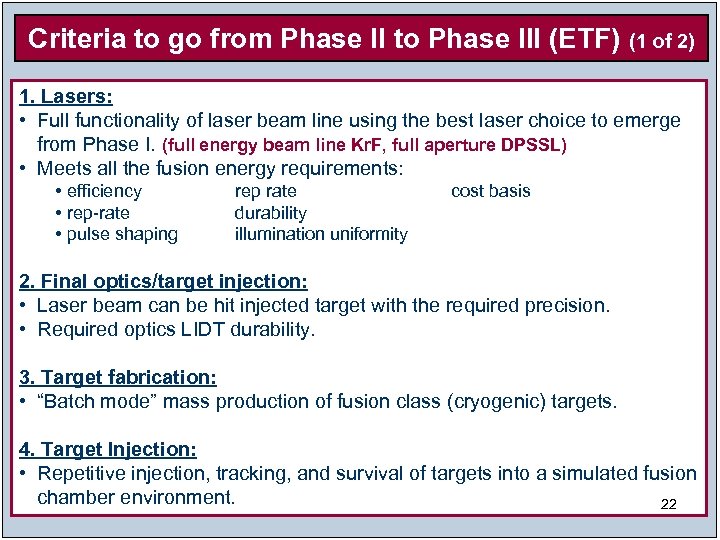 Criteria to go from Phase II to Phase III (ETF) (1 of 2) 1. Lasers: • Full functionality of laser beam line using the best laser choice to emerge from Phase I. (full energy beam line Kr. F, full aperture DPSSL) • Meets all the fusion energy requirements: • efficiency • rep-rate • pulse shaping rep rate durability illumination uniformity cost basis 2. Final optics/target injection: • Laser beam can be hit injected target with the required precision. • Required optics LIDT durability. 3. Target fabrication: • “Batch mode” mass production of fusion class (cryogenic) targets. 4. Target Injection: • Repetitive injection, tracking, and survival of targets into a simulated fusion chamber environment. 22
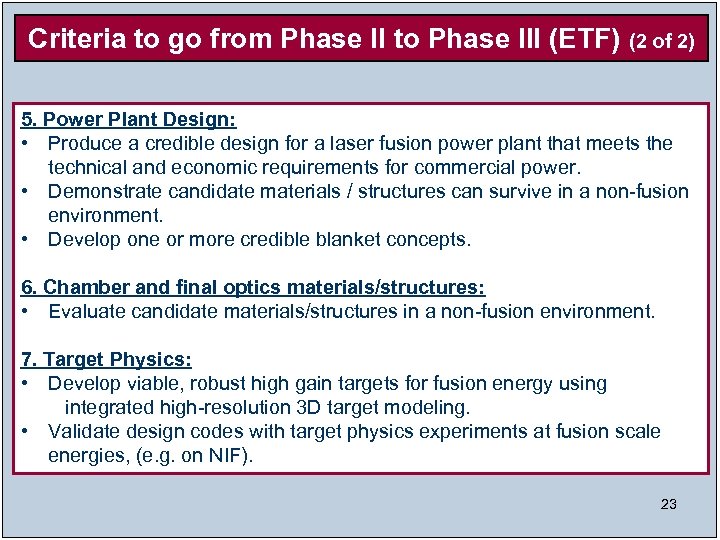 Criteria to go from Phase II to Phase III (ETF) (2 of 2) 5. Power Plant Design: • Produce a credible design for a laser fusion power plant that meets the technical and economic requirements for commercial power. • Demonstrate candidate materials / structures can survive in a non-fusion environment. • Develop one or more credible blanket concepts. 6. Chamber and final optics materials/structures: • Evaluate candidate materials/structures in a non-fusion environment. 7. Target Physics: • Develop viable, robust high gain targets for fusion energy using integrated high-resolution 3 D target modeling. • Validate design codes with target physics experiments at fusion scale energies, (e. g. on NIF). 23
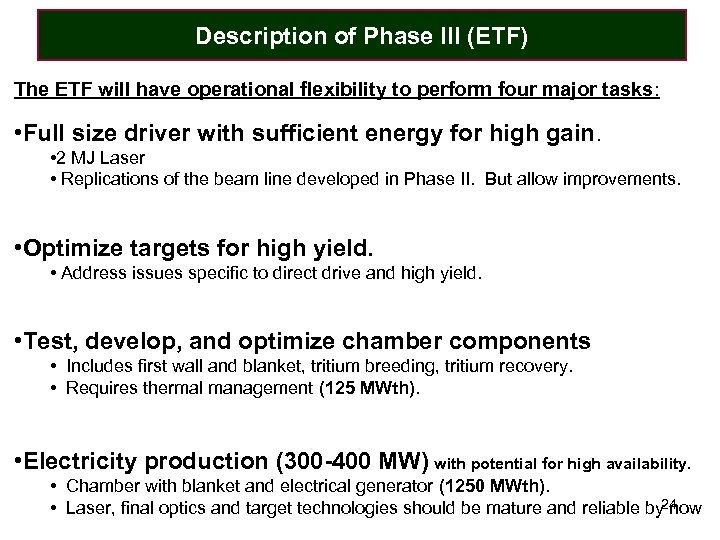 Description of Phase III (ETF) The ETF will have operational flexibility to perform four major tasks: • Full size driver with sufficient energy for high gain. • 2 MJ Laser • Replications of the beam line developed in Phase II. But allow improvements. • Optimize targets for high yield. • Address issues specific to direct drive and high yield. • Test, develop, and optimize chamber components • Includes first wall and blanket, tritium breeding, tritium recovery. • Requires thermal management (125 MWth). • Electricity production (300 -400 MW) with potential for high availability. • Chamber with blanket and electrical generator (1250 MWth). 24 • Laser, final optics and target technologies should be mature and reliable by now
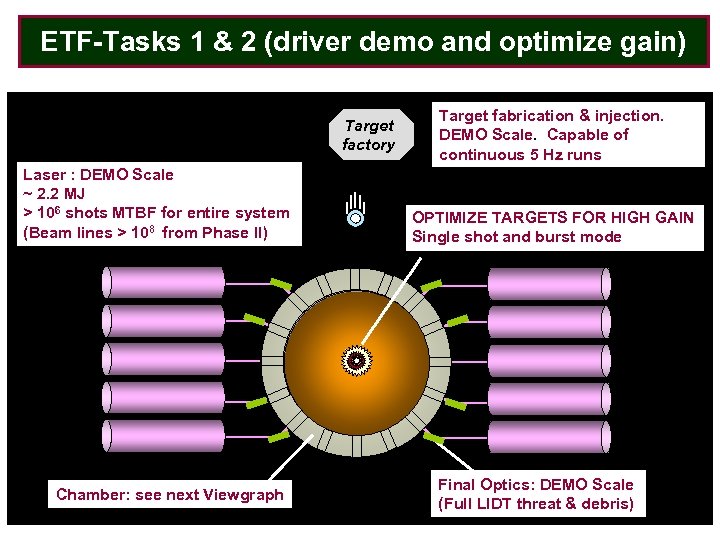 ETF-Tasks 1 & 2 (driver demo and optimize gain) Target factory Laser : DEMO Scale ~ 2. 2 MJ > 106 shots MTBF for entire system (Beam lines > 108 from Phase II) Chamber: see next Viewgraph Target fabrication & injection. DEMO Scale. Capable of continuous 5 Hz runs OPTIMIZE TARGETS FOR HIGH GAIN Single shot and burst mode Final Optics: DEMO Scale (Full LIDT threat & debris) 25
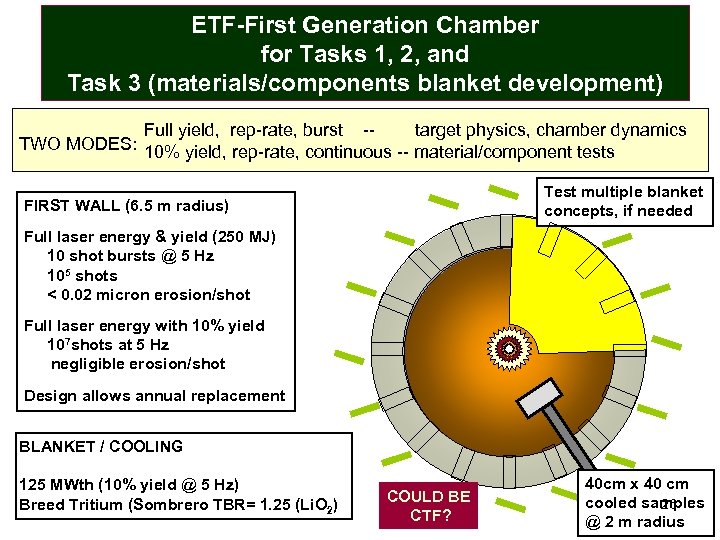 ETF-First Generation Chamber for Tasks 1, 2, and Task 3 (materials/components blanket development) Full yield, rep-rate, burst -- target physics, chamber dynamics TWO MODES: 10% yield, rep-rate, continuous -- material/component tests Test multiple blanket concepts, if needed FIRST WALL (6. 5 m radius) Full laser energy & yield (250 MJ) 10 shot bursts @ 5 Hz 105 shots < 0. 02 micron erosion/shot Full laser energy with 10% yield 107 shots at 5 Hz negligible erosion/shot Design allows annual replacement BLANKET / COOLING 125 MWth (10% yield @ 5 Hz) Breed Tritium (Sombrero TBR= 1. 25 (Li. O 2) COULD BE CTF? 40 cm x 40 cm cooled samples 26 @ 2 m radius
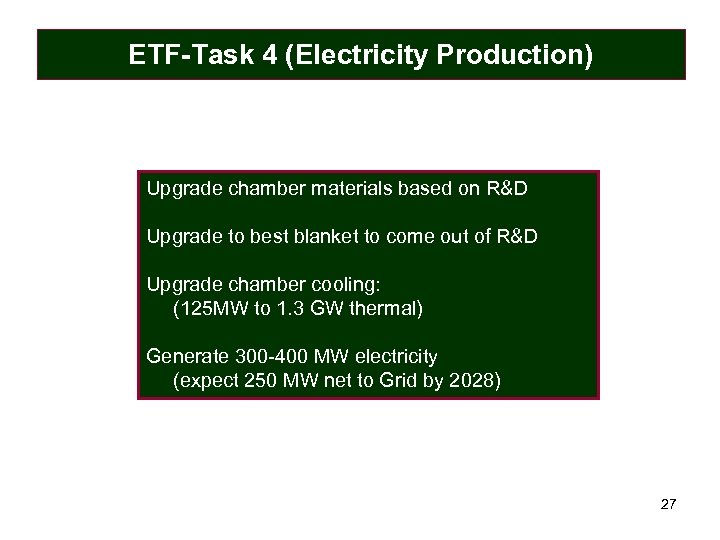 ETF-Task 4 (Electricity Production) Upgrade chamber materials based on R&D Upgrade to best blanket to come out of R&D Upgrade chamber cooling: (125 MW to 1. 3 GW thermal) Generate 300 -400 MW electricity (expect 250 MW net to Grid by 2028) 27
 Cost Breakdown for ETF: Kr. F laser 28
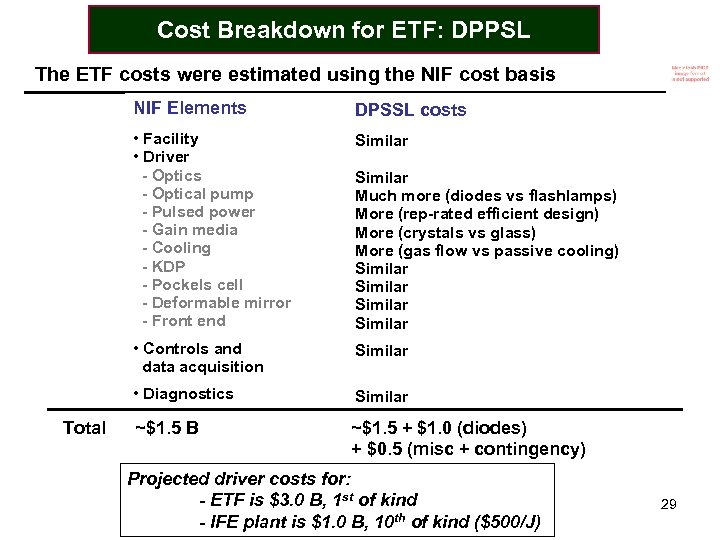 Cost Breakdown for ETF: DPPSL The ETF costs were estimated using the NIF cost basis NIF Elements • Facility • Driver - Optics - Optical pump - Pulsed power - Gain media - Cooling - KDP - Pockels cell - Deformable mirror - Front end Similar • Controls and data acquisition Similar • Diagnostics Total DPSSL costs Similar ~$1. 5 B ~$1. 5 + $1. 0 (diodes) + $0. 5 (misc + contingency) Similar Much more (diodes vs flashlamps) More (rep-rated efficient design) More (crystals vs glass) More (gas flow vs passive cooling) Similar Projected driver costs for: - ETF is $3. 0 B, 1 st of kind - IFE plant is $1. 0 B, 10 th of kind ($500/J) 29
 Cost Breakdown for ETF: other technologies 30
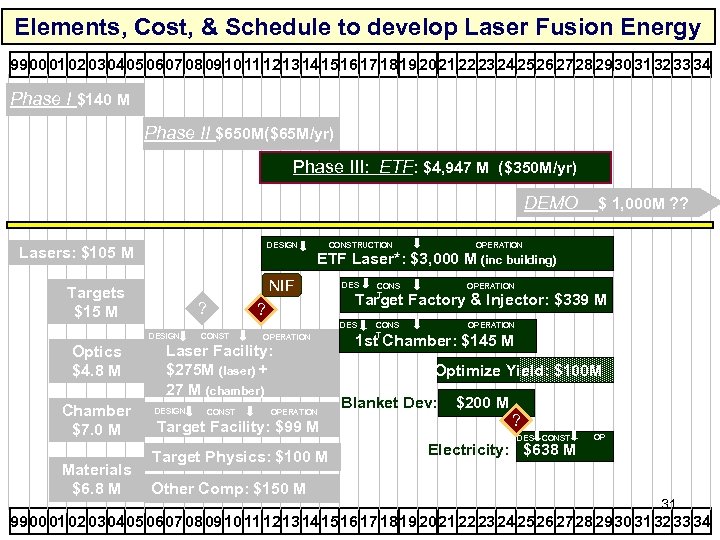 Elements, Cost, & Schedule to develop Laser Fusion Energy 99 00 01 02 03 04 05 06 07 08 09 10 11 1213 14 1516 17 18 19 20 21 22 23 24 25 26 27 28 2930 31 32 33 34 Phase I $140 M Phase II $650 M($65 M/yr) Phase III: ETF: $4, 947 M ($350 M/yr) DEMO DESIGN Lasers: $105 M CONSTRUCTION NIF ? ? DES Materials $6. 8 M CONST OPERATION Laser Facility: $275 M (laser) + 27 M (chamber) DESIGN CONST OPERATION Target Facility: $99 M Target Physics: $100 M Other Comp: $150 M CONS T OPERATION Target Factory & Injector: $339 M DESIGN Chamber $7. 0 M OPERATION ETF Laser*: $3, 000 M (inc building) Targets $15 M Optics $4. 8 M $ 1, 000 M ? ? 1 st Chamber: $145 M Optimize Yield: $100 M Blanket Dev: $200 M ? DES CONST Electricity: $638 M OP 31 99 00 01 02 03 04 05 06 07 08 09 10 11 1213 14 1516 17 18 19 20 21 22 23 24 25 26 27 28 2930 31 32 33 34
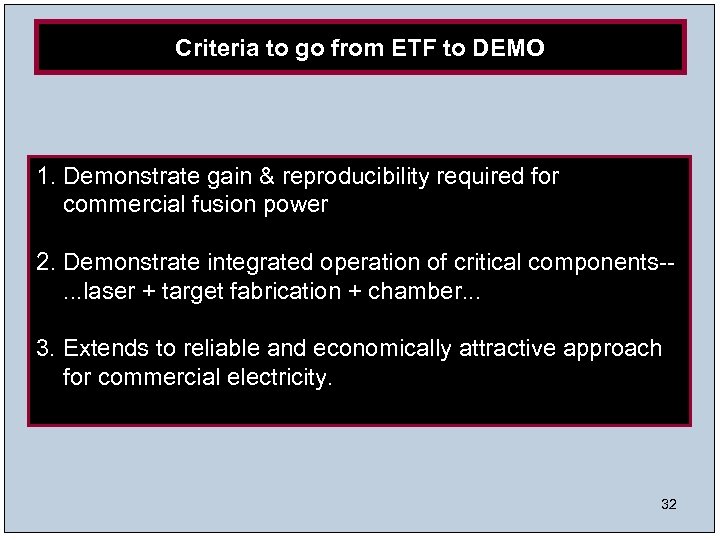 Criteria to go from ETF to DEMO 1. Demonstrate gain & reproducibility required for commercial fusion power 2. Demonstrate integrated operation of critical components-. . . laser + target fabrication + chamber. . . 3. Extends to reliable and economically attractive approach for commercial electricity. 32
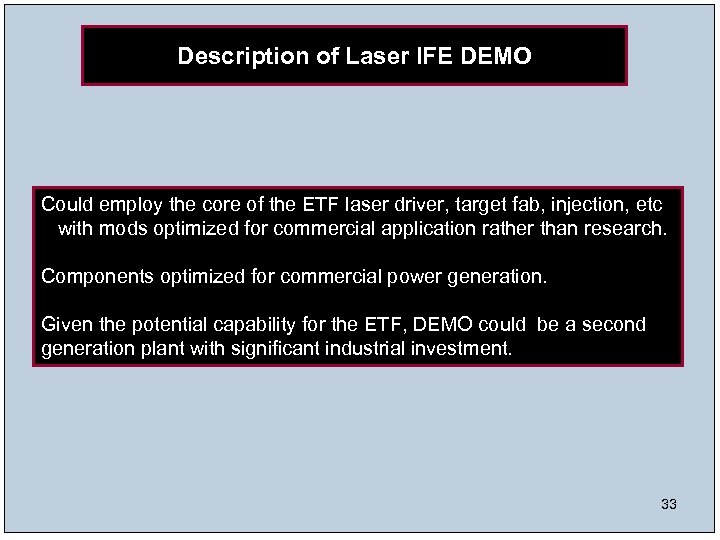 Description of Laser IFE DEMO Could employ the core of the ETF laser driver, target fab, injection, etc with mods optimized for commercial application rather than research. Components optimized for commercial power generation. Given the potential capability for the ETF, DEMO could be a second generation plant with significant industrial investment. 33
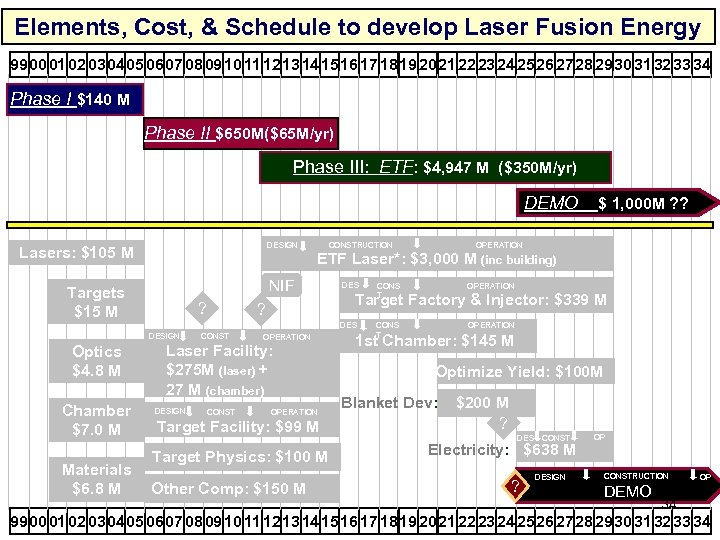 Elements, Cost, & Schedule to develop Laser Fusion Energy 99 00 01 02 03 04 05 06 07 08 09 10 11 1213 14 1516 17 18 19 20 21 22 23 24 25 26 27 28 2930 31 32 33 34 Phase I $140 M Phase II $650 M($65 M/yr) Phase III: ETF: $4, 947 M ($350 M/yr) DEMO DESIGN Lasers: $105 M CONSTRUCTION NIF ? ? DES Materials $6. 8 M CONST OPERATION Laser Facility: $275 M (laser) + 27 M (chamber) DESIGN CONST OPERATION Target Facility: $99 M Target Physics: $100 M Other Comp: $150 M CONS T OPERATION Target Factory & Injector: $339 M DESIGN Chamber $7. 0 M OPERATION ETF Laser*: $3, 000 M (inc building) Targets $15 M Optics $4. 8 M $ 1, 000 M ? ? 1 st Chamber: $145 M Optimize Yield: $100 M Blanket Dev: $200 M ? DES CONST Electricity: $638 M ? DESIGN OP CONSTRUCTION DEMO OP 34 99 00 01 02 03 04 05 06 07 08 09 10 11 1213 14 1516 17 18 19 20 21 22 23 24 25 26 27 28 2930 31 32 33 34
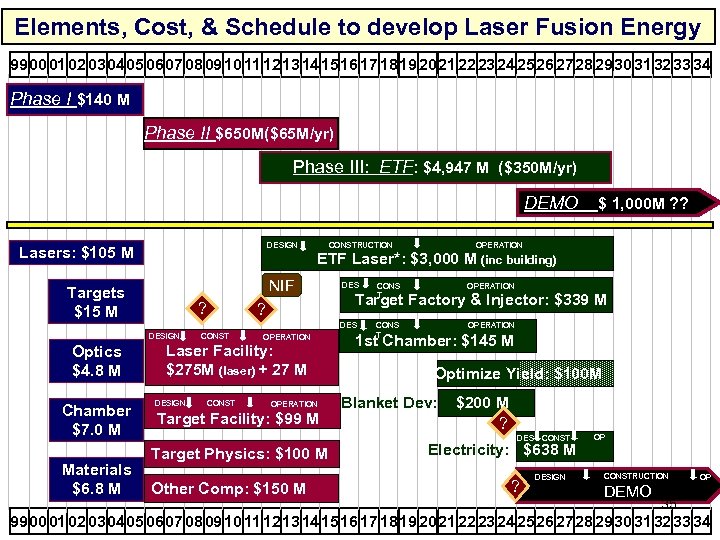 Elements, Cost, & Schedule to develop Laser Fusion Energy 99 00 01 02 03 04 05 06 07 08 09 10 11 1213 14 1516 17 18 19 20 21 22 23 24 25 26 27 28 2930 31 32 33 34 Phase I $140 M Phase II $650 M($65 M/yr) Phase III: ETF: $4, 947 M ($350 M/yr) DEMO DESIGN Lasers: $105 M CONSTRUCTION NIF ? ? DES CONST OPERATION Laser Facility: $275 M (laser) + 27 M (chamber) Materials $6. 8 M DESIGN CONST OPERATION Target Facility: $99 M CONS T OPERATION Target Factory & Injector: $339 M DESIGN Chamber $7. 0 M OPERATION ETF Laser*: $3, 000 M (inc building) Targets $15 M Optics $4. 8 M $ 1, 000 M ? ? 1 st Chamber: $145 M Optimize Yield: $100 M Blanket Dev: $200 M ? DES Target Physics: $100 M Other Comp: $150 M CONST Electricity: $638 M ? DESIGN OP CONSTRUCTION DEMO OP 35 99 00 01 02 03 04 05 06 07 08 09 10 11 1213 14 1516 17 18 19 20 21 22 23 24 25 26 27 28 2930 31 32 33 34