


 Скачать презентацию A particle monitor for LISA Pathfinder and Gravity
16395eab4fb70a8c988002c170889e6b.ppt
- Количество слайдов: 16
 A particle monitor for LISA Pathfinder and Gravity Probe-B gyroscope charging in LEO Peter Wass, Henrique Araújo, Tim Sumner Imperial College London, UK Mokhtar Chmiessani, Alberto Lobo, IFAE & IEEC, Barcelona, Spain Lenny Sapronov, Sasha Buchman Stanford University, California, USA
 Talk outline • • • LISA and LISA Pathfinder Previous GEANT work LISA Pathfinder radiation monitor definition Radiation monitor simulations Conclusions • • Gravity Probe B Gyroscope charging simulations and data Proton monitor simulations and data Conclusions
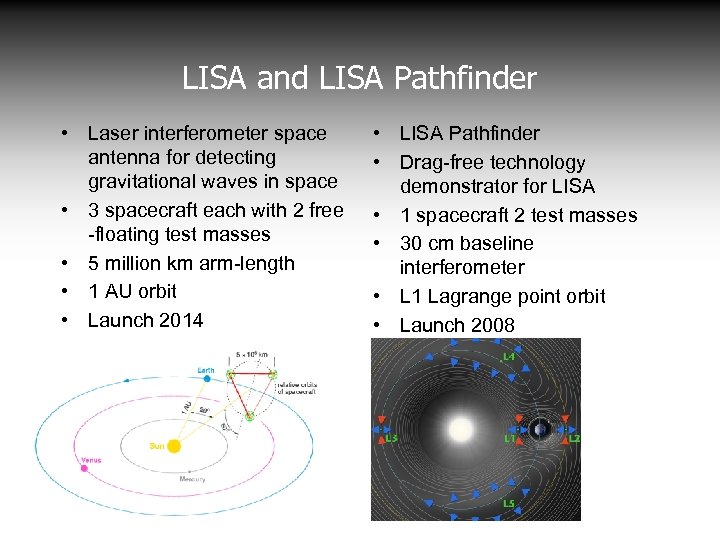 LISA and LISA Pathfinder • Laser interferometer space antenna for detecting gravitational waves in space • 3 spacecraft each with 2 free -floating test masses • 5 million km arm-length • 1 AU orbit • Launch 2014 • LISA Pathfinder • Drag-free technology demonstrator for LISA • 1 spacecraft 2 test masses • 30 cm baseline interferometer • L 1 Lagrange point orbit • Launch 2008
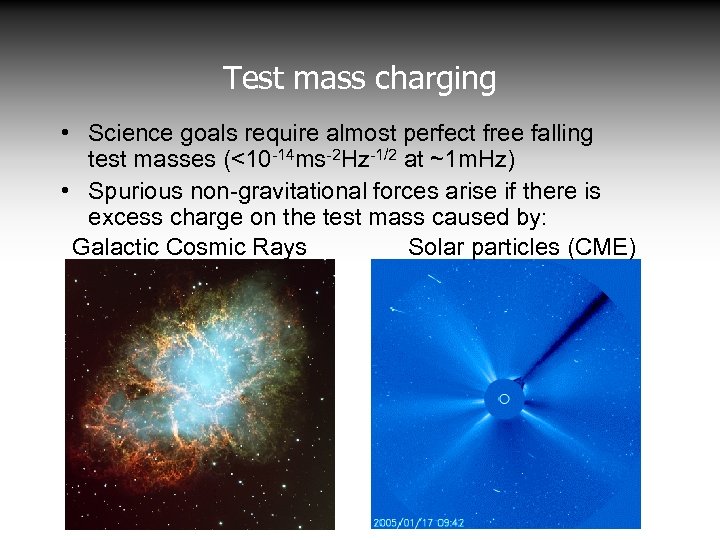 Test mass charging • Science goals require almost perfect free falling test masses (<10 -14 ms-2 Hz-1/2 at ~1 m. Hz) • Spurious non-gravitational forces arise if there is excess charge on the test mass caused by: Galactic Cosmic Rays Solar particles (CME)
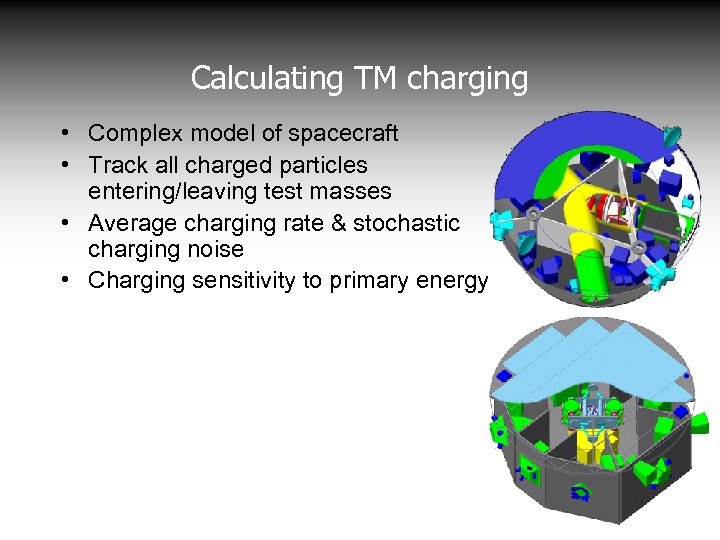 Calculating TM charging • Complex model of spacecraft • Track all charged particles entering/leaving test masses • Average charging rate & stochastic charging noise • Charging sensitivity to primary energy
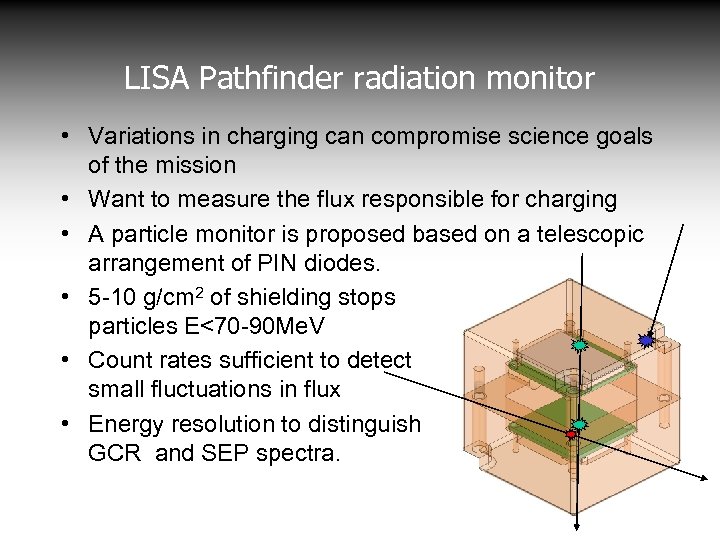 LISA Pathfinder radiation monitor • Variations in charging can compromise science goals of the mission • Want to measure the flux responsible for charging • A particle monitor is proposed based on a telescopic arrangement of PIN diodes. • 5 -10 g/cm 2 of shielding stops particles E<70 -90 Me. V • Count rates sufficient to detect small fluctuations in flux • Energy resolution to distinguish GCR and SEP spectra.
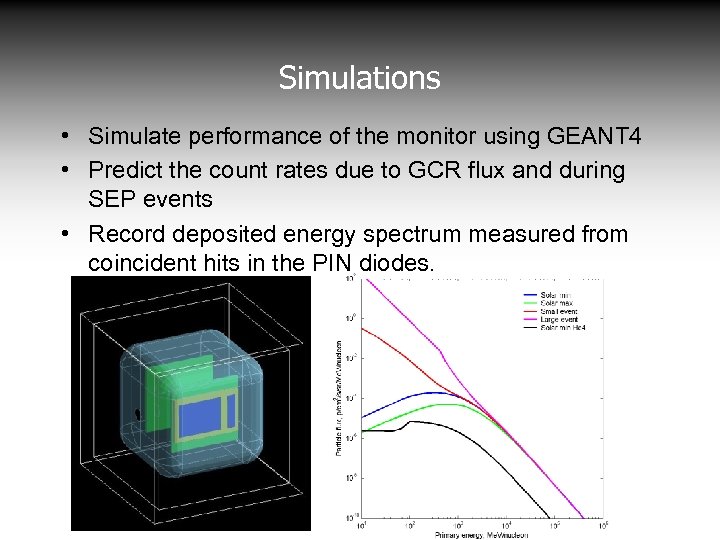 Simulations • Simulate performance of the monitor using GEANT 4 • Predict the count rates due to GCR flux and during SEP events • Record deposited energy spectrum measured from coincident hits in the PIN diodes.
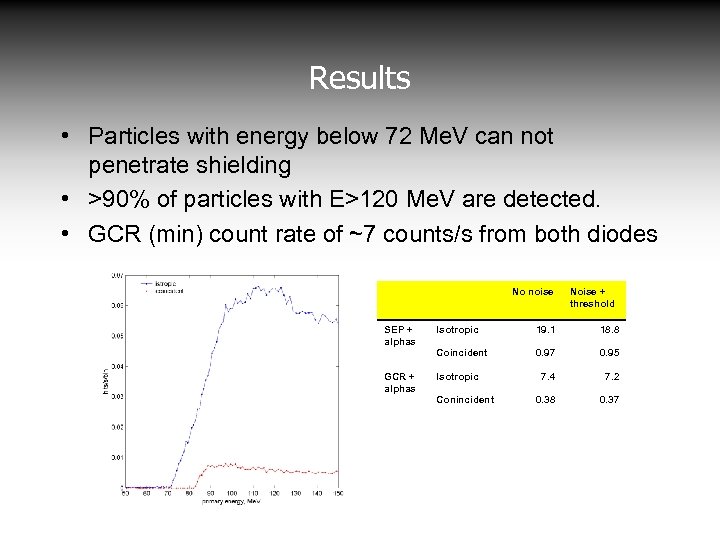 Results • Particles with energy below 72 Me. V can not penetrate shielding • >90% of particles with E>120 Me. V are detected. • GCR (min) count rate of ~7 counts/s from both diodes No noise SEP + alphas Noise + threshold 19. 1 18. 8 Coincident GCR + alphas Isotropic 0. 97 0. 95 7. 4 7. 2 0. 38 0. 37 Isotropic Conincident
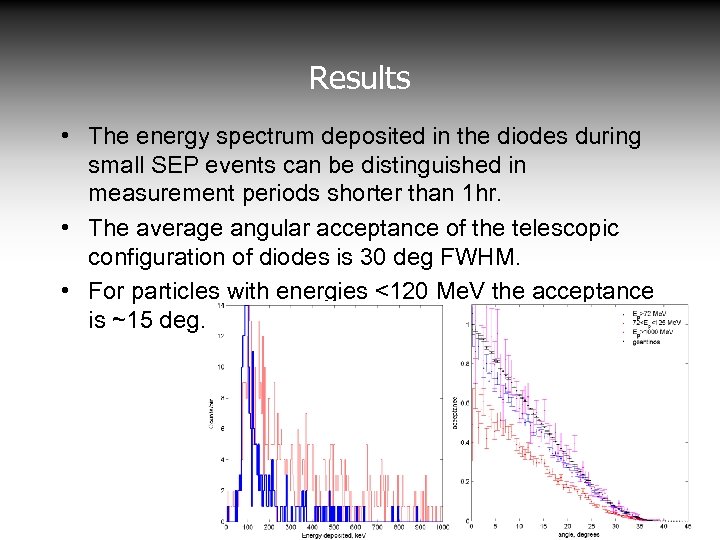 Results • The energy spectrum deposited in the diodes during small SEP events can be distinguished in measurement periods shorter than 1 hr. • The average angular acceptance of the telescopic configuration of diodes is 30 deg FWHM. • For particles with energies <120 Me. V the acceptance is ~15 deg.
 Conclusions and Future work • According to simulations, the monitor fulfils all requirements • 28 October 2005 - Radiation monitor testing at PSI • Using 50 -250 Me. V protons, measure: – – Shielding cut-off Max count rates Angular dependence Diode degradation
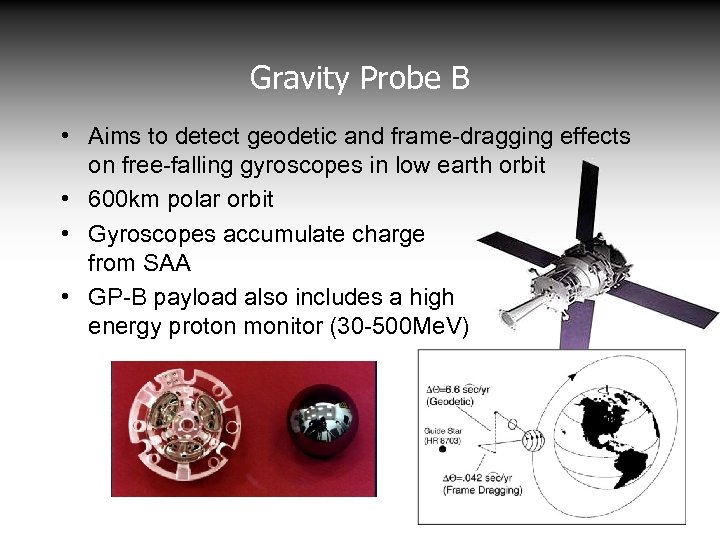 Gravity Probe B • Aims to detect geodetic and frame-dragging effects on free-falling gyroscopes in low earth orbit • 600 km polar orbit • Gyroscopes accumulate charge from SAA • GP-B payload also includes a high energy proton monitor (30 -500 Me. V)
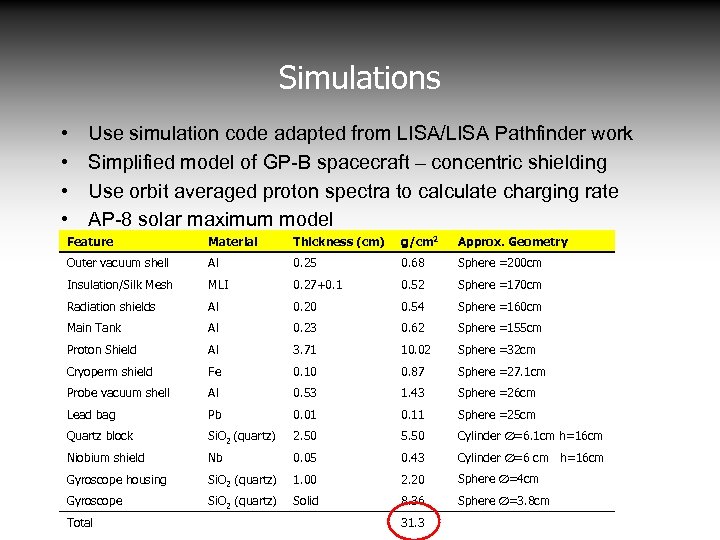 Simulations • • Use simulation code adapted from LISA/LISA Pathfinder work Simplified model of GP-B spacecraft – concentric shielding Use orbit averaged proton spectra to calculate charging rate AP-8 solar maximum model Feature Material Thickness (cm) g/cm 2 Approx. Geometry Outer vacuum shell Al 0. 25 0. 68 Sphere =200 cm Insulation/Silk Mesh MLI 0. 27+0. 1 0. 52 Sphere =170 cm Radiation shields Al 0. 20 0. 54 Sphere =160 cm Main Tank Al 0. 23 0. 62 Sphere =155 cm Proton Shield Al 3. 71 10. 02 Sphere =32 cm Cryoperm shield Fe 0. 10 0. 87 Sphere =27. 1 cm Probe vacuum shell Al 0. 53 1. 43 Sphere =26 cm Lead bag Pb 0. 01 0. 11 Sphere =25 cm Quartz block Si. O 2 (quartz) 2. 50 5. 50 Cylinder =6. 1 cm h=16 cm Niobium shield Nb 0. 05 0. 43 Cylinder =6 cm h=16 cm Gyroscope housing Si. O 2 (quartz) 1. 00 2. 20 Sphere =4 cm Gyroscope Si. O 2 (quartz) Solid 8. 36 Sphere =3. 8 cm Total 31. 3
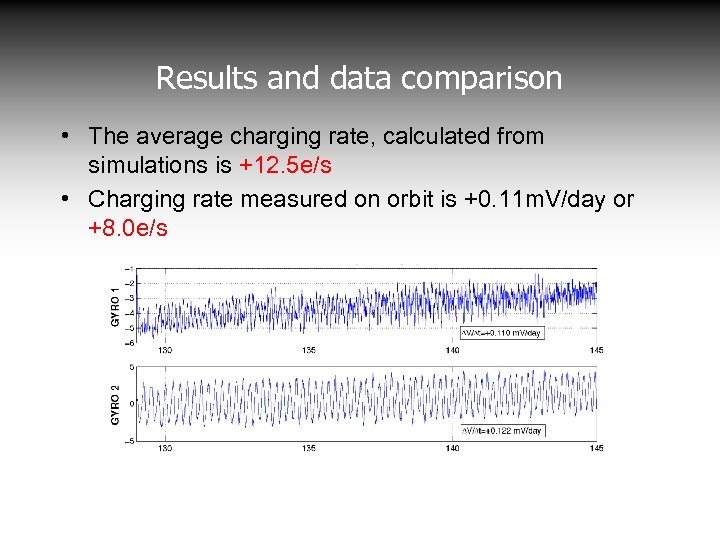 Results and data comparison • The average charging rate, calculated from simulations is +12. 5 e/s • Charging rate measured on orbit is +0. 11 m. V/day or +8. 0 e/s
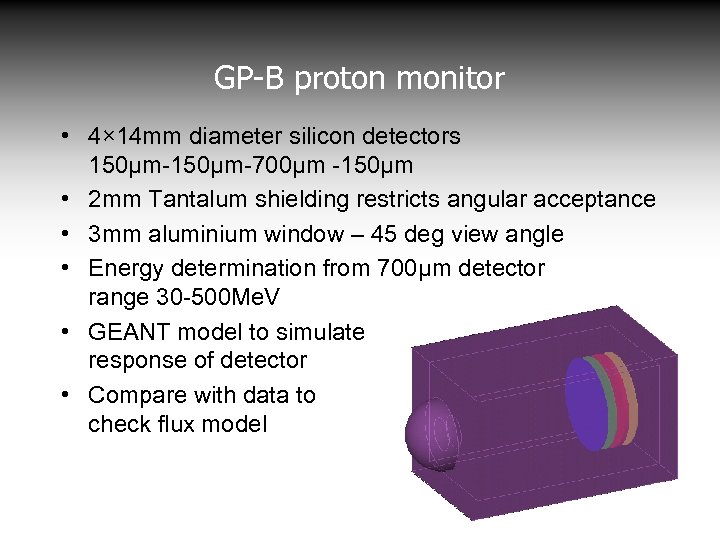 GP-B proton monitor • 4× 14 mm diameter silicon detectors 150µm-700µm -150µm • 2 mm Tantalum shielding restricts angular acceptance • 3 mm aluminium window – 45 deg view angle • Energy determination from 700µm detector range 30 -500 Me. V • GEANT model to simulate response of detector • Compare with data to check flux model
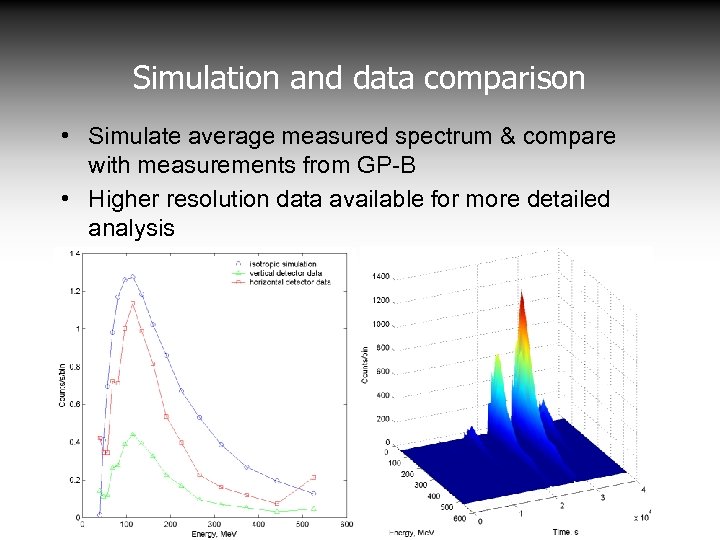 Simulation and data comparison • Simulate average measured spectrum & compare with measurements from GP-B • Higher resolution data available for more detailed analysis
 Conclusions and Future work • • • Early results seem in good agreement Test other radiation models Charging/proton counts during solar particle event Difference between gyros? Simulate more complex geometry? Dedicated post-science phase measurements?