 Скачать презентацию A Parallel External-Memory Frontier Breadth-First Traversal Algorithm for
8a841e6cbdfa84337dcc9abd0fc84c32.ppt
- Количество слайдов: 18




A Parallel External-Memory Frontier Breadth-First Traversal Algorithm for Clusters of Workstations Robert Niewiadomski, José Nelson Amaral, and Robert C. Holte Department of Computing Science, Edmonton, Alberta, Canada
Overview • A parallel algorithm for executing a breadth-first traversal algorithm of an implicit graph, a. k. a. state space • The algorithm: • is based on the frontier breadth-first traversal algorithm • is secondary-storage oriented • is designed to run on a distributed-memory system • features: • bandwidth-bound secondary-storage access • bandwidth-bound communication • automated and adaptive workload distribution • Traverse bigger graphs and traverse them faster
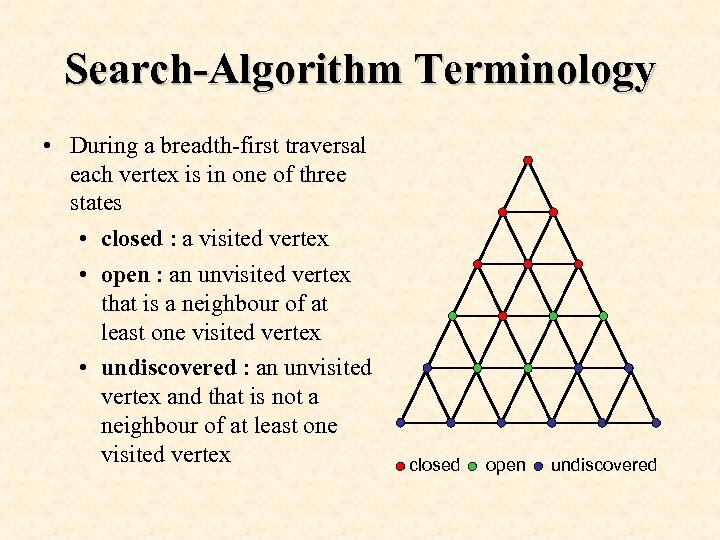
Search-Algorithm Terminology • During a breadth-first traversal each vertex is in one of three states • closed : a visited vertex • open : an unvisited vertex that is a neighbour of at least one visited vertex • undiscovered : an unvisited vertex and that is not a neighbour of at least one visited vertex closed open undiscovered
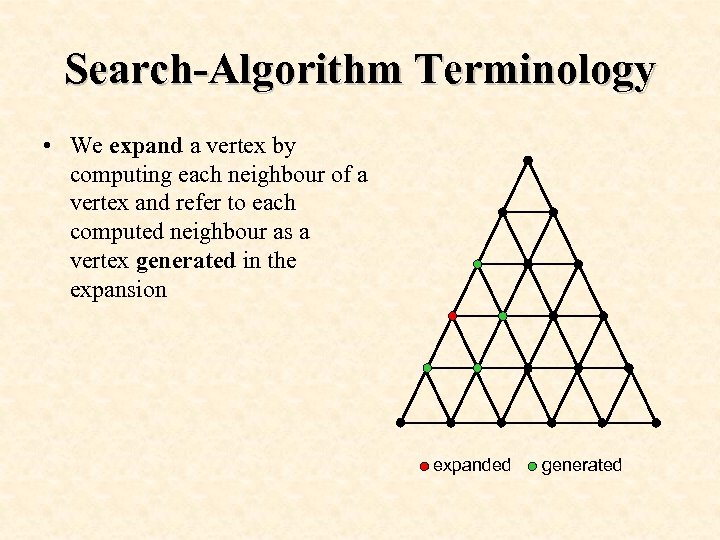
Search-Algorithm Terminology • We expand a vertex by computing each neighbour of a vertex and refer to each computed neighbour as a vertex generated in the expansion expanded generated
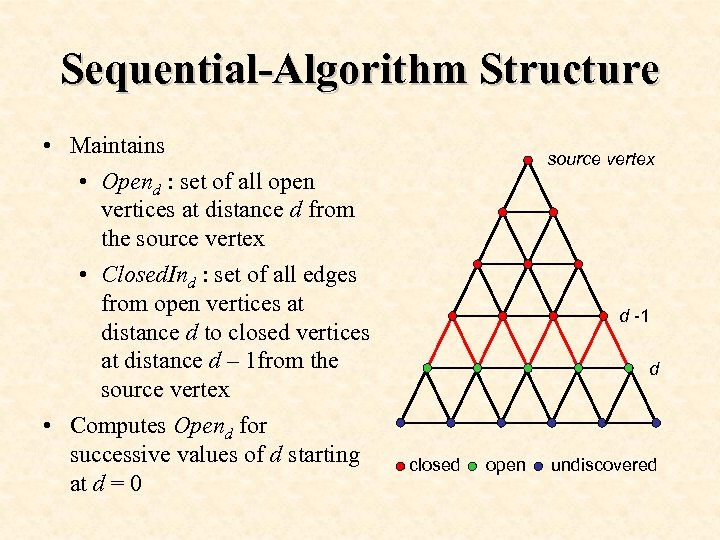
Sequential-Algorithm Structure • Maintains • Opend : set of all open vertices at distance d from the source vertex • Closed. Ind : set of all edges from open vertices at distance d to closed vertices at distance d – 1 from the source vertex • Computes Opend for successive values of d starting at d = 0 source vertex d -1 d closed open undiscovered
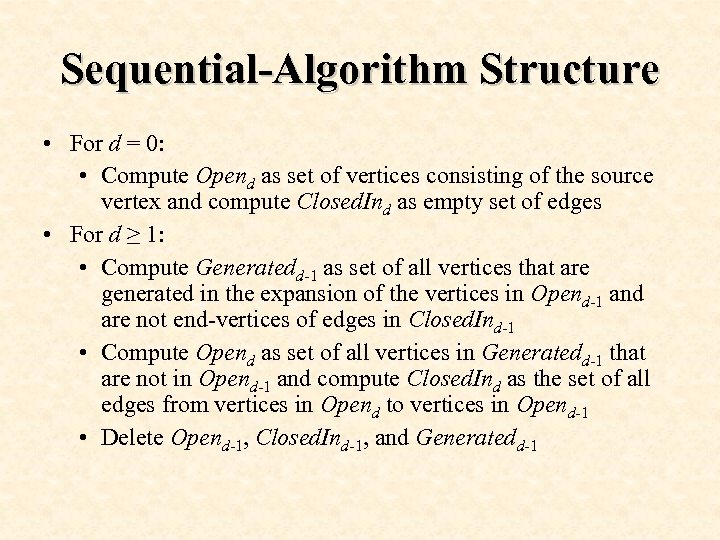
Sequential-Algorithm Structure • For d = 0: • Compute Opend as set of vertices consisting of the source vertex and compute Closed. Ind as empty set of edges • For d ≥ 1: • Compute Generatedd-1 as set of all vertices that are generated in the expansion of the vertices in Opend-1 and are not end-vertices of edges in Closed. Ind-1 • Compute Opend as set of all vertices in Generatedd-1 that are not in Opend-1 and compute Closed. Ind as the set of all edges from vertices in Opend to vertices in Opend-1 • Delete Opend-1, Closed. Ind-1, and Generatedd-1
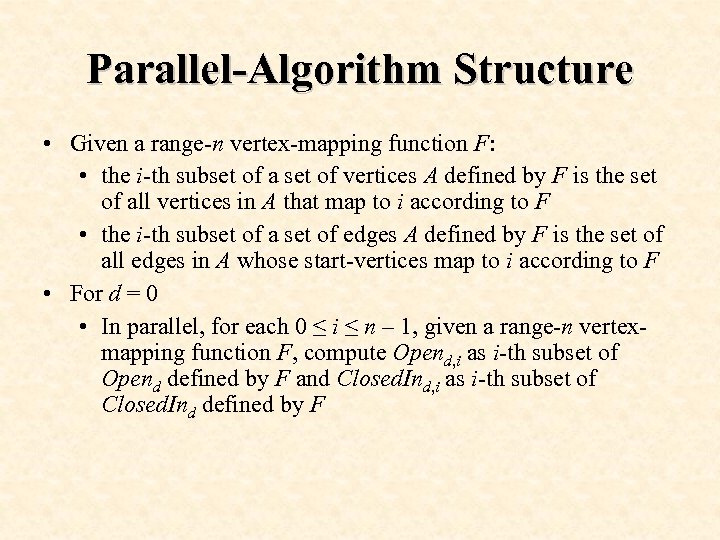
Parallel-Algorithm Structure • Given a range-n vertex-mapping function F: • the i-th subset of a set of vertices A defined by F is the set of all vertices in A that map to i according to F • the i-th subset of a set of edges A defined by F is the set of all edges in A whose start-vertices map to i according to F • For d = 0 • In parallel, for each 0 ≤ i ≤ n – 1, given a range-n vertexmapping function F, compute Opend, i as i-th subset of Opend defined by F and Closed. Ind, i as i-th subset of Closed. Ind defined by F
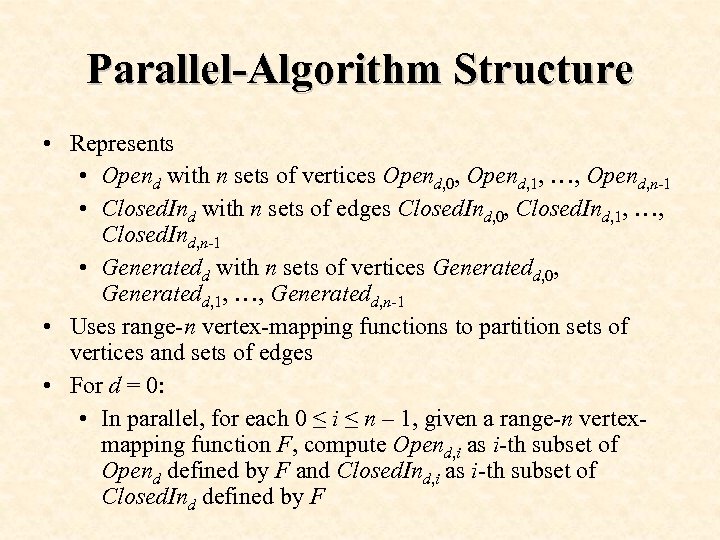
Parallel-Algorithm Structure • Represents • Opend with n sets of vertices Opend, 0, Opend, 1, …, Opend, n-1 • Closed. Ind with n sets of edges Closed. Ind, 0, Closed. Ind, 1, …, Closed. Ind, n-1 • Generatedd with n sets of vertices Generatedd, 0, Generatedd, 1, …, Generatedd, n-1 • Uses range-n vertex-mapping functions to partition sets of vertices and sets of edges • For d = 0: • In parallel, for each 0 ≤ i ≤ n – 1, given a range-n vertexmapping function F, compute Opend, i as i-th subset of Opend defined by F and Closed. Ind, i as i-th subset of Closed. Ind defined by F

Parallel-Algorithm Structure • For d ≥ 1: • In parallel, for each 0 ≤ i ≤ n – 1, compute Generatedd-1, i as set of all vertices that are generated in the expansion of the vertices in Opend-1, i and are not end-points of edges in Closed. Ind-1, i • In parallel, given range-n vertex-mapping function F, for each 0 ≤ i ≤ n – 1, logically partition Opend-1, i into the n subsets defined by F and logically partition Generatedd-1, i into the n subsets defined by F
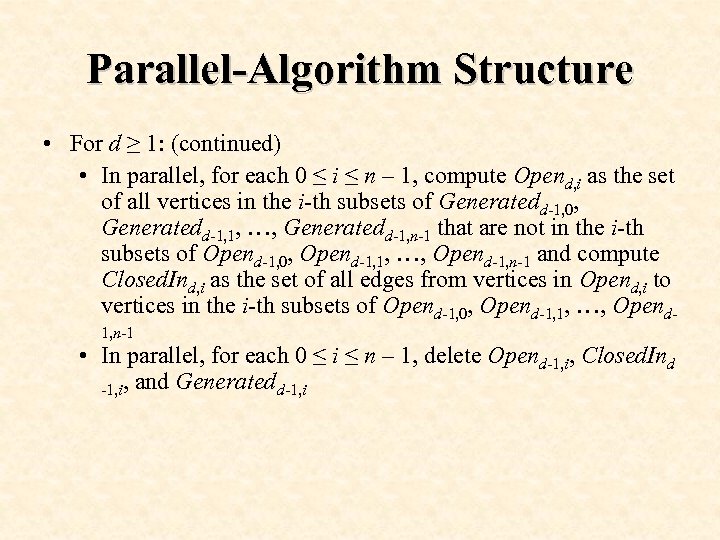
Parallel-Algorithm Structure • For d ≥ 1: (continued) • In parallel, for each 0 ≤ i ≤ n – 1, compute Opend, i as the set of all vertices in the i-th subsets of Generatedd-1, 0, Generatedd-1, 1, …, Generatedd-1, n-1 that are not in the i-th subsets of Opend-1, 0, Opend-1, 1, …, Opend-1, n-1 and compute Closed. Ind, i as the set of all edges from vertices in Opend, i to vertices in the i-th subsets of Opend-1, 0, Opend-1, 1, …, Opend 1, n-1 • In parallel, for each 0 ≤ i ≤ n – 1, delete Opend-1, i, Closed. Ind -1, i, and Generatedd-1, i
Implementation • Uses record runs and record sub-runs • a record consists of a vertex and of a subset of edges that start at the vertex • a run is a list of records where records appear in a nondecreasing order of their vertices • a sub-run maps a sub-list of a run • Encapsulates • Opend, i and Closed. Ind, i with run Xd, i • Generatedd, i and set of all vertices in Generatedd, i to vertices in Opend, i with list of runs Yd, i
Implementation • Range-n vertex-mapping functions • n vertex intervals that split vertex interval from -∞ to ∞ • map vertex to i if it falls into i-th interval • map edge to i if its start vertex falls into i-th interval • the n vertex intervals are computed via a sampling-based mechanism • sample vertices of records in each Xd, i and in each Yd, i at a regular stride, collect samples, and compute n – 1 splitting points • use binary search to compute sub-runs of Xd, i and of runs in Yd, i that correspond to sub-sets defined by range-n vertexmapping function
Implementation • Each Xd, i and Yd, i resides in secondary storage of i-th workstation • Each workstation i executes two processes • worker : performs algorithm • server : facilitates streaming-access to Xd, i and each run in Yd, i to remote workers
![Xd-1, 0 Xd-1, 1 Xd-1, 2 Expand Yd-1, 0[0] Yd-1, 0[1] Yd-1, 1[0] Yd-1,](https://present5.com/presentation/8a841e6cbdfa84337dcc9abd0fc84c32/image-14.jpg "Xd-1, 0 Xd-1, 1 Xd-1, 2 Expand Yd-1, 0[0] Yd-1, 0[1] Yd-1, 1[0] Yd-1,")
Xd-1, 0 Xd-1, 1 Xd-1, 2 Expand Yd-1, 0[0] Yd-1, 0[1] Yd-1, 1[0] Yd-1, 1[1] Yd-1, 2[0] Yd-1, 2[1]
![Xd-1, 0 Yd-1, 0[0] Yd-1, 0[1] Local Sample Xd-1, 1 Yd-1, 1[0] Yd-1, 1[1]](https://present5.com/presentation/8a841e6cbdfa84337dcc9abd0fc84c32/image-15.jpg "Xd-1, 0 Yd-1, 0[0] Yd-1, 0[1] Local Sample Xd-1, 1 Yd-1, 1[0] Yd-1, 1[1]")
Xd-1, 0 Yd-1, 0[0] Yd-1, 0[1] Local Sample Xd-1, 1 Yd-1, 1[0] Yd-1, 1[1] Local Sample Xd-1, 2 Yd-1, 2[0] Yd-1, 2[1] Local Sample Global Sample Logical Partition Xd-1, 0 Yd-1, 0[0] Yd-1, 0[1] Logical Partition Xd-1, 1 Yd-1, 1[0] Yd-1, 1[1] Logical Partition Xd-1, 2 Yd-1, 2[0] Yd-1, 2[1]
![Xd-1, 0 Yd-1, 0[0] Yd-1, 0[1] Reconcile Xd, 0 Xd-1, 1 Yd-1, 1[0] Yd-1,](https://present5.com/presentation/8a841e6cbdfa84337dcc9abd0fc84c32/image-16.jpg "Xd-1, 0 Yd-1, 0[0] Yd-1, 0[1] Reconcile Xd, 0 Xd-1, 1 Yd-1, 1[0] Yd-1,")
Xd-1, 0 Yd-1, 0[0] Yd-1, 0[1] Reconcile Xd, 0 Xd-1, 1 Yd-1, 1[0] Yd-1, 1[1] Reconcile Xd, 1 Xd-1, 2 Yd-1, 2[0] Yd-1, 2[1] Reconcile Xd, 2
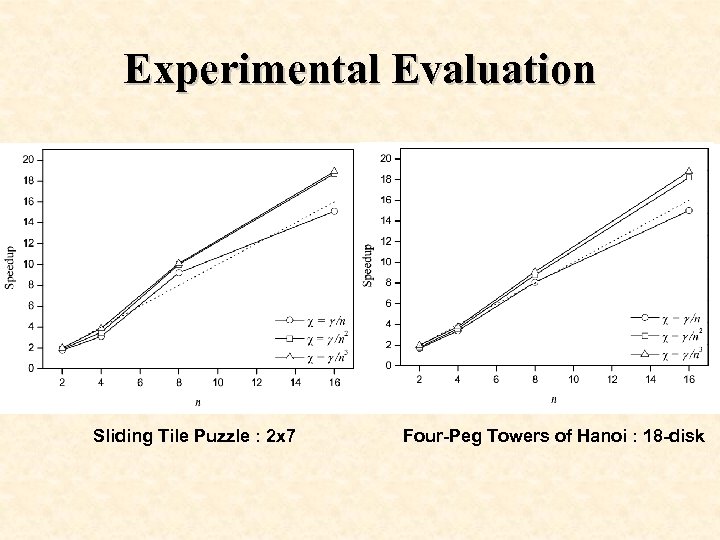
Experimental Evaluation Sliding Tile Puzzle : 2 x 7 Four-Peg Towers of Hanoi : 18 -disk
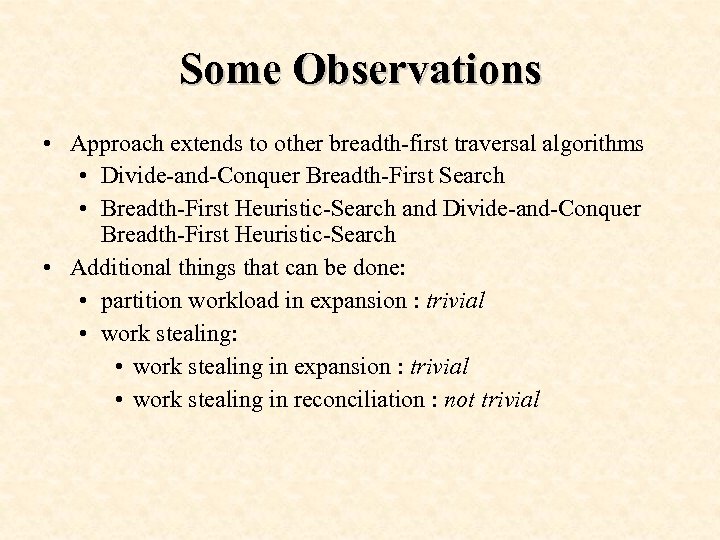
Some Observations • Approach extends to other breadth-first traversal algorithms • Divide-and-Conquer Breadth-First Search • Breadth-First Heuristic-Search and Divide-and-Conquer Breadth-First Heuristic-Search • Additional things that can be done: • partition workload in expansion : trivial • work stealing: • work stealing in expansion : trivial • work stealing in reconciliation : not trivial
Скачать презентацию A Parallel External-Memory Frontier Breadth-First Traversal Algorithm for
8a841e6cbdfa84337dcc9abd0fc84c32.ppt