


 Скачать презентацию A Novel Two-Dimensional LC MS MS Approach For Automated Analysis
ebfdb9039a9fe8b0802dc6a53e995dac.ppt
- Количество слайдов: 1
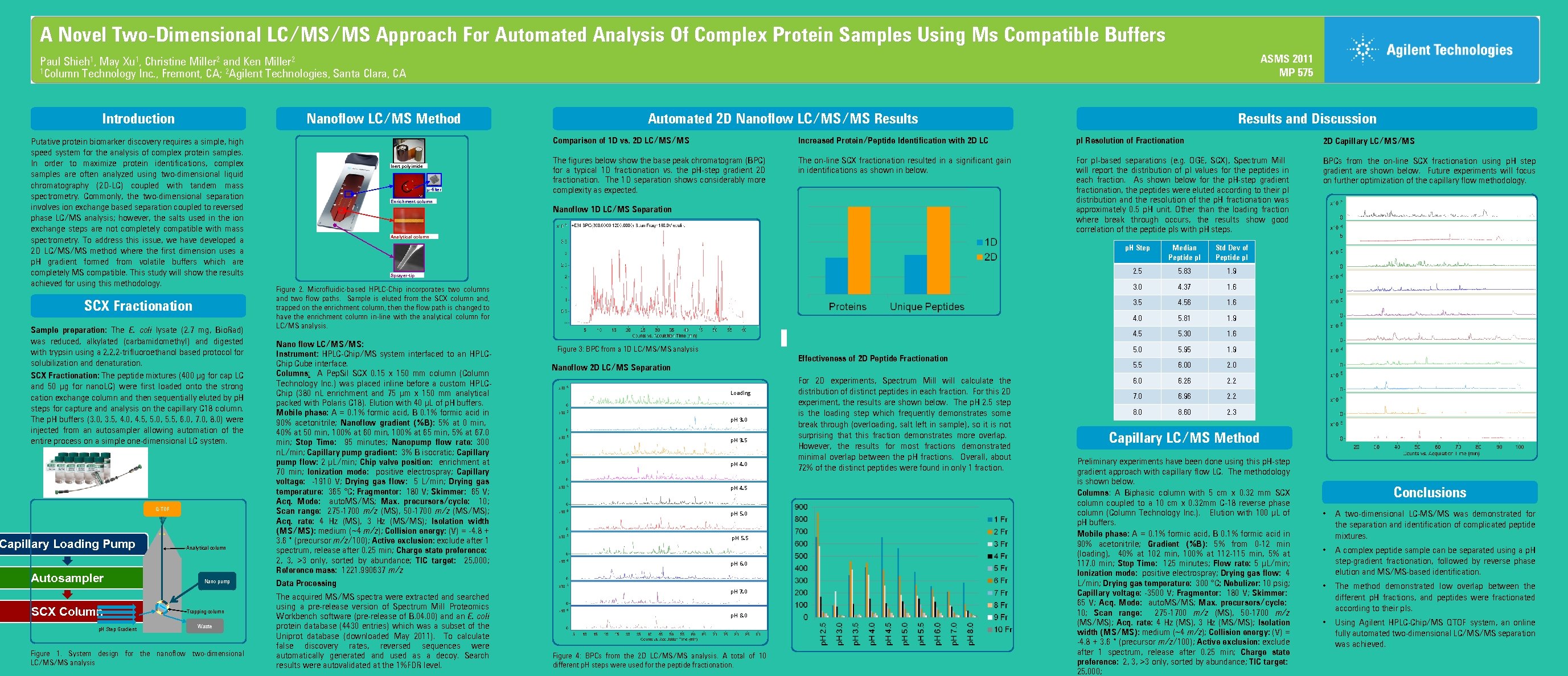 A Novel Two-Dimensional LC/MS/MS Approach For Automated Analysis Of Complex Protein Samples Using Ms Compatible Buffers ASMS 2011 MP 575 Paul Shieh 1, May Xu 1, Christine Miller 2 and Ken Miller 2 1 Column Technology Inc. , Fremont, CA; 2 Agilent Technologies, Santa Clara, CA Introduction Nanoflow LC/MS Method Putative protein biomarker discovery requires a simple, high speed system for the analysis of complex protein samples. In order to maximize protein identifications, complex samples are often analyzed using two-dimensional liquid chromatography (2 D-LC) coupled with tandem mass spectrometry. Commonly, the two-dimensional separation involves ion exchange based separation coupled to reversed phase LC/MS analysis; however, the salts used in the ion exchange steps are not completely compatible with mass spectrometry. To address this issue, we have developed a 2 D LC/MS/MS method where the first dimension uses a p. H gradient formed from volatile buffers which are completely MS compatible. This study will show the results achieved for using this methodology. SCX Fractionation Sample preparation: The E. coli lysate (2. 7 mg, Bio. Rad) was reduced, alkylated (carbamidomethyl) and digested with trypsin using a 2, 2, 2 -trifluoroethanol based protocol for solubilization and denaturation. SCX Fractionation: The peptide mixtures (400 µg for cap LC and 50 µg for nano. LC) were first loaded onto the strong cation exchange column and then sequentially eluted by p. H steps for capture and analysis on the capillary C 18 column. The p. H buffers (3. 0, 3. 5, 4. 0, 4. 5, 5. 0, 5. 5, 6. 0, 7. 0, 8. 0) were injected from an autosampler allowing automation of the entire process on a simple one-dimensional LC system. Q-TOF Capillary Loading Pump Autosampler SCX Column p. H Step Gradient Analytical column Nano pump Trapping column Waste Figure 1. System design for the nanoflow two-dimensional LC/MS/MS analysis Results and Discussion Automated Results and Discussion Results 2 D Nanoflow LC/MS/MS Comparison of 1 D vs. 2 D LC/MS/MS Inert polyimide µ-filter Enrichment column Increased Protein/Peptide Identification with 2 D LC p. I Resolution of Fractionation 2 D Capillary LC/MS/MS The figures below show the base peak chromatogram (BPC) for a typical 1 D fractionation vs. the p. H-step gradient 2 D fractionation. The 1 D separation shows considerably more complexity as expected. The on-line SCX fractionation resulted in a significant gain in identifications as shown in below. For p. I-based separations (e. g. OGE, SCX), Spectrum Mill will report the distribution of p. I values for the peptides in each fraction. As shown below for the p. H-step gradient fractionation, the peptides were eluted according to their p. I distribution and the resolution of the p. H fractionation was approximately 0. 5 p. H unit. Other than the loading fraction where break through occurs, the results show good correlation of the peptide p. Is with p. H steps. BPCs from the on-line SCX fractionation using p. H step gradient are shown below. Future experiments will focus on further optimization of the capillary flow methodology. Nanoflow 1 D LC/MS Separation Analytical column p. H Step Nano flow LC/MS/MS: Instrument: HPLC-Chip/MS system interfaced to an HPLCChip Cube interface. Columns: A Pep. Sil SCX 0. 15 x 150 mm column (Column Technology Inc. ) was placed inline before a custom HPLCChip (380 n. L enrichment and 75 µm x 150 mm analytical packed with Polaris C 18). Elution with 40 µL of p. H buffers. Mobile phase: A = 0. 1% formic acid, B 0. 1% formic acid in 90% acetonitrile; Nanoflow gradient (%B): 5% at 0 min, 40% at 50 min, 100% at 65 min, 5% at 67. 0 min; Stop Time: 95 minutes; Nanopump flow rate: 300 n. L/min; Capillary pump gradient: 3% B isocratic; Capillary pump flow: 2 µL/min; Chip valve position: enrichment at 70 min; Ionization mode: positive electrospray; Capillary voltage: -1910 V; Drying gas flow: 5 L/min; Drying gas temperature: 365 °C; Fragmentor: 180 V; Skimmer: 65 V; Acq. Mode: auto. MS/MS; Max. precursors/cycle: 10; Scan range: 275 -1700 m/z (MS), 50 -1700 m/z (MS/MS); Acq. rate: 4 Hz (MS), 3 Hz (MS/MS); Isolation width (MS/MS): medium (~4 m/z); Collision energy: (V) = -4. 8 + 3. 6 * (precursor m/z/100); Active exclusion: exclude after 1 spectrum, release after 0. 25 min; Charge state preference: 2, 3, >3 only, sorted by abundance; TIC target: 25, 000; Reference mass: 1221. 990637 m/z Data Processing The acquired MS/MS spectra were extracted and searched using a pre-release version of Spectrum Mill Proteomics Workbench software (pre-release of B. 04. 00) and an E. coli protein database (4430 entries) which was a subset of the Uniprot database (downloaded May 2011). To calculate false discovery rates, reversed sequences were automatically generated and used as a decoy. Search results were autovalidated at the 1%FDR level. Loading p. H 3. 0 p. H 3. 5 p. H 4. 0 p. H 4. 5 p. H 5. 0 p. H 5. 5 p. H 6. 0 p. H 7. 0 p. H 8. 0 Figure 4: BPCs from the 2 D LC/MS/MS analysis. A total of 10 different p. H steps were used for the peptide fractionation. For 2 D experiments, Spectrum Mill will calculate the distribution of distinct peptides in each fraction. For this 2 D experiment, the results are shown below. The p. H 2. 5 step is the loading step which frequently demonstrates some break through (overloading, salt left in sample), so it is not surprising that this fraction demonstrates more overlap. However, the results for most fractions demonstrated minimal overlap between the p. H fractions. Overall, about 72% of the distinct peptides were found in only 1 fraction. 1. 6 4. 56 1. 6 5. 81 1. 9 4. 5 Nanoflow 2 D LC/MS Separation 4. 37 4. 0 Effectiveness of 2 D Peptide Fractionation 1. 9 3. 5 Figure 3: BPC from a 1 D LC/MS/MS analysis 5. 83 3. 0 Figure 2. Microfluidic-based HPLC-Chip incorporates two columns and two flow paths. Sample is eluted from the SCX column and, trapped on the enrichment column, then the flow path is changed to have the enrichment column in-line with the analytical column for LC/MS analysis. Std Dev of Peptide p. I 2. 5 Sprayer-tip Median Peptide p. I 5. 30 1. 6 5. 0 5. 95 1. 9 5. 5 6. 00 2. 0 6. 26 2. 2 7. 0 6. 96 2. 2 8. 0 8. 60 2. 3 Capillary LC/MS Method Preliminary experiments have been done using this p. H-step gradient approach with capillary flow LC. The methodology is shown below. Columns: A Biphasic column with 5 cm x 0. 32 mm SCX column coupled to a 10 cm x 0. 32 mm C-18 reverse phase column (Column Technology Inc. ). Elution with 100 µL of p. H buffers. Mobile phase: A = 0. 1% formic acid, B 0. 1% formic acid in 90% acetonitrile; Gradient (%B): 5% from 0 -12 min (loading), 40% at 102 min, 100% at 112 -115 min, 5% at 117. 0 min; Stop Time: 125 minutes; Flow rate: 5 µL/min; Ionization mode: positive electrospray; Drying gas flow: 4 L/min; Drying gas temperature: 300 °C; Nebulizer: 10 psig; Capillary voltage: -3500 V; Fragmentor: 180 V; Skimmer: 65 V; Acq. Mode: auto. MS/MS; Max. precursors/cycle: 10; Scan range: 275 -1700 m/z (MS), 50 -1700 m/z (MS/MS); Acq. rate: 4 Hz (MS), 3 Hz (MS/MS); Isolation width (MS/MS): medium (~4 m/z); Collision energy: (V) = -4. 8 + 3. 6 * (precursor m/z/100); Active exclusion: exclude after 1 spectrum, release after 0. 25 min; Charge state preference: 2, 3, >3 only, sorted by abundance; TIC target: 25, 000; Conclusions • A two-dimensional LC-MS/MS was demonstrated for the separation and identification of complicated peptide mixtures. • A complex peptide sample can be separated using a p. H step-gradient fractionation, followed by reverse phase elution and MS/MS-based identification. • The method demonstrated low overlap between the different p. H fractions, and peptides were fractionated according to their p. Is. • Using Agilent HPLC-Chip/MS QTOF system, an online fully automated two-dimensional LC/MS/MS separation was achieved.