 Скачать презентацию A Novel Dermoscopic Probe for Determining Elasticity Measurements
86daebc142571436da2b74a9bcf3a024.ppt
- Количество слайдов: 1



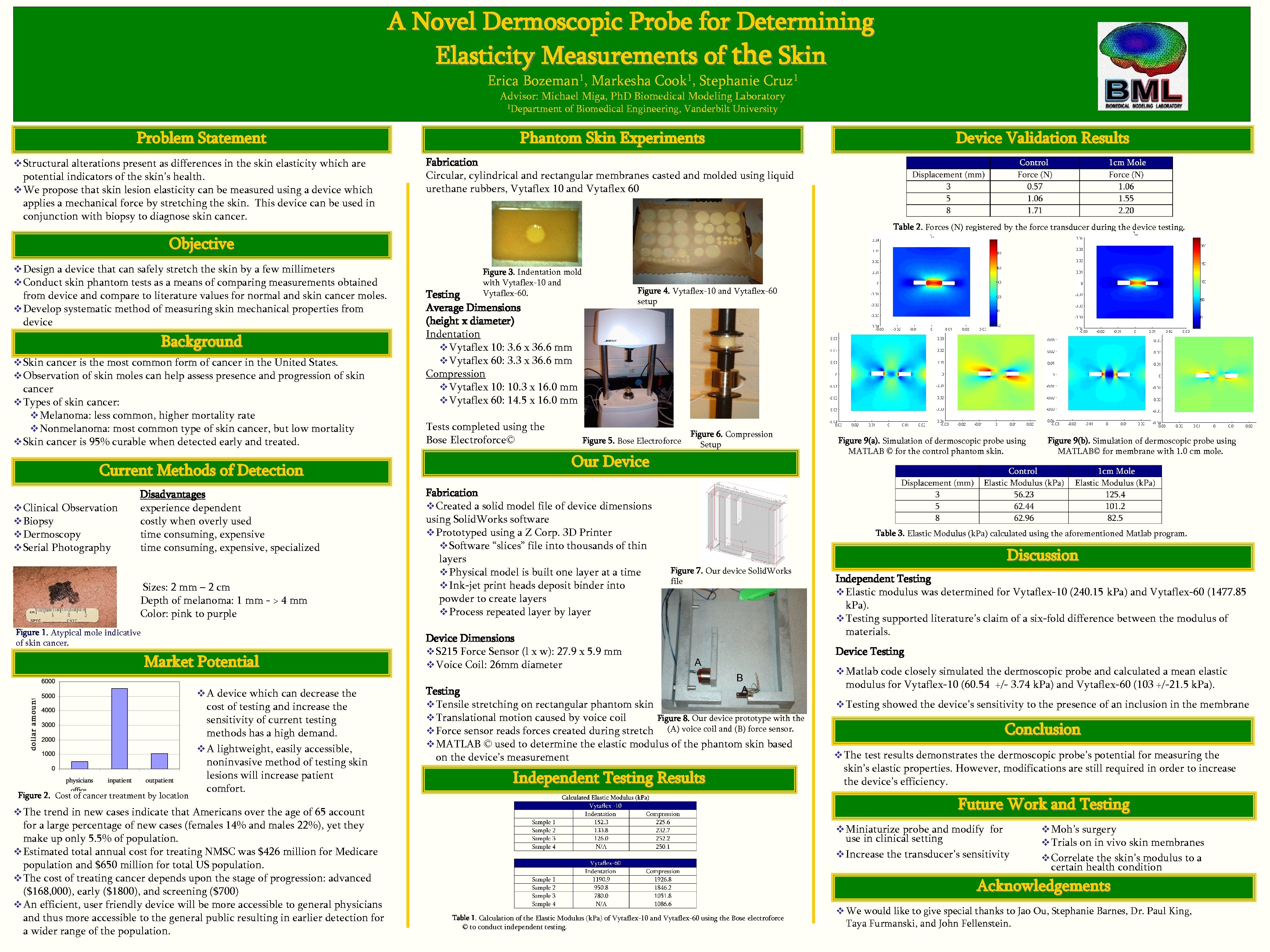
A Novel Dermoscopic Probe for Determining Elasticity Measurements of the Skin Erica Bozeman 1, Markesha Cook 1, Stephanie Cruz 1 Advisor: Michael Miga, Ph. D Biomedical Modeling Laboratory 1 Department Problem Statement v Structural alterations present as differences in the skin elasticity which are potential indicators of the skin’s health. v We propose that skin lesion elasticity can be measured using a device which applies a mechanical force by stretching the skin. This device can be used in conjunction with biopsy to diagnose skin cancer. of Biomedical Engineering, Vanderbilt University Phantom Skin Experiments Device Validation Results Fabrication Circular, cylindrical and rectangular membranes casted and molded using liquid urethane rubbers, Vytaflex 10 and Vytaflex 60 Table 2. Forces (N) registered by the force transducer during the device testing. Objective v Design a device that can safely stretch the skin by a few millimeters v Conduct skin phantom tests as a means of comparing measurements obtained from device and compare to literature values for normal and skin cancer moles. v Develop systematic method of measuring skin mechanical properties from device Background v Skin cancer is the most common form of cancer in the United States. v Observation of skin moles can help assess presence and progression of skin cancer v Types of skin cancer: v Melanoma: less common, higher mortality rate v Nonmelanoma: most common type of skin cancer, but low mortality v Skin cancer is 95% curable when detected early and treated. Current Methods of Detection v Clinical Observation v Biopsy v Dermoscopy v Serial Photography Skin Moles: Disadvantages experience dependent costly when overly used time consuming, expensive, specialized Sizes: 2 mm – 2 cm Depth of melanoma: 1 mm - > 4 mm Color: pink to purple Figure 1. Atypical mole indicative of skin cancer. Market Potential v A device which can decrease the Figure 2. Cost of cancer treatment by location cost of testing and increase the sensitivity of current testing methods has a high demand. v A lightweight, easily accessible, noninvasive method of testing skin lesions will increase patient comfort. Figure 3. Indentation mold with Vytaflex-10 and Vytaflex-60. Figure 4. Vytaflex-10 and Vytaflex-60 setup Testing Average Dimensions (height x diameter) Indentation v Vytaflex 10: 3. 6 x 36. 6 mm v Vytaflex 60: 3. 3 x 36. 6 mm Compression v Vytaflex 10: 10. 3 x 16. 0 mm v Vytaflex 60: 14. 5 x 16. 0 mm Tests completed using the Bose Electroforce© Figure 5. Bose Electroforce Figure 6. Compression Setup Our Device Fabrication v Created a solid model file of device dimensions using Solid. Works software v Prototyped using a Z Corp. 3 D Printer v Software “slices” file into thousands of thin layers v Physical model is built one layer at a time v Ink-jet print heads deposit binder into powder to create layers v Process repeated layer by layer Device Dimensions v S 215 Force Sensor (l x w): 27. 9 x 5. 9 mm v Voice Coil: 26 mm diameter Figure 9(b). Simulation of dermoscopic probe using MATLAB© for membrane with 1. 0 cm mole. Table 3. Elastic Modulus (k. Pa) calculated using the aforementioned Matlab program. Figure 7. Our device Solid. Works file Discussion Independent Testing v Elastic modulus was determined for Vytaflex-10 (240. 15 k. Pa) and Vytaflex-60 (1477. 85 k. Pa). v Testing supported literature’s claim of a six-fold difference between the modulus of materials. Device Testing A B A Testing v Tensile stretching on rectangular phantom skin v Translational motion caused by voice coil Figure 8. Our device prototype with the v Force sensor reads forces created during stretch (A) voice coil and (B) force sensor. v MATLAB © used to determine the elastic modulus of the phantom skin based on the device’s measurement Independent Testing Results v Matlab code closely simulated the dermoscopic probe and calculated a mean elastic modulus for Vytaflex-10 (60. 54 +/- 3. 74 k. Pa) and Vytaflex-60 (103 +/-21. 5 k. Pa). v Testing showed the device’s sensitivity to the presence of an inclusion in the membrane Conclusion v The test results demonstrates the dermoscopic probe’s potential for measuring the skin’s elastic properties. However, modifications are still required in order to increase the device’s efficiency. Future Work and Testing v The trend in new cases indicate that Americans over the age of 65 account for a large percentage of new cases (females 14% and males 22%), yet they make up only 5. 5% of population. v Estimated total annual cost for treating NMSC was $426 million for Medicare population and $650 million for total US population. v The cost of treating cancer depends upon the stage of progression: advanced ($168, 000), early ($1800), and screening ($700) v An efficient, user friendly device will be more accessible to general physicians and thus more accessible to the general public resulting in earlier detection for a wider range of the population. Figure 9(a). Simulation of dermoscopic probe using MATLAB © for the control phantom skin. v Miniaturize probe and modify for use in clinical setting v Increase the transducer’s sensitivity v Moh’s surgery v Trials on in vivo skin membranes v Correlate the skin’s modulus to a certain health condition Acknowledgements Table 1. Calculation of the Elastic Modulus (k. Pa) of Vytaflex-10 and Vytaflex-60 using the Bose electroforce © to conduct independent testing. v We would like to give special thanks to Jao Ou, Stephanie Barnes, Dr. Paul King, Taya Furmanski, and John Fellenstein.
Скачать презентацию A Novel Dermoscopic Probe for Determining Elasticity Measurements
86daebc142571436da2b74a9bcf3a024.ppt