


 Скачать презентацию A New Working Item for ISO IEC JTC 1
399dfa3f32d38ee8e578b78dccd20a6f.ppt
- Количество слайдов: 28
 A New Working Item for ISO/IEC JTC 1 SC 32 RGPS: Metamodel for On -Demand Model Selection He Keqing, Wang Jian, He Yangfan, Wang Chong State Key Lab of Software Engineering, Wuhan University, China 2008 -05 -27 1
 Content • Motivation • Scope • Summary 2
 Content • Motivation – Software as a Service (Saa. S) – Hints from Mass Customization (MC) • Scope • Summary 3
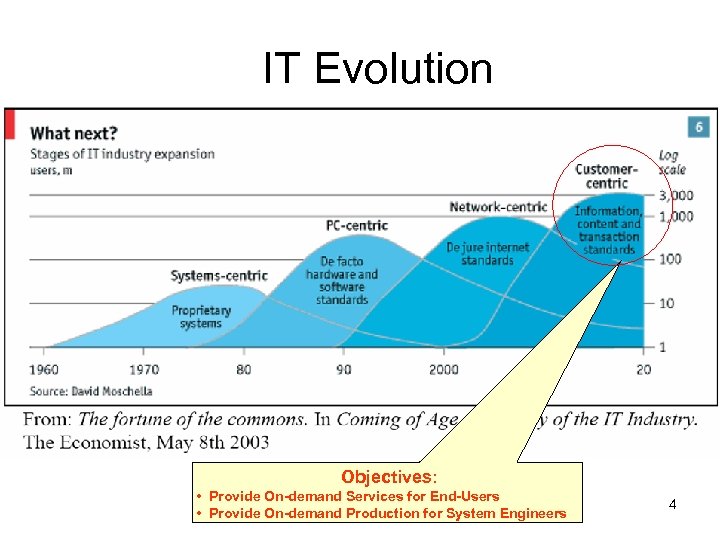 IT Evolution Objectives: • Provide On-demand Services for End-Users • Provide On-demand Production for System Engineers 4
 From the perspective of Saa. S • Software as a Service (Saa. S) – A typical customer-centric application – A model of software delivery where software providers provide daily maintenance and technical supports for customers – What customers need is the online service provided by software, instead of software itself. – Customers care how to select suitable services. Accordingly, software providers should provide on-demand services to satisfy customers. – Scale changes everything! • System of systems • The size and complexity of systems are increasing continuously, which will increase difficulties and bring challenges to on-demand service selection. On-demand service selection should be effectively supported ! 5
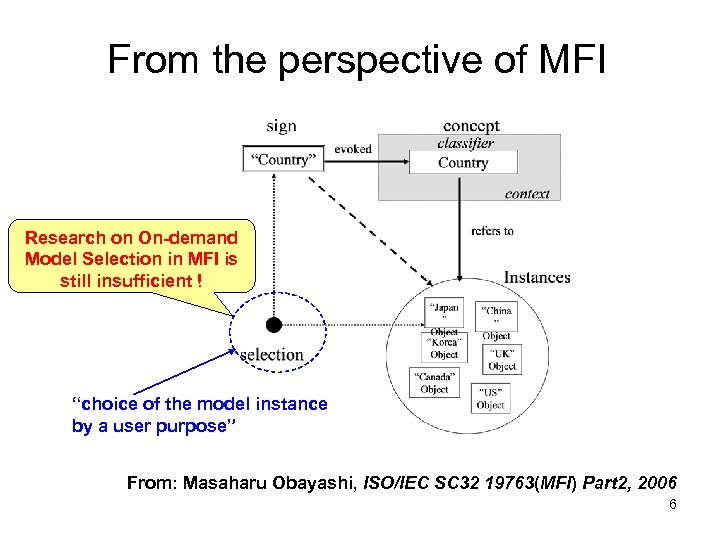 From the perspective of MFI Research on On-demand Model Selection in MFI is still insufficient ! “choice of the model instance by a user purpose” From: Masaharu Obayashi, ISO/IEC SC 32 19763(MFI) Part 2, 2006 6
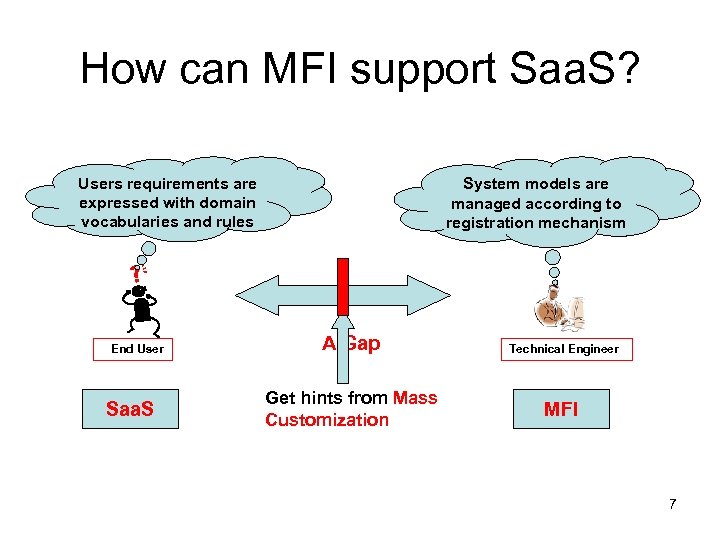 How can MFI support Saa. S? Users requirements are expressed with domain vocabularies and rules End User Saa. S System models are managed according to registration mechanism A Gap Get hints from Mass Customization Technical Engineer MFI 7
 What is Mass Customization (MC) • Mass Customization provides solutions for ondemand product supply – It has been successfully applied in manufacturing industry. – It embodies the key elements for effective on-demand model selection! • Mass Customization – Mass Production + Customization Production – Point:Customization and personalization of products and services for individual customers at a low price and in a short time • Strategies in MC can also satisfy the need of on-demand model selection. 8
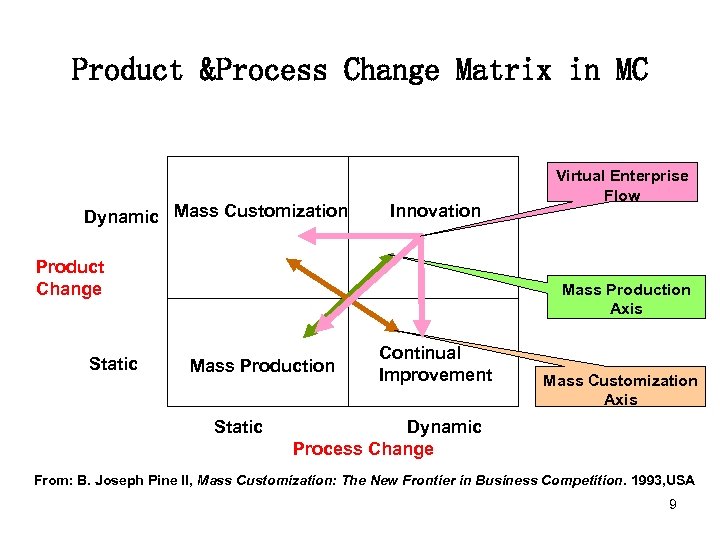 Product &Process Change Matrix in MC Dynamic Mass Customization Innovation Product Change Static Virtual Enterprise Flow Mass Production Axis Mass Production Static Continual Improvement Mass Customization Axis Dynamic Process Change From: B. Joseph Pine ll, Mass Customization: The New Frontier in Business Competition. 1993, USA 9
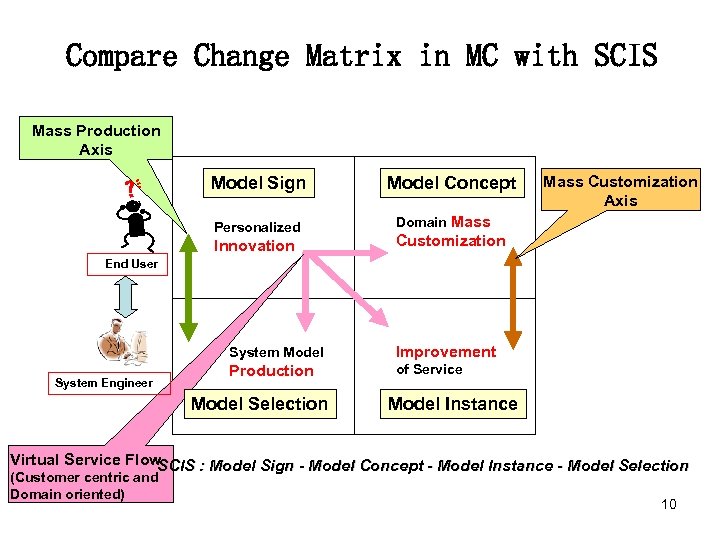 Compare Change Matrix in MC with SCIS Mass Production Axis Model Sign Personalized Innovation Model Concept Mass Customization Axis Domain Mass Customization End User System Model System Engineer Improvement Production of Service Model Selection Model Instance Virtual Service Flow SCIS : Model Sign - Model Concept - Model Instance - Model Selection (Customer centric and Domain oriented) 10
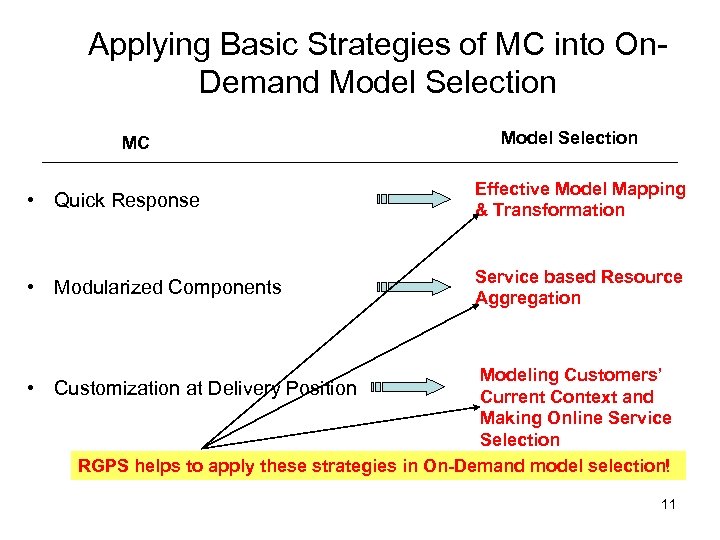 Applying Basic Strategies of MC into On. Demand Model Selection MC Model Selection • Quick Response Effective Model Mapping & Transformation • Modularized Components Service based Resource Aggregation Modeling Customers’ Current Context and Making Online Service Selection RGPS helps to apply these strategies in On-Demand model selection! • Customization at Delivery Position 11
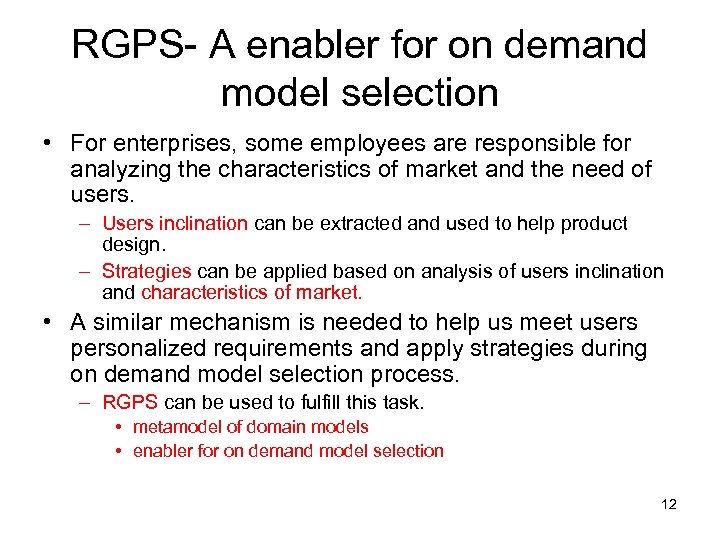 RGPS- A enabler for on demand model selection • For enterprises, some employees are responsible for analyzing the characteristics of market and the need of users. – Users inclination can be extracted and used to help product design. – Strategies can be applied based on analysis of users inclination and characteristics of market. • A similar mechanism is needed to help us meet users personalized requirements and apply strategies during on demand model selection process. – RGPS can be used to fulfill this task. • metamodel of domain models • enabler for on demand model selection 12
 Why RGPS? • Target -- modeling customers’ real intention and composing candidate components to satisfy customers. • Considering the characteristics of customers’ intention and implementation form in network – Customers’ intention is proposed from the perspective of the roles they play, and the roles are always tangled. – Customers’ goals are aptly variable and diverse. – The business processes to fulfill the goals are usually complex. – Services are the representative form of software systems in network. • Modeling customers’ real intention from four aspects: Role, Goal, Process, and Service. – Customers’ intention can be expressed from different level and different granularity – RGPS: From disorder to order -- To help users select appropriate service models 13
 Content • Motivation • Scope • Summary 14
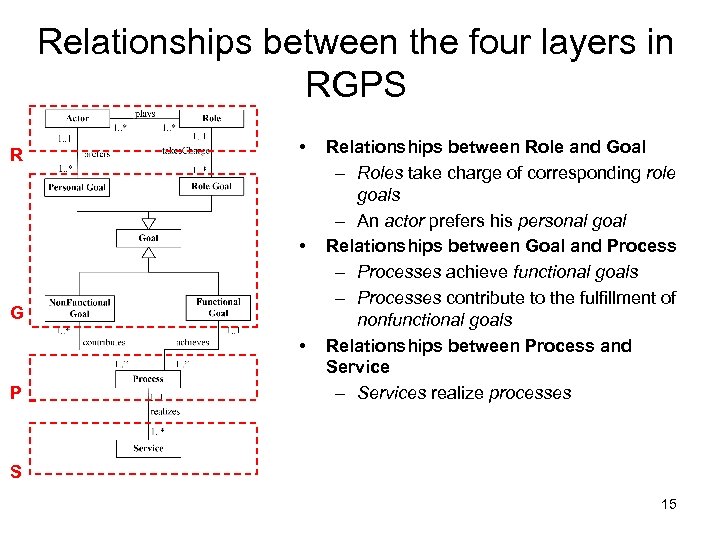 Relationships between the four layers in RGPS R • • G • P Relationships between Role and Goal – Roles take charge of corresponding role goals – An actor prefers his personal goal Relationships between Goal and Process – Processes achieve functional goals – Processes contribute to the fulfillment of nonfunctional goals Relationships between Process and Service – Services realize processes S 15
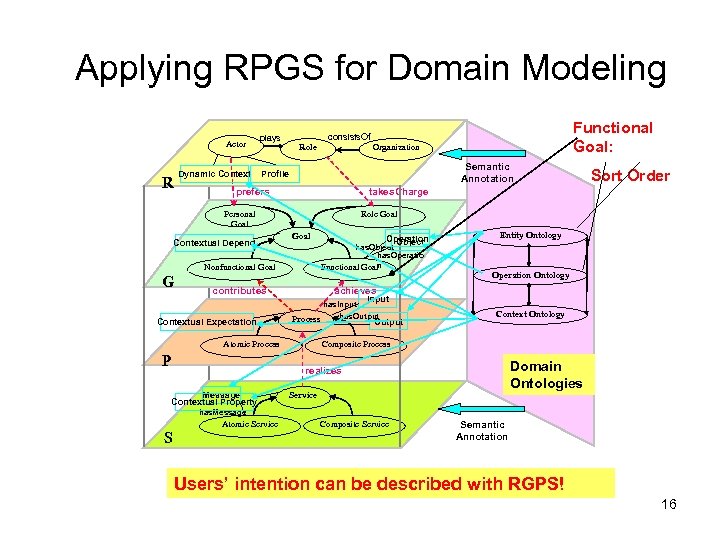 Applying RPGS for Domain Modeling Actor Dynamic Context R plays Role Organization Semantic Annotation Profile prefers Role Goal contributes Contextual Expectation Entity Ontology Operation Ontology achieves Input has. Output Process Output Atomic Process P Operation Object has. Operatio n Functional Goal Nonfunctional Goal G Context Ontology Composite Process Domain Ontologies realizes Message Contextual Property Sort Order takes. Charge Personal Goal Contextual Depend Functional Goal: consists. Of Service has. Message S Atomic Service Composite Service Semantic Annotation Users’ intention can be described with RGPS! 16
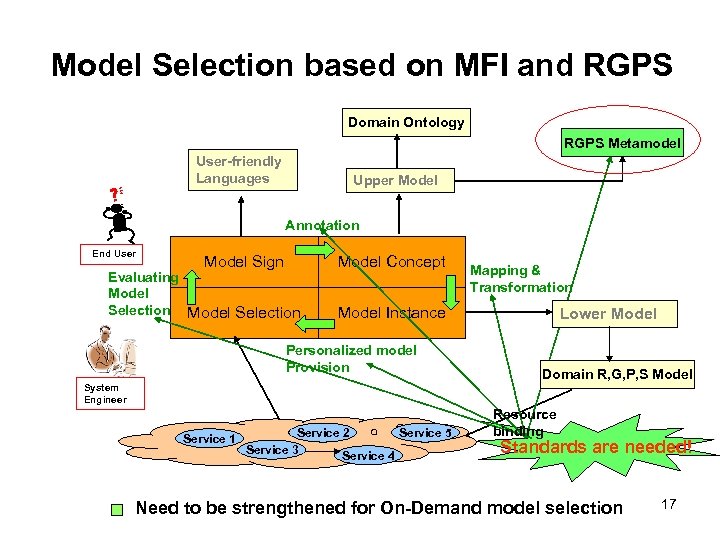 Model Selection based on MFI and RGPS Domain Ontology RGPS Metamodel User-friendly Languages Upper Model Annotation End User Model Sign Evaluating Model Selection Model Concept Model Instance Personalized model Provision System Engineer Service 1 Mapping & Transformation Service 2 Service 5 Service 3 Service 4 Lower Model Domain R, G, P, S Model Resource binding Standards are needed! Need to be strengthened for On-Demand model selection 17
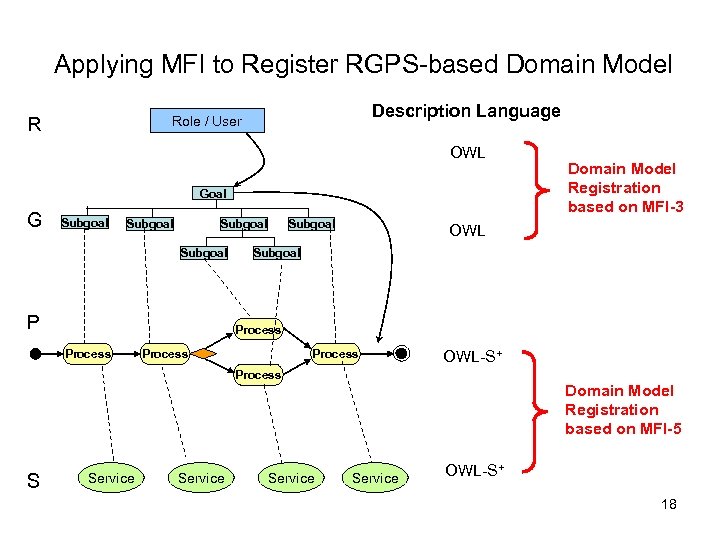 Applying MFI to Register RGPS-based Domain Model R Description Language Role / User OWL Goal G Subgoal P Subgoal OWL Subgoal Process OWL-S+ Process S Domain Model Registration based on MFI-3 Service Domain Model Registration based on MFI-5 Service OWL-S+ 18
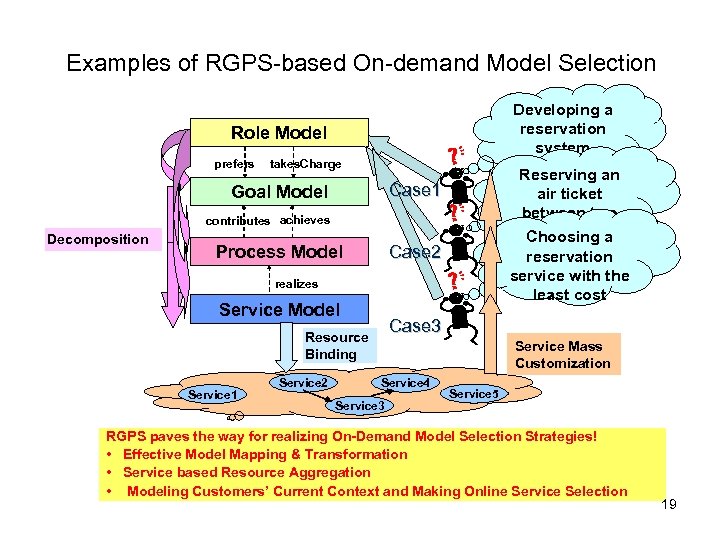 Examples of RGPS-based On-demand Model Selection Developing a reservation system Role Model prefers takes. Charge Reserving an air ticket between two cities Choosing a reservation service with the least cost Case 1 Goal Model contributes achieves Decomposition Case 2 Process Model realizes Service Model Case 3 Resource Binding Service 1 Service 2 Service Mass Customization Service 4 Service 3 Service 5 RGPS paves the way for realizing On-Demand Model Selection Strategies! • Effective Model Mapping & Transformation • Service based Resource Aggregation • Modeling Customers’ Current Context and Making Online Service Selection 19
 Content • Motivation • Scope • Summary 20
 Research Foundation • Projects supported – “Requirements Engineering - the Basic Research of Software Engineering for Complex System”, National Basic Research Program of China (No. 2007 CB 310801 ) – “Research on Requirements Elicitation and Evolution Modeling of Networked Software”, National Basic Research Program of China (No. 2006 CB 708302 ) – “Semantic Interoperability Application and Integration Mechanism of Complex Information Resource”, National High Technology Research and Development Program of China (No. 2006 AA 04 Z 156) • Research papers – Jian Wang, Keqing He, Ping Gong, Chong Wang, Rong Peng, Bing Li, "RGPS: A Unified Requirements Meta-Modeling Frame for Networked Software", In Proceedings of IWAAPF'08 at ICSE'08 Workshop , Leipzig, Germany, May 2008. – Keqing He, Peng Liang, Bing Li, Rong Peng, and Jing Liu, “Meta-modeling of Requirement for Networked Software - An Open Hierarchical & Cooperative Unified Requirement Framework URF”, Dynamics of Continuous Discrete and Impulsive Systems - Series B, Special issue on Software Engineering and Complex Networks, 2007, pp. 293 -298. – Jian Wang, Keqing He, Bing Li, Wei Liu, Rong Peng, “Meta-models of Domain Modeling Framework for Networked Software”. In: Proceedings of The Sixth International Conference on Grid and Cooperative Computing. Urumchi, China, July 2007, pp. 878885. – Keqing He, Peng Liang, Rong Peng, Bing Li, Jing Liu, “Requirement emergence computation of networked software”, Frontiers of Computer Science in China, 2007, 21 1(3), pp. 322 -328.
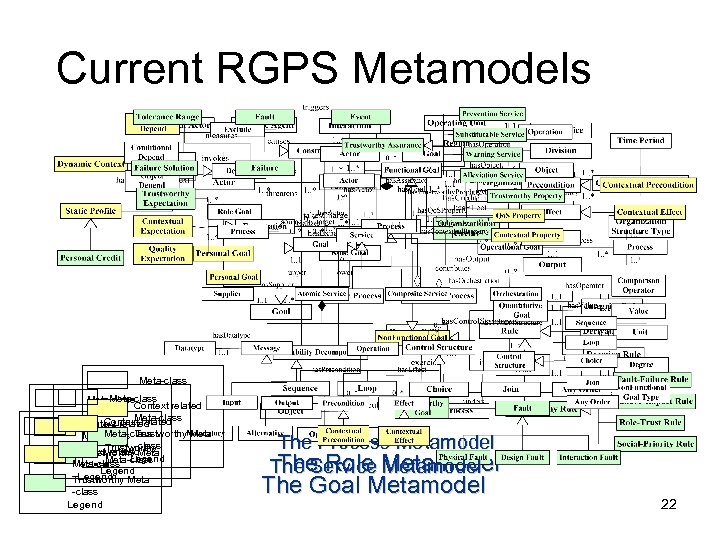 Current RGPS Metamodels Meta-class Context related Meta-class Trustworthy Meta -class Context. Trustworthy related Trustworthy Meta Legend Meta-class Legend Trustworthy Meta -class Legend The Process Metamodel The Role Metamodel The Service Metamodel The Goal Metamodel 22
 Strength of RGPS • Help to model the real intention of customers • Support effective on-demand model selection • As an enabler for service mass customization • As a supplement of MFI and MDR 23
 Thank you! hekeqing@sklse. org wangjian_sd@163. com heyangfan 927@163. com wangchong_whu@yahoo. com 24
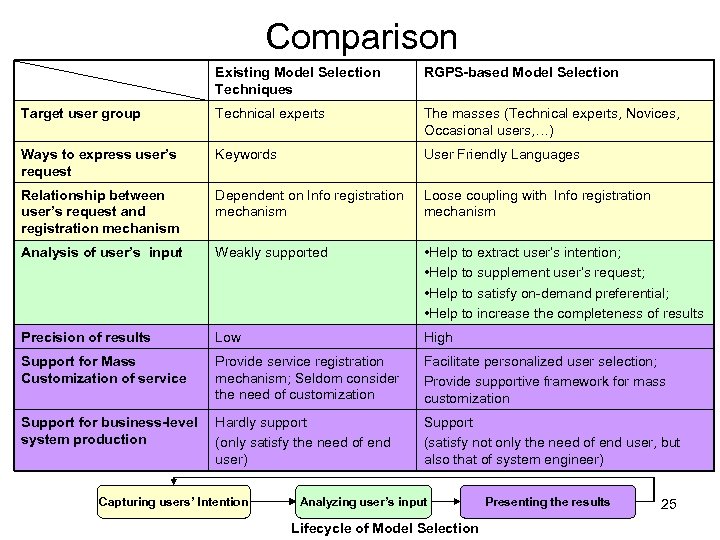 Comparison Existing Model Selection Techniques RGPS-based Model Selection Target user group Technical experts The masses (Technical experts, Novices, Occasional users, …) Ways to express user’s request Keywords User Friendly Languages Relationship between user’s request and registration mechanism Dependent on Info registration mechanism Loose coupling with Info registration mechanism Analysis of user’s input Weakly supported • Help to extract user’s intention; • Help to supplement user’s request; • Help to satisfy on-demand preferential; • Help to increase the completeness of results Precision of results Low High Support for Mass Customization of service Provide service registration mechanism; Seldom consider the need of customization Facilitate personalized user selection; Provide supportive framework for mass customization Support for business-level system production Hardly support (only satisfy the need of end user) Support (satisfy not only the need of end user, but also that of system engineer) Capturing users’ Intention Analyzing user’s input Lifecycle of Model Selection Presenting the results 25
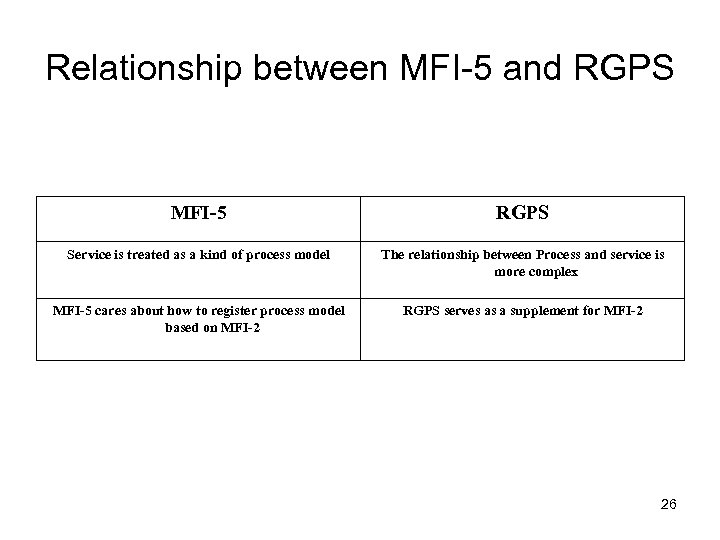 Relationship between MFI-5 and RGPS MFI-5 RGPS Service is treated as a kind of process model The relationship between Process and service is more complex MFI-5 cares about how to register process model based on MFI-2 RGPS serves as a supplement for MFI-2 26
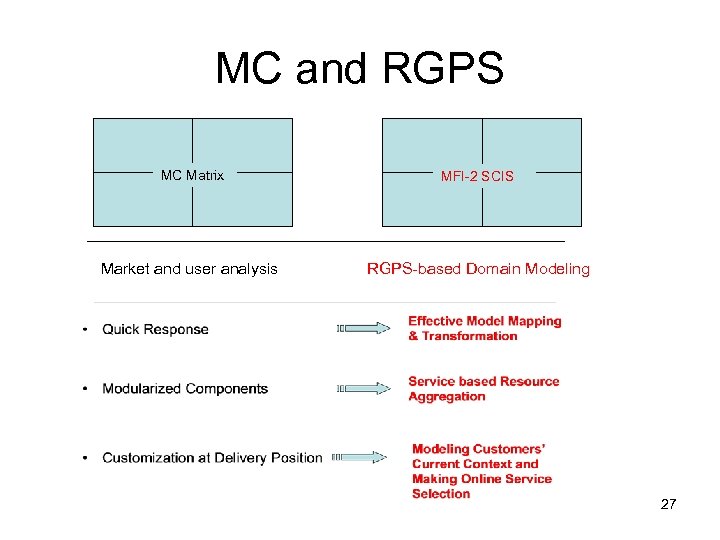 MC and RGPS MC Matrix MFI-2 SCIS Market and user analysis RGPS-based Domain Modeling 27
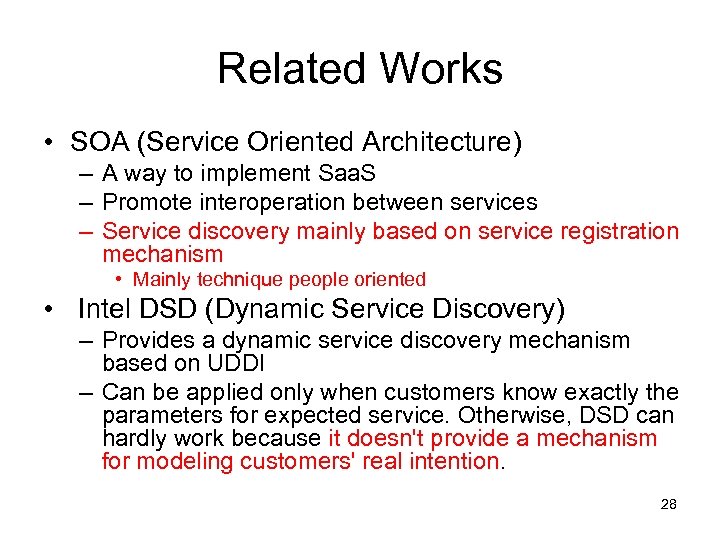 Related Works • SOA (Service Oriented Architecture) – A way to implement Saa. S – Promote interoperation between services – Service discovery mainly based on service registration mechanism • Mainly technique people oriented • Intel DSD (Dynamic Service Discovery) – Provides a dynamic service discovery mechanism based on UDDI – Can be applied only when customers know exactly the parameters for expected service. Otherwise, DSD can hardly work because it doesn't provide a mechanism for modeling customers' real intention. 28