


 Скачать презентацию A New Era in Politics In the
4de52541a32fcaa0a3403502dc0267de.ppt
- Количество слайдов: 72
 A New Era in Politics • In the early 1800 s, many states eliminated property ownership as a qualification for ______. • As a result, many more ________ gained the right to vote. • At the same time, the number of urban ________ who did not own property increased. • As ________, they demanded voting rights. (pages 266– 268) Click the mouse button or press the Space Bar to display the information.
 A New Era in Politics (cont. ) • In the 1828 election, many of these voters elected Andrew Jackson as ________. • By this time, ________ had changed a great deal. • There were many more _______states. • Average citizens had taken an interest in ________ because they realized it did affect them. • Election 1828 was the first large ________ of ordinary people. Click the mouse button or press the Space Bar to display the information. (pages 266– 268)
 A New Era in Politics (cont. ) • ________ : Adams vs. Jackson. • Even more ________ this time. • Adams was accused of ________ off the government. • Jackson was accused of being immoral because his wife ________ had been married before (accused of having an affair before the divorce). • Final count gave Jackson ________ for a victory! (pages 266– 268) Click the mouse button or press the Space Bar to display the information.
 A New Era in Politics (cont. ) • President Andrew Jackson. • President Jackson believed in the participation of the ________ citizen in government. • He supported the _______________, the practice of appointing people to government jobs on the basis of party loyalty and support. • ________ man / semi-educated. • Evolved into a ________. • More than anything, he was a true _____. (pages 266– 268) Click the mouse button or press the Space Bar to display the information.
 A New Era in Politics (cont. ) • He believed that this practice extended democracy and opened up the ________ to average citizens. • To make the political system more democratic, President Jackson supported a new way in which presidential ________ were chosen. • At that time, they were chosen through the _______________, in which congressional party members would choose the nominee. (pages 266– 268) Click the mouse button or press the Space Bar to display the information.
 A New Era in Politics (cont. ) • Jackson’s supporters replaced this system with the national ________ convention. • Under this system, delegates from the states met at conventions to choose the party’s ________ nominee. (pages 266– 268) Click the mouse button or press the Space Bar to display the information.
 Jackson’s Battles • Andrew Jackson faced off in many battles during his ________. • The ________ Crisis. • The ________. • Tension with Vice President _______. • The ________ Issue. • The ________ War • Controversy in the ________. (pages 268– 269) Click the mouse button or press the Space Bar to display the information.
 The Nullification Crisis • In the early 1800 s, South Carolina’s economy was ________, and many people blamed the nation’s tariffs. • South Carolina purchased most of its ________ goods from England, and the high tariffs made these goods expensive. • When Congress levied a new tariff in 1828–called the _______________ by critics–South Carolina threatened to secede, or withdraw, from the Union. (pages 268– 269) Click the mouse button or press the Space Bar to display the information.
 The Nullification Crisis (cont. ) • John C. Calhoun, the nation’s vice president, was torn between supporting the nation’s policies and supporting fellow _______________. • In 1828, he wrote The South Carolina ________ and ________. • In this, he reiterated the belief that the Union was a “_______” among states. • He said one state should never benefit at the ________ of another. • He promoted “________ rights. ” Click the mouse button or press the Space Bar to display the information. (pages 268– 269)
 The Nullification Crisis (cont. ) • John C. Calhoun, the nation’s vice president, was torn between supporting the nation’s policies and supporting fellow South Carolinians. • Instead of supporting secession, he proposed the idea of ________. • The idea argued that because states had created the ________, they had the right to declare a federal law null, or not valid. (pages 268– 269) Click the mouse button or press the Space Bar to display the information.
 The Nullification Crisis (cont. ) • John C. Calhoun, the nation’s vice president, was torn between supporting the nation’s policies and supporting fellow South Carolinians. • When President Jackson came to office, he did nothing about the _______________. • This angered V. P. John ________. • This brought on ________ between the president and the vice president. (pages 268– 269) Click the mouse button or press the Space Bar to display the information.
 President vs. Vice President • Growing tension between Jackson and Calhoun got worse on April 13, 1830 at the ________ Day Dinner. • Organized by ________ and supporters of states’ rights. • The ________ and his cabinet were invited to attend. • Up until now, Jackson had kept his ________ attitude very quiet. (pages 268– 269) Click the mouse button or press the Space Bar to display the information.
 President vs. Vice President • Growing tension between Jackson and Calhoun got worse on April 13, 1830 at the _______________ Dinner. • He and his buddy Martin Van Buren thought this to be a great opportunity to promote ________. • At the dinner, _____ toasts were made promoting states’ rights. • Then it was the ________ turn. (pages 268– 269) Click the mouse button or press the Space Bar to display the information.
 President vs. Vice President • Growing tension between Jackson and Calhoun got worse on April 13, 1830 at the Jefferson Day Dinner. • Jackson’s toast: “________, it must be preserved. ” • Calhoun quickly jumped to his feet and said, “Our Union, next to _______________, must be preserved. ” • After this, the Jackson / Calhoun relationship ________ even more. (pages 268– 269) Click the mouse button or press the Space Bar to display the information.
 The Nullification Crisis (cont. ) • The issue of nullification erupted again in 1830 in a debate between Senator _______________ of South Carolina and Senator _______________ of Massachusetts on the Senate floor. • Hayne defended ________ rights, while Webster defended the ________. • President Jackson defended the ________. (pages 268– 269) Click the mouse button or press the Space Bar to display the information.
 The Nullification Crisis (cont. ) • After Congress passed another tariff law in 1832, South Carolina called a special convention, which declared the tariffs of 1828 and 1832 ________. • SC said no tariff would be collected in her state after _______________, 1833. • A South Carolina convention chose a new states’ right governor and chose _______________ as U. S. Senator. • Calhoun ________ as vice president and took his senate seat representing S. C. (pages 268– 269) Click the mouse button or press the Space Bar to display the information.
 The Nullification Crisis (cont. ) • After Congress passed another tariff law in 1832, South Carolina called a special convention, which declared the tariffs of 1828 and 1832 unconstitutional. • Jackson considered the declaration an act of ________, and he sent a ________ to Charleston. • Congress passed the _______________, authorizing the president to use the military to enforce acts of Congress. (pages 268– 269) Click the mouse button or press the Space Bar to display the information.
 The Nullification Crisis (cont. ) • After Senator Henry Clay pushed through a ________ that would lower tariffs within two years, South Carolina ________ its nullification of the tariff law. • It also helped that South Carolina was the only state ________ nullification and ________ at this point. (pages 268– 269)
 Policies Toward Native Americans • President Jackson supported the idea of moving all Native Americans to the ________ • In 1830 he supported the passage of the ________ Act, which allocated funds to relocate Native Americans. • Although most Native Americans resettled in the ________, the Cherokee of Georgia refused. • They sued the state, and the case reached the _______________. (pages 269– 270) Click the mouse button or press the Space Bar to display the information.
 Policies Toward Native Americans (cont. ) • In Worcester v. Georgia, Chief Justice John Marshall ruled for the ________ and ordered the state to honor their property rights. • President Jackson ________ to support the decision. • His reaction: “John Marshall has made his decision, now ________. ” • Jackson was really showing his ________ colors. (pages 269– 270) Click the mouse button or press the Space Bar to display the information.
 Policies Toward Native Americans (cont. ) • Thousands of Cherokee died on the journey that became known as the _______________. • Although most Americans supported the removal policy, some National Republicans and a few religious ________ condemned it. (pages 269– 270) Click the mouse button or press the Space Bar to display the information.
 Jackson Battles the National Bank • President Andrew Jackson opposed the ________ Bank of the United States, regarding it as a benefit only to the ________. • At the time, the Bank was instrumental in keeping the nation’s _______________ stable. • The Bank ________ state banks from loaning too much money by asking the state banks to redeem bank notes for gold and silver. (pages 270– 271) Click the mouse button or press the Space Bar to display the information.
 Jackson Battles the National Bank (cont. ) • This helped keep ________ in check. • Many ________ settlers who needed easy credit opposed the Bank’s policies. • President Jackson believed the Bank was ________, even though the Supreme Court ruled otherwise. • President Jackson ________ a bill that would extend the charter of the Bank for another _____ years. (pages 270– 271) Click the mouse button or press the Space Bar to display the information.
 Jackson Battles the National Bank (cont. ) • During the 1832 presidential election, President Jackson ________ the Bank. • Most Americans supported Jackson viewed their support as a directive to ________ the Bank. • He removed the ________ deposits from the Bank, forcing it to call in its loans and stop lending. (pages 270– 271) Click the mouse button or press the Space Bar to display the information.
 Election of 1836 • In 1836, Jackson chose _______to run. • With Jackson’s urging, Democrats nominated _______________. • Van Buren was ________ and ________. • With Jackson’s popularity high, his ________ went a long way. • Van Buren easily defeated ________ others. (pages 271– 272) Click the mouse button or press the Space Bar to display the answer.
 President Van Buren • Many challenges. • By 1837, ________ began closing. • ________ systems were collapsing. • Businesses were going ________. • People were losing _______ accounts. • ________ % had lost their job. • This became known as the ________ of 1837. (pages 271– 272) Click the mouse button or press the Space Bar to display the answer.
 A New Party Emerges • By the mid-1830 s, a new political party called the ________ formed to oppose President Jackson. • Many members were former National Republicans, whose ________ had fallen apart. • Unlike Jackson’s Democrats, Whigs advocated ________ the federal government and encouraging ________ development. (pages 271– 272) Click the mouse button or press the Space Bar to display the answer.
 A New Party Emerges (cont. ) • In the 1840 election, Whigs saw an opportunity to unseat the ________ president. • The party nominated General William Henry Harrison for ________ and John Tyler, a former Democrat, for _______________. (pages 271– 272) Click the mouse button or press the Space Bar to display the information.
 The Election of 1840 • Whigs came out stronger than ever. Martin Van Buren, ________ • ________ for economic panic. • Portrayed as luxury-loving, _______________, aristocrat. • Described as “out of touch with the ________ people. ” (pages 271– 272) Click the mouse button or press the Space Bar to display the information.
 The Election of 1840 • Whigs came out stronger than ever. William Henry Harrison, Whig • War Hero from Battle of ________. • Chose former Democrat _______________ as his running mate. • Slogan was “________ and Tyler Too!” • He was viewed as the “________ man’s candidate. ” (pages 271– 272) Click the mouse button or press the Space Bar to display the information.
 President Harrison • With Harrison being ____ years old, there were questions about his ability to serve. To prove that his age would not interfere with his work, he delivered his inaugural speech in a Washington ________. As a result, Harrison came down with ________ and ________ a month later. Serving only ________ month, Harrison served the ________ term as president. (pages 271– 272) Click the mouse button or press the Space Bar to display the information.
 President Tyler • Vice President John Tyler became president upon Harrison’s death. Tyler was not _____% sold on Whig policies. Tyler was not a ________ man in the eyes of most Whigs. Tyler’s challenges: ________ National Bank, the tariff, problems with Britain, and _______________ inside or outside his party. (pages 271– 272) Click the mouse button or press the Space Bar to display the information.
 A New Party Emerges (cont. ) • The _______________ established a firm boundary between the United States and Canada from Maine to Minnesota. (pages 271– 272)
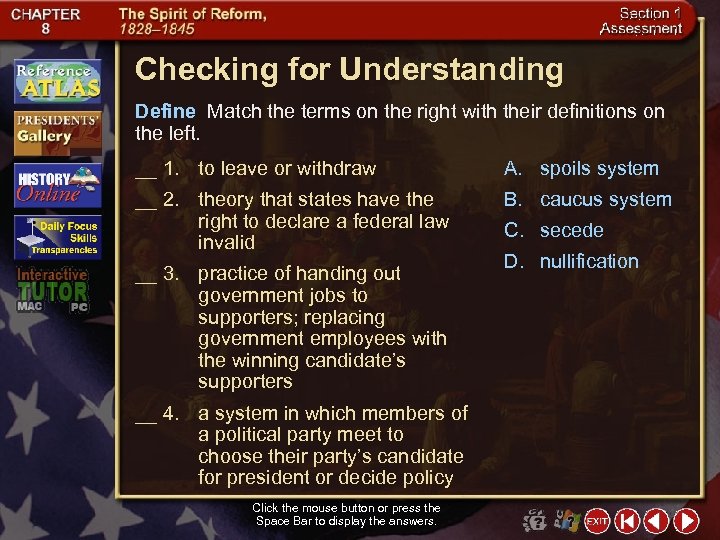 Checking for Understanding Define Match the terms on the right with their definitions on the left. __ 1. to leave or withdraw A. spoils system __ 2. theory that states have the right to declare a federal law invalid B. caucus system __ 3. practice of handing out government jobs to supporters; replacing government employees with the winning candidate’s supporters __ 4. a system in which members of a political party meet to choose their party’s candidate for president or decide policy Click the mouse button or press the Space Bar to display the answers. C. secede D. nullification
 The New Wave of Immigrants • The United States experienced a massive influx of _____ between 1815 and 1860. • They arrived for ________ and ________ reasons. • The largest groups of immigrants, almost _______, came from Ireland. • They were driven out because of widespread famine in 1845, when a fungus destroyed the ________. (pages 273– 275) Click the mouse button or press the Space Bar to display the information.
 The New Wave of Immigrants (cont. ) • The ________ generally settled in the Northeast and worked as unskilled laborers. • The second largest group of immigrants was the ________, who settled in the Midwest, where they started farms and businesses. • The presence of people from different _______________, and religions brought about feelings of ________, or hostility toward foreigners, among many Americans. (pages 273– 275) Click the mouse button or press the Space Bar to display the information.
 The New Wave of Immigrants (cont. ) • Anti-Catholic sentiments towards the many Catholic immigrants led to the rise of ________ groups. • The groups pushed for laws banning ________ and Catholics from holding public office. • Delegates from the various groups formed the ________ Party. • Membership in the party was secret. When questioned, members were obliged to answer, “________. ” As a result, the party was nicknamed the ________. (pages 273– 275) Click the mouse button or press the Space Bar to display the information.
 A Religious Revival • Religious leaders organized to revive the nation’s commitment to religion in a movement known as the _______________. • This movement promoted the belief that all people could attain ________ by readmitting God and Christ into their lives. • An important advocate of this movement was _______________, who helped found modern revivalism. (pages 275– 276) Click the mouse button or press the Space Bar to display the information.
 A Religious Revival (cont. ) • A number of new religious ________ emerged from the new religious revival. • These included the Unitarians and the Universalists. • , a New Englander, founded the Church of Jesus Christ of _______________, whose followers are known as Mormons. ________ • After being harassed in New England, the Mormons moved ________ and settled in ________. (pages 275– 276) Click the mouse button or press the Space Bar to display the information.
 A Religious Revival (cont. ) • became the leader of the church after Smith was murdered. The Mormons then moved to the ________ territory. _______________ (pages 275– 276)
 A Literary Renaissance • Many writers and thinkers of the day adopted the tenets of a movement known as ________. • This movement advocated feeling over reason and individuals above society. _______________ was an expression of romanticism. • The philosophy urged people to ________ the limits of their mind and let their ________ embrace the beauty of the universe. (pages 276– 277) Click the mouse button or press the Space Bar to display the information.
 A Literary Renaissance (cont. ) • Some influential transcendentalist writers included Ralph Waldo ________ and Henry David ________. • Thoreau believed that individuals should fight the pressure to ________. • Other writers created works that were ________ American. • They included Washington ________, James Fenimore ________, Nathaniel ________, Herman Melville, Edgar Allan ________, and Emily ________. (pages 276– 277) Click the mouse button or press the Space Bar to display the information.
 A Literary Renaissance (cont. ) • The early 1800 s saw the rise of mass ________. • Before the 1800 s, most newspapers catered to ________ readers. • As more Americans learned to read and write, and more men gained the right to ________, publishers began producing inexpensive newspapers that included the news that people wanted to know. • General interest magazines, such as _______________, also emerged. (pages 276– 277) Click the mouse button or press the Space Bar to display the information.
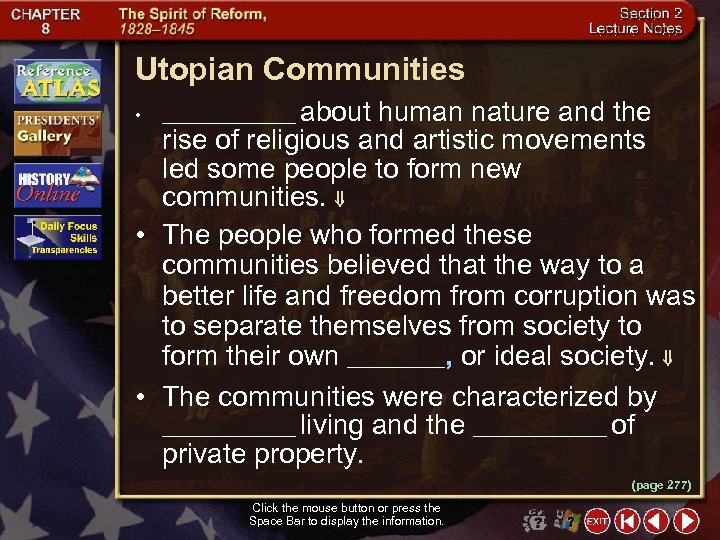 Utopian Communities about human nature and the rise of religious and artistic movements led some people to form new communities. • The people who formed these communities believed that the way to a better life and freedom from corruption was to separate themselves from society to form their own ______, or ideal society. • The communities were characterized by ________ living and the ________ of private property. • ________ (page 277) Click the mouse button or press the Space Bar to display the information.
 Utopian Communities (cont. ) • Utopian communities included _______________ in Massachusetts and small communities established throughout the country by a religious group called the ________. (page 277)
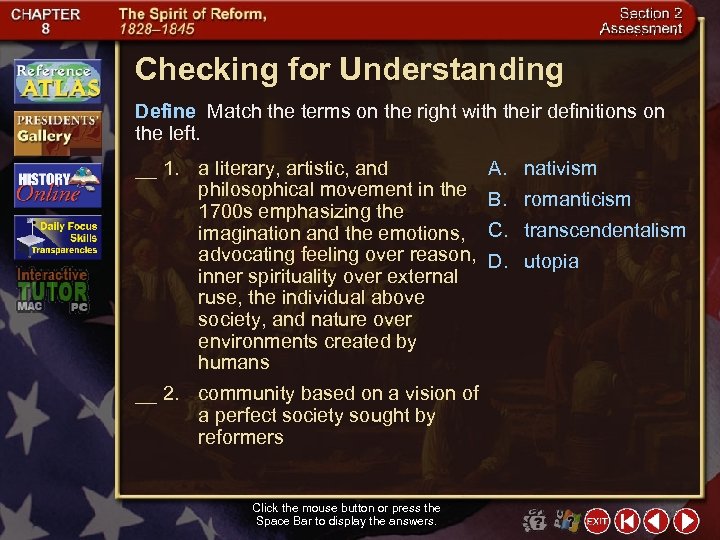 Checking for Understanding Define Match the terms on the right with their definitions on the left. __ 1. a literary, artistic, and philosophical movement in the 1700 s emphasizing the imagination and the emotions, advocating feeling over reason, inner spirituality over external ruse, the individual above society, and nature over environments created by humans __ 2. community based on a vision of a perfect society sought by reformers Click the mouse button or press the Space Bar to display the answers. A. nativism B. romanticism C. transcendentalism D. utopia
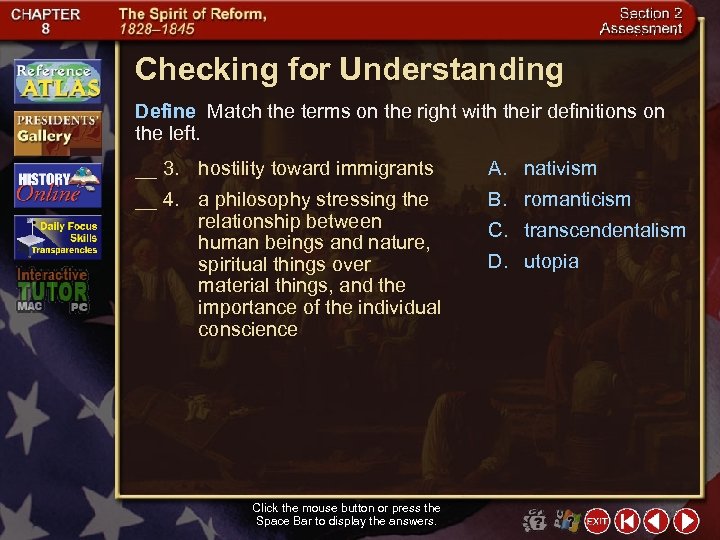 Checking for Understanding Define Match the terms on the right with their definitions on the left. __ 3. hostility toward immigrants A. nativism __ 4. a philosophy stressing the relationship between human beings and nature, spiritual things over material things, and the importance of the individual conscience B. romanticism Click the mouse button or press the Space Bar to display the answers. C. transcendentalism D. utopia
 The Reform Spirit • In the mid-1800 s, many Americans worked to reform various aspects of society. worked for improved treatment of the mentally ill. • _______________ was instrumental in establishing associations known as benevolent societies. • Although first started to spread God’s teaching, these societies also sought to combat _______________. (pages 278– 281) Click the mouse button or press the Space Bar to display the information.
 The Reform Spirit (cont. ) • Many reformers argued that the excessive use of ________ was one of the major causes of crime and poverty. • These reformers advocated ________, or moderation in the consumption of alcohol. • Several temperance groups joined together in 1833 to form the _______________. • Temperance groups also pushed for laws to prohibit the sale of ________. (pages 278– 281) Click the mouse button or press the Space Bar to display the information.
 The Reform Spirit (cont. ) • Some reformers focused on improving ________ conditions in the nation. • Many states began building new prisons, which they called ________, that tried to rehabilitate prisoners. • _______________ education reform. focused on • Mann pushed for more public education and backed the creation of a state board of education in ________. (pages 278– 281) Click the mouse button or press the Space Bar to display the information.
 The Reform Spirit (cont. ) • In 1852 Massachusetts passed the first mandatory school ________ law. • At the same time, many reformers pushed for the ________ of taxsupported public elementary schools. • Education ________ generally had men, not women, in mind. • During the 1850 s, however, some women worked to create more educational opportunities for ________. (pages 278– 281) Click the mouse button or press the Space Bar to display the information.
 The Reform Spirit (cont. ) founded a girls’ boarding school that taught academic subjects, which were rarely taught to women then. • _______________ founded the first institution of higher education for women only. (pages 278– 281) Click the mouse button or press the Space Bar to display the information.
 The Early Women’s Movement • In the 1800 s, people began dividing their life between the home and the ________. Men generally went to ________, while women took care of the house and children. • Most people at that time believed that ________ was the proper place for women. • Many women saw themselves as ________ with their husbands, and as such believed that they should be treated ________. (pages 281– 282) Click the mouse button or press the Space Bar to display the information.
 The Early Women’s Movement (cont. ) • Many women began to believe that they had an important role to improve ________. • Some began to argue that they needed greater ________ to promote their roles. • Other women also argued that equal rights for men and women would end many social ________. (pages 281– 282) Click the mouse button or press the Space Bar to display the information.
 The Early Women’s Movement (cont. ) • In 1848 _______________ and _______________ organized the Seneca Falls Convention, a meeting to focus on equal rights for women and one that marked the ________ of the women’s movement. • Throughout the 1850 s, women organized more conventions to promote greater ________ for women. (pages 281– 282) Click the mouse button or press the Space Bar to display the information.
 Checking for Understanding Define Match the terms on the right with their definitions on the left. __ 1. prison whose purpose is to reform prisoners A. benevolent society __ 2. an association focusing on spreading the word of God and combating social problems B. temperance __ 3. moderation in or abstinence from alcohol Click the mouse button or press the Space Bar to display the answers. C. penitentiary
 Anti-slavery v. Abolitionism • Anti-Slavery • Slavery has a ________ effect on American life. • Slavery is an outdated ________ of labor. • Slavery not consistent with ________. • ________ is acceptable. • Eliminate slavery ________. (pages 284– 285) Click the mouse button or press the Space Bar to display the information.
 Anti-slavery v. Abolitionism • Committed to freeing ________. • Slavery is ________. • Slavery is not consistent with ________. • ________ is NOT ENOUGH! • Abolish slavery ________! • Unorganized; only made up about _____ of population at the time period. (pages 284– 285) Click the mouse button or press the Space Bar to display the information.
 Early Opposition to Slavery • The movement to end slavery polarized the nation and contributed to the ________. • Many Americans opposed slavery, but they ________ on ways to end it. • Some antislavery societies supported an approach known as ________. They called for a gradual end to slavery. • Some antislavery societies believed that ending slavery would not end racism. They believed that the best solution was to send African Americans _______________. (pages 284– 285) Click the mouse button or press the Space Bar to display the information.
 Early Opposition to Slavery (cont. ) • The _______________(ACS) was formed to move African Americans to Africa. • The ACS acquired land in West Africa, chartered ships, and moved some free African Americans to a colony that eventually became the nation of ________. • Colonization was not a ________ solution. The ________ of transporting was high. (pages 284– 285) Click the mouse button or press the Space Bar to display the information.
 Early Opposition to Slavery (cont. ) • Also, most African Americans regarded the United States as their ________ and had _______________ to migrate to another continent. (pages 284– 285)
 The New Abolitionists • In the 1830 s, the idea of ________ began to take hold. • Abolitionists argued that enslaved Africans should be freed ________. • The development of a large national abolitionist movement was largely due to the work of _______________. • He founded the ________, an antislavery newspaper that advocated ________, or the freeing of all enslaved people. (pages 285– 287) Click the mouse button or press the Space Bar to display the information.
 The New Abolitionists (cont. ) • With an increasing following, he founded the _______________ in 1833. • Free African Americans also played a prominent role in the ________ movement. • The most prominent was _______________, who published his own antislavery newspaper, the North Star. • was another important African American abolitionist. _______________ (pages 285– 287) Click the mouse button or press the Space Bar to display the information.
 The New Abolitionists (cont. ) • The ________ sisters were also famed abolitionists. • Angelina and Sarah Grimke, daughters of a South Carolina _______________, disagreed with slavery. • They left their father’s _______as result. • They wrote a book persuading other Southern women to revolt against ________. • Their lectures drew big ________. (pages 285– 287) Click the mouse button or press the Space Bar to display the information.
 The New Abolitionists (cont. ) • In 1837, the abolition movement got itself a ________. • _______________ Louis Observer. , editor of the St. • He was more anti-slavery, but he was viewed as an ________ by many readers for his opinions. • St. Louis passed laws ________ him, so he moved to the ________ state of Illinois. (pages 285– 287) Click the mouse button or press the Space Bar to display the information.
 The New Abolitionists (cont. ) • In 1837, the abolition movement got itself a martyr. • When he began publicly criticizing slavery, his press was ________. • He replaced the press only to have it destroyed ________ more times. • He never even used the ________ press. • He placed his ________ press under guard. (pages 285– 287) Click the mouse button or press the Space Bar to display the information.
 The New Abolitionists (cont. ) • In 1837, the abolition movement got itself a martyr. • A ________ gathered and shots were fired. • The building was set on ________ ire. • Lovejoy himself was ________ to death (in a free state). • In his own eyes, Lovejoy died defending free ________, but the ________ movement adopted him as well. • J. Q. Adams: “an ________ that will shake America. ” (pages 285– 287) Click the mouse button or press the Space Bar to display the information.
 The Response to Abolitionism • Many Northerners, even those who disapproved of slavery, opposed extreme ________, viewing it as a threat to the existing social system. • Many warned that it would produce conflict between the North & South. • Others feared a possible huge _____ of African Americans to the North. • Still others feared that abolition would ________ the Southern economy, and thereby affect their own economy. (pages 287– 288) Click the mouse button or press the Space Bar to display the information.
 The Response to Abolitionism Southern Justification for Slavery. • (cont. ) justification (old and new testament refers to slavery). ________ • Means of ________ control (blacks and white cannot live together; controls social unrest). • Fear of _______________(blacks would rape white women without slavery). • Racial ________(blacks are inferior to (pages 287– 288) whites). Click the mouse button or press the Space Bar to display the information.
 The Response to Abolitionism Southern Justification for Slavery. (cont. ) THE BEST DEFENSE OF SLAVERY: • Wage Slavery Said Northern factory workers were slaves with a ________. Southern slaves were provided _______________, and _______. Northern “wage slaves” had to “fend for themselves” with little ________ in dangerous working ________. (pages 287– 288) Click the mouse button or press the Space Bar to display the information.
 The Response to Abolitionism (cont. ) • In 1831 ________ led a revolt by enslaved people that killed more than 50 Virginians. • Southerners suppressed the circulation of the ________, and other abolitionist publications. • Southern postal workers refused to deliver such publications, and the House of Representatives, under pressure from the South, shelved all ________ petitions. (pages 287– 288) Click the mouse button or press the Space Bar to display the information.