


 Скачать презентацию A New Computer Science Curriculum for All School
a67d2ce6381bc338857035445637582e.ppt
- Количество слайдов: 33
 A New Computer Science Curriculum for All School Levels in Poland Maciej M. Sysło University of Wrocław, University of Toruń, syslo@mat. umk. pl, http: //mmsyslo. pl/
 Contents § § § § § School system in Poland informatics education Informatics versus ICT Is Computer Science Education in crisis? Informatics education – shifts in approach Computational thinking (CT) A new curriculum The role of programming Introducing computer science concepts – examples Supporting activities Maciej M. Sysło
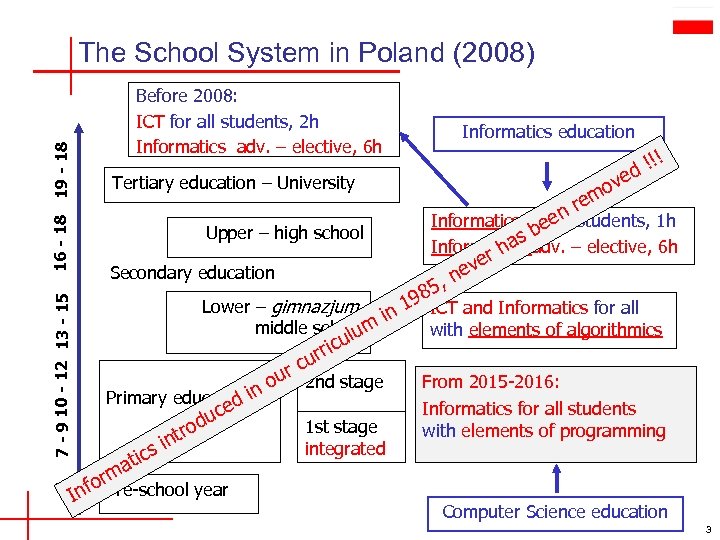 6 7 - 9 10 - 12 13 - 15 16 - 18 19 - 18 The School System in Poland (2008) Before 2008: ICT for all students, 2 h Informatics adv. – elective, 6 h Informatics education v mo re Tertiary education – University Upper – high school Secondary education !!! d e Informatics for en students, 1 h be all a Informaticss adv. – elective, 6 h rh 5 98 , e ev n Lower – gimnazjum, n 1 ICT and Informatics for all i middle school m with elements of algorithmics lu u rric u c ur 2 nd stage no Primary educationi ed uc d tro s in c ati m for In Pre-school year 1 st stage integrated From 2015 -2016: Informatics forlessons (ICT) Computer all students with elements of programming Computer Science education 3
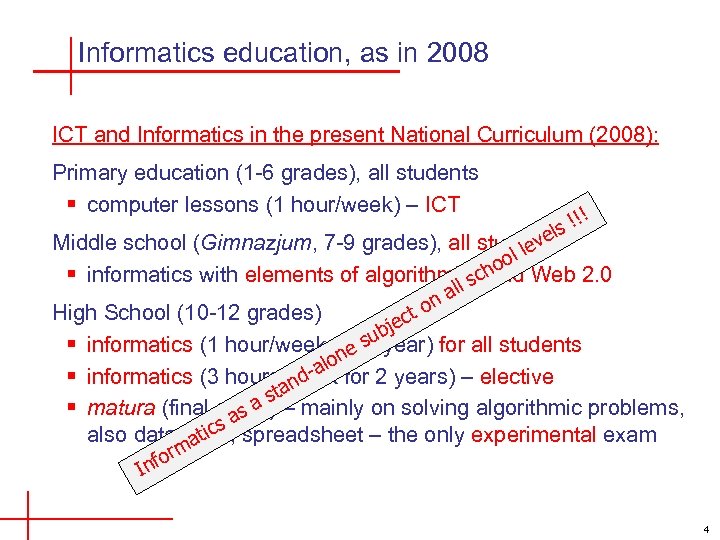 Informatics education, as in 2008 ICT and Informatics in the present National Curriculum (2008): Primary education (1 -6 grades), all students § computer lessons (1 hour/week) – ICT !! s! el v Middle school (Gimnazjum, 7 -9 grades), all students l le o ho Web 2. 0 § informatics with elements of algorithmicsc and ls al n o High School (10 -12 grades) ct je ub § informatics (1 hour/week for s year) for all students ea on -al § informatics (3 hours/week for 2 years) – elective d tan as § matura (final exam) – mainly on solving algorithmic problems, s sa c also data base, spreadsheet – the only experimental exam ati m for In 4
 Informatics (CS) versus ICT n n Informatics (Computer Sience) is concerned with designing and creating informatics ‘products’ and ‘tools’, such as: algorithms, programs, application software, systems, methods, theorems, computers, … ICT – applications of CS (computing) – concentrates on how to use and apply informatics and other information technology tools in working with information; can be also creative Now: n computer science education (CS education) – education on computer science n informatics education – includes CS education, ICT in other subjects, anything in schools related to computers computing – the term not used Maciej M. Sysło 5
 History: 1965 – … computers in education 1965 … 1985 … Informatics curricula and teaching – computer science – there was no information technology beginning of 90’ moves in education: n computer science → information technology i. e. : constructing computer solutions → using ready-made tools i. e. : computer science for some students → information technology for all n recent move: informatics for all based on computational thinking Maciej M. Sysło 6
 Computer science (education) – in crisis? Q: Is computer science in crisis? a dying discipline? A crisis in university computer science (US, in 2008): n n the number of students enrolled in CS has fallen for several years: in 2007 dropped 49% from 2001/2002 impact on degree „production”: the number of bachelor’s degrees fell 43% between 2003/04 and 2006/07 Similar figures for UK In Poland: declining interests in high school informatics, in „matura” in informatics and in university CS and CS career On the other hand – there is still a demand for experts and specialists in computer use and applications Maciej M. Sysło 7
 Computer science education in crisis some answers A: n n students have tested enough ICT in their upbringing and they want something different at a university level the traditional school and university curricula in computing are unattractive to present-day students (but not only students) do not distinguish between using and studying (computer tools) opposed to a vocational qualification, the mission of university is to develop understanding, rather than skills only The lack of adequate CS education in high schools Maciej M. Sysło 8
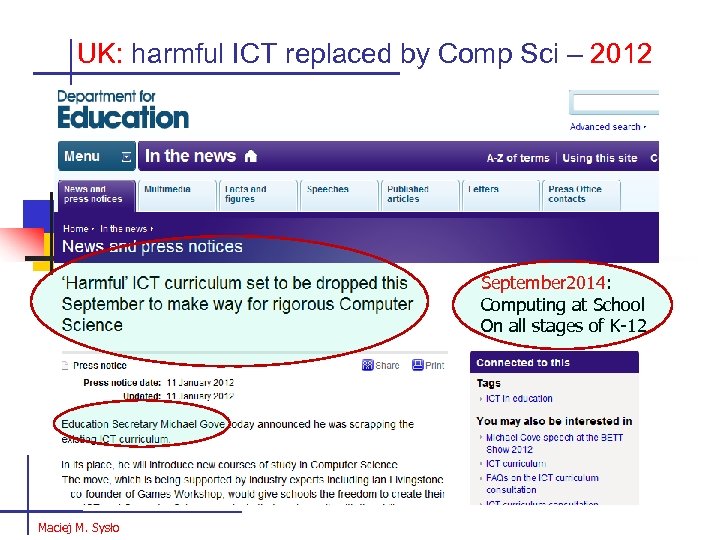 UK: harmful ICT replaced by Comp Sci – 2012 Ewolucja szkoły ku elastycznemu systemowi kształcenia M. M. Sysło September 2014: Computing at School On all stages of K-12 Maciej M. Sysło
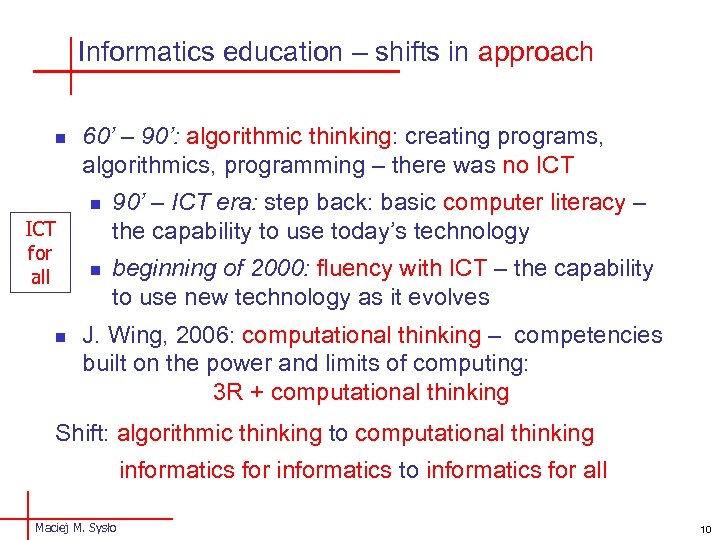 Informatics education – shifts in approach n 60’ – 90’: algorithmic thinking: creating programs, algorithmics, programming – there was no ICT n ICT for all n n 90’ – ICT era: step back: basic computer literacy – the capability to use today’s technology beginning of 2000: fluency with ICT – the capability to use new technology as it evolves J. Wing, 2006: computational thinking – competencies built on the power and limits of computing: 3 R + computational thinking Shift: algorithmic thinking to computational thinking informatics for informatics to informatics for all Maciej M. Sysło 10
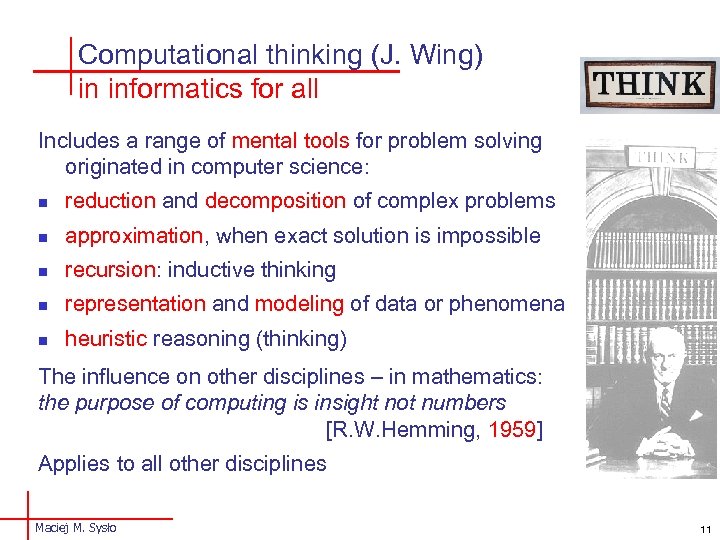 Computational thinking (J. Wing) in informatics for all Includes a range of mental tools for problem solving originated in computer science: n reduction and decomposition of complex problems n approximation, when exact solution is impossible n recursion: inductive thinking n representation and modeling of data or phenomena n heuristic reasoning (thinking) The influence on other disciplines – in mathematics: the purpose of computing is insight not numbers [R. W. Hemming, 1959] Applies to all other disciplines Maciej M. Sysło 11
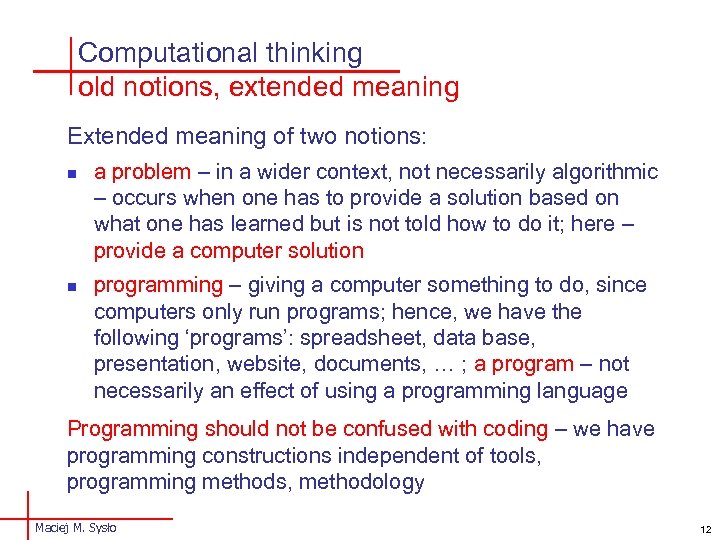 Computational thinking old notions, extended meaning Extended meaning of two notions: n n a problem – in a wider context, not necessarily algorithmic – occurs when one has to provide a solution based on what one has learned but is not told how to do it; here – provide a computer solution programming – giving a computer something to do, since computers only run programs; hence, we have the following ‘programs’: spreadsheet, data base, presentation, website, documents, … ; a program – not necessarily an effect of using a programming language Programming should not be confused with coding – we have programming constructions independent of tools, programming methods, methodology Maciej M. Sysło 12
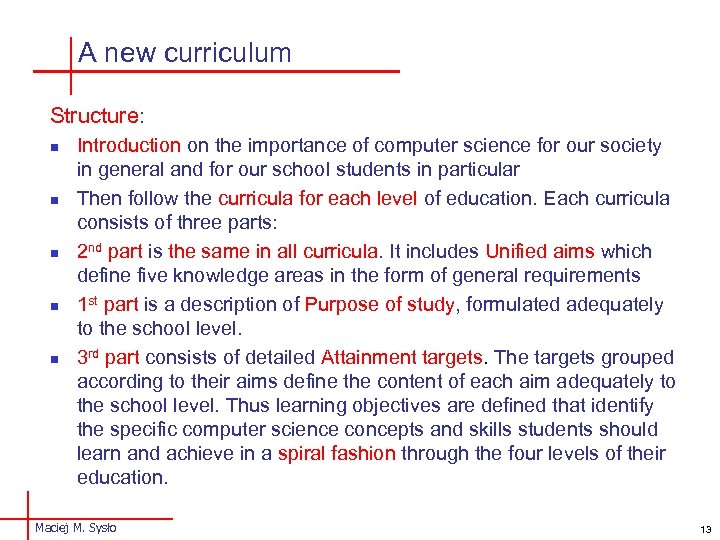 A new curriculum Structure: n n n Introduction on the importance of computer science for our society in general and for our school students in particular Then follow the curricula for each level of education. Each curricula consists of three parts: 2 nd part is the same in all curricula. It includes Unified aims which define five knowledge areas in the form of general requirements 1 st part is a description of Purpose of study, formulated adequately to the school level. 3 rd part consists of detailed Attainment targets. The targets grouped according to their aims define the content of each aim adequately to the school level. Thus learning objectives are defined that identify the specific computer science concepts and skills students should learn and achieve in a spiral fashion through the four levels of their education. Maciej M. Sysło 13
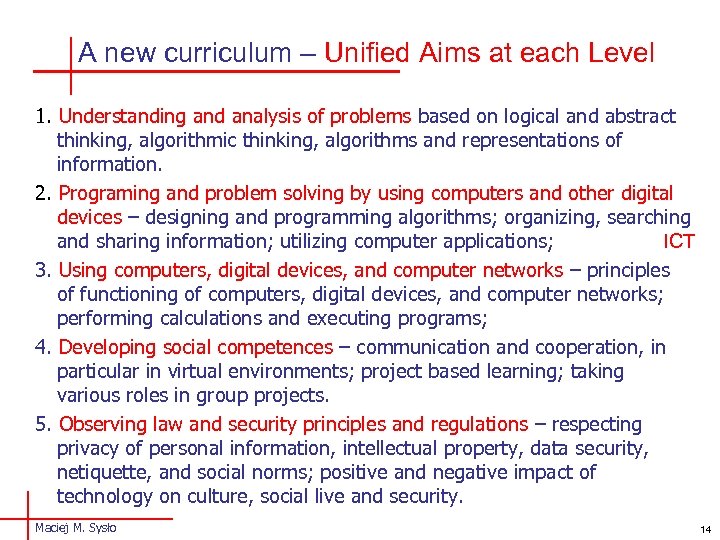 A new curriculum – Unified Aims at each Level 1. Understanding and analysis of problems based on logical and abstract thinking, algorithmic thinking, algorithms and representations of information. 2. Programing and problem solving by using computers and other digital devices – designing and programming algorithms; organizing, searching ICT and sharing information; utilizing computer applications; 3. Using computers, digital devices, and computer networks – principles of functioning of computers, digital devices, and computer networks; performing calculations and executing programs; 4. Developing social competences – communication and cooperation, in particular in virtual environments; project based learning; taking various roles in group projects. 5. Observing law and security principles and regulations – respecting privacy of personal information, intellectual property, data security, netiquette, and social norms; positive and negative impact of technology on culture, social live and security. Maciej M. Sysło 14
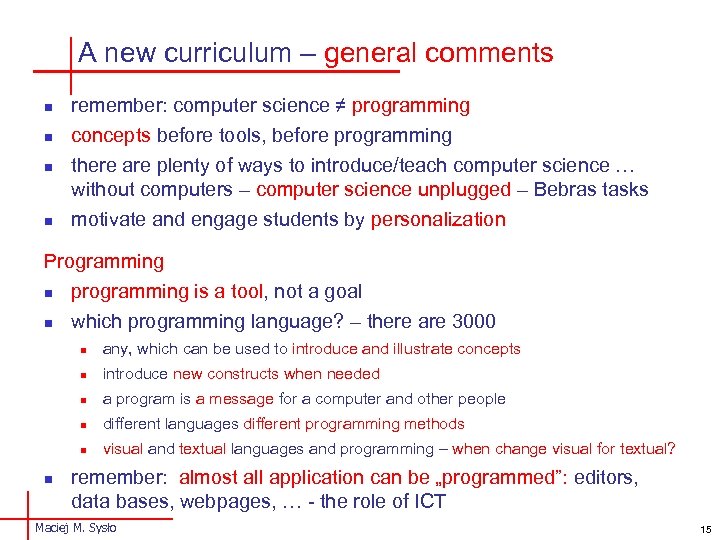 A new curriculum – general comments n n remember: computer science ≠ programming concepts before tools, before programming there are plenty of ways to introduce/teach computer science … without computers – computer science unplugged – Bebras tasks motivate and engage students by personalization Programming n programming is a tool, not a goal n which programming language? – there are 3000 n n introduce new constructs when needed n a program is a message for a computer and other people n different languages different programming methods n n any, which can be used to introduce and illustrate concepts visual and textual languages and programming – when change visual for textual? remember: almost all application can be „programmed”: editors, data bases, webpages, … - the role of ICT Maciej M. Sysło 15
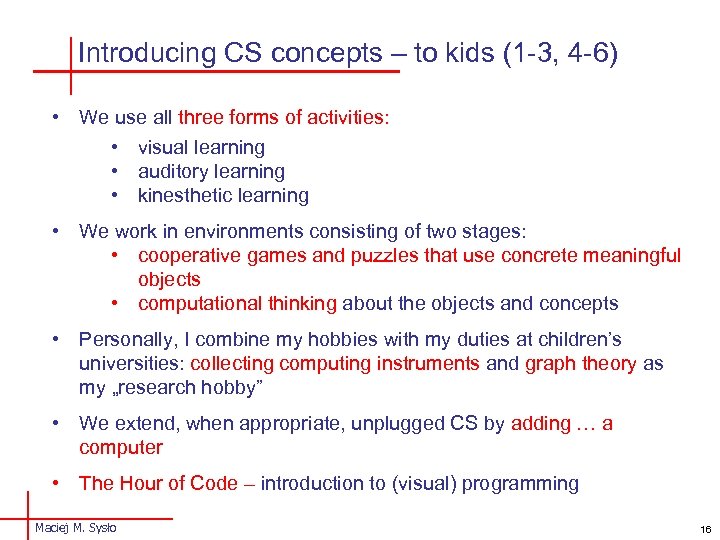 Introducing CS concepts – to kids (1 -3, 4 -6) • We use all three forms of activities: • visual learning • auditory learning • kinesthetic learning • We work in environments consisting of two stages: • cooperative games and puzzles that use concrete meaningful objects • computational thinking about the objects and concepts • Personally, I combine my hobbies with my duties at children’s universities: collecting computing instruments and graph theory as my „research hobby” • We extend, when appropriate, unplugged CS by adding … a computer • The Hour of Code – introduction to (visual) programming Maciej M. Sysło 16
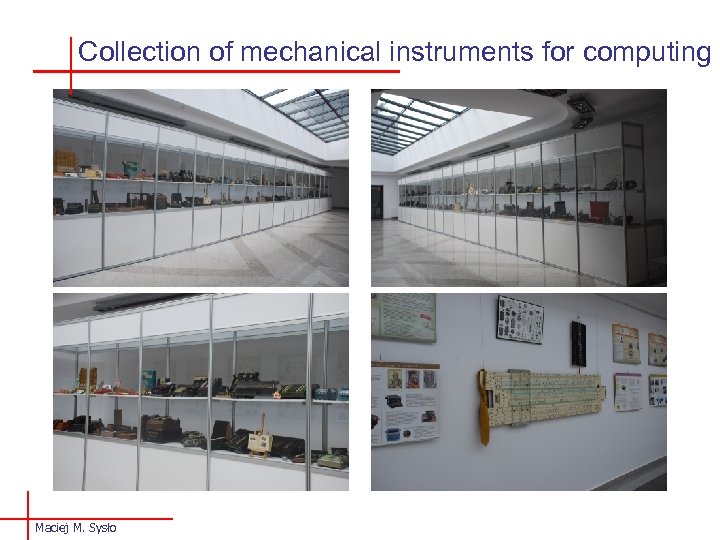 Collection of mechanical instruments for computing Maciej M. Sysło
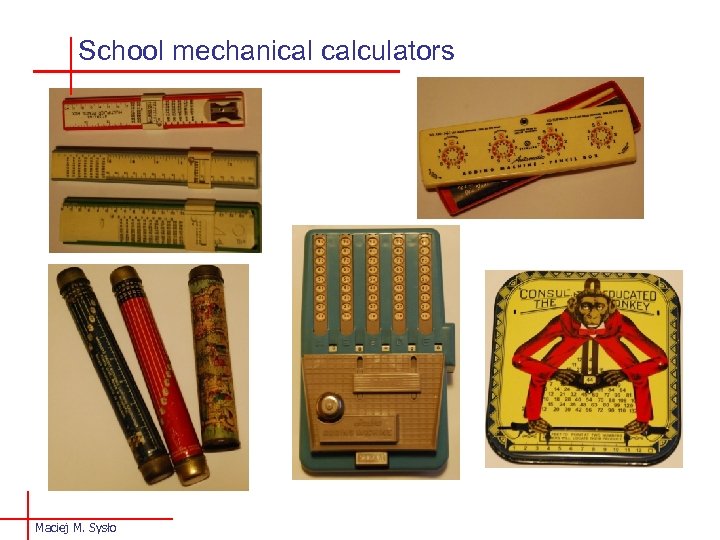 School mechanical calculators Maciej M. Sysło
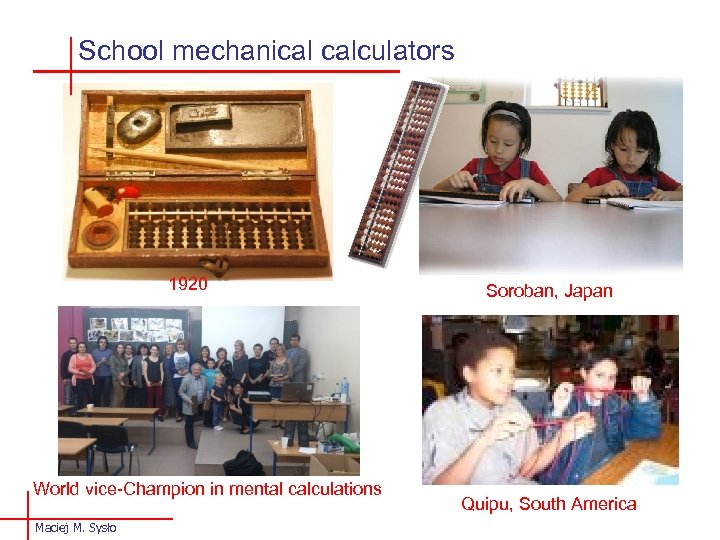 School mechanical calculators 1920 World vice-Champion in mental calculations Maciej M. Sysło Soroban, Japan Quipu, South America
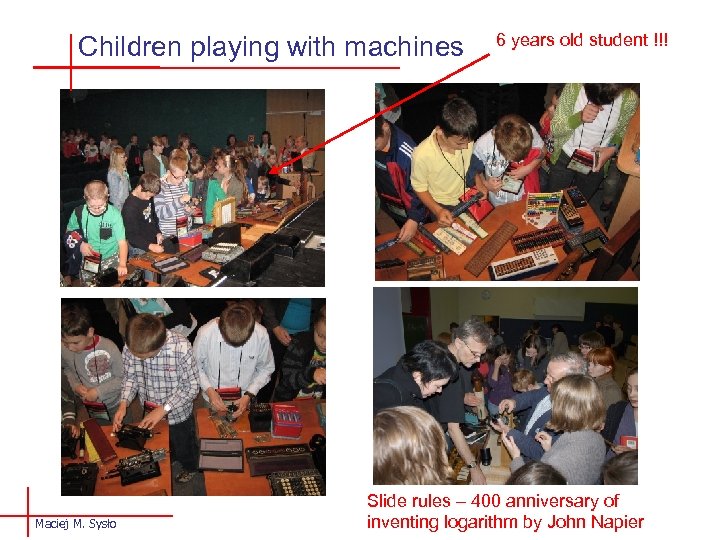 Children playing with machines Maciej M. Sysło 6 years old student !!! Slide rules – 400 anniversary of inventing logarithm by John Napier
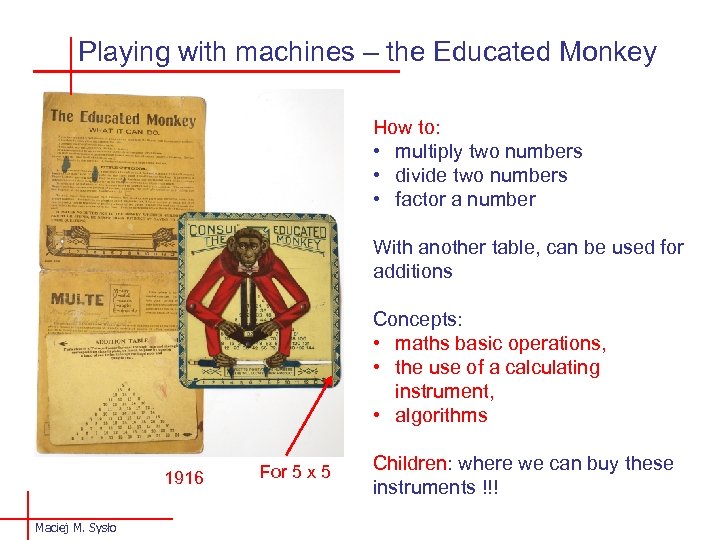 Playing with machines – the Educated Monkey How to: • multiply two numbers • divide two numbers • factor a number With another table, can be used for additions Concepts: • maths basic operations, • the use of a calculating instrument, • algorithms 1916 Maciej M. Sysło For 5 x 5 Children: where we can buy these instruments !!!
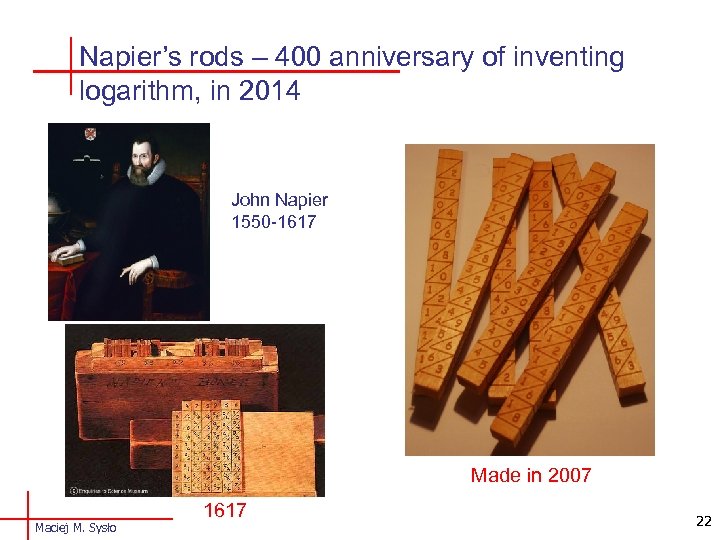 Napier’s rods – 400 anniversary of inventing logarithm, in 2014 John Napier 1550 -1617 Made in 2007 Maciej M. Sysło 1617 22
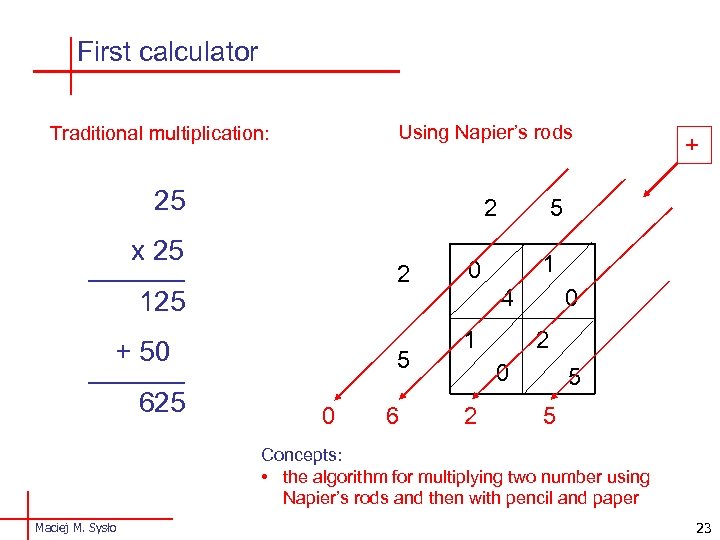 First calculator Using Napier’s rods Traditional multiplication: 25 2 x 25 2 125 + 50 625 5 0 6 5 1 0 4 1 0 2 + 5 5 Concepts: • the algorithm for multiplying two number using Napier’s rods and then with pencil and paper Maciej M. Sysło 23
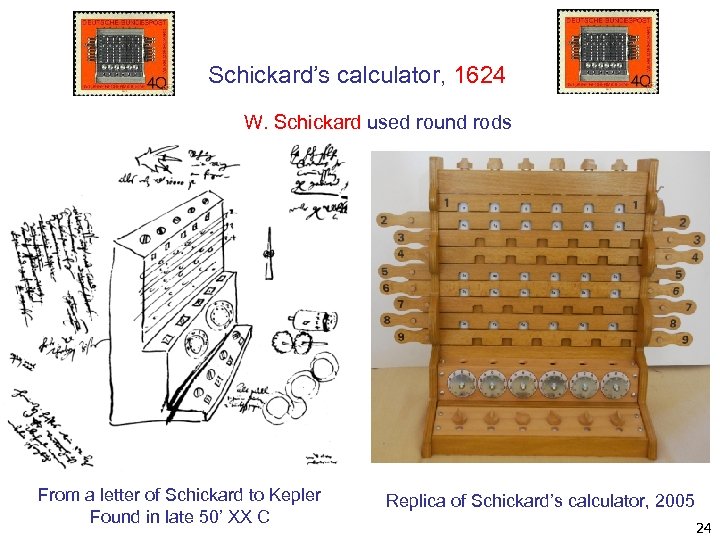 Schickard’s calculator, 1624 W. Schickard used round rods From a letter of Schickard to Kepler Found in late 50’ XX C Replica of Schickard’s calculator, 2005 24
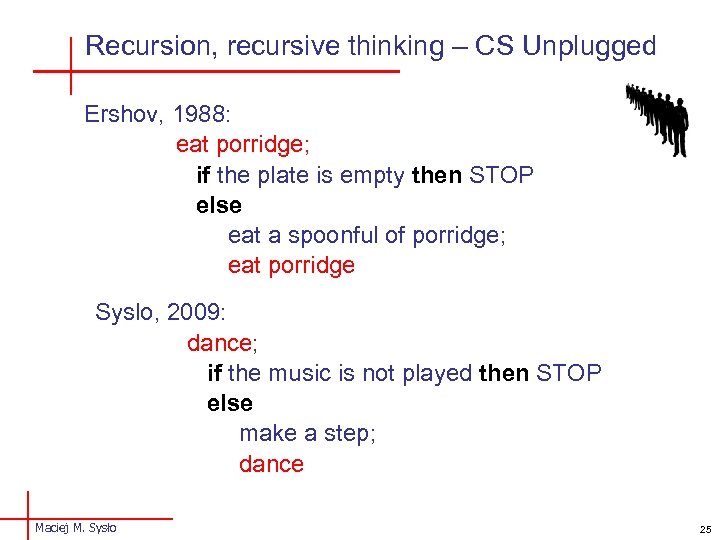 Recursion, recursive thinking – CS Unplugged Ershov, 1988: eat porridge; if the plate is empty then STOP else eat a spoonful of porridge; eat porridge Syslo, 2009: dance; if the music is not played then STOP else make a step; dance Maciej M. Sysło 25
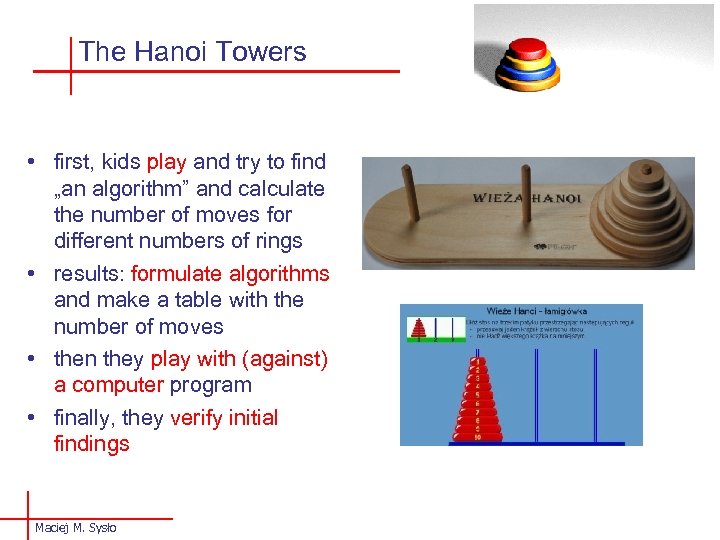 The Hanoi Towers • first, kids play and try to find „an algorithm” and calculate the number of moves for different numbers of rings • results: formulate algorithms and make a table with the number of moves • then they play with (against) a computer program • finally, they verify initial findings Maciej M. Sysło
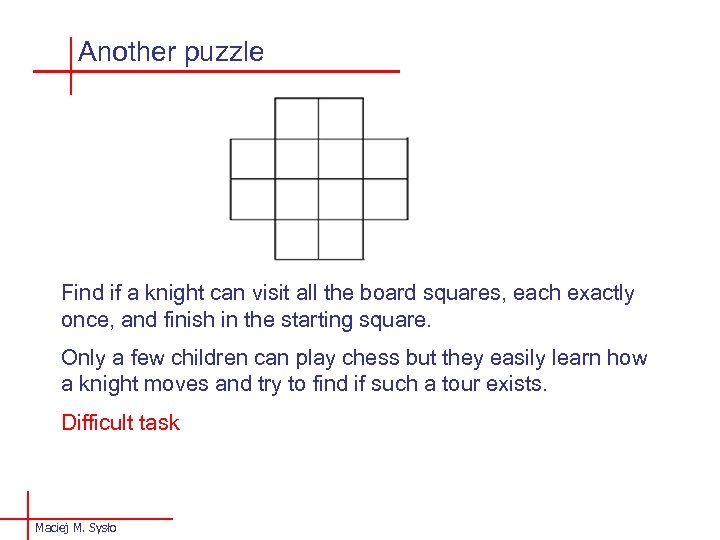 Another puzzle Find if a knight can visit all the board squares, each exactly once, and finish in the starting square. Only a few children can play chess but they easily learn how a knight moves and try to find if such a tour exists. Difficult task Maciej M. Sysło
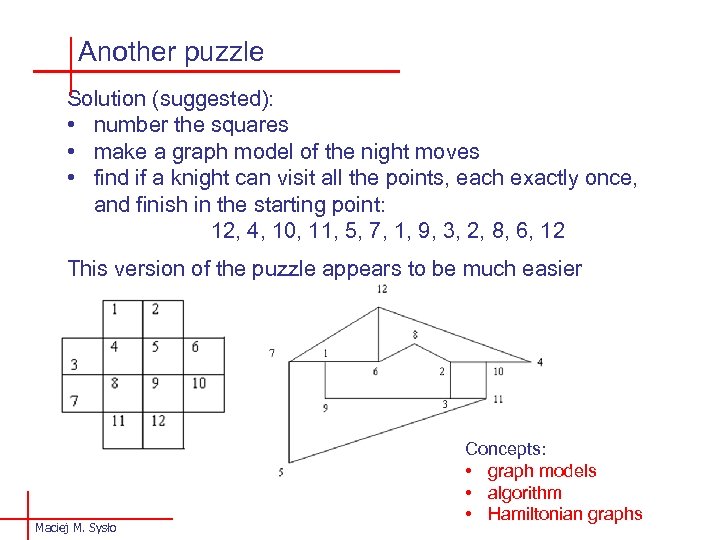 Another puzzle Solution (suggested): • number the squares • make a graph model of the night moves • find if a knight can visit all the points, each exactly once, and finish in the starting point: 12, 4, 10, 11, 5, 7, 1, 9, 3, 2, 8, 6, 12 This version of the puzzle appears to be much easier Maciej M. Sysło Concepts: • graph models • algorithm • Hamiltonian graphs
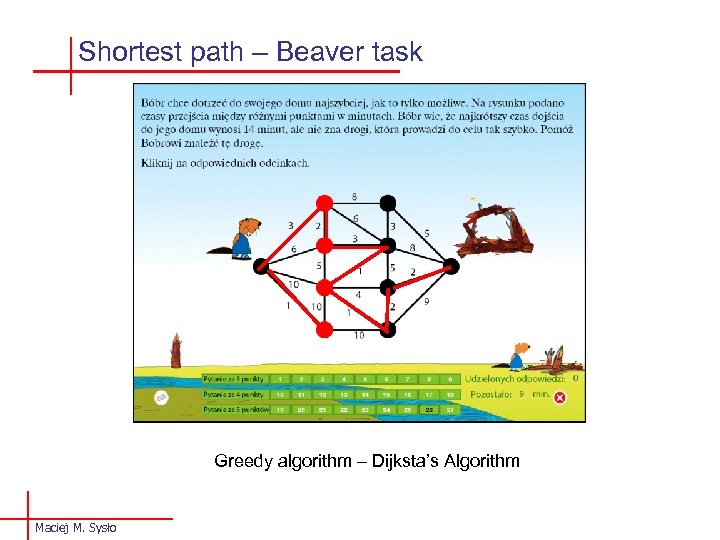 Shortest path – Beaver task Greedy algorithm – Dijksta’s Algorithm Maciej M. Sysło
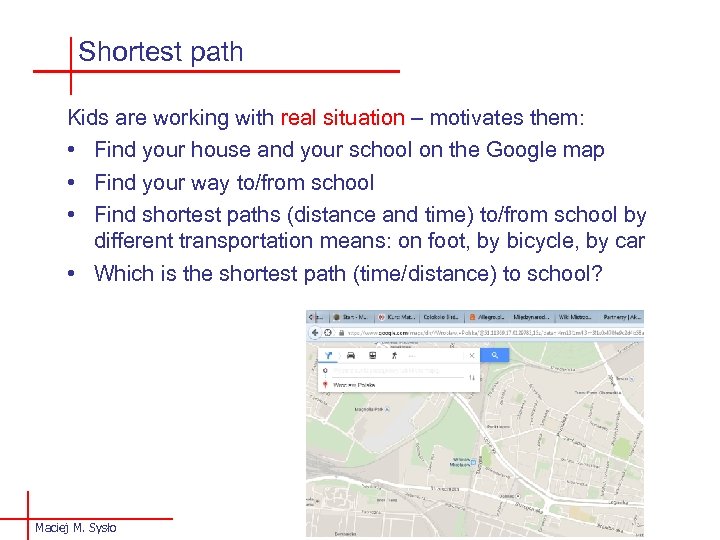 Shortest path Kids are working with real situation – motivates them: • Find your house and your school on the Google map • Find your way to/from school • Find shortest paths (distance and time) to/from school by different transportation means: on foot, by bicycle, by car • Which is the shortest path (time/distance) to school? Maciej M. Sysło
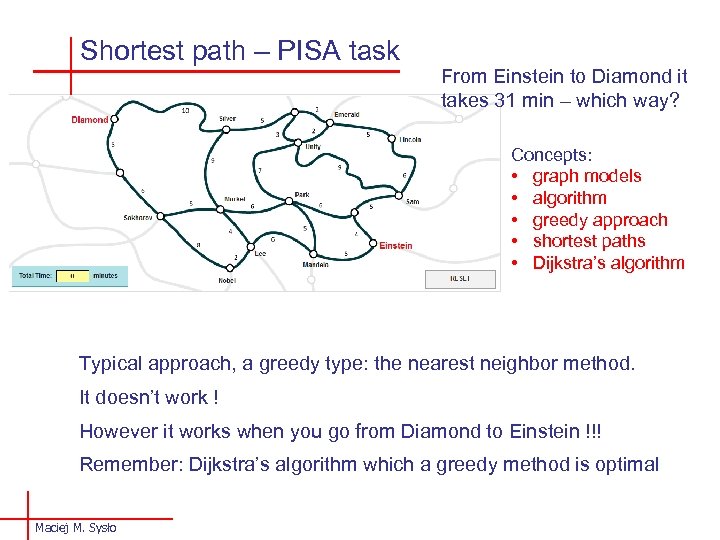 Shortest path – PISA task From Einstein to Diamond it takes 31 min – which way? Concepts: • graph models • algorithm • greedy approach • shortest paths • Dijkstra’s algorithm Typical approach, a greedy type: the nearest neighbor method. It doesn’t work ! However it works when you go from Diamond to Einstein !!! Remember: Dijkstra’s algorithm which a greedy method is optimal Maciej M. Sysło
 Supporting activities • Teacher preparation – a teacher is the most important technology • standards, evaluation and support in the classroom • in-service training at universities – based on standards • Web service – materials, MOOCs Our goal: a computer science teacher should be prepared as a Ist degree computer science graduate (3 years of study) • Comments to the curricula of other subjects how to use computational thinking in solving problems coming from other areas • PBL and flipped learning – off school activities of students – extra hours of school learning • Computer science oriented tasks in school tests Maciej M. Sysło
 Thank you for your attention and don’t forget to: