


 Скачать презентацию A new approach to researching inter nationalism in school
ec4faeb410dff4a73daa5192607ff018.ppt
- Количество слайдов: 10
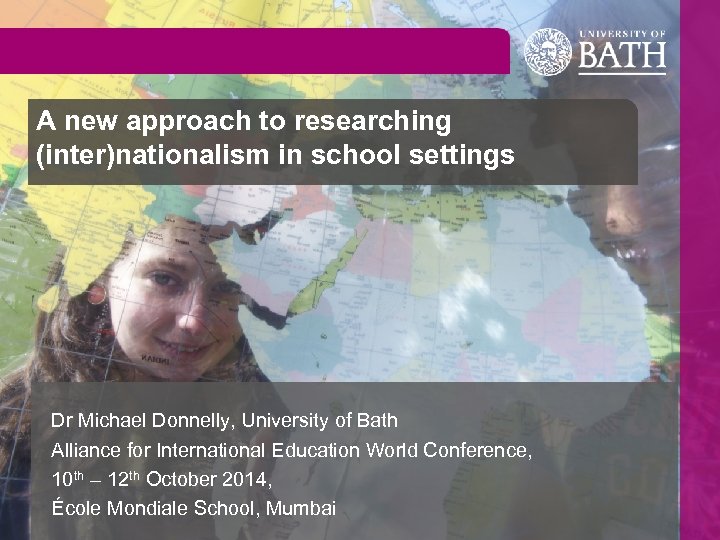 A new approach to researching (inter)nationalism in school settings Dr Michael Donnelly, University of Bath Alliance for International Education World Conference, 10 th – 12 th October 2014, École Mondiale School, Mumbai
 Global citizenship education • ‘Internationalism’ as a key component of global citizenship education • Often focussed on formal curriculum delivery aspects • “Wheeling out the global”: a commodity to be delivered/used • What this misses: the way (inter)nationalism is routinely (rep)presented through internal properties of schools • Each school lives and breathes a particular version of (inter)nationalism through their internal mechanisms/properties
 Studying institutions: insights from case study research of school settings • Organisational sorting of pupils and its impact on differentiation/polarisation of student body (Lacey 1970, Hargreaves 1967) • Impact of ‘banding’: band stereotypes, pupil friendship groups (Ball, 1981) • Temporal dimensions, movement and immobility in the school setting, home/school relations (Delamont and Gaulton, 1986) • Impact of testing and teachers on young people’s educational identities/trajectories (Gillborn and Youdell 2000) • School space (timetable, events/activities), teacher-student interactions, artefacts and resources (Donnelly, 2014)
 Internal mechanisms of schools • Space and time in school: formal curriculum, events, activities, timetable, school calander • Selection, sorting and grouping of staff/pupils • Teacher-student interactions • Practices and processes: routine organisation and management of school, teaching and learning • Artefacts (both physical and virtual): school website, displays, school-home communications, learning materials etc.
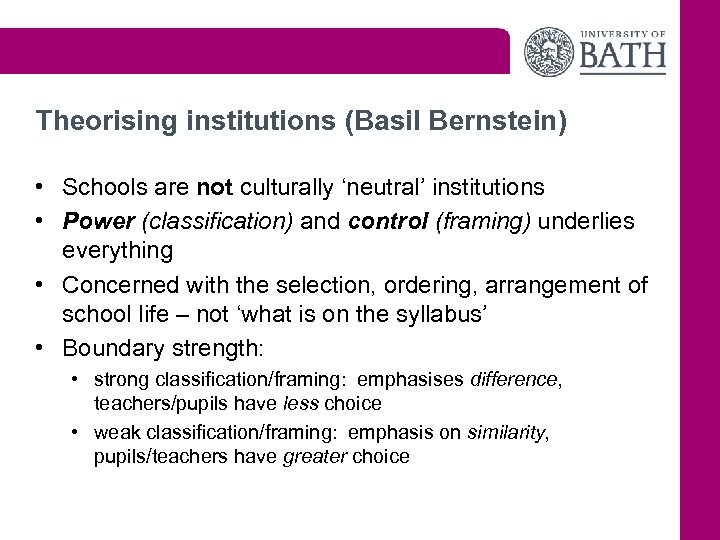 Theorising institutions (Basil Bernstein) • Schools are not culturally ‘neutral’ institutions • Power (classification) and control (framing) underlies everything • Concerned with the selection, ordering, arrangement of school life – not ‘what is on the syllabus’ • Boundary strength: • strong classification/framing: emphasises difference, teachers/pupils have less choice • weak classification/framing: emphasis on similarity, pupils/teachers have greater choice
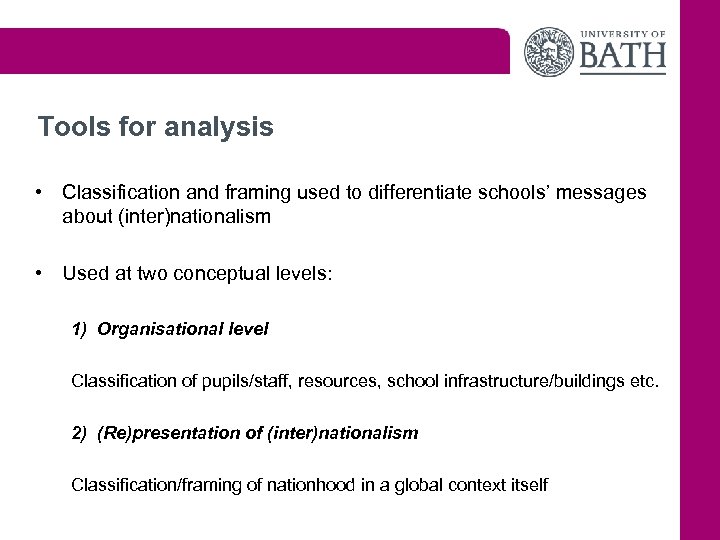 Tools for analysis • Classification and framing used to differentiate schools’ messages about (inter)nationalism • Used at two conceptual levels: 1) Organisational level Classification of pupils/staff, resources, school infrastructure/buildings etc. 2) (Re)presentation of (inter)nationalism Classification/framing of nationhood in a global context itself
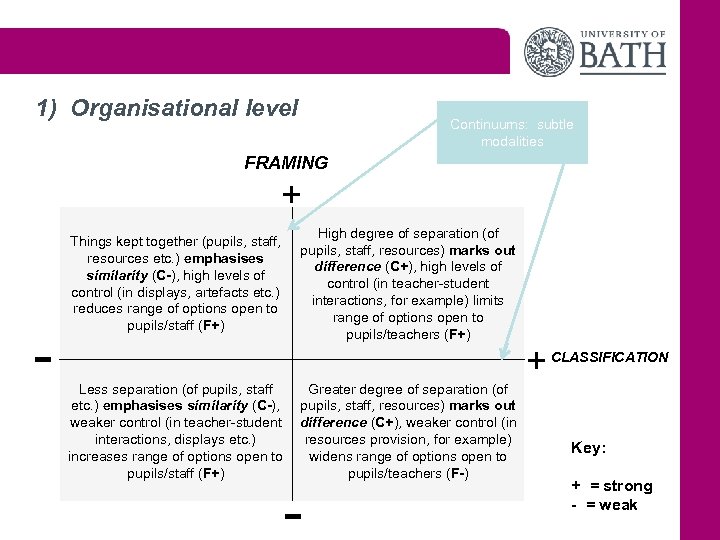 1) Organisational level Continuums: subtle modalities FRAMING + - Things kept together (pupils, staff, resources etc. ) emphasises similarity (C-), high levels of control (in displays, artefacts etc. ) reduces range of options open to pupils/staff (F+) Less separation (of pupils, staff etc. ) emphasises similarity (C-), weaker control (in teacher-student interactions, displays etc. ) increases range of options open to pupils/staff (F+) High degree of separation (of pupils, staff, resources) marks out difference (C+), high levels of control (in teacher-student interactions, for example) limits range of options open to pupils/teachers (F+) Greater degree of separation (of pupils, staff, resources) marks out difference (C+), weaker control (in resources provision, for example) widens range of options open to pupils/teachers (F-) - + CLASSIFICATION Key: + = strong - = weak
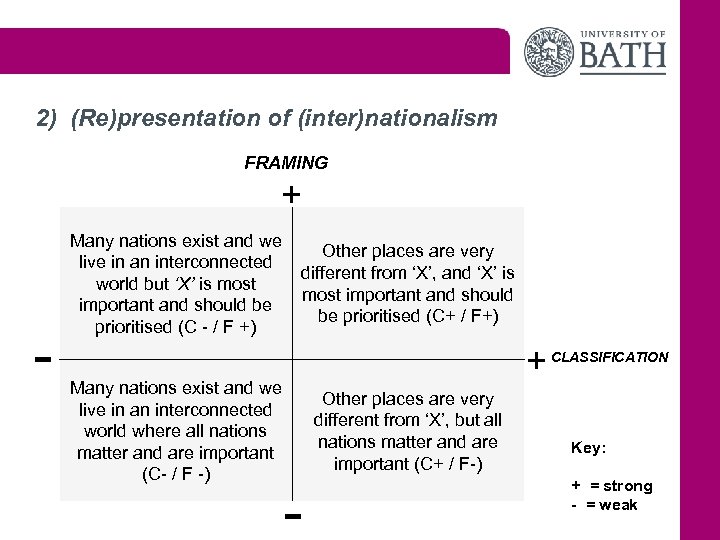 2) (Re)presentation of (inter)nationalism FRAMING + - Many nations exist and we live in an interconnected world but ‘X’ is most important and should be prioritised (C - / F +) Many nations exist and we live in an interconnected world where all nations matter and are important (C- / F -) Other places are very different from ‘X’, and ‘X’ is most important and should be prioritised (C+ / F+) + Other places are very different from ‘X’, but all nations matter and are important (C+ / F-) - CLASSIFICATION Key: + = strong - = weak
 Conclusion and future directions • Avoids deficit thinking… Nothing never happens! • Provides a degree of analytical precision • Captures all that is left un-said and/or hidden: potentially a more powerful influence? (but how can we research this? ) • Transformatory potential of schooling: schools are not just representations of culture. • Implies an ethnographic approach: immersion in school setting capturing the mundane, routine, and taken for granted. • What next? … empirical work to apply the framework (Funding proposal to AHRC: Young people, place and (inter)nationalism: the role of educational institutions)
 Dr Michael Donnelly Department of Education University of Bath m. p. donnelly@bath. ac. uk @Dr_M_Donnelly