 Скачать презентацию A Neoclassical Look at Behavioral Finance by Steve
ff6b654ae667d02cf2f0d78f7b402def.ppt
- Количество слайдов: 56



A Neoclassical Look at Behavioral Finance by Steve Ross MIT Isaac Newton Institute for Mathematical Sciences University of Cambridge July 8, 2005 Copyright © 2005 Steve Ross
Neoclassical Finance • For the most part: NOT a theory of rational ‘economan’ • A theory of ‘sharks’
Efficient Markets • Markets are pretty efficient – Weak Form: prices are nearly serially uncorrelated over time – Semi Strong Form: its hard to make excess returns using fundamentals – Strong Form: If a tree falls in a forest even if a squirrel hears it he can’t make a killing in timber
No Arbitrage • If there is arbitrage its hard to find • No arbitrage ═ Risk Neutral Pricing – – Kernels Martingales AD prices Theory of Derivatives • Black Scholes • Binomials • Smiles, smirks, etc.
Asset Pricing Models • Demand based: Some index is mean variance efficient and pricing is from beta risks – APT – CAPM – CBM – ICAPM
Corporate Finance • Modigliani Miller • Taxes, bankruptcy • Some modest signaling and single proprietorship agency theory • I don’t know anything else
Theory Meets the Data Its no fun to talk about supportive data so lets look at problem children: Anomalies & Aberrations
Anomalies and Aberrations: A Sampling of Some Favorites • Stocks: – Small firm effects, P/E, momentum, calendar year effects, long run predictablility, bubbles, equity premium puzzles • Violations of the LOP: – MCI/MCIC Jr, Royal Dutch Shell/Shell Trading, 3 COM/Palm Pilot, Citizen’s Public Utilities, internet stocks, closed end funds • Volatility: – Noisy prices – low R 2, stock market volatility/fundamental volatility, weekend and trading time vols • Successful investors – Hedge fund alphas, mutual fund performance persistence, Warren Buffett
Stop Already! • Too many problem children in the class • A modest proposal: – A moratorium on all empirical work for 5 years to allow the slower neoclassical theorists time to catch up – We’re just not as quick at coming up with new theories; we have to use one for a lot of problems while in the new world of theory you can have one per anomaly • For now, though, let’s see where we stand
The Financial Hurricane Scale

Is it true?

(0, 7) (7, 7) How damaging is it? (0, 0) Is it true? (7, 0)
Some Test Cases • The Siberian stock market is a modest but flourishing and competitive regional market • Interestingly, for the past six years, with 4 exceptions, on the Siberian stock market, stocks have risen every Wednesday and fallen every Thursday • Furthermore, over the past six years, on all but 3 weekends in which the returns were modest, stocks opened lower on Monday than they closed on Friday.
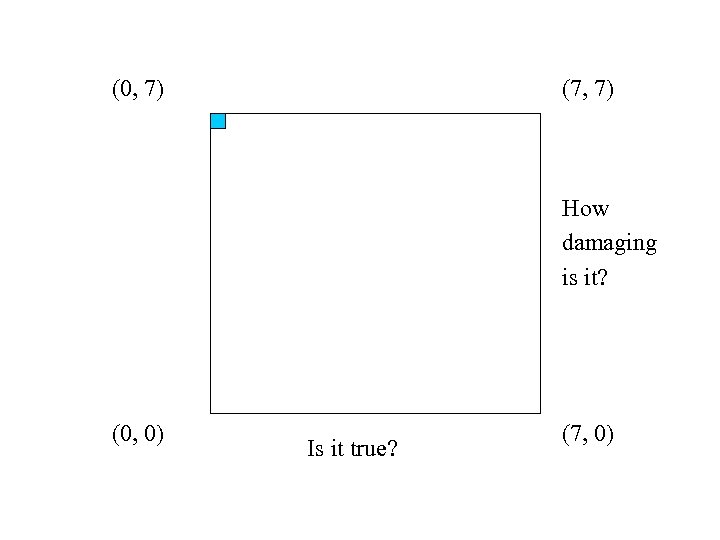
(0, 7) (7, 7) How damaging is it? (0, 0) Is it true? (7, 0)
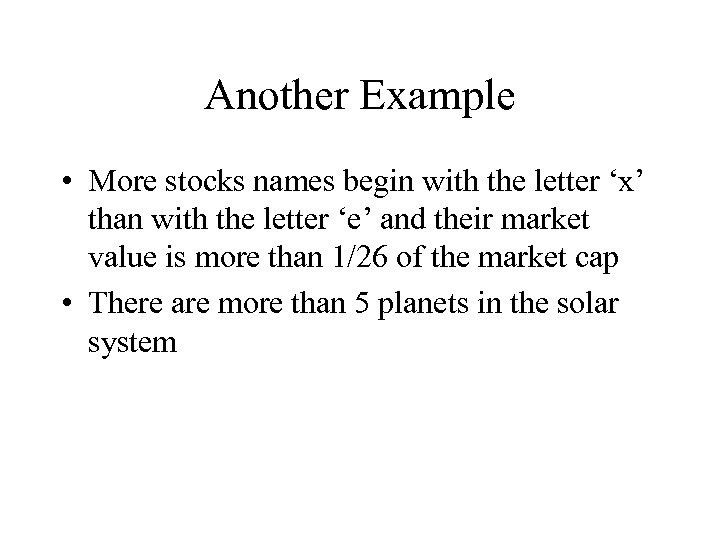
Another Example • More stocks names begin with the letter ‘x’ than with the letter ‘e’ and their market value is more than 1/26 of the market cap • There are more than 5 planets in the solar system
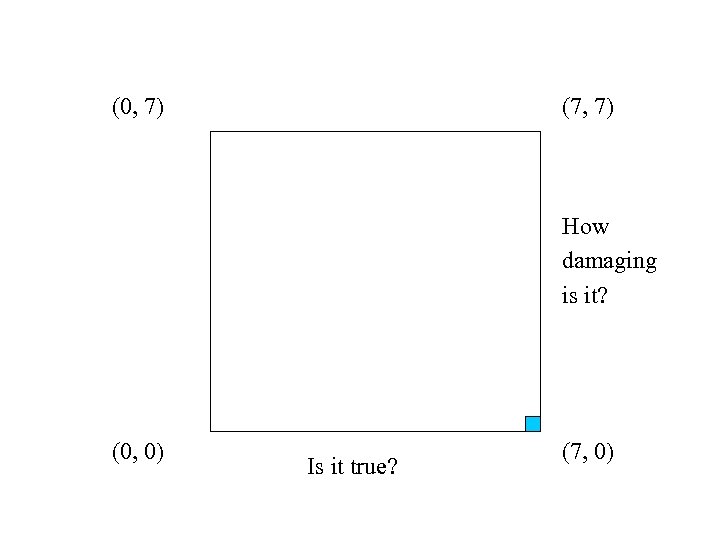
(0, 7) (7, 7) How damaging is it? (0, 0) Is it true? (7, 0)
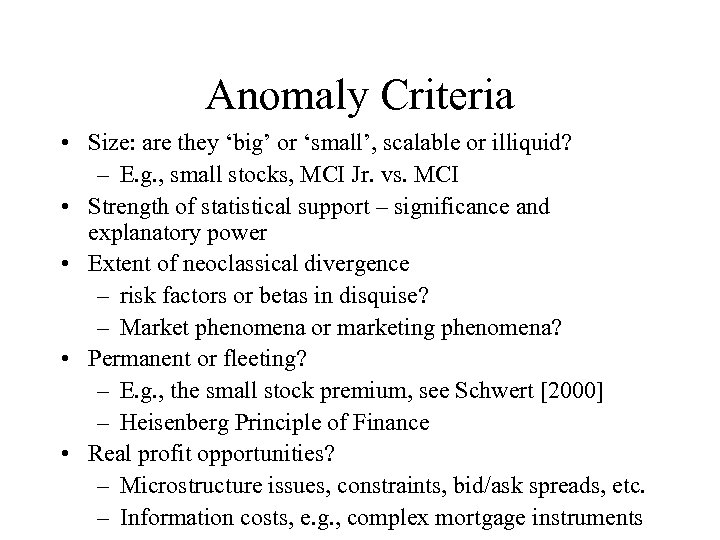
Anomaly Criteria • Size: are they ‘big’ or ‘small’, scalable or illiquid? – E. g. , small stocks, MCI Jr. vs. MCI • Strength of statistical support – significance and explanatory power • Extent of neoclassical divergence – risk factors or betas in disquise? – Market phenomena or marketing phenomena? • Permanent or fleeting? – E. g. , the small stock premium, see Schwert [2000] – Heisenberg Principle of Finance • Real profit opportunities? – Microstructure issues, constraints, bid/ask spreads, etc. – Information costs, e. g. , complex mortgage instruments
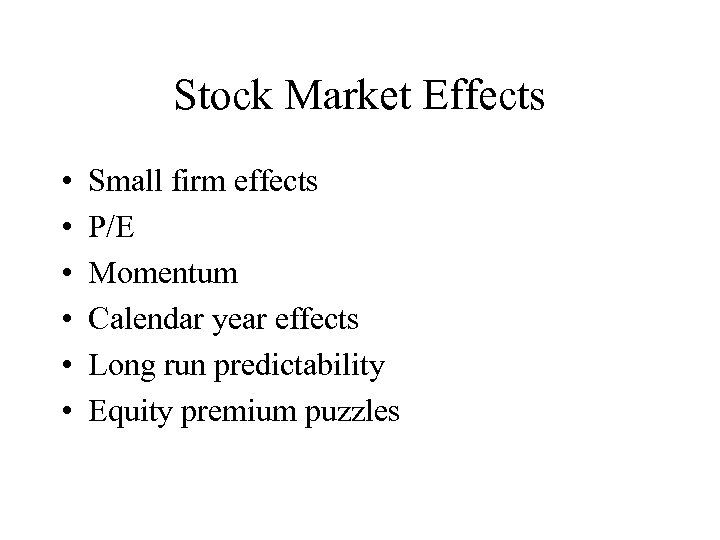
Stock Market Effects • • • Small firm effects P/E Momentum Calendar year effects Long run predictability Equity premium puzzles
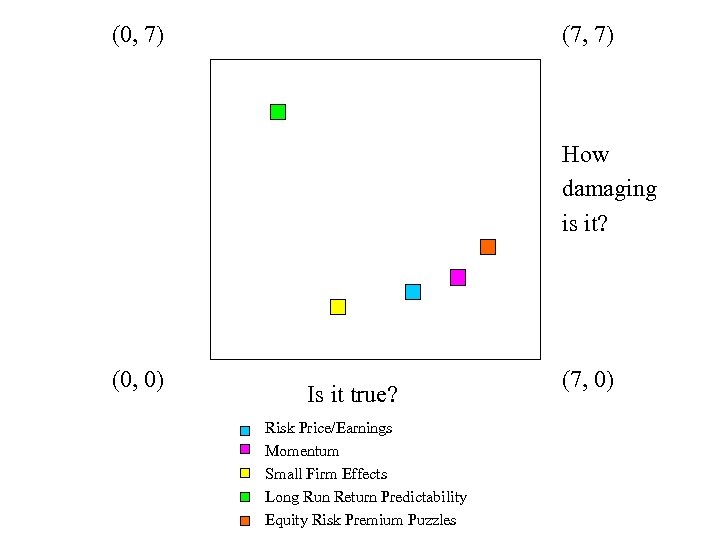
(0, 7) (7, 7) How damaging is it? (0, 0) Is it true? Risk Price/Earnings Momentum Small Firm Effects Long Run Return Predictability Equity Risk Premium Puzzles (7, 0)
Volatility • Stock market volatility relative to fundamental volatility, • Weekend and trading time volatility differences • Correlation between volatility and volume • Noisy prices - low R 2
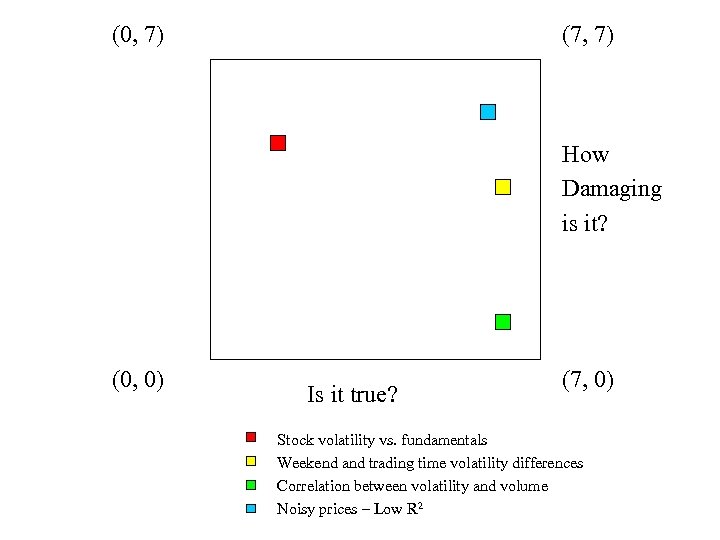
(0, 7) (7, 7) How Damaging is it? (0, 0) Is it true? (7, 0) Stock volatility vs. fundamentals Weekend and trading time volatility differences Correlation between volatility and volume Noisy prices – Low R 2
LOP Violations • Matched arbitrages: – – MCI/MCIC Jr 3 COM/Palm Pilot Royal Dutch Shell/Shell Trading Citizen’s Public Utilities, internet stocks, closed end funds • Closed end fund puzzles – Discounts – Country effects • Overpriced assets and bubbles – Prices ≠ Fundamentals – Large scale: internet stocks, real estate – Macro: the whole US market, the US$ • Aren’t there any underpriced assets?
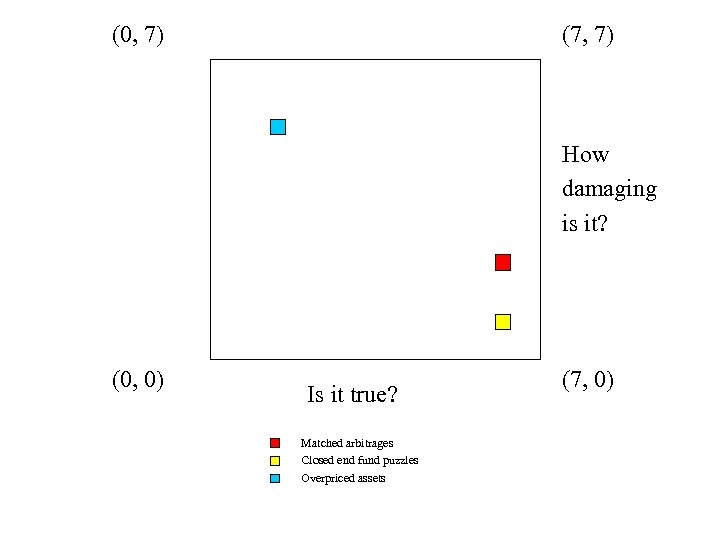
(0, 7) (7, 7) How damaging is it? (0, 0) Is it true? Matched arbitrages Closed end fund puzzles Overpriced assets (7, 0)
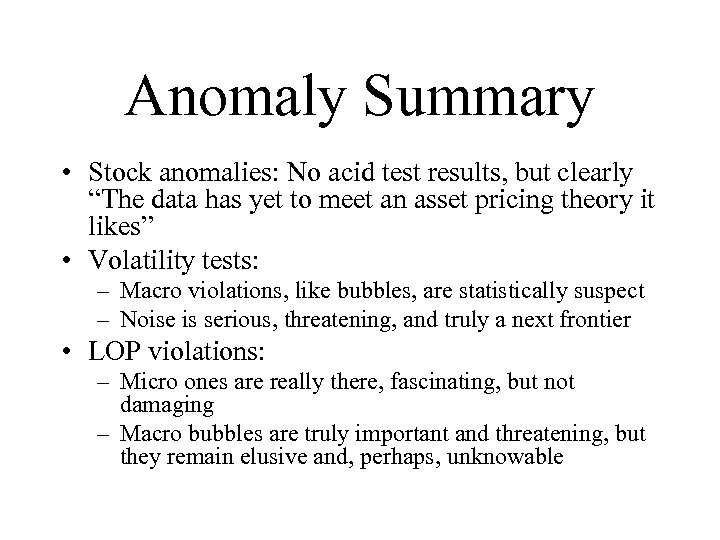
Anomaly Summary • Stock anomalies: No acid test results, but clearly “The data has yet to meet an asset pricing theory it likes” • Volatility tests: – Macro violations, like bubbles, are statistically suspect – Noise is serious, threatening, and truly a next frontier • LOP violations: – Micro ones are really there, fascinating, but not damaging – Macro bubbles are truly important and threatening, but they remain elusive and, perhaps, unknowable
“Science progresses funeral by funeral”* *Samuelson

Our Many New Friends • Psychologists – Behavioral Finance • Physicists – Complex Systems • Biologists – Markets as evolving organisms: – Mutations, survival, etc.
Behavioral Finance • More defined by what it doesn’t like than by what it offers as alternatives • People aren’t rational • Data doesn’t fit the established orthodox views • Time is ripe for a Kuhn like seismic shift
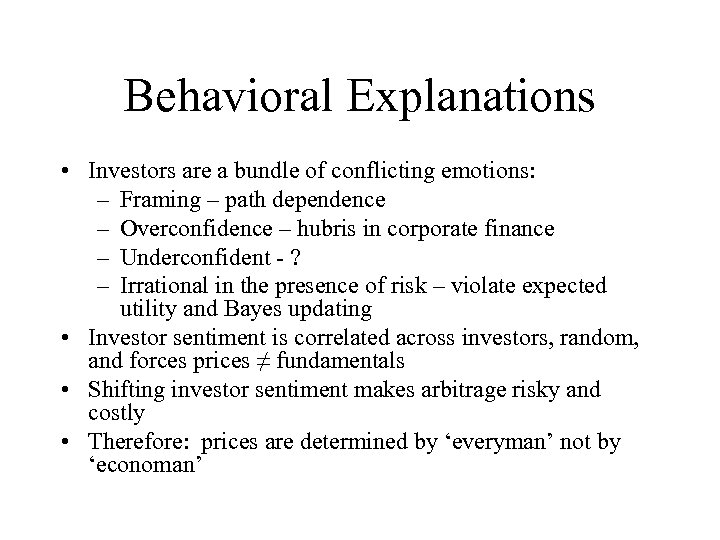
Behavioral Explanations • Investors are a bundle of conflicting emotions: – Framing – path dependence – Overconfidence – hubris in corporate finance – Underconfident - ? – Irrational in the presence of risk – violate expected utility and Bayes updating • Investor sentiment is correlated across investors, random, and forces prices ≠ fundamentals • Shifting investor sentiment makes arbitrage risky and costly • Therefore: prices are determined by ‘everyman’ not by ‘economan’
Prices Fundamentals • Internet Stocks and the whole market • Royal Dutch Shell and Shell Trading • But, ‘fundamentals’ are inherently ambiguous and depend on some pricing theory
Closed End Funds • Fundamentals are unambiguous; net asset value (NAV)
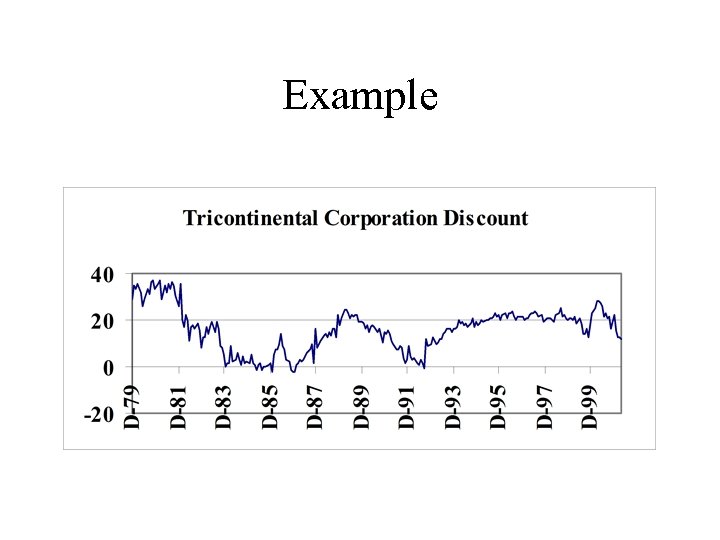
Example
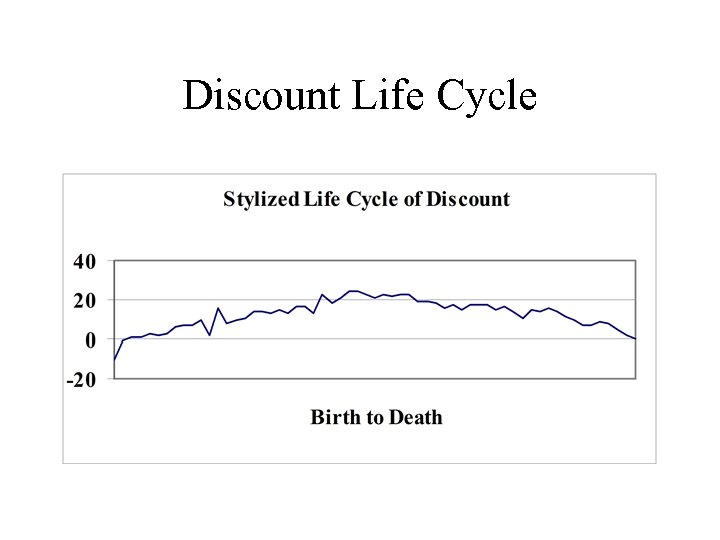
Discount Life Cycle
Closed End Funds • Fundamentals are unambiguous; net asset value • Data – – – Trade at discounts from NAV Discounts are correlated across funds Discounts narrow as market rises Discounts disappear when funds are opened up Begin life at an IPO premium! Country funds rise and fall in value depending not just on domestic returns but also with the US market
Behavioral Explanation • Discounts and premiums are a function of investor sentiment • Investor sentiment is correlated across investors implying discounts are correlated across funds • Arbitrage is costly and problematic – Managers fight opening up their funds and fight takeovers – Correlated investor sentiment makes arbitrage risky; discounts could widen • But, even if arbitrage isn’t possible, then why don’t large holders buy discounted funds instead of holding their underlying assets?
![Neoclassical Analysis Reprised • Earlier work (Malkiel [1977])dismissed agency costs, i. e. , management](https://present5.com/presentation/ff6b654ae667d02cf2f0d78f7b402def/image-35.jpg "Neoclassical Analysis Reprised • Earlier work (Malkiel [1977])dismissed agency costs, i. e. , management")
Neoclassical Analysis Reprised • Earlier work (Malkiel [1977])dismissed agency costs, i. e. , management fees • But, early analysis used an inappropriate technology to value fees; discounted projected cash flows • Fees are a derivative on the fund NAV • An interesting case of scientific sociology; everyone just quoted the previous papers as ‘proof’ that fees didn’t matter
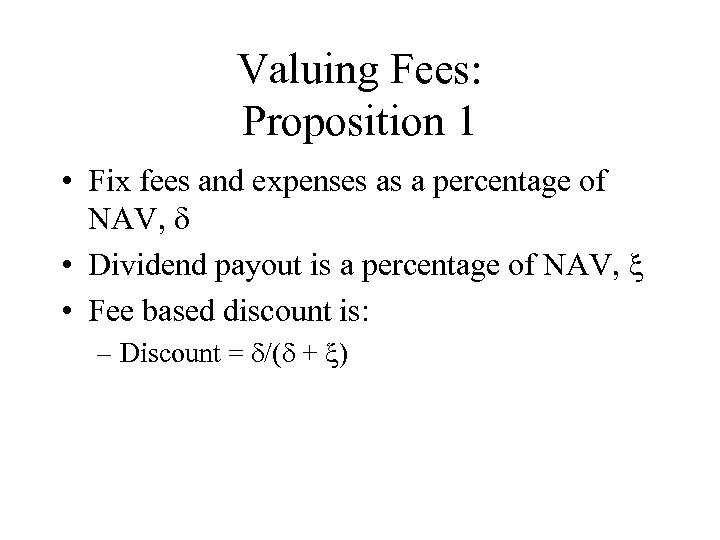
Valuing Fees: Proposition 1 • Fix fees and expenses as a percentage of NAV, • Dividend payout is a percentage of NAV, • Fee based discount is: – Discount = /( + )
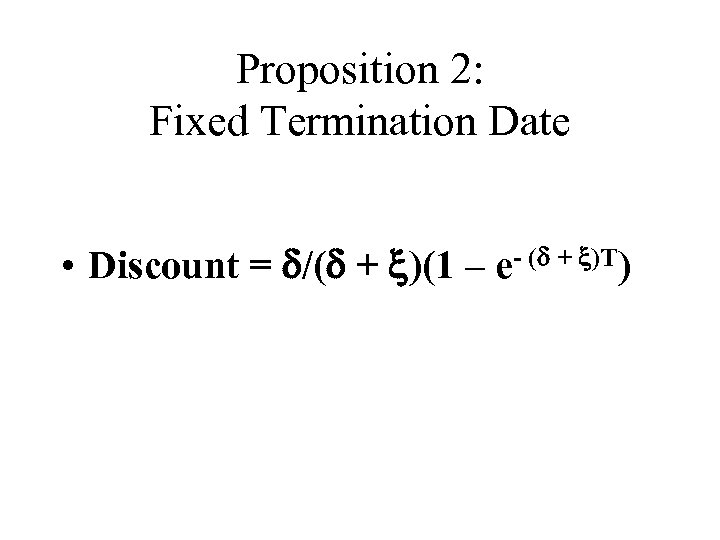
Proposition 2: Fixed Termination Date • Discount = /( + )(1 – e- ( + )T)
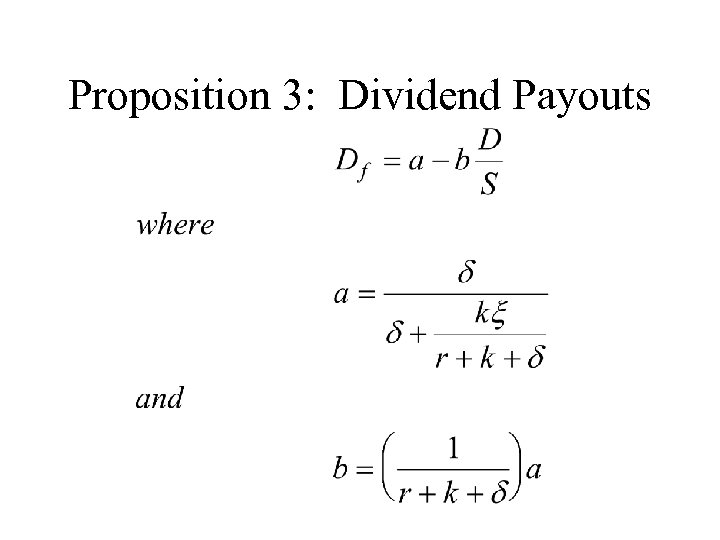
Proposition 3: Dividend Payouts
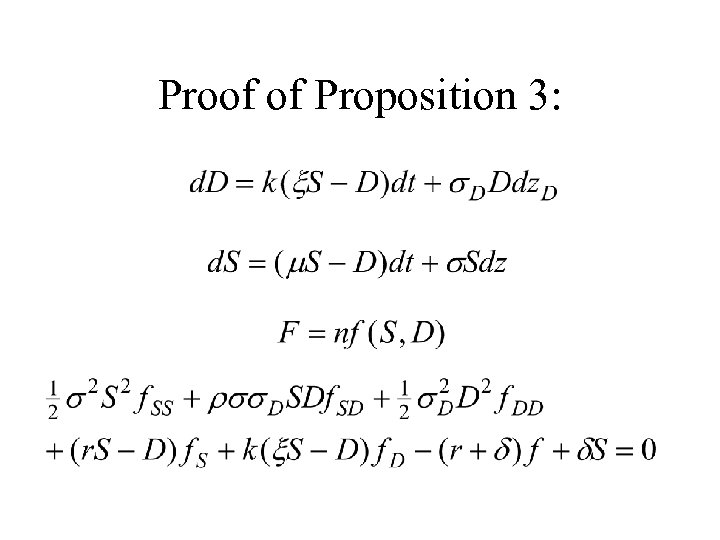
Proof of Proposition 3:
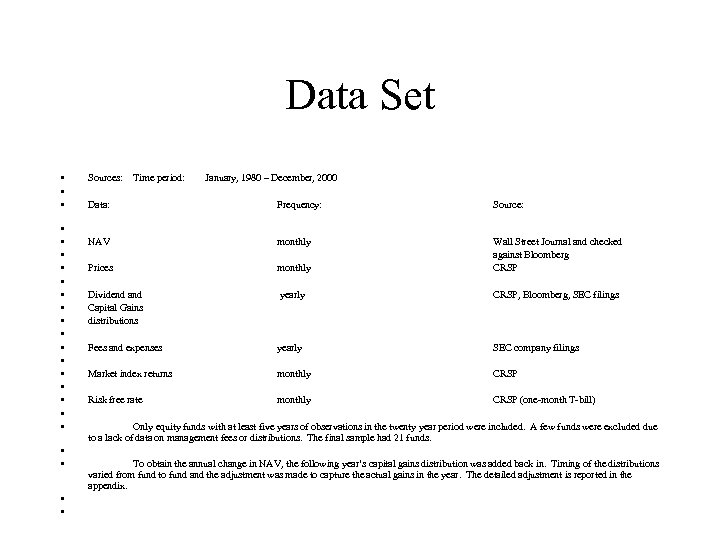
Data Set • • • Sources: Data: • • • • NAV • • Time period: January, 1980 – December, 2000 Frequency: Source: monthly Wall Street Journal and checked against Bloomberg CRSP Prices monthly Dividend and yearly CRSP, Bloomberg, SEC filings Capital Gains distributions Fees and expenses yearly SEC company filings Market index returns monthly CRSP Risk free rate monthly CRSP (one-month T-bill) Only equity funds with at least five years of observations in the twenty year period were included. A few funds were excluded due to a lack of data on management fees or distributions. The final sample had 21 funds. To obtain the annual change in NAV, the following year’s capital gains distribution was added back in. Timing of the distributions varied from fund to fund and the adjustment was made to capture the actual gains in the year. The detailed adjustment is reported in the appendix.
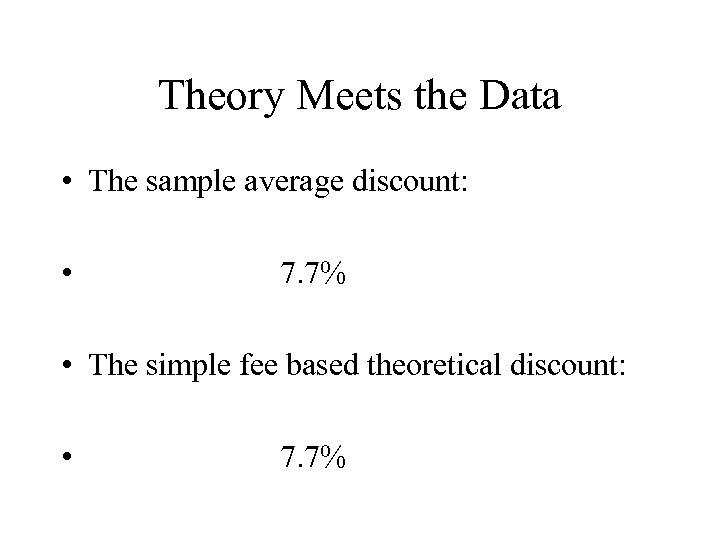
Theory Meets the Data • The sample average discount: • 7. 7% • The simple fee based theoretical discount: • 7. 7%
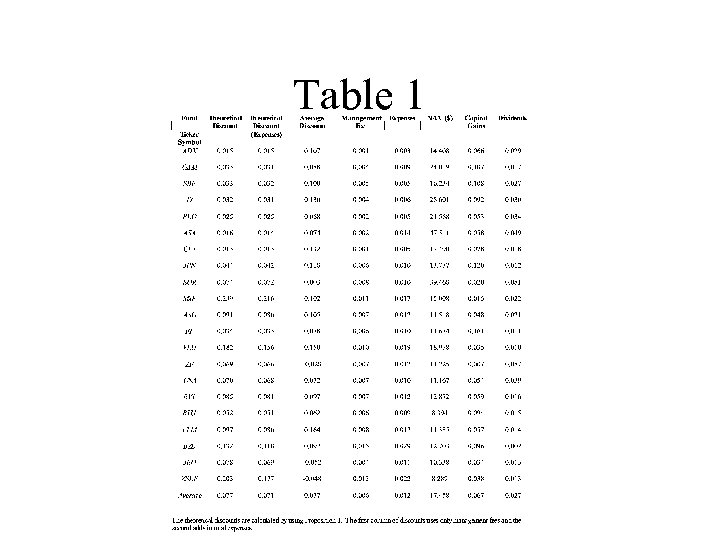
Table 1
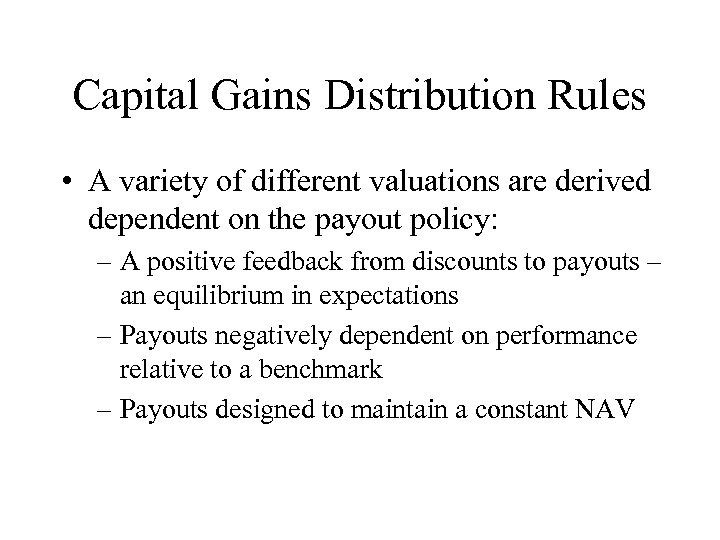
Capital Gains Distribution Rules • A variety of different valuations are derived dependent on the payout policy: – A positive feedback from discounts to payouts – an equilibrium in expectations – Payouts negatively dependent on performance relative to a benchmark – Payouts designed to maintain a constant NAV
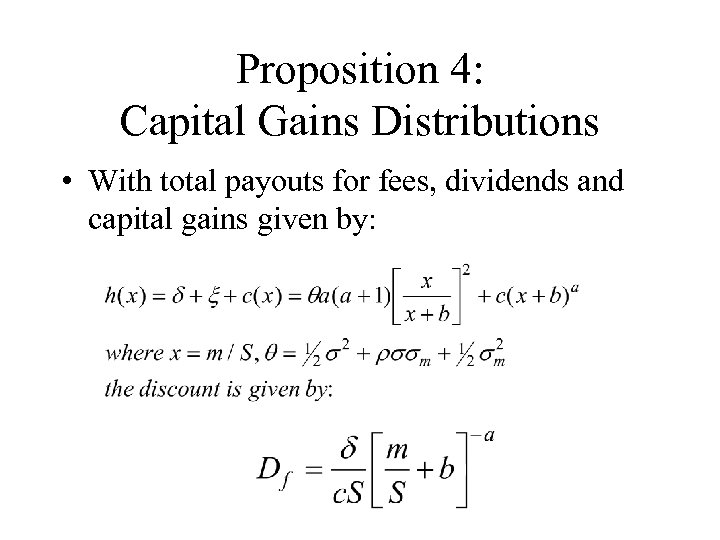
Proposition 4: Capital Gains Distributions • With total payouts for fees, dividends and capital gains given by:
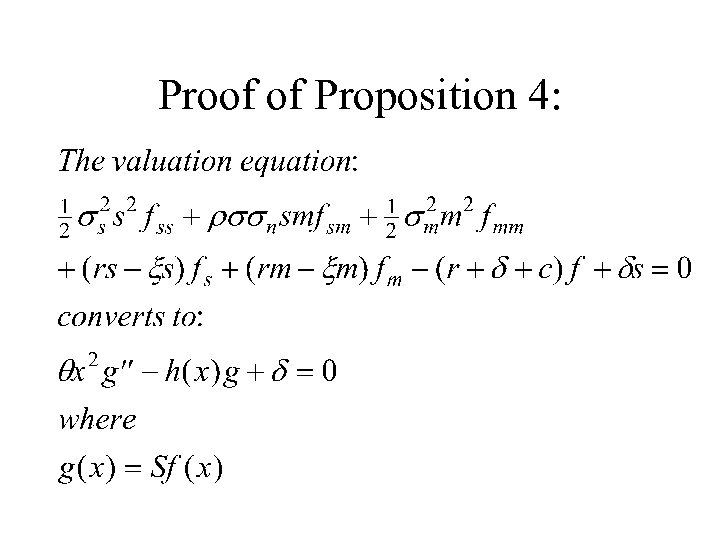
Proof of Proposition 4:
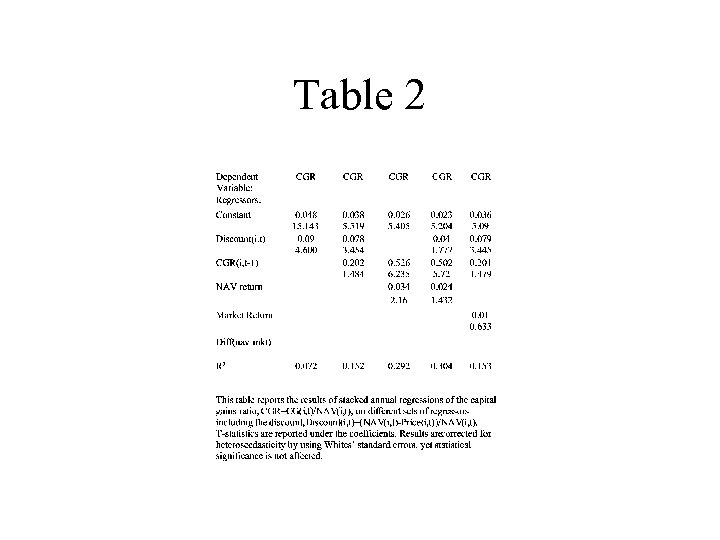
Table 2
Distribution Dynamics • Capital Gains Distributions are significantly positively related to discounts and past distributions
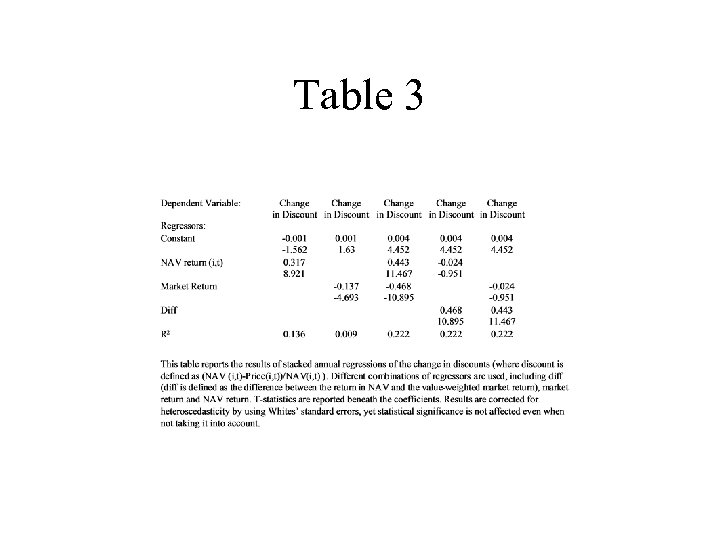
Table 3
Discounts, NAV’s, and Market Returns • Discounts are positively correlated with NAV’s • Discounts are negatively correlated with market returns • But, they are positively correlated with the difference between NAV and market returns • Given the difference, neither NAV nor market returns has explanatory power
Some Further Anomalies • Discounts are correlated: – They move with NAV and NAV’s rise when the market rises • Country funds’ discounts move with the market in which they are traded: – Capital gains policies depend on the investors’ home market, hence, country fund discounts move with the investors’ home market
More Extensions: IPO Premiums • A simple information story where the buyers get strong initial signals would accommodate this finding – IPO’s are designed to prevent buyers from inferring information from prices • The first buyers may simply be ‘irrational’ • Nothing in neoclassical finance requires people to be rational and there is no inconsistency in my agreeing that – Most of the time most of the people can be wrong – The efficient market protects the sheep from the wolves but nothing protects the sheep from themselves
Neoclassical vs. Behavioral • Parsimony vs. ad hocery – No arbitrage and efficiency produce the answer • Psychology produces too many answers and no theory – Are people optimists or pessimists – they are both • Neoclassical theory predicts the magnitude as well as the signs of effects • Aesthetics; I like theories with some distance between assumptions and conclusions – You want correlations, presto! Assume individual irrational behavior is correlated
The Value of Psychology • Psychology is a hodgepodge of fascinating anecdotes and observations devoid of theory and with – at present – limited predictive abilities • As such, it has little to offer for price determination, but • It may have value for marketing and the flows of funds – although its value added over the economist is not clear
Finance as Physics • No real theory yet: complex systems may have common features but they have fundamental flaws • At a theoretical level economic systems are more about global effects than about local interactions • At an empirical level, some of their power law and fractal observations are interesting
Financial Genetics and Evolution • Companies as animals or genes or molecules • Industries are species • Simple minded fun
Conclusion • Finance has unsolved problems • Thank God for that! • Unfortunately, though, so far it looks as though we will have to solve them ourselves
Скачать презентацию A Neoclassical Look at Behavioral Finance by Steve
ff6b654ae667d02cf2f0d78f7b402def.ppt