


 Скачать презентацию A Needs Analysis Tool NAT for Small Micro
9f08fa61f0fc84cf13b4abe0d4a2d2aa.ppt
- Количество слайдов: 14
 A Needs Analysis Tool (NAT) for Small, Micro and Very Small Enterprises (SME’S) This NAT has been designed and developed to assist small companies with basic skills development requirements
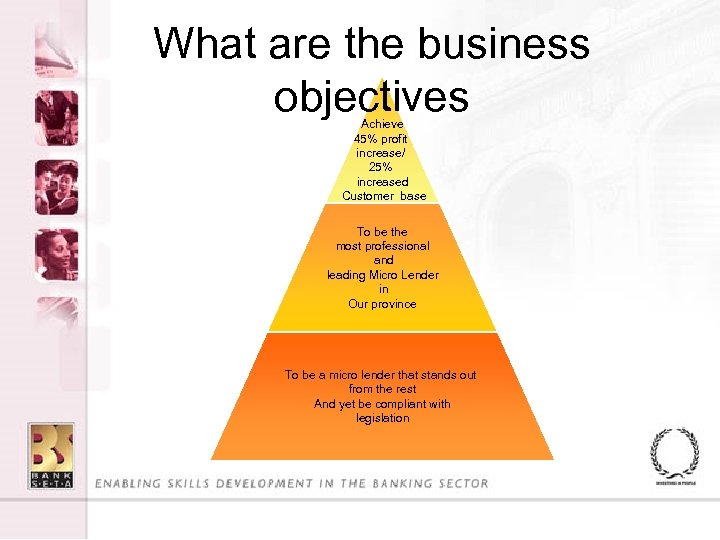 What are the business objectives Achieve 45% profit increase/ 25% increased Customer base To be the most professional and leading Micro Lender in Our province To be a micro lender that stands out from the rest And yet be compliant with legislation
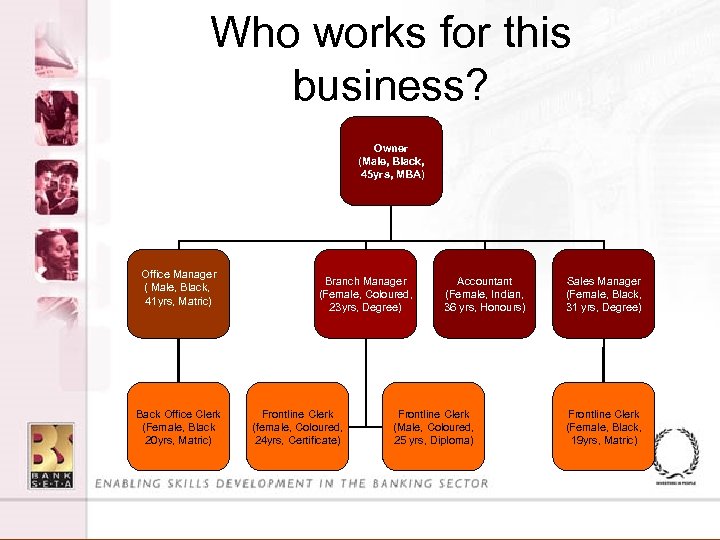 Who works for this business? Owner (Male, Black, 45 yrs, MBA) Office Manager ( Male, Black, 41 yrs, Matric) Back Office Clerk (Female, Black 20 yrs, Matric) Branch Manager (Female, Coloured, 23 yrs, Degree) Frontline Clerk (female, Coloured, 24 yrs, Certificate) Accountant (Female, Indian, 36 yrs, Honours) Frontline Clerk (Male, Coloured, 25 yrs, Diploma) Sales Manager (Female, Black, 31 yrs, Degree) Frontline Clerk (Female, Black, 19 yrs, Matric)
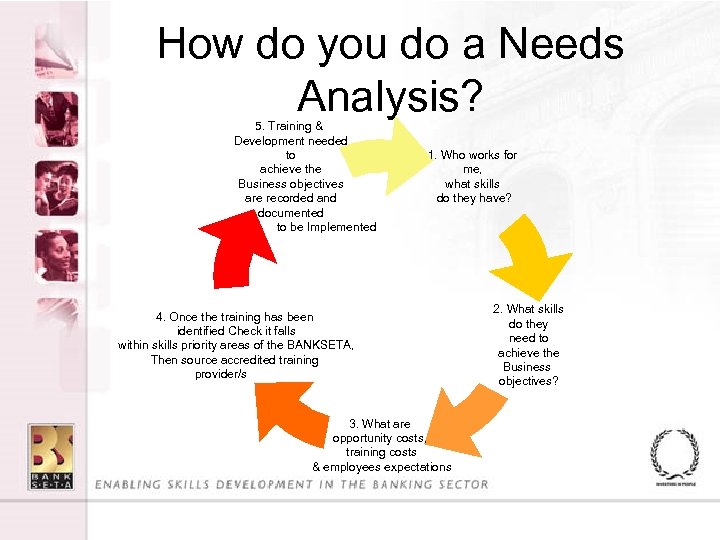 How do you do a Needs Analysis? 5. Training & Development needed to achieve the Business objectives are recorded and documented to be Implemented 1. Who works for me, what skills do they have? 4. Once the training has been identified Check it falls within skills priority areas of the BANKSETA, Then source accredited training provider/s 3. What are opportunity costs, training costs & employees expectations 2. What skills do they need to achieve the Business objectives?
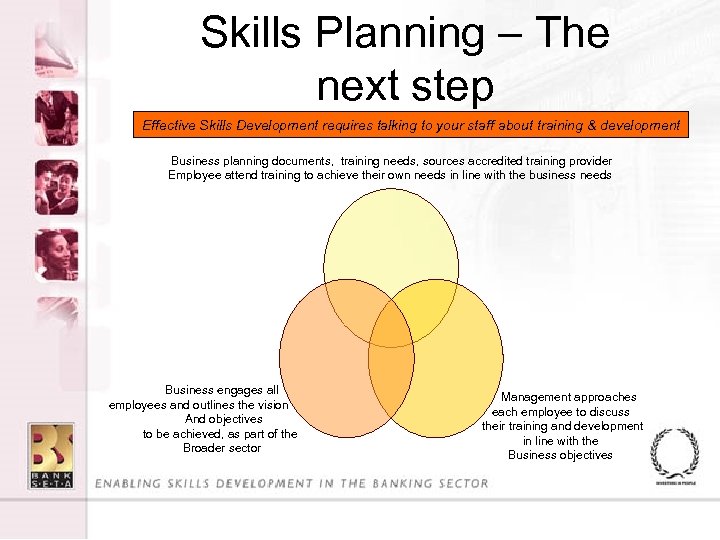 Skills Planning – The next step Effective Skills Development requires talking to your staff about training & development Business planning documents, training needs, sources accredited training provider Employee attend training to achieve their own needs in line with the business needs Business engages all employees and outlines the vision And objectives to be achieved, as part of the Broader sector Management approaches each employee to discuss their training and development in line with the Business objectives
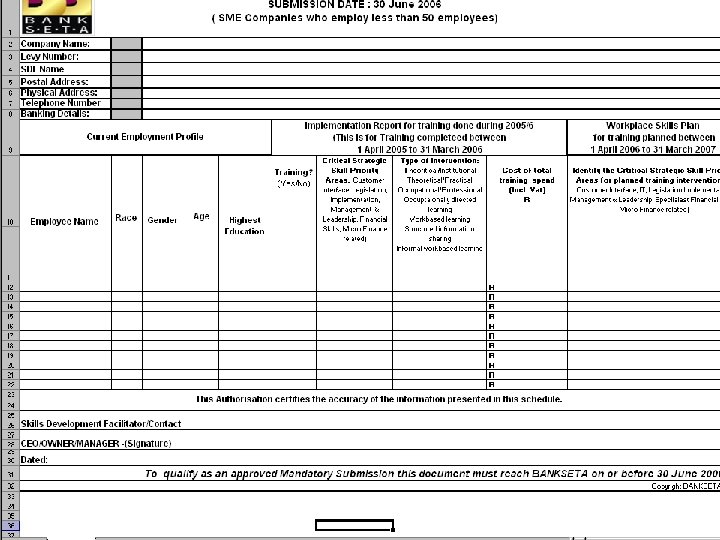
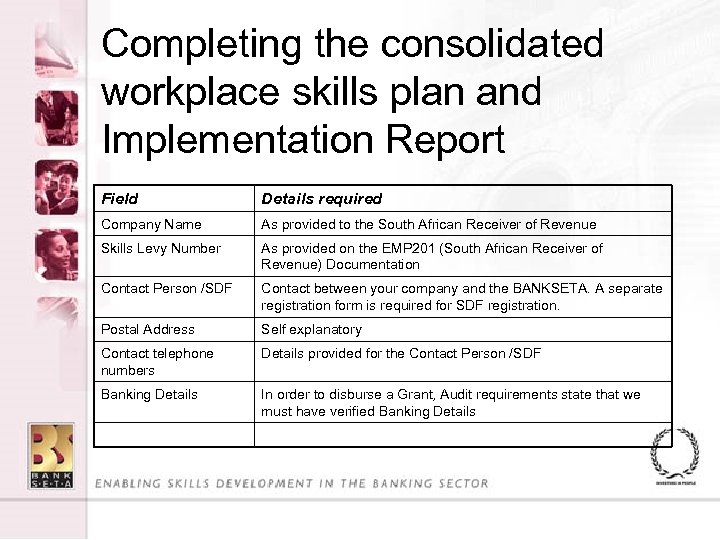 Completing the consolidated workplace skills plan and Implementation Report Field Details required Company Name As provided to the South African Receiver of Revenue Skills Levy Number As provided on the EMP 201 (South African Receiver of Revenue) Documentation Contact Person /SDF Contact between your company and the BANKSETA. A separate registration form is required for SDF registration. Postal Address Self explanatory Contact telephone numbers Details provided for the Contact Person /SDF Banking Details In order to disburse a Grant, Audit requirements state that we must have verified Banking Details
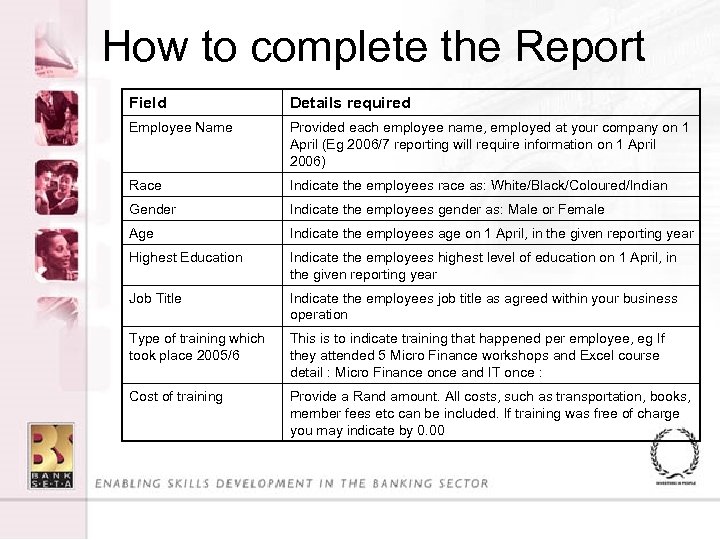 How to complete the Report Field Details required Employee Name Provided each employee name, employed at your company on 1 April (Eg 2006/7 reporting will require information on 1 April 2006) Race Indicate the employees race as: White/Black/Coloured/Indian Gender Indicate the employees gender as: Male or Female Age Indicate the employees age on 1 April, in the given reporting year Highest Education Indicate the employees highest level of education on 1 April, in the given reporting year Job Title Indicate the employees job title as agreed within your business operation Type of training which took place 2005/6 This is to indicate training that happened per employee, eg If they attended 5 Micro Finance workshops and Excel course detail : Micro Finance once and IT once : Cost of training Provide a Rand amount. All costs, such as transportation, books, member fees etc can be included. If training was free of charge you may indicate by 0. 00
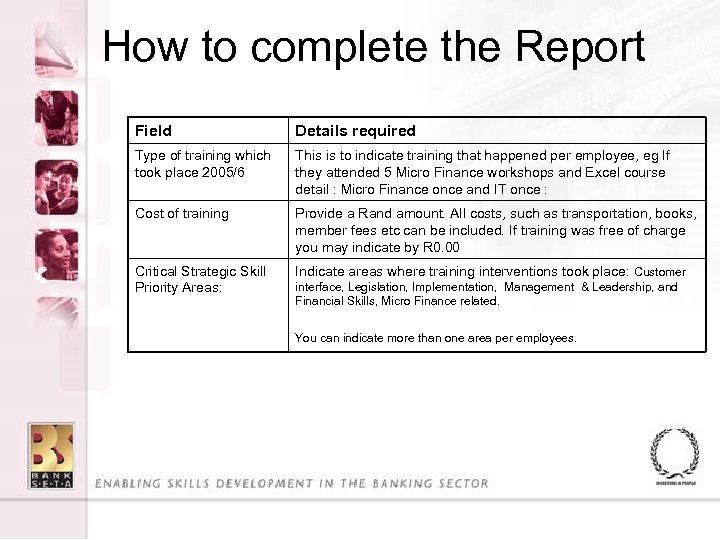 How to complete the Report Field Details required Type of training which took place 2005/6 This is to indicate training that happened per employee, eg If they attended 5 Micro Finance workshops and Excel course detail : Micro Finance once and IT once : Cost of training Provide a Rand amount. All costs, such as transportation, books, member fees etc can be included. If training was free of charge you may indicate by R 0. 00 Critical Strategic Skill Priority Areas: Indicate areas where training interventions took place: Customer interface, Legislation, Implementation, Management & Leadership, and Financial Skills, Micro Finance related. You can indicate more than one area per employees.
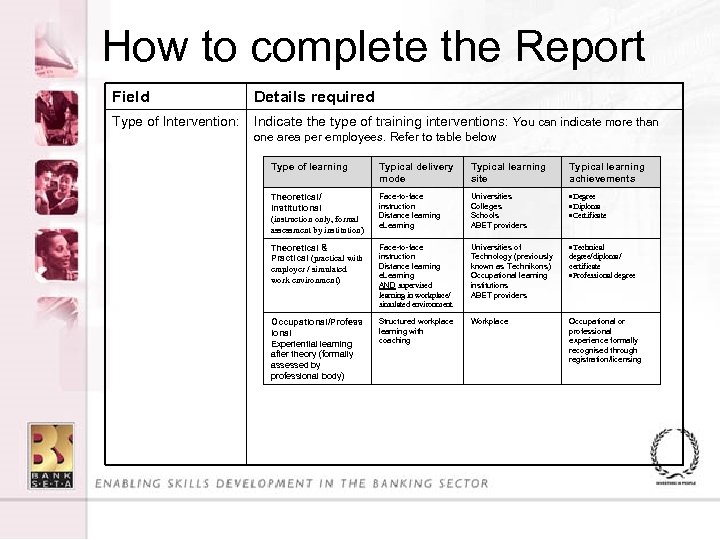 How to complete the Report Field Details required Type of Intervention: Indicate the type of training interventions: You can indicate more than one area per employees. Refer to table below Type of learning Typical delivery mode Typical learning site Typical learning achievements Theoretical/ Institutional (instruction only, formal assessment by institution) Face-to-face instruction Distance learning e. Learning Universities Colleges Schools ABET providers Degree Diploma Certificate Theoretical & Practical (practical with employer / simulated work environment) Face-to-face instruction Distance learning e. Learning AND supervised learning in workplace/ simulated environment Universities of Technology (previously known as Technikons) Occupational learning institutions ABET providers Technical Occupational/Profess ional Experiential learning after theory (formally assessed by professional body) Structured workplace learning with coaching Workplace Occupational or professional experience formally recognised through registration/licensing degree/diploma/ certificate Professional degree
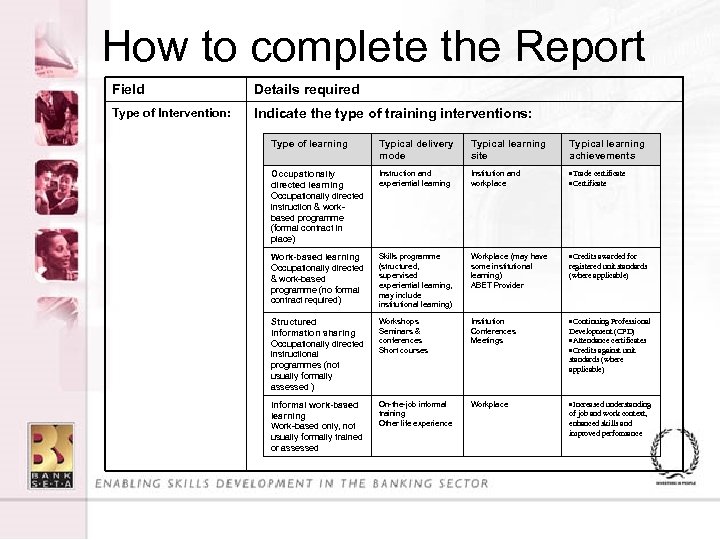 How to complete the Report Field Details required Type of Intervention: Indicate the type of training interventions: Type of learning Typical delivery mode Typical learning site Typical learning achievements Occupationally directed learning Occupationally directed instruction & workbased programme (formal contract in place) Instruction and experiential learning Institution and workplace Trade certificate Certificate Work-based learning Occupationally directed & work-based programme (no formal contract required) Skills programme (structured, supervised experiential learning, may include institutional learning) Workplace (may have some institutional learning) ABET Provider Credits awarded for Structured information sharing Occupationally directed instructional programmes (not usually formally assessed ) Workshops Seminars & conferences Short courses Institution Conferences Meetings Continuing Professional Informal work-based learning Work-based only, not usually formally trained or assessed On-the-job informal training Other life experience Workplace Increased understanding registered unit standards (where applicable) Development (CPD) Attendance certificates Credits against unit standards (where applicable) of job and work context, enhanced skills and improved performance
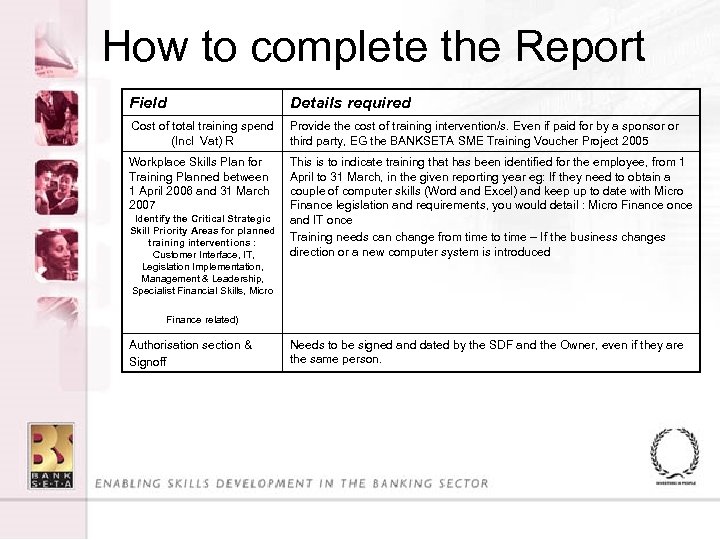 How to complete the Report Field Details required Cost of total training spend (Incl Vat) R Provide the cost of training intervention/s. Even if paid for by a sponsor or third party, EG the BANKSETA SME Training Voucher Project 2005 Workplace Skills Plan for Training Planned between 1 April 2006 and 31 March 2007 This is to indicate training that has been identified for the employee, from 1 April to 31 March, in the given reporting year eg: If they need to obtain a couple of computer skills (Word and Excel) and keep up to date with Micro Finance legislation and requirements, you would detail : Micro Finance once and IT once Training needs can change from time to time – If the business changes direction or a new computer system is introduced Identify the Critical Strategic Skill Priority Areas for planned training interventions : Customer Interface, IT, Legislation Implementation, Management & Leadership, Specialist Financial Skills, Micro Finance related) Authorisation section & Signoff Needs to be signed and dated by the SDF and the Owner, even if they are the same person.
 What are the benefits of Skills Planning? • • Employees feel enriched Productivity Increases Efficiency Increases Business Objectives are achieved
 BANKSETA THORNHILL OFFICE PARK BLOCK NO. 15 BEKKER ROAD MIDRAND 1685 TEL 011 805 9661 FAX 011 805 8348 WEBSITE www. bankseta. org. za