


 Скачать презентацию A National Town Meeting on Demand Response Chairman
3407540f53ce353b5090122f9bb65d16.ppt
- Количество слайдов: 37
 A National Town Meeting on Demand Response Chairman Barry T. Smitherman Public Utility Commission June 3, 2008
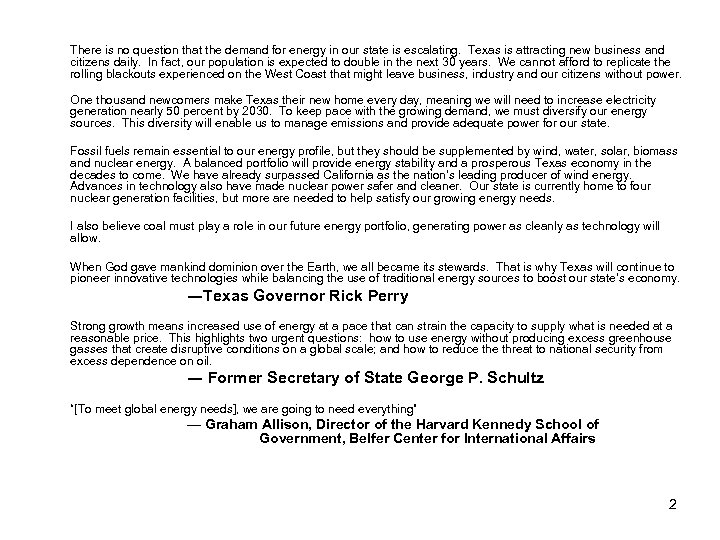 There is no question that the demand for energy in our state is escalating. Texas is attracting new business and citizens daily. In fact, our population is expected to double in the next 30 years. We cannot afford to replicate the rolling blackouts experienced on the West Coast that might leave business, industry and our citizens without power. One thousand newcomers make Texas their new home every day, meaning we will need to increase electricity generation nearly 50 percent by 2030. To keep pace with the growing demand, we must diversify our energy sources. This diversity will enable us to manage emissions and provide adequate power for our state. Fossil fuels remain essential to our energy profile, but they should be supplemented by wind, water, solar, biomass and nuclear energy. A balanced portfolio will provide energy stability and a prosperous Texas economy in the decades to come. We have already surpassed California as the nation’s leading producer of wind energy. Advances in technology also have made nuclear power safer and cleaner. Our state is currently home to four nuclear generation facilities, but more are needed to help satisfy our growing energy needs. I also believe coal must play a role in our future energy portfolio, generating power as cleanly as technology will allow. When God gave mankind dominion over the Earth, we all became its stewards. That is why Texas will continue to pioneer innovative technologies while balancing the use of traditional energy sources to boost our state’s economy. ―Texas Governor Rick Perry Strong growth means increased use of energy at a pace that can strain the capacity to supply what is needed at a reasonable price. This highlights two urgent questions: how to use energy without producing excess greenhouse gasses that create disruptive conditions on a global scale; and how to reduce threat to national security from excess dependence on oil. ― Former Secretary of State George P. Schultz “[To meet global energy needs], we are going to need everything” ― Graham Allison, Director of the Harvard Kennedy School of Government, Belfer Center for International Affairs 2
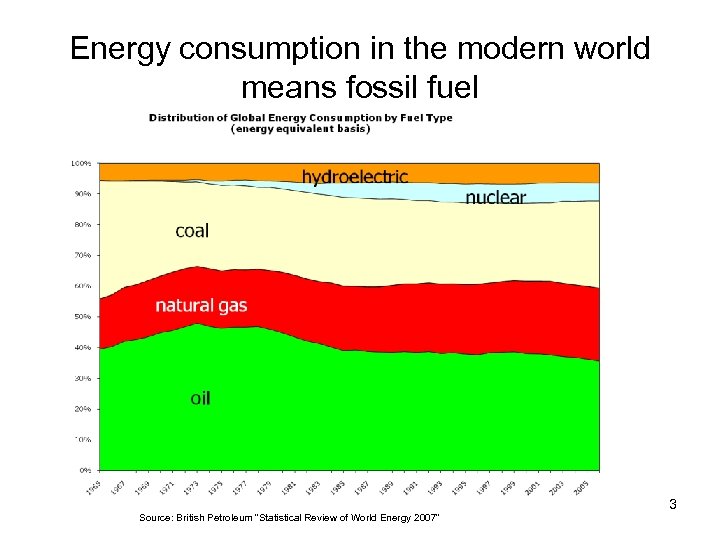 Energy consumption in the modern world means fossil fuel 3 Source: British Petroleum “Statistical Review of World Energy 2007”
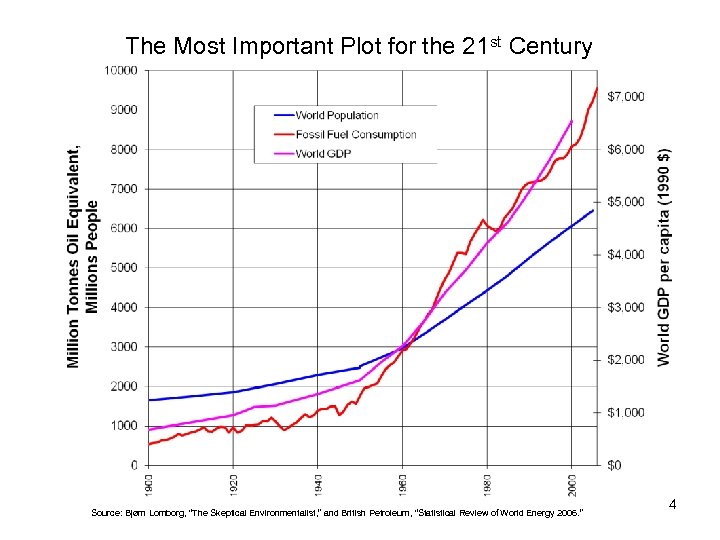 The Most Important Plot for the 21 st Century Source: Bjørn Lomborg, “The Skeptical Environmentalist, ” and British Petroleum, “Statistical Review of World Energy 2006. ” 4
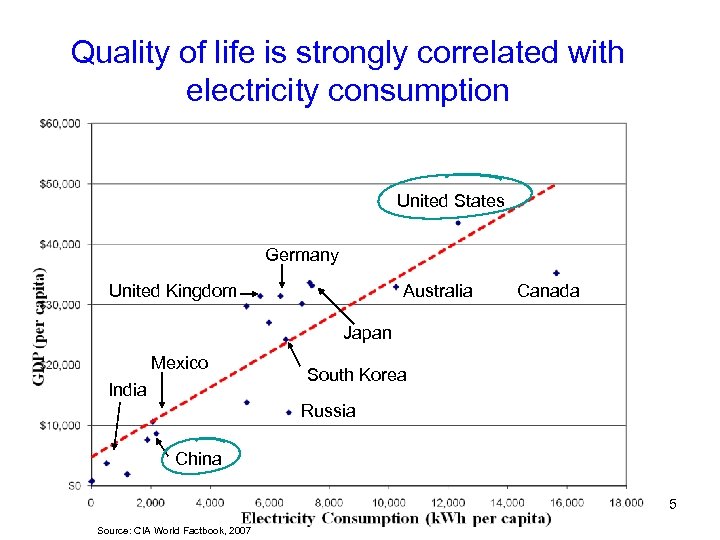 Quality of life is strongly correlated with electricity consumption United States Germany United Kingdom Australia Canada Japan Mexico India South Korea Russia China 5 Source: CIA World Factbook, 2007
 6
6
 Source: Texas State Data Center and Office of the State Demographer, Texas Population Estimates and Projections Program, 2006 7
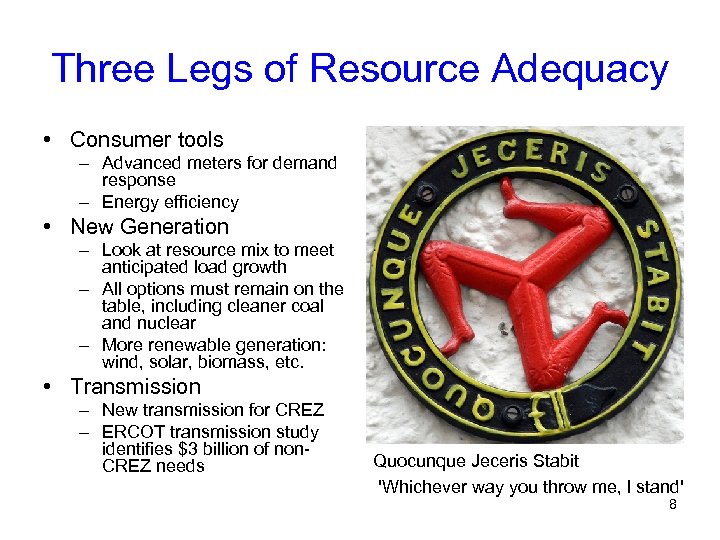 Three Legs of Resource Adequacy • Consumer tools – Advanced meters for demand response – Energy efficiency • New Generation – Look at resource mix to meet anticipated load growth – All options must remain on the table, including cleaner coal and nuclear – More renewable generation: wind, solar, biomass, etc. • Transmission – New transmission for CREZ – ERCOT transmission study identifies $3 billion of non. CREZ needs Quocunque Jeceris Stabit 'Whichever way you throw me, I stand' 8
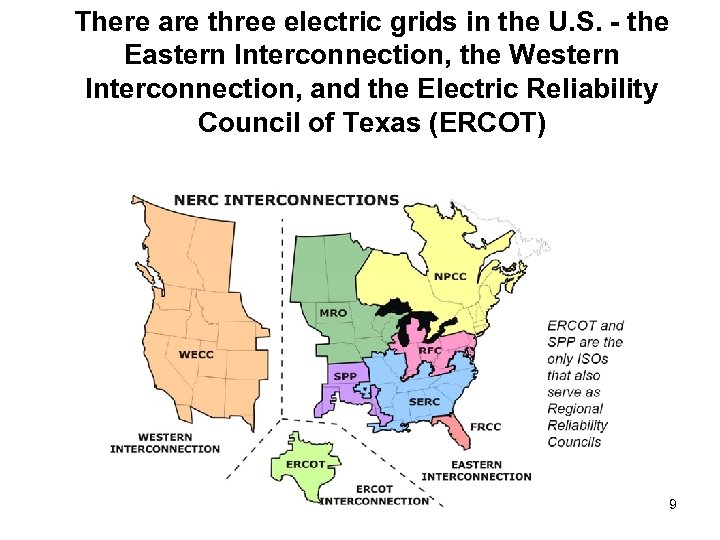 There are three electric grids in the U. S. - the Eastern Interconnection, the Western Interconnection, and the Electric Reliability Council of Texas (ERCOT) 9
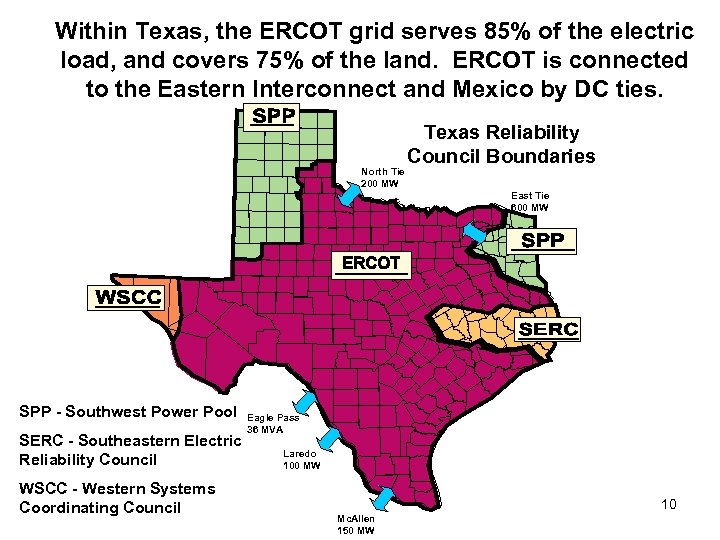 Within Texas, the ERCOT grid serves 85% of the electric load, and covers 75% of the land. ERCOT is connected to the Eastern Interconnect and Mexico by DC ties. North Tie 200 MW Texas Reliability Council Boundaries East Tie 600 MW SPP - Southwest Power Pool SERC - Southeastern Electric Reliability Council WSCC - Western Systems Coordinating Council Eagle Pass 36 MVA Laredo 100 MW 10 Mc. Allen 150 MW
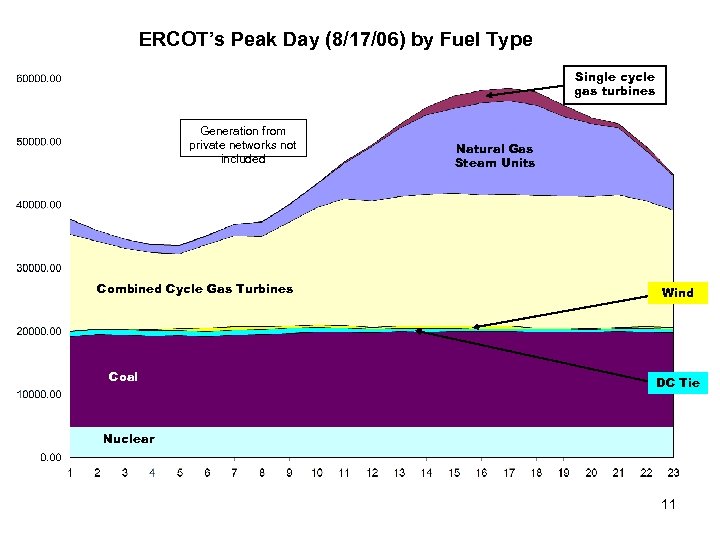 ERCOT’s Peak Day (8/17/06) by Fuel Type Single cycle gas turbines Generation from private networks not included Combined Cycle Gas Turbines Coal Natural Gas Steam Units Wind DC Tie Nuclear 11
 12
12
 13
13
 14
14
 15
15
 Aggressive 16 Source: Merrill Lynch
 17
17
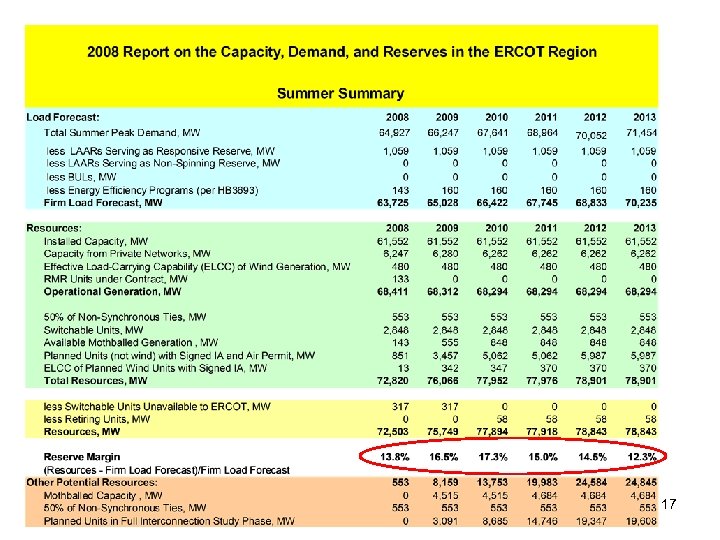
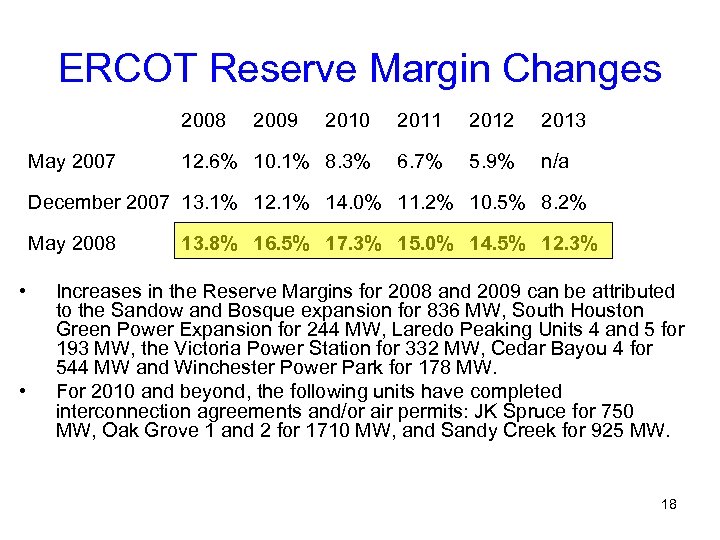 ERCOT Reserve Margin Changes 2008 May 2007 2009 2010 2011 2012 2013 12. 6% 10. 1% 8. 3% 6. 7% 5. 9% n/a December 2007 13. 1% 12. 1% 14. 0% 11. 2% 10. 5% 8. 2% May 2008 • • 13. 8% 16. 5% 17. 3% 15. 0% 14. 5% 12. 3% Increases in the Reserve Margins for 2008 and 2009 can be attributed to the Sandow and Bosque expansion for 836 MW, South Houston Green Power Expansion for 244 MW, Laredo Peaking Units 4 and 5 for 193 MW, the Victoria Power Station for 332 MW, Cedar Bayou 4 for 544 MW and Winchester Power Park for 178 MW. For 2010 and beyond, the following units have completed interconnection agreements and/or air permits: JK Spruce for 750 MW, Oak Grove 1 and 2 for 1710 MW, and Sandy Creek for 925 MW. 18
 19 19
19 19
 20 20
20 20
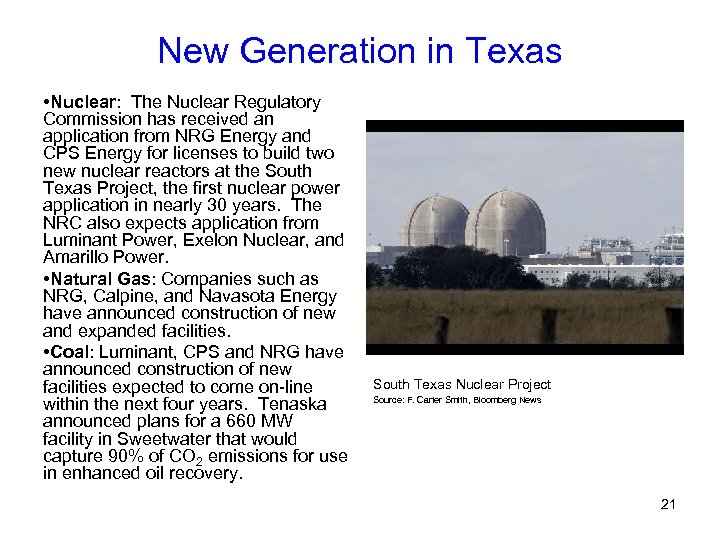 New Generation in Texas • Nuclear: The Nuclear Regulatory Commission has received an application from NRG Energy and CPS Energy for licenses to build two new nuclear reactors at the South Texas Project, the first nuclear power application in nearly 30 years. The NRC also expects application from Luminant Power, Exelon Nuclear, and Amarillo Power. • Natural Gas: Companies such as NRG, Calpine, and Navasota Energy have announced construction of new and expanded facilities. • Coal: Luminant, CPS and NRG have announced construction of new facilities expected to come on-line within the next four years. Tenaska announced plans for a 660 MW facility in Sweetwater that would capture 90% of CO 2 emissions for use in enhanced oil recovery. South Texas Nuclear Project Source: F. Carter Smith, Bloomberg News 21
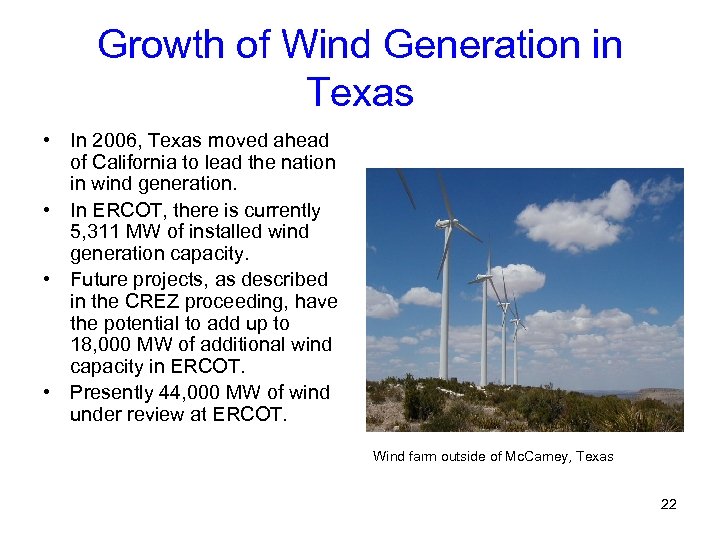 Growth of Wind Generation in Texas • In 2006, Texas moved ahead of California to lead the nation in wind generation. • In ERCOT, there is currently 5, 311 MW of installed wind generation capacity. • Future projects, as described in the CREZ proceeding, have the potential to add up to 18, 000 MW of additional wind capacity in ERCOT. • Presently 44, 000 MW of wind under review at ERCOT. Wind farm outside of Mc. Camey, Texas 22
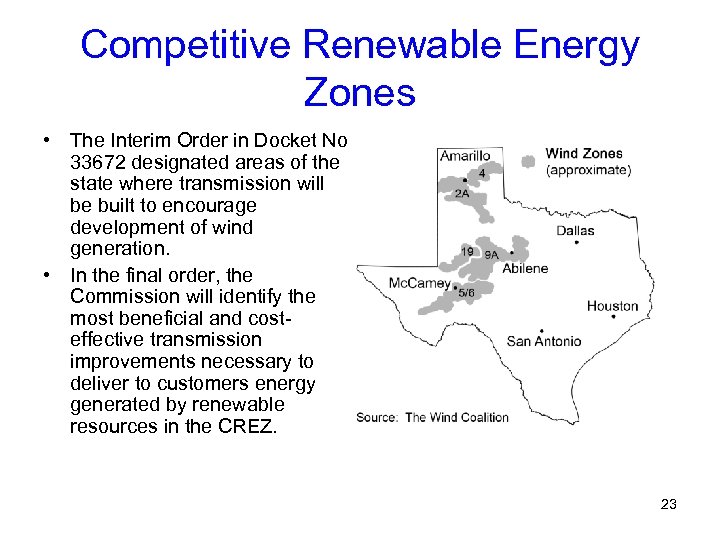 Competitive Renewable Energy Zones • The Interim Order in Docket No 33672 designated areas of the state where transmission will be built to encourage development of wind generation. • In the final order, the Commission will identify the most beneficial and costeffective transmission improvements necessary to deliver to customers energy generated by renewable resources in the CREZ. 23
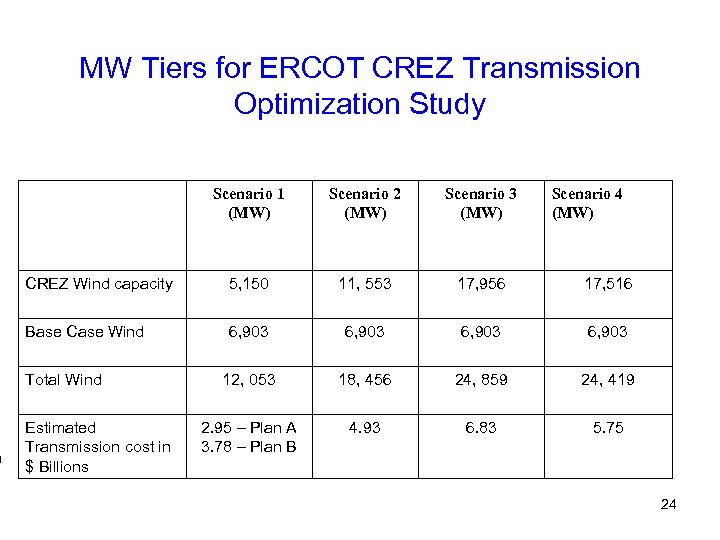 MW Tiers for ERCOT CREZ Transmission Optimization Study Scenario 1 (MW) Scenario 2 (MW) Scenario 3 (MW) CREZ Wind capacity 5, 150 11, 553 17, 956 17, 516 Base Case Wind 6, 903 12, 053 18, 456 24, 859 24, 419 2. 95 – Plan A 3. 78 – Plan B 4. 93 6. 83 5. 75 Total Wind Estimated Transmission cost in $ Billions Scenario 4 (MW) 24
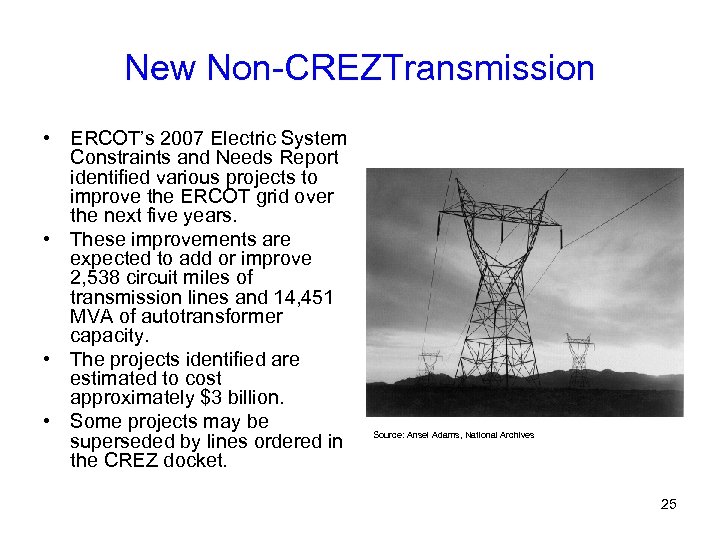 New Non-CREZTransmission • ERCOT’s 2007 Electric System Constraints and Needs Report identified various projects to improve the ERCOT grid over the next five years. • These improvements are expected to add or improve 2, 538 circuit miles of transmission lines and 14, 451 MVA of autotransformer capacity. • The projects identified are estimated to cost approximately $3 billion. • Some projects may be superseded by lines ordered in the CREZ docket. Source: Ansel Adams, National Archives 25
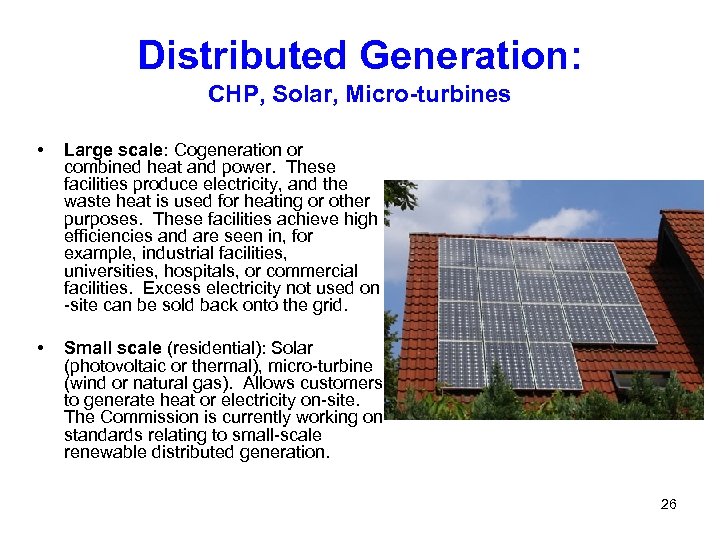 Distributed Generation: CHP, Solar, Micro-turbines • Large scale: Cogeneration or combined heat and power. These facilities produce electricity, and the waste heat is used for heating or other purposes. These facilities achieve high efficiencies and are seen in, for example, industrial facilities, universities, hospitals, or commercial facilities. Excess electricity not used on -site can be sold back onto the grid. • Small scale (residential): Solar (photovoltaic or thermal), micro-turbine (wind or natural gas). Allows customers to generate heat or electricity on-site. The Commission is currently working on standards relating to small-scale renewable distributed generation. 26
 Tools to Help the Customer Reduce Electric Consumption • Energy Efficiency: Incentives paid by the transmission and distribution utilities to energy service companies and other providers of energy efficiency services to offset a portion of the upfront cost associated with energy efficiency measures. Customers can decide on a wide variety of energy efficiency options, and make the best choice for their specific situation. • Demand Response and other benefits of advanced meters: Gives customers information on their electric use, allowing them to adjust their consumption based on price signals and emergency situations. With advanced meters, utilities should also have the ability to better monitor the electric system and address disruptions. 27
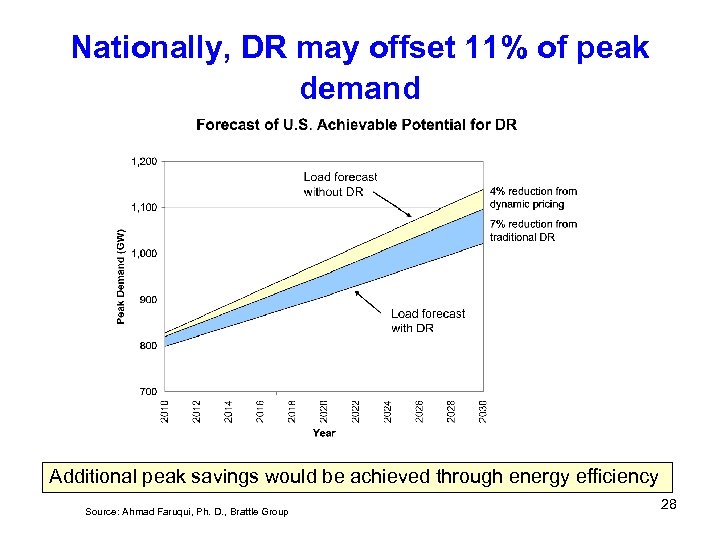 Nationally, DR may offset 11% of peak demand Additional peak savings would be achieved through energy efficiency Source: Ahmad Faruqui, Ph. D. , Brattle Group 28
 Large-Scale Demand Response Programs in ERCOT • • Load acting as a Resource (Laa. R): Customers with interruptible loads that can meet certain performance requirements may be qualified to provide operating reserves under this program. In eligible ancillary services (AS) markets, the value of the Laa. R load reduction is equal to that of an increase in generation by a generating plant. In addition, any provider of operating reserves selected through an ERCOT AS market is eligible for a capacity payment, regardless of whether the demand-side resource is actually curtailed. Up to 1300 MW can be deployed through this program. Emergency Interruptible Load Service (EILS): ERCOT selects EILS resources to provide load reduction services under emergency conditions. These load resources may bid to make themselves available for curtailment during an emergency. This service is authorized by PUC Substantive Rule § 25. 507. Currently, over 200 MW has bid into and been accepted into the EILS program for peak time period (1 PM to 8 PM). EILS resources are only deployed after the Laa. Rs have been deployed. 29
 Energy Efficiency Programs • • • Prior to 80 th Legislature, Texas utilities were required to offer programs to reduce annual growth in demand by 10% per year. During 2006, Center. Point’s goal was to achieve peak demand reduction of 20, 440 k. W. Center. Point exceeded this goal by reducing its peak demand by 41, 448 k. W. TXU Electric Delivery’s goal for 2006 was peak demand reduction of 79, 149 k. W. TXU exceeded this goal with 91, 486 k. W of peak demand reduction. Texas Will See Greater Efficiency Gaines Going Forward • • • HB 3693 requires utilities to offer energy efficiency programs to reduce annual growth in demand by 10% in 2007, 15% in 2008, and 20% in 2009 and requires the PUC to study whether an increase in the goal to 30% by December 31, 2010, and 50% by December 31, 2015 is achievable. HB 3693 requires, for example, that state facilities use energy efficient lights and equipment, and that any single or multifamily dwelling built with assistance from the Texas Department of Housing and Community Affairs be built to certain efficiency and conservation measures. PUCT and ERCOT must develop a method for including energy efficiency impacts into ERCOT’s CDR. 30
 Energy Efficiency Benefits Customers • Energy efficiency helps customers lower their long term demand for electricity. • There a wide variety of energy efficiency options and prices for consumers: – Compact fluorescent bulbs and other efficient lighting; – More efficient appliances, such as HVAC, refrigerators, and water heaters (Energy Star); – Weatherization (more insulation, caulking around doors and windows, heat shield on roof, etc. ). • The customer can decide on the best option for their situation. • www. texasefficiency. com provides a link to each utility’s energy efficiency program. 31
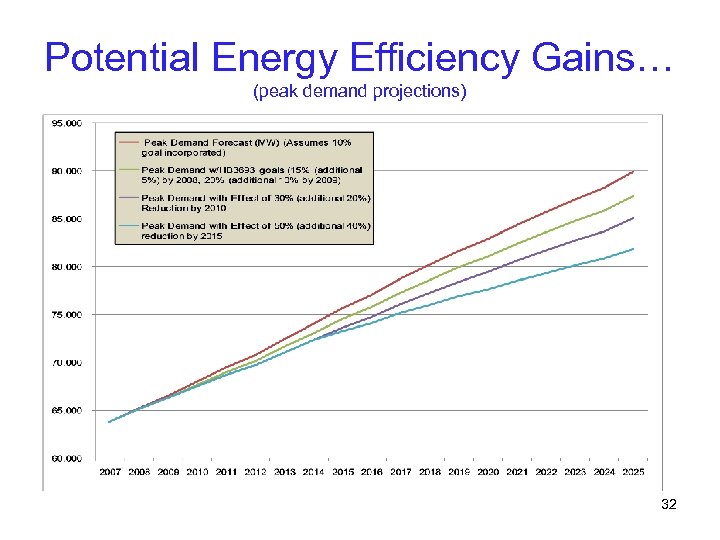 Potential Energy Efficiency Gains… (peak demand projections) 32
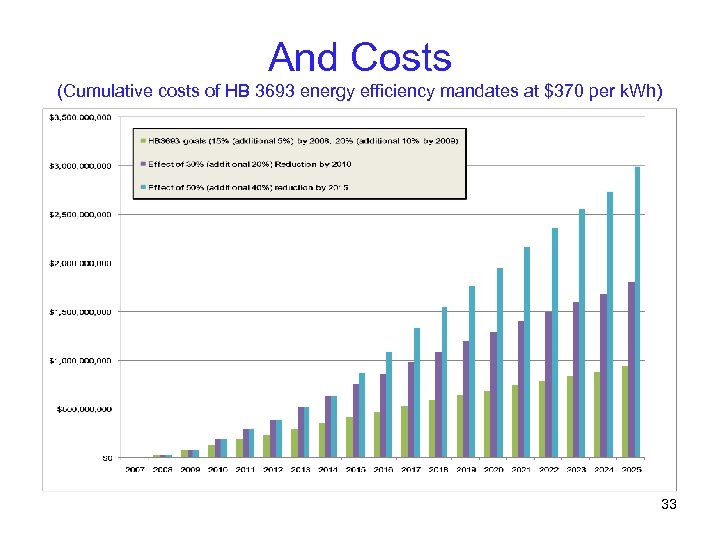 And Costs (Cumulative costs of HB 3693 energy efficiency mandates at $370 per k. Wh) 33
 Advanced Meters Texas Legislature has recognized the benefits of advanced meters • HB 2129 (79 th R. S. ): “In recognition that advances in digital and communications equipment and technologies, including new metering and meter information technologies, have the potential to increase the reliability of the regional electrical network, encourage dynamic pricing and demand response, make better use of generation assets and transmission and generation assets, and provide more choices for consumers, the legislature encourages the adoption of these technologies by electric utilities in this state. ” • HB 3693 (80 th R. S. ): It is the intent of the Legislature that utilities deploy advanced meters “as rapidly as possible. ” 34
 Advanced Meters Increase Options for Market Participants • Real-time pricing will allow consumers to monitor and adjust their use. • Consumers can participate in demand response programs to reduce peak demand. • Advanced meters can automate functions for utilities, such as meter reading and thermostat cycling programs. • Recent pilot program in the Pacific NW garnered average 10% savings for customers. • Center. Point and Oncor Electric have filed its advanced meter deployment plans. 35
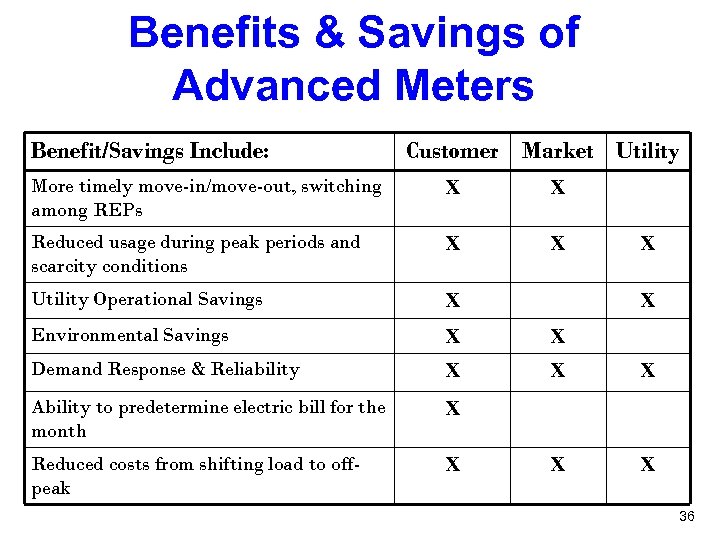 Benefits & Savings of Advanced Meters Benefit/Savings Include: Customer Market Utility More timely move-in/move-out, switching among REPs X X Reduced usage during peak periods and scarcity conditions X X Utility Operational Savings X Environmental Savings X X Demand Response & Reliability X X X Ability to predetermine electric bill for the month X Reduced costs from shifting load to offpeak X X X 36
 Questions?