Скачать презентацию A N Kondakova Higher School of Social Studies
2. Formal plan - Background page and Aims.ppt
- Количество слайдов: 22
 A. N. Kondakova Higher School of Social Studies, Humanities and International Communication
 By the end of this session you will be able to: Identify the main components of lesson plans Differentiate between different types of aims Name main components of lesson plans Discuss how to use lesson plans in ELT classrooms
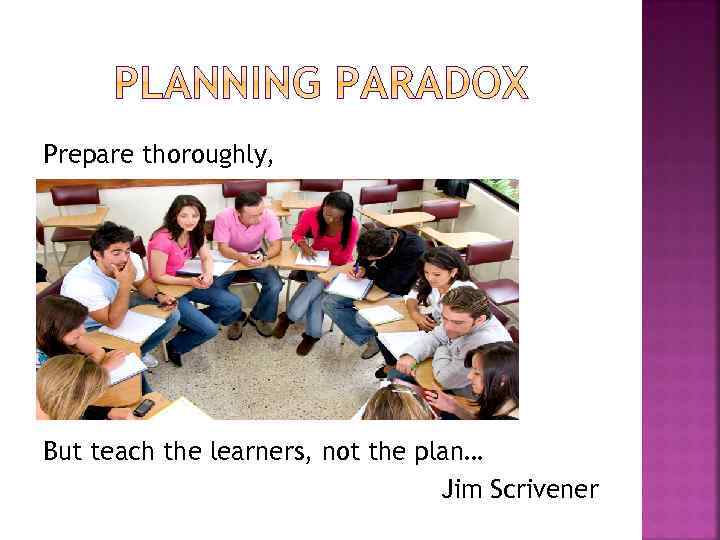 Prepare thoroughly, But teach the learners, not the plan… Jim Scrivener
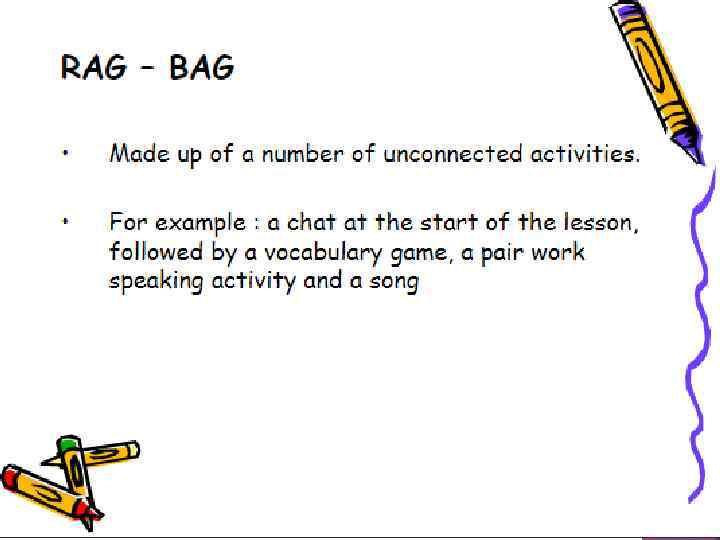
 Logical line Topic umbrella Jungle path Rag-bag (J. Scrivener Learning teaching 2005)
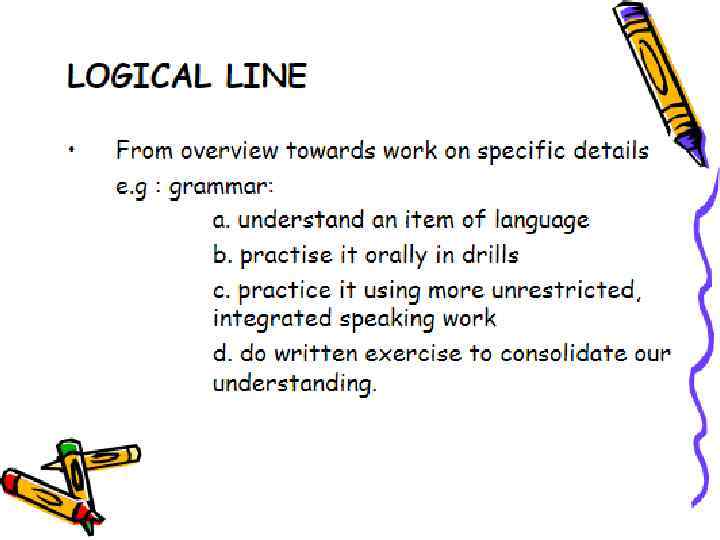
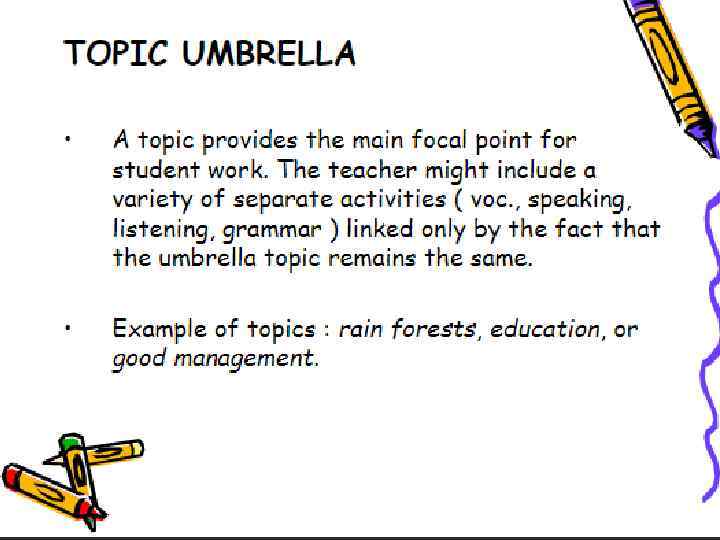
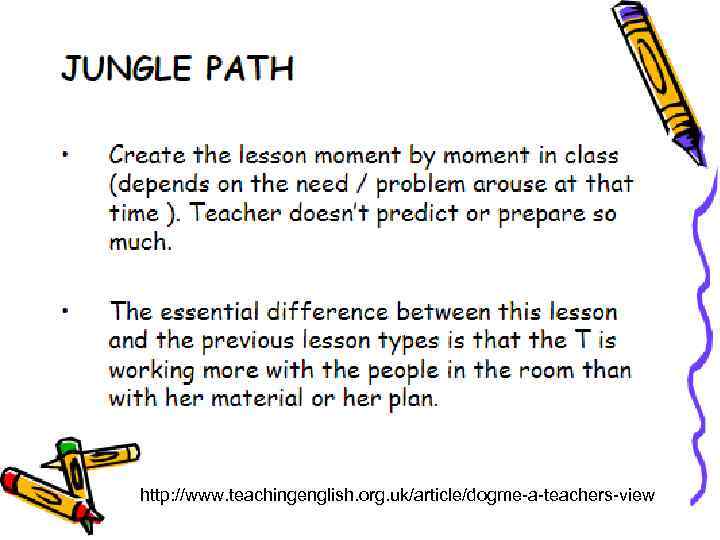 http: //www. teachingenglish. org. uk/article/dogme-a-teachers-view
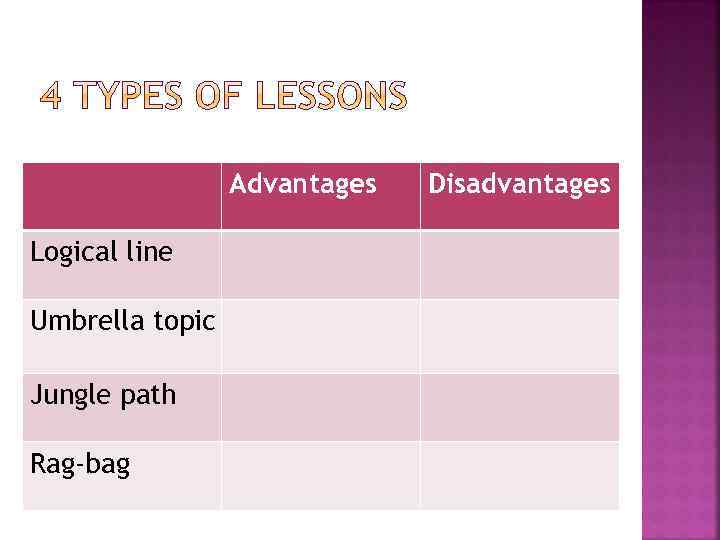 Advantages Logical line Umbrella topic Jungle path Rag-bag Disadvantages
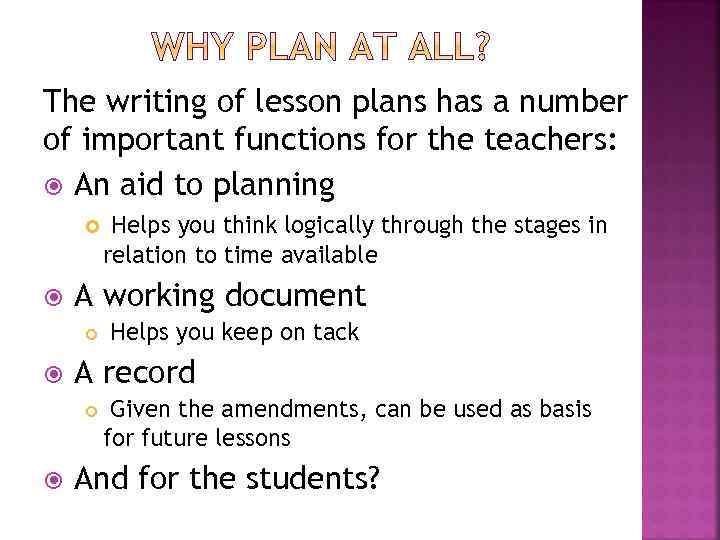 The writing of lesson plans has a number of important functions for the teachers: An aid to planning A working document Helps you keep on tack A record Helps you think logically through the stages in relation to time available Given the amendments, can be used as basis for future lessons And for the students?
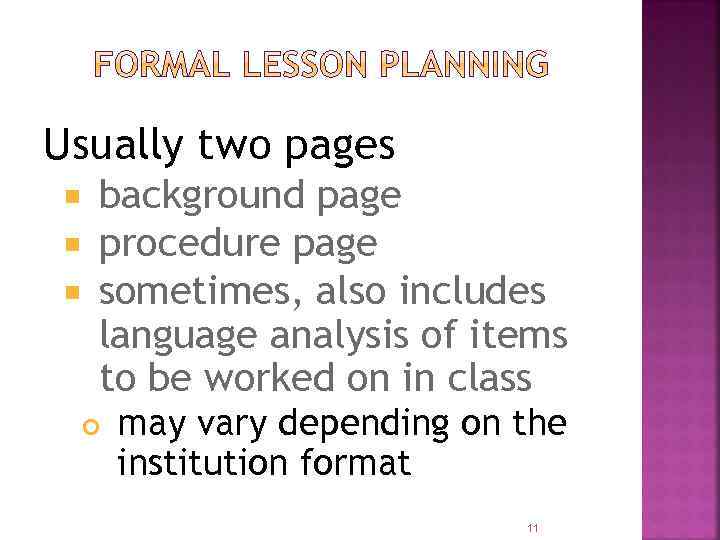 Usually two pages background page procedure page sometimes, also includes language analysis of items to be worked on in class may vary depending on the institution format 11
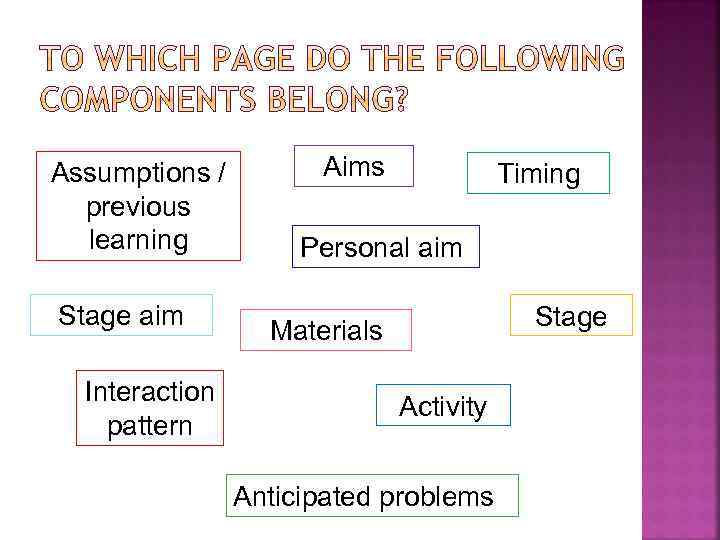 Assumptions / previous learning Stage aim Interaction pattern Aims Timing Personal aim Stage Materials Activity Anticipated problems
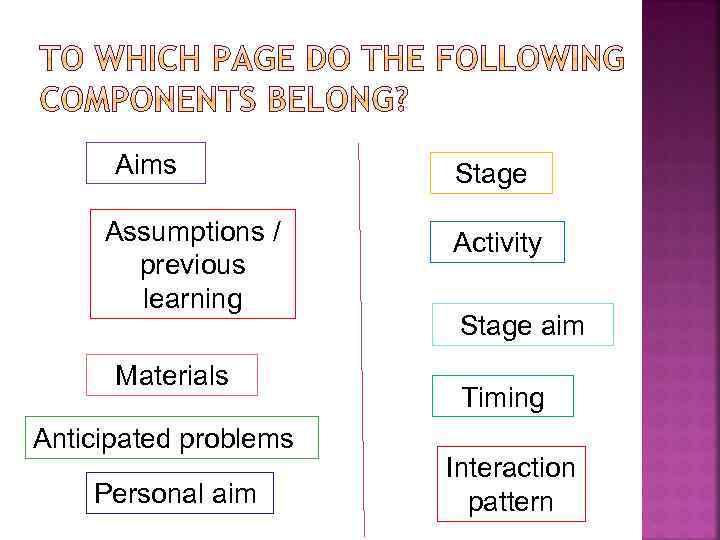 Aims Assumptions / previous learning Materials Anticipated problems Personal aim Stage Activity Stage aim Timing Interaction pattern
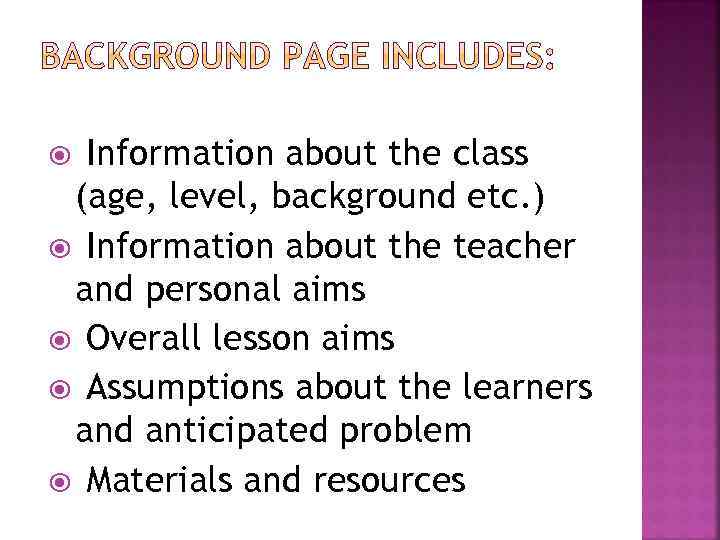 Information about the class (age, level, background etc. ) Information about the teacher and personal aims Overall lesson aims Assumptions about the learners and anticipated problem Materials and resources
 1. 2. 3. 4. 5. 6. 7. 8. 9. Reducing my TTT; get silent students to talk Use different prepositions of place accurately in spoken English to describe where things are. It’s on/on top of/next to/ under/opposite the box. Students are familiar with some basic household vocabulary, such as table, fridge, etc. Confusion about the meaning of opposite; pronunciation of weak forms to, of, the etc. A mouse is loose in the house! Where is it? Frightened husband wants to know. Prepositions of place: next to, on top of, near, beside, under, opposite. They will be able to complete the information exchange activity successfully. Pictures on board. 15
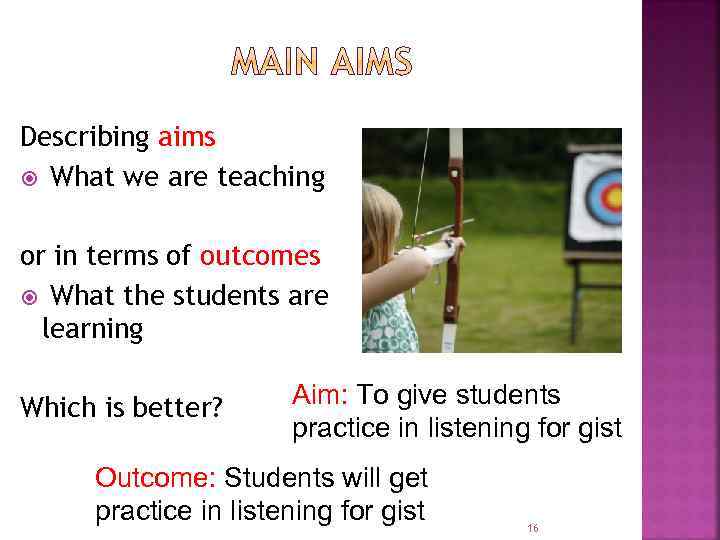 Describing aims What we are teaching or in terms of outcomes What the students are learning Which is better? Aim: To give students practice in listening for gist Outcome: Students will get practice in listening for gist 16
 Describe what we want our students to be able to do after instruction What is the point of doing it? How will they benefit from doing it? Formulated for individual lessons, for a sequence of lessons, or for the whole course Focus on particular areas of language To formulate aims, we need to ask ourselves: What do my learners know? What do they need to learn? 17
 a) b) c) d) e) f) teacher trainers (and directors of schools) require them they make planning easier they make lesson plans look more professional They frame the criteria by which the lesson will be judged The learners need to know the focus of the lesson they set a goal that can be used to test learners’ achievement 18
 Trainee teachers typically use procedure aims instead of achievement aims Procedure aims – what the students will do in class e. g. Students will read a text about holidays Achievement aims – what learners will achieve by doing this activities
 1. 2. 3. 4. 5. 6. Students will be better able to ask and answer informal questions about a person’s life, likes and dislikes. Students will have done a role-play about meeting new clients. Students will be better able to use the phone to order food, call a taxi etc. Listen to coursebook recording 13. 6 Present and practice comparatives. Students will be better able to assess different people’s attitudes when listening to a phone-in discussion on the radio.