 Скачать презентацию A Multiple Ontology Concept-Based Context-Sensitive Search and Retrieval
f53ffc6c0989086f2ce255cc52ad6317.ppt
- Количество слайдов: 25




A Multiple Ontology, Concept-Based, Context-Sensitive Search and Retrieval Robert Moskovitch and Prof. Yuval Shahar Medical Informatics Research Center n Ben Gurion University, Israel n n
Clinical Guidelines • Clinical practice guidelines (CPGs) and protocols are a powerful method for standardizing the quality of medical care • The main challenge is providing easy access to CPGs at the point of care • Access involves representation of the guidelines and easy, accurate retrieval of relevant guidelines
The DEGEL Framework n Ben Gurion University’s Digital Electronic Guidelines Library (De. Ge. L) is an architecture and a Web-based set of computational tools for: ¡ ¡ ¡ Authoring markup (semi-structuring and structuring) Retrieval browsing Runtime application of clinical guidelines Retrospective assessment of the quality of the application
The Goal • Build a search and retrieval tool to retrieve CPGs, to support the challenge of accurately retrieving CPGs at the point of care • Enable concept-based search, which supports querying using an existing set of semantic classification indices • Support context-sensitive search, which supports querying for a term only within a particular knowledge role (e. g. , eligibility conditions)
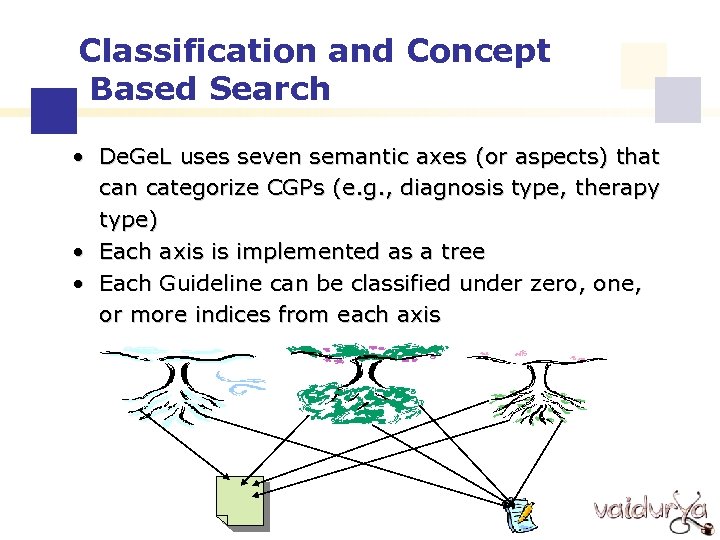
Classification and Concept Based Search • De. Ge. L uses seven semantic axes (or aspects) that can categorize CGPs (e. g. , diagnosis type, therapy type) • Each axis is implemented as a tree • Each Guideline can be classified under zero, one, or more indices from each axis
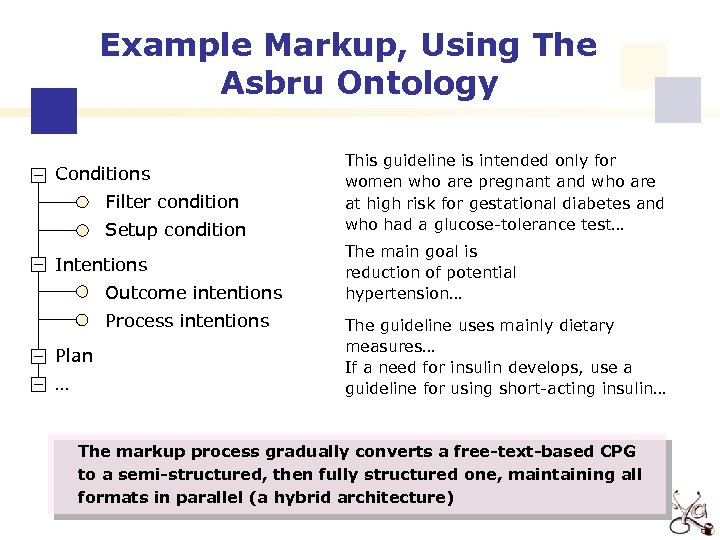
Example Markup, Using The Asbru Ontology Conditions Filter condition Setup condition Intentions Outcome intentions Process intentions Plan … This guideline is intended only for women who are pregnant and who are at high risk for gestational diabetes and who had a glucose-tolerance test… The main goal is reduction of potential hypertension… The guideline uses mainly dietary measures… If a need for insulin develops, use a guideline for using short-acting insulin… The markup process gradually converts a free-text-based CPG to a semi-structured, then fully structured one, maintaining all formats in parallel (a hybrid architecture)
Context-Sensitive Search Within Knowledge Roles of Ontologies • Several ontologies such as Asbru, GEM, and GLIF were developed to represent CPGs in a structured fashion in order to provide automated support for their use • Context-Based Search exploits the existence of certain terms within semantically meaningful segments of the text, or knowledge roles Example: searching within articles summarizing clinical studies [G. Purcell, 1996]. According to Purcell, a context defines a semantically meaningful region of the document for searching, and thus facilitates precise retrieval of information from the medical literature
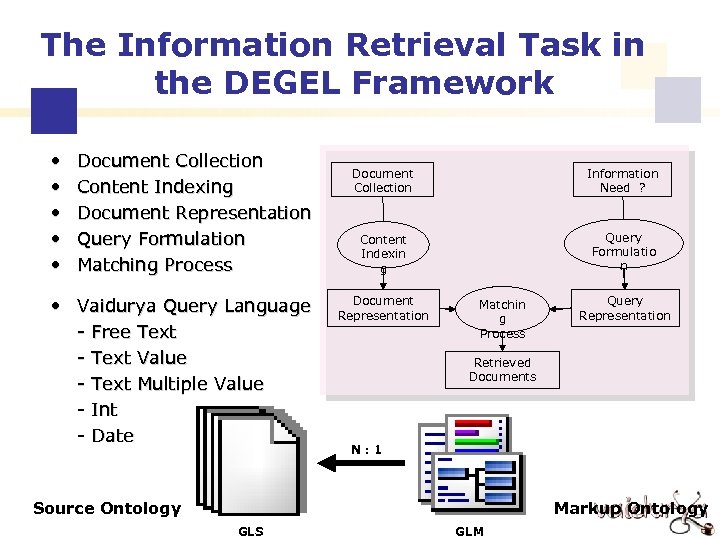
The Information Retrieval Task in the DEGEL Framework • • • Document Collection Content Indexing Document Representation Query Formulation Matching Process • Vaidurya Query Language - Free Text - Text Value - Text Multiple Value - Int - Date Document Collection Information Need ? Content Indexin g Query Formulatio n Document Representation Matchin g Process Query Representation Retrieved Documents N: 1 Source Ontology Markup Ontology GLS GLM
Representing Ontolgies for Search Purposes n To implement the Concept-Based Search and the Context-Sensitive Search, two properties for each element in a guideline representation ontology were defined, Search Type and Search Scope. These properties, or aspects, define how an element will be indexed, queried and retrieved.
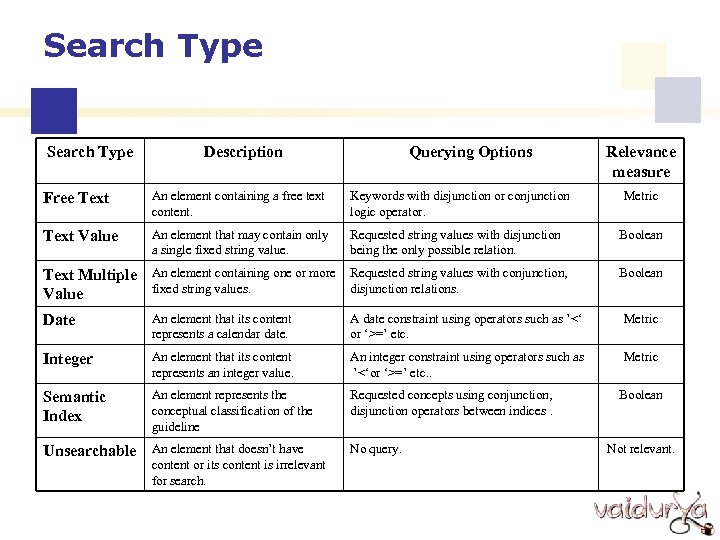
Search Type Description Querying Options Free Text An element containing a free text content. Keywords with disjunction or conjunction logic operator. Text Value An element that may contain only a single fixed string value. Requested string values with disjunction being the only possible relation. Text Multiple An element containing one or more Requested string values with conjunction, fixed string values. disjunction relations. Value Relevance measure Metric Boolean Date An element that its content represents a calendar date. A date constraint using operators such as ’<‘ or ‘>=’ etc. Metric Integer An element that its content represents an integer value. An integer constraint using operators such as ’<‘or ‘>=’ etc. . Metric Semantic Index An element represents the conceptual classification of the guideline Requested concepts using conjunction, disjunction operators between indices. Unsearchable An element that doesn’t have content or its content is irrelevant for search. No query. Boolean Not relevant.
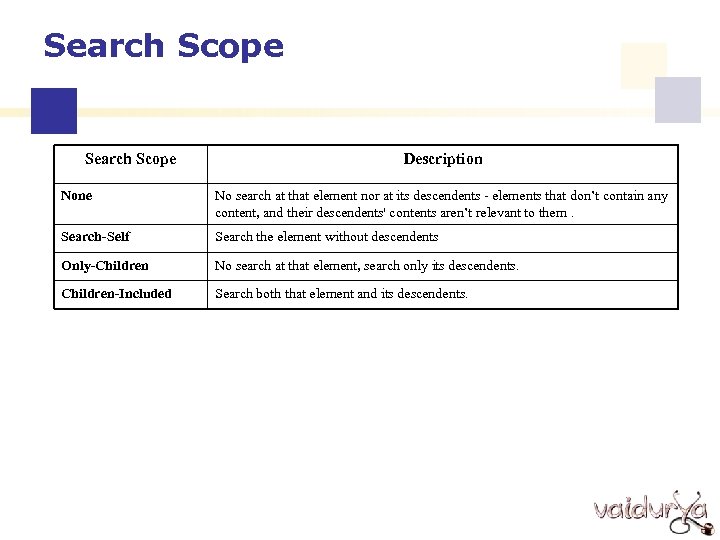
Search Scope Description None No search at that element nor at its descendents - elements that don’t contain any content, and their descendents' contents aren’t relevant to them. Search-Self Search the element without descendents Only-Children No search at that element, search only its descendents. Children-Included Search both that element and its descendents.
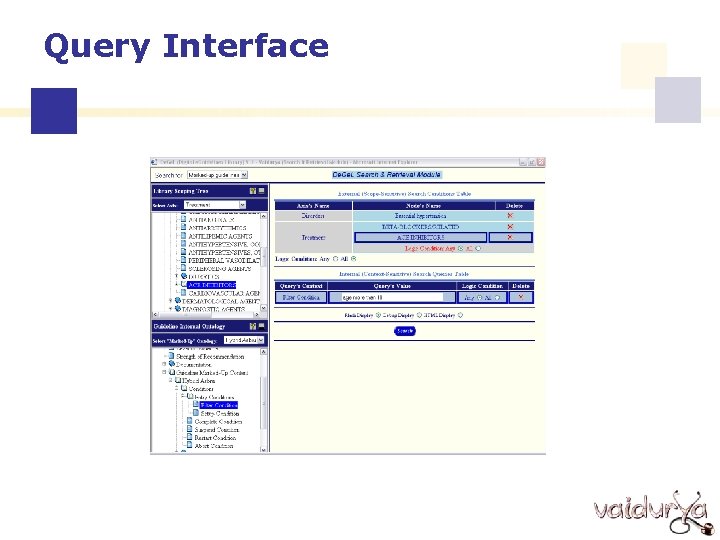
Query Interface
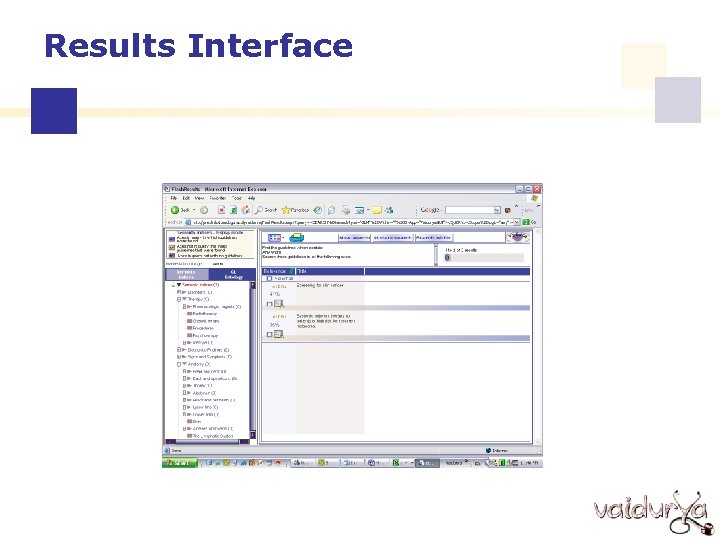
Results Interface
Evaluation n n The evaluation goals were, to examine the contribution of the concept search and the context sensitive to the traditional full text search. Test sets: ¡ ¡ TREC NGC CPGs collection
Concept-based and Contextsensitive evaluation n NGC CPGs collection 1136 CPGs stored in a GEM based ontology ¡ Classified along two Me. SH taxonomies: Disease/Condition and Treatment/Intervention. ¡ Each taxonomy contains ~2500 concepts, in some regions the concepts are 10 levels deep but averages 4 -6 levels. ¡
Queries and Judgments n n In order to evaluate an IR system Queries and judgments should be created. We created a set of 15 daily queries created by 5 physicians ( E&C and Stanford ) Each Physician was asked to label the relevant CPGs, for each query, in the collection. Each query had three formats: ¡ ¡ ¡ Full Text Concept Query in 2 nd and 3 rd level Context Query in 3 elements
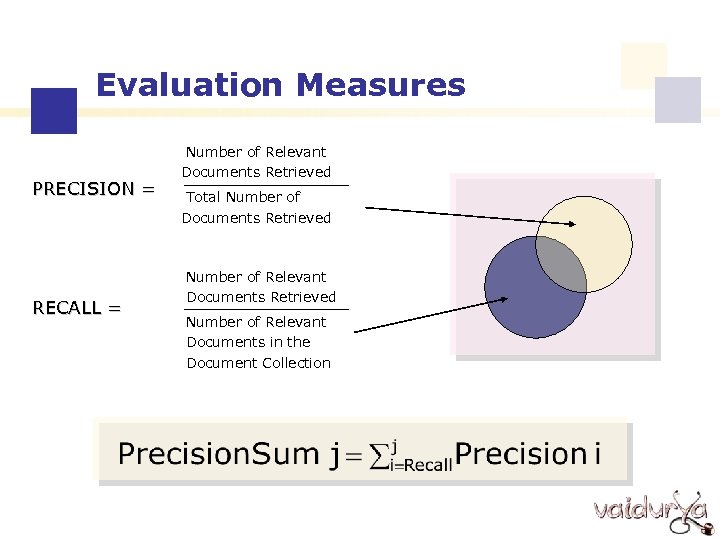
Evaluation Measures PRECISION = RECALL = Number of Relevant Documents Retrieved Total Number of Documents Retrieved Number of Relevant Documents in the Document Collection
Evaluation Hypotheses n n Hypothesis 1 Retrieval performance will be increased as more context elements are queried, also in addition to full-text search. Hypothesis 2 Retrieval performance will be increased as concept based queries will be used in addition to full text search.
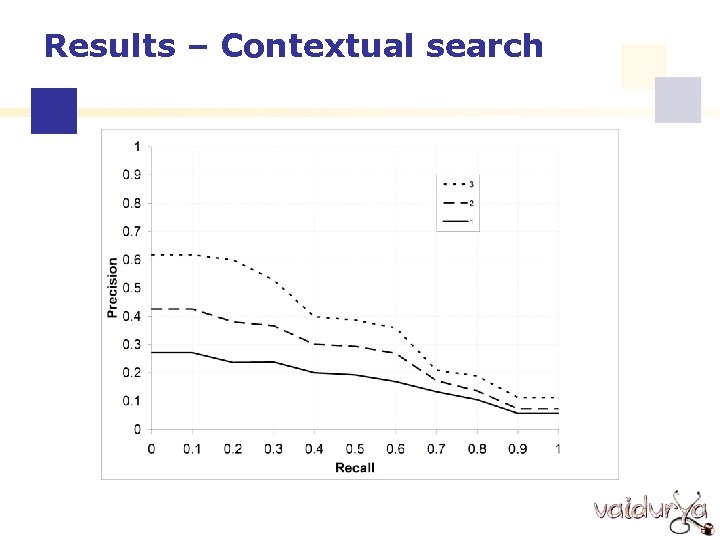
Results – Contextual search
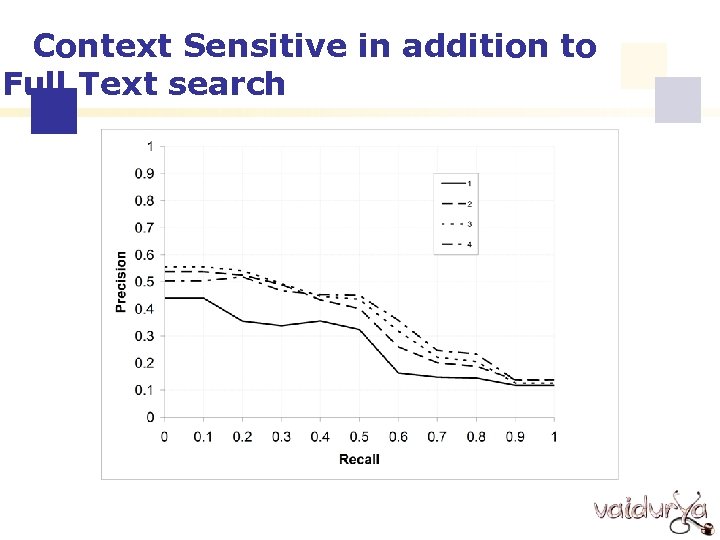
Context Sensitive in addition to Full Text search
Results – Concept based search in addition to three contexts
Results – Concept based search in addition to full-text search
Results – Concept based search in addition to single context
Discussion n Concept based search increased the retrieval performance in any of the cases. Improvement observed when deeper queries used using conjunctive relation. n Context sensitive search improves performance as more contexts participate in the query.
Questions ? robertmo@bgu. ac. il
Скачать презентацию A Multiple Ontology Concept-Based Context-Sensitive Search and Retrieval
f53ffc6c0989086f2ce255cc52ad6317.ppt