


 Скачать презентацию A Midsummer Night s Dream Teaching Shakespeare Effectively
528a455a697f1ff0e5b3185b3d16fb61.ppt
- Количество слайдов: 59
 A Midsummer Night’s Dream Teaching Shakespeare Effectively
 Chorus While native English-speaking teenagers are untangling the unusual grammar and sophisticated wordplay of Romeo and Juliet, ESL students are trying to bridge a cultural as well as communicative gap to understand Shakespeare, his times, and his works.
 The Characters l Students l know who parts of speech l understand complex sentences l read at a high-intermediate level
 Act I Orientation l Scene 1: Historical Focus l Elizabethan Society l Elizabethan Economy l The Tudor Family
 Scene 2: Sonnets l Different rhyming patterns l Petrarchan l Spenserian l Shakespearean l “Purgatory” l Translate by Maxine Kumin to everyday language
 Act II l Decoding the Grammar l Reordered Grammar l Inventive grammar l Unfamiliar Pronouns l Surprising Prepositions
 Act III l Decoding the Language l Invented Words l Unfamiliar Words l Familiar Words l Music of the Language
 Act IV l Literary Devices l Puns l Alliteration l Similes, Metaphors, Personification l Juxtaposition l Foreshadowing l Idioms l Stage Directions
 Act V l Outline for an 8 -week course l Journals l Illustrations l Analysis l Character Development l Research Paper l Oral Presentations
 Epilogue The I-Pod arrives on the scene!
 The Question is Whether to be or Not (Decoding Shakespeare’s Grammar) l Why? To enable students to realize Shakespeare’s sentence structures vary from today’s. By analyzing the differences, the meanings of the sentences become clear. l How? While reading each act, students must find and translate Shakespearean sentences into everyday sentence structures. l Result? Students are able to find subject – verb – object relationships easily and finish reading the play in less time with much more comprehension.
 Act I Reordered Grammar Scene I Verb Followed by the Subject Turn thee, Benvolio; look upon thy death. (1. 1. 72) (Benvolio, thee turn; look upon thy death) Take thou this vial, being then in bed (4. 1. 95, 96) (Thou take this vial, being then in bed) A crutch, a crutch! Why call you for a sword? (1. 1. 77) (Why (do) you call for a sword? )
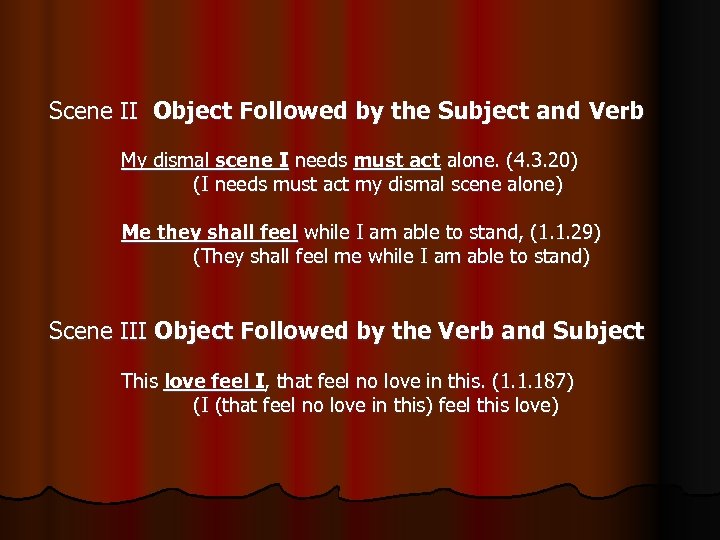 Scene II Object Followed by the Subject and Verb My dismal scene I needs must act alone. (4. 3. 20) (I needs must act my dismal scene alone) Me they shall feel while I am able to stand, (1. 1. 29) (They shall feel me while I am able to stand) Scene III Object Followed by the Verb and Subject This love feel I, that feel no love in this. (1. 1. 187) (I (that feel no love in this) feel this love)
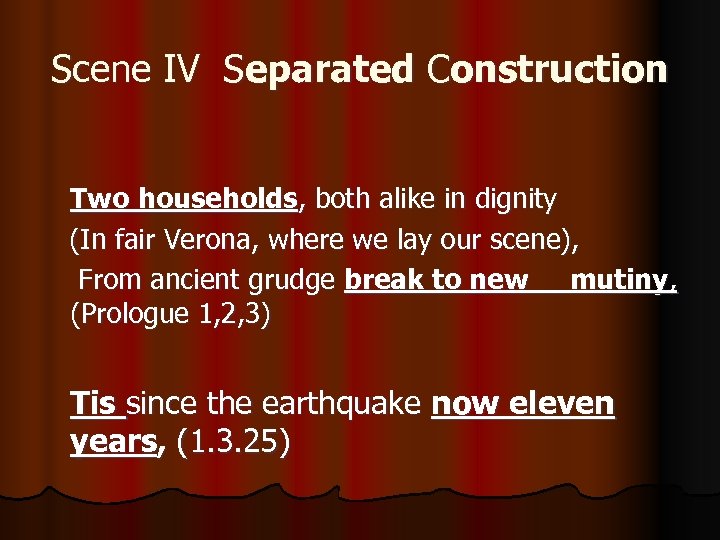 Scene IV Separated Construction Two households, both alike in dignity (In fair Verona, where we lay our scene), From ancient grudge break to new mutiny, (Prologue 1, 2, 3) Tis since the earthquake now eleven years, (1. 3. 25)
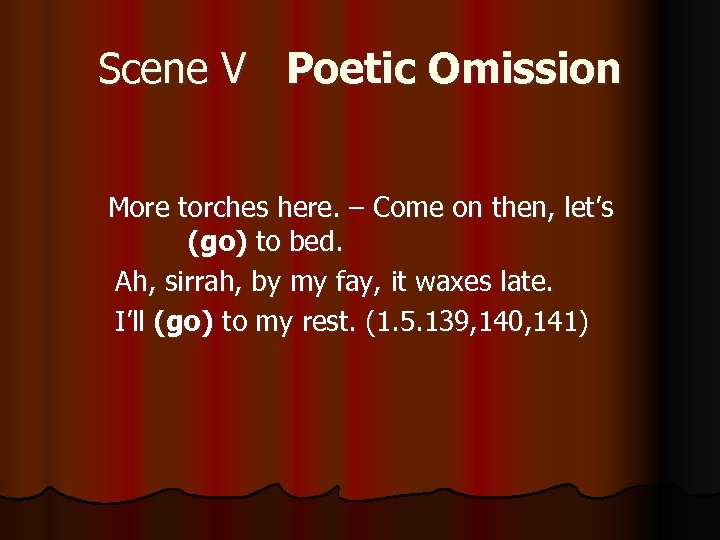 Scene V Poetic Omission More torches here. – Come on then, let’s (go) to bed. Ah, sirrah, by my fay, it waxes late. I’ll (go) to my rest. (1. 5. 139, 140, 141)
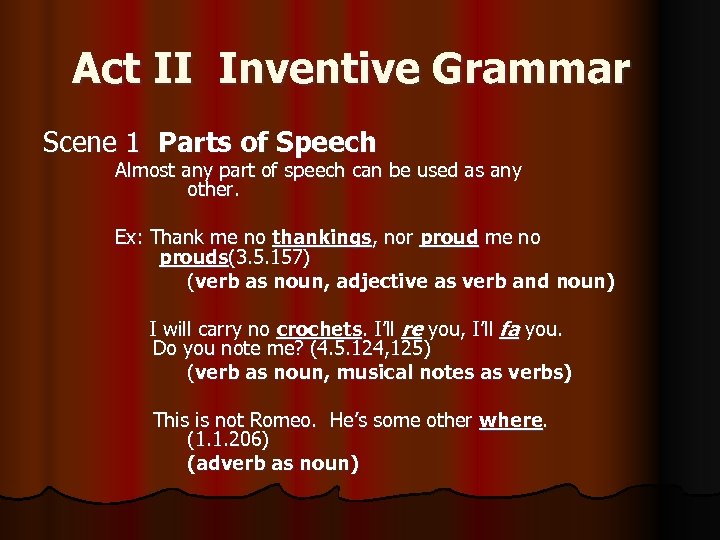 Act II Inventive Grammar Scene 1 Parts of Speech Almost any part of speech can be used as any other. Ex: Thank me no thankings, nor proud me no prouds(3. 5. 157) (verb as noun, adjective as verb and noun) I will carry no crochets. I’ll re you, I’ll fa you. Do you note me? (4. 5. 124, 125) (verb as noun, musical notes as verbs) This is not Romeo. He’s some other where. (1. 1. 206) (adverb as noun)
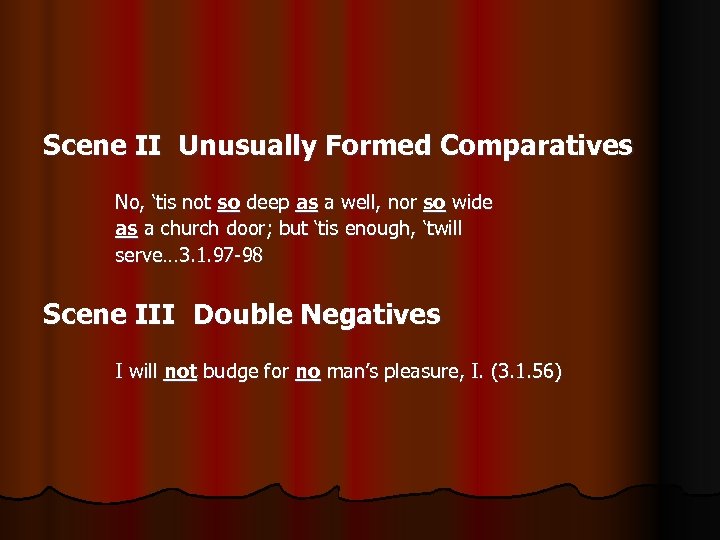 Scene II Unusually Formed Comparatives No, ‘tis not so deep as a well, nor so wide as a church door; but ‘tis enough, ‘twill serve… 3. 1. 97 -98 Scene III Double Negatives I will not budge for no man’s pleasure, I. (3. 1. 56)
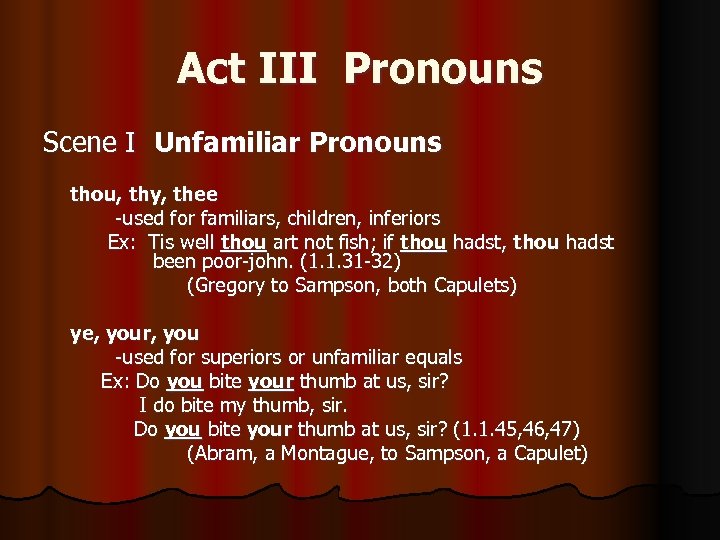 Act III Pronouns Scene I Unfamiliar Pronouns thou, thy, thee -used for familiars, children, inferiors Ex: Tis well thou art not fish; if thou hadst, thou hadst been poor-john. (1. 1. 31 -32) (Gregory to Sampson, both Capulets) ye, your, you -used for superiors or unfamiliar equals Ex: Do you bite your thumb at us, sir? I do bite my thumb, sir. Do you bite your thumb at us, sir? (1. 1. 45, 46, 47) (Abram, a Montague, to Sampson, a Capulet)
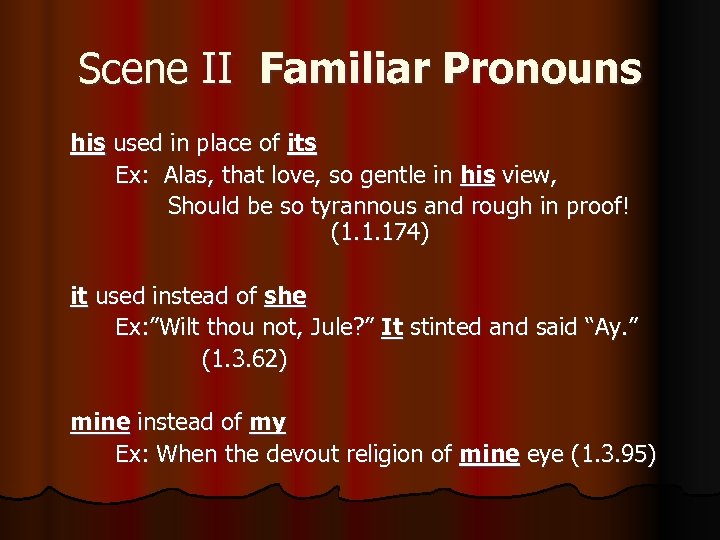 Scene II Familiar Pronouns his used in place of its Ex: Alas, that love, so gentle in his view, Should be so tyrannous and rough in proof! (1. 1. 174) it used instead of she Ex: ”Wilt thou not, Jule? ” It stinted and said “Ay. ” (1. 3. 62) mine instead of my Ex: When the devout religion of mine eye (1. 3. 95)
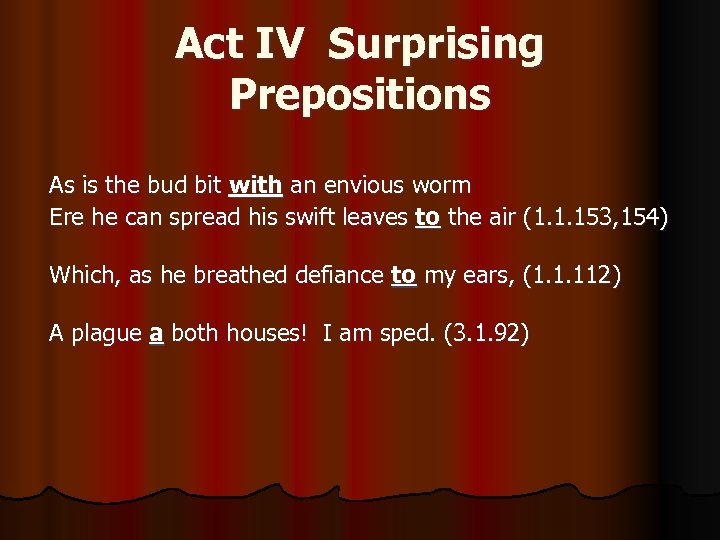 Act IV Surprising Prepositions As is the bud bit with an envious worm Ere he can spread his swift leaves to the air (1. 1. 153, 154) Which, as he breathed defiance to my ears, (1. 1. 112) A plague a both houses! I am sped. (3. 1. 92)
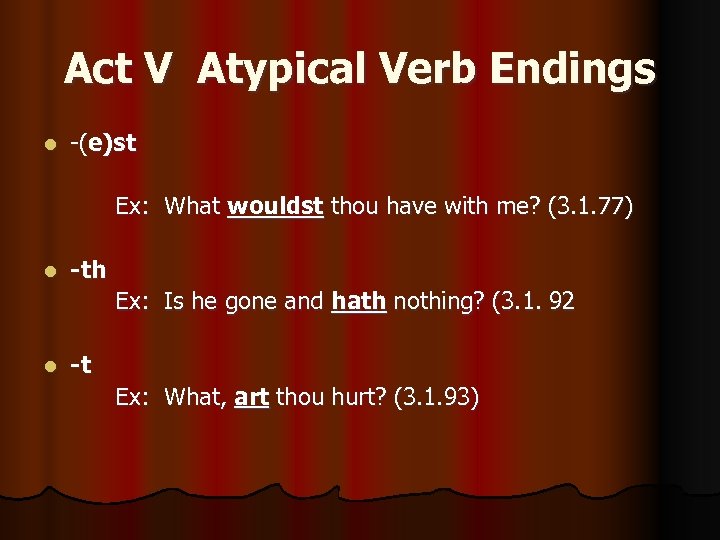 Act V Atypical Verb Endings l -(e)st Ex: What wouldst thou have with me? (3. 1. 77) l -th Ex: Is he gone and hath nothing? (3. 1. 92 l -t Ex: What, art thou hurt? (3. 1. 93)
 The Taming of the Decoding Shakespeare’s Language
 Act I Shakespeare’s vocabulary (30, 000 words) l -not multisyllabic words, but reflect a wide range of life Love goes toward love as schoolboys from their books. But love from love, toward school with heavy looks. (2. 2. 166 -168)
 Act II Invented Words (approx. 3200 words) Scene 1 Invented Words still used today A pair of star-crossed lovers take their life (Prologue, 6) Scene II Invented Words now in disuse Drawn with a team of little atomies (1. 4. 57) (little creatures)
 Act III Unfamiliar Words Scene I The Age of the Text -use an edition with good text notes (The New Folger Library) Who set this ancient quarrel new abroach? (1. 1. 6) (stirred up the quarrel anew) (Folger)
 Scene II Specialized Vocabulary l used to construct an unfamiliar setting or unfamiliar customs On Lammas Eve at night shall she be fourteen. (1. 3. 16) (Lammas Eve = July 31) How long is ‘t now since last yourself and I Were in a mask? (1. 5. 37, 38)
 Act IV Different Meanings of Familiar Words l But soft, what light through yonder window breaks? (2. 2. 1) (soft = just a minute, wait) l Marry, that, I think, be young Petruchio. (1. 5. 145) (marry = really, indeed) l By my brotherhood, the letter was not nice, but full of charge. (5. 3. 18) (nice = trivial)
 Familiar Vocabulary Used to Construct a Theme l Civil disharmony Clubs, bills, and partisans! Strike! Beat them down! Down with the Capulets! Down with the Montagues! (1. l. 74 -75) l Love My bounty is as boundless as the sea, My love as deep. The more I give to thee, The more I have, for both are infinite. (2. 2. 140 -142)
 Act V Different “Music” of His Language Scene I Lines appear to be metrically irregular, but they aren’t. • Different accent on words O me, this sight of death is as a bell That warns my old age to a sepulcher (5. 3. 206 -7) Give me thy torch, boy. Hence, and stand aloof (5. 3. 1)
 Different Number of Syllables l Syllables added And hear the sentence of your moved prince. (1. 1. 91) That I must love a loathed enemy (1. 5. 155) l Syllables deleted God gi’ good e’en. I pray, sir, can you read? (1. 2. 61) (God give you good even = good evening) May stand in number, though in reck’ning none. (1. 3. 33)
 Different Sounds of Words Make Them Rhyme Lo, here upon thy cheek the stain doth sit Of an old tear that is not washed off yet (2. 3. 79 -80) O, she is rich in beauty, only poor That, when she dies, with beauty dies her store. (1. 1. 223 -223)
 Scene II Lines Shift from Prose to Poetry l Shifts reflect shifts in emotions What lady’s that which doth enrich the hand Of yonder knight? I know not, sir. O, she doth teach the torches to burn bright! It seems she hangs upon the cheek of night (1. 5. 48 -52) (Romeo from dispassionate to passionate)
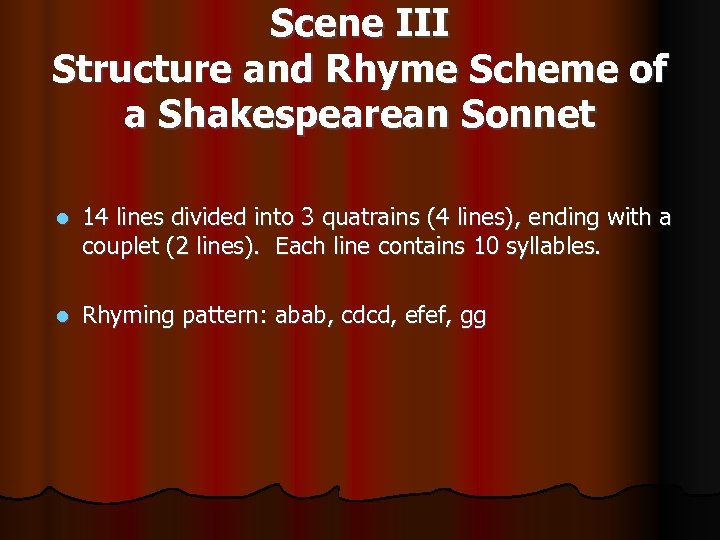 Scene III Structure and Rhyme Scheme of a Shakespearean Sonnet l 14 lines divided into 3 quatrains (4 lines), ending with a couplet (2 lines). Each line contains 10 syllables. l Rhyming pattern: abab, cdcd, efef, gg
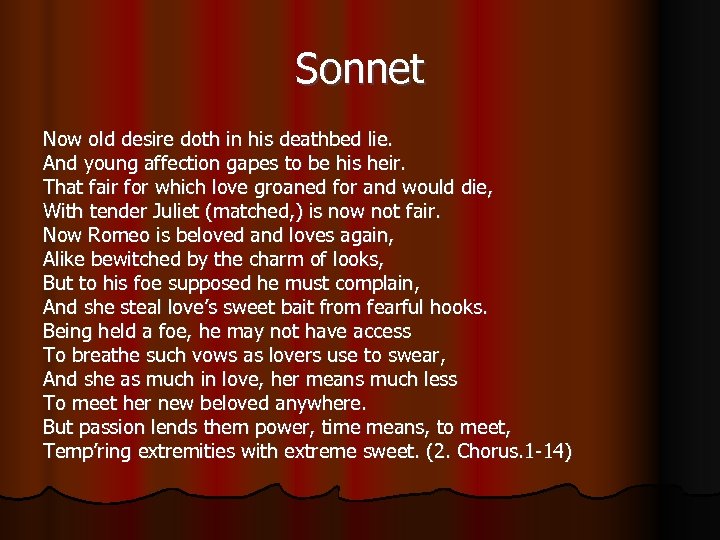 Sonnet Now old desire doth in his deathbed lie. And young affection gapes to be his heir. That fair for which love groaned for and would die, With tender Juliet (matched, ) is now not fair. Now Romeo is beloved and loves again, Alike bewitched by the charm of looks, But to his foe supposed he must complain, And she steal love’s sweet bait from fearful hooks. Being held a foe, he may not have access To breathe such vows as lovers use to swear, And she as much in love, her means much less To meet her new beloved anywhere. But passion lends them power, time means, to meet, Temp’ring extremities with extreme sweet. (2. Chorus. 1 -14)
 What Light Through Yonder Window Breaks? (Literary Devices)
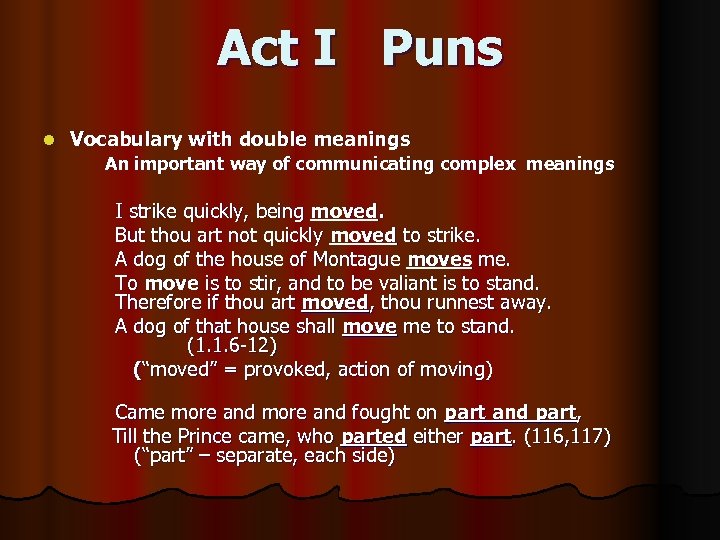 Act I Puns l Vocabulary with double meanings An important way of communicating complex meanings I strike quickly, being moved. But thou art not quickly moved to strike. A dog of the house of Montague moves me. To move is to stir, and to be valiant is to stand. Therefore if thou art moved, thou runnest away. A dog of that house shall move me to stand. (1. 1. 6 -12) (“moved” = provoked, action of moving) Came more and fought on part and part, Till the Prince came, who parted either part. (116, 117) (“part” – separate, each side)
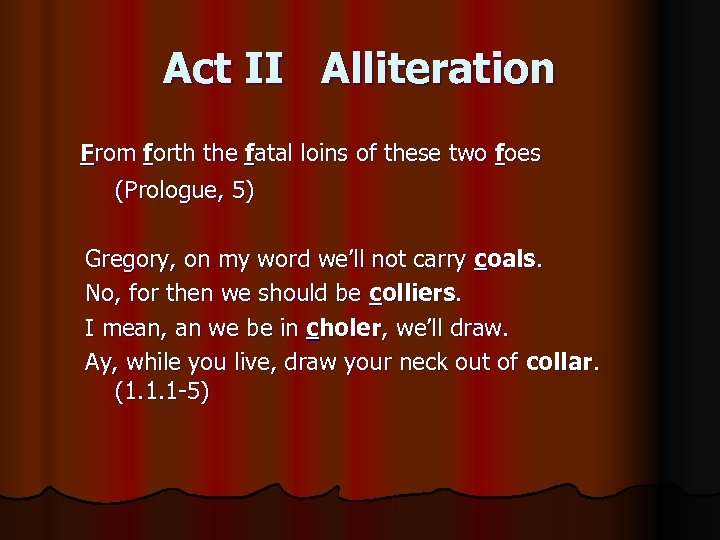 Act II Alliteration From forth the fatal loins of these two foes (Prologue, 5) Gregory, on my word we’ll not carry coals. No, for then we should be colliers. I mean, an we be in choler, we’ll draw. Ay, while you live, draw your neck out of collar. (1. 1. 1 -5)
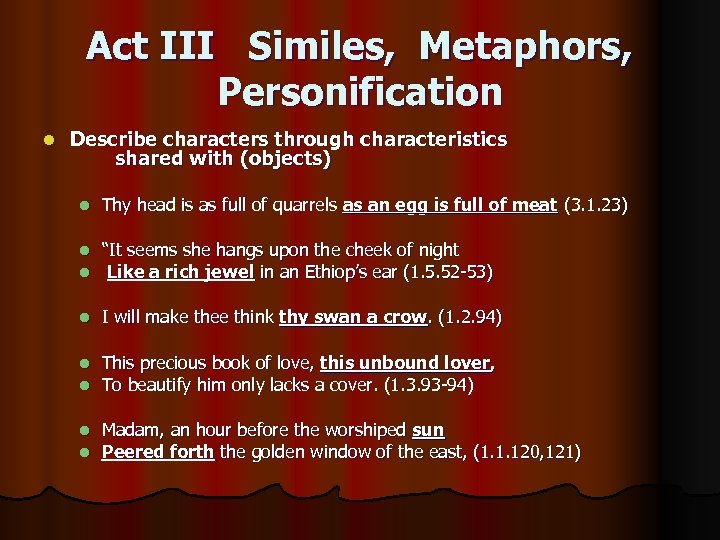 Act III Similes, Metaphors, Personification l Describe characters through characteristics shared with (objects) l Thy head is as full of quarrels as an egg is full of meat (3. 1. 23) l l “It seems she hangs upon the cheek of night Like a rich jewel in an Ethiop’s ear (1. 5. 52 -53) l I will make thee think thy swan a crow. (1. 2. 94) l l This precious book of love, this unbound lover, To beautify him only lacks a cover. (1. 3. 93 -94) l l Madam, an hour before the worshiped sun Peered forth the golden window of the east, (1. 1. 120, 121)
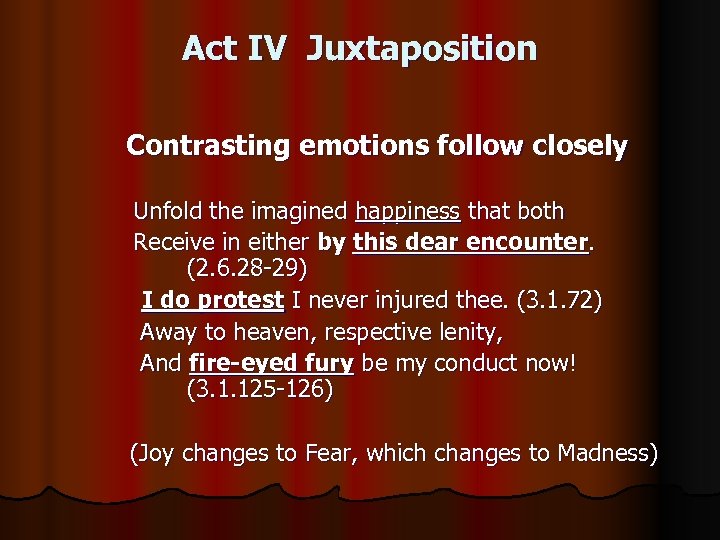 Act IV Juxtaposition Contrasting emotions follow closely Unfold the imagined happiness that both Receive in either by this dear encounter. (2. 6. 28 -29) I do protest I never injured thee. (3. 1. 72) Away to heaven, respective lenity, And fire-eyed fury be my conduct now! (3. 1. 125 -126) (Joy changes to Fear, which changes to Madness)
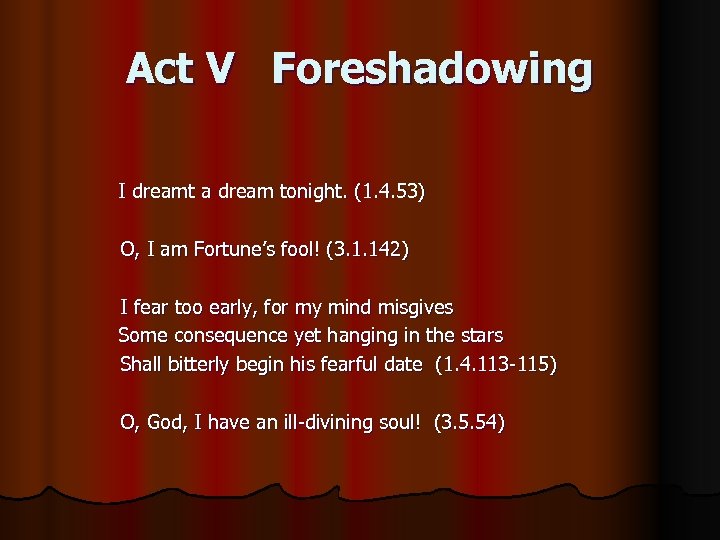 Act V Foreshadowing I dreamt a dream tonight. (1. 4. 53) O, I am Fortune’s fool! (3. 1. 142) I fear too early, for my mind misgives Some consequence yet hanging in the stars Shall bitterly begin his fearful date (1. 4. 113 -115) O, God, I have an ill-divining soul! (3. 5. 54)
 Act VI Idioms l You kiss by th’ book. 1. 5. 122 l Gregory, on my word we’ll not carry coals. (1. 1. 1) (be humiliated) l A man, young lady—lady such a man As all the world—why, he’s a man of wax. (1. 3. 82) (a perfect man as if sculpted by an artist )
 Act VII Stage Directions Scene 1 Motions Part, fools. Put up your swords. (1. 1. 65) Hark, how they knock! – Who’s there? Romeo, arise…(3. 3. 78, 79) Here, sir, a ring she bade me give you, sir. (3. 3. 173)
 Scene II Gestures I do bite my thumb, sir. (1. 1. 47) Scene III Facial Expressions I will frown as I pass by… (1. 1. 41)
 Scene IV Implied Directions Here comes the furious Tybalt back again. (3. 1. 126) Go then, for ‘tis in vain To seek him here that means not to be found. (2. 1. 45, 46) But he that hath the steerage of my course Direct my (sail). On, lusty gentlemen. Strike, drum. (1. 4. 119 -121)
 All’s Well that Ends Well Outline for an 8 -week Course Text: Romeo and Juliet (The New Folger Library: Washington Square Press. 1992) ISBN 0671722859
 Week 1 l l Introduce Shakespeare, his importance, his works, and his world Discuss Shakespearean grammar, language, and literary devices Explain the use of the daily journal in which students: l Explain the meanings of unfamiliar vocabulary l Take class notes l Write their reflections and opinions about the readings and discussions l Write their questions to be asked in the next class Read “Shakespeare’s Life” ( text pp xxv-xxxiii)
 Week 2 l l l Read “Shakespeare’s Language” (text pp xvi-xxiv) Find samples of puns, metaphors, similes, foreshadowing in Prologue and Act I Introduce the Tudor family history Read, analyze, paraphrase the Prologue, making journal entries Discuss modern idioms and their use in translating Shakespearean scenes into everyday conversations: “a little too late” and “bad vibes” Assign research paper on character comparison – due beginning of Week 6 l l Five paragraph expository essay Note cards, Outline, Quotes, Footnotes, Bibliography
 Week 3 l l l l Read Acts 1 and 2, making journal entries Listen to both acts in class (Shakespeare, W. , Romeo and Juliet, Arkangel Shakespeare, Learn. Out. Loud, 2002, ISBN 1932219706) Analyze theme of “Light and Dark” Discuss Queen Elizabeth and her siblings Draw Act 1 Scene 1 Draw Act 2 Scene 6 Find research paper sources and develop a thesis with supporting ideas Discuss modern idioms and their use in translating Shakespearean scenes into everyday conversations: “from the frying pan into the fire” and “up the creek without a paddle”
 Week 4 l Discuss Elizabethan England l l l l Societal norms Entertainment Superstition Women’s Rights Anne Boleyn Catherine of Aragon Lady Jane Grey Formation of the Church of England Assign oral presentations on Elizabethan England or members of the Tudor family due Week 5 Read Act 3, making journal entries Listen to Act 3 Analyze theme of “Time” Make a time line with artwork of main plot events Turn in research paper outline Discuss modern idioms and their use in translating Shakespearean scenes into everyday conversations: “You can pick your friends, but not your family. ”
 Week 5 l l l l Make oral presentations assigned Week 4 Read Act 4, making journal entries Listen to Act 4 Analyze theme of “Generational Conflict” Introduce Sonnets: Prologue Submit research paper rough draft Discuss modern idioms and their use in translating Shakespearean scenes into everyday conversations: “Good intentions pave the road to Hell. ”
 Week 6 l l l l Read Act 5, making journal entries Listen to Act 5 Discuss how the words “tragic heroes”, “tragedies”, “inexorable”, and “hubris” apply to the play Submit research paper final draft Draw Act 5 Scene 3 Write an obituary for Romeo and Juliet as a couple Discuss George Bernard Shaw’s comment, “Youth is wasted on the young. ”
 Week 7 l l l Rewrite research paper incorporating corrections Write an in-class expository essay in preparation for final test Find examples of juxtaposition, alliteration, and personification Analyze theme of “Fate and the Wheel of Fortune” Review themes: “Light and Dark”, “Generational Conflict”, “Time”, “Fate and the Wheel of Fortune” Read and discuss sonnets: “Ozymandias” by Percy B. Shelley l “Purgatory” by Maxine Kumin l
 Week 8 l Make study sheets by reviewing journals l Translate “Ozymandias” into a current event news story l Translate “Purgatory” into everyday language l Final test
 The Tempest in an Ipod
 Act I l Library purchases (3) Ipods ($140 each approx)
 Act II l Library buys BBC downloads of Romeo & Juliet, the Tempest from I Tunes ($9. 95 -$12. 95 each, including music & sound effects) l stores them on a private drive.
 Act III Students check out the audio l Scene I The audio is downloaded onto a library Ipod, which the student checks out. It has a renewal/ return date. Content is erased when the Ipod is returned. l Scene II The audio is downloaded onto a student’s Ipod, with a renewal/ return date. Content is erased at the conclusion of student use.
 Act IV l Scene I Students use their own earphones l Scene II Teachers use the Ipod to broadcast to the entire class using a standard headphone jack connected to a stereo or boombox.
 Epilogue Can the video Ipod be far behind? www. lfanet. org (Campus Life- Library- new mp 3 s) (Campus Life-Library-Ipod policy)