


 Скачать презентацию A Mathematical View of Our World 1 st
c88bf18df105d429adae1480d21552ad.ppt
- Количество слайдов: 126
 A Mathematical View of Our World 1 st ed. Parks, Musser, Trimpe, Maurer, and Maurer
 Chapter 5 Apportionment
 Section 5. 1 Quota Methods • Goals • Study apportionment • Standard divisor • Standard quota • Study apportionment methods • Hamilton’s method • Lowndes’ method
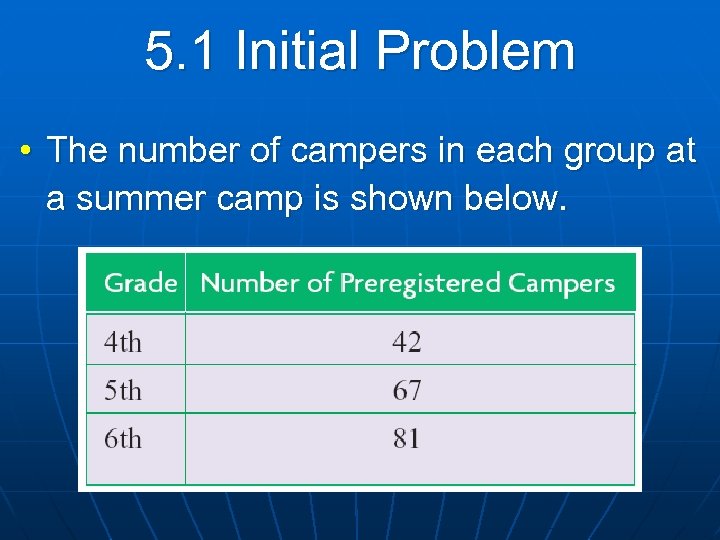 5. 1 Initial Problem • The number of campers in each group at a summer camp is shown below.
 5. 1 Initial Problem, cont’d • The camp organizers will assign 15 counselors to the groups of campers. • How many of the 15 counselors should be assigned to each group? • The solution will be given at the end of the section.
 Apportionment • The verb apportion means • “Assign to as a due portion. ” • “To divide into shares which may not be equal. ” • Apportionment problems arise when what is being divided cannot be divided into fractional parts. • An example of apportionment is the process of assigning seats in the House of Representatives to the states.
 Apportionment, cont’d • The apportionment problem is to determine a method for rounding a collection of numbers so that: • The numbers are rounded to whole numbers. • The sum of the numbers is unchanged.
 Apportionment, cont’d • The Constitution does not specify a method for apportioning seats in the House of Representatives. • Various methods, named after their authors, have been used: • Alexander Hamilton • Thomas Jefferson • Daniel Webster • William Lowndes
 The Standard Divisor • Suppose the total population is P and the number of seats to be apportioned is M. • The standard divisor is the ratio D = P/M. • The standard divisor gives the number of people per legislative seat.
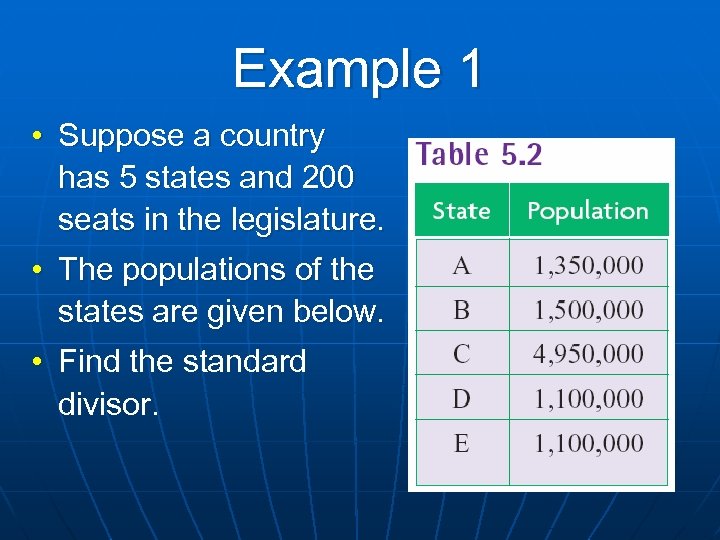 Example 1 • Suppose a country has 5 states and 200 seats in the legislature. • The populations of the states are given below. • Find the standard divisor.
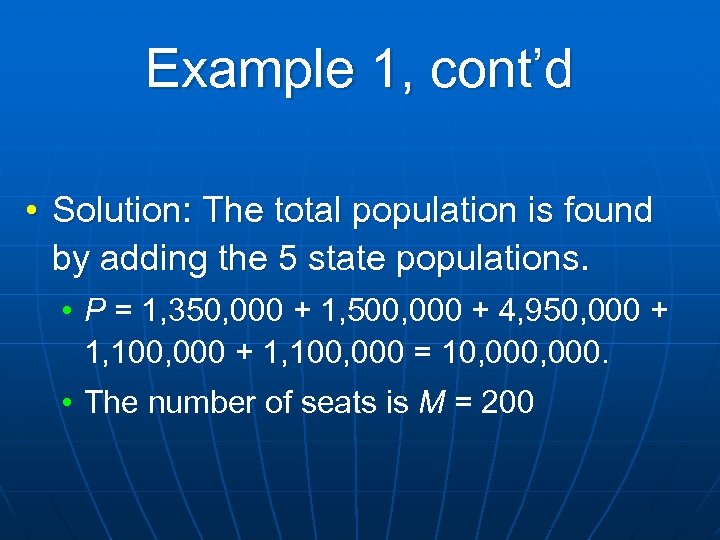 Example 1, cont’d • Solution: The total population is found by adding the 5 state populations. • P = 1, 350, 000 + 1, 500, 000 + 4, 950, 000 + 1, 100, 000 = 10, 000. • The number of seats is M = 200
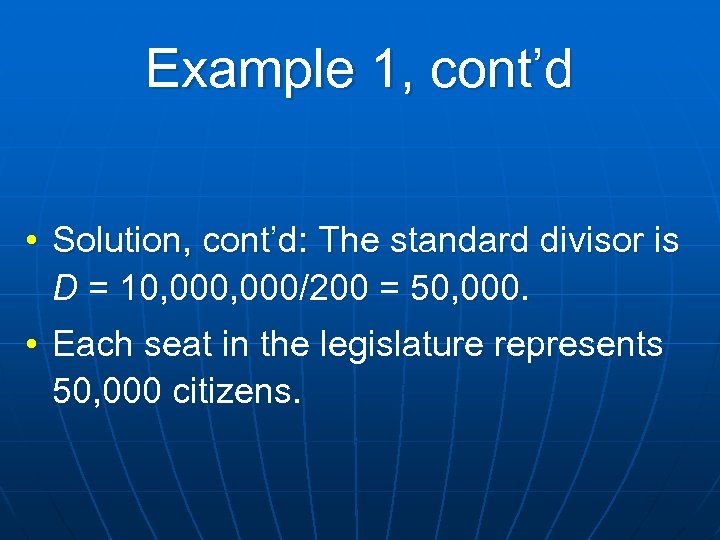 Example 1, cont’d • Solution, cont’d: The standard divisor is D = 10, 000/200 = 50, 000. • Each seat in the legislature represents 50, 000 citizens.
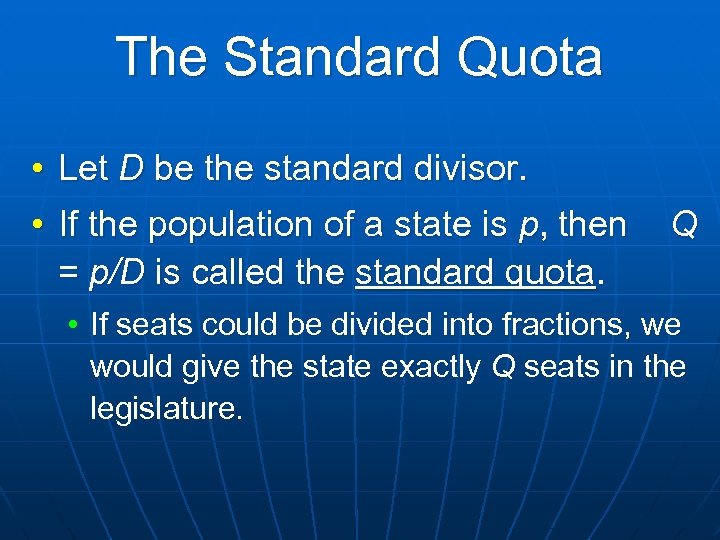 The Standard Quota • Let D be the standard divisor. • If the population of a state is p, then = p/D is called the standard quota. Q • If seats could be divided into fractions, we would give the state exactly Q seats in the legislature.
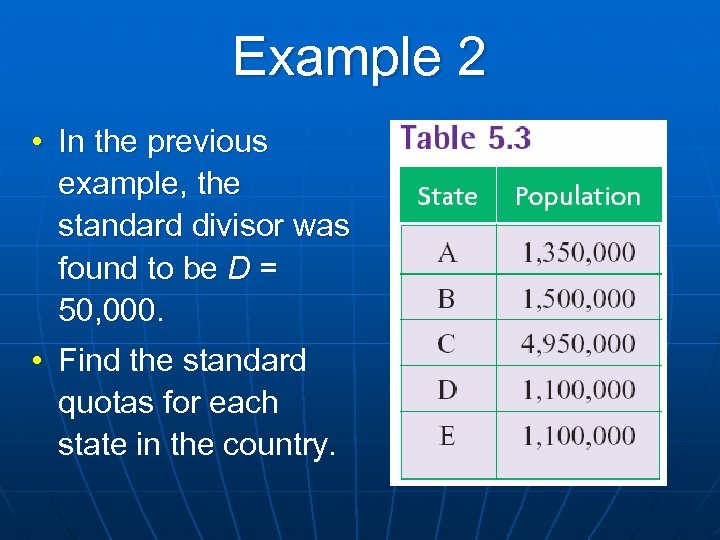 Example 2 • In the previous example, the standard divisor was found to be D = 50, 000. • Find the standard quotas for each state in the country.
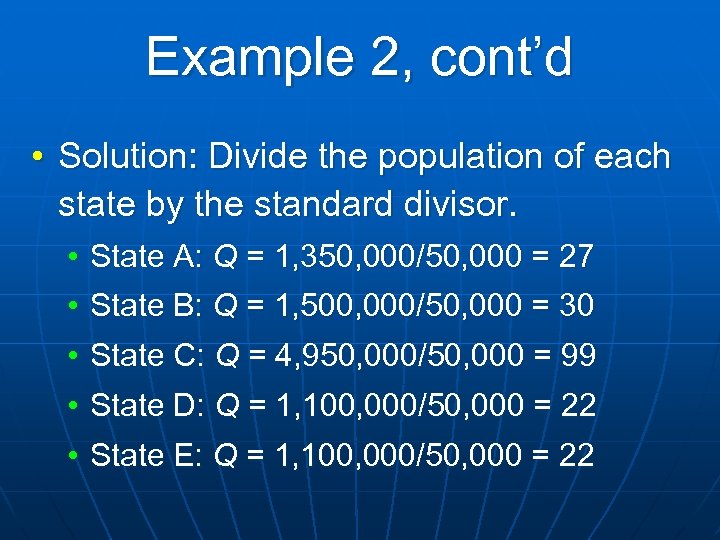 Example 2, cont’d • Solution: Divide the population of each state by the standard divisor. • State A: Q = 1, 350, 000/50, 000 = 27 • State B: Q = 1, 500, 000/50, 000 = 30 • State C: Q = 4, 950, 000/50, 000 = 99 • State D: Q = 1, 100, 000/50, 000 = 22 • State E: Q = 1, 100, 000/50, 000 = 22
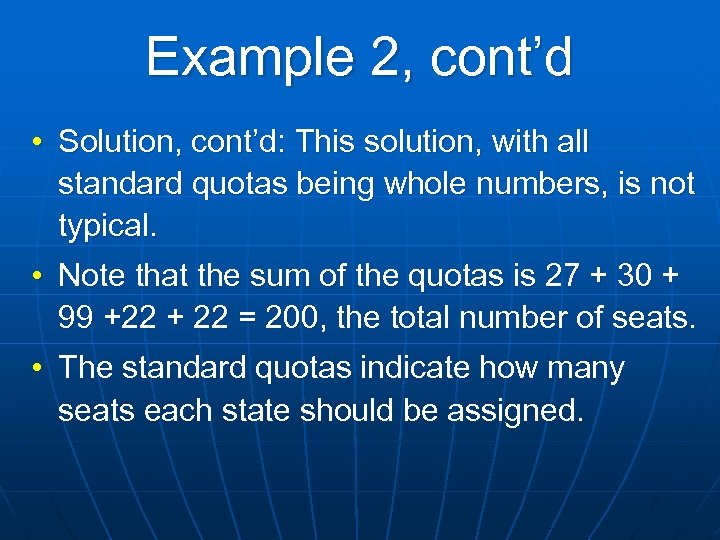 Example 2, cont’d • Solution, cont’d: This solution, with all standard quotas being whole numbers, is not typical. • Note that the sum of the quotas is 27 + 30 + 99 +22 + 22 = 200, the total number of seats. • The standard quotas indicate how many seats each state should be assigned.
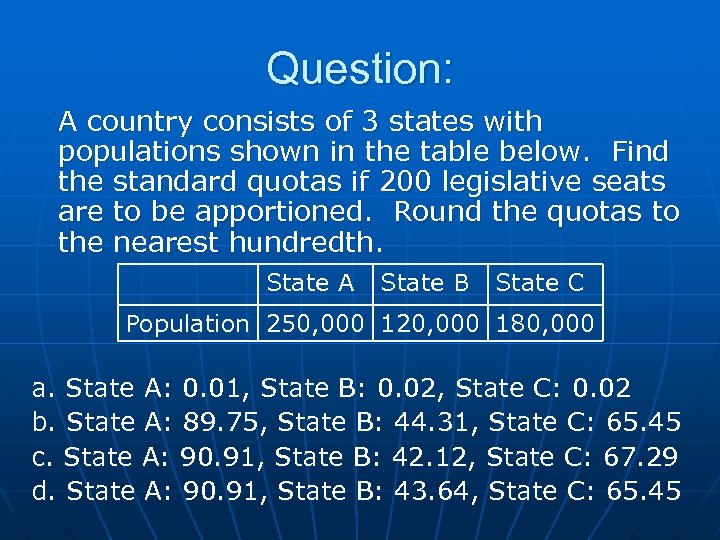 Question: A country consists of 3 states with populations shown in the table below. Find the standard quotas if 200 legislative seats are to be apportioned. Round the quotas to the nearest hundredth. State A State B State C Population 250, 000 120, 000 180, 000 a. State A: 0. 01, State B: 0. 02, State C: 0. 02 b. State A: 89. 75, State B: 44. 31, State C: 65. 45 c. State A: 90. 91, State B: 42. 12, State C: 67. 29 d. State A: 90. 91, State B: 43. 64, State C: 65. 45
 Apportionment, cont’d • Typically, the standard quotas will not all be whole numbers and will have to be rounded. • The various apportionment methods provide procedures for determining how the rounding should be done.
 Hamilton’s Method 1) Find the standard divisor. 2) Determine each state’s standard quota. • Round each quota down to a whole number. • Each state gets that number of seats, with a minimum of 1 seat. 3) Leftover seats are assigned one at a time to states according to the size of the fractional parts of the standard quotas. • Begin with the state with the largest fractional part.
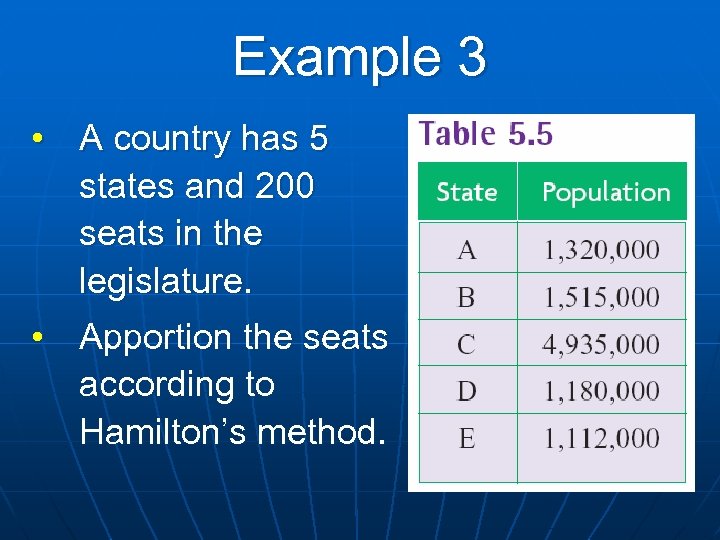 Example 3 • A country has 5 states and 200 seats in the legislature. • Apportion the seats according to Hamilton’s method.
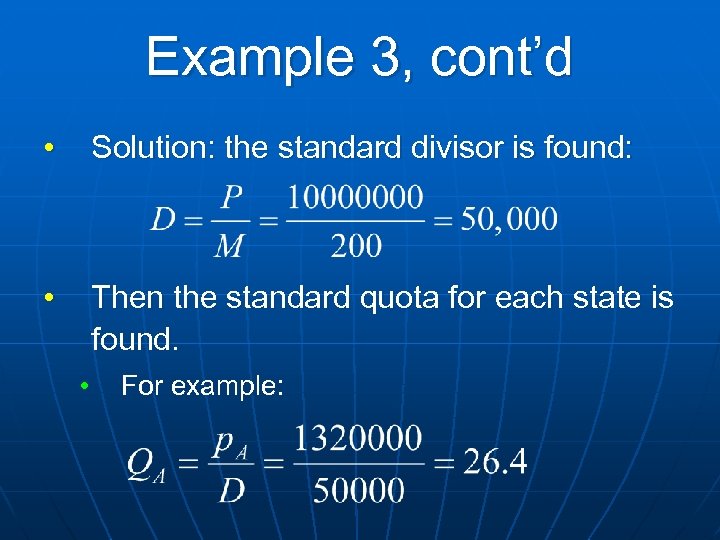 Example 3, cont’d • Solution: the standard divisor is found: • Then the standard quota for each state is found. • For example:
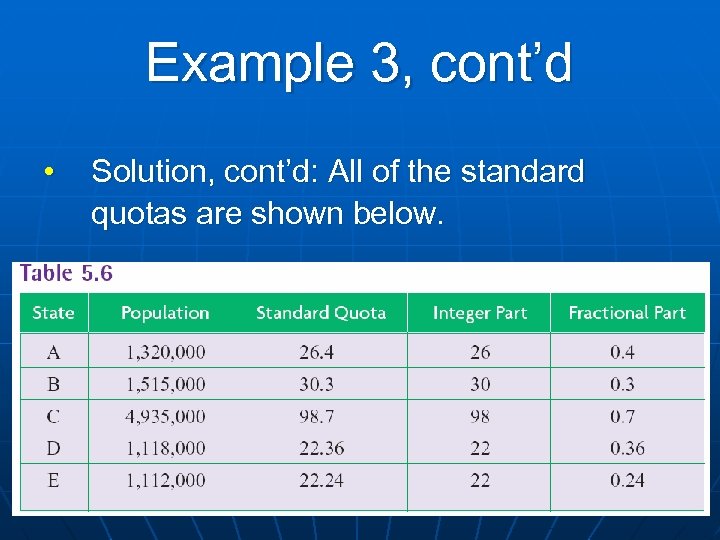 Example 3, cont’d • Solution, cont’d: All of the standard quotas are shown below.
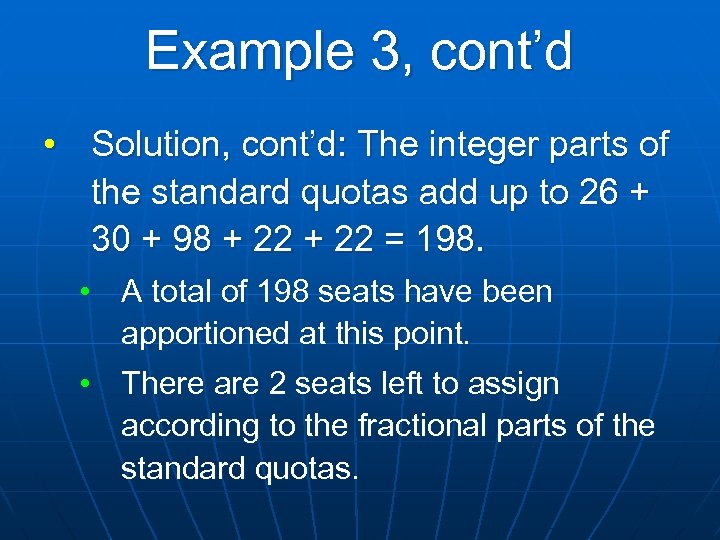 Example 3, cont’d • Solution, cont’d: The integer parts of the standard quotas add up to 26 + 30 + 98 + 22 = 198. • A total of 198 seats have been apportioned at this point. • There are 2 seats left to assign according to the fractional parts of the standard quotas.
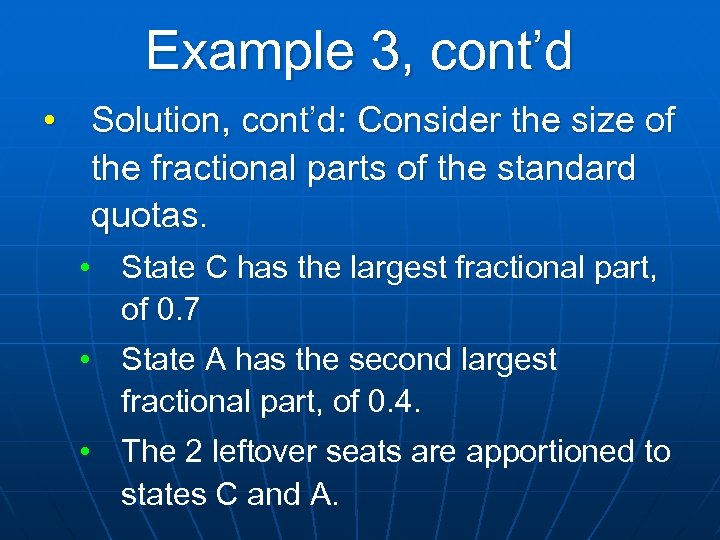 Example 3, cont’d • Solution, cont’d: Consider the size of the fractional parts of the standard quotas. • State C has the largest fractional part, of 0. 7 • State A has the second largest fractional part, of 0. 4. • The 2 leftover seats are apportioned to states C and A.
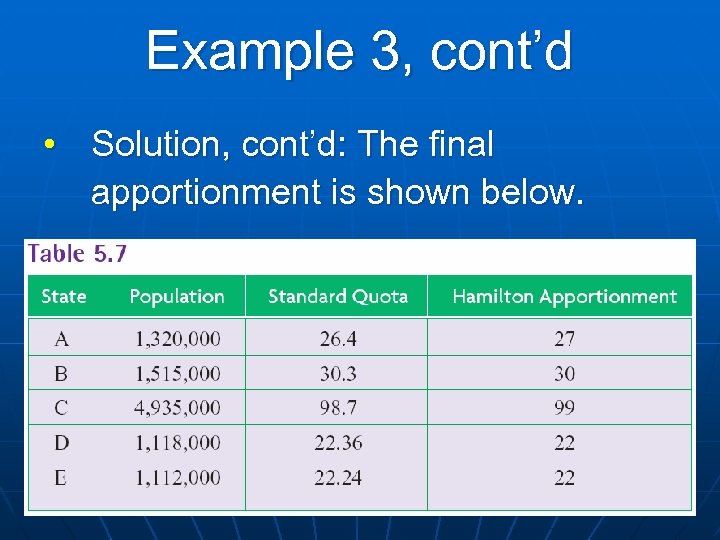 Example 3, cont’d • Solution, cont’d: The final apportionment is shown below.
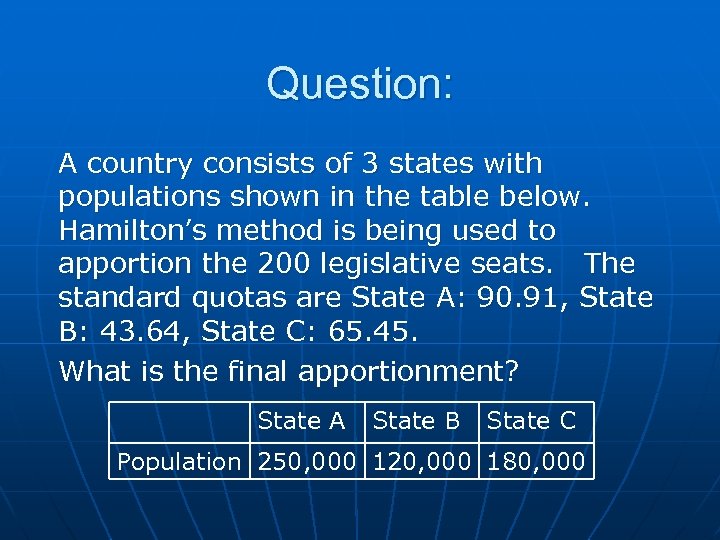 Question: A country consists of 3 states with populations shown in the table below. Hamilton’s method is being used to apportion the 200 legislative seats. The standard quotas are State A: 90. 91, State B: 43. 64, State C: 65. 45. What is the final apportionment? State A State B State C Population 250, 000 120, 000 180, 000
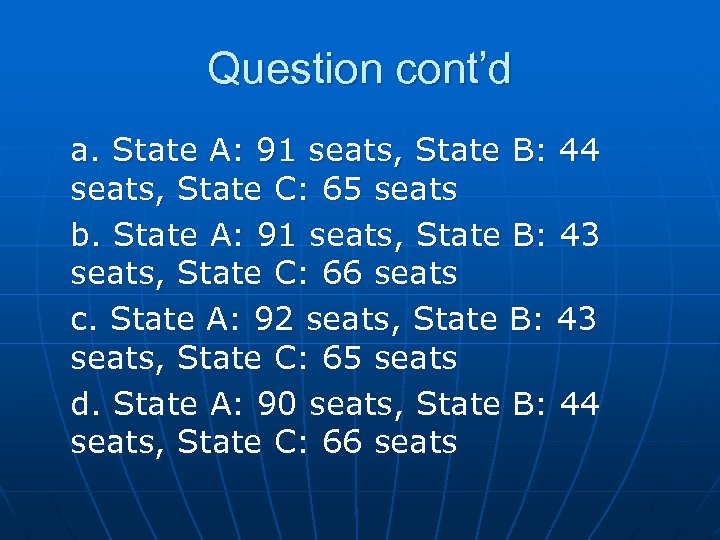 Question cont’d a. State A: 91 seats, State B: 44 seats, State C: 65 seats b. State A: 91 seats, State B: 43 seats, State C: 66 seats c. State A: 92 seats, State B: 43 seats, State C: 65 seats d. State A: 90 seats, State B: 44 seats, State C: 66 seats
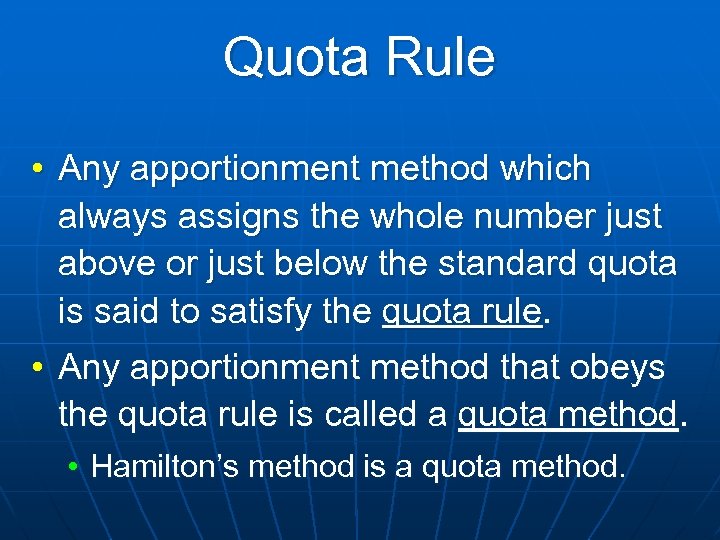 Quota Rule • Any apportionment method which always assigns the whole number just above or just below the standard quota is said to satisfy the quota rule. • Any apportionment method that obeys the quota rule is called a quota method. • Hamilton’s method is a quota method.
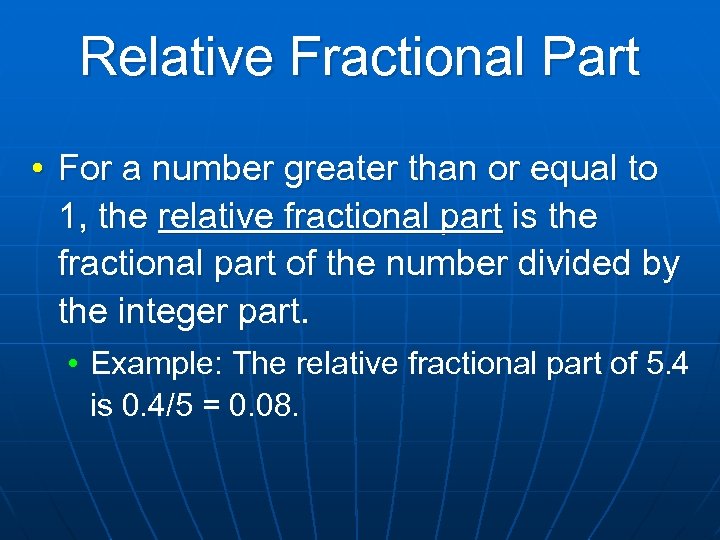 Relative Fractional Part • For a number greater than or equal to 1, the relative fractional part is the fractional part of the number divided by the integer part. • Example: The relative fractional part of 5. 4 is 0. 4/5 = 0. 08.
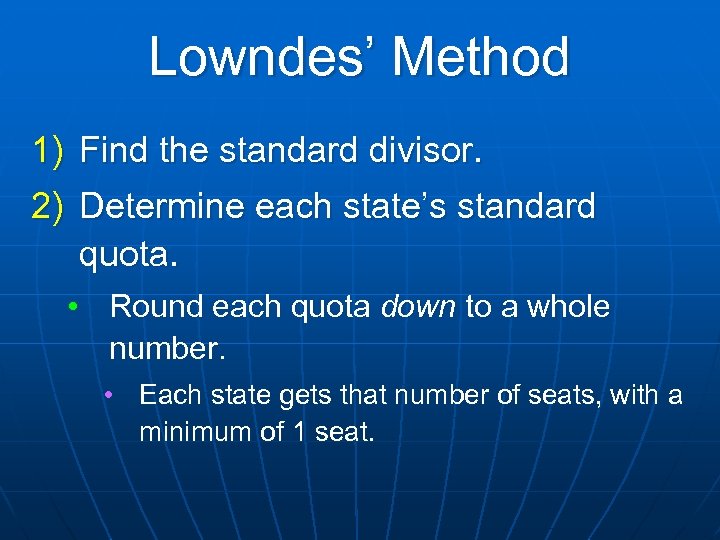 Lowndes’ Method 1) Find the standard divisor. 2) Determine each state’s standard quota. • Round each quota down to a whole number. • Each state gets that number of seats, with a minimum of 1 seat.
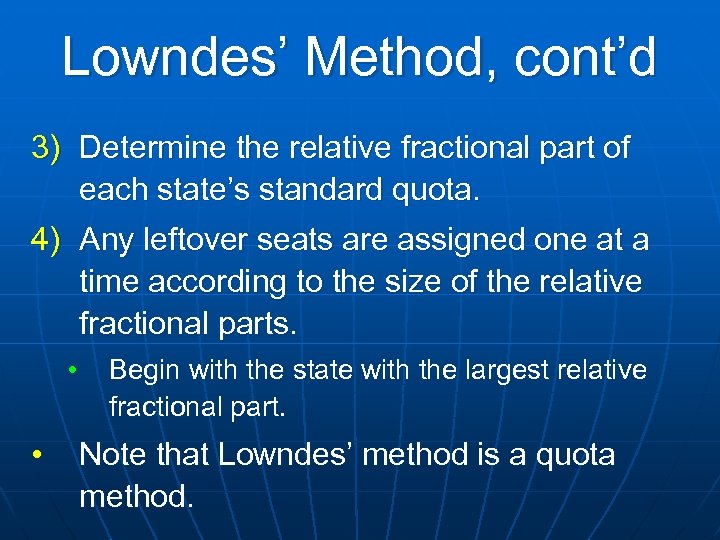 Lowndes’ Method, cont’d 3) Determine the relative fractional part of each state’s standard quota. 4) Any leftover seats are assigned one at a time according to the size of the relative fractional parts. • • Begin with the state with the largest relative fractional part. Note that Lowndes’ method is a quota method.
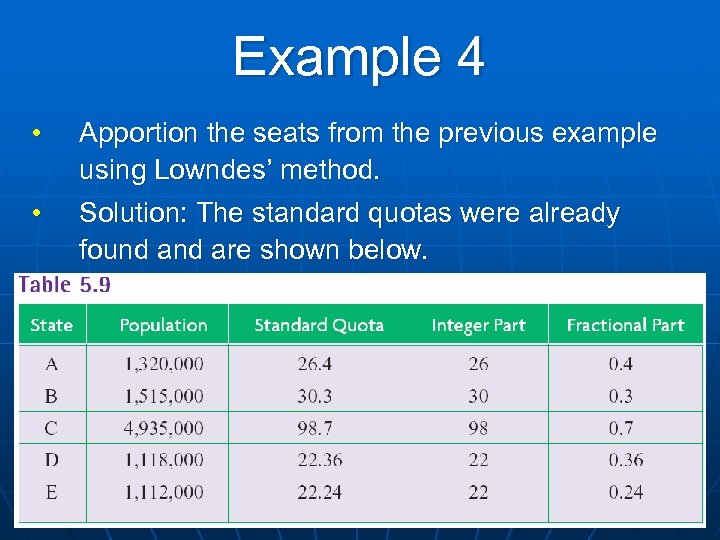 Example 4 • Apportion the seats from the previous example using Lowndes’ method. • Solution: The standard quotas were already found are shown below.
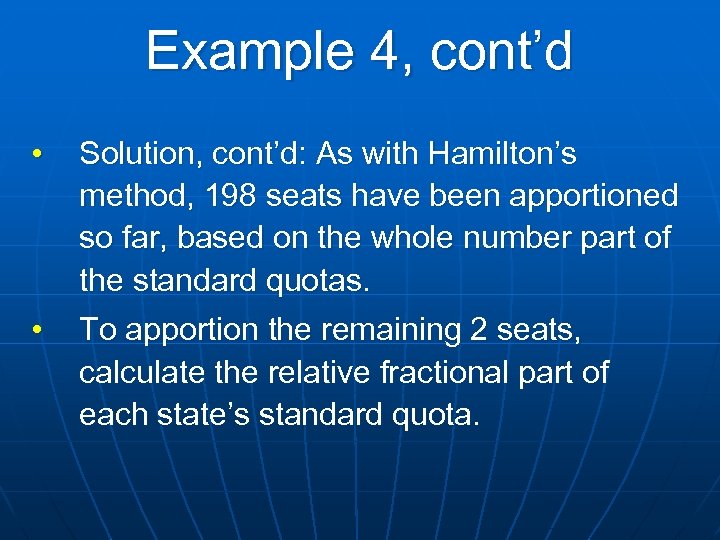 Example 4, cont’d • Solution, cont’d: As with Hamilton’s method, 198 seats have been apportioned so far, based on the whole number part of the standard quotas. • To apportion the remaining 2 seats, calculate the relative fractional part of each state’s standard quota.
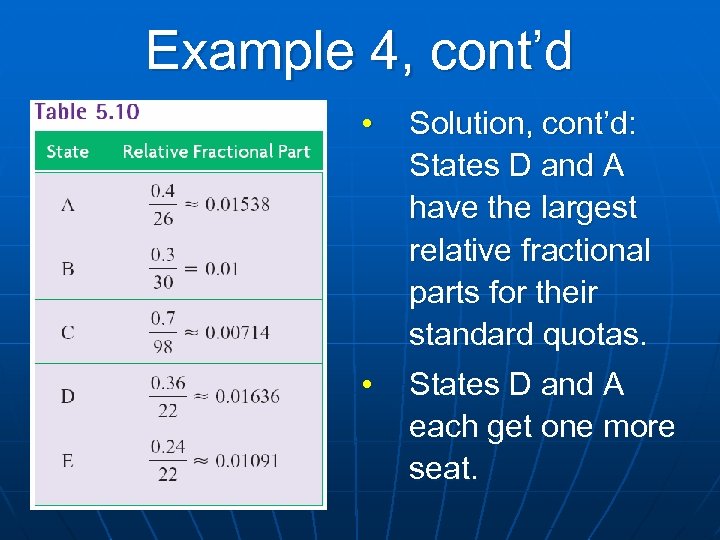 Example 4, cont’d • Solution, cont’d: States D and A have the largest relative fractional parts for their standard quotas. • States D and A each get one more seat.
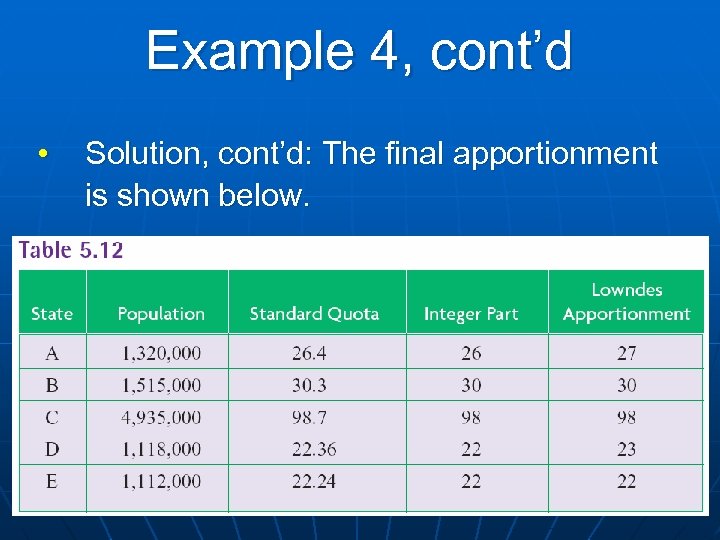 Example 4, cont’d • Solution, cont’d: The final apportionment is shown below.
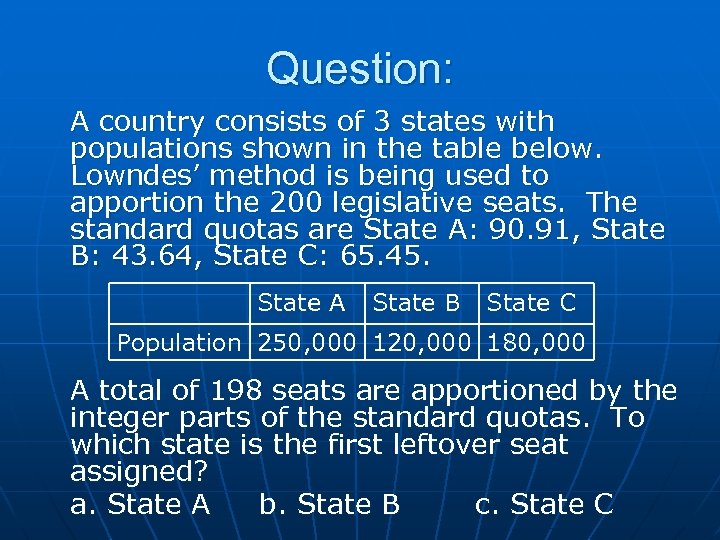 Question: A country consists of 3 states with populations shown in the table below. Lowndes’ method is being used to apportion the 200 legislative seats. The standard quotas are State A: 90. 91, State B: 43. 64, State C: 65. 45. State A State B State C Population 250, 000 120, 000 180, 000 A total of 198 seats are apportioned by the integer parts of the standard quotas. To which state is the first leftover seat assigned? a. State A b. State B c. State C
 Method Comparison • Hamilton’s method and Lowndes’ method gave different apportionments in the previous example. • Hamilton’s method is biased toward larger states. • Lowndes’ method is biased toward smaller states.
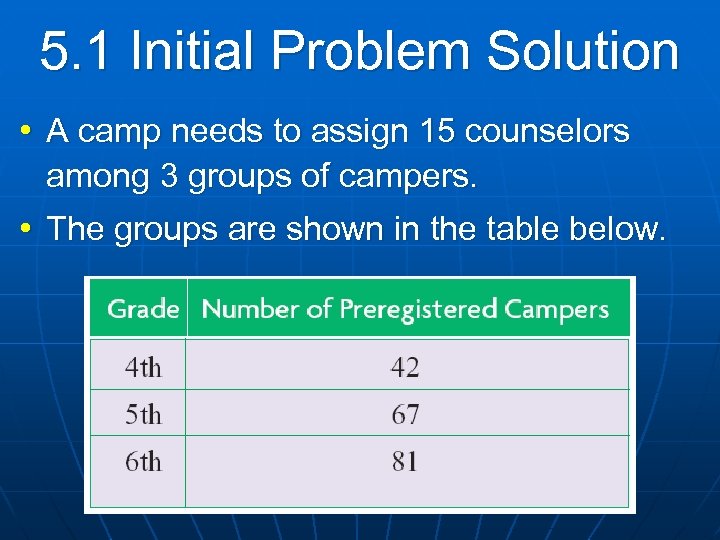 5. 1 Initial Problem Solution • A camp needs to assign 15 counselors among 3 groups of campers. • The groups are shown in the table below.
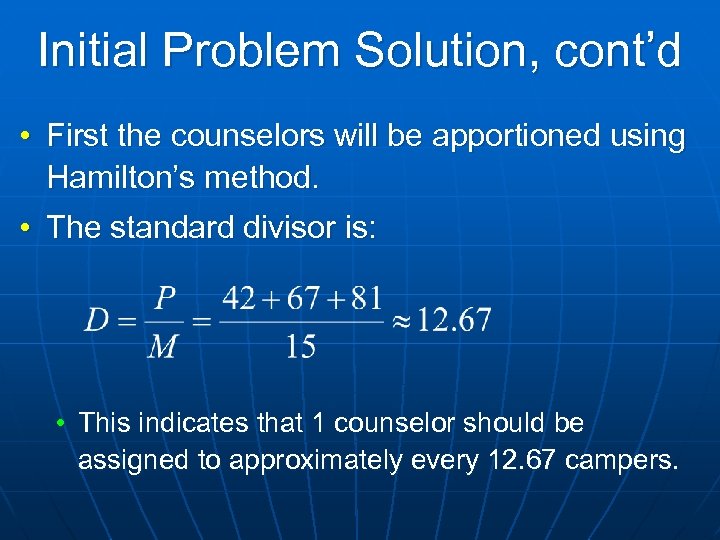 Initial Problem Solution, cont’d • First the counselors will be apportioned using Hamilton’s method. • The standard divisor is: • This indicates that 1 counselor should be assigned to approximately every 12. 67 campers.
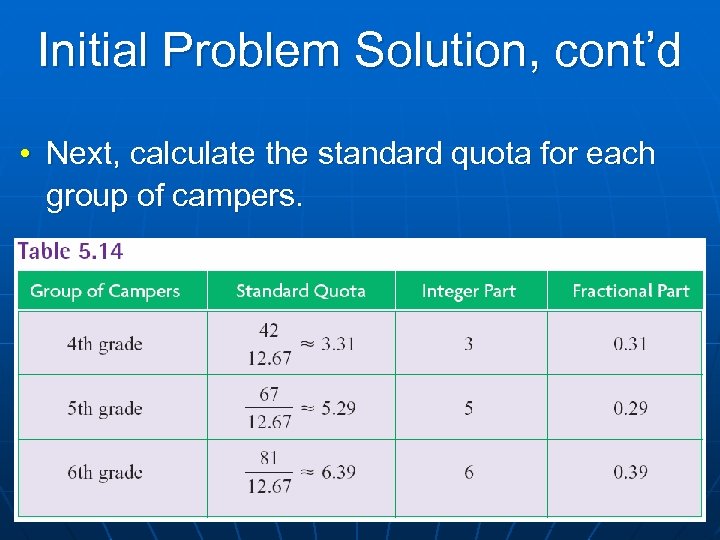 Initial Problem Solution, cont’d • Next, calculate the standard quota for each group of campers.
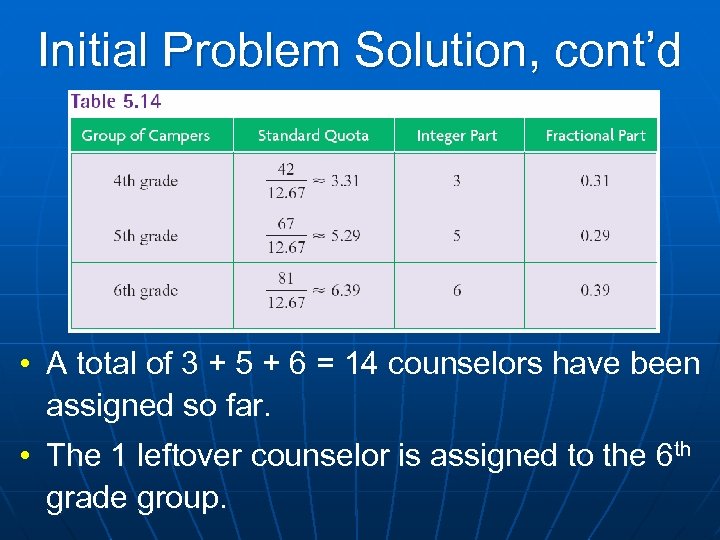 Initial Problem Solution, cont’d • A total of 3 + 5 + 6 = 14 counselors have been assigned so far. • The 1 leftover counselor is assigned to the 6 th grade group.
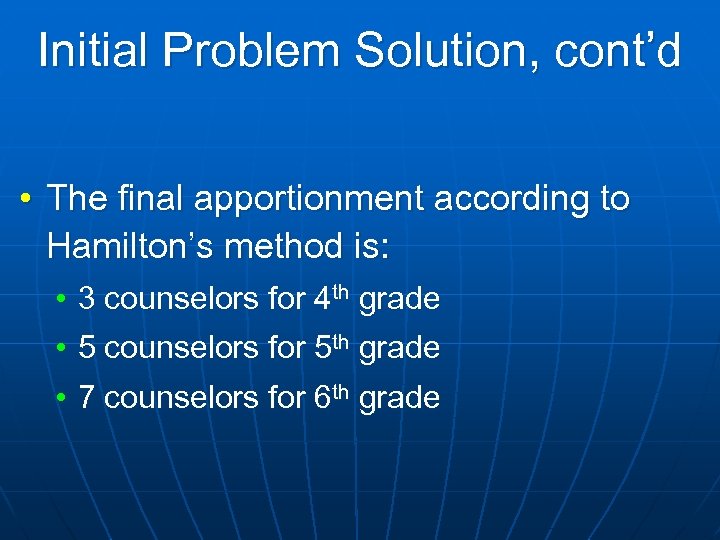 Initial Problem Solution, cont’d • The final apportionment according to Hamilton’s method is: • 3 counselors for 4 th grade • 5 counselors for 5 th grade • 7 counselors for 6 th grade
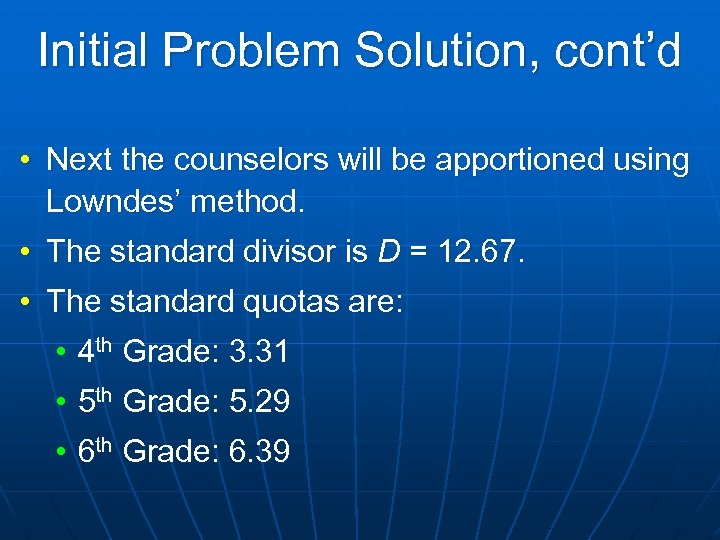 Initial Problem Solution, cont’d • Next the counselors will be apportioned using Lowndes’ method. • The standard divisor is D = 12. 67. • The standard quotas are: • 4 th Grade: 3. 31 • 5 th Grade: 5. 29 • 6 th Grade: 6. 39
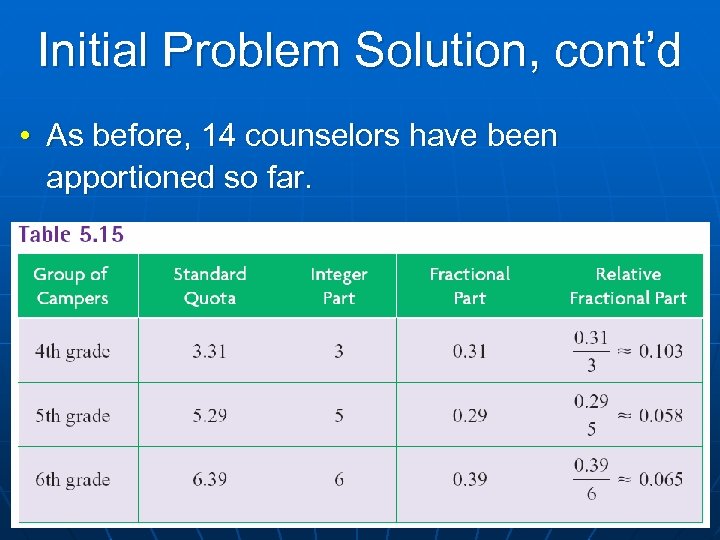 Initial Problem Solution, cont’d • As before, 14 counselors have been apportioned so far.
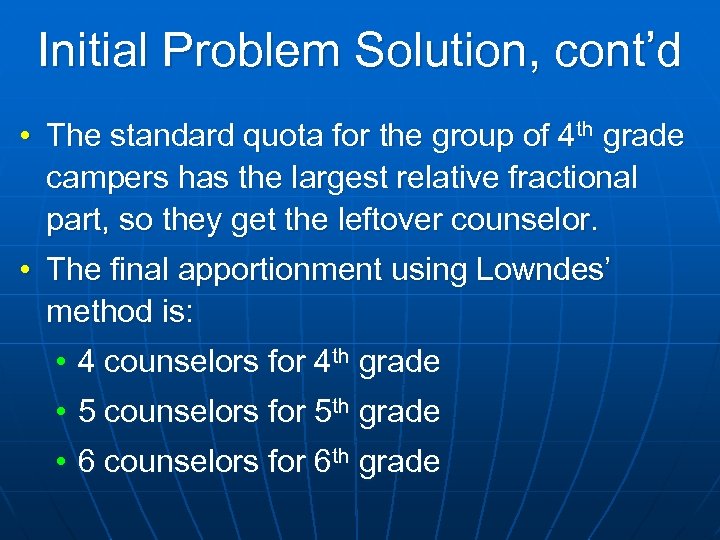 Initial Problem Solution, cont’d • The standard quota for the group of 4 th grade campers has the largest relative fractional part, so they get the leftover counselor. • The final apportionment using Lowndes’ method is: • 4 counselors for 4 th grade • 5 counselors for 5 th grade • 6 counselors for 6 th grade
 Section 5. 2 Divisor Methods • Goals • Study apportionment methods • Jefferson’s method • Webster’s method
 5. 2 Initial Problem • Suppose you, your sister, and your brother have inherited 85 gold coins. • The coins will be divided based on the number of hours each of you have volunteered at the local soup kitchen. • How should the coins be apportioned? • The solution will be given at the end of the section.
 Apportionment Methods • Section 5. 1 covered two quota methods. • Hamilton’s method • Lowndes’ method. • This section will consider two apportionment methods that do not follow the quota rule.
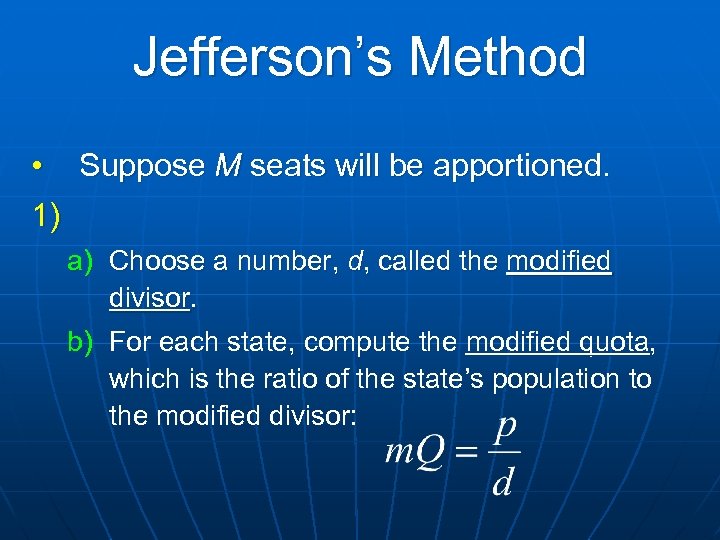 Jefferson’s Method • Suppose M seats will be apportioned. 1) a) Choose a number, d, called the modified divisor. b) For each state, compute the modified quota, which is the ratio of the state’s population to the modified divisor:
 Jefferson’s Method, cont’d 1) Cont’d: c) If the integer parts of the modified quotas for all the states add to M, then go on to Step 2. Otherwise go back to Step 1, part (a) and choose a different value for d. 2) Assign to each state the integer part of its modified quota.
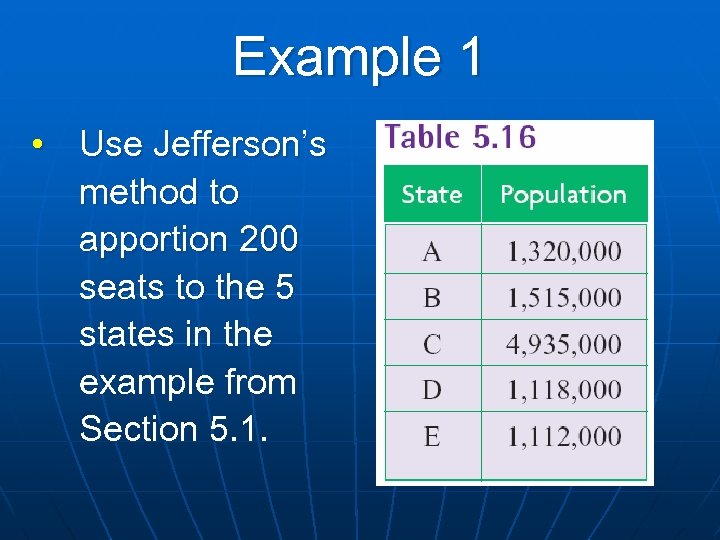 Example 1 • Use Jefferson’s method to apportion 200 seats to the 5 states in the example from Section 5. 1.
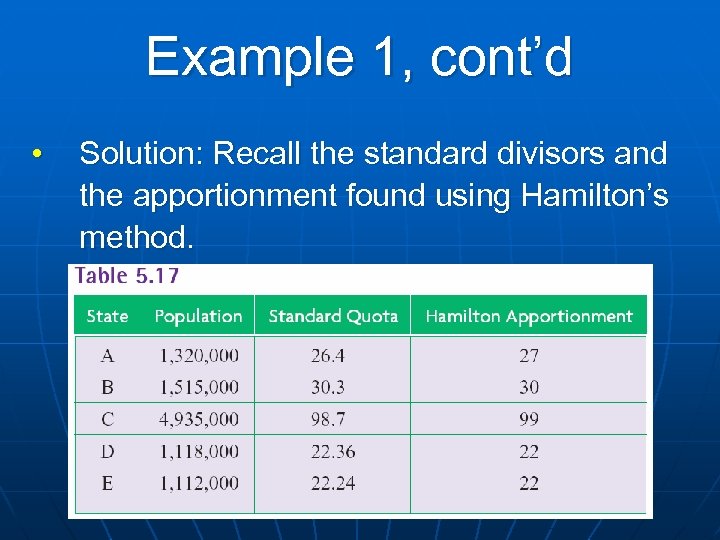 Example 1, cont’d • Solution: Recall the standard divisors and the apportionment found using Hamilton’s method.
 Example 1, cont’d • Solution, cont’d: In Jefferson’s method all the (modified) quotas will be rounded down. • Note that if all the standard quotas were rounded down, the total would be only 198 seats. • The modified quotas need to be slightly larger than the standard ones.
 Example 1, cont’d • Solution, cont’d: For the modified quotas to be larger, the modified divisor needs to be smaller than the standard divisor of 50, 000. • A good guess for a modified divisor can be found by dividing the largest state’s population by 1 more, 2 more, 3 more, …, than the integer part of its standard quota. • Start with 1 more, and keep going until you find one that works.
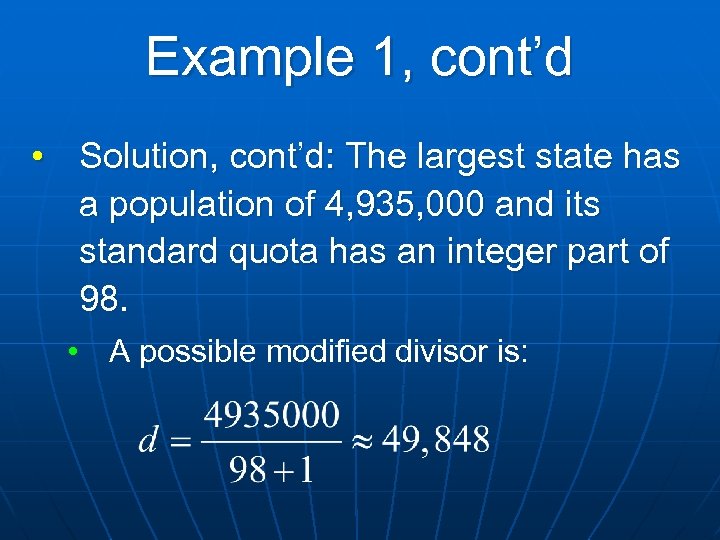 Example 1, cont’d • Solution, cont’d: The largest state has a population of 4, 935, 000 and its standard quota has an integer part of 98. • A possible modified divisor is:
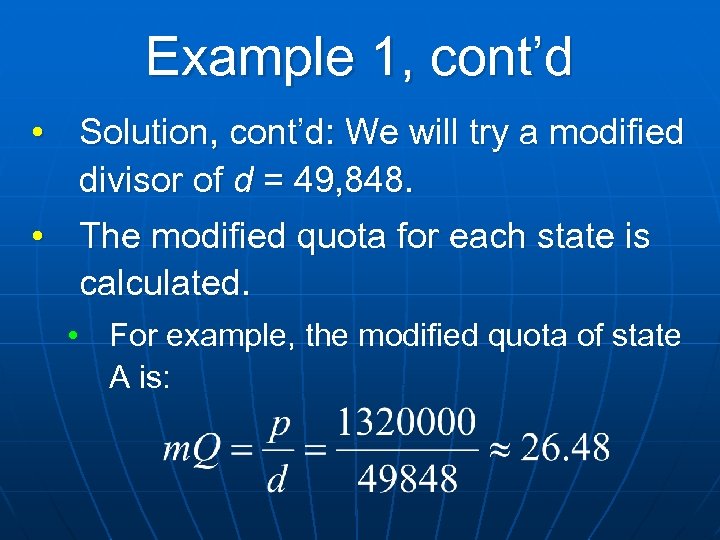 Example 1, cont’d • Solution, cont’d: We will try a modified divisor of d = 49, 848. • The modified quota for each state is calculated. • For example, the modified quota of state A is:
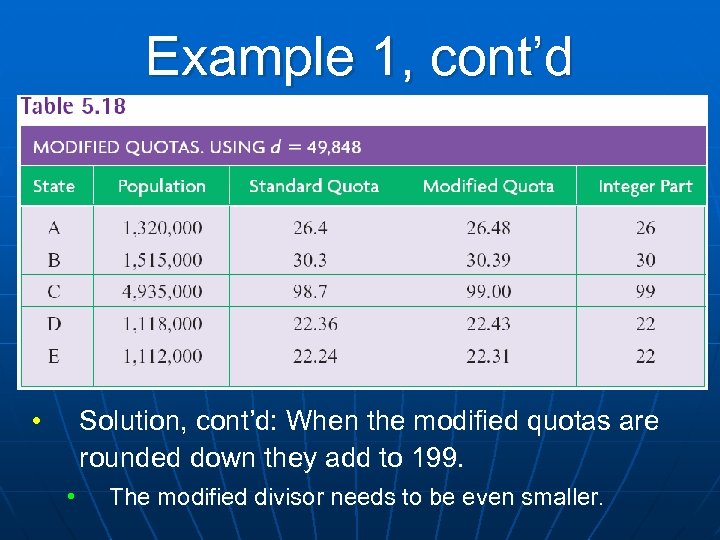 Example 1, cont’d • Solution, cont’d: When the modified quotas are rounded down they add to 199. • The modified divisor needs to be even smaller.
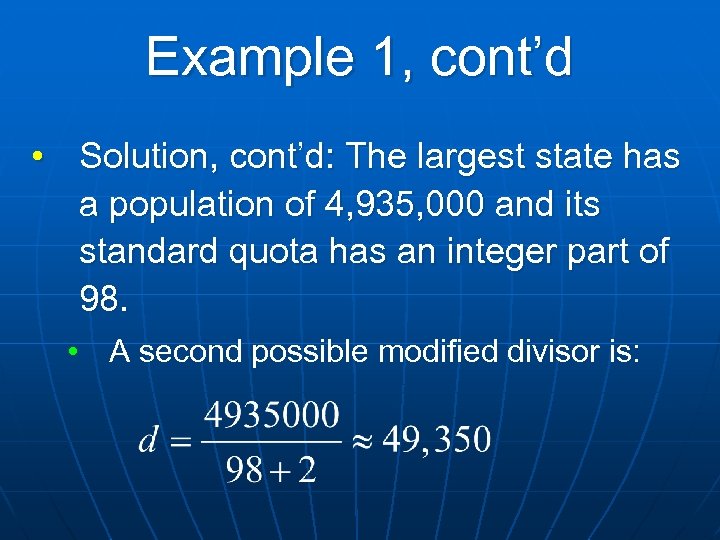 Example 1, cont’d • Solution, cont’d: The largest state has a population of 4, 935, 000 and its standard quota has an integer part of 98. • A second possible modified divisor is:
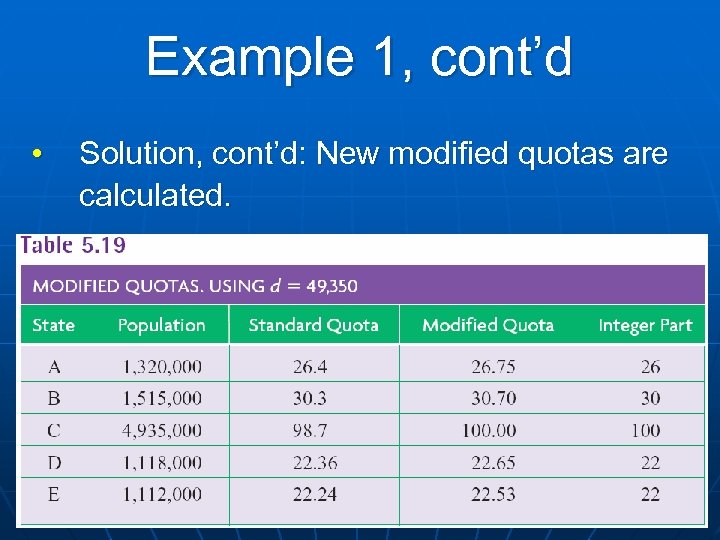 Example 1, cont’d • Solution, cont’d: New modified quotas are calculated.
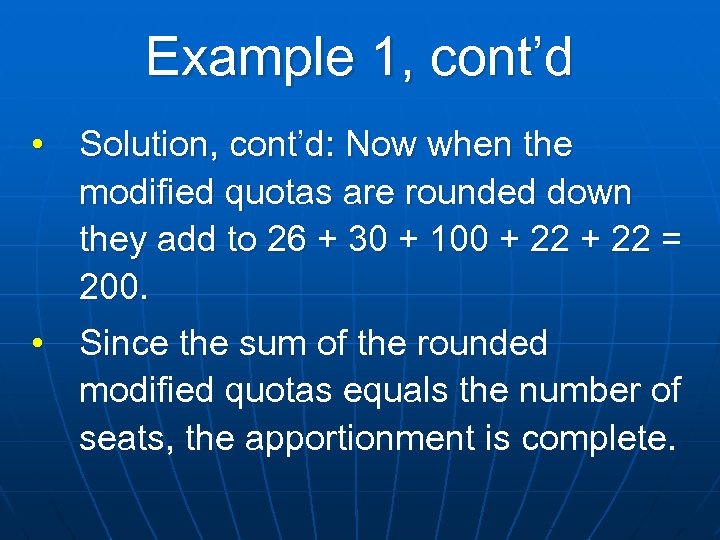 Example 1, cont’d • Solution, cont’d: Now when the modified quotas are rounded down they add to 26 + 30 + 100 + 22 = 200. • Since the sum of the rounded modified quotas equals the number of seats, the apportionment is complete.
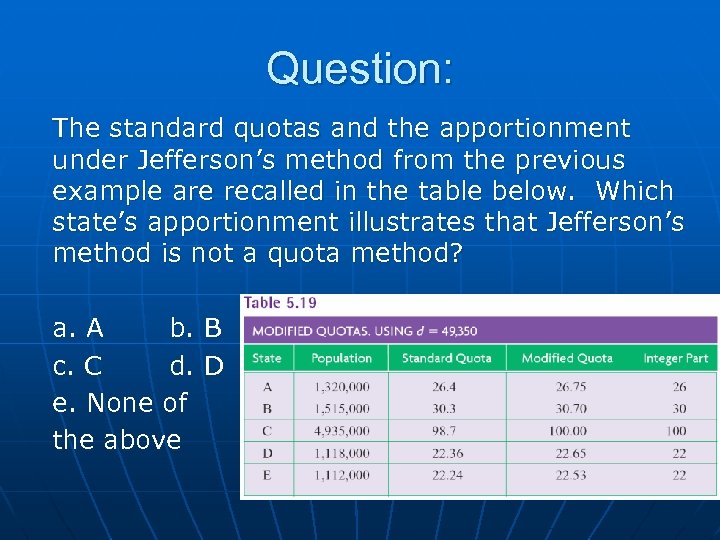 Question: The standard quotas and the apportionment under Jefferson’s method from the previous example are recalled in the table below. Which state’s apportionment illustrates that Jefferson’s method is not a quota method? a. A b. B c. C d. D e. None of the above
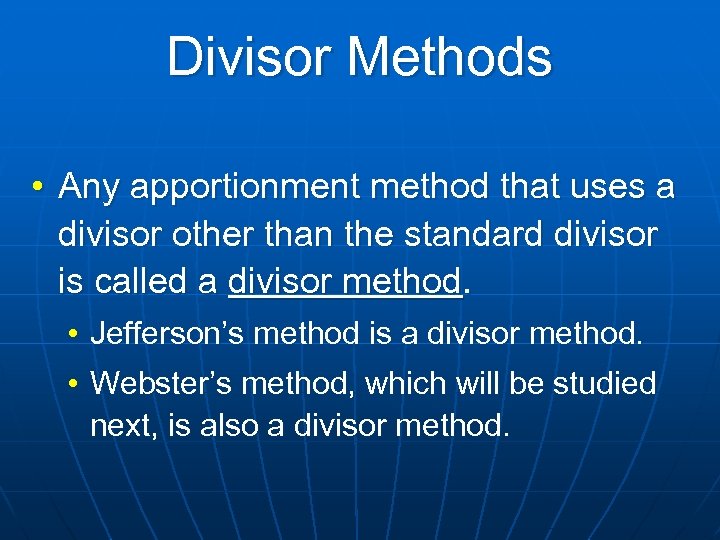 Divisor Methods • Any apportionment method that uses a divisor other than the standard divisor is called a divisor method. • Jefferson’s method is a divisor method. • Webster’s method, which will be studied next, is also a divisor method.
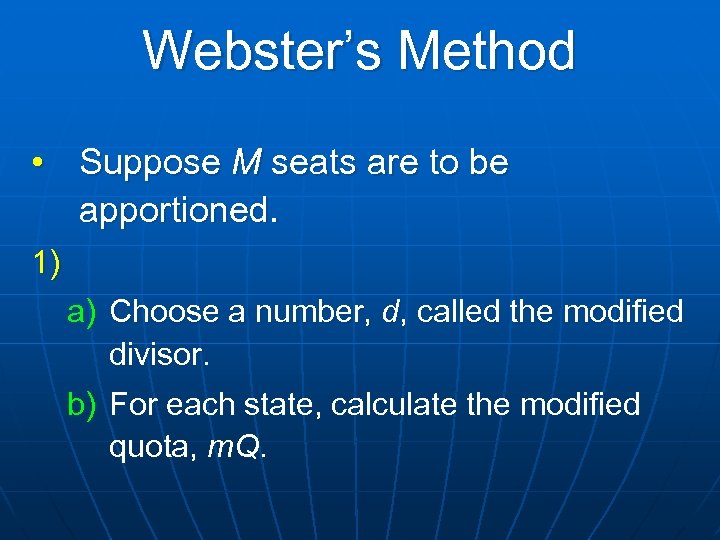 Webster’s Method • Suppose M seats are to be apportioned. 1) a) Choose a number, d, called the modified divisor. b) For each state, calculate the modified quota, m. Q.
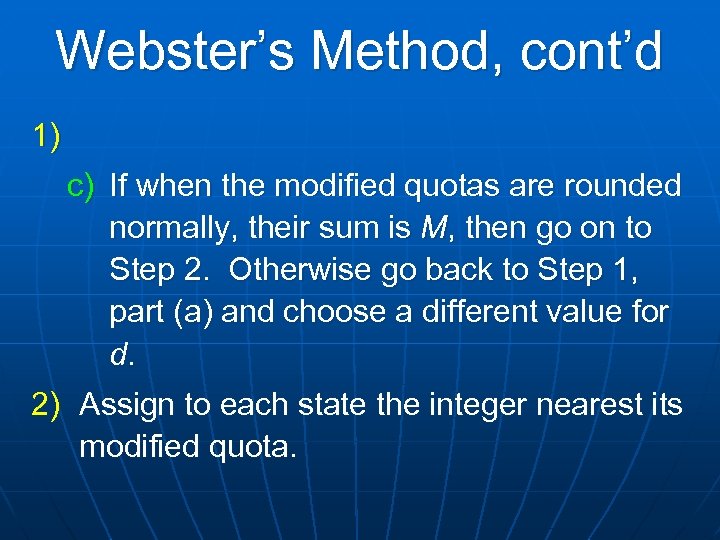 Webster’s Method, cont’d 1) c) If when the modified quotas are rounded normally, their sum is M, then go on to Step 2. Otherwise go back to Step 1, part (a) and choose a different value for d. 2) Assign to each state the integer nearest its modified quota.
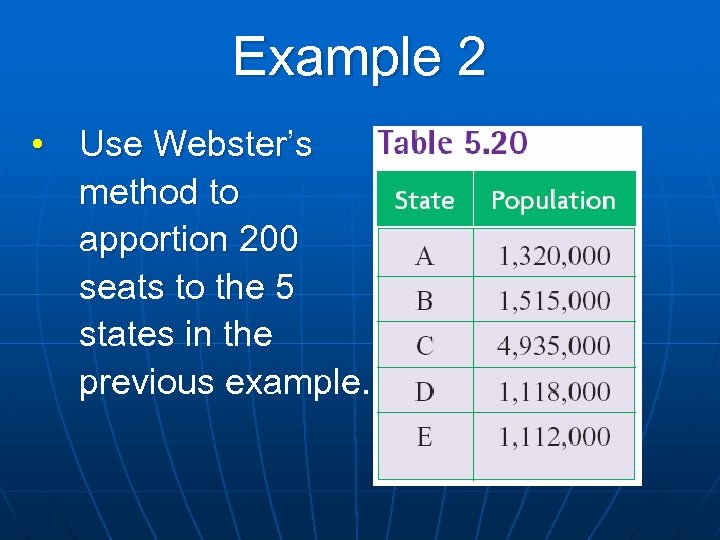 Example 2 • Use Webster’s method to apportion 200 seats to the 5 states in the previous example.
 Example 2, cont’d • Solution: Rounding the standard quotas normally gives a sum of 199, one short of the desired total. • Unlike when using Jefferson’s method, it is not clear whether the modified divisor should be larger or smaller than the standard divisor. • In general, try to create an apportionment like the one obtained from Hamilton’s method.
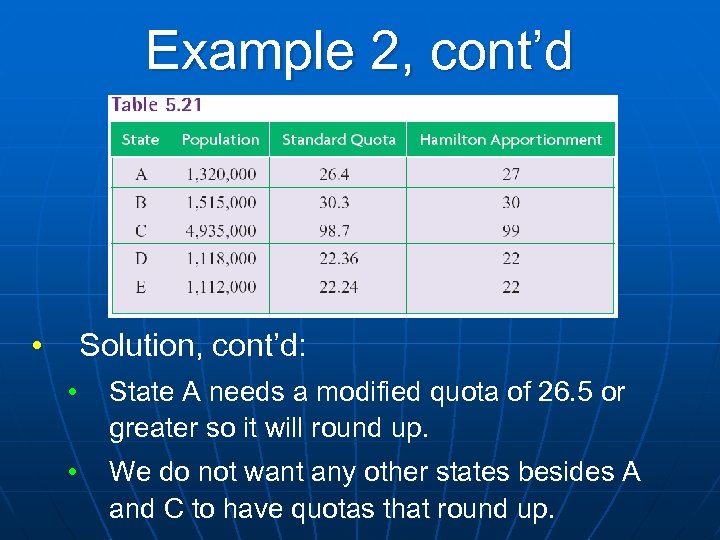 Example 2, cont’d • Solution, cont’d: • State A needs a modified quota of 26. 5 or greater so it will round up. • We do not want any other states besides A and C to have quotas that round up.
 Example 2, cont’d • Solution, cont’d: To make the modified quota for A larger, we need a modified divisor that is slightly smaller. • The calculations done for Jefferson’s method show us that d = 49, 848 is too large and d = 49, 350 is too small.
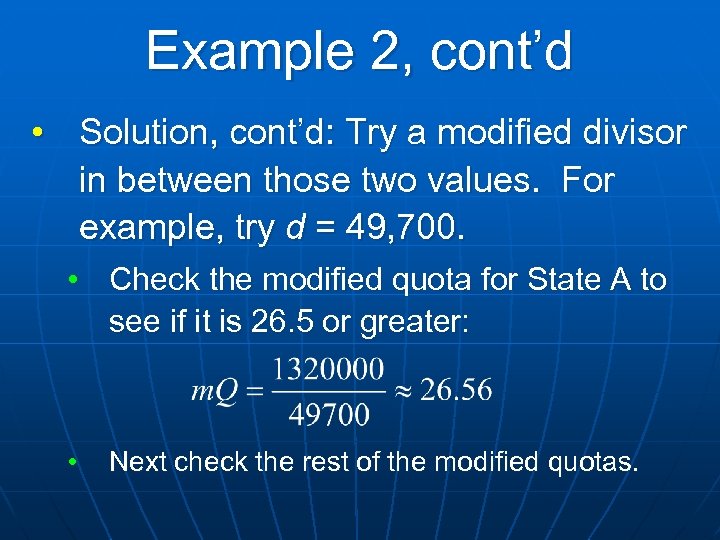 Example 2, cont’d • Solution, cont’d: Try a modified divisor in between those two values. For example, try d = 49, 700. • Check the modified quota for State A to see if it is 26. 5 or greater: • Next check the rest of the modified quotas.
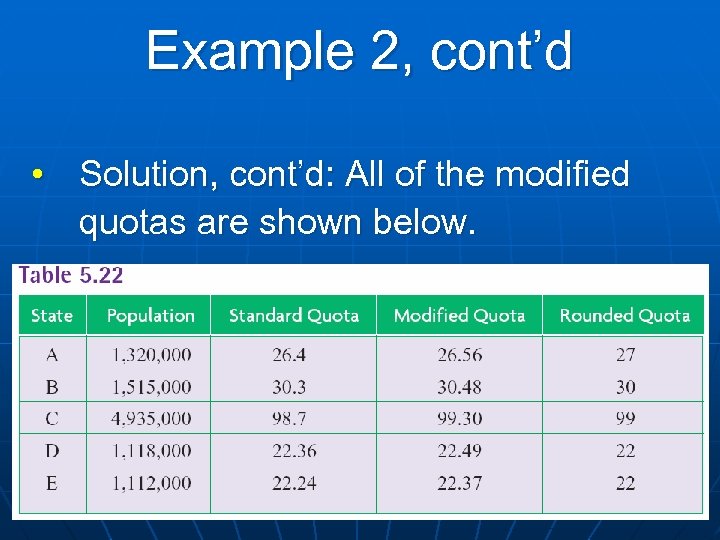 Example 2, cont’d • Solution, cont’d: All of the modified quotas are shown below.
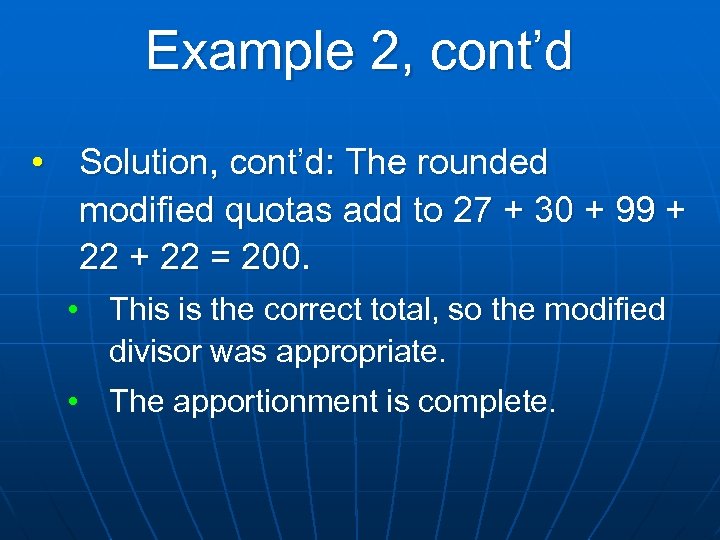 Example 2, cont’d • Solution, cont’d: The rounded modified quotas add to 27 + 30 + 99 + 22 = 200. • This is the correct total, so the modified divisor was appropriate. • The apportionment is complete.
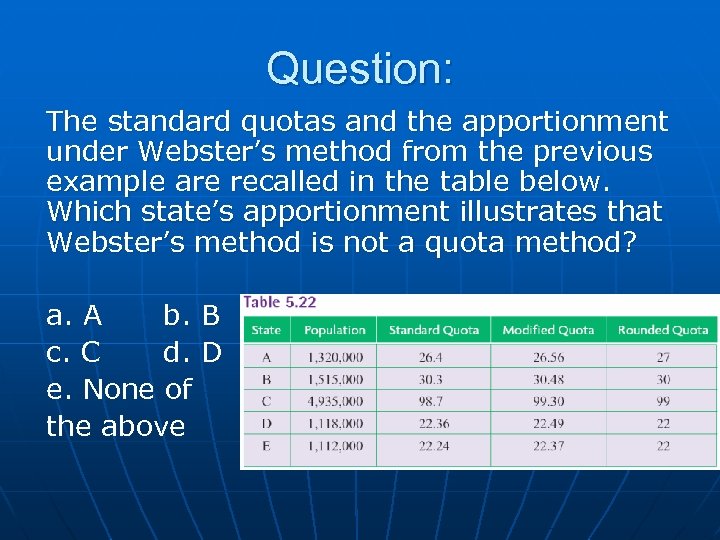 Question: The standard quotas and the apportionment under Webster’s method from the previous example are recalled in the table below. Which state’s apportionment illustrates that Webster’s method is not a quota method? a. A b. B c. C d. D e. None of the above
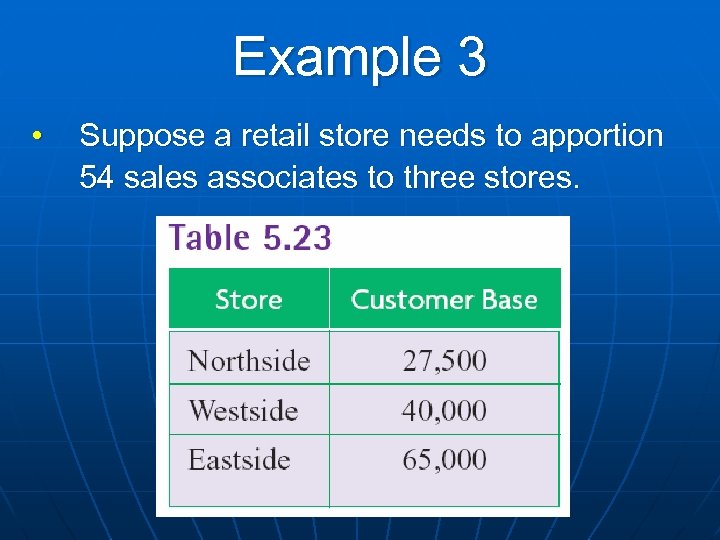 Example 3 • Suppose a retail store needs to apportion 54 sales associates to three stores.
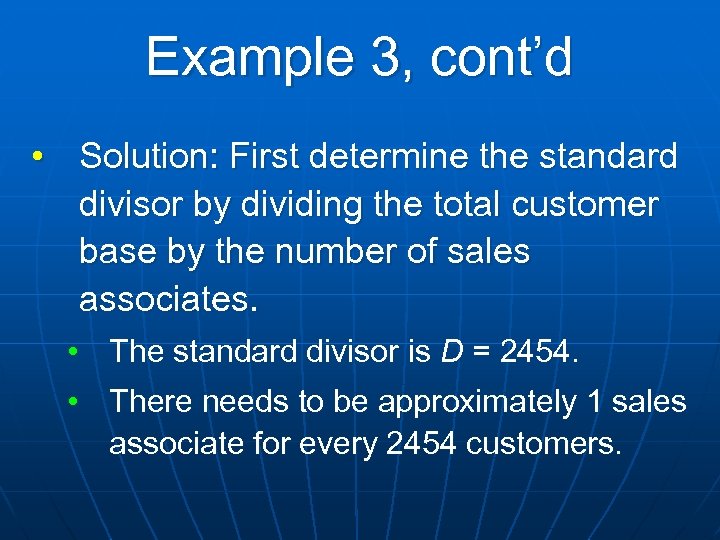 Example 3, cont’d • Solution: First determine the standard divisor by dividing the total customer base by the number of sales associates. • The standard divisor is D = 2454. • There needs to be approximately 1 sales associate for every 2454 customers.
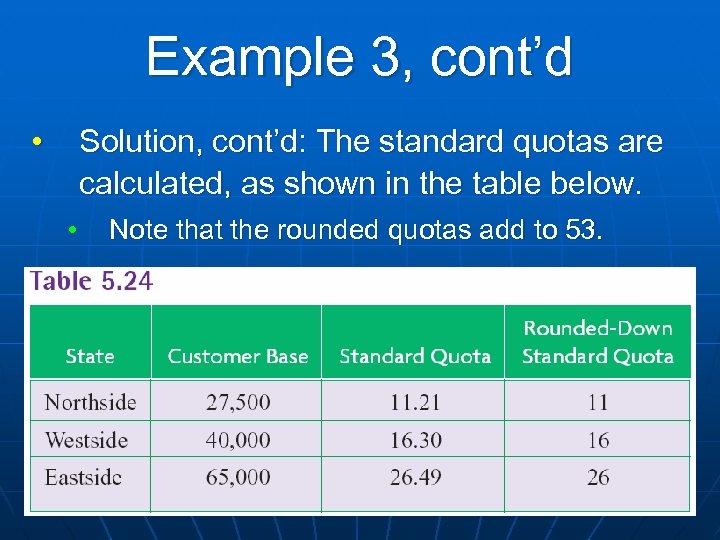 Example 3, cont’d • Solution, cont’d: The standard quotas are calculated, as shown in the table below. • Note that the rounded quotas add to 53.
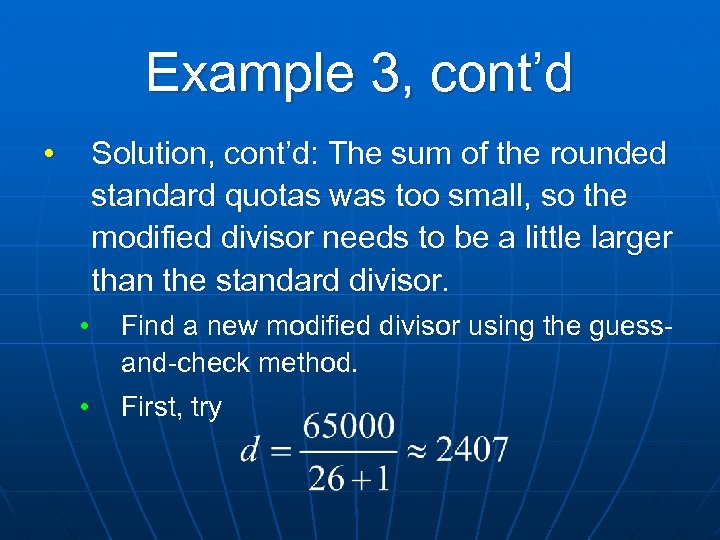 Example 3, cont’d • Solution, cont’d: The sum of the rounded standard quotas was too small, so the modified divisor needs to be a little larger than the standard divisor. • Find a new modified divisor using the guessand-check method. • First, try
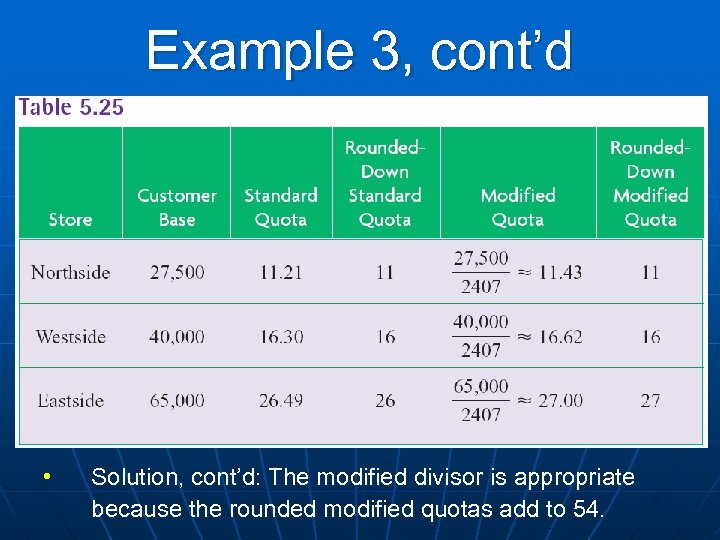 Example 3, cont’d • Solution, cont’d: The modified divisor is appropriate because the rounded modified quotas add to 54.
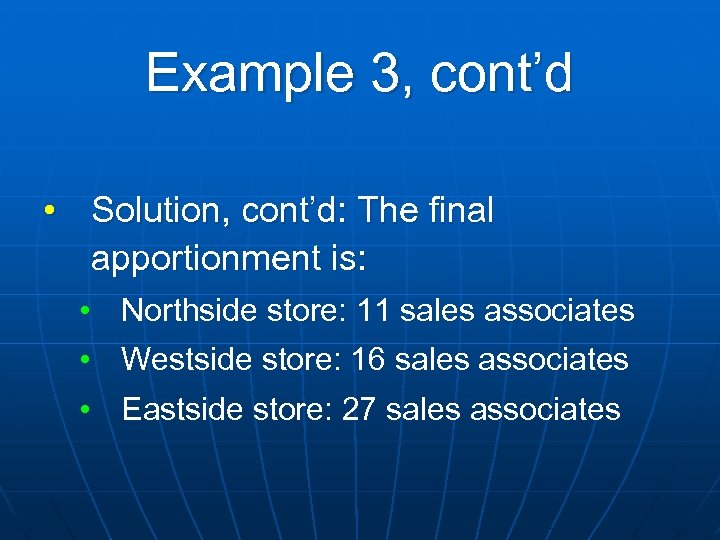 Example 3, cont’d • Solution, cont’d: The final apportionment is: • Northside store: 11 sales associates • Westside store: 16 sales associates • Eastside store: 27 sales associates
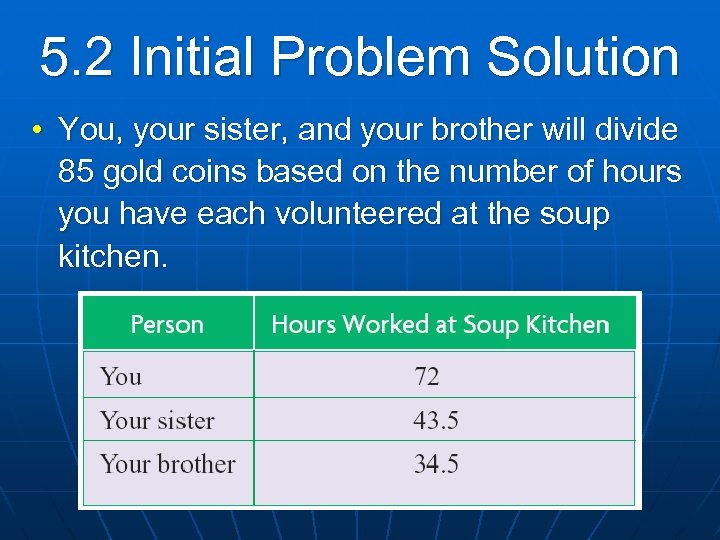 5. 2 Initial Problem Solution • You, your sister, and your brother will divide 85 gold coins based on the number of hours you have each volunteered at the soup kitchen.
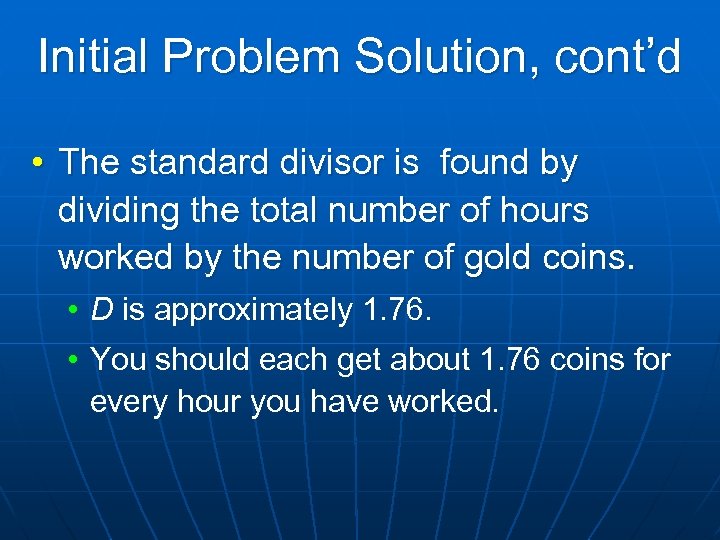 Initial Problem Solution, cont’d • The standard divisor is found by dividing the total number of hours worked by the number of gold coins. • D is approximately 1. 76. • You should each get about 1. 76 coins for every hour you have worked.
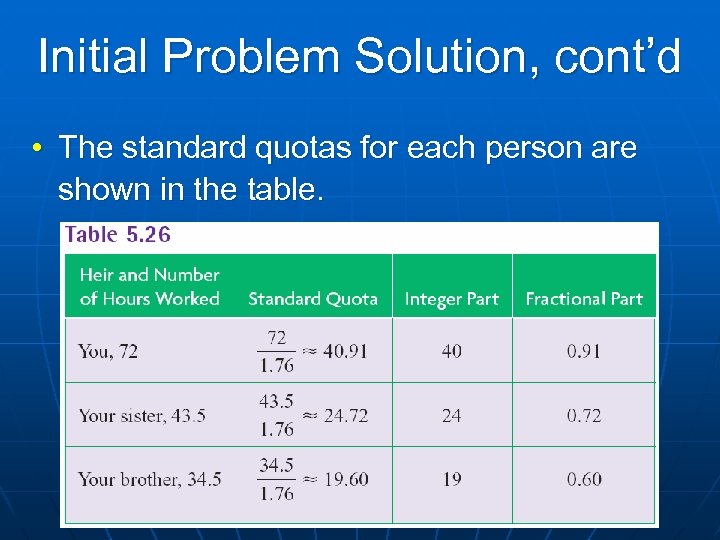 Initial Problem Solution, cont’d • The standard quotas for each person are shown in the table.
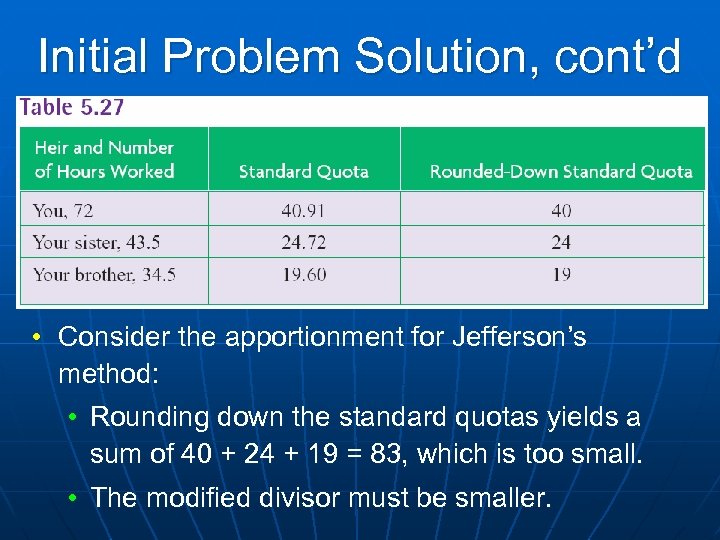 Initial Problem Solution, cont’d • Consider the apportionment for Jefferson’s method: • Rounding down the standard quotas yields a sum of 40 + 24 + 19 = 83, which is too small. • The modified divisor must be smaller.
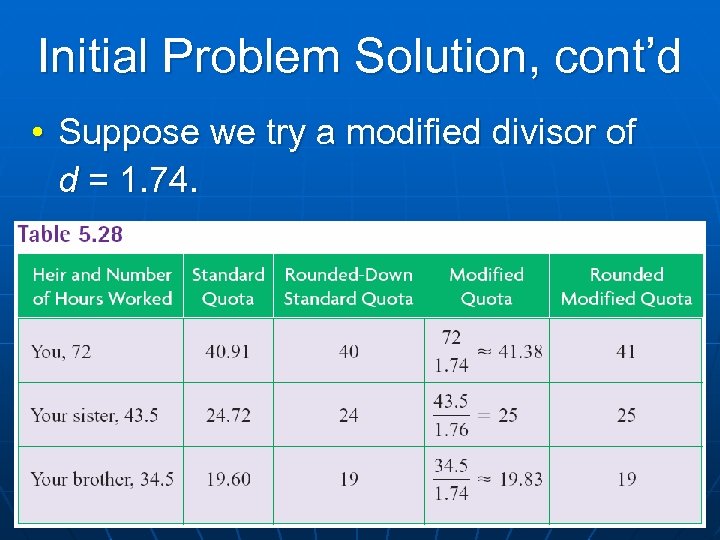 Initial Problem Solution, cont’d • Suppose we try a modified divisor of d = 1. 74.
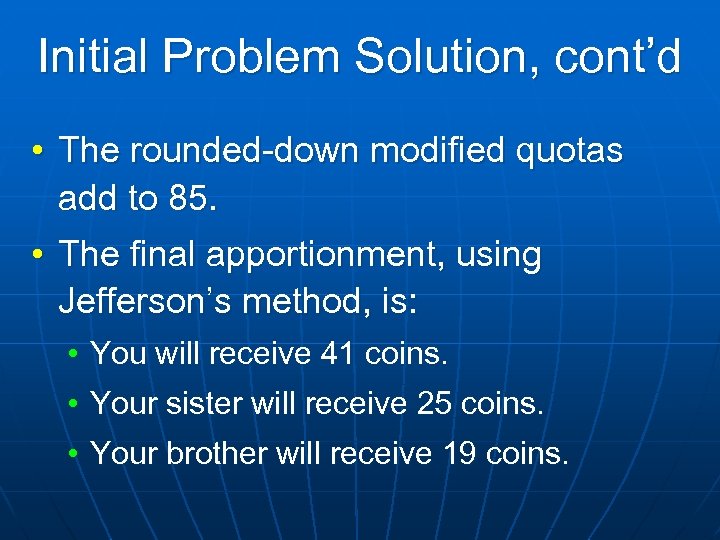 Initial Problem Solution, cont’d • The rounded-down modified quotas add to 85. • The final apportionment, using Jefferson’s method, is: • You will receive 41 coins. • Your sister will receive 25 coins. • Your brother will receive 19 coins.
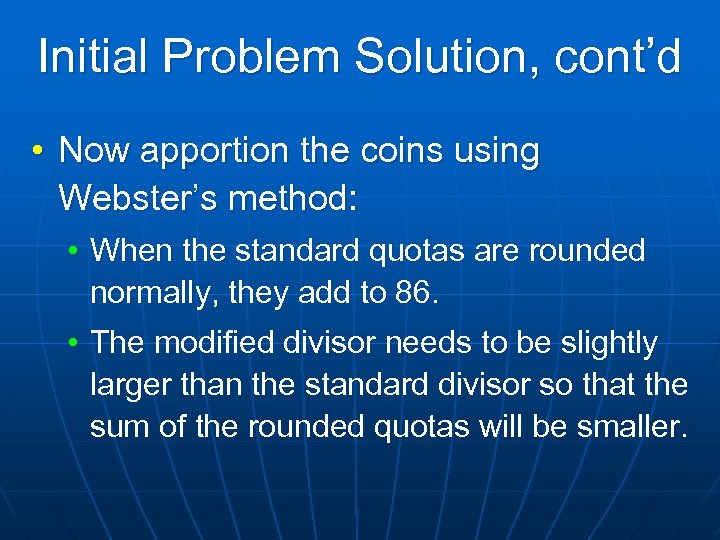 Initial Problem Solution, cont’d • Now apportion the coins using Webster’s method: • When the standard quotas are rounded normally, they add to 86. • The modified divisor needs to be slightly larger than the standard divisor so that the sum of the rounded quotas will be smaller.
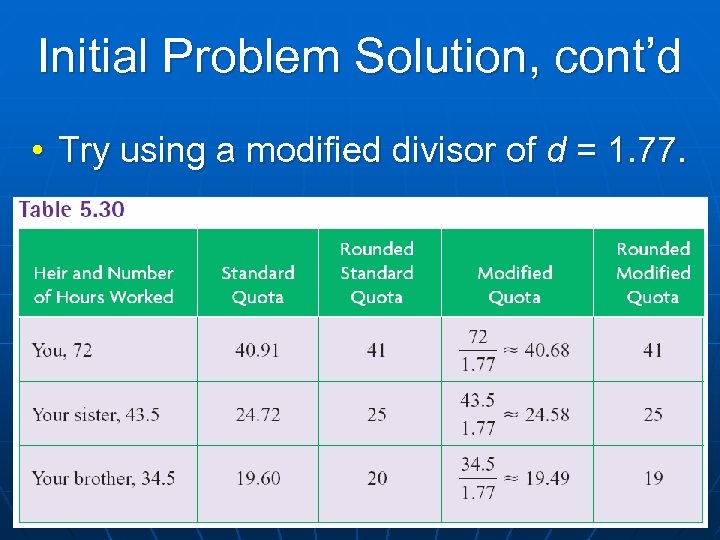 Initial Problem Solution, cont’d • Try using a modified divisor of d = 1. 77.
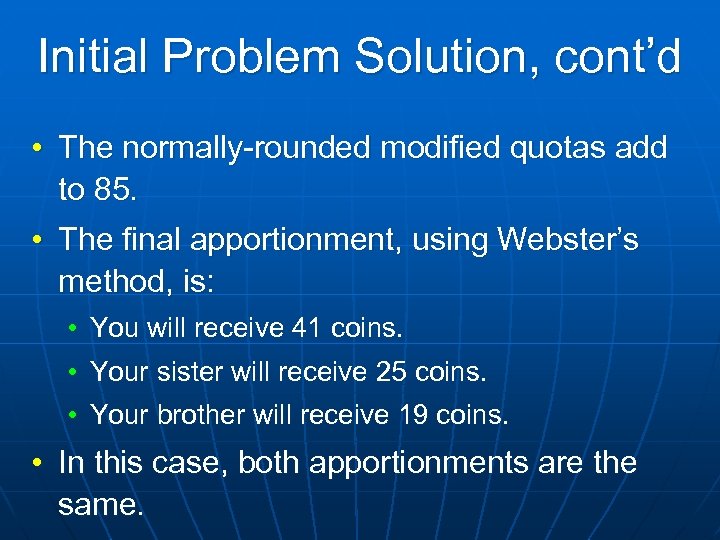 Initial Problem Solution, cont’d • The normally-rounded modified quotas add to 85. • The final apportionment, using Webster’s method, is: • You will receive 41 coins. • Your sister will receive 25 coins. • Your brother will receive 19 coins. • In this case, both apportionments are the same.
 Section 5. 3 Flaws of the Apportionment Methods • Goals • Study the Alabama paradox • Study the population paradox • Study the new-states paradox
 5. 3 Initial Problem • A total of 25 computers will be divided among the schools in a district. • Initially, your school is to receive 6 computers. • After the total number of computers increases to 26, it is discovered that your school will now only get 5 computers. • How is that possible? • The solution will be given at the end of the section.
 Apportionment Problems • No apportionment method is free of flaws. • Circumstances that can cause apportionment problems include: • A reapportionment based on population changes. • A change in the total number of seats. • The addition of one or more new states.
 The Quota Rule • Recall that the quota rule says that each state’s apportionment should be equal to the whole number just below or just above the state’s standard quota. • • Every quota method satisfies the quota rule. No divisor method can always satisfy the quota rule. • Both quota and divisor methods may have flaws.
 The Alabama Paradox • In 1880 it was discovered that if the number of seats in the House of Representatives was increased from 299 to 300 then Alabama would be apportioned one fewer seat than before, using Hamilton’s method. • The possibility that the addition of one legislative seat will cause a state to lose a seat is called the Alabama paradox.
 The Alabama Paradox, cont’d • When the total number of seats is increased, each standard quota must also increase. • For a state to lose a seat (under a quota method), the decrease must be due to a change from rounding up the state’s quota to rounding it down. • The lost seat must be apportioned to another state, so that state’s quota had to change from being rounded down to rounded up.
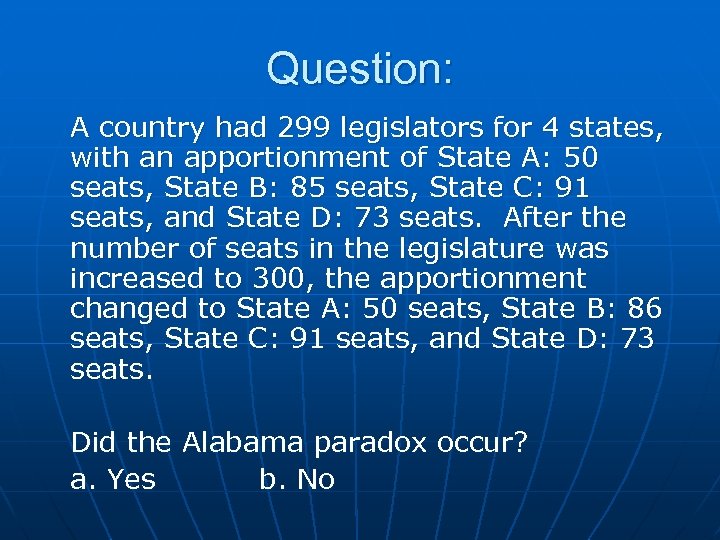 Question: A country had 299 legislators for 4 states, with an apportionment of State A: 50 seats, State B: 85 seats, State C: 91 seats, and State D: 73 seats. After the number of seats in the legislature was increased to 300, the apportionment changed to State A: 50 seats, State B: 86 seats, State C: 91 seats, and State D: 73 seats. Did the Alabama paradox occur? a. Yes b. No
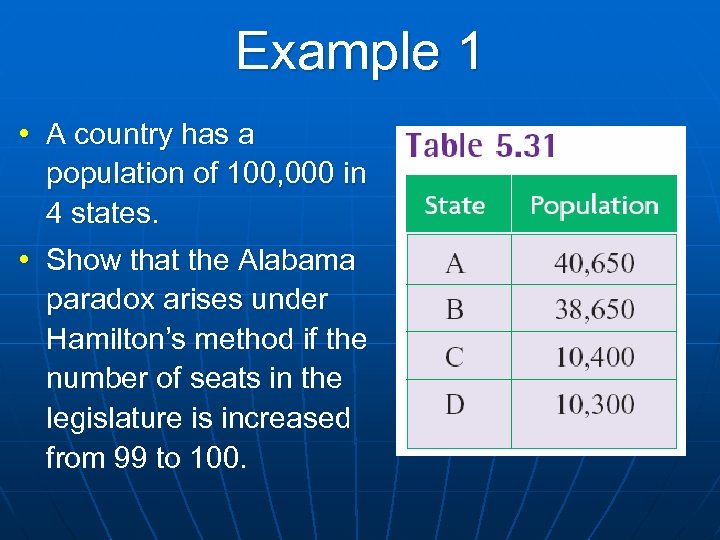 Example 1 • A country has a population of 100, 000 in 4 states. • Show that the Alabama paradox arises under Hamilton’s method if the number of seats in the legislature is increased from 99 to 100.
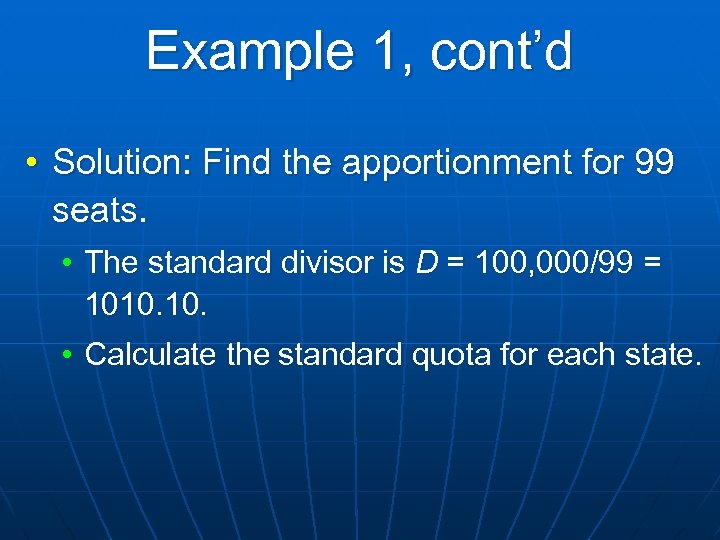 Example 1, cont’d • Solution: Find the apportionment for 99 seats. • The standard divisor is D = 100, 000/99 = 1010. • Calculate the standard quota for each state.
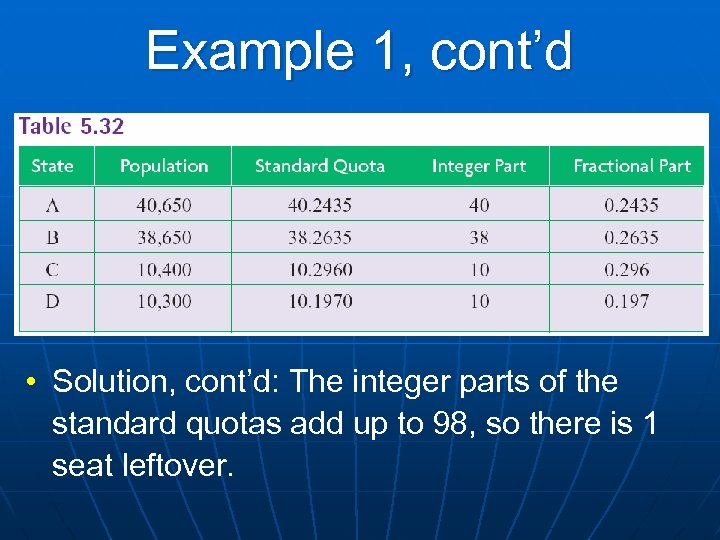 Example 1, cont’d • Solution, cont’d: The integer parts of the standard quotas add up to 98, so there is 1 seat leftover.
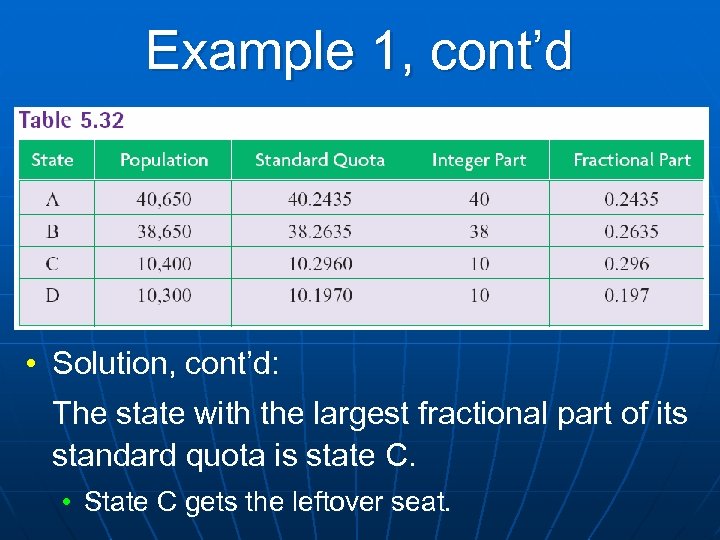 Example 1, cont’d • Solution, cont’d: The state with the largest fractional part of its standard quota is state C. • State C gets the leftover seat.
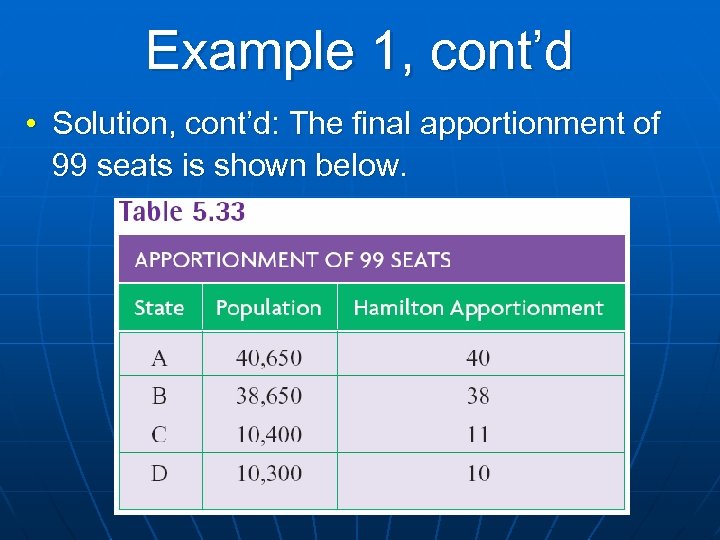 Example 1, cont’d • Solution, cont’d: The final apportionment of 99 seats is shown below.
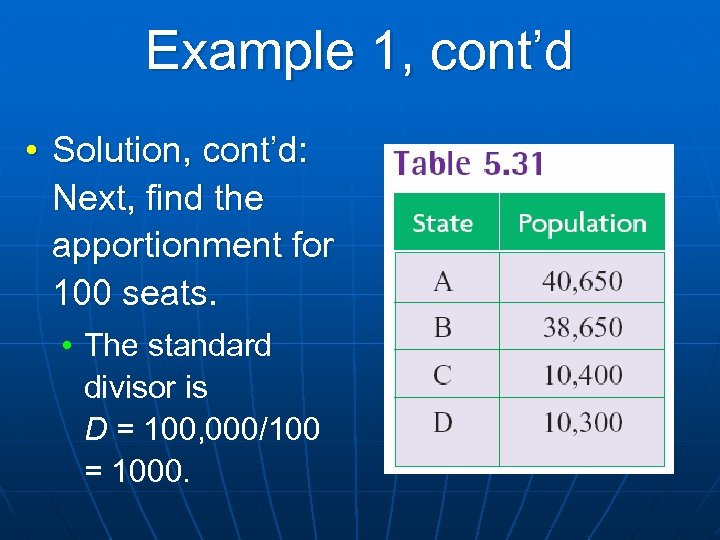 Example 1, cont’d • Solution, cont’d: Next, find the apportionment for 100 seats. • The standard divisor is D = 100, 000/100 = 1000.
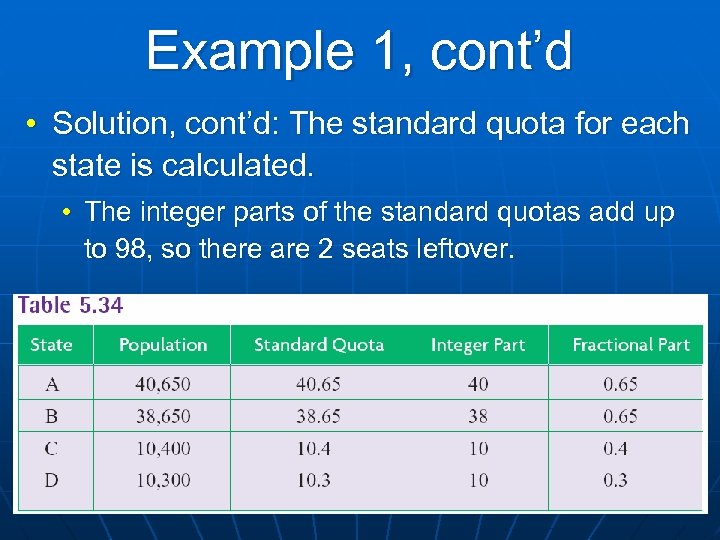 Example 1, cont’d • Solution, cont’d: The standard quota for each state is calculated. • The integer parts of the standard quotas add up to 98, so there are 2 seats leftover.
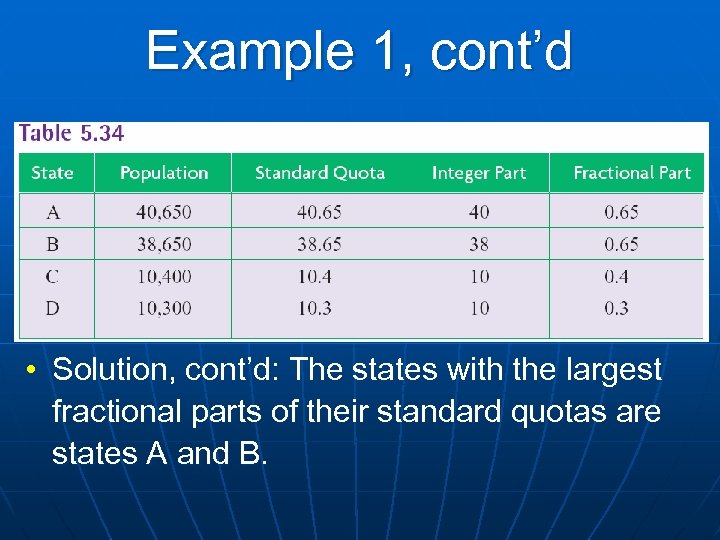 Example 1, cont’d • Solution, cont’d: The states with the largest fractional parts of their standard quotas are states A and B.
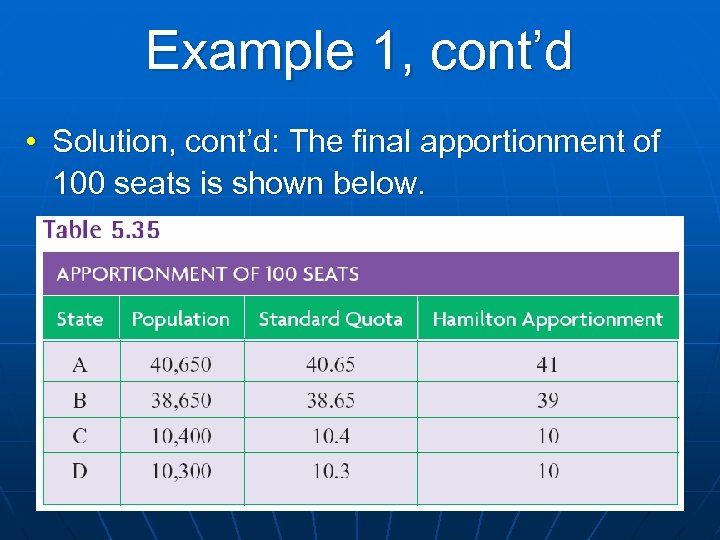 Example 1, cont’d • Solution, cont’d: The final apportionment of 100 seats is shown below.
 Example 1, cont’d • Solution, cont’d: Note that state C had 11 seats in the first apportionment, but only 10 seats in the second apportionment. • The bigger states, A and B, have benefited at the expense of the smaller state C. • This is an example of the Alabama paradox.
 Population Paradox • The population paradox can occur when the population in two states increases. • The legislature is reapportioned based on a new census and a seat is switched from one state to the other. • The paradox occurs when the fastergrowing state is the one that loses the seat.
 Question: A census shows that State A is growing at a rate of 2%, State B at a rate of 0%, and State C at a rate of 3. 5%. The previous apportionment was State A: 38 seats, State B: 52 seats, and State C: 60 seats. The new apportionment after the census was State A: 39 seats, State B: 52 seats, and State C: 59 seats. Did the population paradox occur? a. Yes b. No
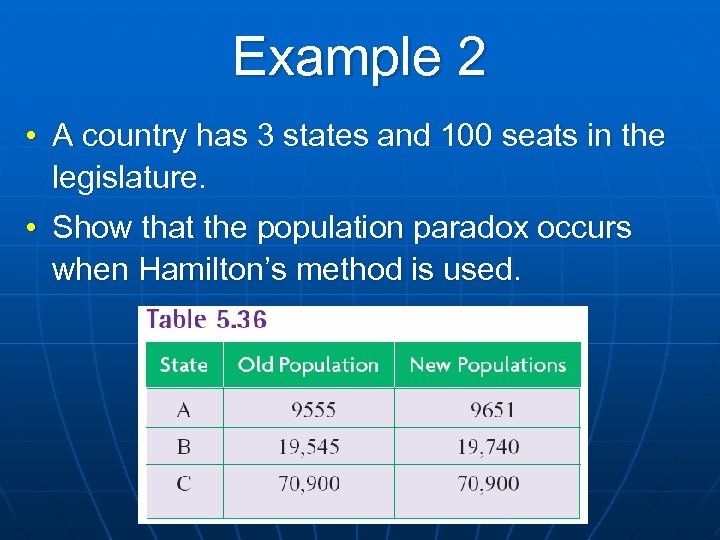 Example 2 • A country has 3 states and 100 seats in the legislature. • Show that the population paradox occurs when Hamilton’s method is used.
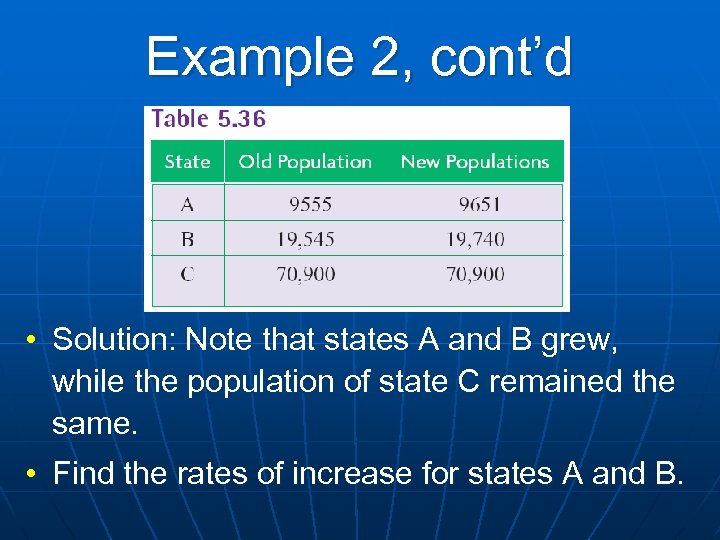 Example 2, cont’d • Solution: Note that states A and B grew, while the population of state C remained the same. • Find the rates of increase for states A and B.
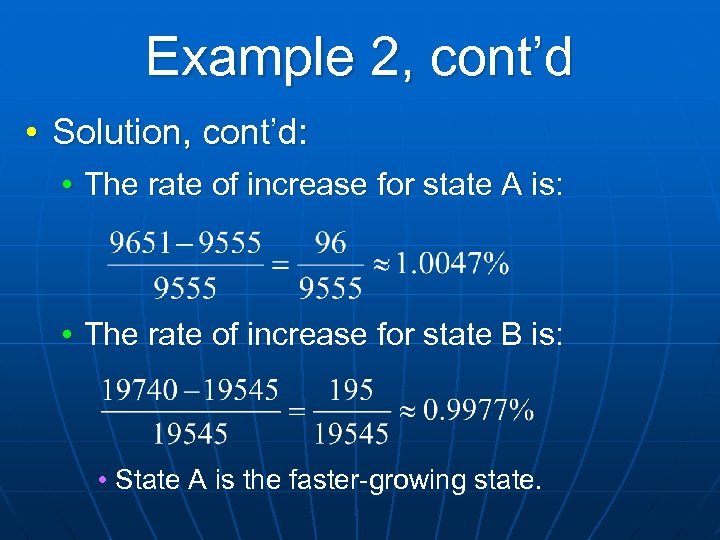 Example 2, cont’d • Solution, cont’d: • The rate of increase for state A is: • The rate of increase for state B is: • State A is the faster-growing state.
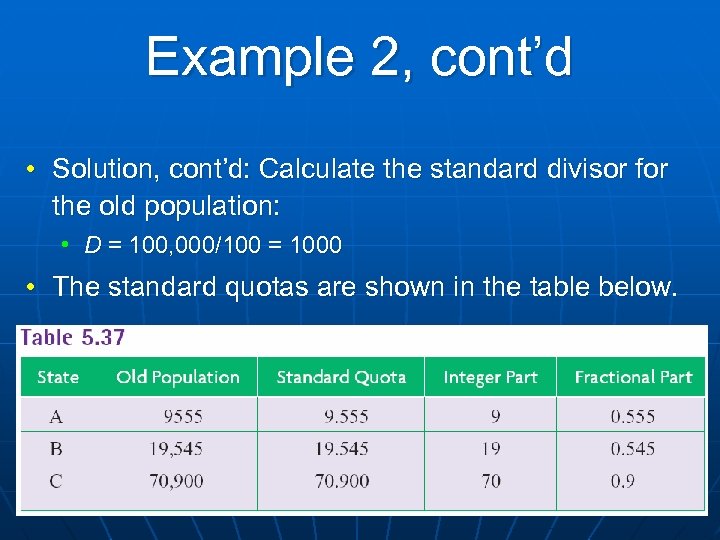 Example 2, cont’d • Solution, cont’d: Calculate the standard divisor for the old population: • D = 100, 000/100 = 1000 • The standard quotas are shown in the table below.
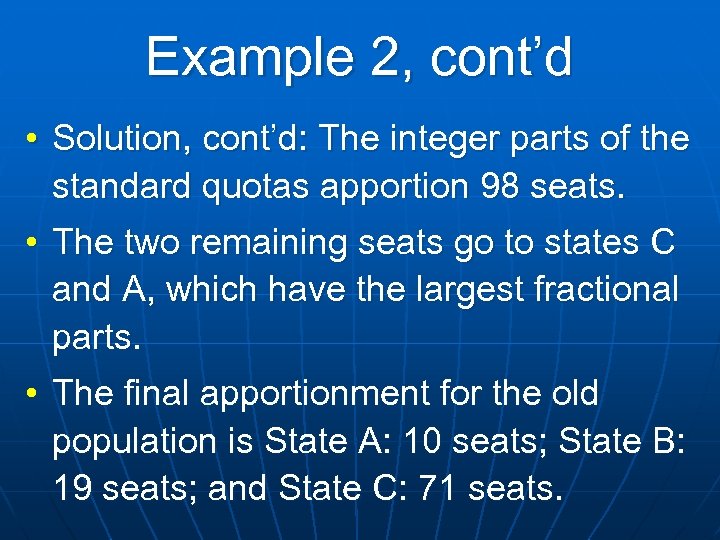 Example 2, cont’d • Solution, cont’d: The integer parts of the standard quotas apportion 98 seats. • The two remaining seats go to states C and A, which have the largest fractional parts. • The final apportionment for the old population is State A: 10 seats; State B: 19 seats; and State C: 71 seats.
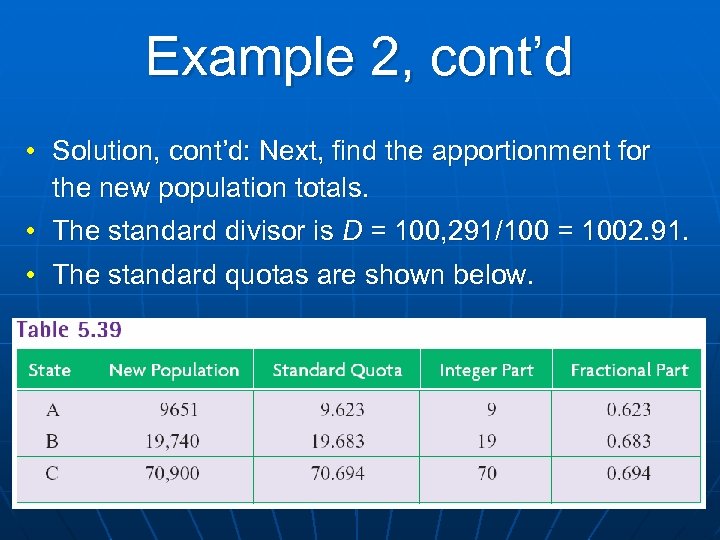 Example 2, cont’d • Solution, cont’d: Next, find the apportionment for the new population totals. • The standard divisor is D = 100, 291/100 = 1002. 91. • The standard quotas are shown below.
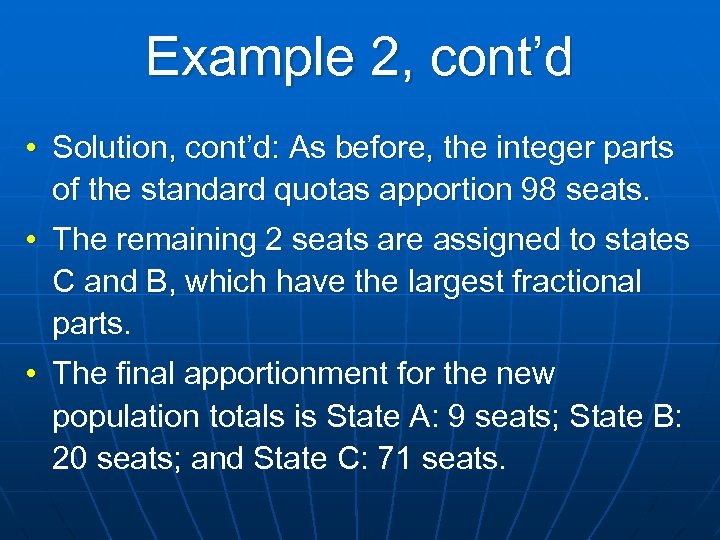 Example 2, cont’d • Solution, cont’d: As before, the integer parts of the standard quotas apportion 98 seats. • The remaining 2 seats are assigned to states C and B, which have the largest fractional parts. • The final apportionment for the new population totals is State A: 9 seats; State B: 20 seats; and State C: 71 seats.
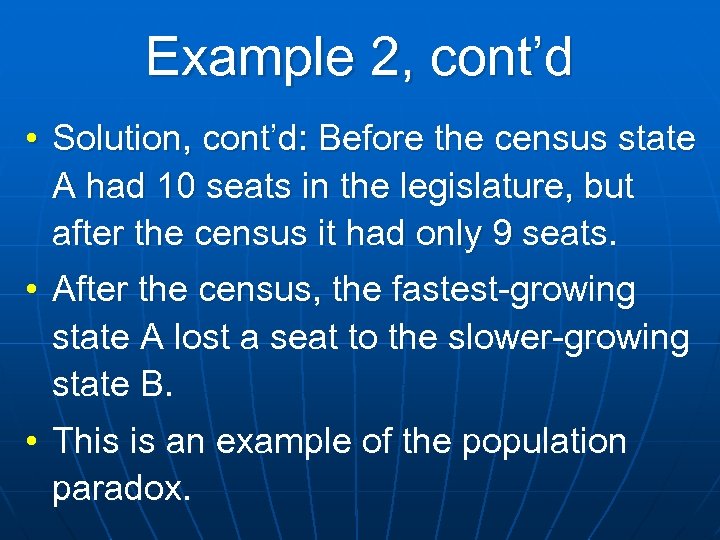 Example 2, cont’d • Solution, cont’d: Before the census state A had 10 seats in the legislature, but after the census it had only 9 seats. • After the census, the fastest-growing state A lost a seat to the slower-growing state B. • This is an example of the population paradox.
 New States Paradox • If a new state is added to a country, then how many seats must be added to the legislature? • A reasonable number of seats would seem to be the integer part of the new state’s standard quota. • The new-states paradox occurs when a recalculation of the apportionment results in a change of the apportionment of some of the other states, not the new state.
 Question: A fourth state was just added to a country. The previous apportionment was State A: 48 seats, State B: 52 seats, and State C: 50 seats. The new apportionment after State D was added is State A: 49 seats, State B: 51 seats, State C: 50 seats, and State D: 29 seats. Did the new-states paradox occur? a. Yes b. No
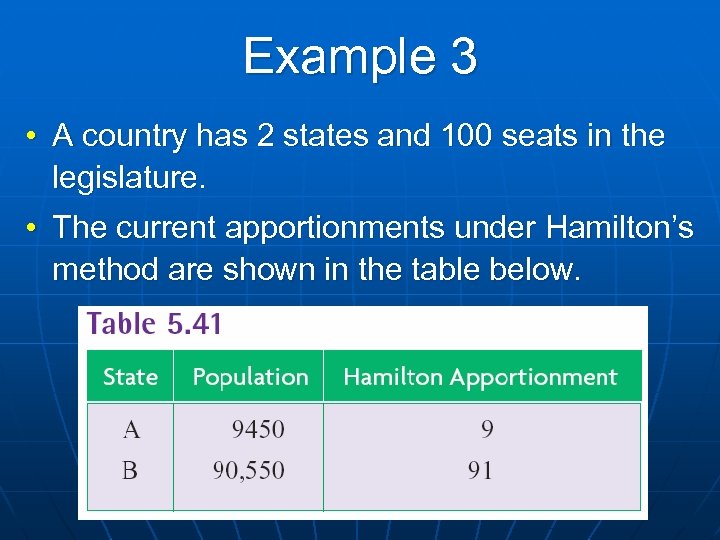 Example 3 • A country has 2 states and 100 seats in the legislature. • The current apportionments under Hamilton’s method are shown in the table below.
 Example 3, cont’d • Show that if a third state with a population of 10, 400 is added, the new-states paradox occurs. • Solution: Since the old standard divisor was 1000, the new state’s standard quota would have been Q = 10, 400/1000 = 10. 4. • We assume that 10 new seats should be added to the legislature. • A total of 110 seats will now be apportioned to the 3 states.
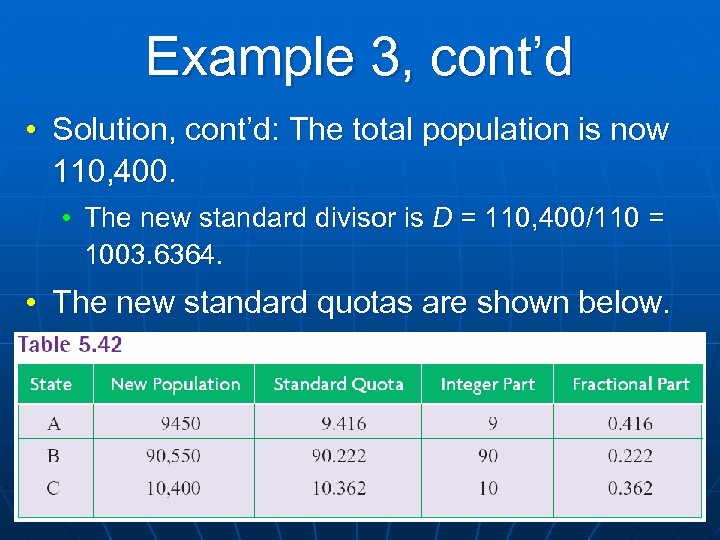 Example 3, cont’d • Solution, cont’d: The total population is now 110, 400. • The new standard divisor is D = 110, 400/110 = 1003. 6364. • The new standard quotas are shown below.
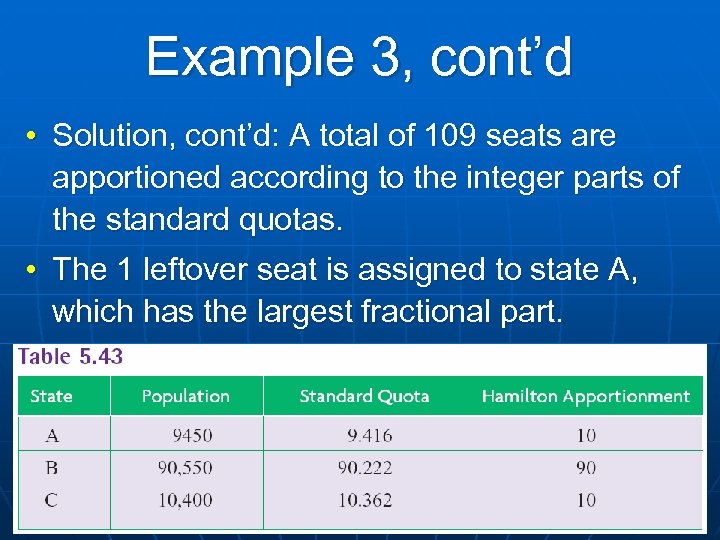 Example 3, cont’d • Solution, cont’d: A total of 109 seats are apportioned according to the integer parts of the standard quotas. • The 1 leftover seat is assigned to state A, which has the largest fractional part.
 Example 3, cont’d • Solution, cont’d: After the new state, C, was added: • State C received 10 seats, as expected. • State A lost a seat to State B. • The change in apportionment among the old states is an example of the newstates paradox.
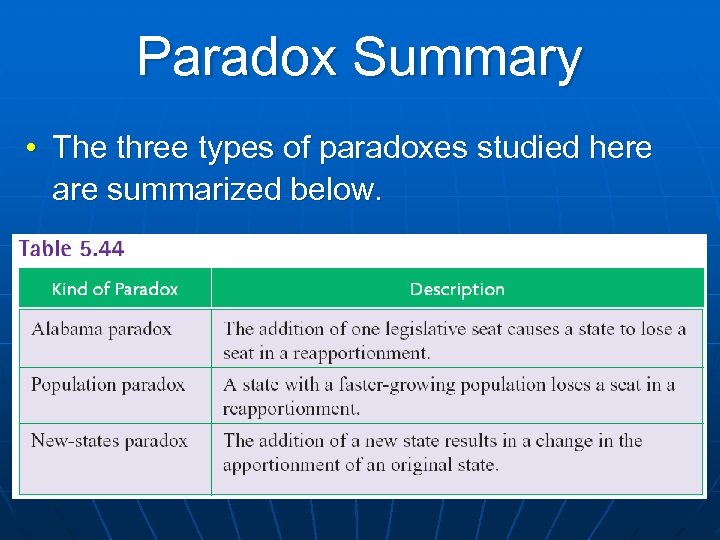 Paradox Summary • The three types of paradoxes studied here are summarized below.
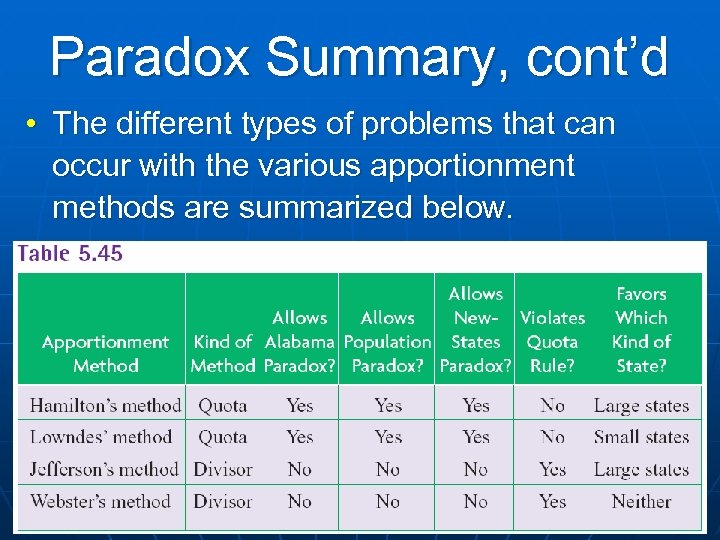 Paradox Summary, cont’d • The different types of problems that can occur with the various apportionment methods are summarized below.
 Paradox Summary, cont’d • As seen in the table, all 4 apportionment methods either violate the quota rule or allow paradoxes to occur. • Mathematicians Michel L. Balinski and H. Peyton Young proved there is no apportionment method that obeys the quota rule and always avoids the three paradoxes.
 5. 3 Initial Problem Solution • When the district was getting 25 computers, your school would get 6 of them. • Now that the district will get 26 computers, but your school will only get 5. • How is this possible?
 Initial Problem Solution, cont’d • Without more information, we cannot check the mathematics behind the apportionment. • However, this situation is possible. • Your school losing 1 computer after the total number of computers increased is an example of the Alabama paradox. • This can occur if the district uses Hamilton’s or Lowndes’ method to apportion the computers.