


 Скачать презентацию A Market Assessment of Residential Grid-Tied PV Systems
f0138ed5ec349e1e286c121b1ad8a5a1.ppt
- Количество слайдов: 44
 A Market Assessment of Residential Grid-Tied PV Systems in Colorado NREL Technical Report, Sept. 2000 by Barbara C. Farhar, Ph. D. Timothy C. Coburn, Ph. D. Summarized by Pamela Quigley
 Study Objective • To develop estimates of the size of the Grid-Tied Photovoltaic (GPV) market among Colorado homeowners • Identify • PV benefits • Barriers to adoption • Information needs & sources • Desired PV attributes • Market Segmentation & Size
 Research Approach • Use knowledge gained in prior qualitative study • 120? open ended face-to-face interviews with self-nominated parties conducted between 199 x – 199 x • Purpose to identify 50 homeowners willing to pay $8, 000 -12, 000 for 2 - or 3 -k. W GPV systems ($4/watt by homeowner) • Subsidized by federal grant • Results published “Public Response to Residential Grid-Tied PV Systems in Colorado: A Qualitative Market Assessment” – Farhar & Buhrmann, 1998
 Research Approach • Mailed 6, 088 surveys to single-family Colorado homeowners in 1998* • 3001 responses; response rate 60% • Assumed most homeowners knew little about GPV systems • GPV not available in CO at time of survey • Designed to permit categorization of respondents into stages of adoption process *Near as I can tell
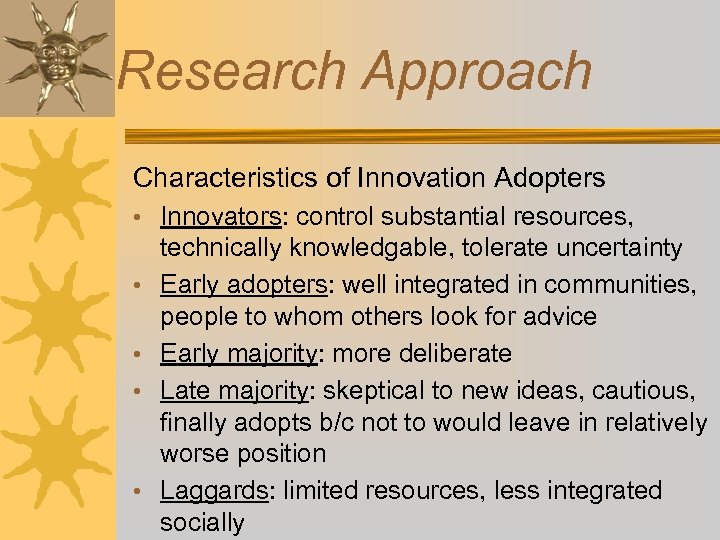 Research Approach Characteristics of Innovation Adopters • Innovators: control substantial resources, • • technically knowledgable, tolerate uncertainty Early adopters: well integrated in communities, people to whom others look for advice Early majority: more deliberate Late majority: skeptical to new ideas, cautious, finally adopts b/c not to would leave in relatively worse position Laggards: limited resources, less integrated socially
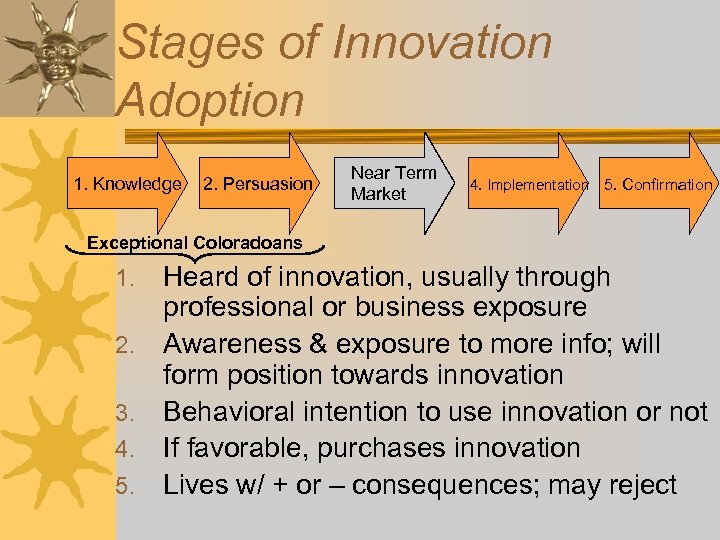 Stages of Innovation Adoption 1. Knowledge 2. Persuasion Near Term 3. Decision Market 4. Implementation 5. Confirmation Exceptional Coloradoans 1. 2. 3. 4. 5. Heard of innovation, usually through professional or business exposure Awareness & exposure to more info; will form position towards innovation Behavioral intention to use innovation or not If favorable, purchases innovation Lives w/ + or – consequences; may reject
 Dependent Variables • Favorability to GPV • System size / price tradeoffs • Willingness to pay for GPV • Behavioral intention
 Independent Variables • Perceived relative advantage of PV • Rated importance of 23 perceived benefits • Perceived fuel source in CO • Perceived feasibility of GPV • Rated importance of 21 product attributes • Preferred payment methods • Preferred source of GPV • Knowledge • Familiarity of GPV; Knowledge to make decision
 Independent Variables • Information • Importance of 15 information needs • Importance of 24 information sources • Policy Preferences • Subsidy preference & how to pay • Compatible lifestyle & values • Environmental values • Early adopter characteristics • Also collected demographics
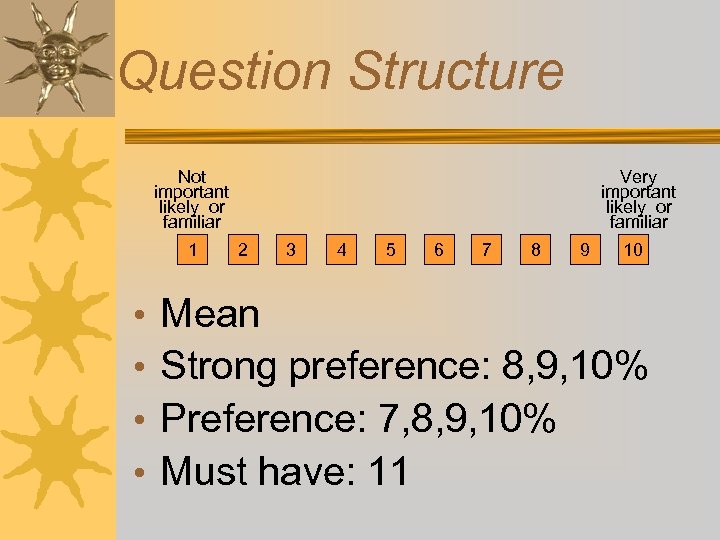 Question Structure Not important likely or familiar 1 Very important likely or familiar 2 3 4 5 6 7 8 9 10 • Mean • Strong preference: 8, 9, 10% • Preference: 7, 8, 9, 10% • Must have: 11
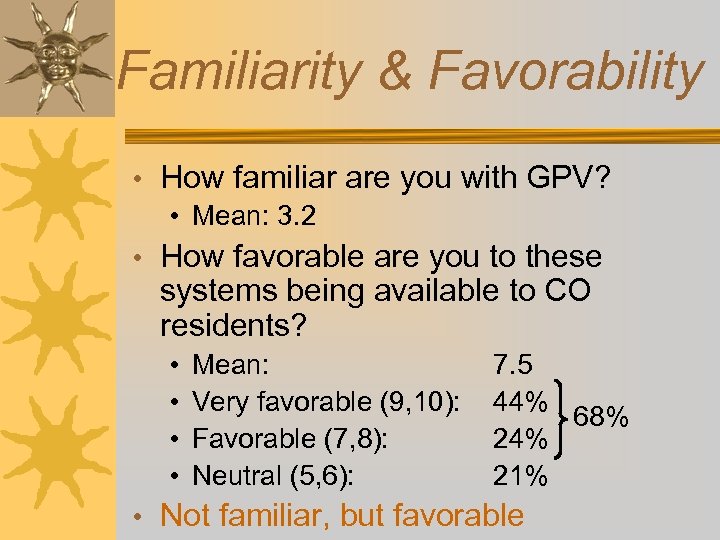 Familiarity & Favorability • How familiar are you with GPV? • Mean: 3. 2 • How favorable are you to these systems being available to CO residents? • • Mean: Very favorable (9, 10): Favorable (7, 8): Neutral (5, 6): 7. 5 44% 68% 24% 21% • Not familiar, but favorable
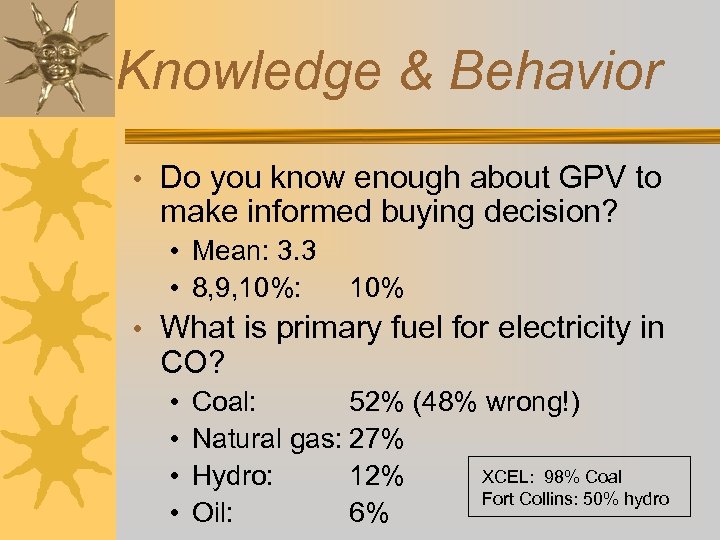 Knowledge & Behavior • Do you know enough about GPV to make informed buying decision? • Mean: 3. 3 • 8, 9, 10%: 10% • What is primary fuel for electricity in CO? • • Coal: 52% (48% wrong!) Natural gas: 27% XCEL: 98% Coal Hydro: 12% Fort Collins: 50% hydro Oil: 6%
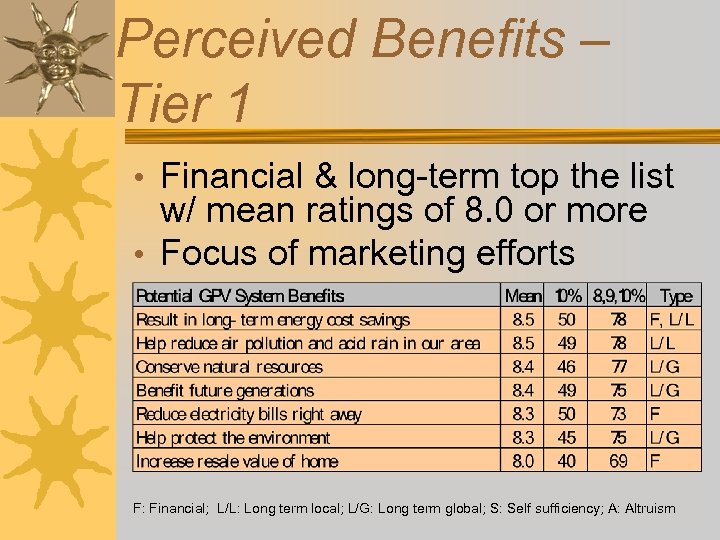 Perceived Benefits – Tier 1 • Financial & long-term top the list w/ mean ratings of 8. 0 or more • Focus of marketing efforts F: Financial; L/L: Long term local; L/G: Long term global; S: Self sufficiency; A: Altruism
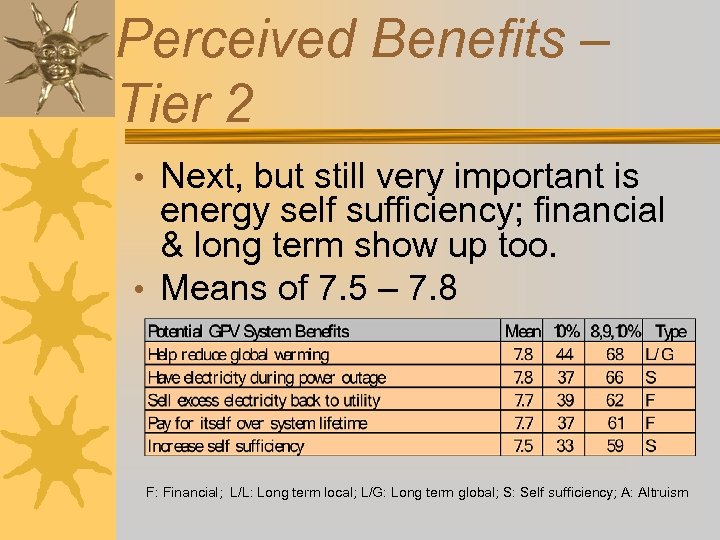 Perceived Benefits – Tier 2 • Next, but still very important is energy self sufficiency; financial & long term show up too. • Means of 7. 5 – 7. 8 F: Financial; L/L: Long term local; L/G: Long term global; S: Self sufficiency; A: Altruism
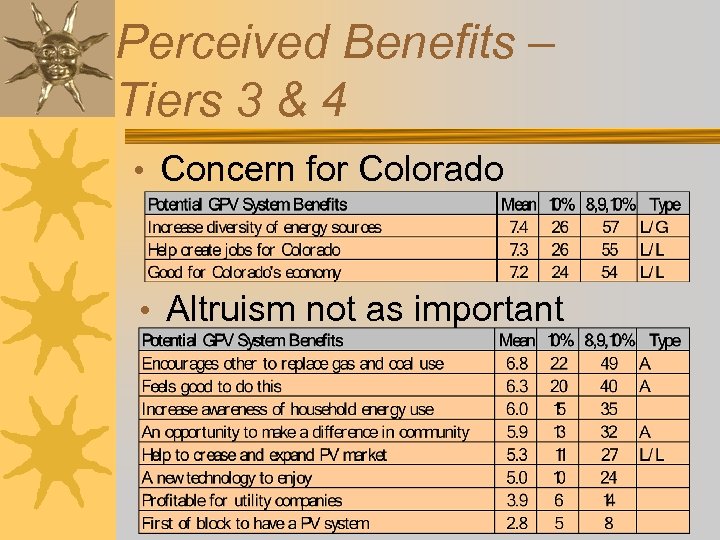 Perceived Benefits – Tiers 3 & 4 • Concern for Colorado • Altruism not as important
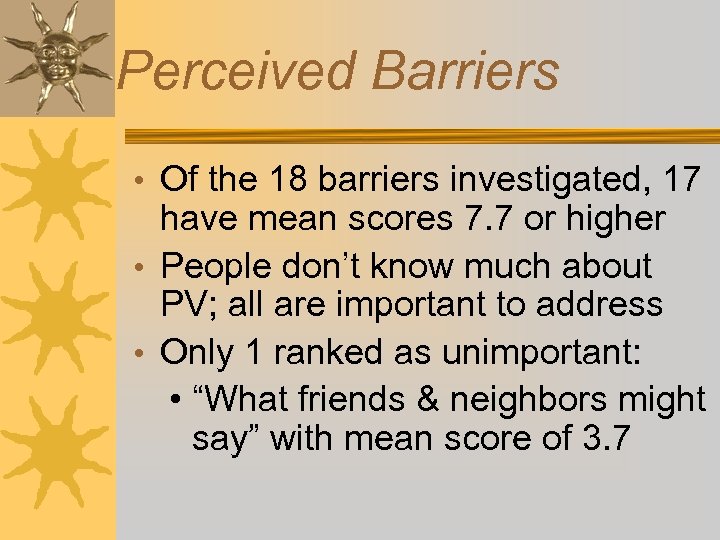 Perceived Barriers • Of the 18 barriers investigated, 17 have mean scores 7. 7 or higher • People don’t know much about PV; all are important to address • Only 1 ranked as unimportant: • “What friends & neighbors might say” with mean score of 3. 7
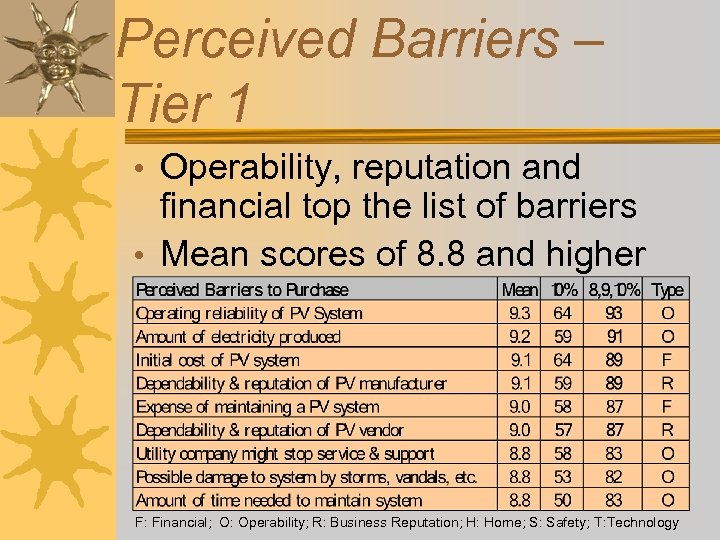 Perceived Barriers – Tier 1 • Operability, reputation and financial top the list of barriers • Mean scores of 8. 8 and higher F: Financial; O: Operability; R: Business Reputation; H: Home; S: Safety; T: Technology
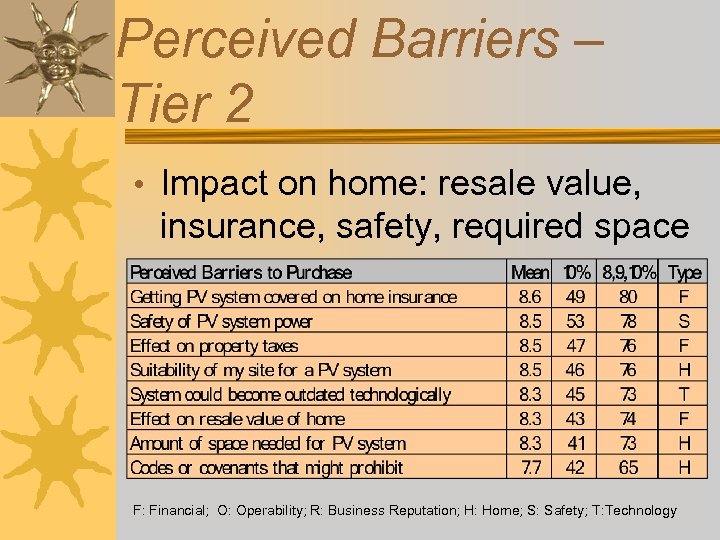 Perceived Barriers – Tier 2 • Impact on home: resale value, insurance, safety, required space F: Financial; O: Operability; R: Business Reputation; H: Home; S: Safety; T: Technology
 Information Needs • All 15 information needs investigated ranked as important with mean scores 7. 0 and higher • Again, indicates that people are unfamiliar
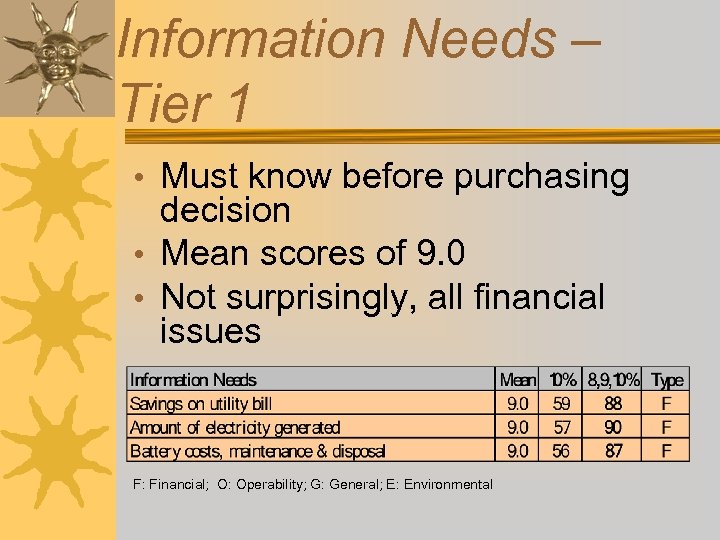 Information Needs – Tier 1 • Must know before purchasing decision • Mean scores of 9. 0 • Not surprisingly, all financial issues F: Financial; O: Operability; G: General; E: Environmental
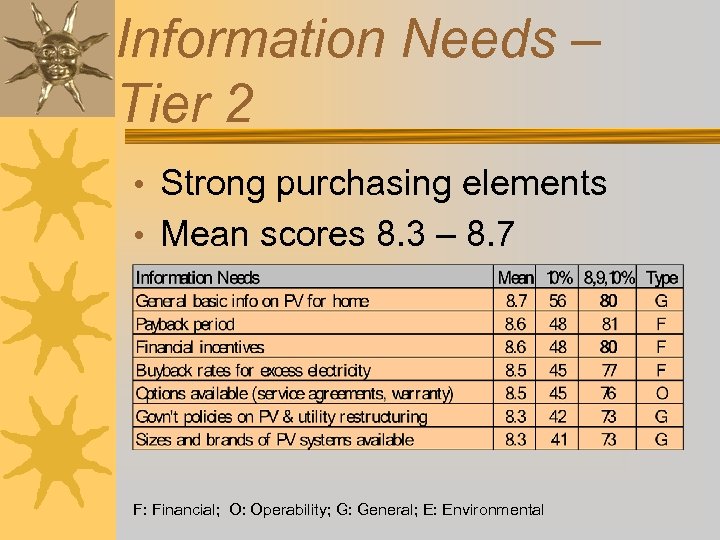 Information Needs – Tier 2 • Strong purchasing elements • Mean scores 8. 3 – 8. 7 F: Financial; O: Operability; G: General; E: Environmental
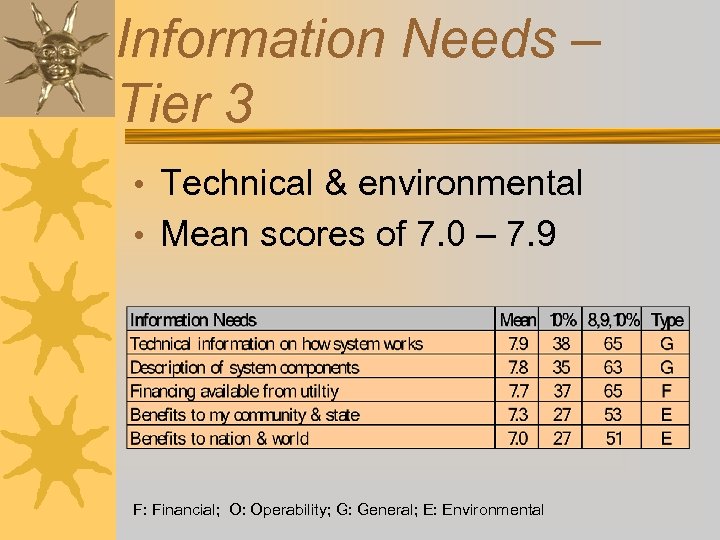 Information Needs – Tier 3 • Technical & environmental • Mean scores of 7. 0 – 7. 9 F: Financial; O: Operability; G: General; E: Environmental
 Information Sources • No single “go to” source • Highest mean score of 6. 9 indicates people are either: • Unsure who has reliable info • Not likely to be seeking more info • People want to see it themselves • Utility ranked 2 nd! • Government agencies ranked low
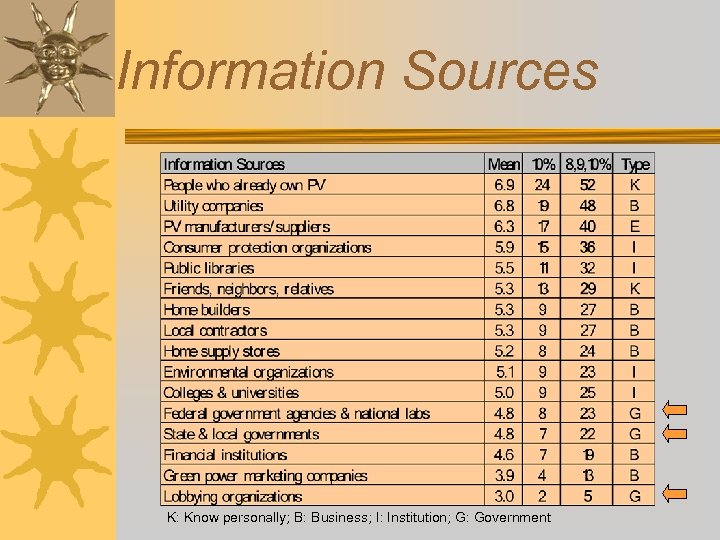 Information Sources K: Know personally; B: Business; I: Institution; G: Government
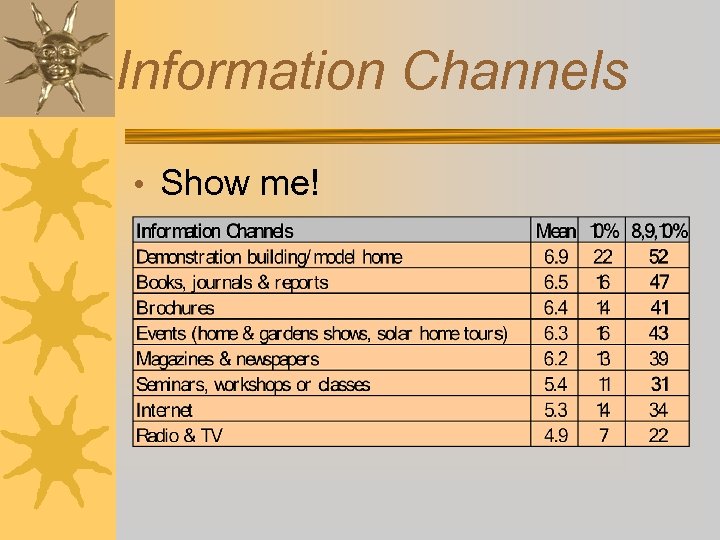 Information Channels • Show me!
 Preferred System Features • Investigated 21 features • Identified some ‘must haves’
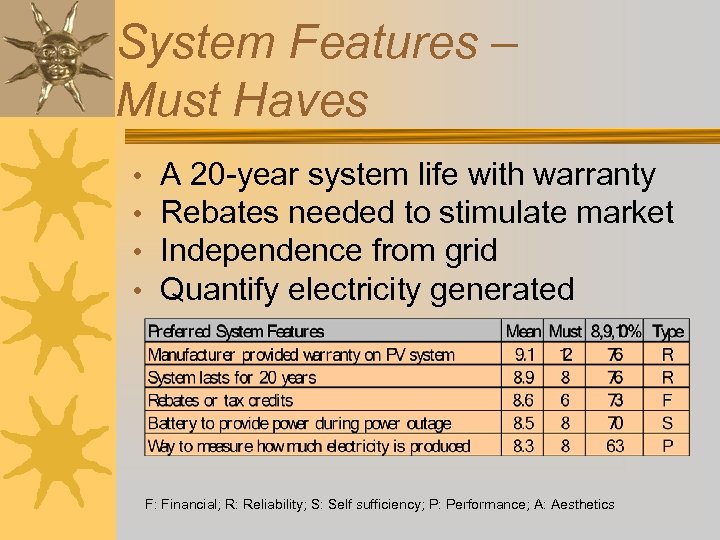 System Features – Must Haves • • A 20 -year system life with warranty Rebates needed to stimulate market Independence from grid Quantify electricity generated F: Financial; R: Reliability; S: Self sufficiency; P: Performance; A: Aesthetics
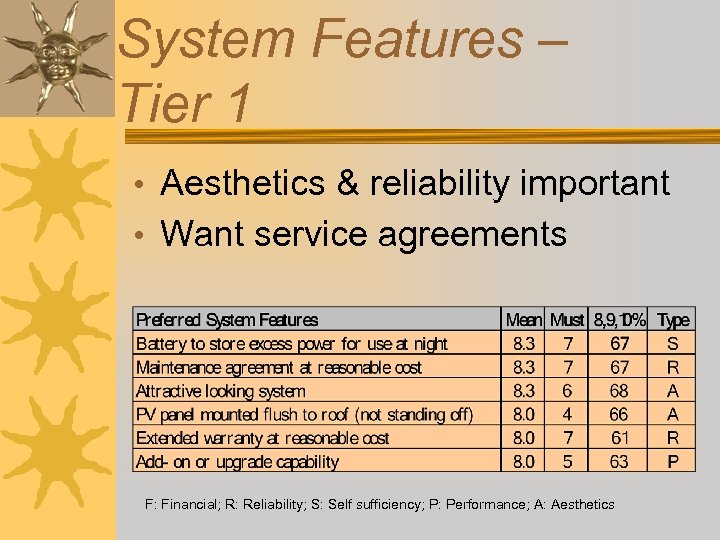 System Features – Tier 1 • Aesthetics & reliability important • Want service agreements F: Financial; R: Reliability; S: Self sufficiency; P: Performance; A: Aesthetics
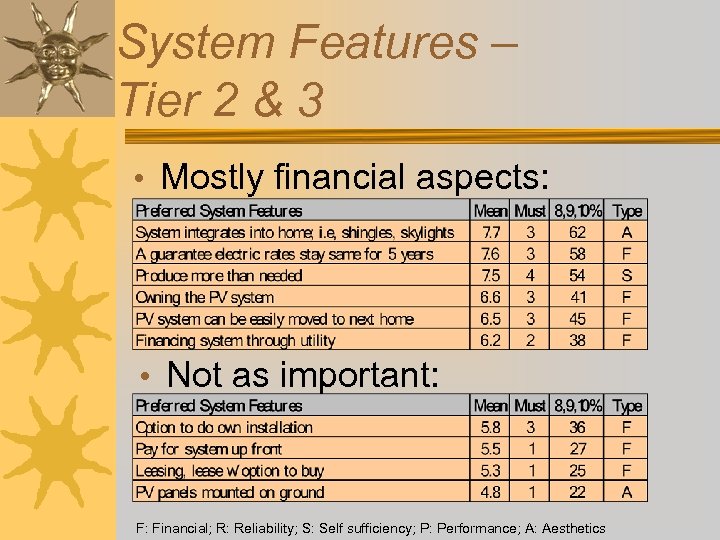 System Features – Tier 2 & 3 • Mostly financial aspects: • Not as important: F: Financial; R: Reliability; S: Self sufficiency; P: Performance; A: Aesthetics
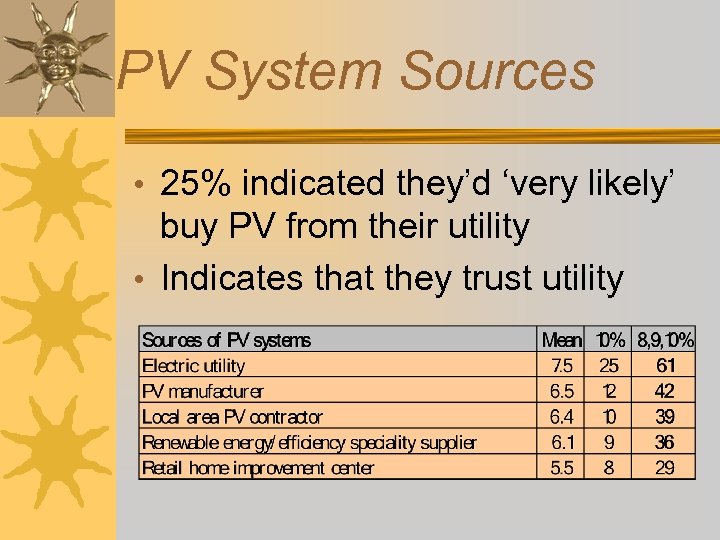 PV System Sources • 25% indicated they’d ‘very likely’ buy PV from their utility • Indicates that they trust utility
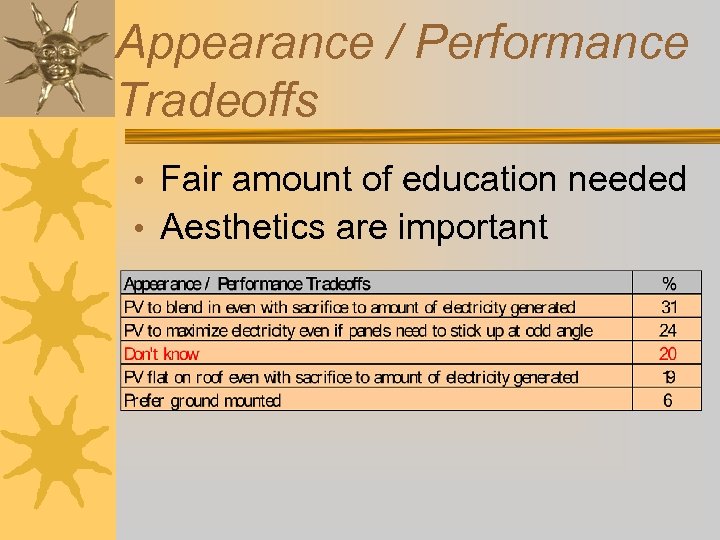 Appearance / Performance Tradeoffs • Fair amount of education needed • Aesthetics are important
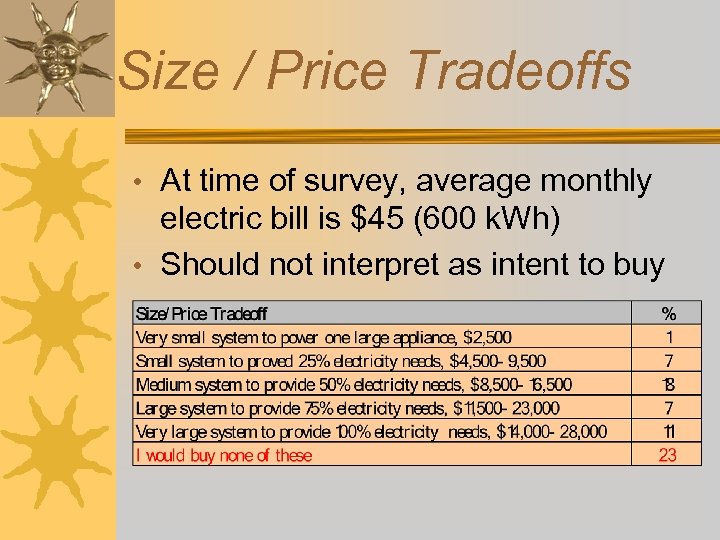 Size / Price Tradeoffs • At time of survey, average monthly electric bill is $45 (600 k. Wh) • Should not interpret as intent to buy
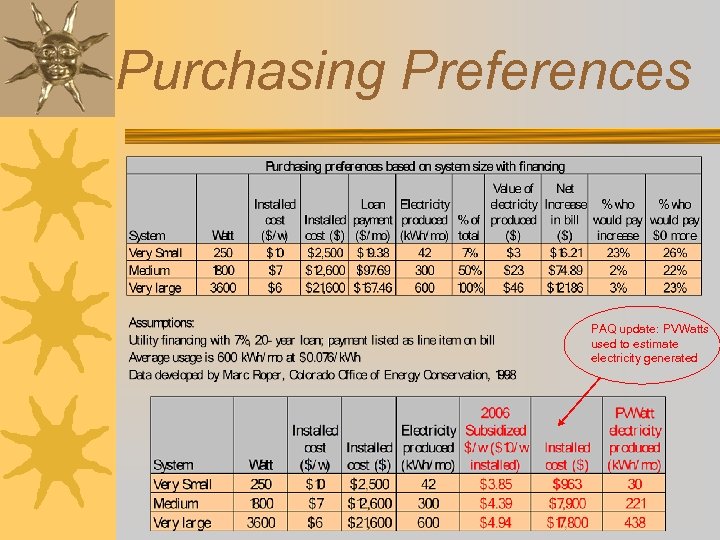 Purchasing Preferences PAQ update: PVWatts used to estimate electricity generated
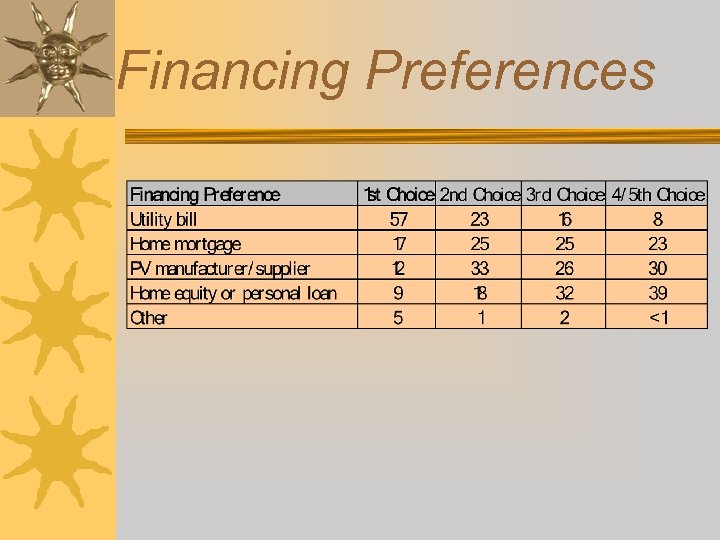 Financing Preferences
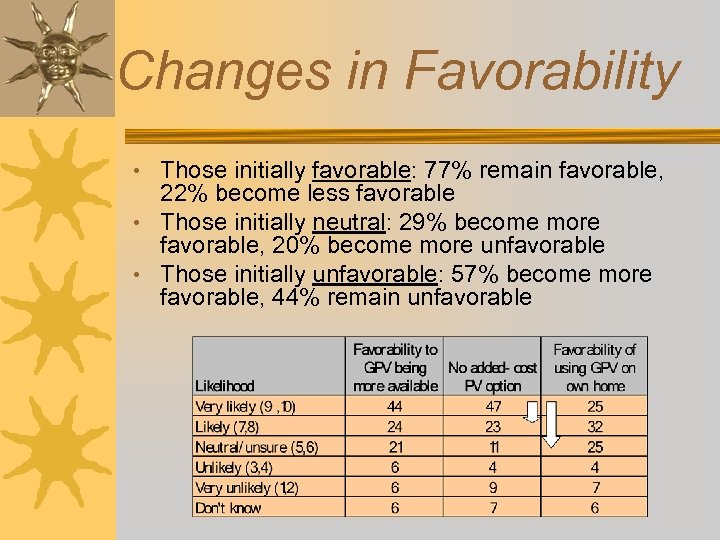 Changes in Favorability • Those initially favorable: 77% remain favorable, 22% become less favorable • Those initially neutral: 29% become more favorable, 20% become more unfavorable • Those initially unfavorable: 57% become more favorable, 44% remain unfavorable
 Market Segmentation Analysis • Sensitivity analysis used to identify variables that can be used to measure immediacy of GPV purchase decision thereby estimating the size of near term market – those in the decision making stage
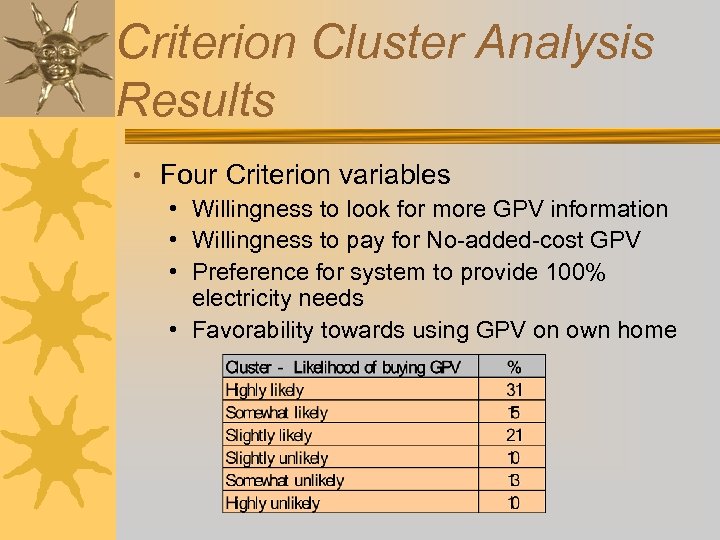 Criterion Cluster Analysis Results • Four Criterion variables • Willingness to look for more GPV information • Willingness to pay for No-added-cost GPV • Preference for system to provide 100% electricity needs • Favorability towards using GPV on own home
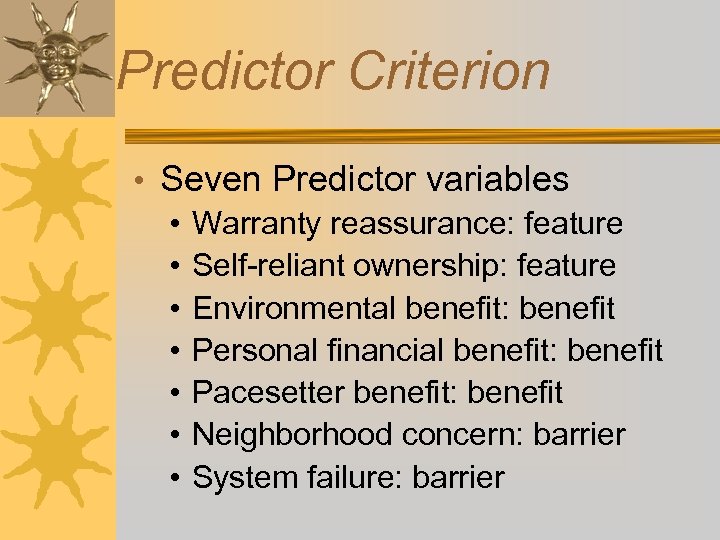 Predictor Criterion • Seven Predictor variables • Warranty reassurance: feature • Self-reliant ownership: feature • Environmental benefit: benefit • Personal financial benefit: benefit • Pacesetter benefit: benefit • Neighborhood concern: barrier • System failure: barrier
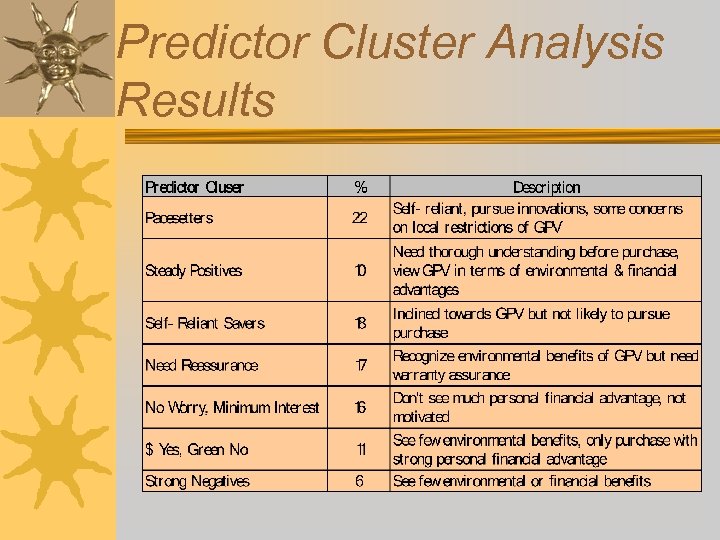 Predictor Cluster Analysis Results
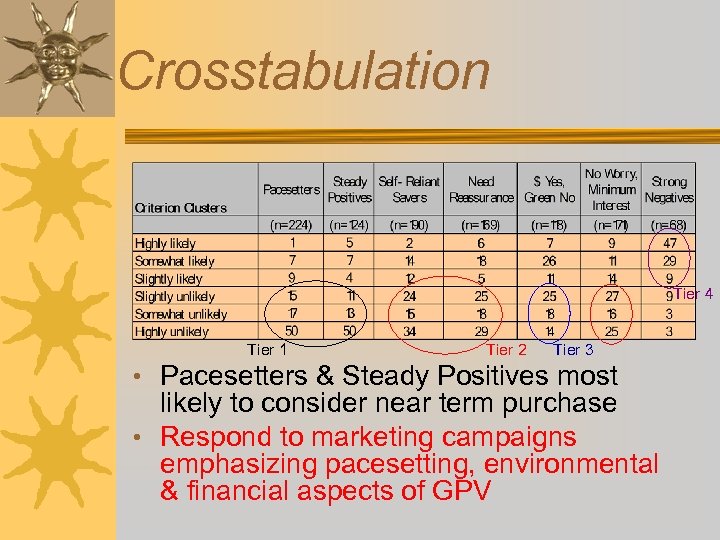 Crosstabulation Tier 4 Tier 1 Tier 2 Tier 3 • Pacesetters & Steady Positives most likely to consider near term purchase • Respond to marketing campaigns emphasizing pacesetting, environmental & financial aspects of GPV
 Composition of Market • Tier 1: Early Adopters, 38% • Higher % of skilled workers • Lowest % of college grads • Higher % of Western Slope residents • Low % of political conservatives • Tier 2: Mid-term Adopters, 47% • Mostly affluent • Highly educated • Highest job positioned • High % of Denver/Boulder residents
 Composition of Market • Tier 3: Late adopters, 8% • Higher % of women & younger • Highest % of skilled workers • High % of politically conservative • Tier 4: Non-adopters, 7% • High % retirees • High % political conservatives • High % Denver/Boulder residents
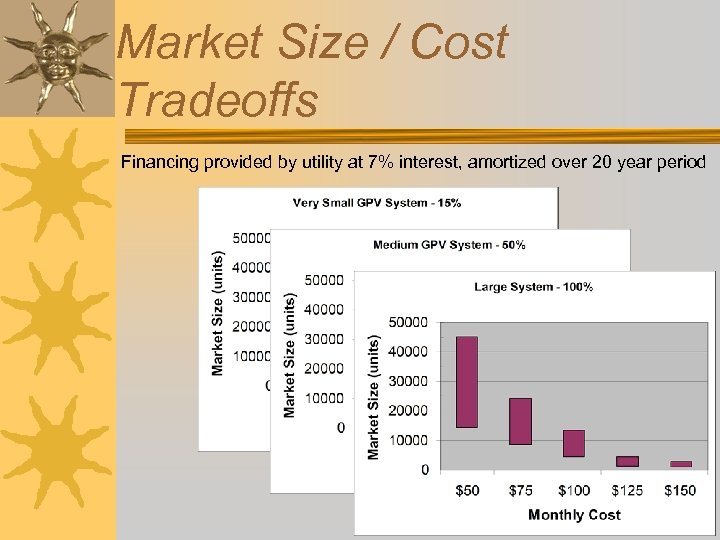 Market Size / Cost Tradeoffs Financing provided by utility at 7% interest, amortized over 20 year period
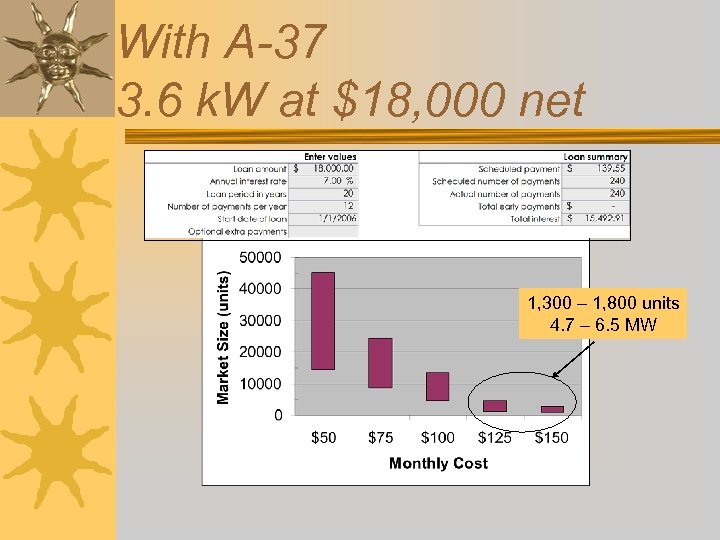 With A-37 3. 6 k. W at $18, 000 net 1, 300 – 1, 800 units 4. 7 – 6. 5 MW