



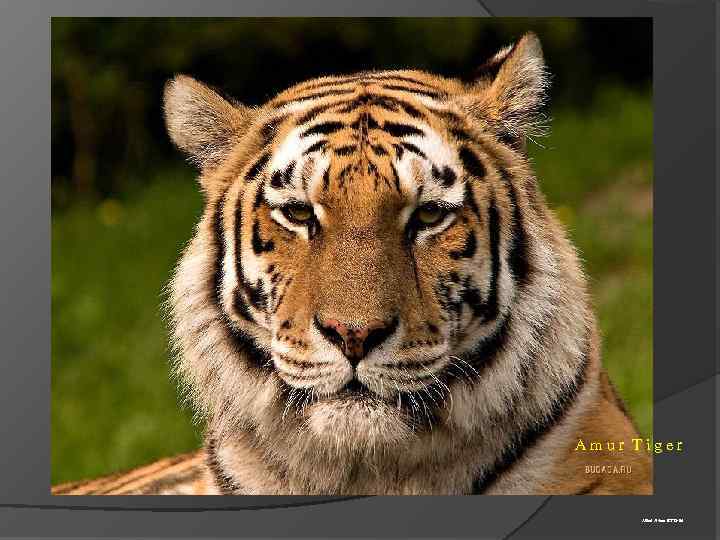
 A m u r T i g e r Alikul Aizhan BT 13 -06
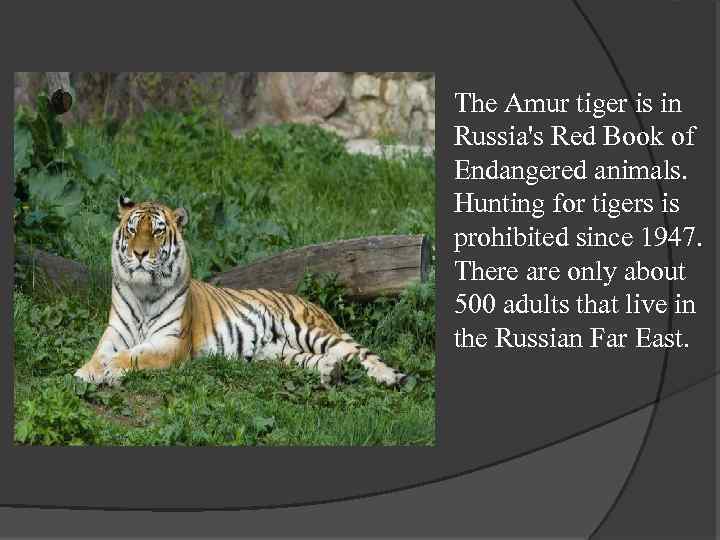 The Amur tiger is in Russia's Red Book of Endangered animals. Hunting for tigers is prohibited since 1947. There are only about 500 adults that live in the Russian Far East.
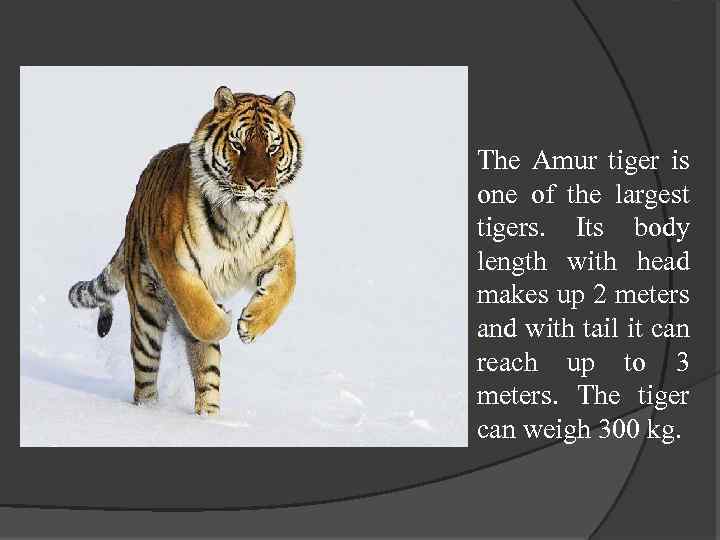 The Amur tiger is one of the largest tigers. Its body length with head makes up 2 meters and with tail it can reach up to 3 meters. The tiger can weigh 300 kg.
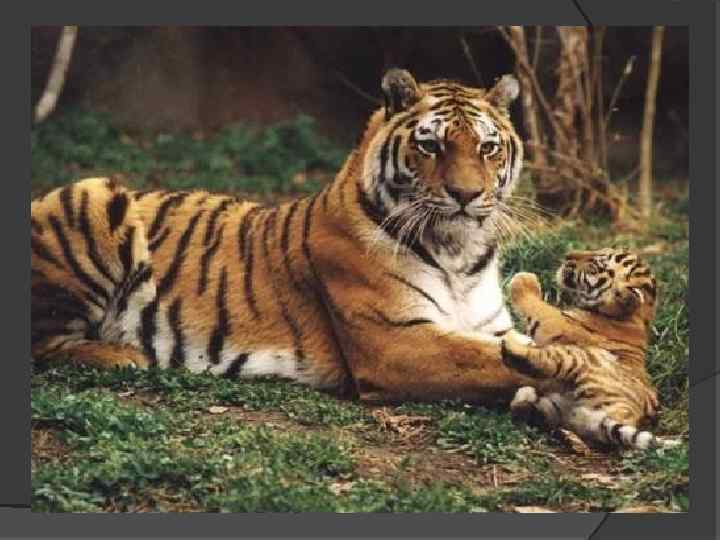
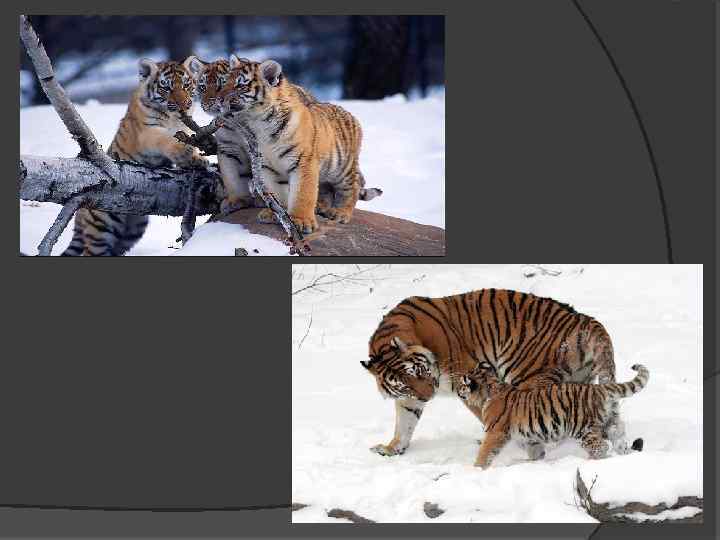
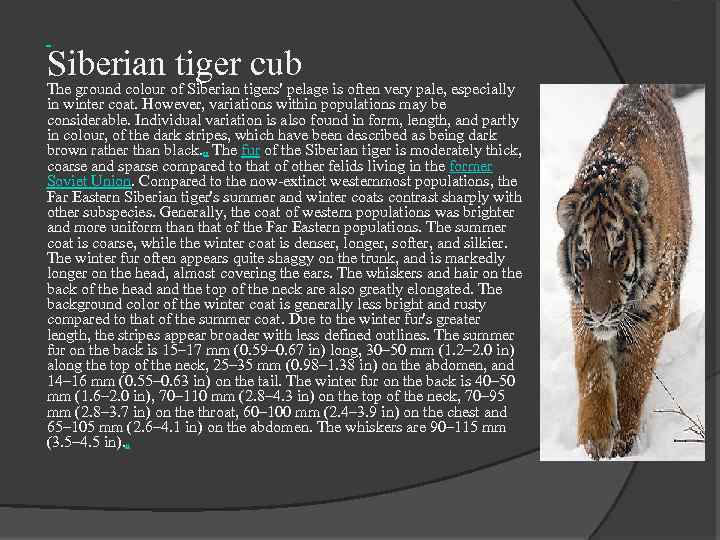 Siberian tiger cub The ground colour of Siberian tigers' pelage is often very pale, especially in winter coat. However, variations within populations may be considerable. Individual variation is also found in form, length, and partly in colour, of the dark stripes, which have been described as being dark brown rather than black. The fur of the Siberian tiger is moderately thick, coarse and sparse compared to that of other felids living in the former Soviet Union. Compared to the now-extinct westernmost populations, the Far Eastern Siberian tiger's summer and winter coats contrast sharply with other subspecies. Generally, the coat of western populations was brighter and more uniform than that of the Far Eastern populations. The summer coat is coarse, while the winter coat is denser, longer, softer, and silkier. The winter fur often appears quite shaggy on the trunk, and is markedly longer on the head, almost covering the ears. The whiskers and hair on the back of the head and the top of the neck are also greatly elongated. The background color of the winter coat is generally less bright and rusty compared to that of the summer coat. Due to the winter fur's greater length, the stripes appear broader with less defined outlines. The summer fur on the back is 15– 17 mm (0. 59– 0. 67 in) long, 30– 50 mm (1. 2– 2. 0 in) along the top of the neck, 25– 35 mm (0. 98– 1. 38 in) on the abdomen, and 14– 16 mm (0. 55– 0. 63 in) on the tail. The winter fur on the back is 40– 50 mm (1. 6– 2. 0 in), 70– 110 mm (2. 8– 4. 3 in) on the top of the neck, 70– 95 mm (2. 8– 3. 7 in) on the throat, 60– 100 mm (2. 4– 3. 9 in) on the chest and 65– 105 mm (2. 6– 4. 1 in) on the abdomen. The whiskers are 90– 115 mm (3. 5– 4. 5 in). [10] [5]
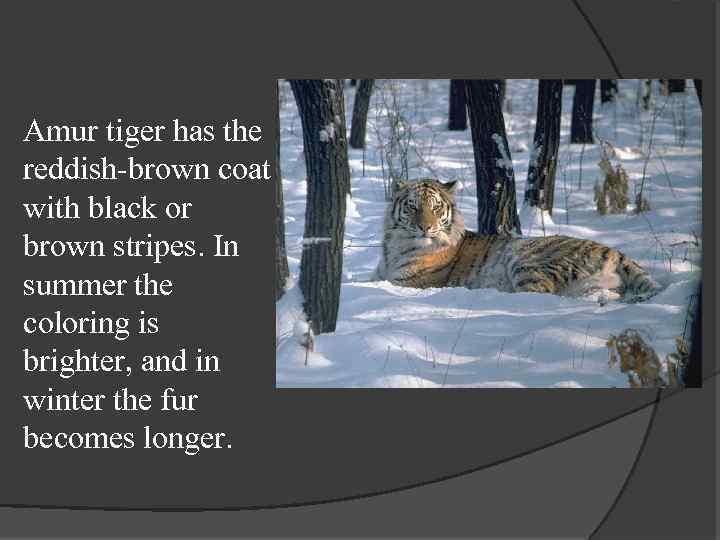 Amur tiger has the reddish-brown coat with black or brown stripes. In summer the coloring is brighter, and in winter the fur becomes longer.
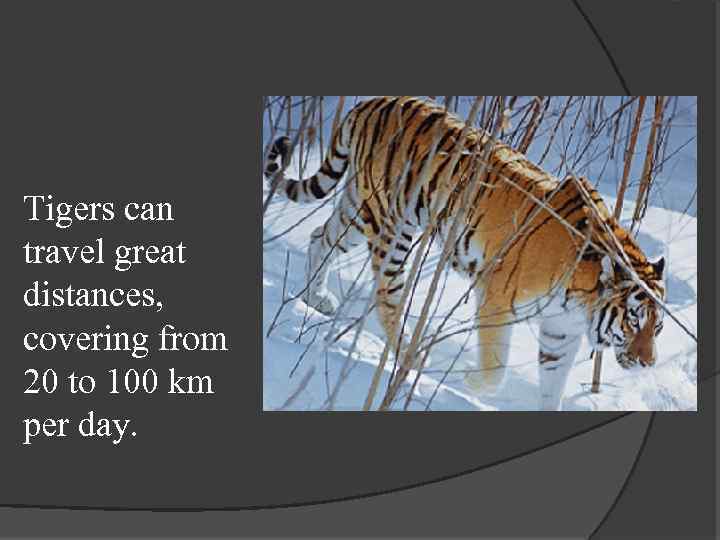 Tigers can travel great distances, covering from 20 to 100 km per day.
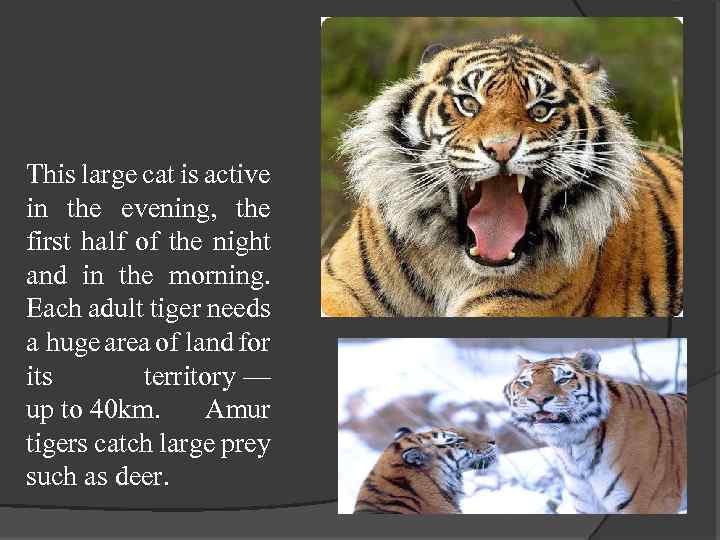 This large cat is active in the evening, the first half of the night and in the morning. Each adult tiger needs a huge area of land for its territory — up to 40 km. Amur tigers catch large prey such as deer.
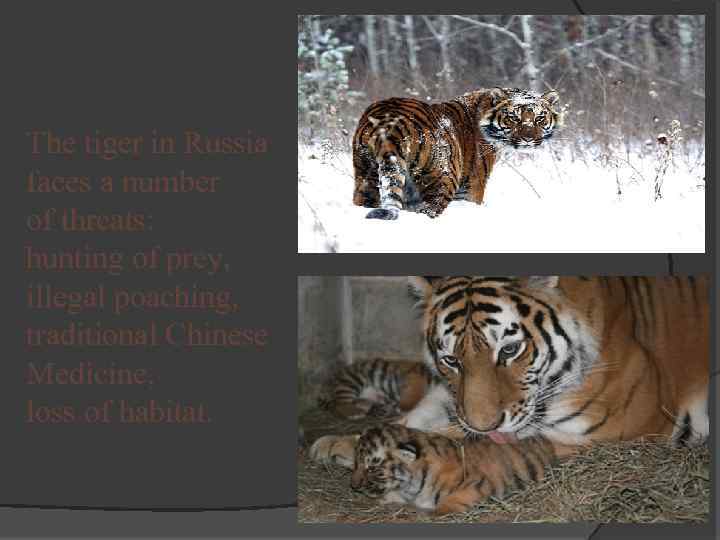 The tiger in Russia faces a number of threats: hunting of prey, illegal poaching, traditional Chinese Medicine, loss of habitat.
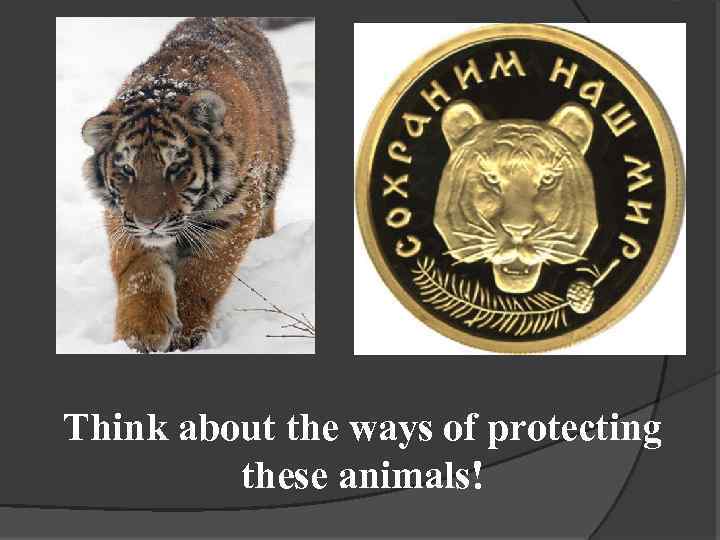 Think about the ways of protecting these animals!