


 Скачать презентацию A — Level Handgrip strength test A Level
9d7634d83a46bed655982bd1b4b21c20.ppt
- Количество слайдов: 16
 A - Level
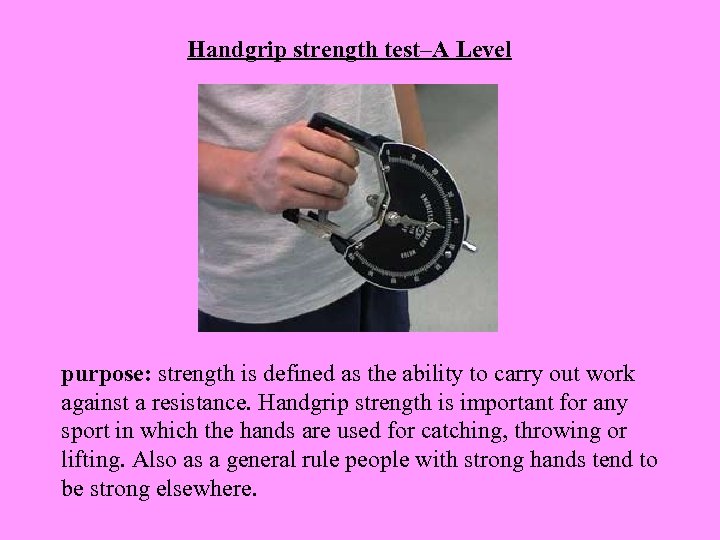 Handgrip strength test–A Level purpose: strength is defined as the ability to carry out work against a resistance. Handgrip strength is important for any sport in which the hands are used for catching, throwing or lifting. Also as a general rule people with strong hands tend to be strong elsewhere.
 Equipment required: handgrip dynamometer Description / procedure: The subject to be tested holds the dynamometer in one hand in line with the forearm and hanging by the thigh. Maximum grip strength is then determined without swinging the arm. · Scoring: The best of two trials for each hand is recorded. The values listed below (in kilograms) give a guide to expected scores for adults. They are the average of the best scores of each hand.
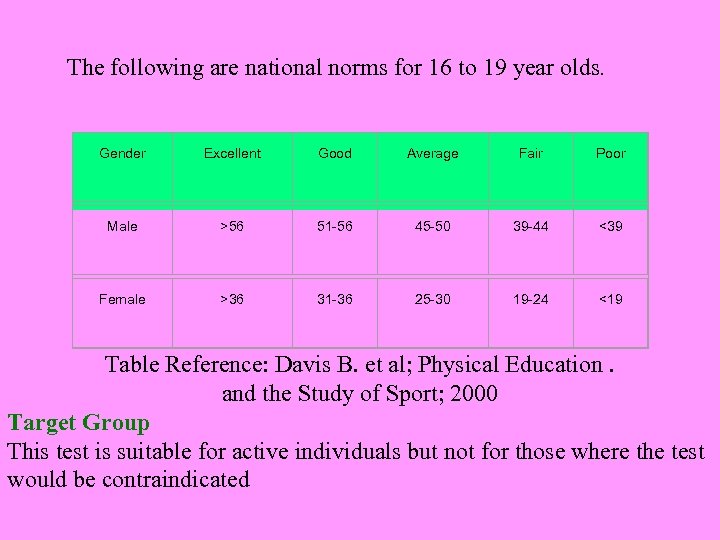 The following are national norms for 16 to 19 year olds. Gender Excellent Good Average Fair Poor Male >56 51 -56 45 -50 39 -44 <39 Female >36 31 -36 25 -30 19 -24 <19 Table Reference: Davis B. et al; Physical Education. and the Study of Sport; 2000 Target Group This test is suitable for active individuals but not for those where the test would be contraindicated
 Reliability would depend upon how strict the test is conducted and the individual's level of motivation to perform the test. Validity · There are published tables to relate results to potential level of fitness and the correlation is high. The validity of this test as a measure of general strength has been questioned, as the strength of the forearm muscles does not necessarily represent the strength of other muscle groups. · advantages: This is a simple and commonly used test of general strength level. · disadvantages: The dynamometer must be adjusted for hand size, how successfully this is done will affect the accuracy of the measurement. comments: It is also useful to record whether the athlete is left or right handed, as this may help in the interpretation of results. The non-dominant hand usually scores about 10% lower
 Repetition Maximum Tests – A Level The one repetition maximum (1 -RM) is still considered the 'gold standard' of strength assessment by most coaches. The procedure usually consists of the bench press and back squat or leg press. These are compound movements incorporating most of the large muscle groups in the upper and lower body. Either free weights or resistance machines can be used for the testing procedure but the choice should be determined by what the athlete intends to use during training. The specific adaptation to imposed demands means that a barbell back squat will more accurately determine the effectiveness of a free weights strength program than a machine leg press for example.
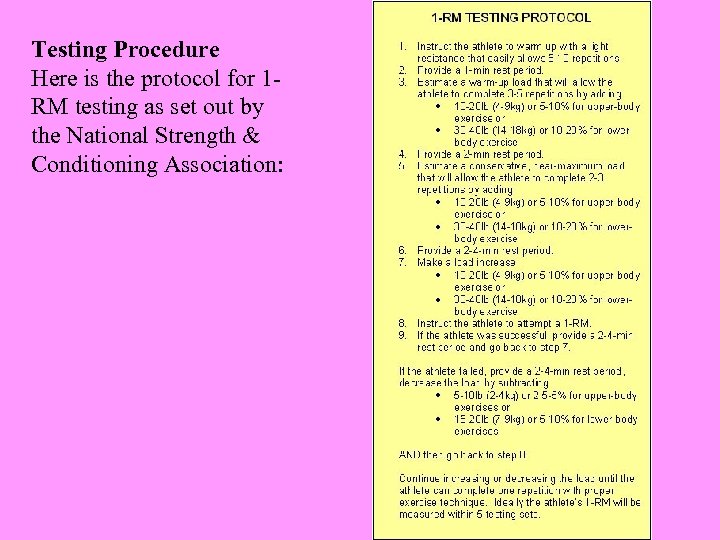 Testing Procedure Here is the protocol for 1 RM testing as set out by the National Strength & Conditioning Association:
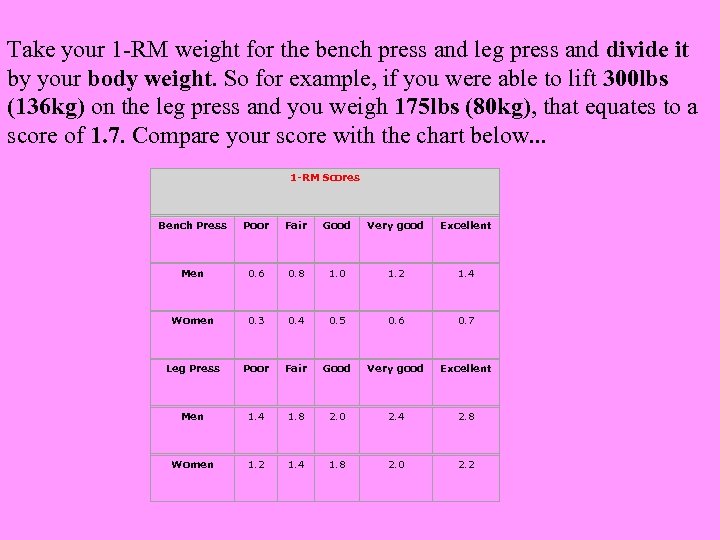 Take your 1 -RM weight for the bench press and leg press and divide it by your body weight. So for example, if you were able to lift 300 lbs (136 kg) on the leg press and you weigh 175 lbs (80 kg), that equates to a score of 1. 7. Compare your score with the chart below. . . 1 -RM Scores Bench Press Poor Fair Good Very good Excellent Men 0. 6 0. 8 1. 0 1. 2 1. 4 Women 0. 3 0. 4 0. 5 0. 6 0. 7 Leg Press Poor Fair Good Very good Excellent Men 1. 4 1. 8 2. 0 2. 4 2. 8 Women 1. 2 1. 4 1. 8 2. 0 2. 2
 The Wingate Test for Anaerobic Power The Wingate test, also known as the Wingate Anaerobic Test (WANT), was developed at the Wingate Institute, in Israel, during the 1970 s. It is perhaps the most popular assessment for peak anaerobic power, anaerobic fatigue and total anaerobic capacity.
 Anaerobic power reflects the ability of the adenosine triphosphate and phosphocreatine (ATP-PCr) energy pathways to produce energy. In short. . . adenosine triphosphate (ATP) is created and stored in muscle cells. These muscle cells then generate mechanical work (i. e. running) from the energy produced in a naturally occurring chemical reaction that converts ATP into adenosine diphosphate (ADP) and a phosphate (P). . . ATP is stored in limited supplies that are quickly consumed by muscle cells during exercise. So. . . the body uses an organic compound found in muscle tissue called phosphocreatine and the resulting ADP to re-synthesize ATP. The ATP-PC energy pathway defines the energy created by a breakdown of PCr to a re-synthesized ATP.
 · Peak anaerobic power represents the highest mechanical power generated during any 3 -5 second interval of the test. · Anaerobic capacity in the Wingate test is the total amount of work accomplished over a 30 -second bout. · Anaerobic fatigue is the percentage decline in power compared with the peak power output.
 Wingate Test Protocol The Wingate test requires the subject to pedal a mechanically braked bicycle ergometer for 30 seconds, at an "all out" pace. A counter is used to record revolutions of the flywheel in 5 second intervals. Although the actual Wingate test is performed in a 30 second time span, the individual is advised to complete a warm-up (3 -5 minutes), followed by a recovery cool down (1 -2 minutes). On commencing the test (usually by a verbal signal from the tester), the individual pedals "all out" with no resistance. Within 3 seconds, the predetermined fixed resistance is applied to the flywheel and remains there for the duration of the 30 -second test.
 Resistance There are two primary bicycle ergometers used for the Wingate test. . . the Fleisch ergometer and the modified Monark ergometer. Fleisch ergometer resistance = 0. 045 kg per kilogram of body weight Monark ergometer resistance = 0. 075 kg per kilogram of body weight. For power athletes and sprint athletes, resistance is often increased to values in the range of 1. 0 kg per kilogram of body weight to 1. 3 kg per kilogram of body weight. So on the Monarch ergometer a 70 kg athlete the flywheel resistance would equal 5. 25 kg (70 x 0. 075).
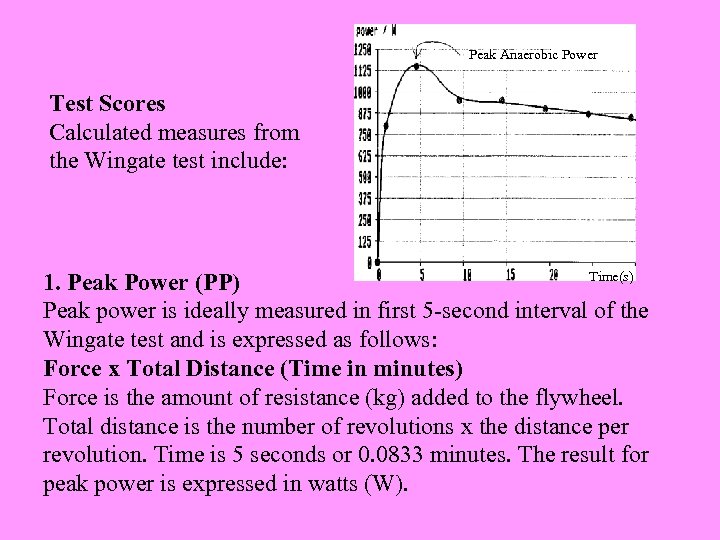 Peak Anaerobic Power Test Scores Calculated measures from the Wingate test include: Time(s) 1. Peak Power (PP) Peak power is ideally measured in first 5 -second interval of the Wingate test and is expressed as follows: Force x Total Distance (Time in minutes) Force is the amount of resistance (kg) added to the flywheel. Total distance is the number of revolutions x the distance per revolution. Time is 5 seconds or 0. 0833 minutes. The result for peak power is expressed in watts (W).
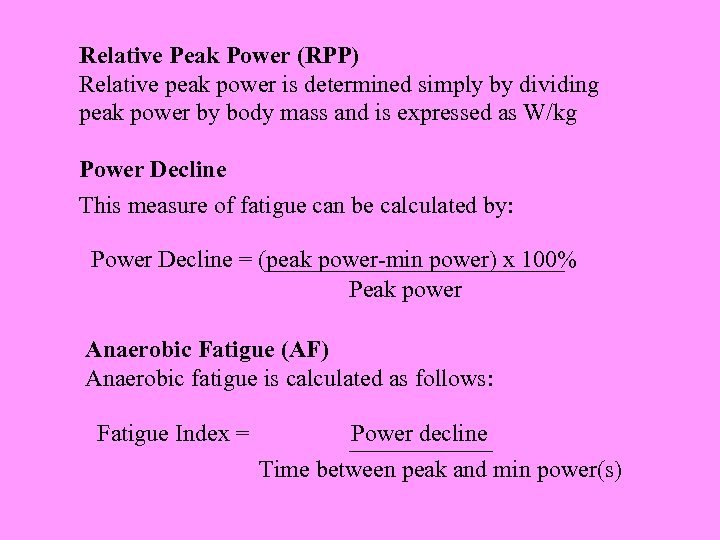 Relative Peak Power (RPP) Relative peak power is determined simply by dividing peak power by body mass and is expressed as W/kg Power Decline This measure of fatigue can be calculated by: Power Decline = (peak power-min power) x 100% _____________ Peak power Anaerobic Fatigue (AF) Anaerobic fatigue is calculated as follows: Fatigue Index = Power decline ______ Time between peak and min power(s)
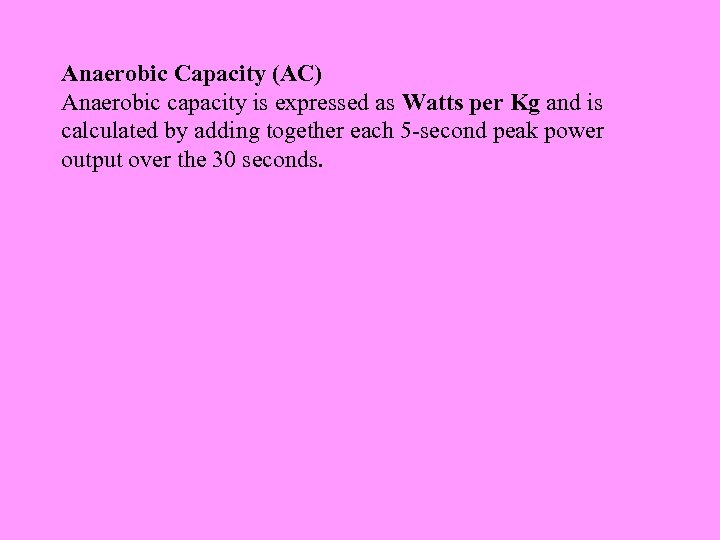 Anaerobic Capacity (AC) Anaerobic capacity is expressed as Watts per Kg and is calculated by adding together each 5 -second peak power output over the 30 seconds.