


 Скачать презентацию A HOUSE DIVIDED CANNOT STAND WHAT IS
d8e97e4ee572dd942676951d825f9e48.ppt
- Количество слайдов: 46
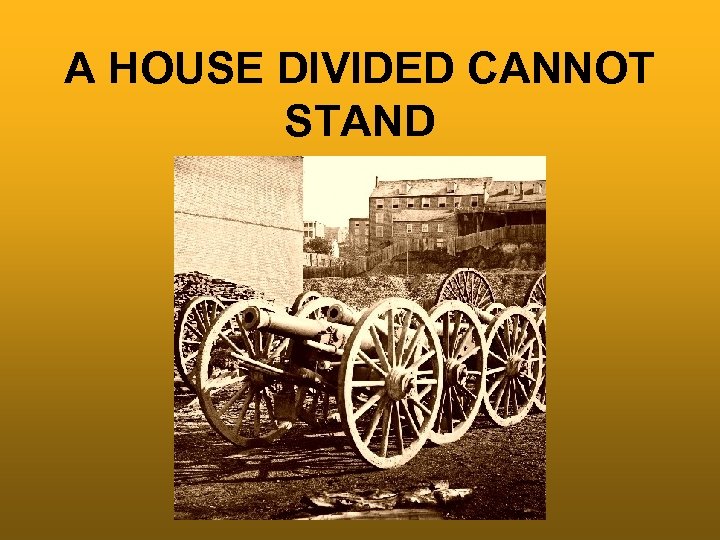 A HOUSE DIVIDED CANNOT STAND
 WHAT IS CIVIL WAR? ü War between the people of the same country ü Often fought because of economic, political, social, and/or religious differences
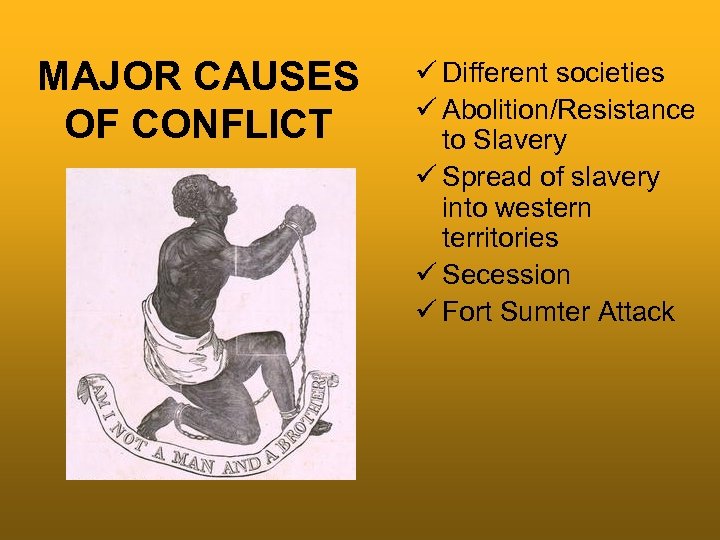 MAJOR CAUSES OF CONFLICT ü Different societies ü Abolition/Resistance to Slavery ü Spread of slavery into western territories ü Secession ü Fort Sumter Attack
 CAUSE 1: DIFFERENT SOCIETIES ü Northern & Southern societies were very different ü Different economies ü Different views on the role/importance of gov’t ü North wanted a big, federal gov’t ü South wanted smaller, state gov’ts ** These differences lead to a lack of trust on both sides
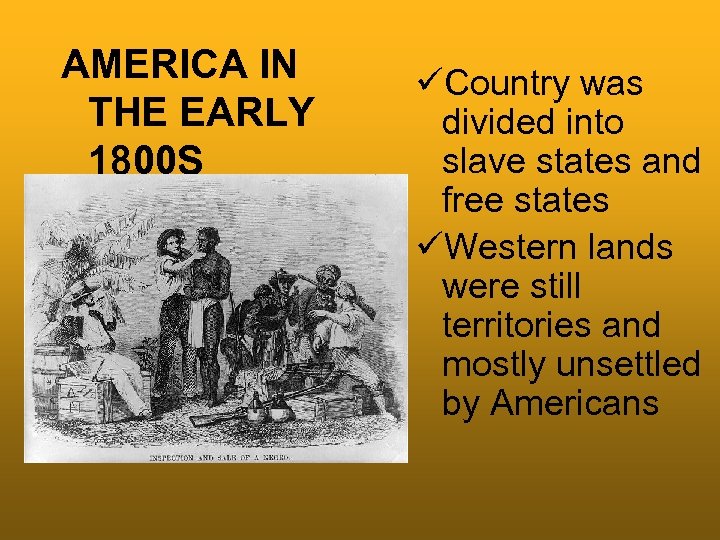 AMERICA IN THE EARLY 1800 S üCountry was divided into slave states and free states üWestern lands were still territories and mostly unsettled by Americans
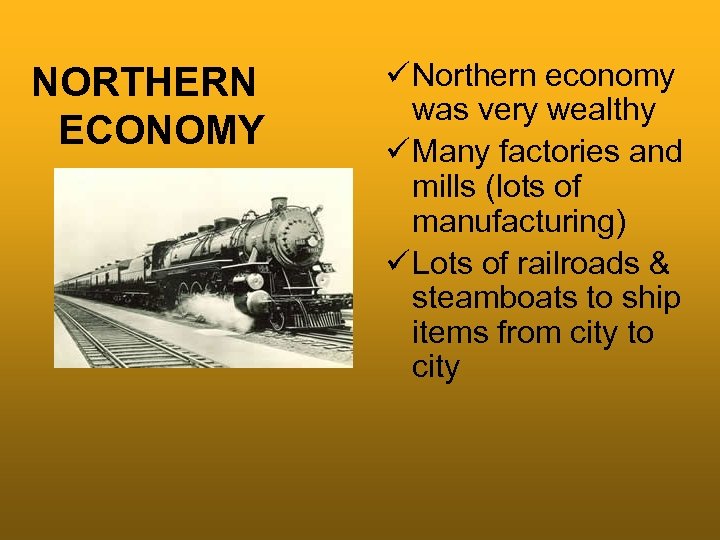 NORTHERN ECONOMY ü Northern economy was very wealthy ü Many factories and mills (lots of manufacturing) ü Lots of railroads & steamboats to ship items from city to city
 NORTHERN SOCIETY ü Many Northern people live in cities ü Have lots of contact with neighbors/communit y ü North had large population ü Strong faith in big government ü Many have strong feelings against slavery
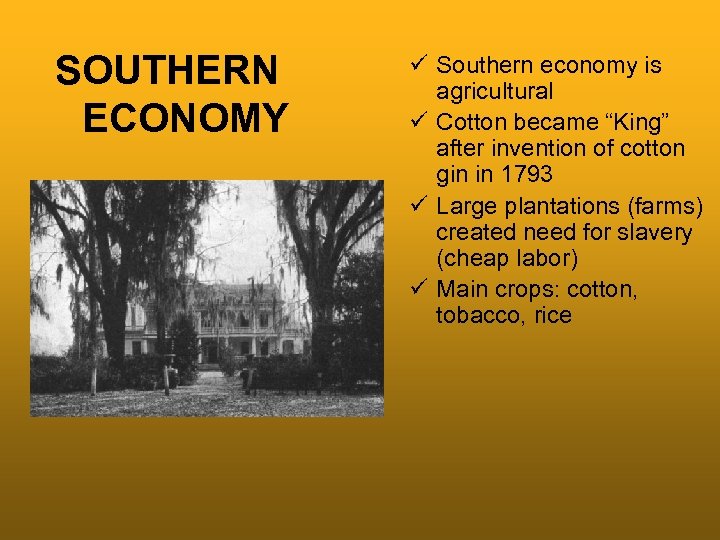 SOUTHERN ECONOMY ü Southern economy is agricultural ü Cotton became “King” after invention of cotton gin in 1793 ü Large plantations (farms) created need for slavery (cheap labor) ü Main crops: cotton, tobacco, rice
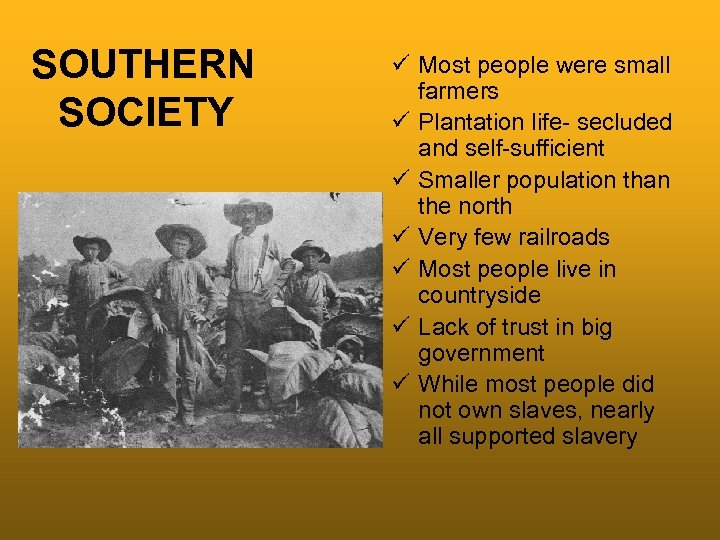 SOUTHERN SOCIETY ü Most people were small farmers ü Plantation life- secluded and self-sufficient ü Smaller population than the north ü Very few railroads ü Most people live in countryside ü Lack of trust in big government ü While most people did not own slaves, nearly all supported slavery
 INTERPRETING GRAPHS Turn to page 407 in your textbook and find the circle graph labeled, Southern Population, 1860. With your partner, answer the following question: 1. What percentage of the population was white? Black? 2. How might the size of the African American population affect whites’ treatment of them?
 INTERPRETING THEMATIC MAPS Turn to page 389 in your textbook. Looking at the map labeled, Railroad Expansion, 1860, answer the following question: 1. Which region might have an advantage for transporting goods and people more easily? Turn to page 401 in your textbook. Find the map labeled, Cotton Production, 1820 -1860, and answer the following questions: 1. What factor contributed to the increase in cotton production? 2. How might an agricultural economy increase the need for workers?
 PARTNER QUESTION Why would these economic and social differences lead to conflict between the North and South?
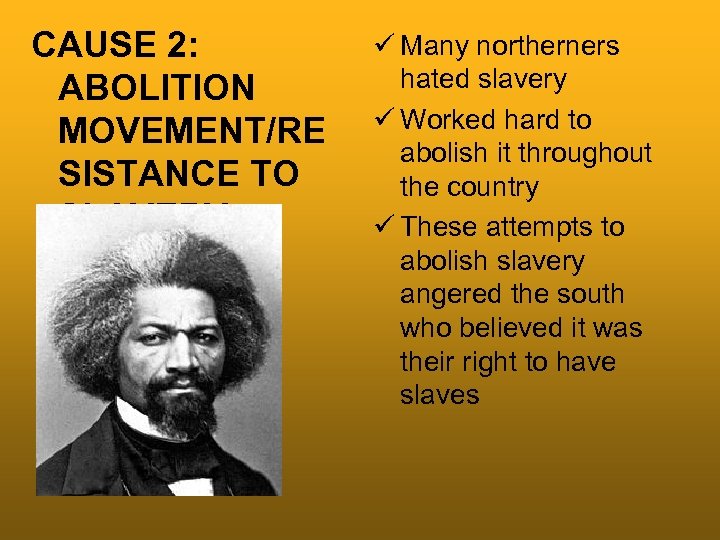 CAUSE 2: ABOLITION MOVEMENT/RE SISTANCE TO SLAVERY ü Many northerners hated slavery ü Worked hard to abolish it throughout the country ü These attempts to abolish slavery angered the south who believed it was their right to have slaves
 WHAT IS SLAVERY? ü Slavery is a system that allows people to be bought and sold like property and then forced to work ü Has existed throughout most of the world ü How did it get to the U. S?
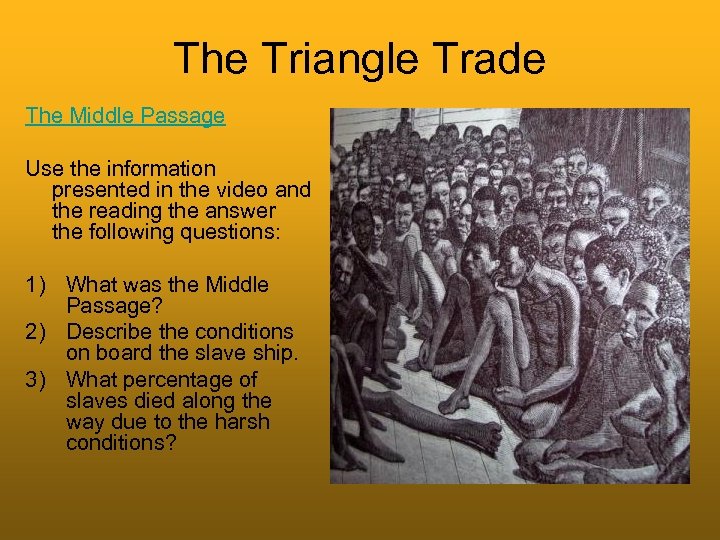 The Triangle Trade The Middle Passage Use the information presented in the video and the reading the answer the following questions: 1) What was the Middle Passage? 2) Describe the conditions on board the slave ship. 3) What percentage of slaves died along the way due to the harsh conditions?
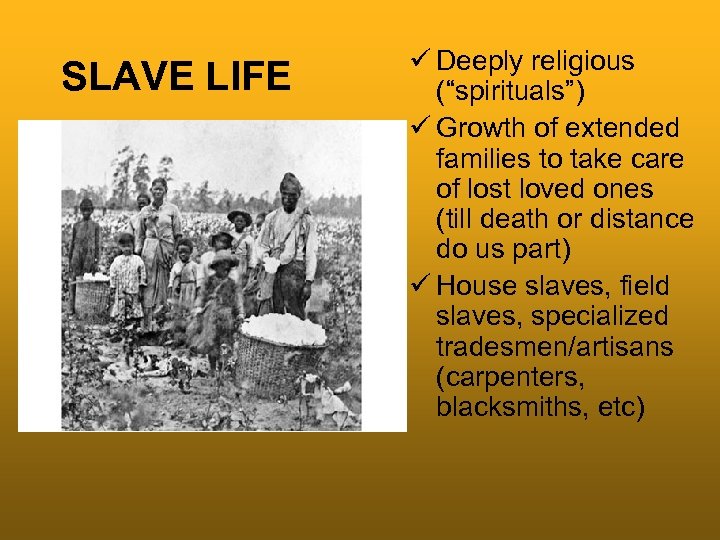 SLAVE LIFE ü Deeply religious (“spirituals”) ü Growth of extended families to take care of lost loved ones (till death or distance do us part) ü House slaves, field slaves, specialized tradesmen/artisans (carpenters, blacksmiths, etc)
 READING FOR INFORMATION Read the passage about slave life with your partner and answer the following questions: 1. How were slaves punished? 2. What could slaves be punished for? 3. What are 2 examples of slave codes?
 PHOTOGRAPH ANALYSIS Analyze the photograph about slave life and answer the questions in your notes.
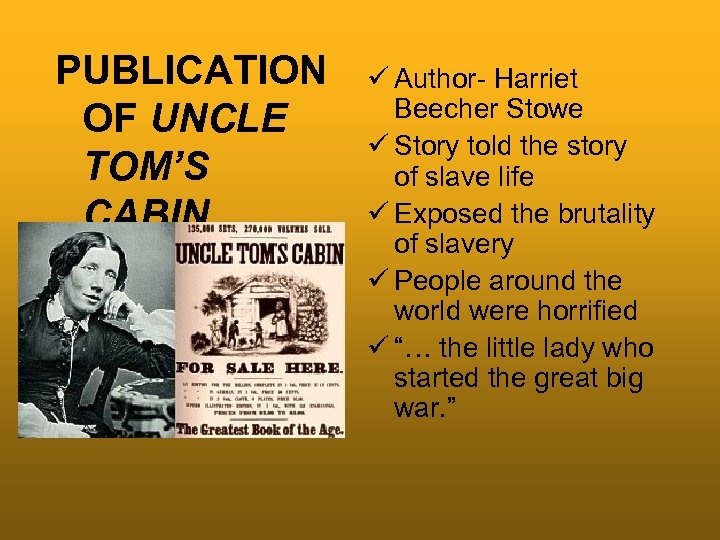 PUBLICATION OF UNCLE TOM’S CABIN ü Author- Harriet Beecher Stowe ü Story told the story of slave life ü Exposed the brutality of slavery ü People around the world were horrified ü “… the little lady who started the great big war. ”
 PRIMARY RESOURCE ANALYSIS Read the excerpt from Uncle Tom’s Cabin and answer the following questions:
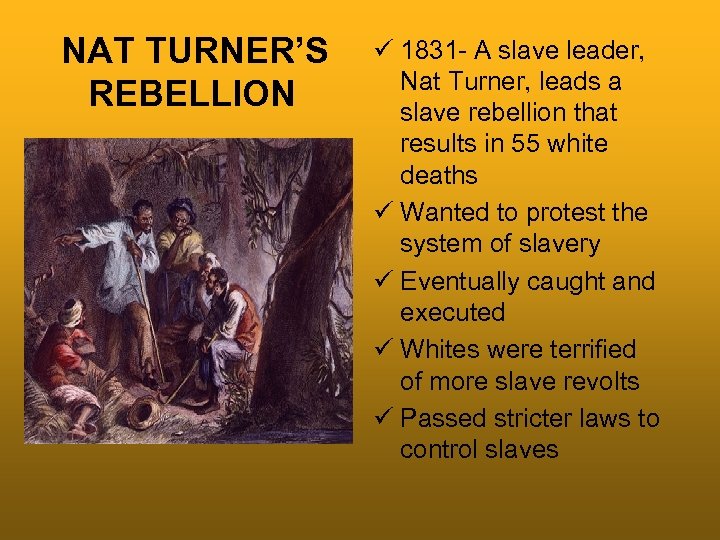 NAT TURNER’S REBELLION ü 1831 - A slave leader, Nat Turner, leads a slave rebellion that results in 55 white deaths ü Wanted to protest the system of slavery ü Eventually caught and executed ü Whites were terrified of more slave revolts ü Passed stricter laws to control slaves
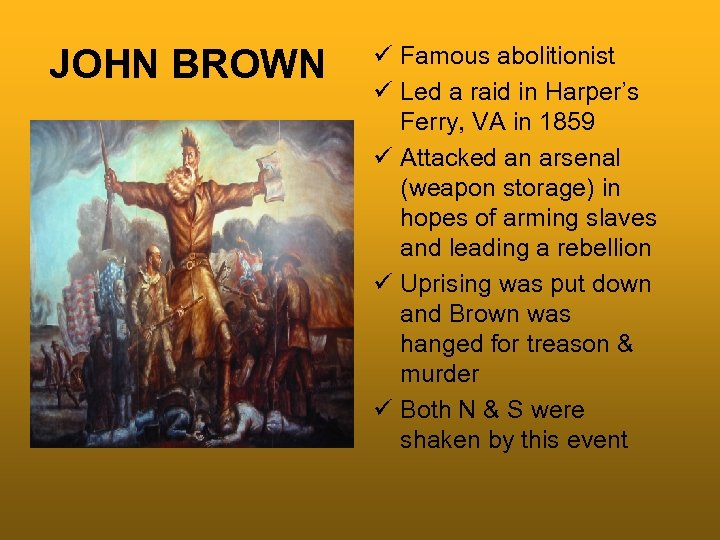 JOHN BROWN ü Famous abolitionist ü Led a raid in Harper’s Ferry, VA in 1859 ü Attacked an arsenal (weapon storage) in hopes of arming slaves and leading a rebellion ü Uprising was put down and Brown was hanged for treason & murder ü Both N & S were shaken by this event
 HERO OR VILLAIN? Turn to pages 456 -457 in your textbook and read the American Diary and the primary resource labeled, Hero or Villain? How did Southerners and Northerners view John Brown differently? Why do you think this is?
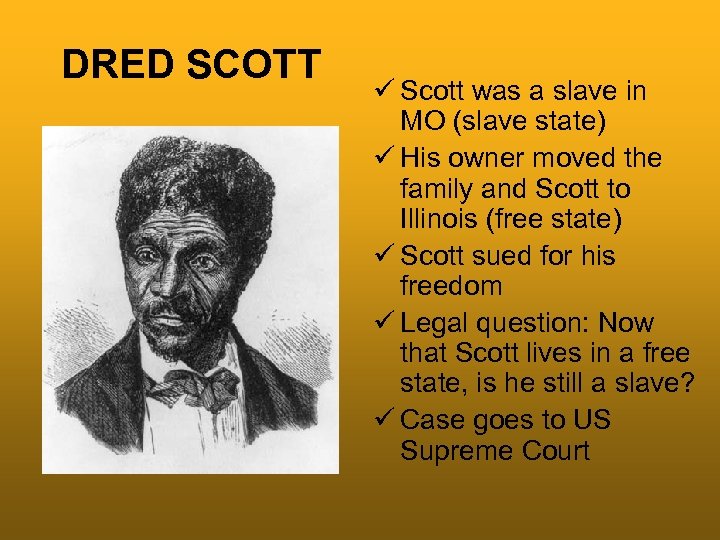 DRED SCOTT ü Scott was a slave in MO (slave state) ü His owner moved the family and Scott to Illinois (free state) ü Scott sued for his freedom ü Legal question: Now that Scott lives in a free state, is he still a slave? ü Case goes to US Supreme Court
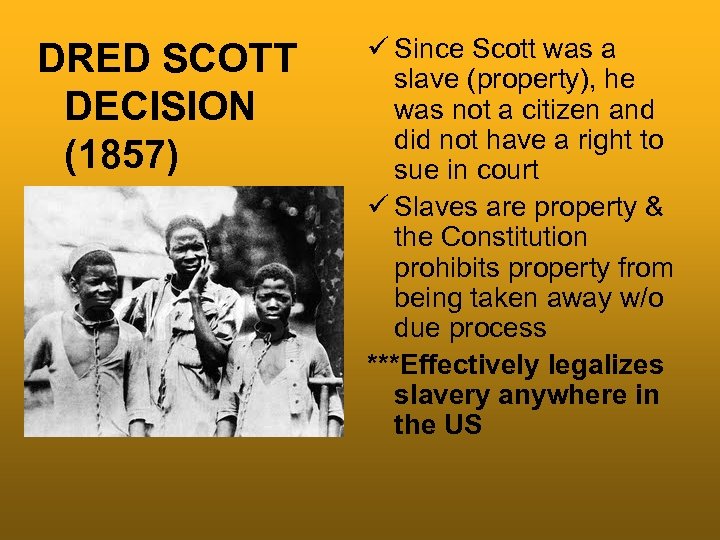 DRED SCOTT DECISION (1857) ü Since Scott was a slave (property), he was not a citizen and did not have a right to sue in court ü Slaves are property & the Constitution prohibits property from being taken away w/o due process ***Effectively legalizes slavery anywhere in the US
 SUMMARY QUESTIONS 1. Why were so many northerners opposed to slavery? 2. How did abolition cause problems between the north and south?
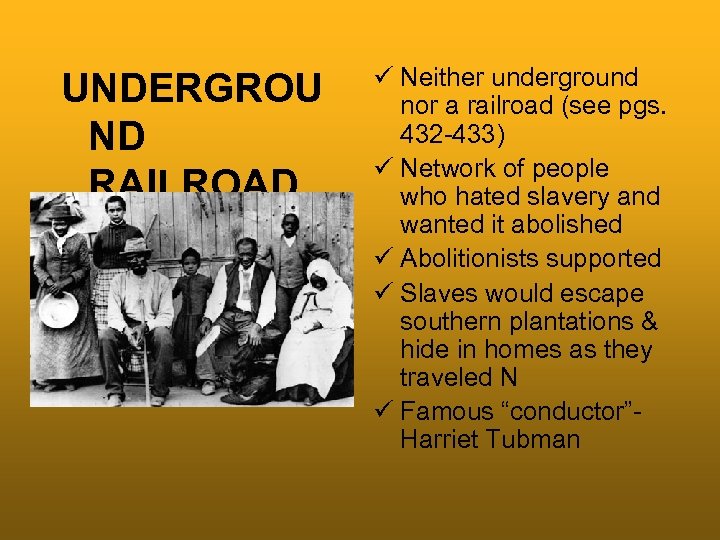 UNDERGROU ND RAILROAD ü Neither underground nor a railroad (see pgs. 432 -433) ü Network of people who hated slavery and wanted it abolished ü Abolitionists supported ü Slaves would escape southern plantations & hide in homes as they traveled N ü Famous “conductor”Harriet Tubman
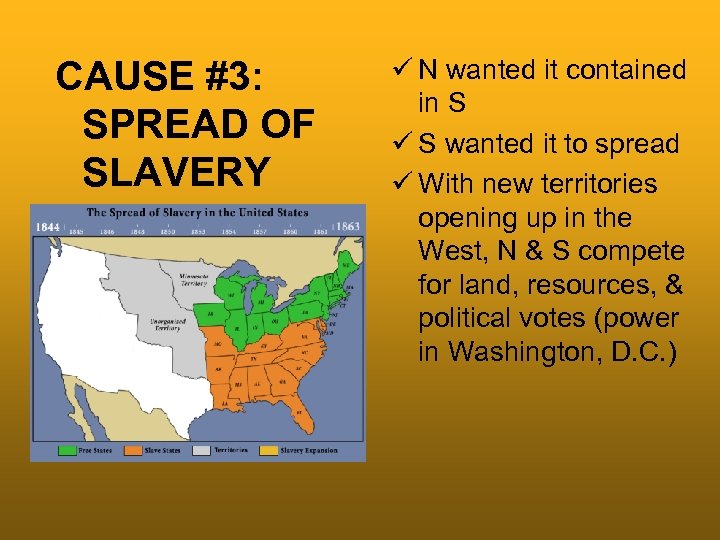 CAUSE #3: SPREAD OF SLAVERY ü N wanted it contained in S ü S wanted it to spread ü With new territories opening up in the West, N & S compete for land, resources, & political votes (power in Washington, D. C. )
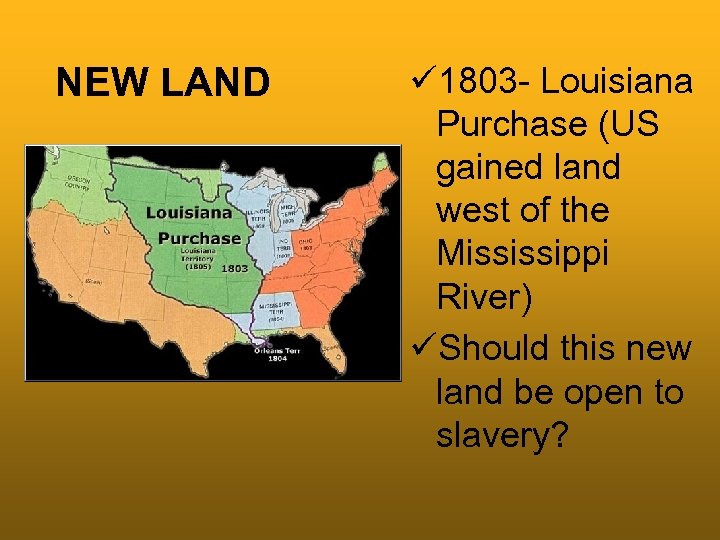 NEW LAND ü 1803 - Louisiana Purchase (US gained land west of the Mississippi River) üShould this new land be open to slavery?
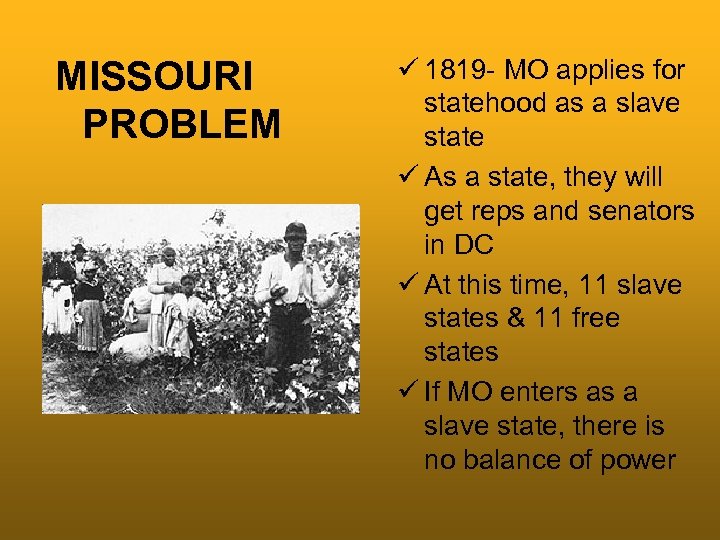 MISSOURI PROBLEM ü 1819 - MO applies for statehood as a slave state ü As a state, they will get reps and senators in DC ü At this time, 11 slave states & 11 free states ü If MO enters as a slave state, there is no balance of power
 AMERICAN DIARY Turn to page 448 in your textbook. After chorally reading the passage as a class, answer the following question with your partner: 1. ) Why was Thomas Jefferson so concerned about Missouri applying for statehood? 2. ) What did he mean when he said, “I considered it at once the knell of the Union. ”
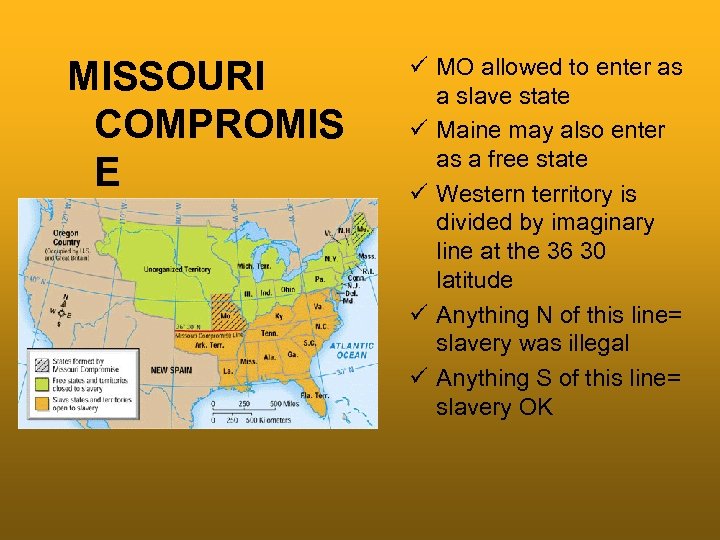 MISSOURI COMPROMIS E ü MO allowed to enter as a slave state ü Maine may also enter as a free state ü Western territory is divided by imaginary line at the 36 30 latitude ü Anything N of this line= slavery was illegal ü Anything S of this line= slavery OK
 PARTNER QUESTION Why were Northern states so concerned about slavery spreading to the western territories?
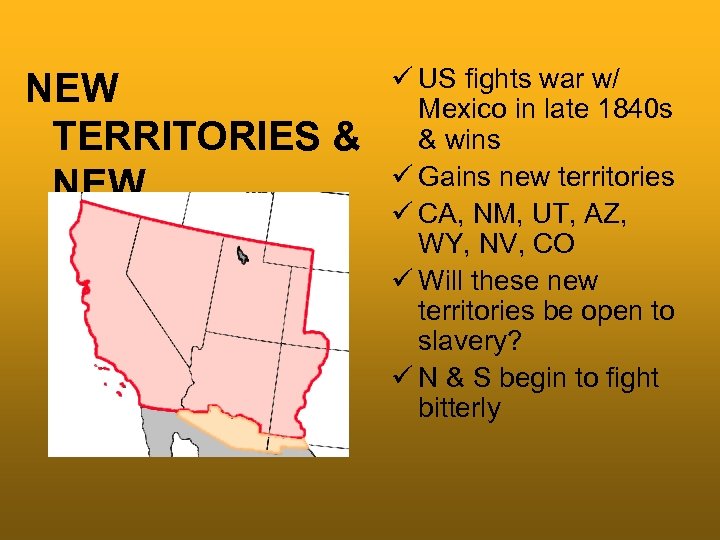 NEW TERRITORIES & NEW CHALLENGES ü US fights war w/ Mexico in late 1840 s & wins ü Gains new territories ü CA, NM, UT, AZ, WY, NV, CO ü Will these new territories be open to slavery? ü N & S begin to fight bitterly
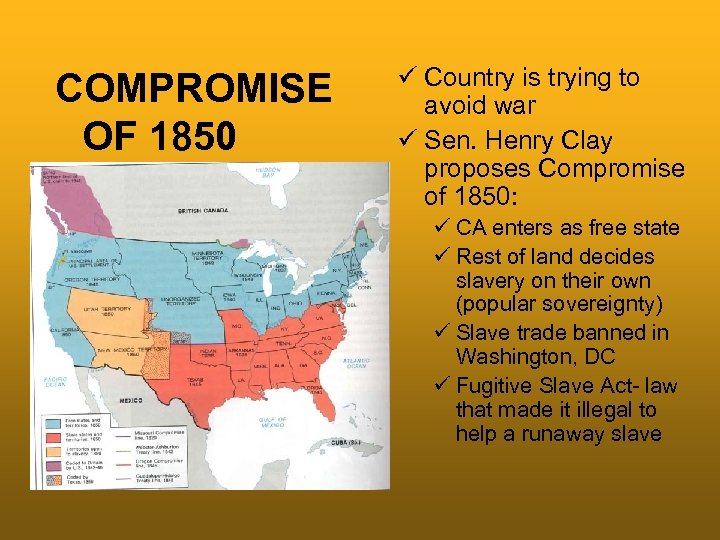 COMPROMISE OF 1850 ü Country is trying to avoid war ü Sen. Henry Clay proposes Compromise of 1850: ü CA enters as free state ü Rest of land decides slavery on their own (popular sovereignty) ü Slave trade banned in Washington, DC ü Fugitive Slave Act- law that made it illegal to help a runaway slave

 PARTNER QUESTION How did both sides compromise on the issue of slavery?
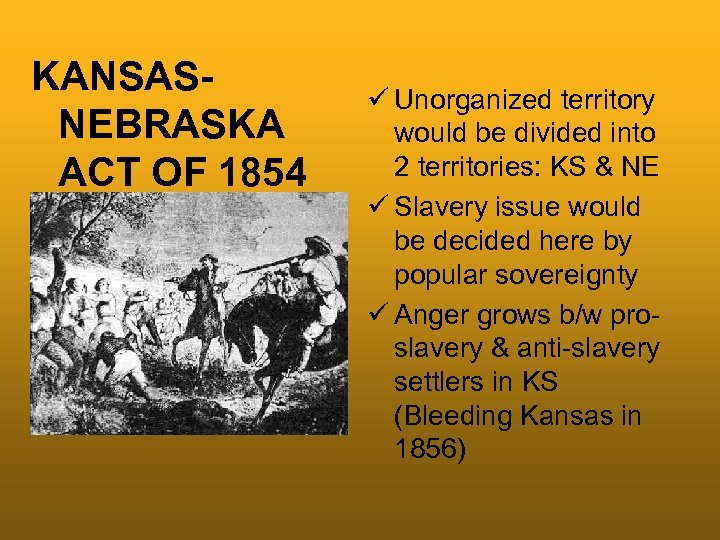 KANSASNEBRASKA ACT OF 1854 ü Unorganized territory would be divided into 2 territories: KS & NE ü Slavery issue would be decided here by popular sovereignty ü Anger grows b/w proslavery & anti-slavery settlers in KS (Bleeding Kansas in 1856)
 INTERPRETING THEMATIC MAPS Turn to page 454 in your textbook and find the two maps labeled, Slavery and Sectionalism. With your partner, answer the following question: 1. According to the two maps, what is the main difference between the Compromise of 1850 and the Kansas-Nebraska Act of 1854?
 SUMMARY Western expansion led to competition for territory between the North and South. The more states each side had, the more _______ that side had in Congress.
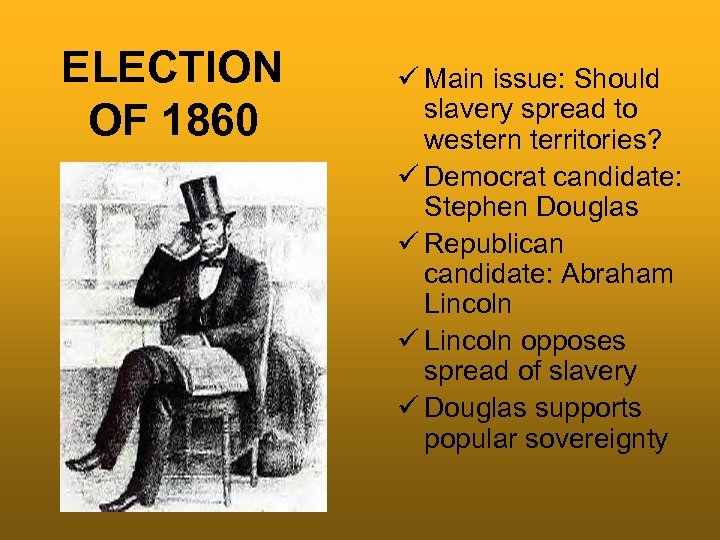 ELECTION OF 1860 ü Main issue: Should slavery spread to western territories? ü Democrat candidate: Stephen Douglas ü Republican candidate: Abraham Lincoln ü Lincoln opposes spread of slavery ü Douglas supports popular sovereignty
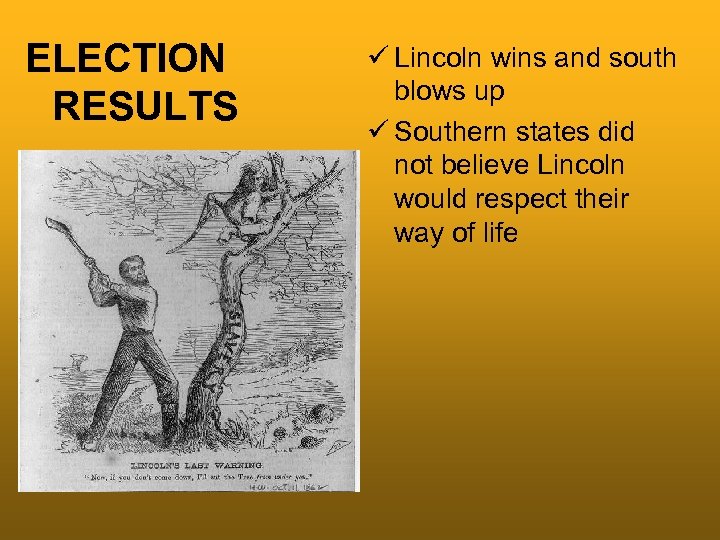 ELECTION RESULTS ü Lincoln wins and south blows up ü Southern states did not believe Lincoln would respect their way of life
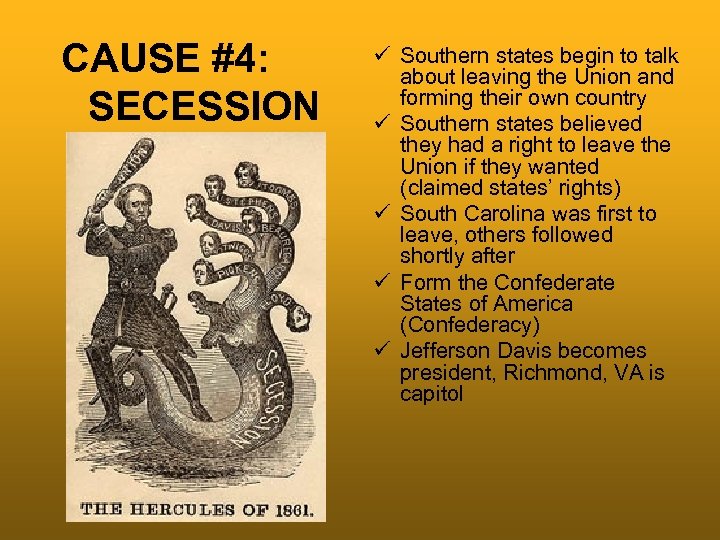 CAUSE #4: SECESSION ü Southern states begin to talk about leaving the Union and forming their own country ü Southern states believed they had a right to leave the Union if they wanted (claimed states’ rights) ü South Carolina was first to leave, others followed shortly after ü Form the Confederate States of America (Confederacy) ü Jefferson Davis becomes president, Richmond, VA is capitol
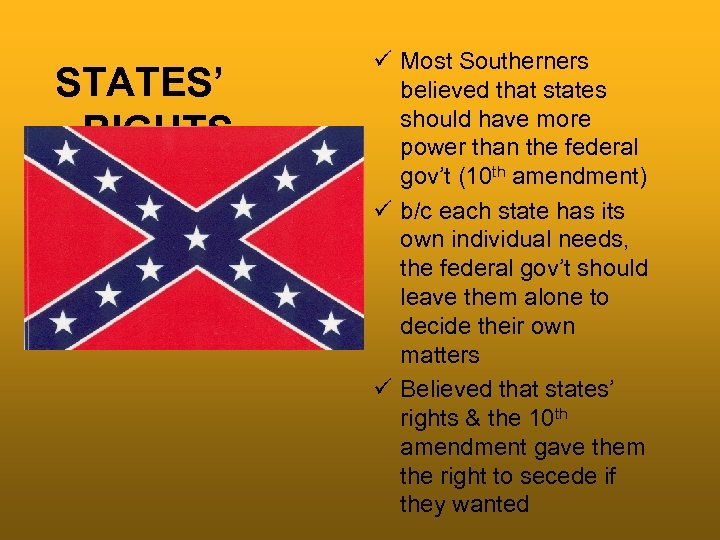 STATES’ RIGHTS ü Most Southerners believed that states should have more power than the federal gov’t (10 th amendment) ü b/c each state has its own individual needs, the federal gov’t should leave them alone to decide their own matters ü Believed that states’ rights & the 10 th amendment gave them the right to secede if they wanted
 POLITICAL CARTOON ANALYSIS Turn to page 464 in your textbook and locate the political cartoon. 1. What do the men in the cartoon represent? 2. Look at each person’s expression. How would you describe their expressions? 3. What does the cartoonist think will result from the men’s actions?
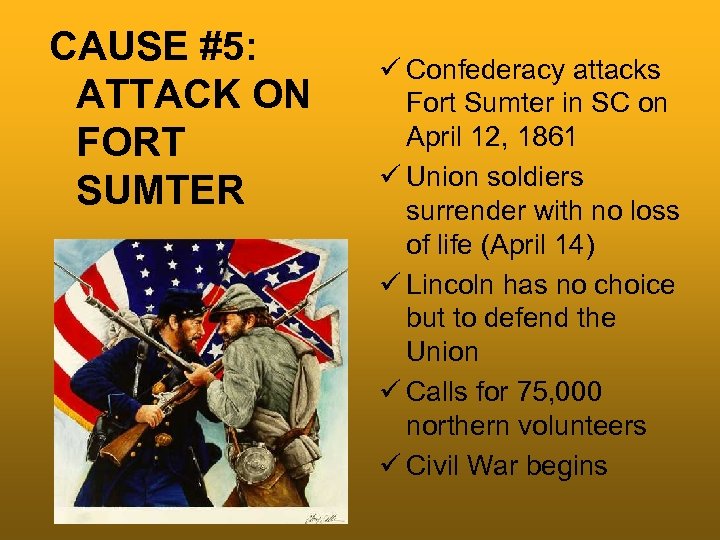 CAUSE #5: ATTACK ON FORT SUMTER ü Confederacy attacks Fort Sumter in SC on April 12, 1861 ü Union soldiers surrender with no loss of life (April 14) ü Lincoln has no choice but to defend the Union ü Calls for 75, 000 northern volunteers ü Civil War begins