Скачать презентацию A House Divided Cannot Stand The Road to
c6f135a4cc296d38deaadfdf083d426b.ppt
- Количество слайдов: 36
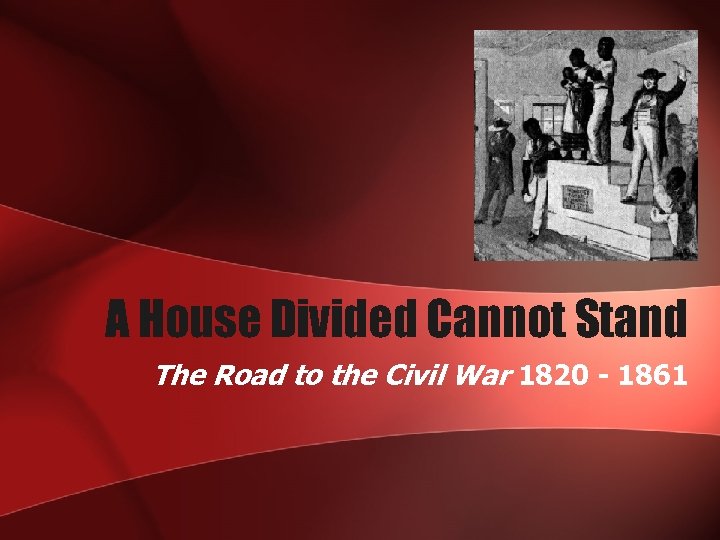 A House Divided Cannot Stand The Road to the Civil War 1820 - 1861
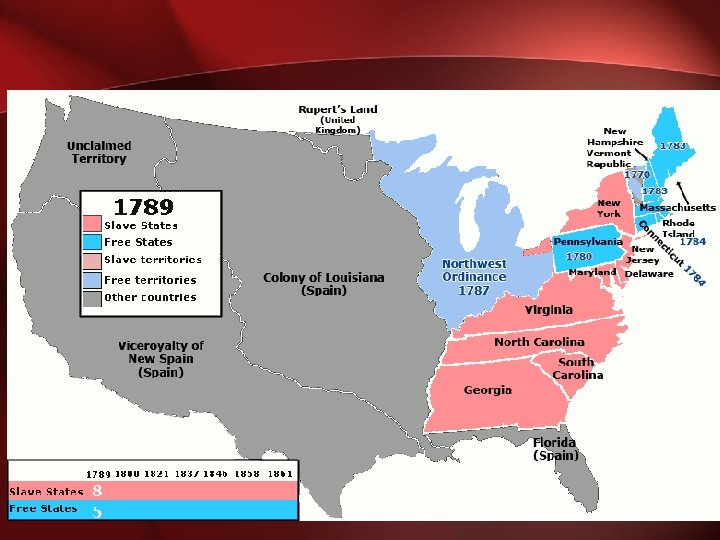
 Past efforts to curb slavery • 1787 - Banned slavery in the Old Northwest. • 1808 – Prohibited the continuation of importing slaves. • 1820 – Missouri Compromise • 1846 – Wilmot Proviso
 Past Catalysts for Slavery • Popularity of TRICk. S crops • Cotton Gin in the 1790 s • Westward expansion – Acquisition of land from Mexico
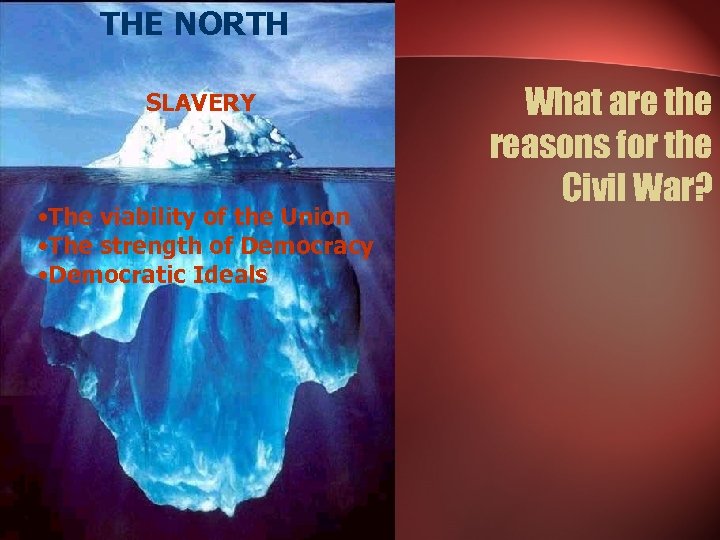 THE NORTH SLAVERY • The viability of the Union • The strength of Democracy • Democratic Ideals What are the reasons for the Civil War?
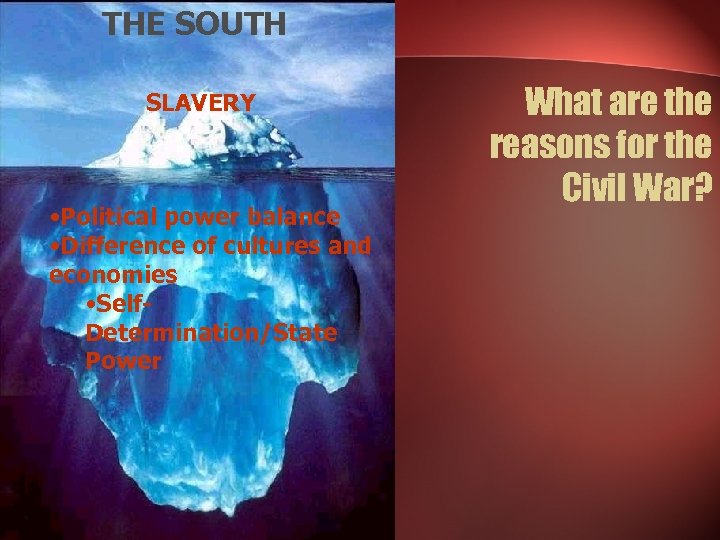 THE SOUTH SLAVERY • Political power balance • Difference of cultures and economies • Self. Determination/State Power What are the reasons for the Civil War?
 S. T. A. P. L. E. R. • • SOCIAL TECHNOLOGY ADMINISTRATION POLITICAL LEGAL ECONOMIC RELIGIOUS
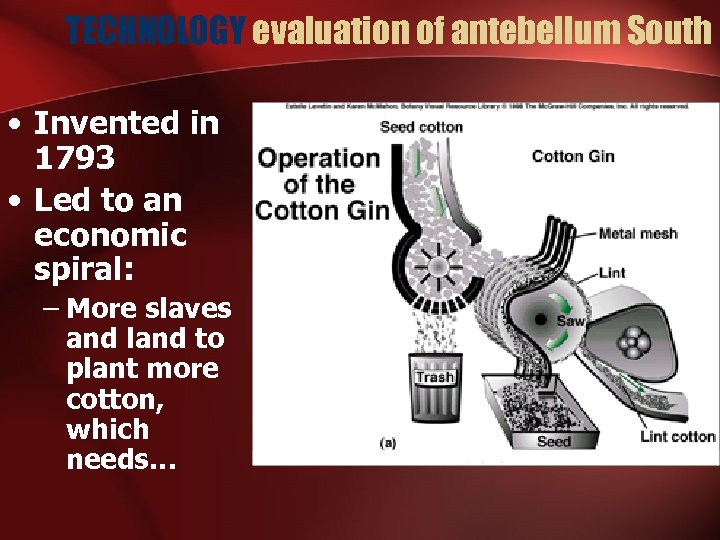 TECHNOLOGY evaluation of antebellum South • Invented in 1793 • Led to an economic spiral: – More slaves and land to plant more cotton, which needs…
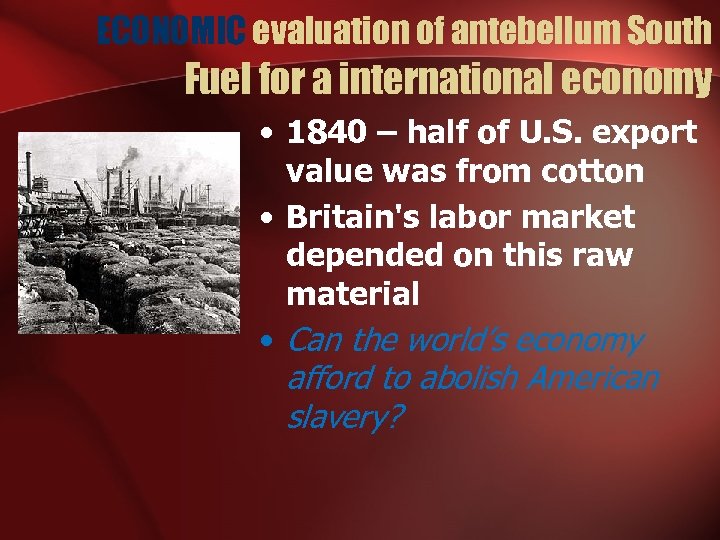 ECONOMIC evaluation of antebellum South Fuel for a international economy • 1840 – half of U. S. export value was from cotton • Britain's labor market depended on this raw material • Can the world’s economy afford to abolish American slavery?
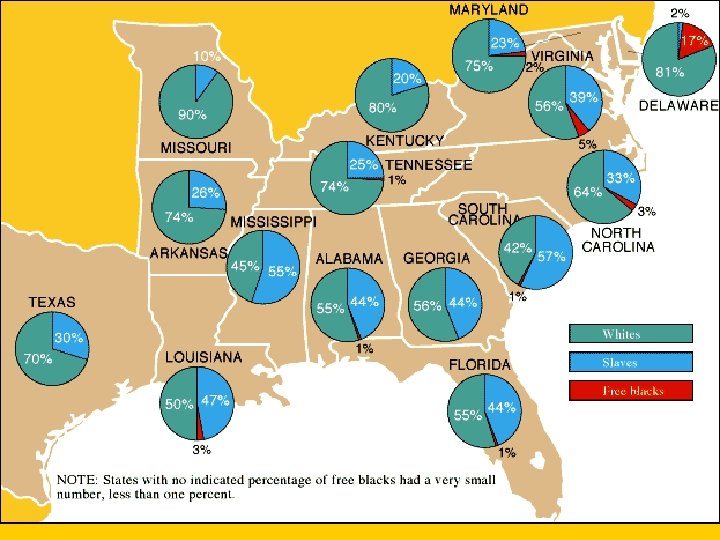
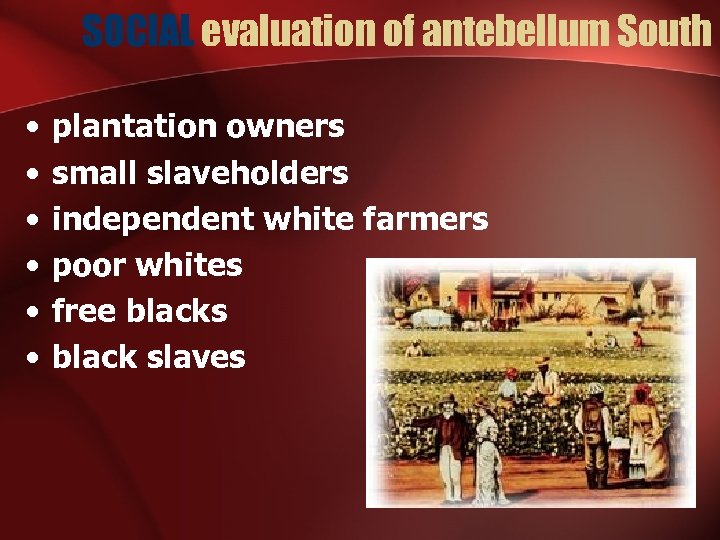 SOCIAL evaluation of antebellum South • • • plantation owners small slaveholders independent white farmers poor whites free blacks black slaves
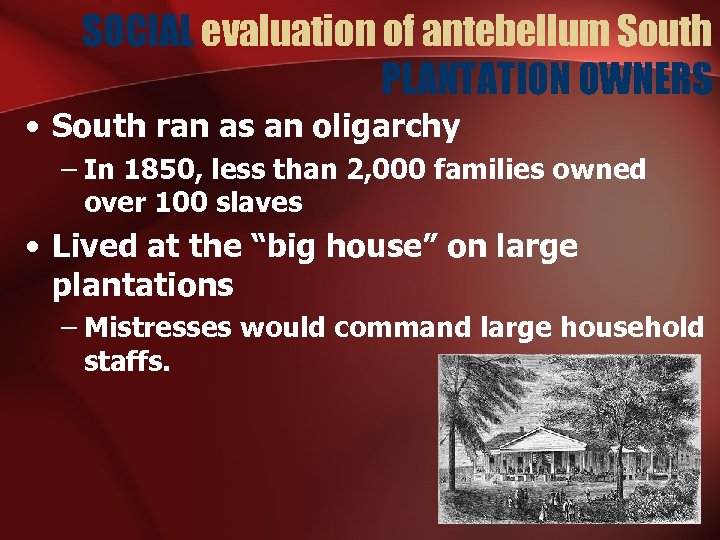 SOCIAL evaluation of antebellum South PLANTATION OWNERS • South ran as an oligarchy – In 1850, less than 2, 000 families owned over 100 slaves • Lived at the “big house” on large plantations – Mistresses would command large household staffs.
 SOCIAL evaluation of antebellum South SMALL SLAVEHOLDERS • Only ¼ of all white southerners owned slaves. • Typically small farmers
 SOCIAL evaluation of antebellum South INDEPENDENT FARMERS • Over six million non-slave owning southerners • Backcountry and mountain regions • Did not participate in the market economy. POOR WHITES • “Poor White Trash” • Seen as lazy and shiftless
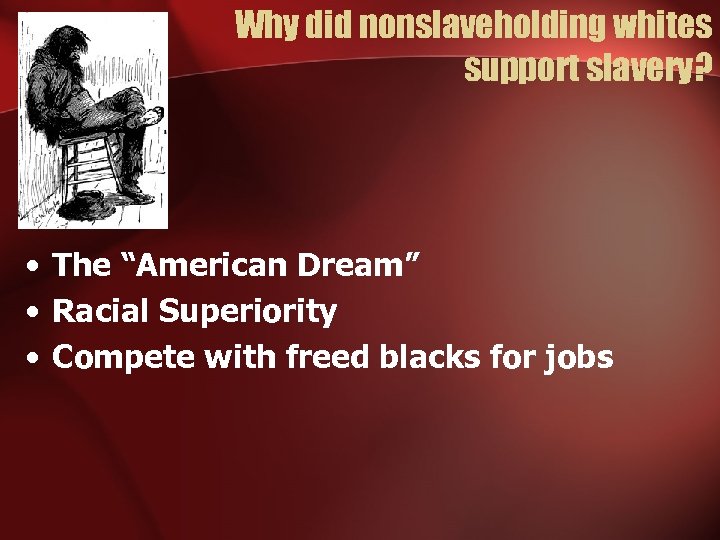 Why did nonslaveholding whites support slavery? • The “American Dream” • Racial Superiority • Compete with freed blacks for jobs
 SOCIAL evaluation of antebellum South FREE BLACKS • 250, 000 free blacks in the South by 1860. • Why freed? – Idealism from the Revolutionary War – Mulattoes from white planters and black mistresses • Strong in New Orleans • Unpopular in the North and South
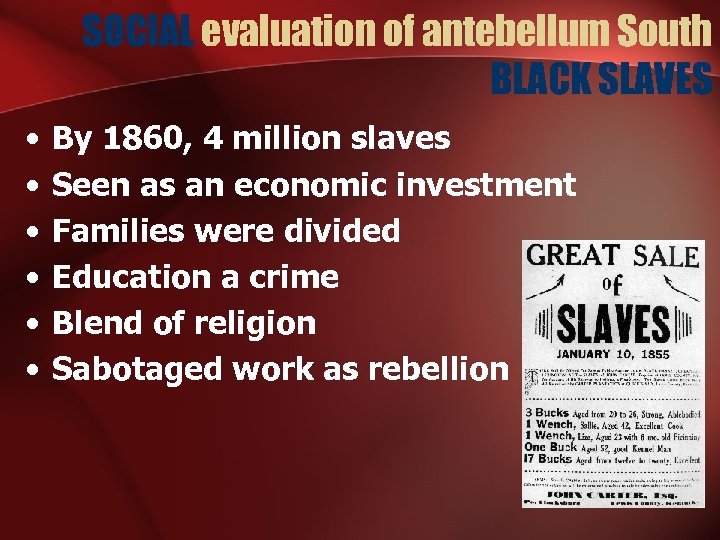 SOCIAL evaluation of antebellum South BLACK SLAVES • • • By 1860, 4 million slaves Seen as an economic investment Families were divided Education a crime Blend of religion Sabotaged work as rebellion
 Southern Defenses for Slavery • Greek and Roman cultures each featured slavery • Essential to the southern economy • Preferable to the "wage slavery" of the North • Slavery was ordained by God, permitted in the Bible ("Slaves, obey your masters") • Beneficial to the blacks who had traded the barbarism of Africa for the blessings of security and Christianity
 RELIGIOUS evaluation of antebellum South • Slave owners and slaves both used the Bible to support their views. • Northern abolitionists also used the Bible to support their cause. – Methodist Episcopalians split in 1844 – Baptists split in 1845
 S. T. A. P. L. E. R. • • SOCIAL TECHNOLOGY ADMINISTATION POLITICAL LEGAL ECONOMIC RELIGIOUS
 Political Road to War over Slavery • PUBLIC POLICY ISSUES, CONTROVERSIES and LAWS ASSOCIATED THEREWITH • Federal Supremacy vs. States’ Rights (nullification, personal liberty laws) • Expansion of slavery in the territories and Caribbean – – – – – Missouri Compromise 1820 Wilmot Proviso 1846 Free-Soil Party 1848 Popular Sovereignty 1840 s Compromise of 1850 Fugitive Slave Act 1850 Death of the Whigs in 1852 Ostend Manifesto 1853 Kansas-Nebraska Act 1854
 Missouri Compromise of 1820 • Maine admitted free • Missouri admitted slave • Maintains balance between slave and free states in the Senate • Territory north of 36° 30' in LA territory to be free of slave; south of 36° 30' can be slave • Jefferson called it the “death knell” of the Union.
 Wilmot Proviso (1846) • Congressman David Wilmot proposes that there be no slavery in any land taken from Mexico • Passes House, fails in Senate • Represents growing divide between North and South
 Free Soil Party (1848) • Platform: Keep slavery out of territories • Van Buren gets 10% of vote • New York votes ensure Taylor’s election – Whig – Sugar plantation owner from Louisiana
 Popular Sovereignty (1840 s) • Do not confuse this popular sovereignty with popular sovereignty that is a fundamental principle of constitutional government in the U. S. (i. e. , the people are sovereign). • This popular sovereignty refers to the right of the people in a territory to decide whether or not to have slavery. (Sen. Stephen Douglas, IL) • This is simple—do not think too much about this.
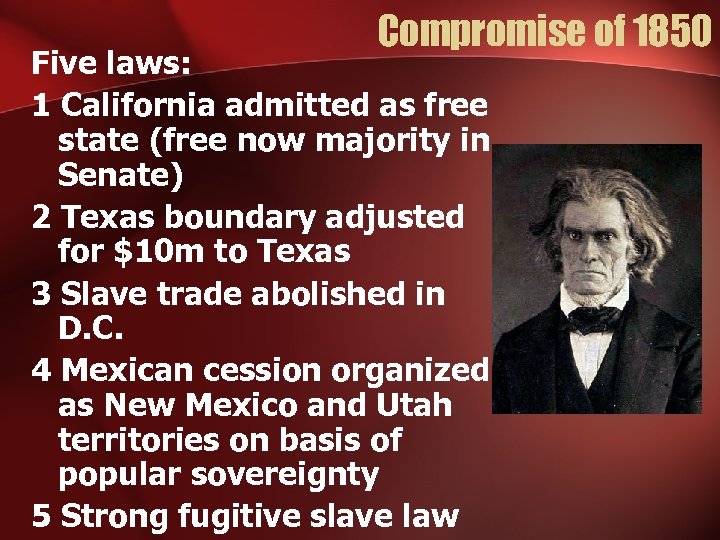 Compromise of 1850 Five laws: 1 California admitted as free state (free now majority in Senate) 2 Texas boundary adjusted for $10 m to Texas 3 Slave trade abolished in D. C. 4 Mexican cession organized as New Mexico and Utah territories on basis of popular sovereignty 5 Strong fugitive slave law
 Fugitive Slave Law of 1850 • Northerners were obligated to help slavecatchers return fugitive slaves • Prompts Northern states to pass “personal liberty laws” to prohibit enforcement of the Fugitive Slave Act • Harriet Beecher Stowe writes Uncle Tom’s Cabin • Whig party breaks up in 1852 over Fugitive Slave Act
 Death of the Whigs • Whig president Fillmore supported the Fugitive Slave Act, alienating many Northern Whigs. • The Whig party divided, and by 1854 was no more, with Northern Whigs joining the new Republican party.
 Ostend Manifesto (1854) • President Pierce, a Southern expansionist, wants to buy Cuba from Spain--Spain won’t sell • Pierce diplomats meet in Ostend, Belgium and prepare report suggesting a seizure of Cuba is Spain won’t sell • This “Ostend Manifesto” is made public and is an embarrassment to Pierce and slaveholding interests • Heightens Northern fears and tensions
 Kansas-Nebraska Act of 1854 • Senator Stephen Douglas (IL) proposes that remainder of Louisiana Territory be divided into Kansas and Nebraska territories with popular sovereignty to determine status of slavery • Free-soilers angered by this repeal of Missouri Compromise line 36° 30' • Republican Party is formed, and Northern Whigs join • Leads to “Bleeding Kansas” • Demonstrates sectional divide is becoming critical
 Uncle Tom’s Cabin (1852) • Written in response to the Fugitive Slave Act, the book is highly critical of slavery • More in the North oppose slavery • Many books attacking Stowe’s work and defending the South were written in response (Aunt Phyllis’s Cabin) • The book enflamed passions on both sides and is, arguably, the most influential book in U. S. History
 Bleeding Kansas (1856) • Bleeding Kansas • Free-soilers and slavers moved to Kansas and fought to establish control • By 1856, fighting broke out as both sides vie for power--“Bleeding Kansas” • Fighting in Kansas “foreshadows” coming of the Civil War • John Brown gets his start here!
 The Lecompton Constitution of 1857 • Pro-slavery faction at Lecompton, Kansas submits constitution to Congress for admission to U. S. —Congress refuses • Northern Democrats oppose, including Sen. Douglas (which costs him Southern Democratic support) • Lecompton Constitution crisis signals growing rift between North and South • [Kansas admitted as a free state in 1861]
 Dred Scott v. Sanford (1857) • Pro-slave Chief Justice Roger B. Taney rules that Africans are not citizens and can’t sue • Slaves have no rights • Congress cannot prohibit slavery in territories (thus the Missouri Compromise was unconstitutional) • Decision enflamed abolitionists and many Northerners, while lifting the hopes of proslavery forces • Tensions increase even more • [14 th Amendment (1868) declares blacks to be citizens, thus overcoming Dred Scott]
 Lincoln-Douglas Debates & Freeport • In Illinois Senate race, 1858, Lincoln and Douglas have debates (Lincoln lost election) • At Freeport, IL, Lincoln got Douglas to admit that if a people in a territory voted down slavery, it would “Stay down. ” • Douglas’s position was consistent with popular sovereignty but inconsistent with Dred Scott • Douglas lost support from Southern Democrats, further dividing the Democratic Party (again, remember these splits as “foreshadowing” the Civil War)
 The Democrats Splinter into Factions 1860 • The Democrats broke up before the election of 1860: Northern Democrats backed Douglas, Southern Democrats backed John C. Breckenridge, and border states (slave states next to the North) backed John Bell of Kentucky • The fracturing of the Democrats opened the door for Lincoln and the Republicans • The breakup of the Democrats in 1860 foreshadowed the coming of the Civil War in 1861