


 Скачать презентацию A House Divided and Restored 18601890 Authors Topics
ab13bda88db3bf90ac4a30a86e1129f7.ppt
- Количество слайдов: 13
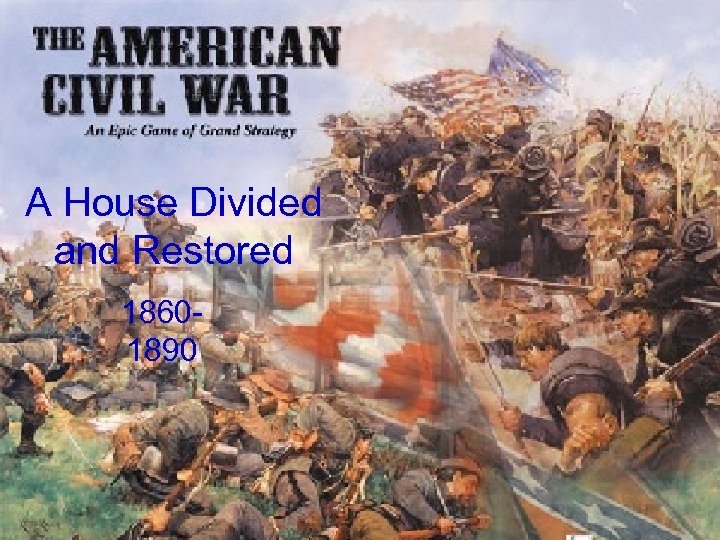 A House Divided and Restored 18601890
 Authors/Topics to be covered • • Walt Whitman’s Poetry Spirituals Frederick Douglass Abraham Lincoln Robert E. Lee Chief Joseph Henry Timrod’s Ode Mark Twain and the Rise of Local Color (onset of Realism) • Brett Harte • Ambrose Bierce
 Shift in Literature from Romanticism to Realism • Consequence of a war that destroyed certain American illusions of innocence • Romantics concentrated on the extremes of existence, the inner life of the isolated individual or the mysteries of the universe (transcendentalists) • Post Civil War writers tended to emphasize the middle ground of life and common human problems in social settings
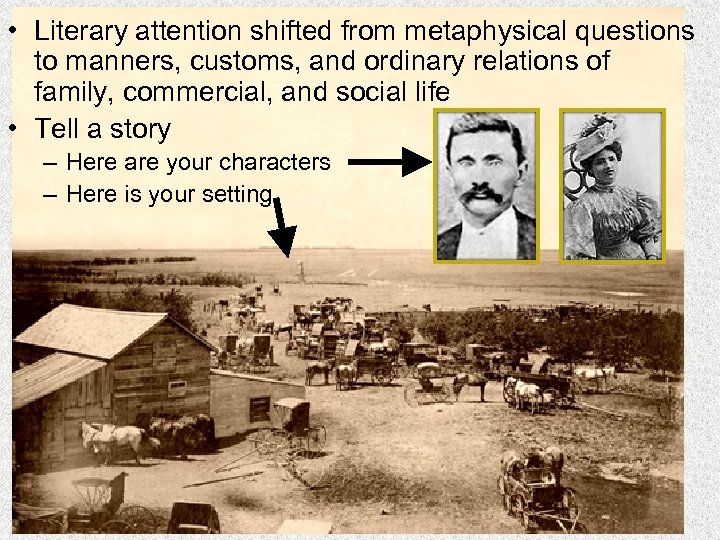 • Literary attention shifted from metaphysical questions to manners, customs, and ordinary relations of family, commercial, and social life • Tell a story – Here are your characters – Here is your setting
 The dreadful drama of the Civil War • Exposed more human limitations due to casualties, assassination, etc. • South exposed to vindictive reconstruction policies • Industrial boom continues in North to focus on civilian goods – Telephone (1876) – Railroad expansion – New emphasis on oil and electricity – Immigration grew – Food production soared • Voices of reform were now silenced and nation focused on commerce and industry
 1870 s---The Great Barbeque; Age of the Robber Barons; The Gilded Age (Twain) • “gilded”---Twain attempts to contrast the cheap and gaudy materialism of this time with the wisdom and humane values of the days of old • End of 1800 s, greater disparity between the rich and the poor, farmers and industrialists, and increase in corruption
 Romanticism to Realism • • Thoreau and Hawthorne---DEAD Emerson---OLD Melville---SILENT Longfellow and Whittier---still POPULAR, but in an old fashioned sort of way • Walt Whitman provided a connection between the romantic idealism of the 1850 s and postwar realities
 • Romantics concern with imagination, intuition, etc… • Realists place less emphasis on the imagination and more on observed fact (more scientific view)
 Local Color and Regionalism • Regional differences highlighted through literature – Distinct patterns of speech, dialects, local customs, recognizable “characters” • Purpose of this style of writing was to familiarize Americans with their own nation • Local color transitions romanticism and realism – Pays attention to dialect, customs, etc. – Human emotion and motivation often sentimentalized
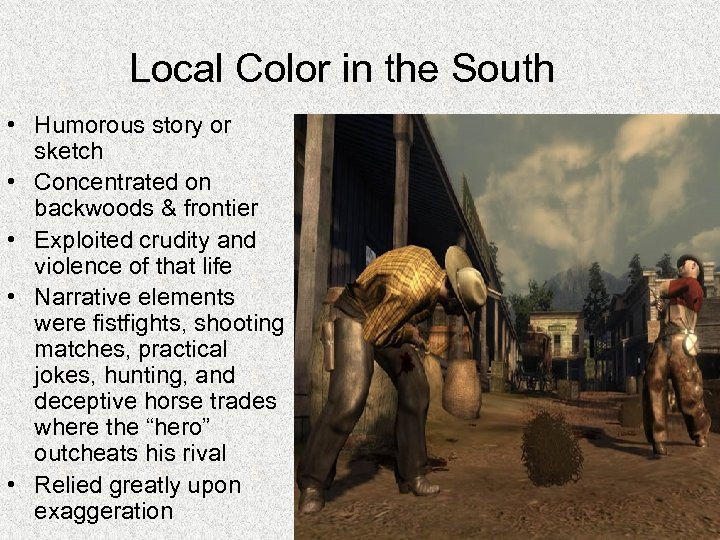 Local Color in the South • Humorous story or sketch • Concentrated on backwoods & frontier • Exploited crudity and violence of that life • Narrative elements were fistfights, shooting matches, practical jokes, hunting, and deceptive horse trades where the “hero” outcheats his rival • Relied greatly upon exaggeration
 Local Color in the North • Best local color writers were women – Harriet Beecher Stowe & Sarah Orne Jewett • Irony is an important aspect to the writing • Writers wanted to transcend local concerns to illuminate universal issues of human life • Tried to create local character types that were true to human nature in any region
 The Far West • New interest in California • San Francisco becomes financial and literary hub • Many writers tried to bring the West to mainstream, particularly Twain
 Overall • Realism tended to restrict imagination • The movement toward regional interest, while valuable in emphasizing the special qualities of a region, threatened to make literature merely regional rather than national • Yet, through writers such as Twain, local color and vernacular humor became America’s voice carried to the world