 Скачать презентацию A hotel is an establishment that provides lodging
types of hotel.pptx
- Количество слайдов: 4



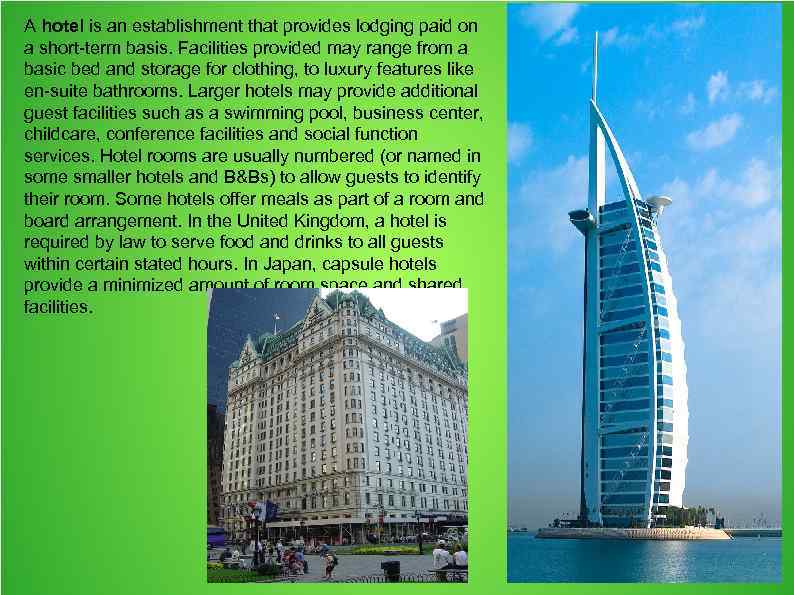
A hotel is an establishment that provides lodging paid on a short-term basis. Facilities provided may range from a basic bed and storage for clothing, to luxury features like en-suite bathrooms. Larger hotels may provide additional guest facilities such as a swimming pool, business center, childcare, conference facilities and social function services. Hotel rooms are usually numbered (or named in some smaller hotels and B&Bs) to allow guests to identify their room. Some hotels offer meals as part of a room and board arrangement. In the United Kingdom, a hotel is required by law to serve food and drinks to all guests within certain stated hours. In Japan, capsule hotels provide a minimized amount of room space and shared facilities.
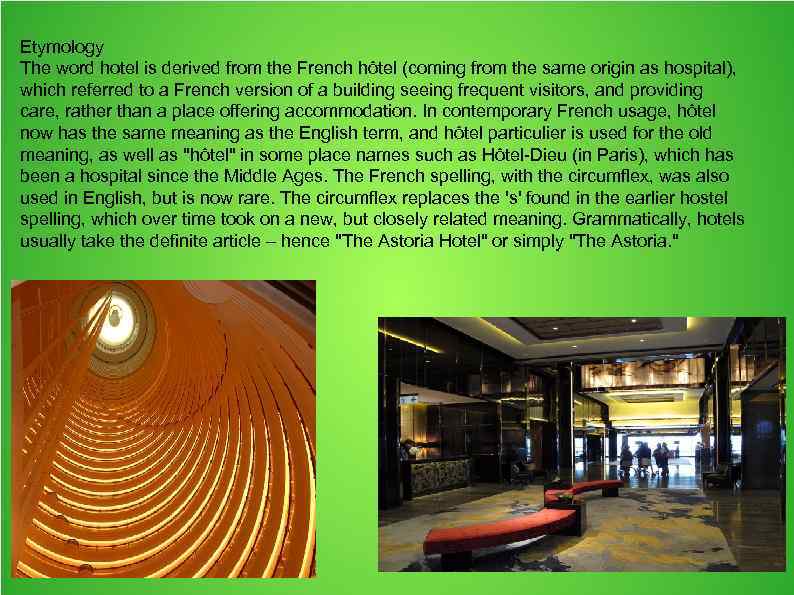
Etymology The word hotel is derived from the French hôtel (coming from the same origin as hospital), which referred to a French version of a building seeing frequent visitors, and providing care, rather than a place offering accommodation. In contemporary French usage, hôtel now has the same meaning as the English term, and hôtel particulier is used for the old meaning, as well as "hôtel" in some place names such as Hôtel-Dieu (in Paris), which has been a hospital since the Middle Ages. The French spelling, with the circumflex, was also used in English, but is now rare. The circumflex replaces the 's' found in the earlier hostel spelling, which over time took on a new, but closely related meaning. Grammatically, hotels usually take the definite article – hence "The Astoria Hotel" or simply "The Astoria. "
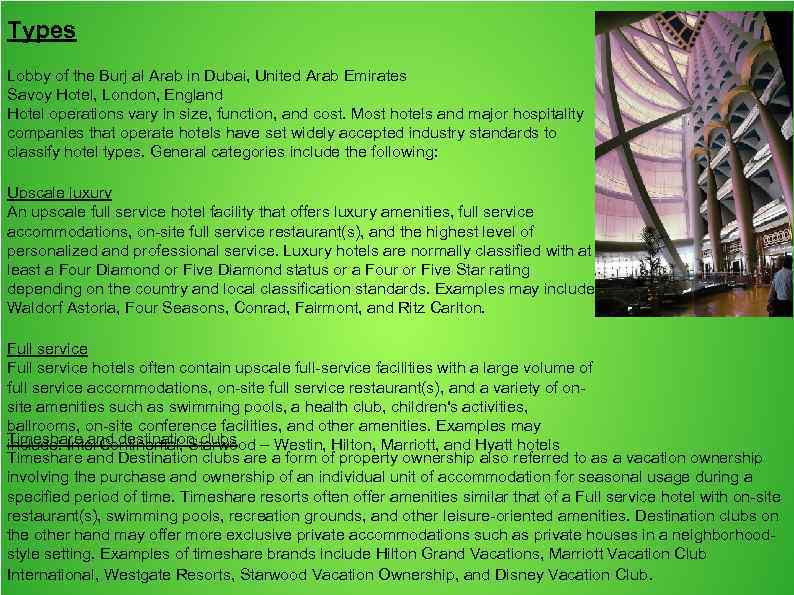
Types Lobby of the Burj al Arab in Dubai, United Arab Emirates Savoy Hotel, London, England Hotel operations vary in size, function, and cost. Most hotels and major hospitality companies that operate hotels have set widely accepted industry standards to classify hotel types. General categories include the following: Upscale luxury An upscale full service hotel facility that offers luxury amenities, full service accommodations, on-site full service restaurant(s), and the highest level of personalized and professional service. Luxury hotels are normally classified with at least a Four Diamond or Five Diamond status or a Four or Five Star rating depending on the country and local classification standards. Examples may include: Waldorf Astoria, Four Seasons, Conrad, Fairmont, and Ritz Carlton. Full service hotels often contain upscale full-service facilities with a large volume of full service accommodations, on-site full service restaurant(s), and a variety of onsite amenities such as swimming pools, a health club, children's activities, ballrooms, on-site conference facilities, and other amenities. Examples may Timeshare and destination clubs – Westin, Hilton, Marriott, and Hyatt hotels include: Inter. Continental, Starwood Timeshare and Destination clubs are a form of property ownership also referred to as a vacation ownership involving the purchase and ownership of an individual unit of accommodation for seasonal usage during a specified period of time. Timeshare resorts often offer amenities similar that of a Full service hotel with on-site restaurant(s), swimming pools, recreation grounds, and other leisure-oriented amenities. Destination clubs on the other hand may offer more exclusive private accommodations such as private houses in a neighborhoodstyle setting. Examples of timeshare brands include Hilton Grand Vacations, Marriott Vacation Club International, Westgate Resorts, Starwood Vacation Ownership, and Disney Vacation Club.
Historic inns and boutique hotels Boutique hotels are smaller independent non-branded hotels that often contain upscale facilities of varying size in unique or intimate settings with full service accommodations. Some historic inns and boutique hotels may be classified as luxury hotels. Focused or select service Small to medium-sized hotel establishments that offer a limited amount of on-site amenities that only cater and market to a specific demographic of travelers, such as the single business traveler. Most focused or select service hotels may still offer full service accommodations but may lack leisure amenities such as an on-site restaurant or a swimming pool. Examples include Courtyard by Marriott and Hilton Garden Inn. Economy and limited service Small to medium-sized hotel establishments that offer a very limited amount of on-site amenities and often only offer basic accommodations with little to no services, these facilities normally only cater and market to a specific demographic of travelers, such as the budget-minded traveler seeking a "no frills" accommodation. Limited service hotels often lack an on-site restaurant but in return may offer a limited complimentary food and beverage amenity such as on-site continental breakfast service. Examples include Hampton Inn, Aloft, Holiday Inn Express, Fairfield Inn, Four Points by Sheraton, and Days Inn. Extended stay hotels are small to medium-sized hotels that offer longer term full service accommodations compared to a traditional hotel. Extended stay hotels may offer non-traditional pricing methods such as a weekly rate that cater towards travelers in need of short-term accommodations for an extended period of time. Similar to limited and select service hotels, on-site amenities are normally limited and most extended stay hotels lack an on-site restaurant. Examples include Staybridge Suites,
Скачать презентацию A hotel is an establishment that provides lodging
types of hotel.pptx