


 Скачать презентацию A History of the Institutional Controversy and Division
a1e13e7853aa2e99f411cd066bd590f4.ppt
- Количество слайдов: 36
 A History of the Institutional Controversy and Division #1 – The 19 th Century Restoration and Division
 Sadly, bitterness and wild charges often go with division • Conservatives oft called “orphan-haters” & “anti-cooperation, ” thus labeled as “antis. ” – “While there a few places where ‘anti-ism’ is still a real threat to the true faith, it is generally of no consequence. Isolated little groups of ‘antis’ still meet; but they are withering away and are having no appreciable effect on the brotherhood at large…”
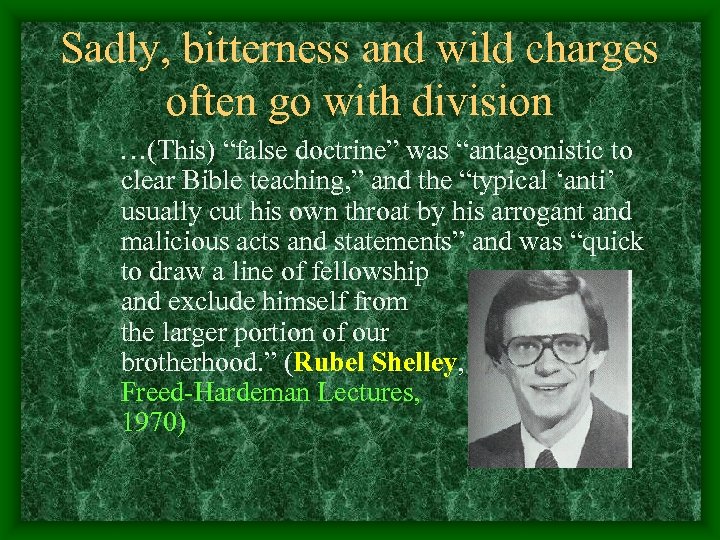 Sadly, bitterness and wild charges often go with division …(This) “false doctrine” was “antagonistic to clear Bible teaching, ” and the “typical ‘anti’ usually cut his own throat by his arrogant and malicious acts and statements” and was “quick to draw a line of fellowship and exclude himself from the larger portion of our brotherhood. ” (Rubel Shelley, Freed-Hardeman Lectures, 1970)
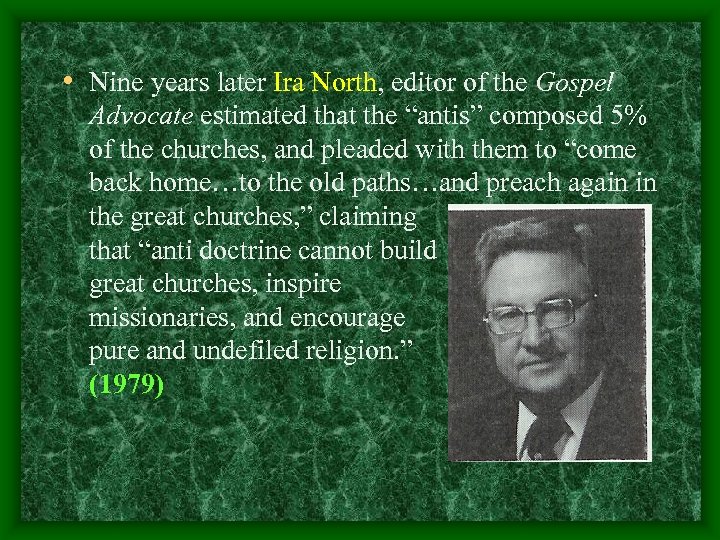 • Nine years later Ira North, editor of the Gospel Advocate estimated that the “antis” composed 5% of the churches, and pleaded with them to “come back home…to the old paths…and preach again in the great churches, ” claiming that “anti doctrine cannot build great churches, inspire missionaries, and encourage pure and undefiled religion. ” (1979)
 Sadly, bitterness and wild charges often go with division • A college professor argued that those who believe that Christians could “visit the fatherless and widows by taking them in your home” have “taken the narrow, crooked pig-path of radicalism. ”
 Sadly, bitterness and wild charges often go with division • A college professor argued that those who believe that Christians could “visit the fatherless and widows by taking them in your home” have “taken the narrow, crooked pig-path of radicalism. ” (Would you consider that a “radical” statement? )
 I. The Bible and Apostasy • The Old Testament period was full of apostasy – (Deut. 31: 19 -21) “Now therefore write this song…and teach it to the children of Israel: put it in their mouths, that this song may be a witness for me against the children of Israel. For when I shall have brought them into the land which I swore unto their fathers, flowing with milk and honey, and they shall have eaten and filled themselves, and waxed fat; then will they turn unto other gods, and serve them, and despise me, and break my covenant…”
 The Bible and Apostasy • The New Testament presents a similar picture – (Acts 20: 28 -30) “Take heed unto yourselves, and to all the flock, in which the Holy Spirit hath made you bishops, to feed the church of the Lord which he purchased with his own blood. I know that after my departing grievous wolves shall enter in among you, not sparing the flock; and from among your own selves shall men arise, speaking perverse things, to draw away the disciples after them. ”
 • (I Tim. 4: 1 -2) “But the Spirit says expressly, that in later times some shall fall away from the faith, giving heed to seducing spirits and doctrines of demons, through the hypocrisy of men that speak lies, branded in their own conscience as with a hot iron…” • (Heb. 3: 12) “Take heed, brethren, lest haply there shall be in any one of you an evil heart of unbelief, in falling away from the living God”
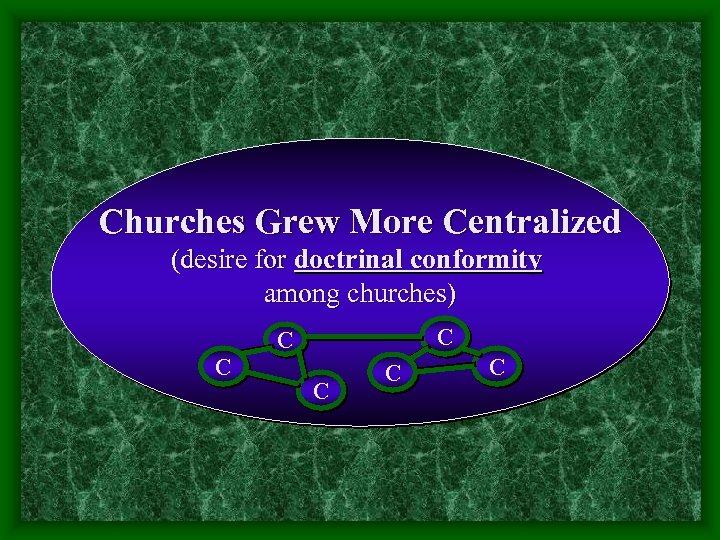 Churches Grew More Centralized (desire for doctrinal conformity among churches) C C C
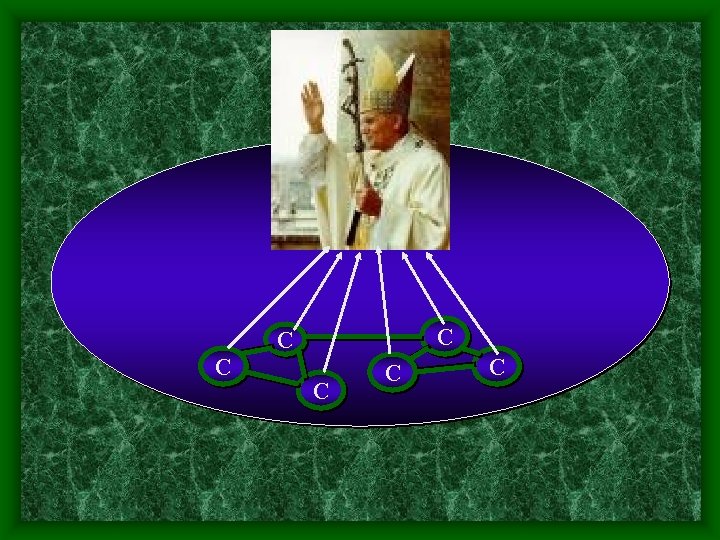 C C C
C C C
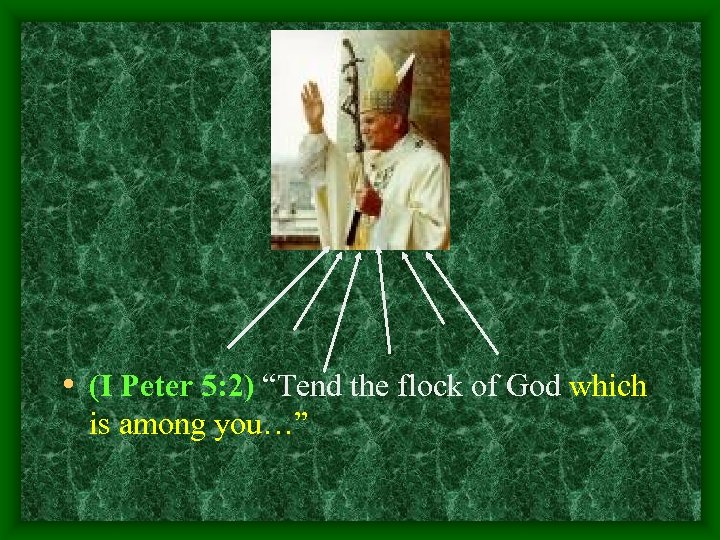 • (I Peter 5: 2) “Tend the flock of God which is among you…”
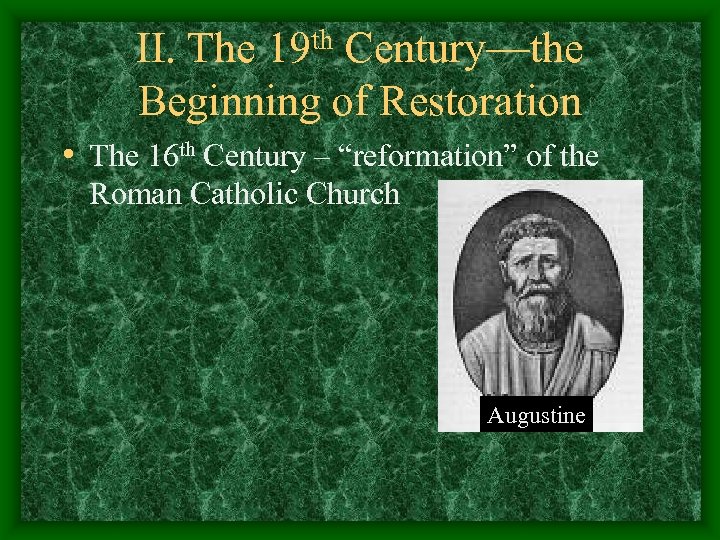 II. The 19 th Century—the Beginning of Restoration • The 16 th Century – “reformation” of the Roman Catholic Church Augustine
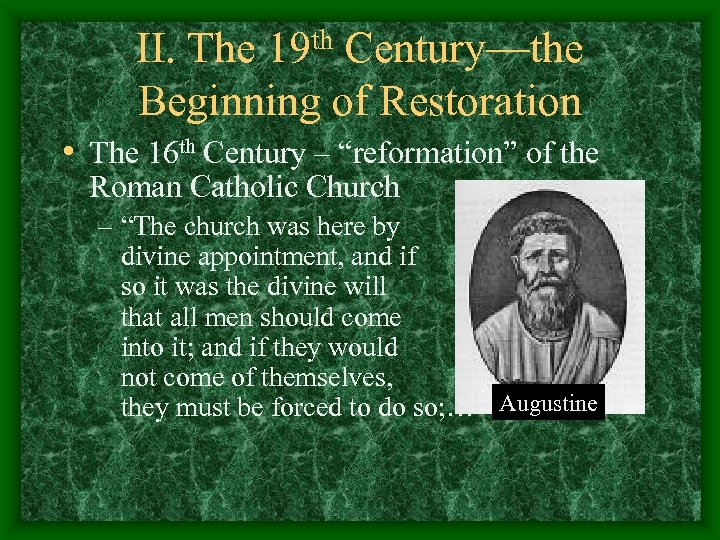 II. The 19 th Century—the Beginning of Restoration • The 16 th Century – “reformation” of the Roman Catholic Church – “The church was here by divine appointment, and if so it was the divine will that all men should come into it; and if they would not come of themselves, they must be forced to do so; … Augustine
 II. The 19 th Century—the Beginning of Restoration • The 16 th Century – “reformation” of the Roman Catholic Church – …and if the church lacked the power of compulsion, it was the sacred duty which the state owed to the church to come to its rescue, and by the might of the sword ‘compel them to come in, ’ that the church might be filled. ” (V. G. Allen Alexander, The Continuity of Christian Thought, pp. 152, 153)
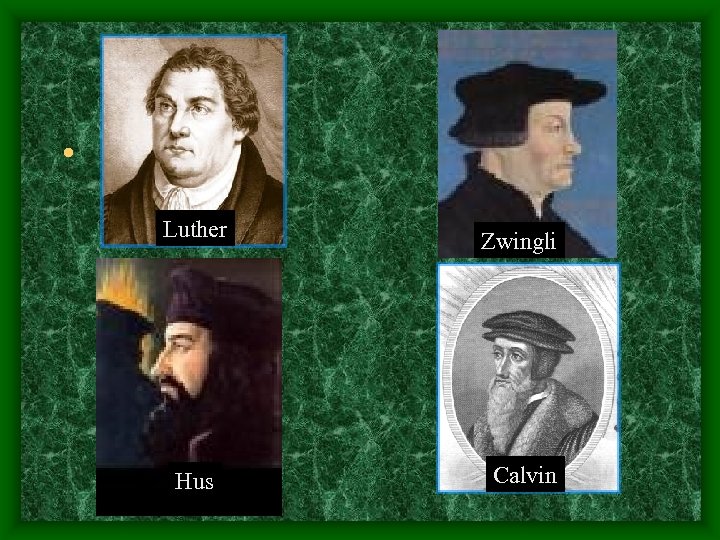 • Luther Zwingli Hus Calvin
 The 19 th Century—the Beginning of Restoration • Around 1800, serious efforts are made at restoring the ancient order of things. – James O’Kelly – “The Republican Methodists”
 – “Brethren, this is a sufficient rule of faith and practice, and by it we are told that the disciples were called Christians, and I move that henceforth and forever the followers of Christ be known as Christians simply. ” (Rice Haggard, Aug. 4, 1794)
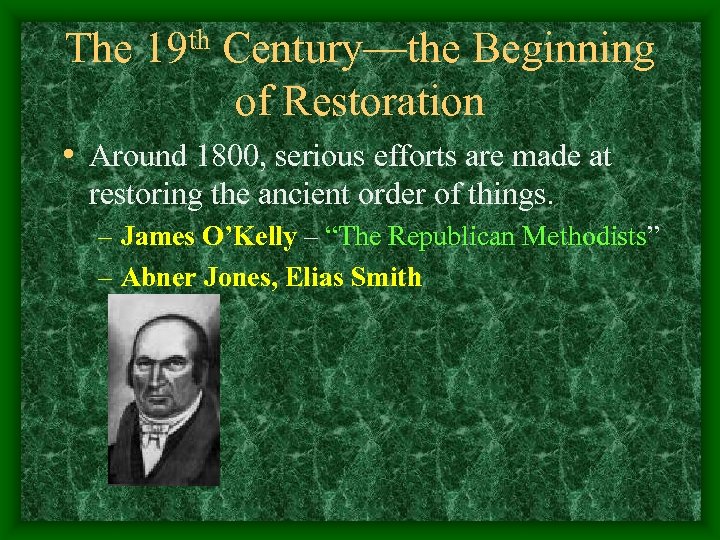 The 19 th Century—the Beginning of Restoration • Around 1800, serious efforts are made at restoring the ancient order of things. – James O’Kelly – “The Republican Methodists” – Abner Jones, Elias Smith
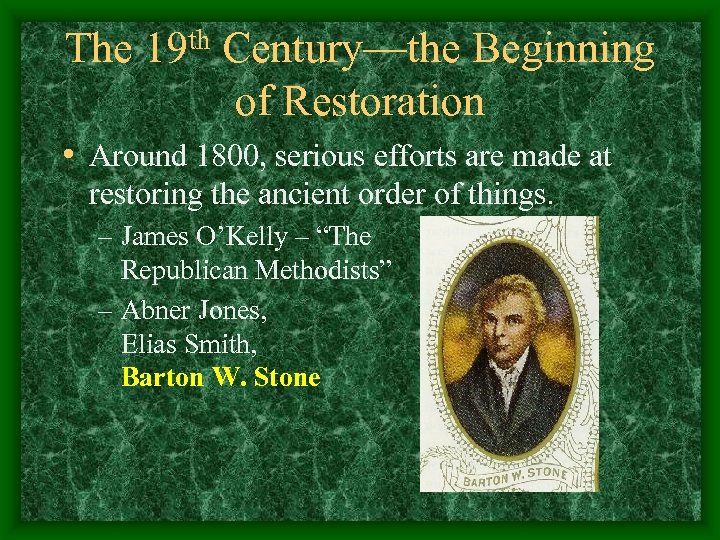 The 19 th Century—the Beginning of Restoration • Around 1800, serious efforts are made at restoring the ancient order of things. – James O’Kelly – “The Republican Methodists” – Abner Jones, Elias Smith, Barton W. Stone
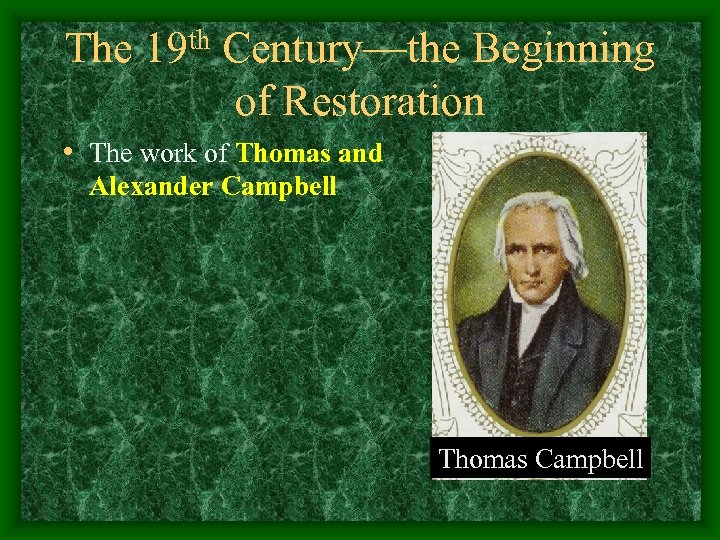 The 19 th Century—the Beginning of Restoration • The work of Thomas and Alexander Campbell Thomas Campbell
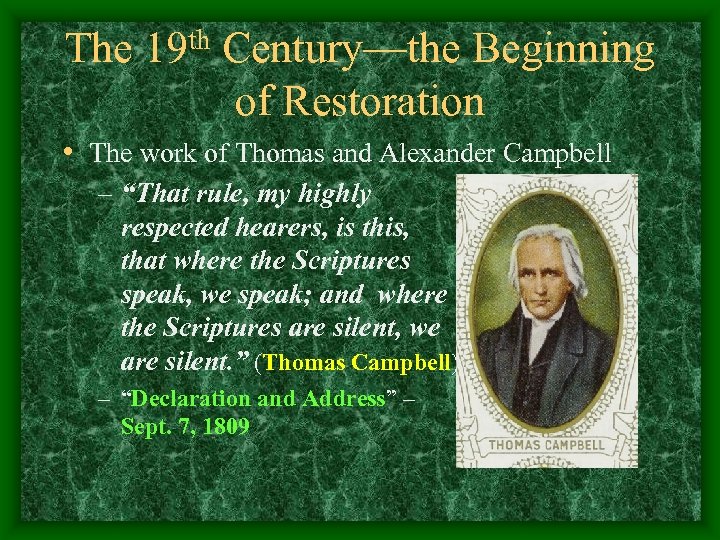 The 19 th Century—the Beginning of Restoration • The work of Thomas and Alexander Campbell – “That rule, my highly respected hearers, is this, that where the Scriptures speak, we speak; and where the Scriptures are silent, we are silent. ” (Thomas Campbell) – “Declaration and Address” – Sept. 7, 1809
 • “…first, that the will of Christ included the revelation and imposition of a definite doctrinal and ecclesiastical program. Second, that the Scriptures give an inerrant report of the teaching of Jesus and His apostles and the procedure of the church of the first century, so that any verse in the New Testament could be quoted with perfect assurance of its historical accuracy…
 …Third, that the teaching authority of Jesus had passed over undiminished to the apostles, so that both the injunctions and the examples of the apostles possessed complete authority over the church for all time, that their teachings were as the commands of God, and that the practice of the church of the apostolic age constituted a pattern which the church must permanently follow. ” (Winfred Ernest Garrison, Religion Follows the Frontier, 95 -6)
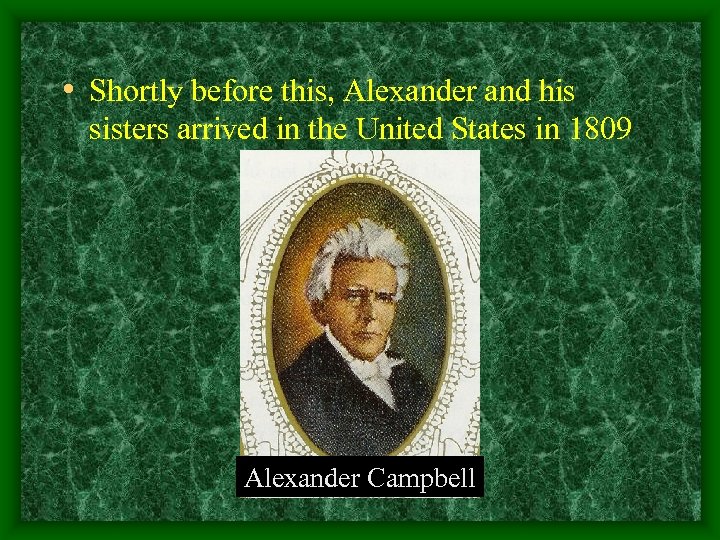 • Shortly before this, Alexander and his sisters arrived in the United States in 1809 Alexander Campbell
 SPREAD OF THE “CHRISTIANS ONLY” PLEA – 1830 -1849
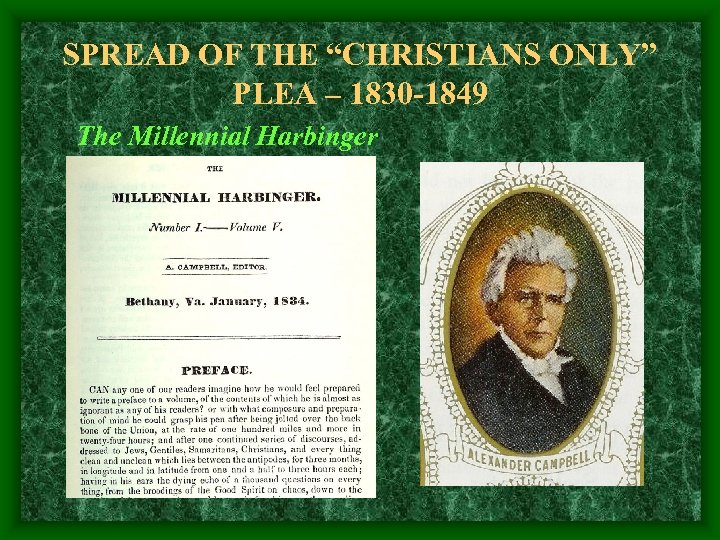 SPREAD OF THE “CHRISTIANS ONLY” PLEA – 1830 -1849 The Millennial Harbinger
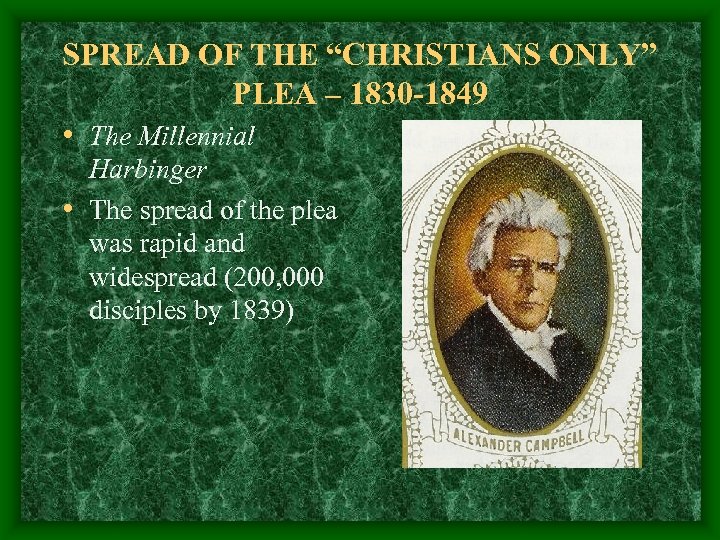 SPREAD OF THE “CHRISTIANS ONLY” PLEA – 1830 -1849 • The Millennial Harbinger • The spread of the plea was rapid and widespread (200, 000 disciples by 1839)
 SPREAD OF THE “CHRISTIANS ONLY” PLEA – 1830 -1949 • The causes of this growth were rooted in the zeal of the believers – “How is such a rapid growth, with no societies, no machinery, no central head or headquarters, to be accounted for? The answer is: They had a message, they believe their message to be the greatest discovery of the age and need of the world; hence, fired with the zeal of discoverers, they became propagandists of the first rank” (Homer Hailey, Attitudes and Consequences, p. 93).
 SPREAD OF THE “CHRISTIANS ONLY” PLEA – 1830 -1949 • Dark clouds appear on the horizon • As the movement continued to grow, there was a growing sentiment for a stronger organized force than the cooperation meetings “He (Raines) believed there were tendencies, which, unless checked, would lead to state organizations and to a ‘United States organization of the congregations’ which would be a dangerous consolidation of power” (Alonzo Willard Fortune, The Disciples in KY, p. 166)
 1849—The Beginning of the End • The American Christian Missionary Society • From the very first, there were strenuous objections
 – “It was said that the Book of God knows nothing of a confederation of churches in an ecclesiastical system, culminating in an earthly head, for government or for any other purpose…It was a dangerous precedent, a departure from the principles for which we have always contended…” (Archibald Mc. Lean, The Foreign Missionary Society, p. 20).
 1849—The Beginning of the End • 1860—Trouble about instrumental music – “There were those who believed the church should move on with the rest of the world and adapt the spirit of the New Testament to conditions that were ever changing. They held that, when not forbidden by the New Testament, they were free to adapt their program to changing needs….
 …On the other hand, there were those who believed the matter of the church was fixed for all time, and the fact that certain things were not sanctioned was sufficient ground for rejecting them. The men on both sides were equally honest, but they had a different approach to these issues that were raised. ” (Fortune, pp. 364, 365)
 1849—The Beginning of the End • “I wonder not, then, that an organ, a fiddle, or a Jews-harp, should be requisite to stir up their carnal hearts, and work into ecstasy their animal souls…and that all persons who have no spiritual discernment, sympathies of renewed hearts, should call for such aids, is but natural. ” • He further stated that “to all spiritually-minded Christians, such aids would be as a cow bell in a concert. ” (Alexander Campbell, Millennial Harbinger, 1851, pp. 581, 582)
 1849—The Beginning of the End • By the turn of the century, the lines were pretty well drawn, and the division was all but complete. – In the 1906 U. S. Census, churches of Christ and the Christian Church were recognized as separate entities—no longer one band of disciples.