 Скачать презентацию A History of the Early HST Bob O Dell
a0342e2b99e183b7a2e0133d0bd6859e.ppt
- Количество слайдов: 70



A History of the Early HST Bob O’Dell STSc. I -21 April 2006 A highly personal version of the history of the program up through launch.
1923 • Hermann Oberth publishes “Die Rakete zu den Planetenraumen” • In this small book he elucidates most of the modern reasons for putting telescopes in space.
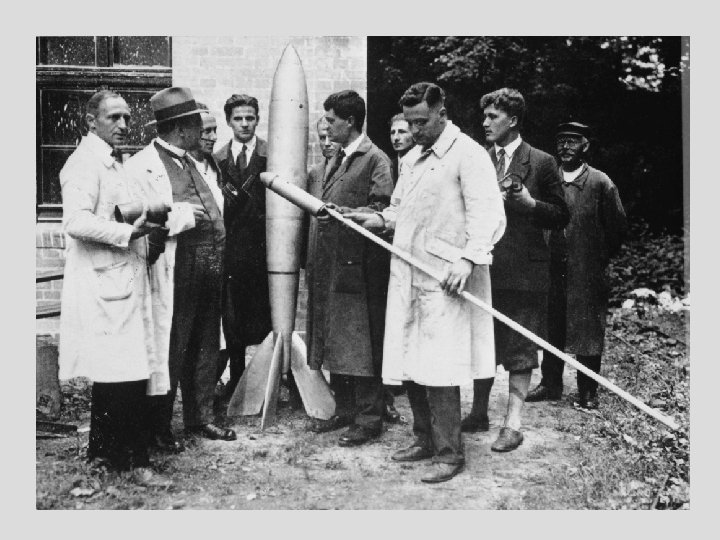
The Berlin Spaceship Society
1945 “Army Surplus” V-2 Rockets come to the US.
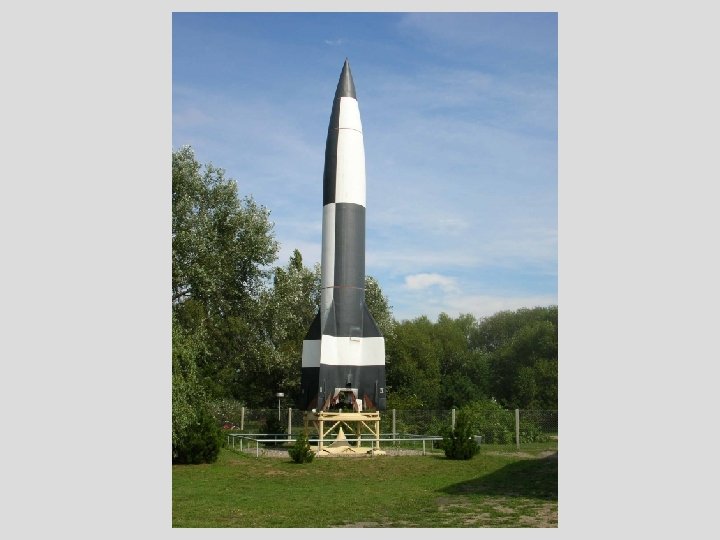
V 2 Small
1946 • The first “Think-Tank”, the RAND corporation commissions a study of potential uses of rockets. • Lyman Spitzer, then a 32 year old professor at Yale is included. • In his study he proposes building space observatories, leading up to something very similar to today’s HST.
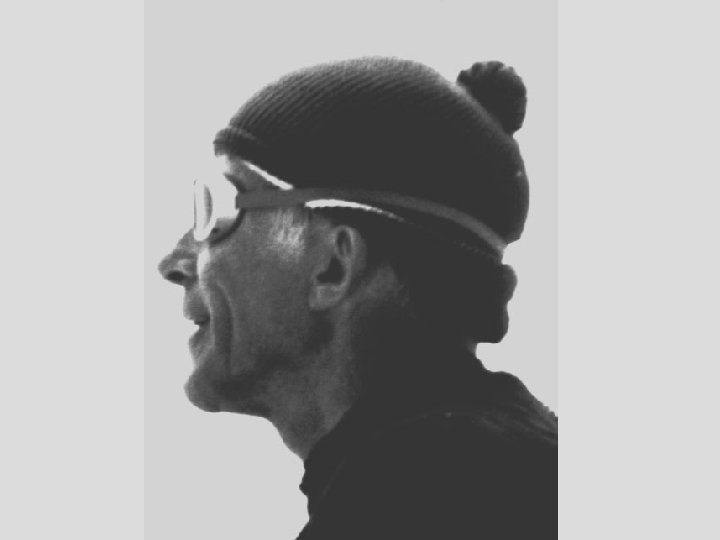
Lyman Spitzer
Earliest Years • 1957 Soviets launch Sputnik. • 1958 NASA created as the civilian space agency to counter the Soviets. • 1962 The NAS’s SSB identifies as a goal for NASA the creation of a large space observatory.
Early Astronomical Satellites • The OAO series was the first large astronomy satellites. • They employed a common outer supportsystems module with different astronomy instruments inside. • OAO-A 2 launched in 1968 (Wisconsin & Smithsonian). • OAO-C (Copernicus launch in 1972, PI Lyman Spitzer). • The IUE (a joint US -ESA) satellite was launched into geosynchronous orbit in 1978.
1969 -Getting ready for HST. • NASA establishes the Astronomy Missions Board to define astronomy payloads over more than a decade. Our report in 1969 included the goal of the HST. • Also published in 1969 was “Chairman Spitzer’s Little Black Book. ” • In 1969 a three person panel of consultants recommended to von Braun that MSFC should go for several astronomical satellites, including the HST.
1971 -72 Feasibility Studies and the Roman Group. • One of the first things NASA did was to establish if the project was feasible (a Phase-A Study). • In parallel with studies by multiple contractors a group of scientists was convened at NASA HQ by Roman to provide feedback.
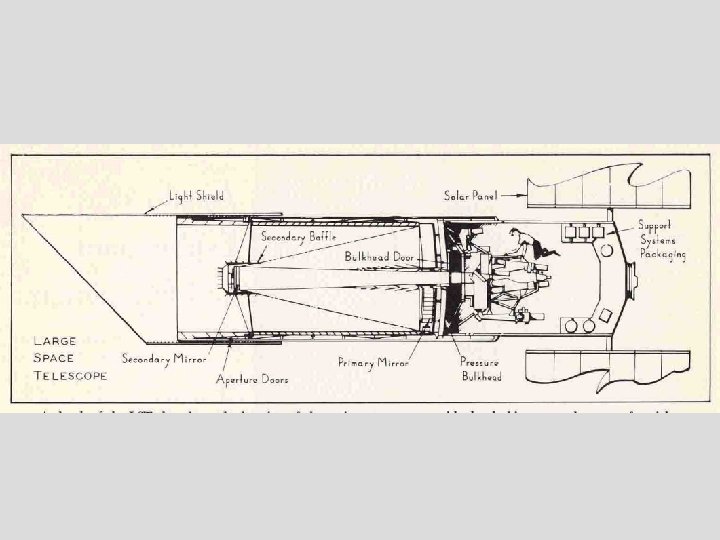
1972 -3 m. Cross. Section
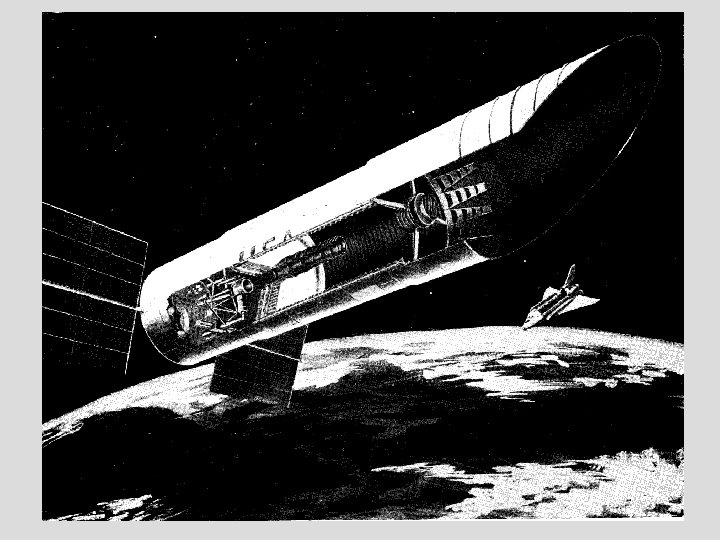
1972 -3 m. Configuration
1972 -MSFC becomes the Lead Center • Associate Administrator John Naugle was convinced that MSFC would do a better job on this magnitude of task, although GSFC would retain responsibility for the SI’s and operations. • MSFC had no optical astronomers. • Stuhlinger approached Spitzer about becoming Project Scientist, which would have involved spending lots of time in Huntsville. • Spitzer fingered me as “the man” and Naugle backed this idea.
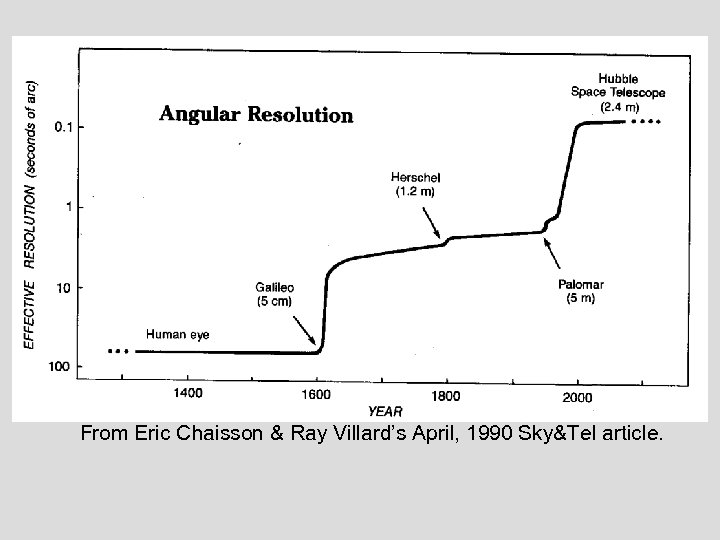
From Eric Chaisson & Ray Villard’s April, 1990 Sky&Tel article.
1973 -A broad Scientific Base is established. • I came on board in September, 1972. • In December NASA issued an AO for creation of Instrument Definition Teams, the leaders plus a few generalists would form a Science Working Group. • January, 1973 a dog-and-pony show was presented at Cal. Tech, Chicago, and Harvard advertising the AO.
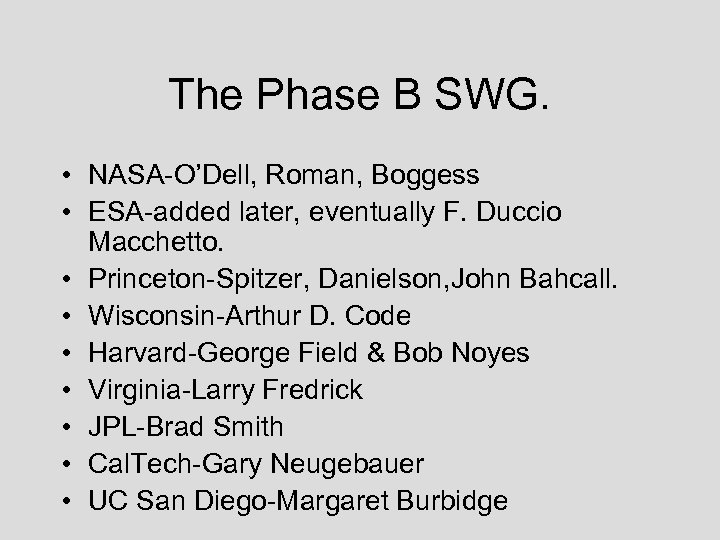
The Phase B SWG. • NASA-O’Dell, Roman, Boggess • ESA-added later, eventually F. Duccio Macchetto. • Princeton-Spitzer, Danielson, John Bahcall. • Wisconsin-Arthur D. Code • Harvard-George Field & Bob Noyes • Virginia-Larry Fredrick • JPL-Brad Smith • Cal. Tech-Gary Neugebauer • UC San Diego-Margaret Burbidge
1974 • However, we needed an even broader constituency. • This was done in part by having special sessions at the AAS. • The pivotal event was the January 30 AIAA meeting.
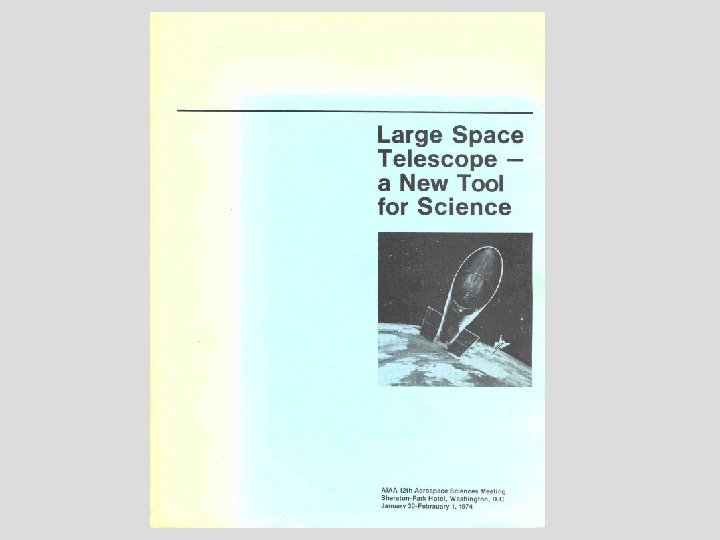
AIAA Cover
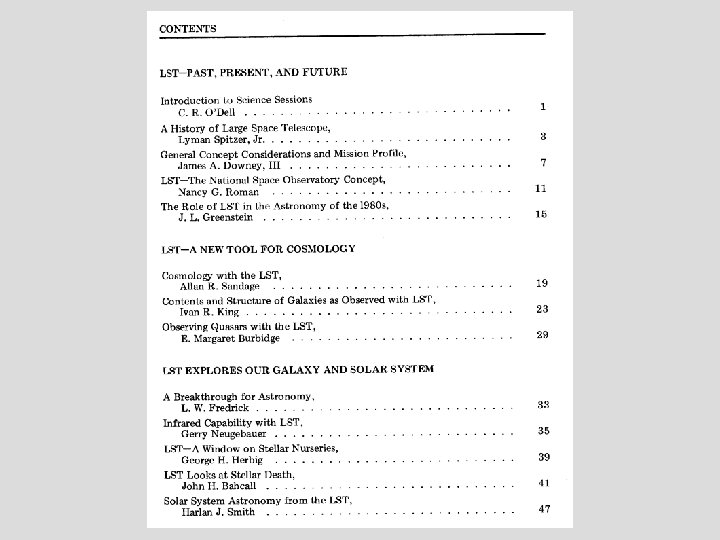
AIAA Science Speakers.
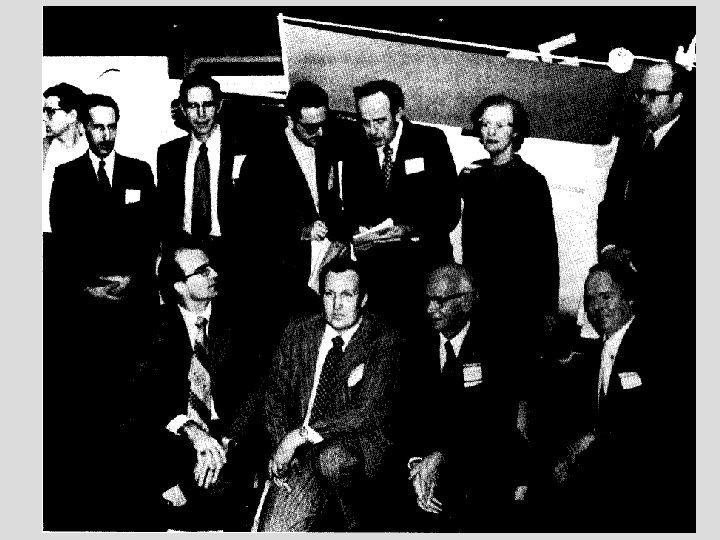
AIAA Participants
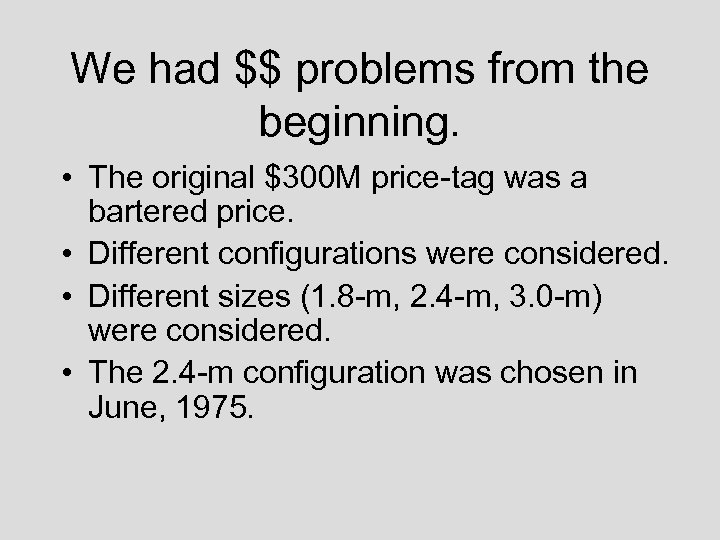
We had $$ problems from the beginning. • The original $300 M price-tag was a bartered price. • Different configurations were considered. • Different sizes (1. 8 -m, 2. 4 -m, 3. 0 -m) were considered. • The 2. 4 -m configuration was chosen in June, 1975.
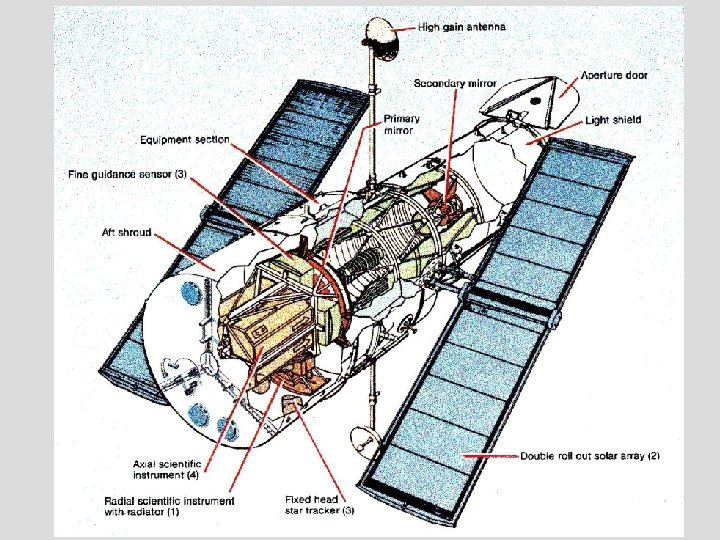
HST Cutaway Cropped
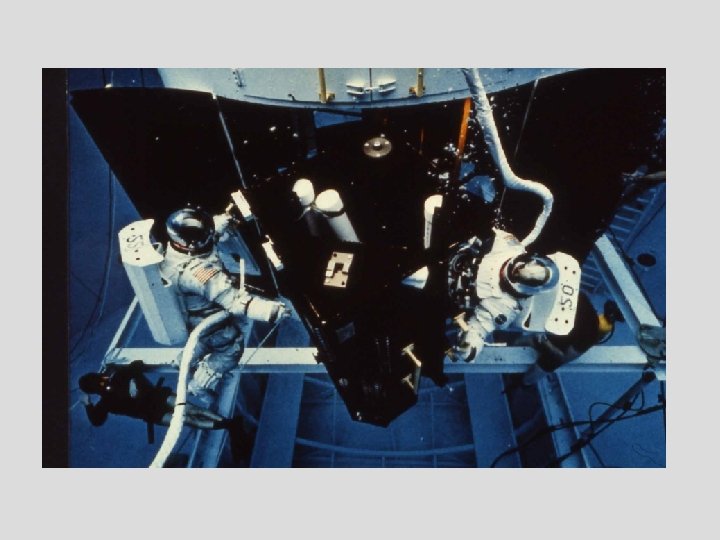
NBS Axial SI Replacement
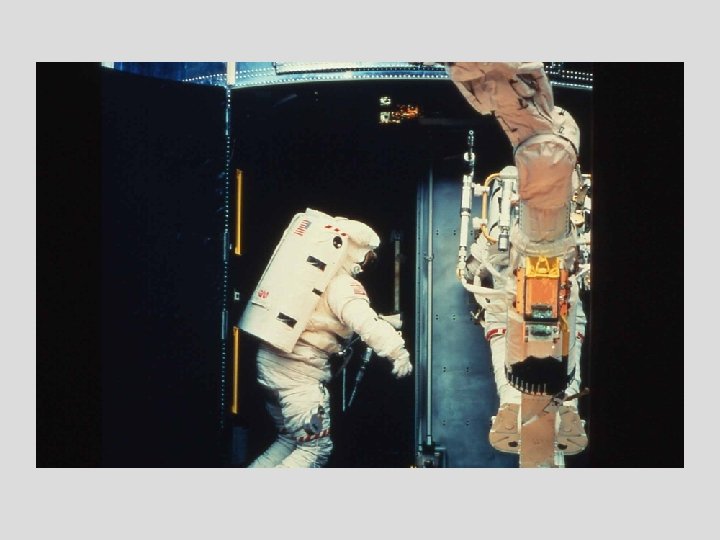
SM 1 Axial SI Replacement
1975 -Seeking Funding for Actual Construction (Phase C/D) • The escalating identified costs caused many in the Congress to balk. Several times the program was considered dead. • NASA negotiates its budgets internally, then with the White House, and then the Congress approves-modifies-rejects the submitted presidential budget. • NASA employees must support the submitted budget and DO NOT make end-runs to Capitol Hill.
Convincing the Congress • Non-NASA scientists COULD go directly to the key members of the House and Senate. • This was done with wisdom and vigor by Lyman Spitzer and John Bahcall. • The truth of their arguments won the day, which may not have been the case without them. • In the early years these efforts kept HST alive as congress stretched out the Phase B activities. • In the final years, the lobbying efforts resulted in the HST being included in the FY 1978 budget almost in spite of NASA.
1976 -European Participation • The first major joint NASA-ESA venture was the IUE (launched in 1978). • Negotiations with the ESA started in Phase B as soon as we started having cost problems. • The areas of participation were finally narrowed down to the Solar Arrays and a Scientific Instrument (the FOC). • Although probably financially and scientifically attractive, the primary determinant was the will of the Congress. • A NASA-ESA agreement was reached in late 1976.
FY 1978 -HST is given its New Start (Phase C/D) funding. • This was anticipated by the selection of the contractors to build the optical system (Perkin-Elmer) and the overall observatory (Lockheed-Martin). • To the scientists, the greater impact was the selection of science-teams (with associated contractors) to provide the SI’s (scientific instruments).
The SI’s Selected. • The Wide Field/Planetary Camera; PI, Jim Westphal of Cal. Tech. • The Faint Object Spectrograph; PI, Richard Harms of UC San Diego. • The Goddard High Resolution Spectrograph; PI, Jack Brandt (Sally Heap). • The High Speed Photometer; PI, Bob Bless of the University of Wisconsin. • The Faint Object Camera; ESA (preselected) PI Duccio Macchetto & Henk van de Hulst. • Astrometry with the FGS; Leader, Bill. Jeffereys
The Phase C/D SWG. • NASA-Project Scientist (O’Dell, Brown, Boggess), and Program Scientist Ed Weiler. • SI Team Leaders (seven in all, John Trauger of JPL added later). • Telescope Scientists: Dan Schroeder -Beloit College & Bill Fastie-JHU) • At Large Members: John Caldwell. Toronto, Malcolm Longair-Edinburgh, Ed Groth -Princeton(Physics), David Lambert. Texas, John Bahcall, and Riccardo Giacconi (added).
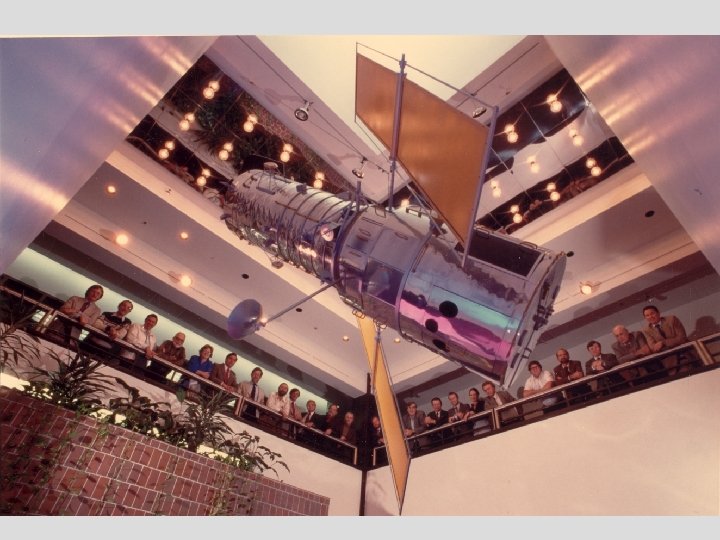
HST SWG Phase C/D
Where were the Princeton Astronomers? • Of course JNB was from the IAS, Ed Groth from PU-Physics and Jim Gunn (a WF/PC co. I) were in Phase C/D. • However, Bob Danielson had died and Spitzer led a team proposing a camera with an obsolete detector. • Their earlier activity became a hindrance in proposing a modern instrument.
How was the Science Data to be managed? • Traditionally astronomer’s data didn’t transport well (mostly photographic). • NASA’s experience was similar, with the instrument teams exclusively using the results from the spacecraft. • Clearly, these were NOT the ways to do the HST.
Data Rights and Distribution • Very early we established that the GTO’s were to have a rapidly decreasing reward in use of the SI’s. • This meant that GO’s would be the primary users of the SI’s. • It was clear that there had to be a central facility(ies) for routine processing and archiving the data.
How was the Science to be Managed? • Astronomers were used to the national facilities being run by consortia of universities. • KPNO+CTIO-AURA, NRAO-AUI. • The idea of the STSc. I was first advocated by the ad hoc Ramsey Committee in 1965, before HST was started, but then forgotten. • Within the HST project, an STSc. I was first advocated by the Project Scientist in 1972, eventually this idea was embraced by the Phase B SWG. • A National Academy of Science study in July, 1976 endorsed the concept and NASA reluctantly accepted it.
1981 -The STSc. I is Established. • A call for bids to run the STSc. I was made in December, 1979; this described the type of institute to be built. • Five formal responses were received. • Semi-finalists were AUI-Princeton and AURAJHU. • AURA was selected in January, 1980 and appointed Arthur Code the acting first director, then succeeded by Riccardo Giacconi.
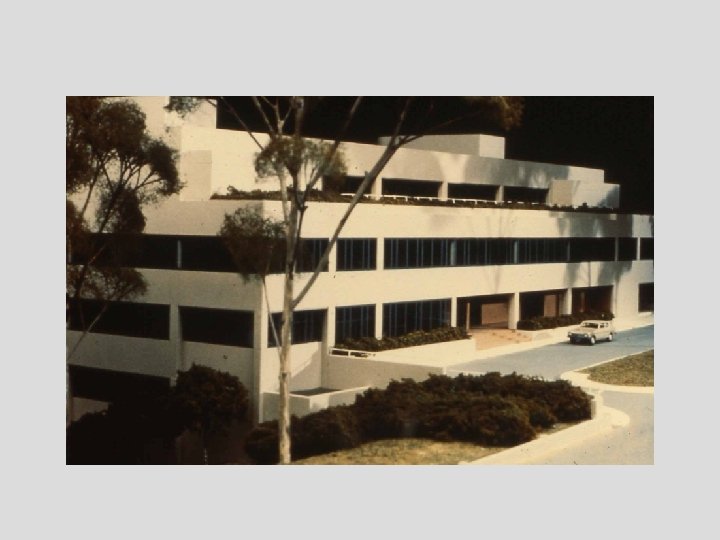
Model of the STSc. I
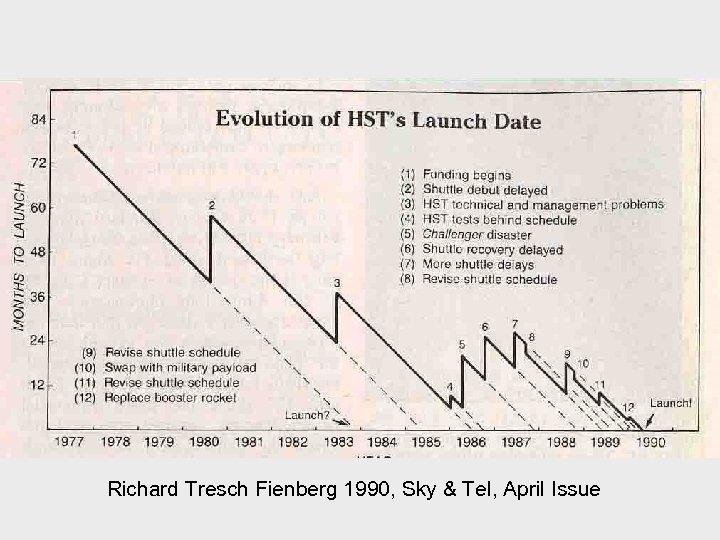
Schedule History Richard Tresch Fienberg 1990, Sky & Tel, April Issue
1983 -The HST is named. • 1971 Large Space Telescope • 1975 Space Telescope • 1983 Hubble Space Telescope
OTA Development Problems • The manufacture of a light-weight, highly precise mirror was considered to be an established technology by the project managers. • As the primary mirror was being tested and finished, the FGS was shown to be inadequate. • This all occurred as a new Project Manager came on-board, whose mandate was to control the escalating costs.
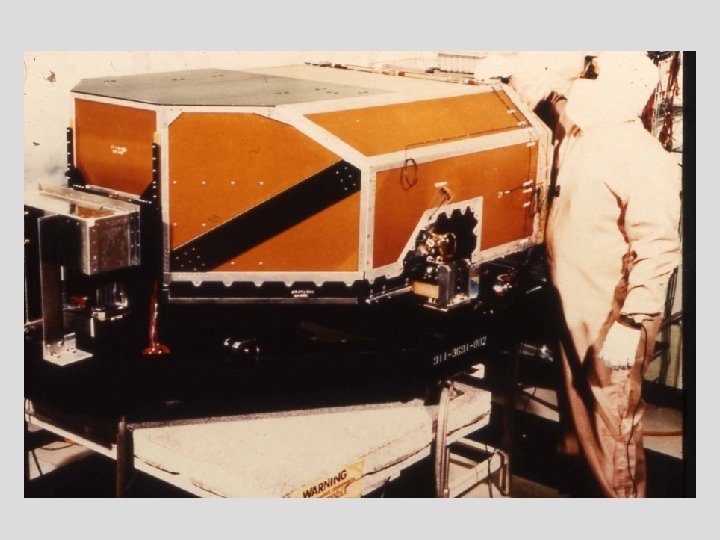
One of the FGS
Spherical Aberration • This was discovered as the first images were made. • The cause was a misaligned optical device used to measure the shape of the primary mirror. • This device made the mirror appear to be flat when it was of the right shape.
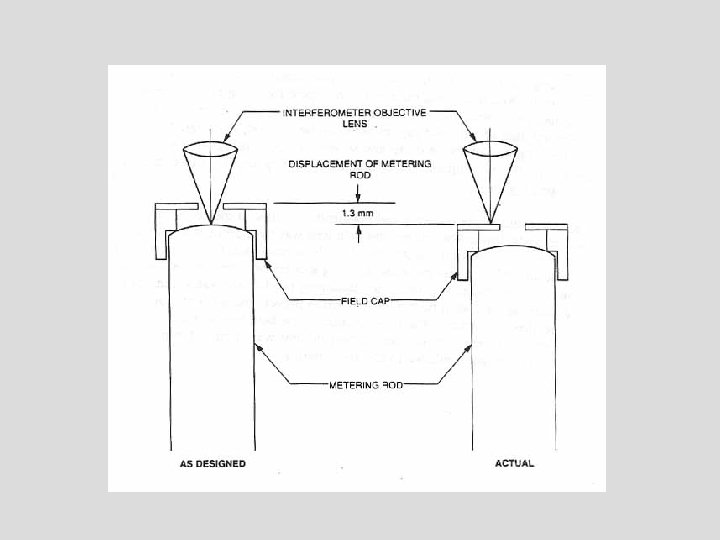
The Direct Mistake
Contributing Factors • The primary mirror was not considered the most demanding part of the HST. • The method of testing had become routine. • Management was concentrating on a redesign of the FGS, which WAS new. • The resident MSFC QA person had not been changed. • The report on the anomaly with the alignment was not forwarded to MSFC.
SI Development Problems • Each SI had its own set of problems. • The FOC was the most complex instrument, but ESA did the most testing and quality assurance. • The HSP was the simplest SI. Although it grew in cost, it remained simple.
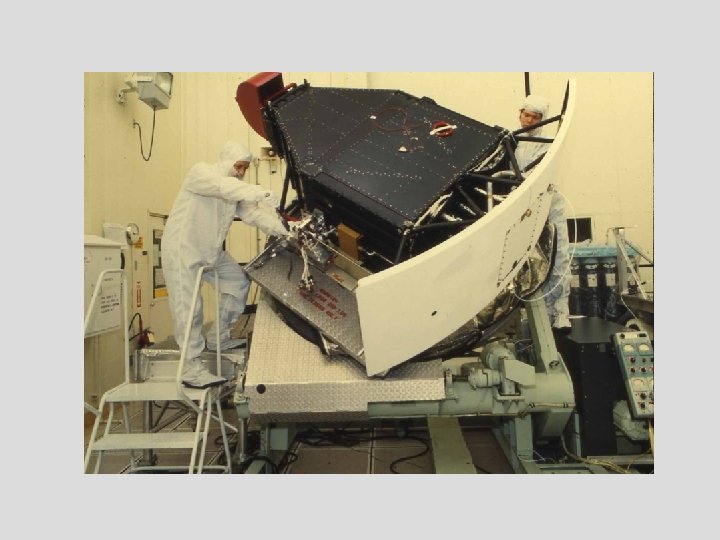
WF/PC Prelaunch
Spacecraft Development Problems. • LMSC had at least its share of problems, however they were usually within areas of their experience and expertise. • An important interface change was when the Gyros were made the primary source of pointing information, with updating by the FGS, rather than the reverse.
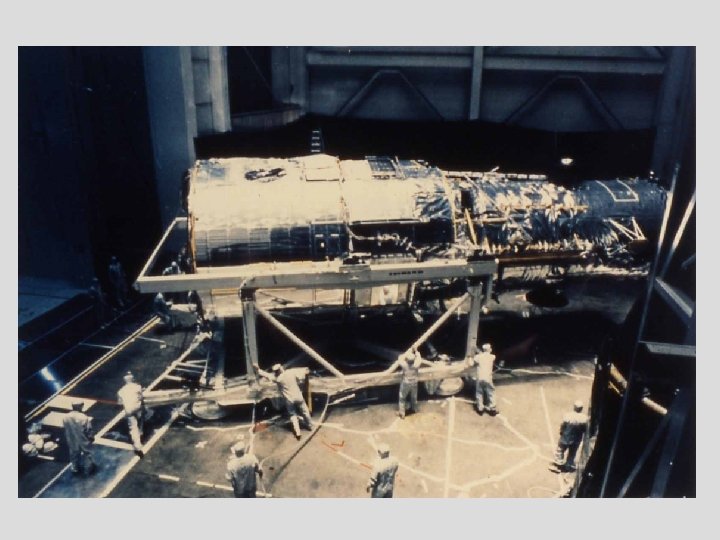
HST-LMSC Horizontal Move
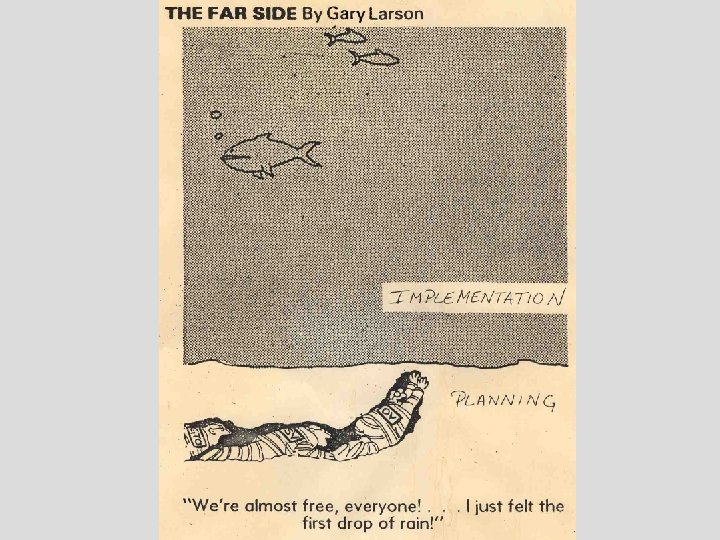
JAW Cartoon
1990 HST is Launched.
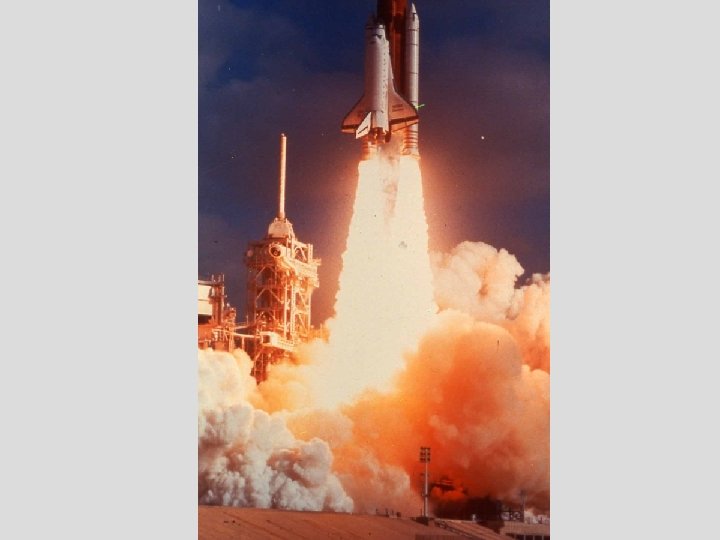
Launch
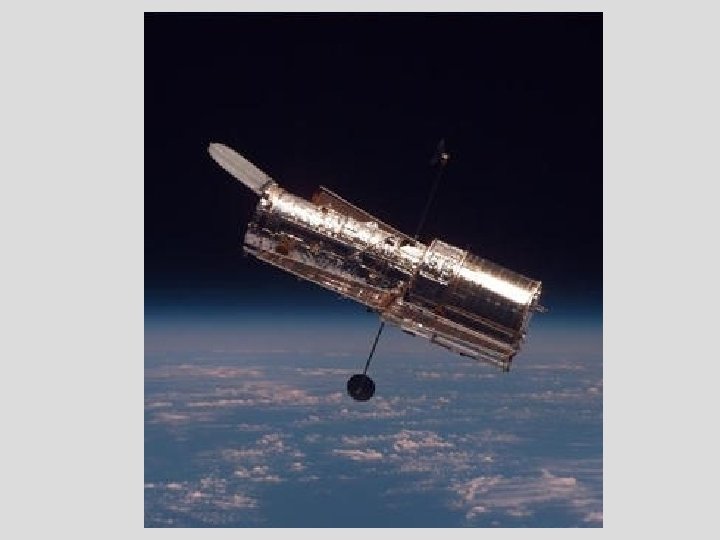
HST in Orbit
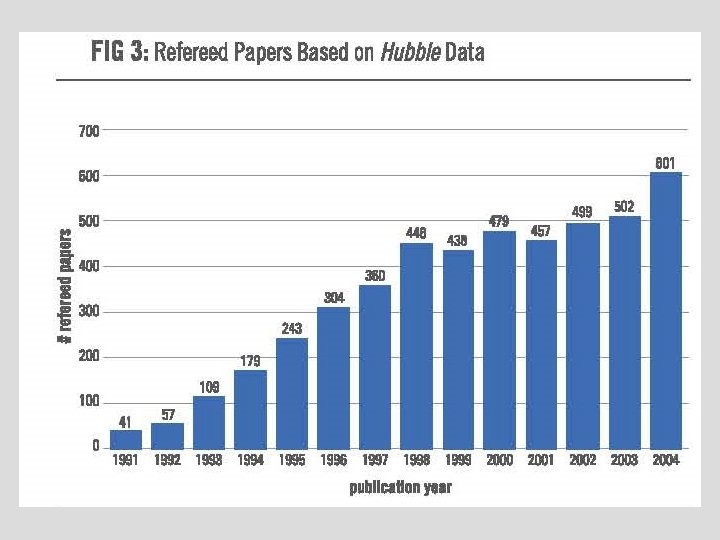
Scientific Productivity
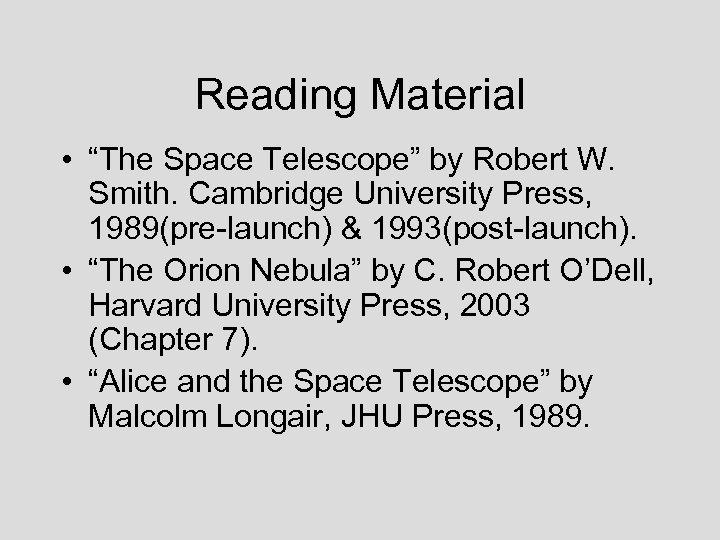
Reading Material • “The Space Telescope” by Robert W. Smith. Cambridge University Press, 1989(pre-launch) & 1993(post-launch). • “The Orion Nebula” by C. Robert O’Dell, Harvard University Press, 2003 (Chapter 7). • “Alice and the Space Telescope” by Malcolm Longair, JHU Press, 1989.
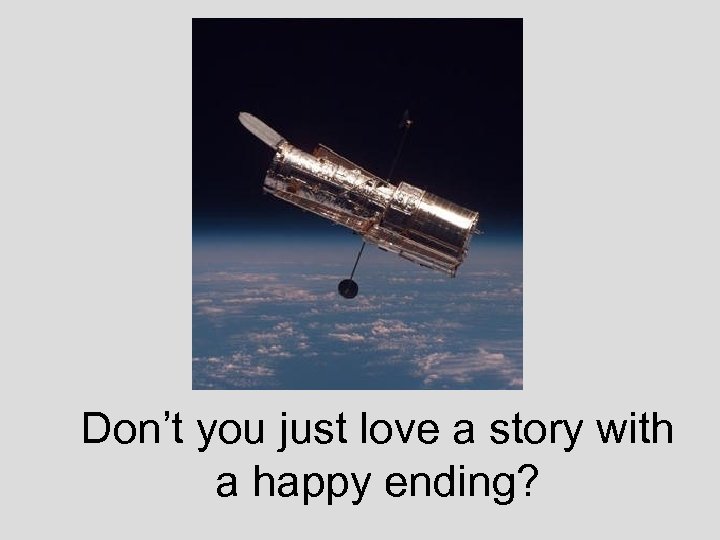
Don’t you just love a story with a happy ending?
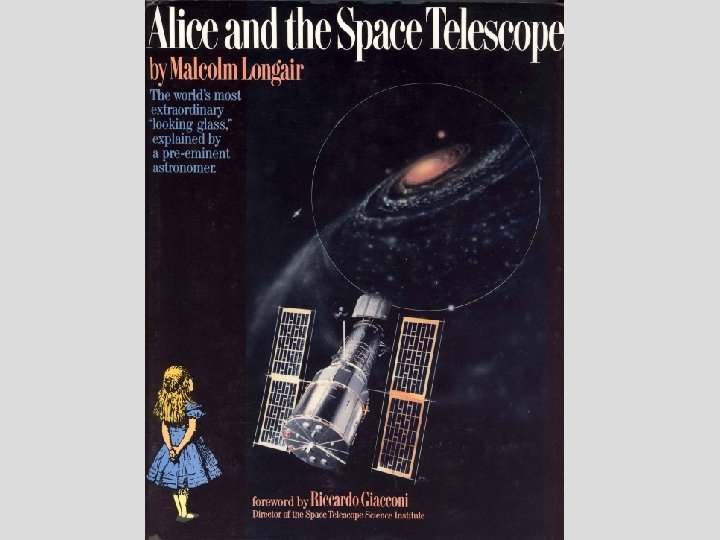
Alice Book Jacket
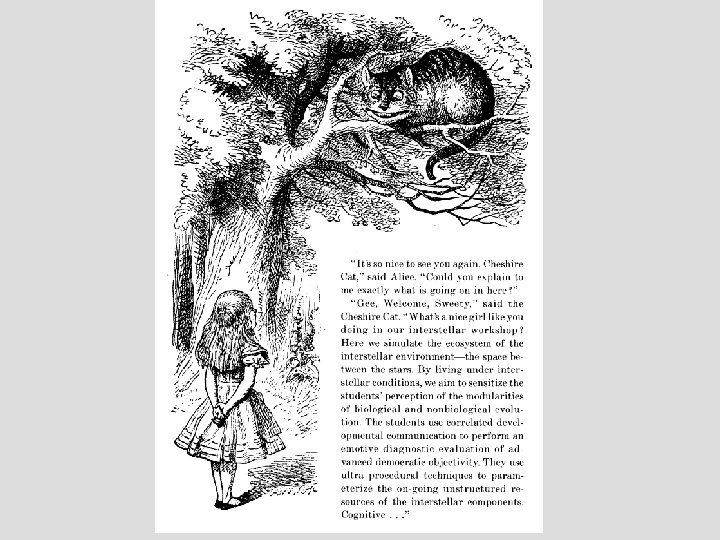
Alice and the Cheshire Cat
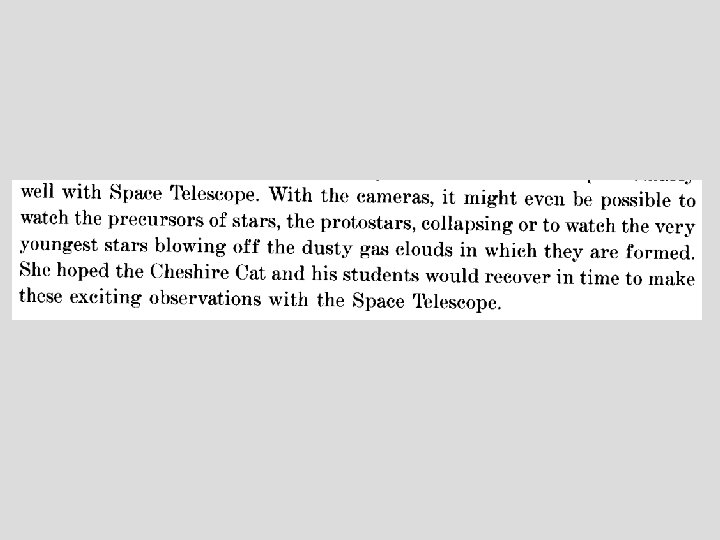
Alice’s Prediction
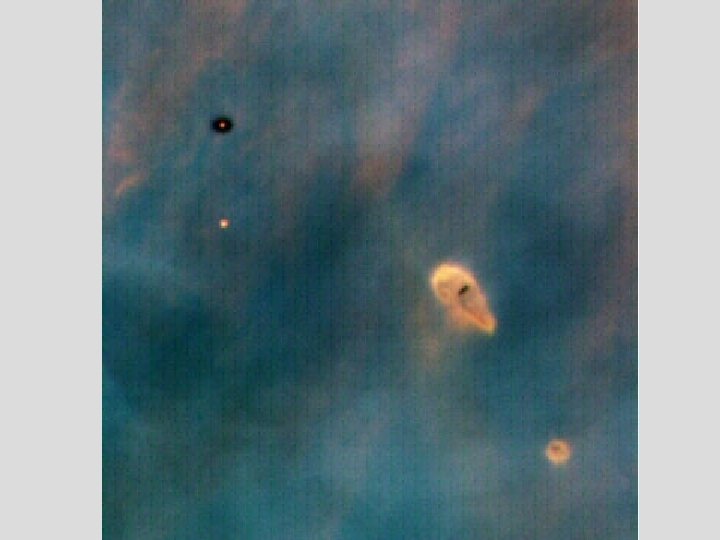
Proplyds in Orion
So what has been your involvement since stepping out as PS? • In 1982 launch was expected in 1985 and the PS didn’t have to be at MSFC. • I took a professorship at Rice University in September, 1982. • In 1983 the schedule slipped and MSFC wanted a resident PS. I was unwilling to relocate and stepped out, becoming the Observatory Scientist Team Leader. • After launch, I served on GSFC’s Telescope Time Steering Group, deciding on non-science uses of the telescope in shaking down the problems.
Science Activity • As a Civil Servant who helped select the GTO’s I couldn’t be an early user. • However, in 1984 the Phase C/D science teams all chipped-in a portion of their time and I was made a GTO. This enabled me to have 3 GTO programs. I shared equally my GTO time with Lyman Spitzer. • Since then, I’ve been PI or co-I on 19 GO programs. • I’ve served on four Science Proposal review panels and currently serve on the STUC.
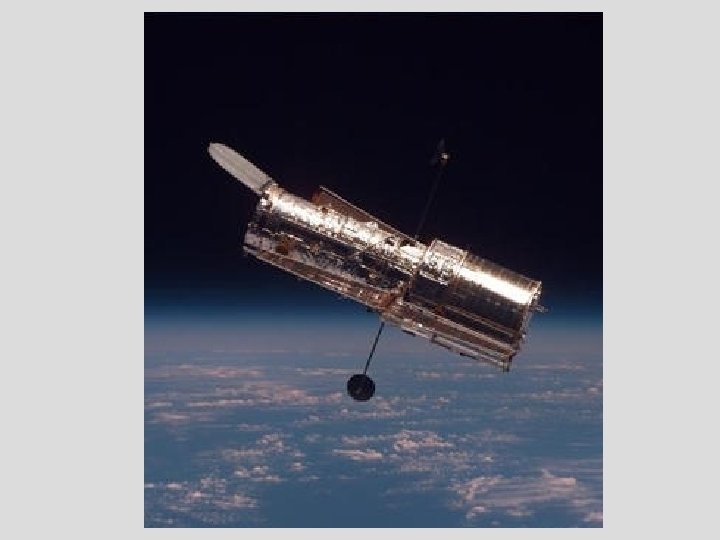
HST in Orbit
The years have taken their toll on the key participants. • Phase-A: Aden Meinel, J. Beverly Oke, Harlan J. Smith, Lyman Spitzer, and Anne B. Underhill • Phase-B: John N. Bahcall, and Robert Danielson • William G. Fastie, Hendrik van de Hulst, and James A. Westphal,
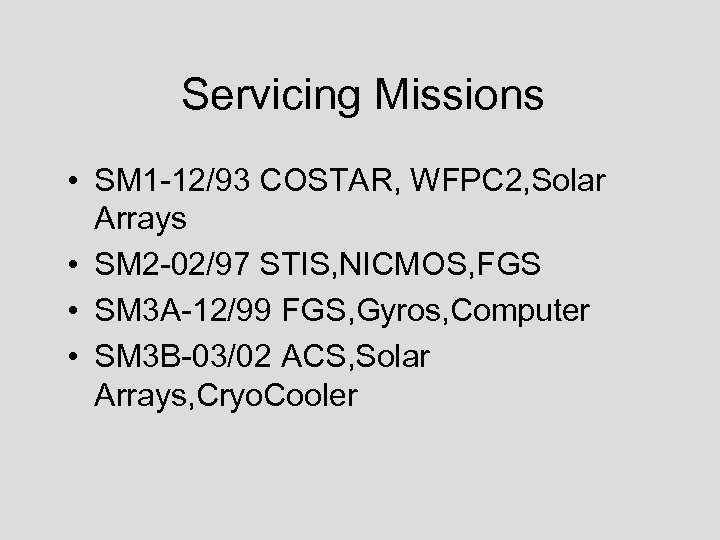
Servicing Missions • SM 1 -12/93 COSTAR, WFPC 2, Solar Arrays • SM 2 -02/97 STIS, NICMOS, FGS • SM 3 A-12/99 FGS, Gyros, Computer • SM 3 B-03/02 ACS, Solar Arrays, Cryo. Cooler
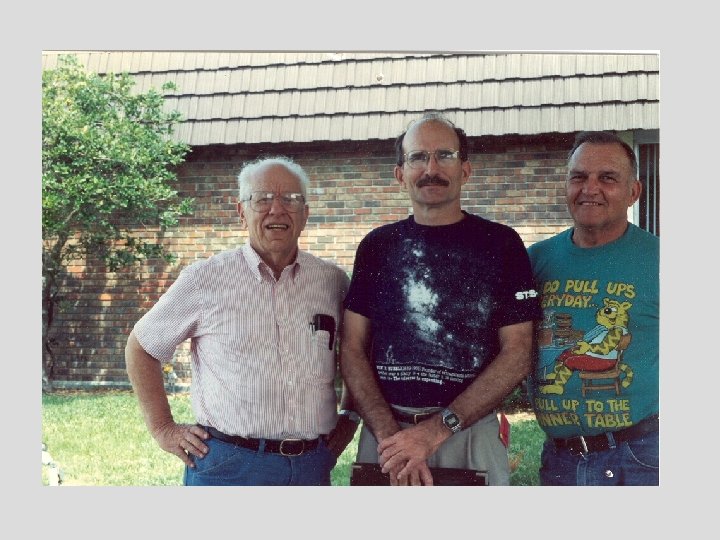
My Teachers
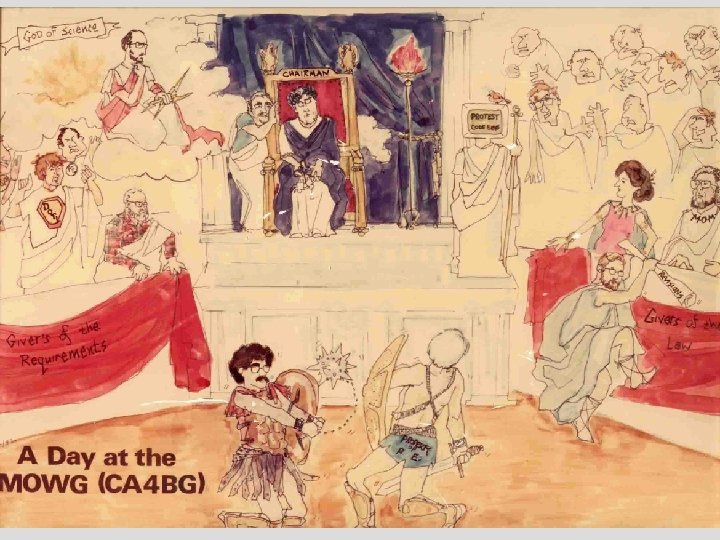
MOWG Cartoon
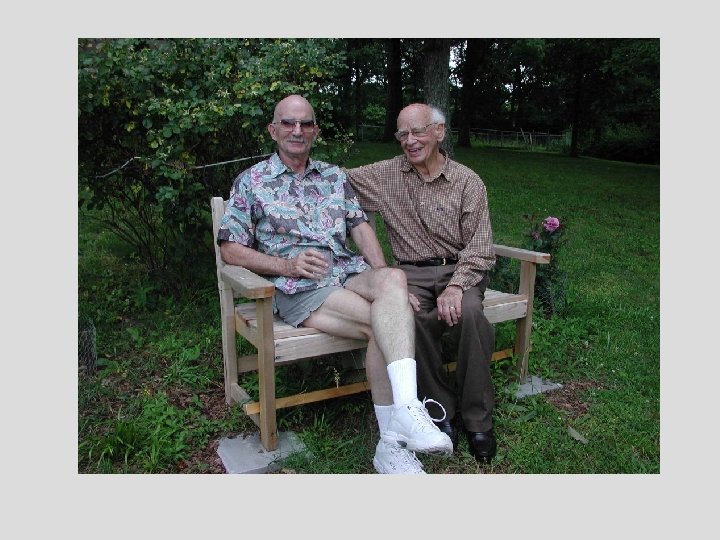
O’Dell&Stuhlinger 2005
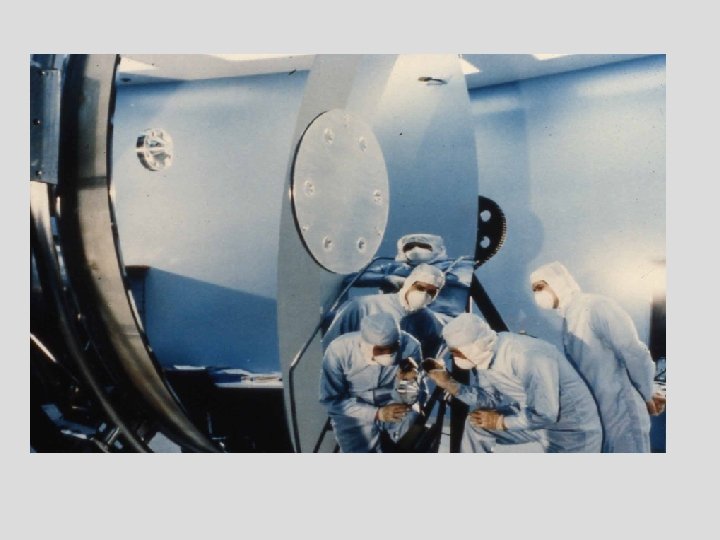
Primary Mirror After Aluminizing
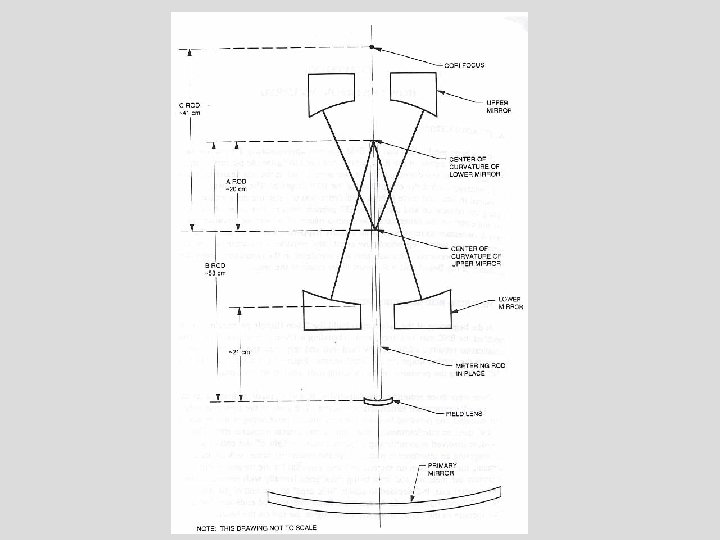
The Reflective Null Corrector
Скачать презентацию A History of the Early HST Bob O Dell
a0342e2b99e183b7a2e0133d0bd6859e.ppt