 Скачать презентацию A High Performance Hybrid Spectrometer for the Single
a3341a1f597d602c468c5468fe5bb092.ppt
- Количество слайдов: 36



A High Performance Hybrid Spectrometer for the Single Crystal Studies at the Pulsed SNS HYSPEC Hybrid Spectrometer Instrument Development Team Igor Zaliznyak Neutron Scattering Group, Brookhaven National Laboratory Outline HYSPEC project: history and general overview (motivation, scientific case, technical concept, etc). q Instrument Development Team and current status of the project. q Conceptual design and floor layout of the proposed instrument q Overview of the results of MC simulations of instrument performance and comparison with the traditional TOF setup. q HYSPEC summary, current issues and plans for future. HYSPEC Letter of Intent. April, 2002 q
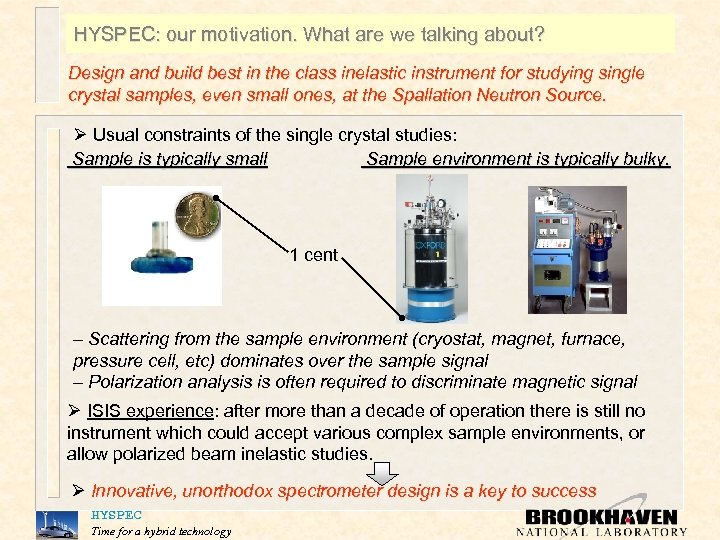
HYSPEC: our motivation. What are we talking about? Design and build best in the class inelastic instrument for studying single crystal samples, even small ones, at the Spallation Neutron Source. Ø Usual constraints of the single crystal studies: Sample is typically small Sample environment is typically bulky. 1 cent – Scattering from the sample environment (cryostat, magnet, furnace, pressure cell, etc) dominates over the sample signal – Polarization analysis is often required to discriminate magnetic signal Ø ISIS experience: after more than a decade of operation there is still no instrument which could accept various complex sample environments, or allow polarized beam inelastic studies. Ø Innovative, unorthodox spectrometer design is a key to success HYSPEC Time for a hybrid technology
“Formal” scientific case for the proposed instrument at the SNS. Neutron spectrometer for studies of the coherent low-energy states in single crystals. q Coherent collective excitations in single crystals: • lattice dynamics (phonons) • spin dynamics (magnons, critical scattering) q Structure and dynamics of partially ordered and glassy states • spin glasses • charge glasses • correlated amorphous phases q Study of the microscopic physical properties of samples in a variety of extreme environments: • magnetic field • pressure • temperature q Characterization of spin-dependent cross-sections by means of polarization analysis More details and particular examples are given in the Letter of Intent. HYSPEC Time for a hybrid technology
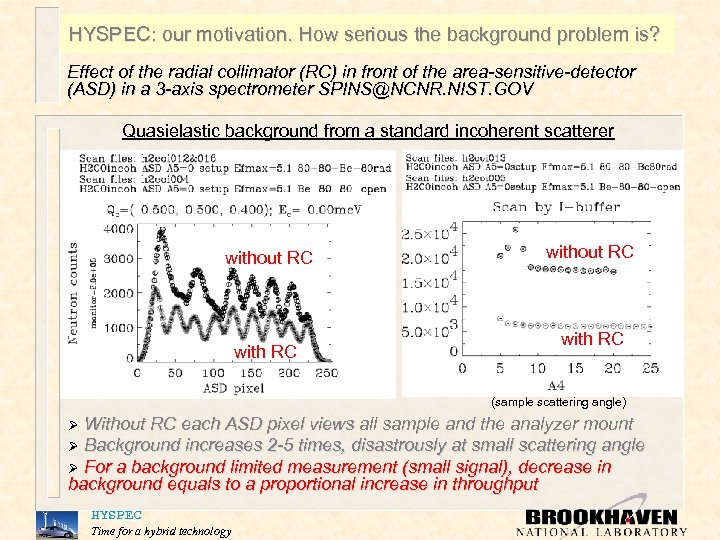
HYSPEC: our motivation. How serious the background problem is? Effect of the radial collimator (RC) in front of the area-sensitive-detector (ASD) in a 3 -axis spectrometer SPINS@NCNR. NIST. GOV Quasielastic background from a standard incoherent scatterer without RC with RC (sample scattering angle) Without RC each ASD pixel views all sample and the analyzer mount Ø Background increases 2 -5 times, disastrously at small scattering angle Ø For a background limited measurement (small signal), decrease in background equals to a proportional increase in throughput Ø HYSPEC Time for a hybrid technology
HYSPEC: our motivation. Design objectives. Major unresolved issues in TOF instruments: (i) efficient focusing neutron optics, (ii) polarized beam. Strive for innovation, build on experience. ü Efficiently use large incident neutron beam by focusing it on the sample ü Minimize the background: scattering volume seen by a detector should be well defined and easily adjustable ü Envisage an easy setup of the polarized beam option ü Optimize the instrument for high throughput at moderate resolution ü Avoid direct view of the moderator by the sample and its environment ü Throughput and resolution should be easily traded and vary smoothly over a substantial energy interval, typically from 2. 5 me. V to 90 me. V ü Both energy and wavevector resolutions should be flexible and easily adjustable, typical resolutions are 1% to 10% ü Accessible range of scattering angles should be as large as possible HYSPEC Time for a hybrid technology
HYSPEC timeline: history of the project. q q q January, 2002 – HYSPEC IDT filed Letter of Intent with SNS Fall, 2001 – Instrument Development Team formed – Workshop on the Hybrid Spectrometer held at BNL – Refined HYSPEC concept presented to EFAC March, 2001 – Draft proposal of a Direct Geometry Hybrid Spectrometer first presented to EFAC, received positive reply December, 2000 – Completed review of the possible instrument designs – Concept of the Hybrid Spectrometer formulated and adopted Fall, 1999 – Center for Neutron Science and Neutron Scattering Group at BNL initiate an effort to design a spectrometer for the SNS HYSPEC Time for a hybrid technology
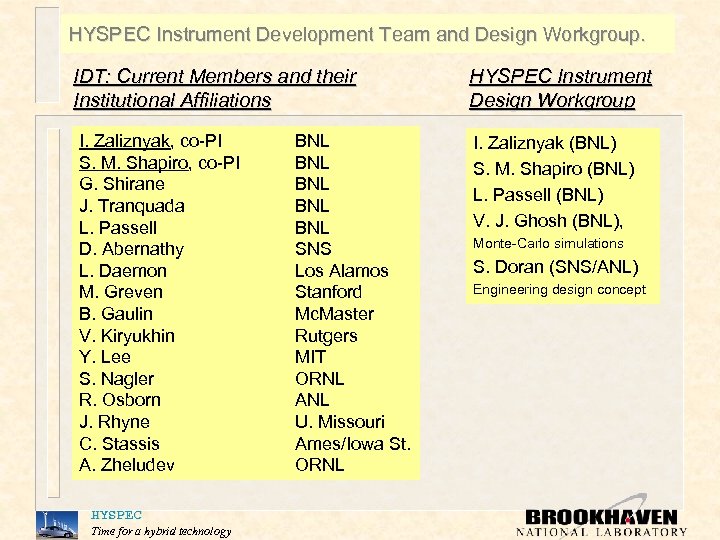
HYSPEC Instrument Development Team and Design Workgroup. IDT: Current Members and their Institutional Affiliations I. Zaliznyak, co-PI S. M. Shapiro, co-PI G. Shirane J. Tranquada L. Passell D. Abernathy L. Daemon M. Greven B. Gaulin V. Kiryukhin Y. Lee S. Nagler R. Osborn J. Rhyne C. Stassis A. Zheludev HYSPEC Time for a hybrid technology BNL BNL BNL SNS Los Alamos Stanford Mc. Master Rutgers MIT ORNL ANL U. Missouri Ames/Iowa St. ORNL HYSPEC Instrument Design Workgroup I. Zaliznyak (BNL) S. M. Shapiro (BNL) L. Passell (BNL) V. J. Ghosh (BNL), Monte-Carlo simulations S. Doran (SNS/ANL) Engineering design concept
![Hybrid Spectrometer BL 15 [BNL] conceptual design: layout of main components. Tentative placement: beamline](https://present5.com/presentation/a3341a1f597d602c468c5468fe5bb092/image-8.jpg "Hybrid Spectrometer BL 15 [BNL] conceptual design: layout of main components. Tentative placement: beamline")
Hybrid Spectrometer BL 15 [BNL] conceptual design: layout of main components. Tentative placement: beamline 15 Primary Beamstop Incorporated into the Curved Guide Shielding HYSPEC Time for a hybrid technology Poured In Place Permanent Shielding T (0) Chopper Disk Chopper Monochromet er Goniometer Radial Collimiator Vacuum Flight Chamber and Detectors
![Hybrid Spectrometer BL 15 [BNL] conceptual design: floor layout. Tentative placement: beamline 15 HYSPEC](https://present5.com/presentation/a3341a1f597d602c468c5468fe5bb092/image-9.jpg "Hybrid Spectrometer BL 15 [BNL] conceptual design: floor layout. Tentative placement: beamline 15 HYSPEC")
Hybrid Spectrometer BL 15 [BNL] conceptual design: floor layout. Tentative placement: beamline 15 HYSPEC Time for a hybrid technology
![Hybrid Spectrometer BL 15 [BNL] conceptual design: setup of the analyzer and experimental area.](https://present5.com/presentation/a3341a1f597d602c468c5468fe5bb092/image-10.jpg "Hybrid Spectrometer BL 15 [BNL] conceptual design: setup of the analyzer and experimental area.")
Hybrid Spectrometer BL 15 [BNL] conceptual design: setup of the analyzer and experimental area. Automated Shutter System For Monochrometer Dual Worm Drive Lifts Shutters, Each At 5 Degree Increments Counter Rotating Disk Chopper HYSPEC Time for a hybrid technology
![Hybrid Spectrometer BL 15 [BNL] conceptual design: typical experimental configuration. Tentative placement: beamline 15](https://present5.com/presentation/a3341a1f597d602c468c5468fe5bb092/image-11.jpg "Hybrid Spectrometer BL 15 [BNL] conceptual design: typical experimental configuration. Tentative placement: beamline 15")
Hybrid Spectrometer BL 15 [BNL] conceptual design: typical experimental configuration. Tentative placement: beamline 15 HYSPEC Time for a hybrid technology
![Hybrid Spectrometer BL 15 [BNL] conceptual design: some details of the operation. 1. Raise](https://present5.com/presentation/a3341a1f597d602c468c5468fe5bb092/image-12.jpg "Hybrid Spectrometer BL 15 [BNL] conceptual design: some details of the operation. 1. Raise")
Hybrid Spectrometer BL 15 [BNL] conceptual design: some details of the operation. 1. Raise Shutters 2. Swing Sample and Detectors On Airpads 3. Close Shutters HYSPEC Time for a hybrid technology
![Hybrid Spectrometer BL 15 [BNL] conceptual design: general floor layout. Beamline 15, sample at](https://present5.com/presentation/a3341a1f597d602c468c5468fe5bb092/image-13.jpg "Hybrid Spectrometer BL 15 [BNL] conceptual design: general floor layout. Beamline 15, sample at")
Hybrid Spectrometer BL 15 [BNL] conceptual design: general floor layout. Beamline 15, sample at ~25 m from the moderator, secondary flightpath 4. 5 m Target Monolith Instrument Building Floor Instrument Shielding 14’ Tall x 14’ Wide Instrument Building Wall HYSPEC Time for a hybrid technology
![Hybrid Spectrometer BL 15 [BNL] conceptual design: shielding. Tentative placement: beamline 15 Removable Block](https://present5.com/presentation/a3341a1f597d602c468c5468fe5bb092/image-14.jpg "Hybrid Spectrometer BL 15 [BNL] conceptual design: shielding. Tentative placement: beamline 15 Removable Block")
Hybrid Spectrometer BL 15 [BNL] conceptual design: shielding. Tentative placement: beamline 15 Removable Block Shielding Poured In Place Temporary Shielding Poured In Place Permanent Shielding Block Wall Shielding Access Door HYSPEC Time for a hybrid technology
![Hybrid Spectrometer BL 15 [BNL] conceptual design: interface with the moderator. Tentative placement: beamline](https://present5.com/presentation/a3341a1f597d602c468c5468fe5bb092/image-15.jpg "Hybrid Spectrometer BL 15 [BNL] conceptual design: interface with the moderator. Tentative placement: beamline")
Hybrid Spectrometer BL 15 [BNL] conceptual design: interface with the moderator. Tentative placement: beamline 15 Moderator Assembly Guide 1 m from Moderator (highlighted in red) Core Vessel Insert Main Beamline Shutter Guides 12 cm ->15 cm guide expander HYSPEC Time for a hybrid technology
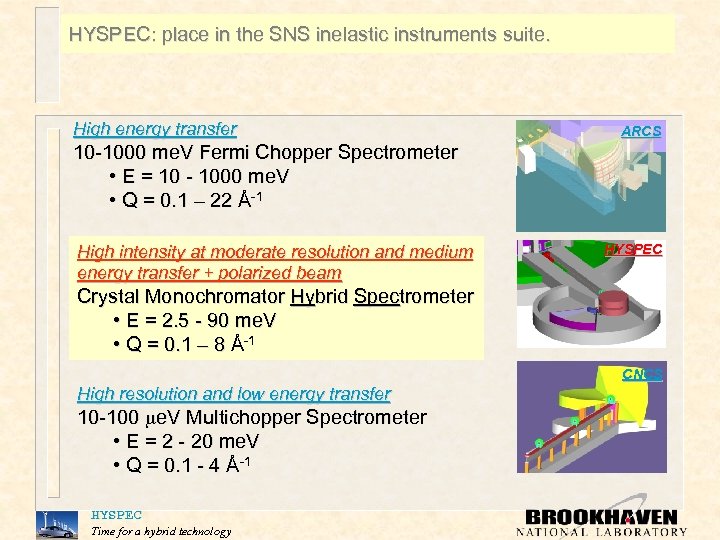
HYSPEC: place in the SNS inelastic instruments suite. High energy transfer ARCS 10 -1000 me. V Fermi Chopper Spectrometer • E = 10 - 1000 me. V • Q = 0. 1 – 22 Å-1 High intensity at moderate resolution and medium energy transfer + polarized beam HYSPEC Crystal Monochromator Hybrid Spectrometer • E = 2. 5 - 90 me. V • Q = 0. 1 – 8 Å-1 CNCS High resolution and low energy transfer 10 -100 e. V Multichopper Spectrometer • E = 2 - 20 me. V • Q = 0. 1 - 4 Å-1 HYSPEC Time for a hybrid technology
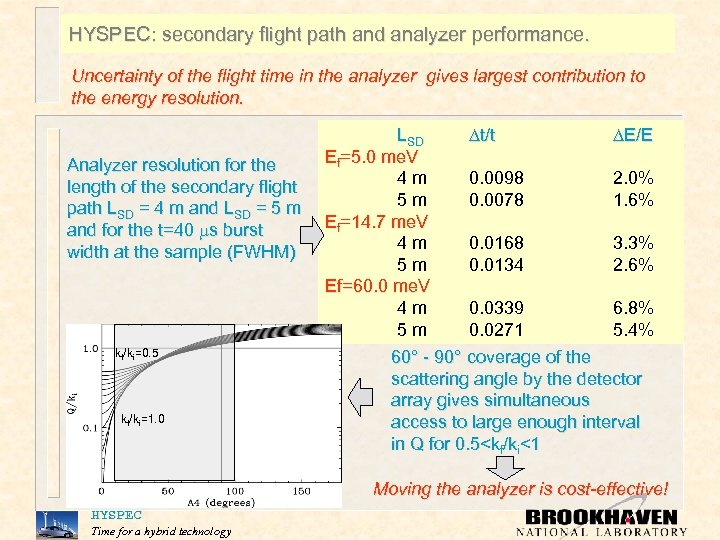
HYSPEC: secondary flight path and analyzer performance. Uncertainty of the flight time in the analyzer gives largest contribution to the energy resolution. Analyzer resolution for the length of the secondary flight path LSD = 4 m and LSD = 5 m and for the t=40 s burst width at the sample (FWHM) kf/ki=0. 5 kf/ki=1. 0 LSD Ef=5. 0 me. V 4 m 5 m Ef=14. 7 me. V 4 m 5 m Ef=60. 0 me. V 4 m 5 m t/t E/E 0. 0098 0. 0078 2. 0% 1. 6% 0. 0168 0. 0134 3. 3% 2. 6% 0. 0339 0. 0271 6. 8% 5. 4% 60° - 90° coverage of the scattering angle by the detector array gives simultaneous access to large enough interval in Q for 0. 5<kf/ki<1 Moving the analyzer is cost-effective! HYSPEC Time for a hybrid technology
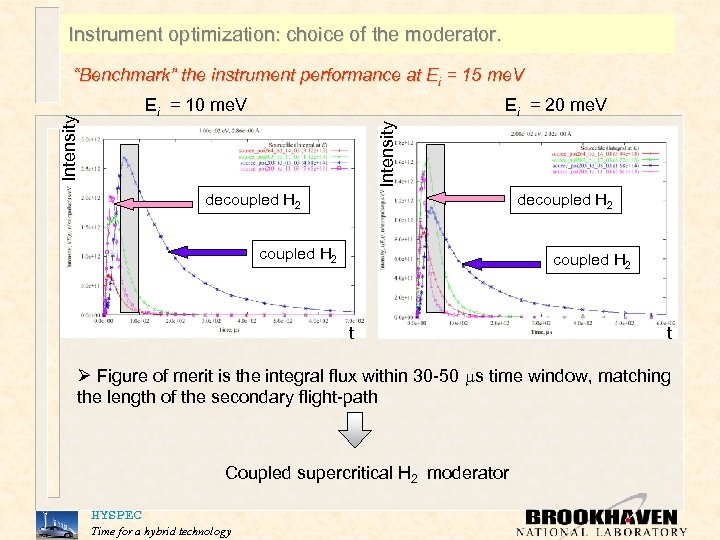
Instrument optimization: choice of the moderator. “Benchmark” the instrument performance at Ei = 15 me. V Ei = 20 me. V Intensity Ei = 10 me. V decoupled H 2 t t Ø Figure of merit is the integral flux within 30 -50 s time window, matching the length of the secondary flight-path Coupled supercritical H 2 moderator HYSPEC Time for a hybrid technology
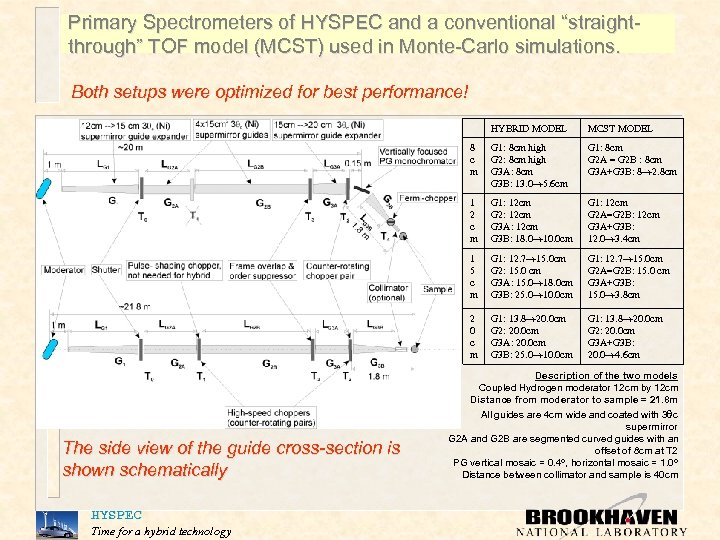
Primary Spectrometers of HYSPEC and a conventional “straightthrough” TOF model (MCST) used in Monte-Carlo simulations. Both setups were optimized for best performance! HYBRID MODEL 8 c m G 1: 12 cm G 2: 12 cm G 3 A: 12 cm G 3 B: 18. 0 10. 0 cm G 1: 12 cm G 2 A=G 2 B: 12 cm G 3 A+G 3 B: 12. 0 3. 4 cm G 1: 12. 7 15. 0 cm G 2: 15. 0 cm G 3 A: 15. 0 18. 0 cm G 3 B: 25. 0 10. 0 cm G 1: 12. 7 15. 0 cm G 2 A=G 2 B: 15. 0 cm G 3 A+G 3 B: 15. 0 3. 8 cm 2 0 c m Time for a hybrid technology G 1: 8 cm G 2 A = G 2 B : 8 cm G 3 A+G 3 B: 8 2. 8 cm 1 5 c m HYSPEC G 1: 8 cm high G 2: 8 cm high G 3 A: 8 cm G 3 B: 13. 0 5. 6 cm 1 2 c m The side view of the guide cross-section is shown schematically MCST MODEL G 1: 13. 8 20. 0 cm G 2: 20. 0 cm G 3 A: 20. 0 cm G 3 B: 25. 0 10. 0 cm G 1: 13. 8 20. 0 cm G 2: 20. 0 cm G 3 A+G 3 B: 20. 0 4. 6 cm Description of the two models Coupled Hydrogen moderator 12 cm by 12 cm Distance from moderator to sample = 21. 8 m All guides are 4 cm wide and coated with 3 c supermirror G 2 A and G 2 B are segmented curved guides with an offset of 8 cm at T 2 PG vertical mosaic = 0. 4 , horizontal mosaic = 1. 0 Distance between collimator and sample is 40 cm
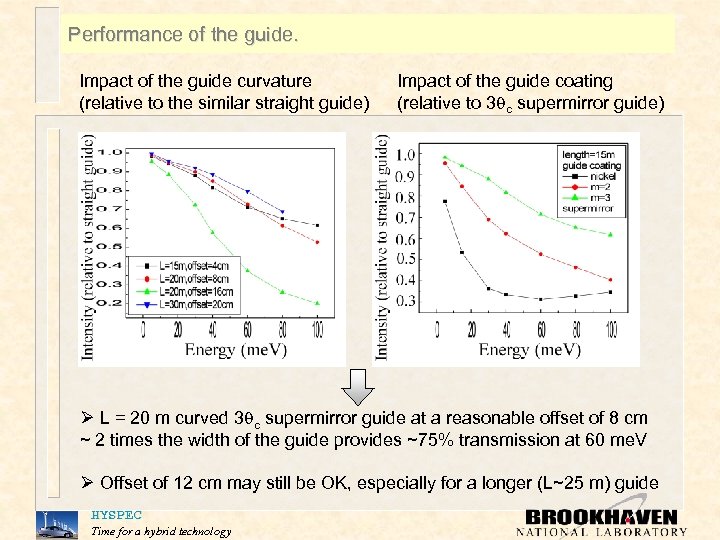
Performance of the guide. Impact of the guide curvature (relative to the similar straight guide) Impact of the guide coating (relative to 3 c supermirror guide) Ø L = 20 m curved 3 c supermirror guide at a reasonable offset of 8 cm ~ 2 times the width of the guide provides ~75% transmission at 60 me. V Ø Offset of 12 cm may still be OK, especially for a longer (L~25 m) guide HYSPEC Time for a hybrid technology
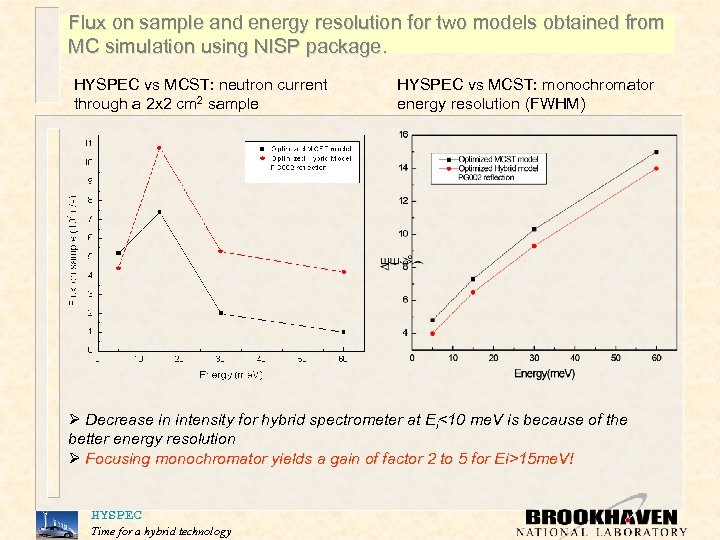
Flux on sample and energy resolution for two models obtained from MC simulation using NISP package. HYSPEC vs MCST: neutron current through a 2 x 2 cm 2 sample HYSPEC vs MCST: monochromator energy resolution (FWHM) Ø Decrease in intensity for hybrid spectrometer at Ei<10 me. V is because of the better energy resolution Ø Focusing monochromator yields a gain of factor 2 to 5 for Ei>15 me. V! HYSPEC Time for a hybrid technology
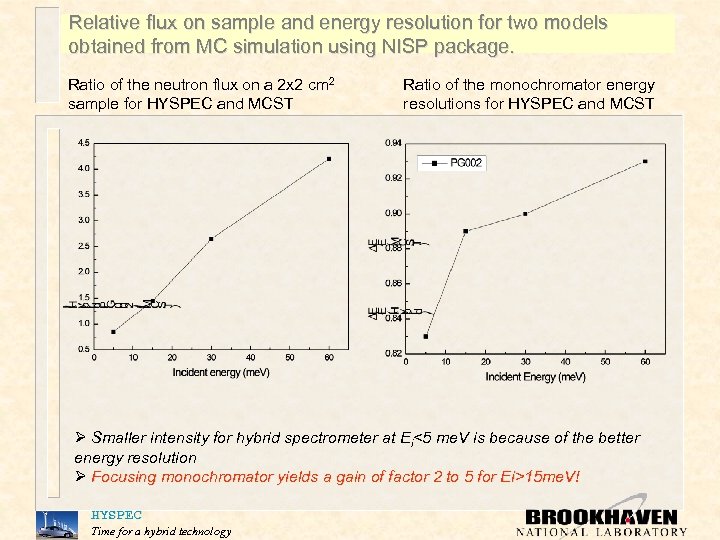
Relative flux on sample and energy resolution for two models obtained from MC simulation using NISP package. Ratio of the neutron flux on a 2 x 2 cm 2 sample for HYSPEC and MCST Ratio of the monochromator energy resolutions for HYSPEC and MCST Ø Smaller intensity for hybrid spectrometer at Ei<5 me. V is because of the better energy resolution Ø Focusing monochromator yields a gain of factor 2 to 5 for Ei>15 me. V! HYSPEC Time for a hybrid technology
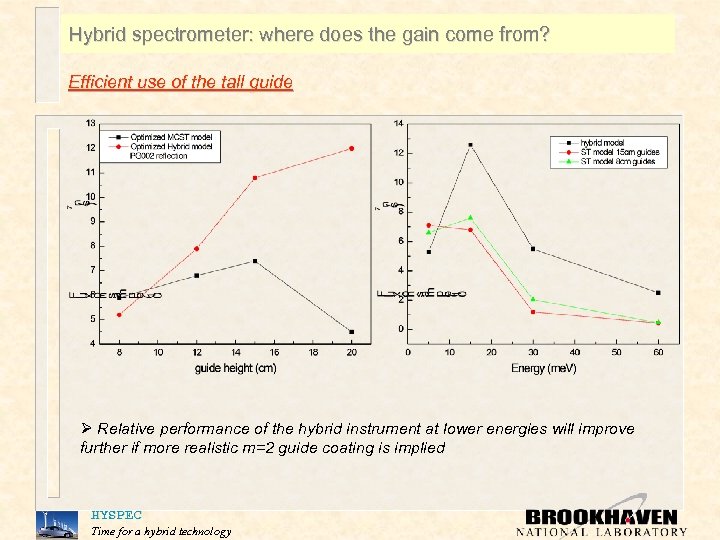
Hybrid spectrometer: where does the gain come from? Efficient use of the tall guide Ø Relative performance of the hybrid instrument at lower energies will improve further if more realistic m=2 guide coating is implied HYSPEC Time for a hybrid technology
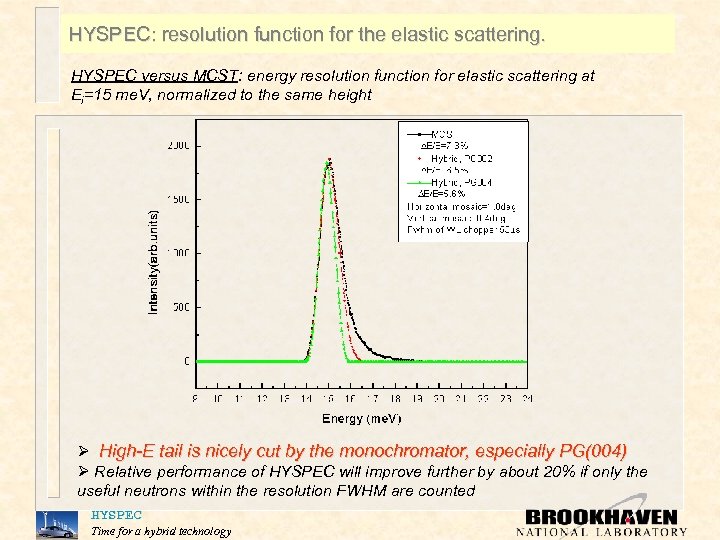
HYSPEC: resolution function for the elastic scattering. HYSPEC versus MCST: energy resolution function for elastic scattering at Ei=15 me. V, normalized to the same height Ø High-E tail is nicely cut by the monochromator, especially PG(004) Ø Relative performance of HYSPEC will improve further by about 20% if only the useful neutrons within the resolution FWHM are counted HYSPEC Time for a hybrid technology
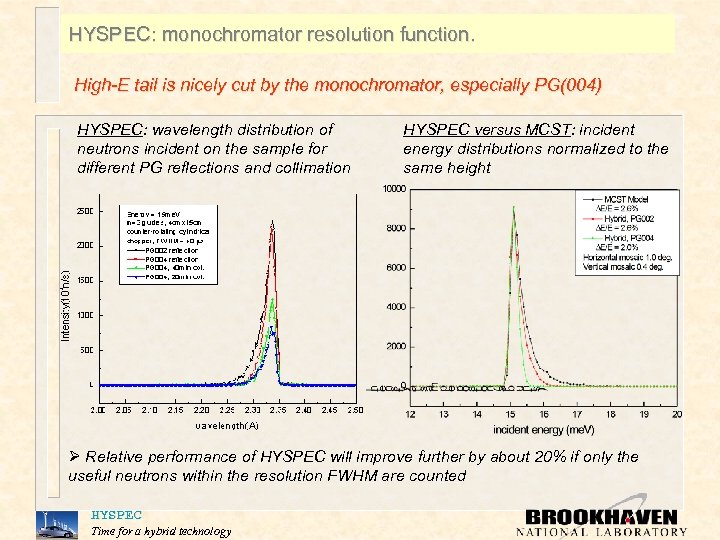
HYSPEC: monochromator resolution function. High-E tail is nicely cut by the monochromator, especially PG(004) HYSPEC: wavelength distribution of neutrons incident on the sample for different PG reflections and collimation HYSPEC versus MCST: incident energy distributions normalized to the same height Ø Relative performance of HYSPEC will improve further by about 20% if only the useful neutrons within the resolution FWHM are counted HYSPEC Time for a hybrid technology
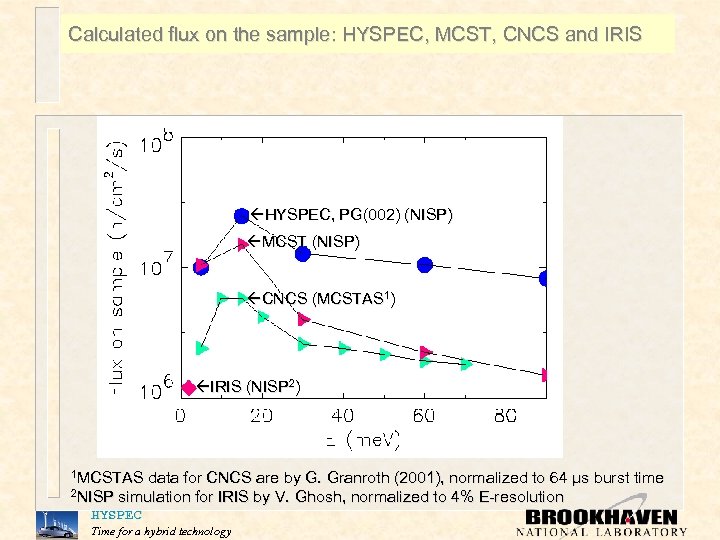
Calculated flux on the sample: HYSPEC, MCST, CNCS and IRIS HYSPEC, PG(002) (NISP) MCST (NISP) CNCS (MCSTAS 1) IRIS (NISP 2) 1 MCSTAS data for CNCS are by G. Granroth (2001), normalized to 64 µs burst time 2 NISP simulation for IRIS by V. Ghosh, normalized to 4% E-resolution HYSPEC Time for a hybrid technology
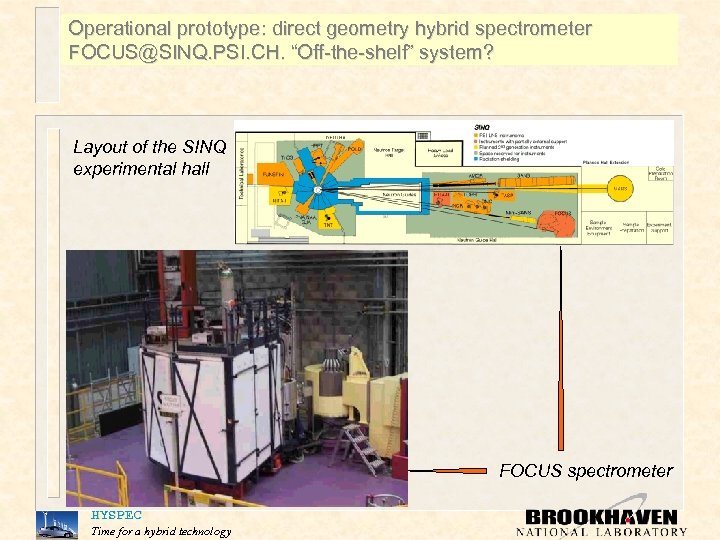
Operational prototype: direct geometry hybrid spectrometer FOCUS@SINQ. PSI. CH. “Off-the-shelf” system? Layout of the SINQ experimental hall FOCUS spectrometer HYSPEC Time for a hybrid technology
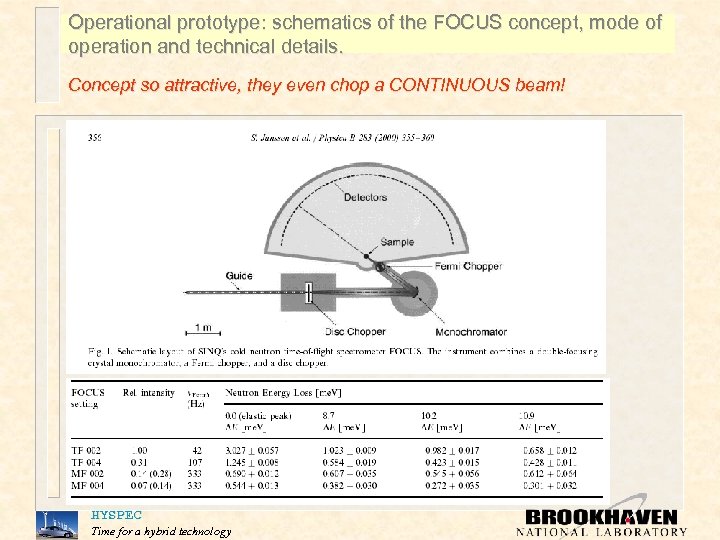
Operational prototype: schematics of the FOCUS concept, mode of operation and technical details. Concept so attractive, they even chop a CONTINUOUS beam! HYSPEC Time for a hybrid technology
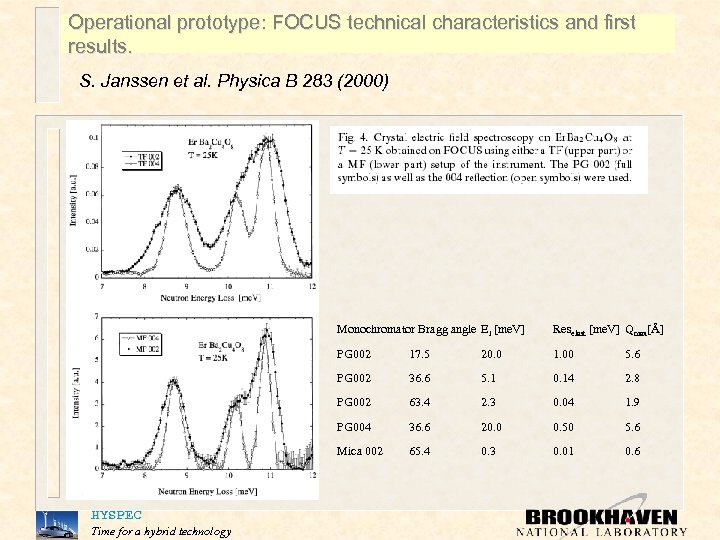
Operational prototype: FOCUS technical characteristics and first results. S. Janssen et al. Physica B 283 (2000) Monochromator Bragg angle Ei [me. V] PG 002 20. 0 1. 00 5. 6 36. 6 5. 1 0. 14 2. 8 PG 002 63. 4 2. 3 0. 04 1. 9 PG 004 36. 6 20. 0 0. 50 5. 6 Mica 002 Time for a hybrid technology 17. 5 PG 002 HYSPEC Reselast [me. V] Qmax[Å] 65. 4 0. 3 0. 01 0. 6
HYSPEC vs FOCUS : what is the difference? Most important: pulsed beam allows using up to ~1/2 of the total amount of neutrons produced => gain factor ~100 HYSPEC: • monochromator with vertical focusing immediately follows the guide, at <1. 8 m from the sample • longer, 4. 5 m secondary flightpath • thick PG crystals with anisotropic mosaic • Heusler crystal monochromator for polarized beam • guide tube before sample ØHYSPEC will do better HYSPEC Time for a hybrid technology
Summary of the technical features of a proposed direct geometry hybrid instrument for the SNS. Tall neutron guide + efficient vertical focusing provide excellent data collection rate, allowing studies of very small samples in challenging environments q Resolution: d. E/E~0. 03 -0. 1, d. Q/Q~0. 01 -0. 03 q High flexibility • continuous variation of the incident energy from 2. 5 to 90 me. V with no higher-order contamination • full range of energy transfers available at each Q • easily and broadly variable energy and Q resolution • possibility of time focusing/defocusing • easily adaptable for polarization analysis q Low-background and friendly to demanding sample environment • standard sample table accepts many different sample environments • sample is away from the direct beam • scattering volume is well defined by collimators and slits q High sensitivity to small scattering cross-sections (signal to BG ratio) q Can be operated at small scattering angles (near the forward direction) HYSPEC Time for a hybrid technology
Summary of the principal features of the proposed hybrid spectrometer (how do we fit our wish list? ). Bonus: monochromator shapes resolution function, cutting ugly high-E tail. Ø High flux on sample at Ei = 5 - 90 me. V: tall neutron guide + efficient vertical focusing by curved crystal monochromator. Ø Polarized beam option: polarized incident neutron beam for Ei = 5 - 90 me. V, polarization analysis of the scattered beam for Ef < 15 me. V. Ø Low background with bulky sample environments: collimator(s)+slit(s) define scattering volume seen by detector(s) and restrict analyzer acceptance to scattering from sample only. Scattering from cryogenic environment, magnet, pressure cell, etc. , is mostly rejected. Ø Continuous wavevector coverage: no “blind spots” caused by spaces in the detector array. Ø Flexibility: both energy and wavevector resolutions are variable and easily adjustable, typical resolutions are 1% to 10%. In addition, different crystal reflections may be user on monochromator. HYSPEC Time for a hybrid technology
Current issues and future plans. Current issues • EFAC evaluation of the proposed spectrometer • Main beam stop and beamline shielding simulations • Mobile “sloppy Fermi-chopper” design for high-E-resolution operation (alternative/additional T 2 chopper, placed after the monochromator) Future plans • Get more seed funding to put together a cost estimate based on a realistic designs of the spectrometer components • Put together a comprehensive proposal and search for funding. • Work on further optimization of the instrument setup. HYSPEC Time for a hybrid technology
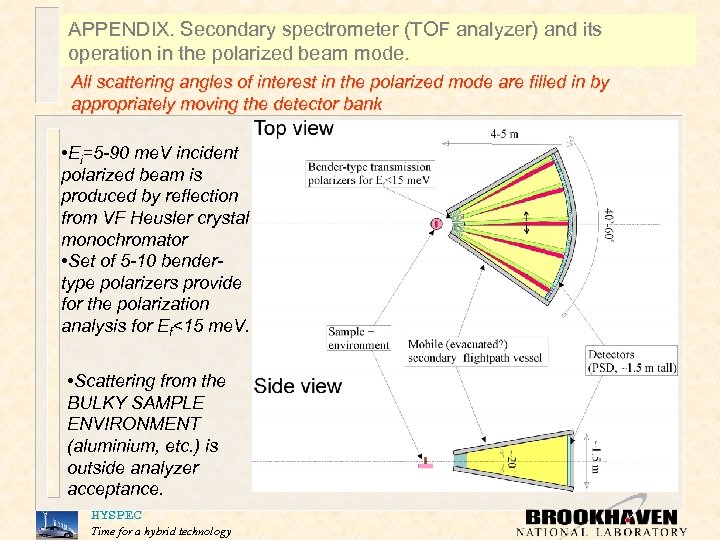
APPENDIX. Secondary spectrometer (TOF analyzer) and its operation in the polarized beam mode. All scattering angles of interest in the polarized mode are filled in by appropriately moving the detector bank • Ei=5 -90 me. V incident polarized beam is produced by reflection from VF Heusler crystal monochromator • Set of 5 -10 bendertype polarizers provide for the polarization analysis for Ef<15 me. V. • Scattering from the BULKY SAMPLE ENVIRONMENT (aluminium, etc. ) is outside analyzer acceptance. HYSPEC Time for a hybrid technology
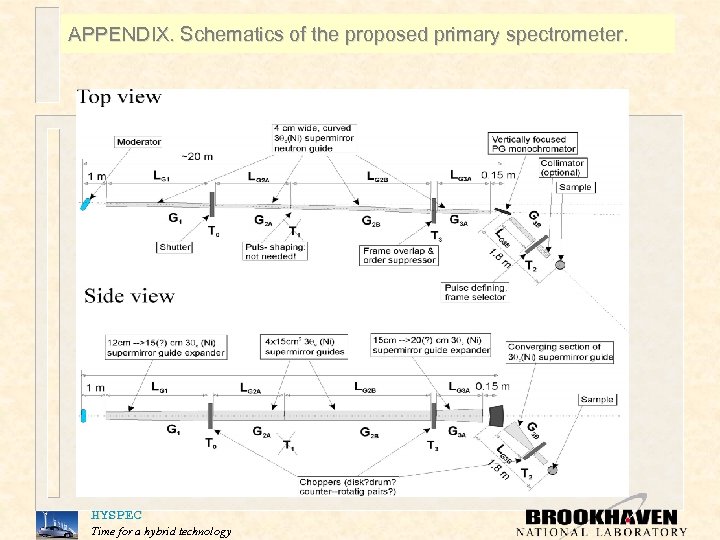
APPENDIX. Schematics of the proposed primary spectrometer. HYSPEC Time for a hybrid technology
APPENDIX. Pro’s and Con’s of a Crystal Monochromator. 1 Advantages of a crystal monochromator • beam may be compressed on the sample using focusing Bragg optics, beam height is not limited • sample and its environment are exposed to reflected monochromatic beam only: reduced background • works for wide beams • resolution is easily adjusted by putting the collimators • (Heusler) may provide a polarized beam for energies up to ~60 me. V 1 Disadvantages of a crystal monochromator • lower than one and energy-dependent reflectivity of the crystal, is not well-suited for providing high-energy incident neutrons • energy and wavevector resolutions are coupled and depend on the instrument position • sample table and secondary spectrometer need to be moved when incident neutrons energy is changed HYSPEC Time for a hybrid technology
Скачать презентацию A High Performance Hybrid Spectrometer for the Single
a3341a1f597d602c468c5468fe5bb092.ppt