


 Скачать презентацию A high grade secure Vo IP using the
8df012e92ee9fc1776daa3cdd11ca96b.ppt
- Количество слайдов: 21
 A high grade secure Vo. IP using the TEA Encryption Algorithm By Ashraf D. Elbayoumy 2005 International Symposium on Advanced Radio Technologies Boulder, Colorado March 1, 2005 1
 Voice over IP (Vo. IP) In recent years, we have witnessed a growing interest in the transmission of voice using the packet-based protocols. Voice over Internet protocol (Vo. IP) is a rapidly growing technology that enables the transport of voice over data networks such as the public Internet. 2
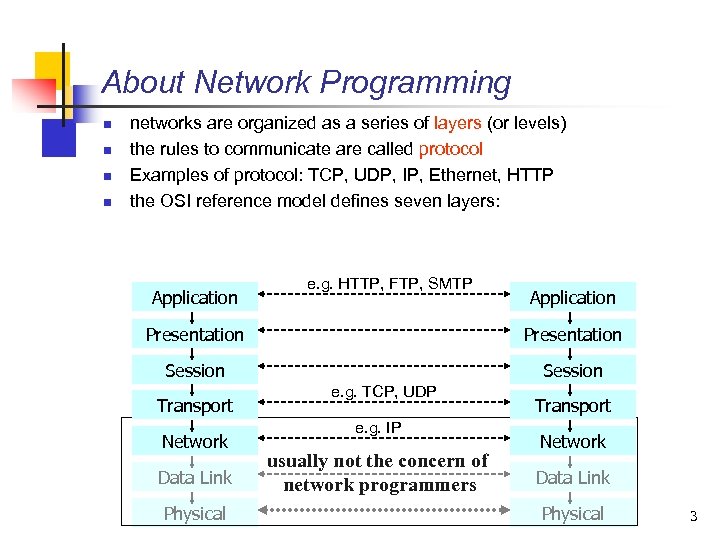 About Network Programming n n networks are organized as a series of layers (or levels) the rules to communicate are called protocol Examples of protocol: TCP, UDP, IP, Ethernet, HTTP the OSI reference model defines seven layers: Application e. g. HTTP, FTP, SMTP Application Presentation Session Transport Network Data Link Physical e. g. TCP, UDP e. g. IP usually not the concern of network programmers Transport Network Data Link Physical 3
 Socket n n n n Socket is the endpoints of a communication channel In Unix, the standard is BSD socket; in Windows, we use Win. Sock basically follows the BSD socket standard, but there are some modifications. The latest version, Winsock 2, provides more support for various protocols. Two types of sockets n SOCK_STREAM (TCP) n SOCK_DGRAM (UDP) TCP is connection-oriented, reliable, … A stream socket works much like an input/output stream. UDP is connectionless, unreliable, send and receive in packets (may arrive out-of-order) 4
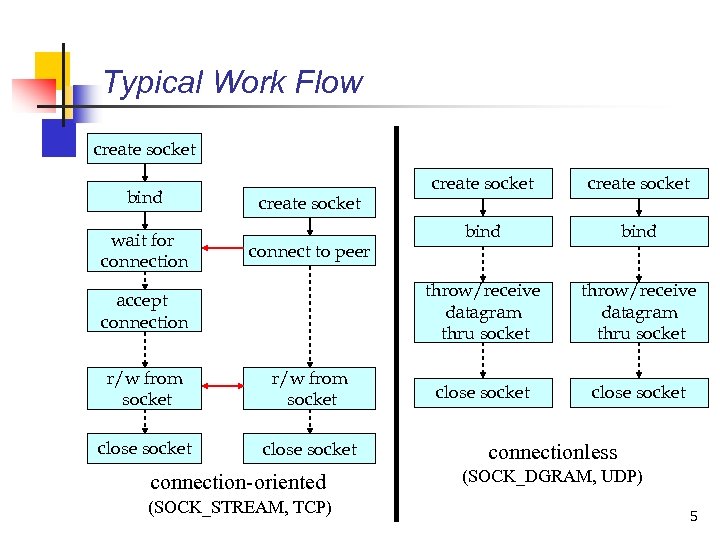 Typical Work Flow create socket bind wait for connection connect to peer accept connection r/w from socket close socket connection-oriented (SOCK_STREAM, TCP) create socket bind throw/receive datagram thru socket create socket throw/receive datagram thru socket close socket connectionless (SOCK_DGRAM, UDP) 5
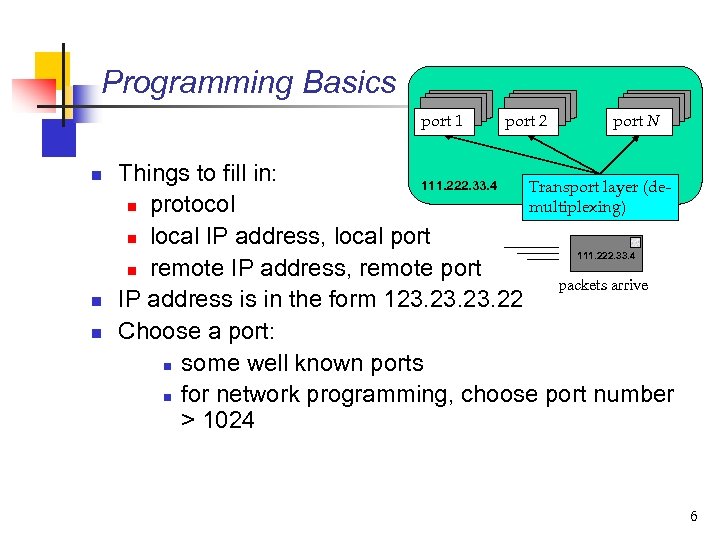 Programming Basics port 1 n n n port 2 port N Things to fill in: 111. 222. 33. 4 Transport layer (demultiplexing) n protocol n local IP address, local port 111. 222. 33. 4 n remote IP address, remote port packets arrive IP address is in the form 123. 23. 22 Choose a port: n some well known ports n for network programming, choose port number > 1024 6
 The basic idea behind Vo. IP The user’s voice is converted from analogue form into a digital form, compressed and broken down into a series of packets (Packetisation). These packets are then routed through private or public IP networks from one user to another and reassembled and decompressed at the receiving side. 7
 Quality of Service is fundamental to the operation of a Vo. IP network. Despite all the money Vo. IP can save users and the network elegance it provides, if it cannot deliver at least the same quality of call setup and voice relay functionality and voice quality as a traditional telephone network, then it will provide little added value. 8
 Among the factors that degrade voice quality are end-to-end delay, packet loss, delay variation, or jitter, voice compression schemes (CODECs), echo cancellation algorithms. 9
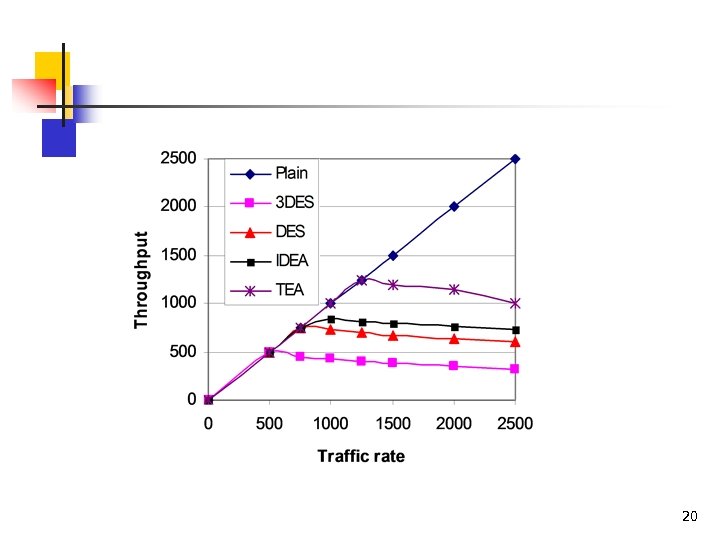
 In the case of voice transmission, the maximum acceptable delay in packet delivery for optimal voice quality is 150 ms, which can be extended up to 200 ms in case of encrypted communications. 10
 The time spent by the CODEC, the device that performs the digitization process, may vary between 0. 75 -30 ms, depending on the coding schemes adopted and the quality of the reproduced signal. The queuing delay (i. e. , the time spent by a packet in the router buffers waiting for being routed) may add up to 30 ms. A further delay in the range of 40 -70 ms, called jitter delay, is introduced by buffering arriving packets so that they can be delivered at a uniform rate. 11
 Vo. IP Security is a serious bottleneck for the future of Vo. IP (anyone with physical access to the office LAN can potentially connect network-monitoring tools and tap into telephone conversations). Because of the time-critical nature of Vo. IP most of the same security measures currently implemented in today’s data networks could not be used in Vo. IP networks. 12
 Vo. IP Security Vulnerabilities n n n n n Voice transport protocols RTP RTCP SCTP Signaling protocols and architecture SIP H. 323 MEGACO MGCP 13
 What’s at Risk? n n n n n IP phones Core routers Media gateways SIP proxies Gatekeepers Location servers Switches Vo. IP-based firewalls Any equipment in Vo. IP infrastructure 14
 Voice Data Convergence Multiplies Threats n n n n Vo. IP inherits IP data network threat models Reconnaissance, Do. S, host vulnerability exploit, surveillance, hijacking, identity theft, misuse, etc. Vo. IP Qo. S requirements increase exposure to Do. S attacks that affect: Delay, jitter, packet loss, bandwidth PCs = authentication; phones = any user User identity theft Vo. IP inherits PBX phone vulnerability Unauthorized access and privileges, service theft Device identity theft Malicious devices on IP network act like IP phones Reduced service availability, eavesdropping Inserting/Deleting/Modifying audio streams 15
 Threats from Phreakers and Hackers n n n n n Phreakers use phone system to: Gain free calls Disrupt system Fun Hackers use computer system to: Gain free services/products Denial of Service (Do. S) Business Fun 16
 Denial of Service Threat n n n n n Do. S venues Flood Abuse protocols Target devices IP phones (easy) Routers, switches (depends on equipment) Signaling gateways, media gateways, SIP proxies Any device in the path a call takes from a caller to a called party 17
 Encryption Algorithms: n n n DES 3 DES IDEA BLOWFISH TEA 18
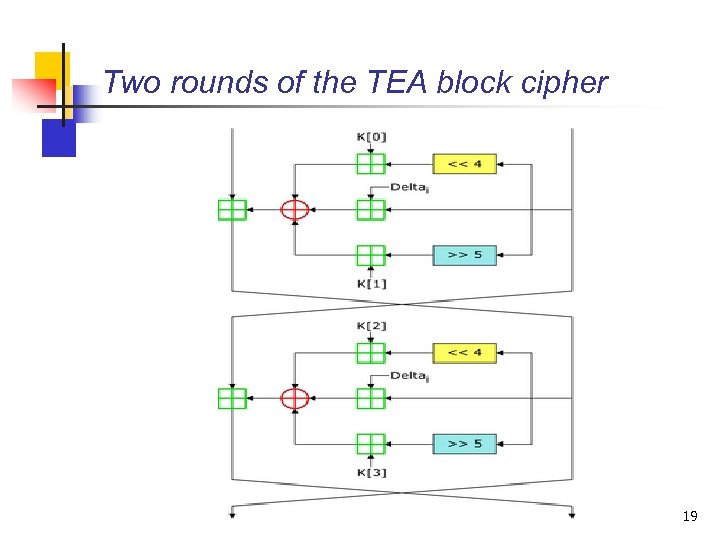 Two rounds of the TEA block cipher 19
 20
20
 Thank You 21