


 Скачать презентацию A High Energy Neutrino Astronomy from infancy
31d5a079c930f48db0fcabadbf59d0ba.ppt
- Количество слайдов: 56
 A High Energy Neutrino Astronomy from infancy to maturity LAUNCH Meeting Heidelberg Christian Spiering DESY
 A High Energy Neutrino Astronomy from infancy to maturity technological
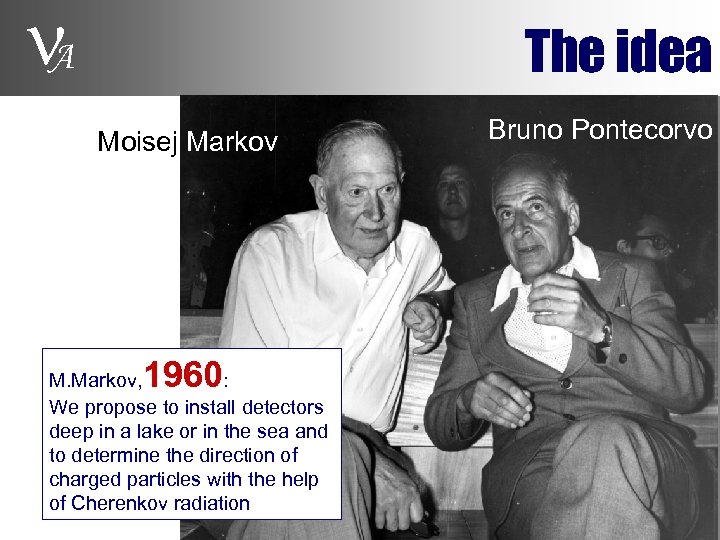 A The idea Moisej Markov 1960 M. Markov, : We propose to install detectors deep in a lake or in the sea and to determine the direction of charged particles with the help of Cherenkov radiation Bruno Pontecorvo
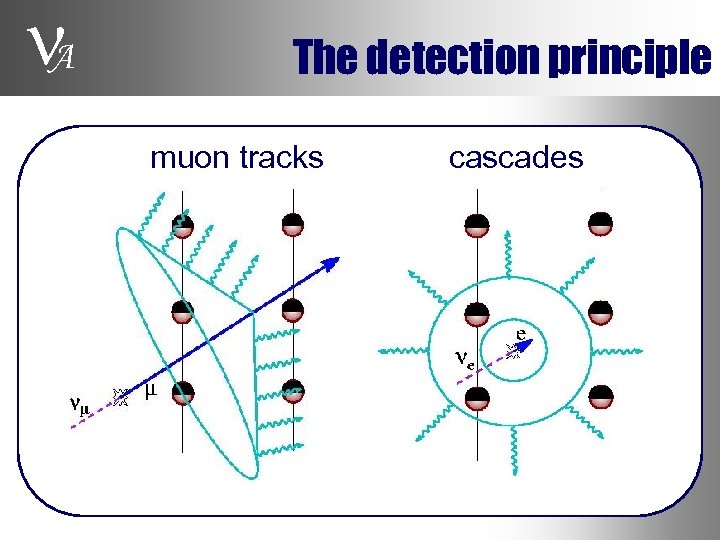 A The detection principle muon tracks cascades
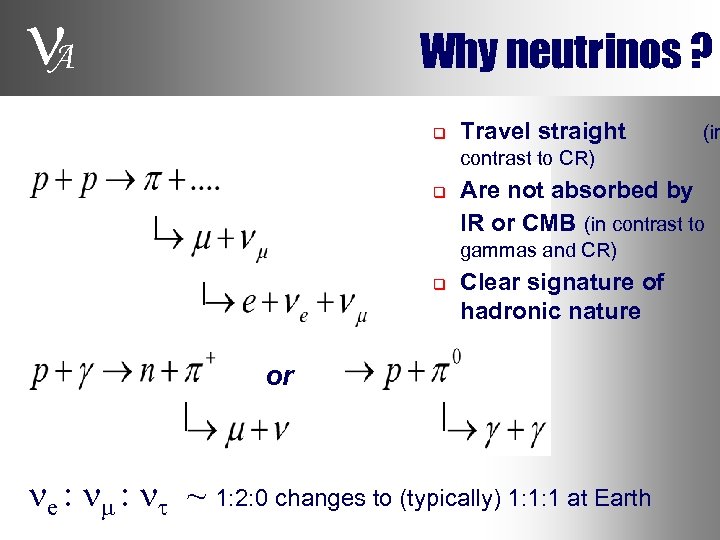 A Why neutrinos ? q Travel straight (in contrast to CR) q Are not absorbed by IR or CMB (in contrast to gammas and CR) q Clear signature of hadronic nature or e : : ~ 1: 2: 0 changes to (typically) 1: 1: 1 at Earth
 A Challenges Low interaction cross section q Need huge detection volumes d q Actual neutrino flux dependseon target timi ld h ed t my wou v thickness elie ono b q r e hav ray ast been up to two q Predictions 25 years ago have one s, Xer. “ uld ian higher tthan today orders of: magnitude ade la „Wo retic t rwit theo dec a recognize need of cubic kilometer a q rtin H 1990 s: s of nly Madetectorstarted o tion ic red ave s p h qikely Now: cubic kilometer detectors will possibly l just scratch the interesting range
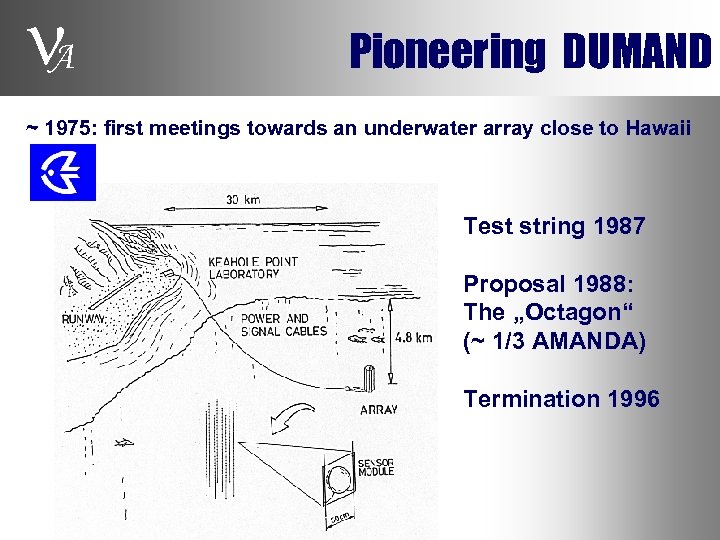 A Pioneering DUMAND ~ 1975: first meetings towards an underwater array close to Hawaii Test string 1987 Proposal 1988: The „Octagon“ (~ 1/3 AMANDA) Termination 1996
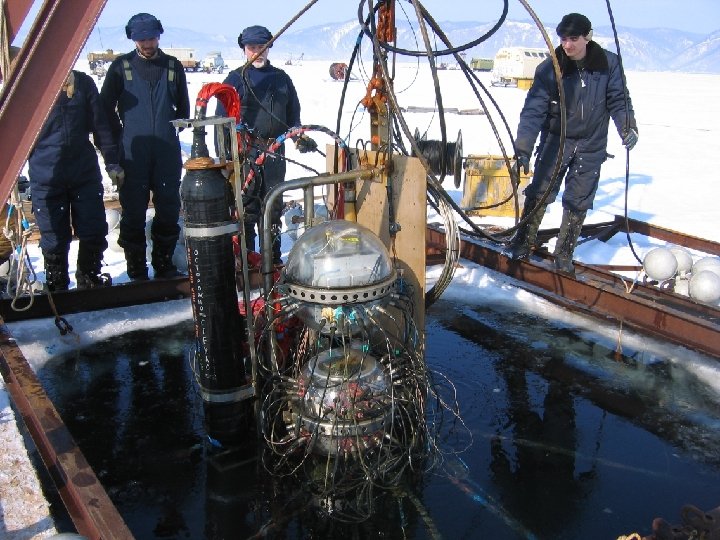
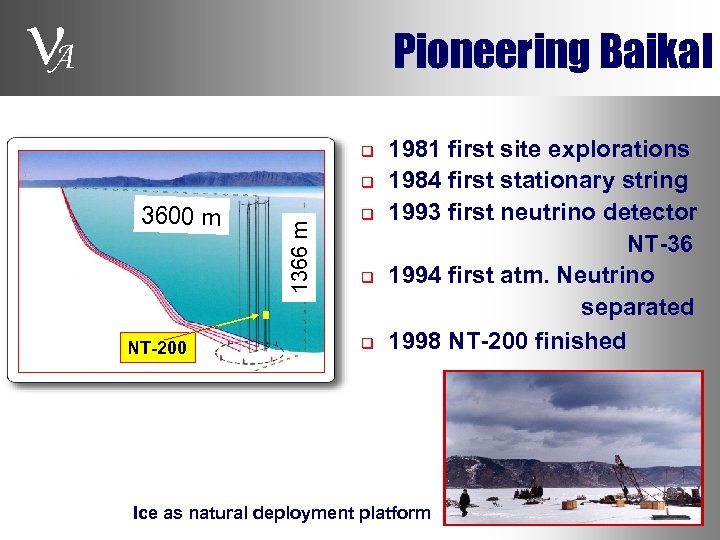 A Pioneering Baikal q 3600 m NT-200 1366 m q q 1981 first site explorations 1984 first stationary string 1993 first neutrino detector NT-36 1994 first atm. Neutrino separated 1998 NT-200 finished Ice as natural deployment platform
 A
A
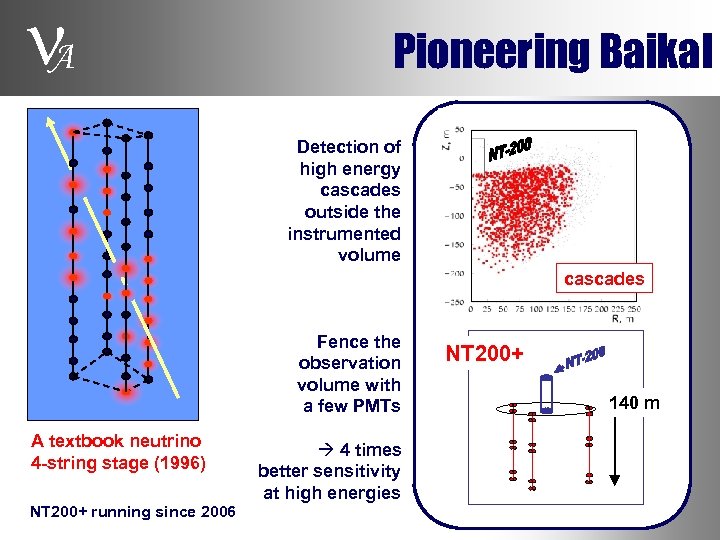 A Pioneering Baikal Detection of high energy cascades outside the instrumented volume cascades Fence the observation volume with a few PMTs A textbook neutrino 4 -string stage (1996) NT 200+ running since 2006 4 times better sensitivity at high energies NT 200+ 140 m
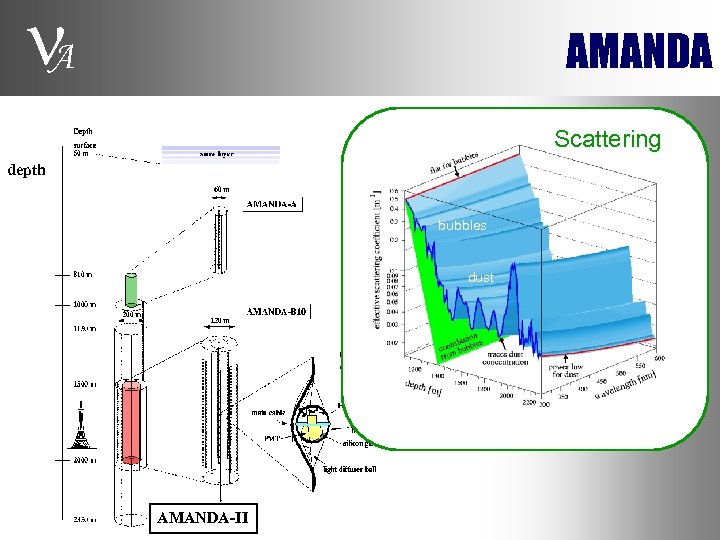
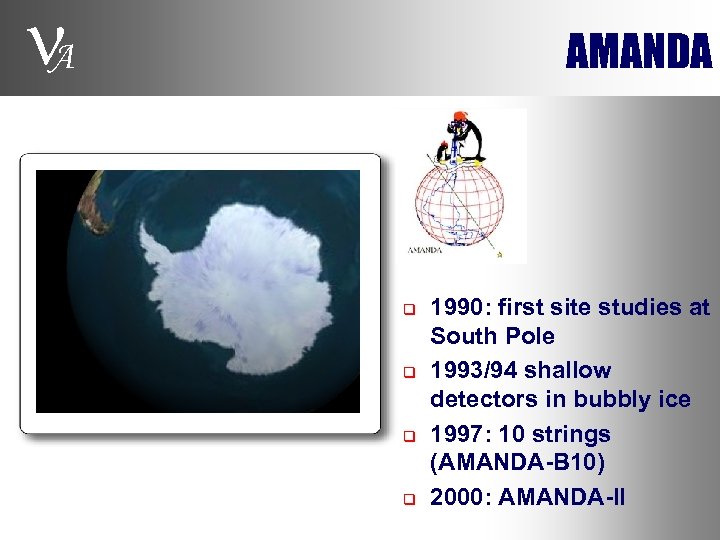 A AMANDA q q 1990: first site studies at South Pole 1993/94 shallow detectors in bubbly ice 1997: 10 strings (AMANDA-B 10) 2000: AMANDA-II
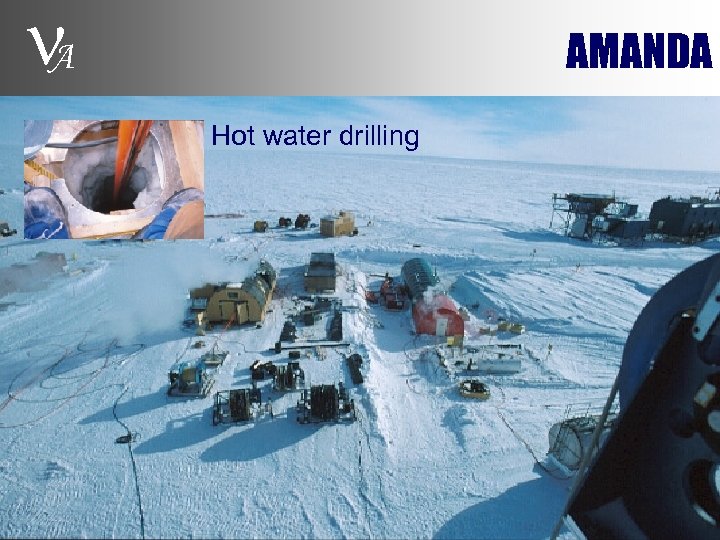 A AMANDA Hot water drilling
 A AMANDA Scattering depth bubbles dust AMANDA-II
 A AMANDA sykplot 2000 -2003 3329 events below horizon + N + X more on point sources in the following talk
 A South and North AMANDA & Baikal skyplot, galactic coordinates
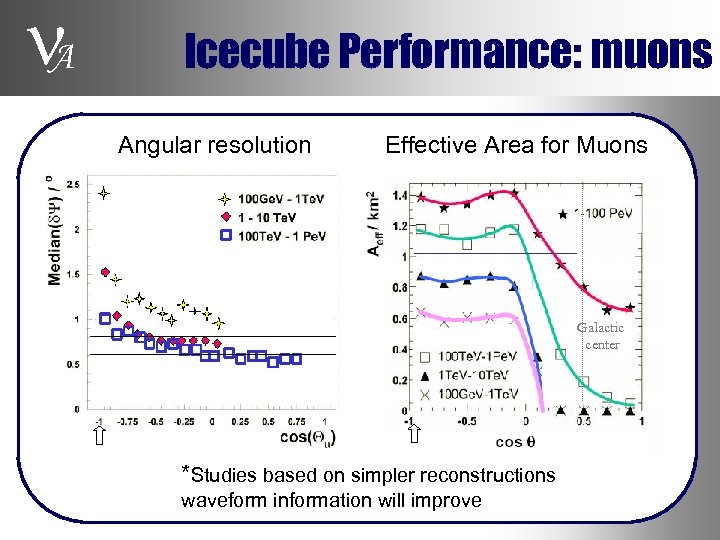
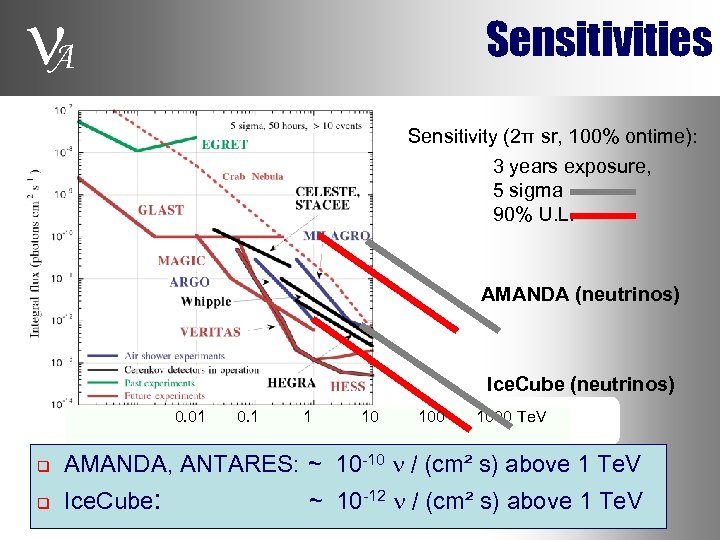
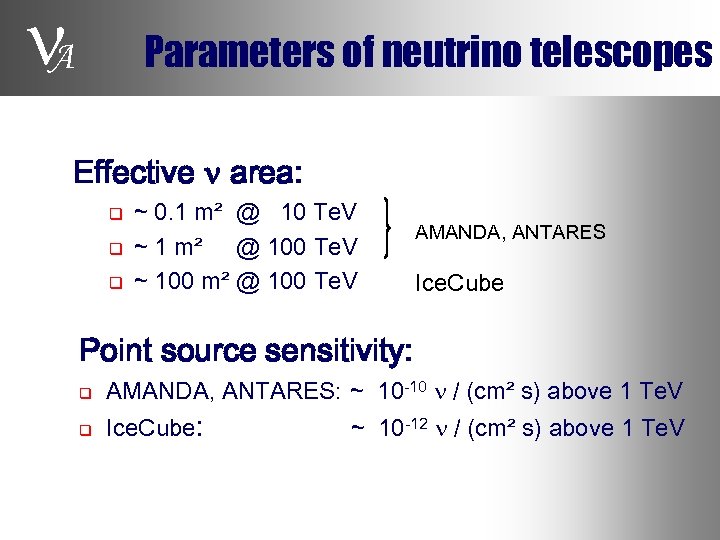 A Parameters of neutrino telescopes Effective area: q q q ~ 0. 1 m² @ 10 Te. V ~ 1 m² @ 100 Te. V ~ 100 m² @ 100 Te. V AMANDA, ANTARES Ice. Cube Point source sensitivity: q AMANDA, ANTARES: ~ 10 -10 / (cm² s) above 1 Te. V q Ice. Cube: ~ 10 -12 / (cm² s) above 1 Te. V
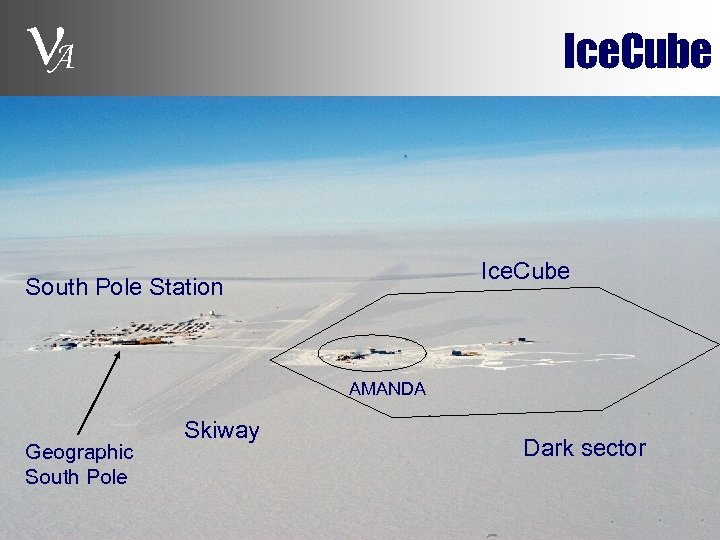 A Ice. Cube South Pole Station AMANDA Geographic South Pole Skiway Dark sector
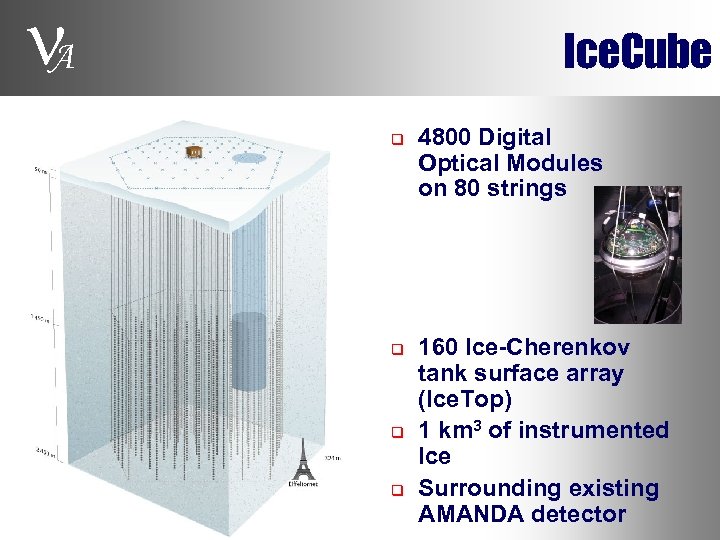 A Ice. Cube q q 4800 Digital Optical Modules on 80 strings 160 Ice-Cherenkov tank surface array (Ice. Top) 1 km 3 of instrumented Ice Surrounding existing AMANDA detector
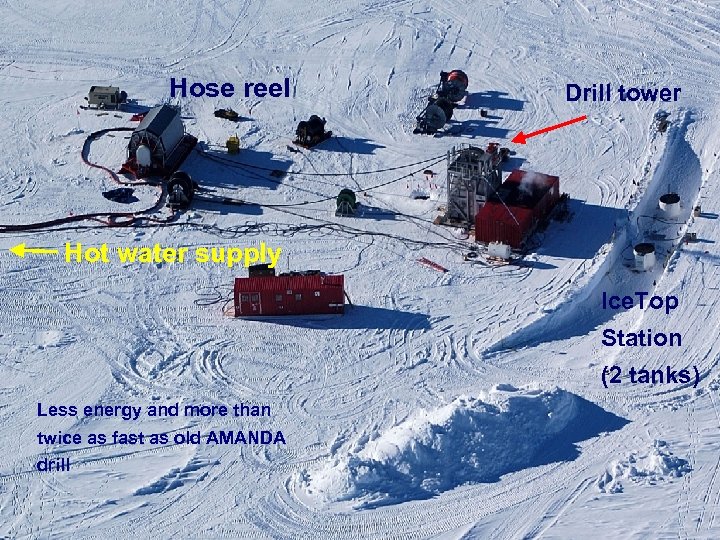 A Hose reel Drill tower Hot water supply Ice. Top Station (2 tanks) Less energy and more than twice as fast as old AMANDA drill
 A
A
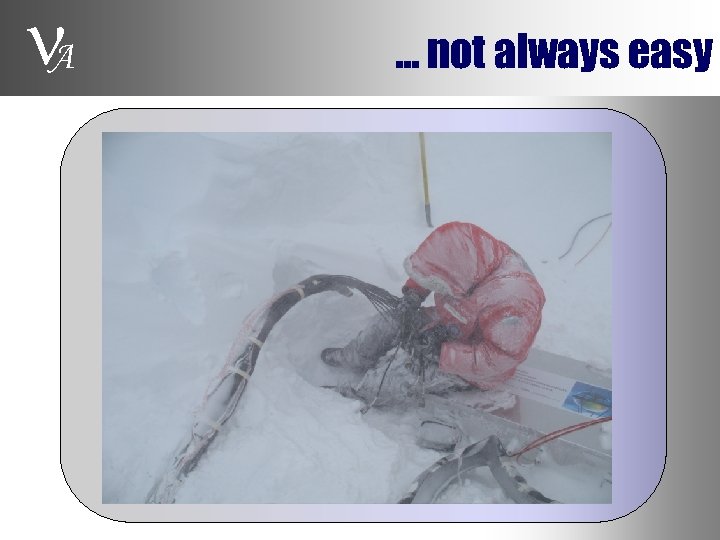 A … not always easy
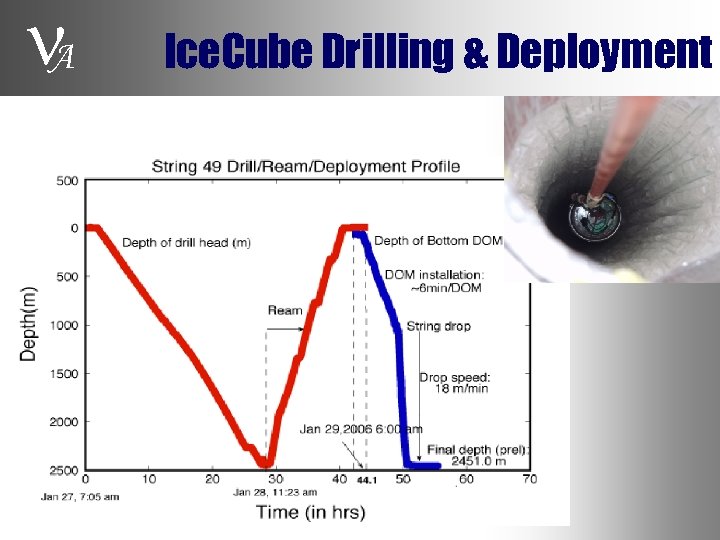 A Ice. Cube Drilling & Deployment
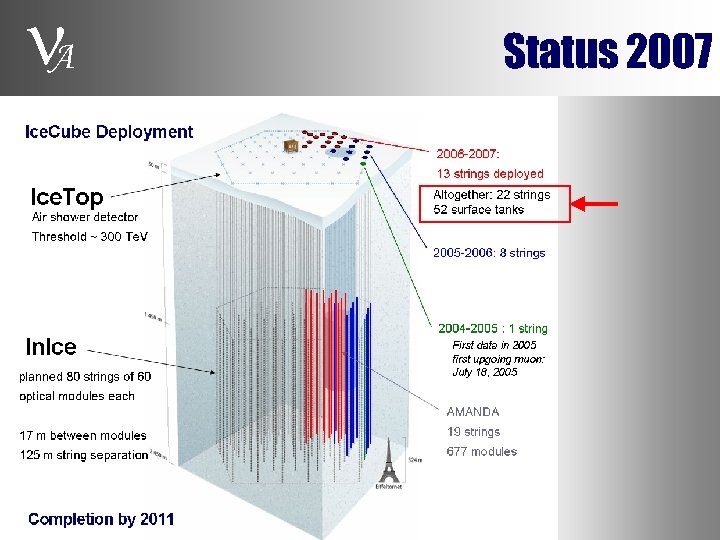 A Status 2007
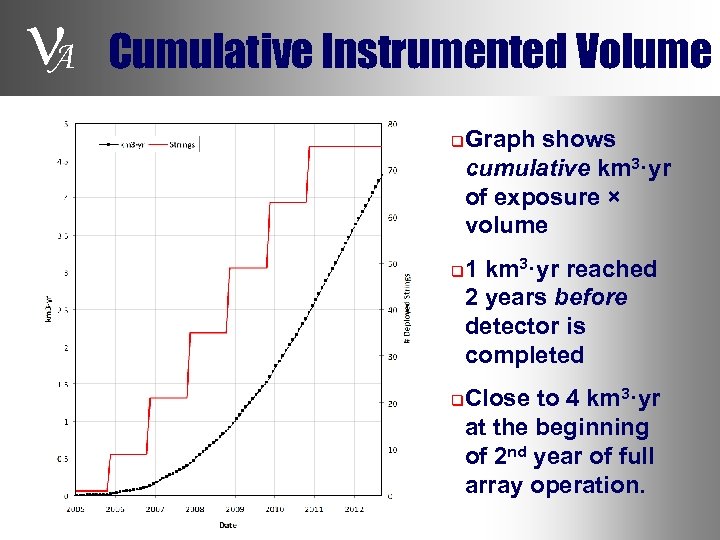 A Cumulative Instrumented Volume q q q Graph shows cumulative km 3·yr of exposure × volume 1 km 3·yr reached 2 years before detector is completed Close to 4 km 3·yr at the beginning of 2 nd year of full array operation.
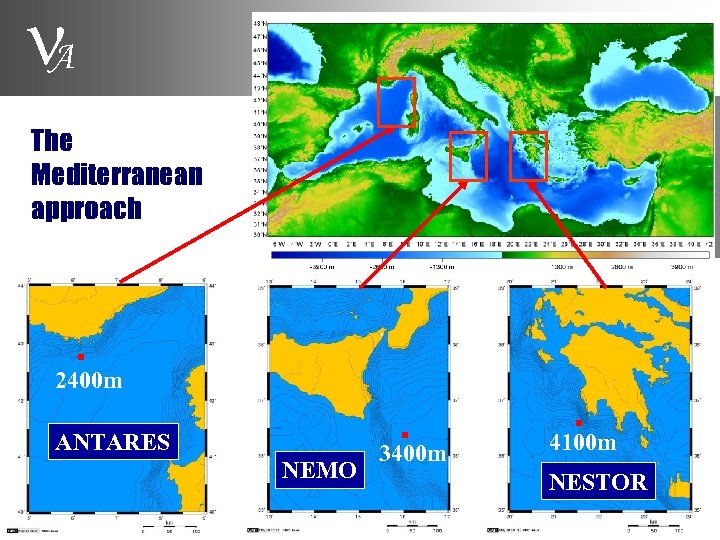 A The Mediterranean approach 2400 m ANTARES NEMO 3400 m 4100 m NESTOR
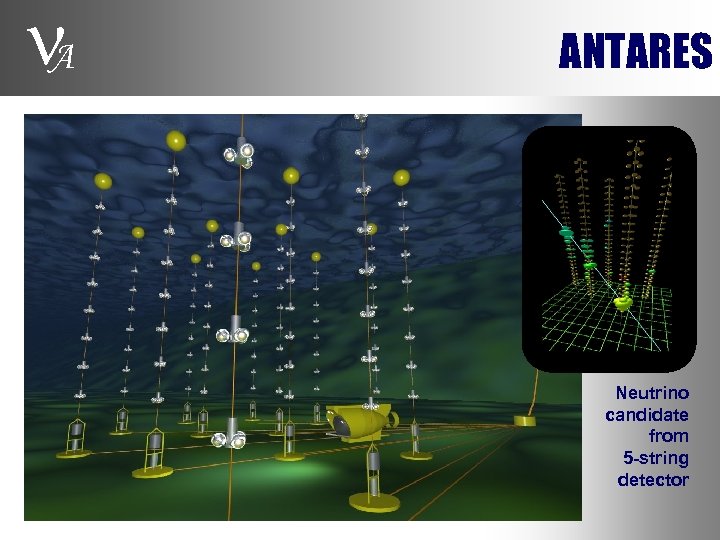 A ANTARES Neutrino candidate from 5 -string detector
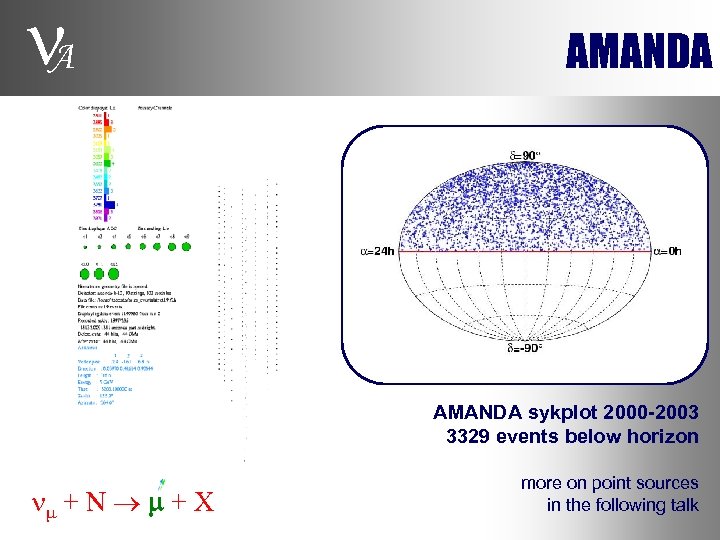
 A q q q q q Physics from Baikal & AMANDA Atmospheric neutrinos Diffuse fluxes Point sources see talk of Elisa Resconi Coincidences with GRB Supernova Bursts & SNEWS WIMP indirect detection Magnetic monopoles …. ….
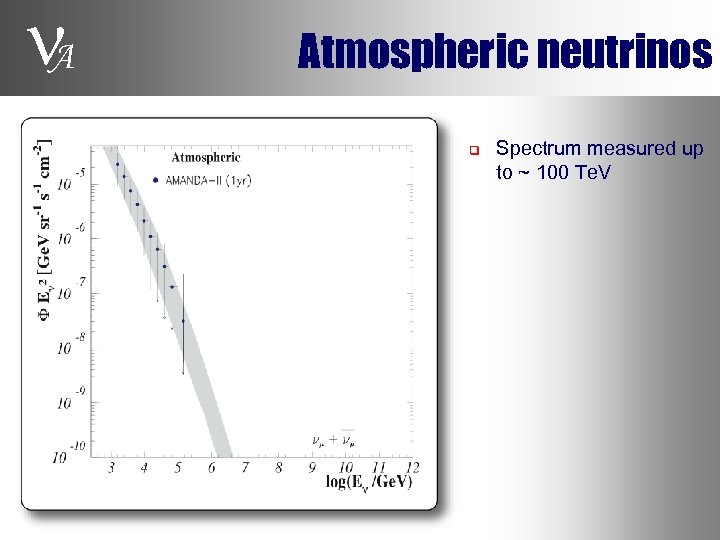 A Atmospheric neutrinos q Spectrum measured up to ~ 100 Te. V
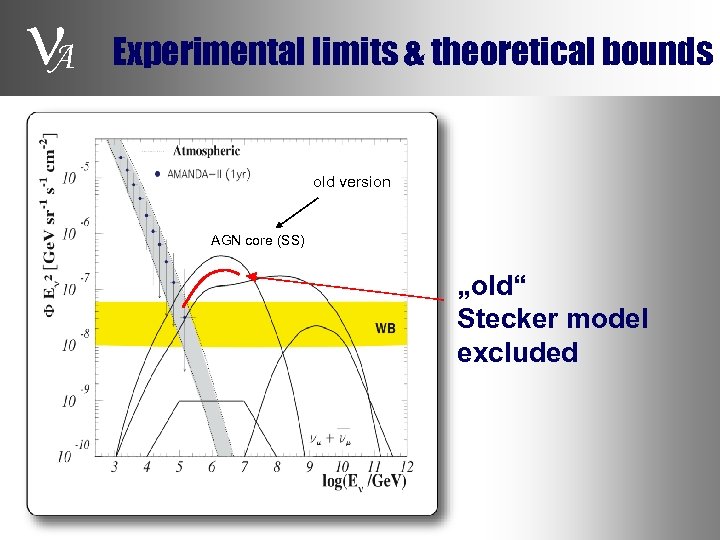
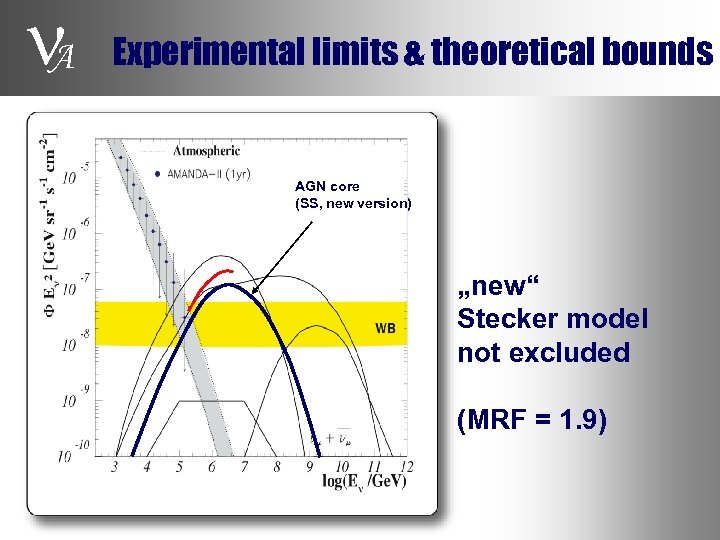
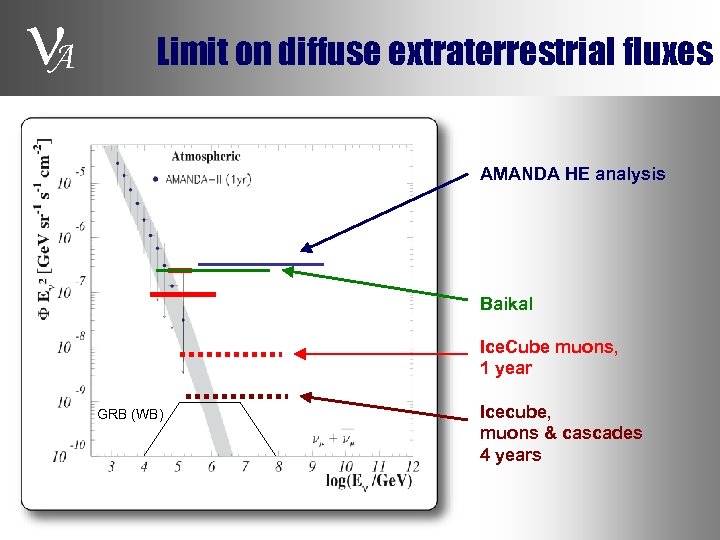
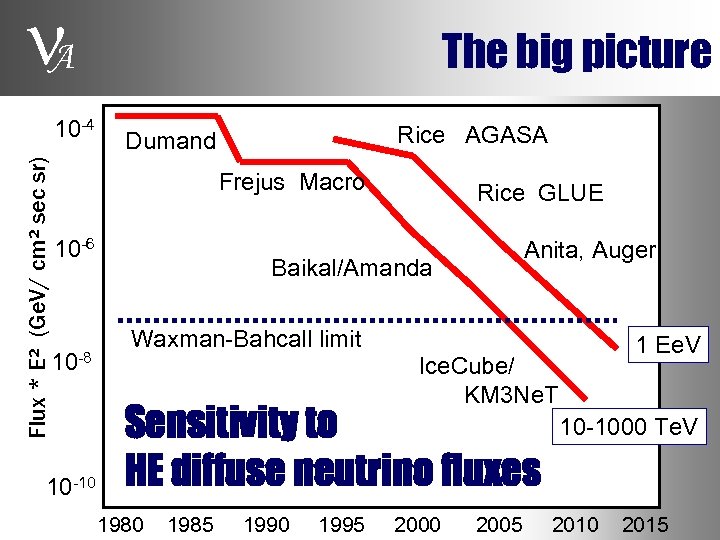
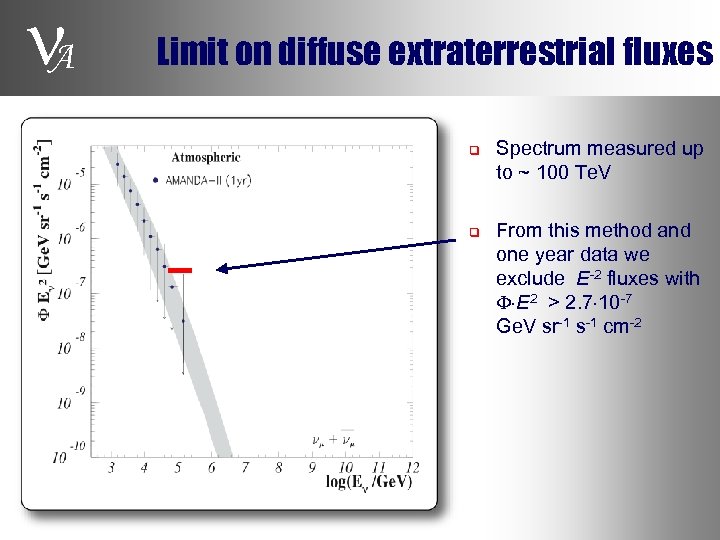 A Limit on diffuse extraterrestrial fluxes q q Spectrum measured up to ~ 100 Te. V From this method and one year data we exclude E-2 fluxes with E 2 > 2. 7 10 -7 Ge. V sr-1 s-1 cm-2
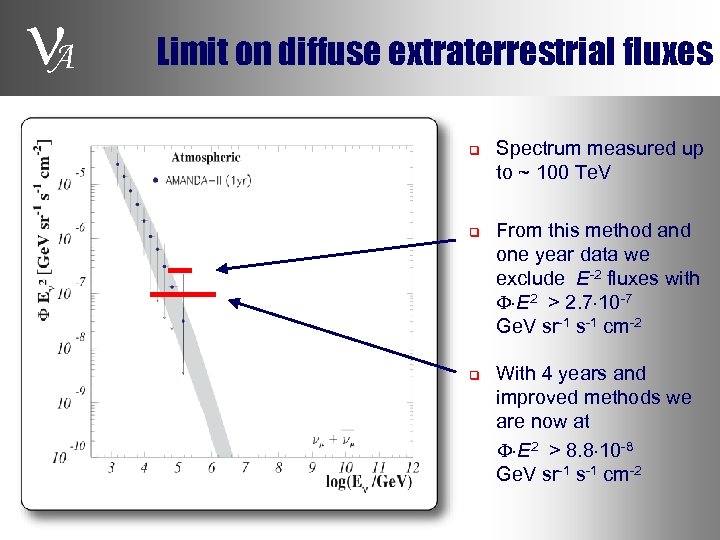 A Limit on diffuse extraterrestrial fluxes q q q Spectrum measured up to ~ 100 Te. V From this method and one year data we exclude E-2 fluxes with E 2 > 2. 7 10 -7 Ge. V sr-1 s-1 cm-2 With 4 years and improved methods we are now at E 2 > 8. 8 10 -8 Ge. V sr-1 s-1 cm-2
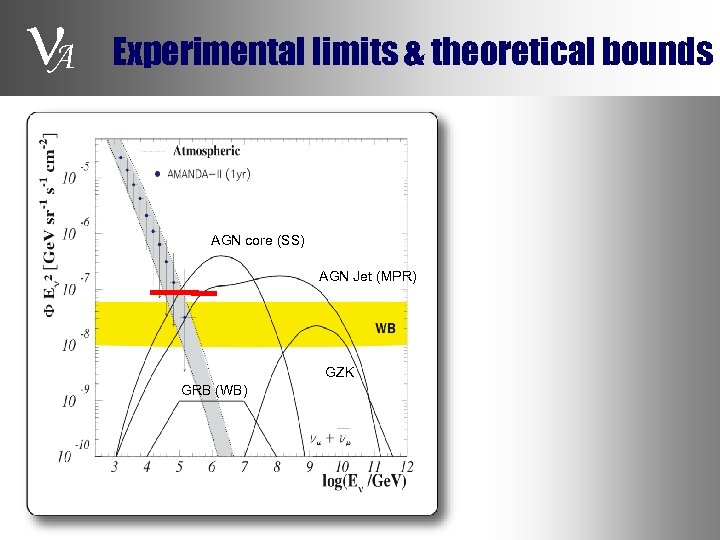
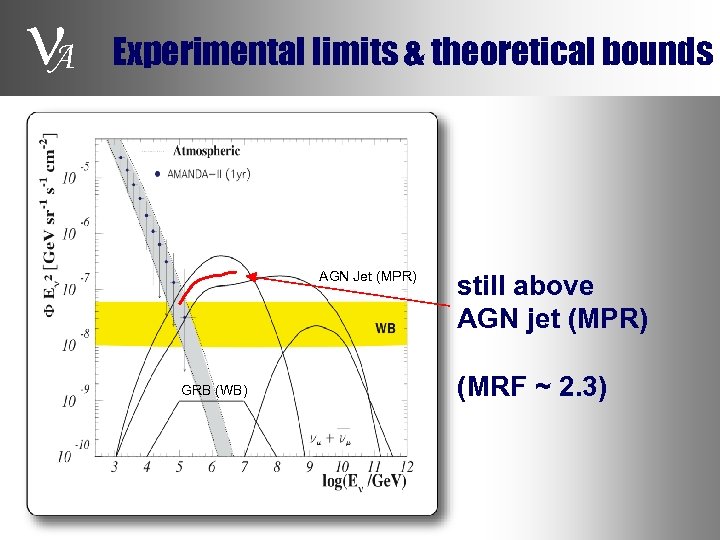
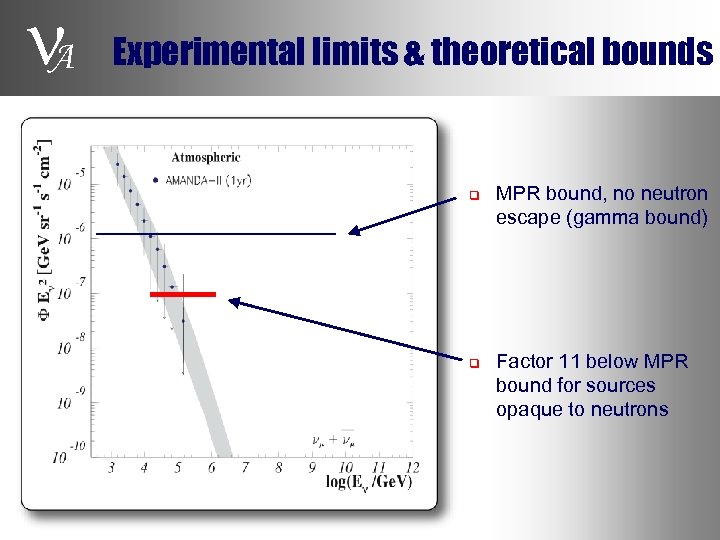 A Experimental limits & theoretical bounds q q MPR bound, no neutron escape (gamma bound) Factor 11 below MPR bound for sources opaque to neutrons
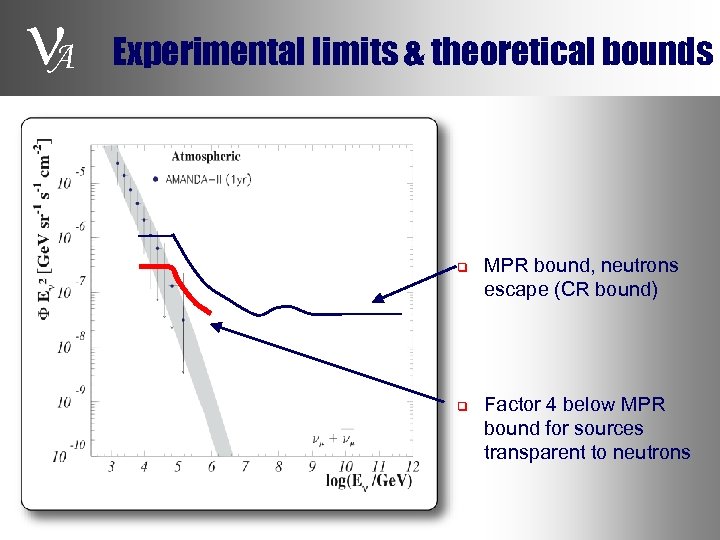 A Experimental limits & theoretical bounds q q MPR bound, neutrons escape (CR bound) Factor 4 below MPR bound for sources transparent to neutrons
 A Experimental limits & theoretical bounds AGN core (SS) AGN Jet (MPR) GZK GRB (WB)
 A Experimental limits & theoretical bounds old version AGN core (SS) „old“ Stecker model excluded
 A Experimental limits & theoretical bounds AGN core (SS, new version) „new“ Stecker model not excluded (MRF = 1. 9)
 A Experimental limits & theoretical bounds AGN Jet (MPR) GRB (WB) still above AGN jet (MPR) (MRF ~ 2. 3)
 A Limit on diffuse extraterrestrial fluxes AMANDA HE analysis Baikal Ice. Cube muons, 1 year GRB (WB) Icecube, muons & cascades 4 years
 A Coincidences with GRB Check for coincidences with - BATSE - IPN - SWIFT 408 bursts With Ice. Cube: test WB within a few months
 A Detection of Supernova Bursts ice uniformly illuminated q q detect correlated rate increase on top of PMT noise Dark noise in AMANDA only ~ 500 Hz ! SN neutrino signal simulation center of galaxy, normalized to SN 1987 A
 A Participation in SNEWS …several hours advanced notice to astronomers Super-K SNO LVD coincidence server @ BNL alert AMANDA (Ice. Cube) Ice. Cube will follow this year http: //snews. bnl. gov and astro-ph/0406214
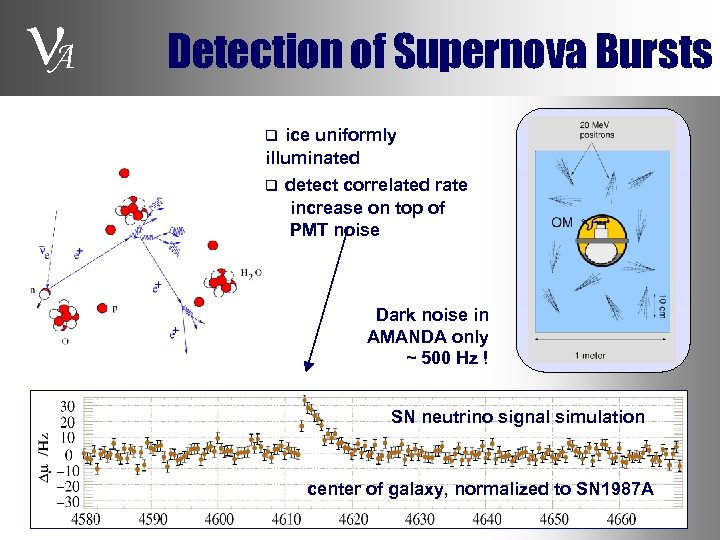
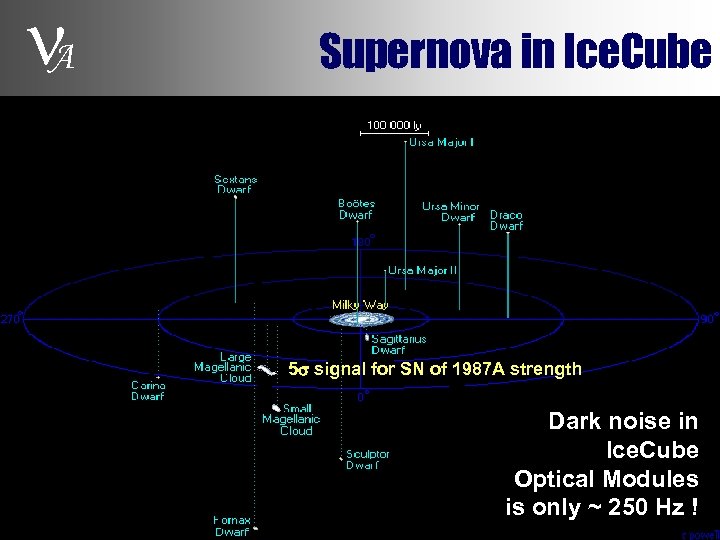 A Supernova in Ice. Cube 5 signal for SN of 1987 A strength Dark noise in Ice. Cube Optical Modules is only ~ 250 Hz !
 A q Summary tremendous technological progress over last decade (Baikal, South Pole, now also Mediterrannean) no positive detection yet, but already testing realistic models/bounds q Ice. Cube reaches 1 km 3 year by the end of 2008 q entering region with realistic discovery potential q Ice. Cube discoveries/non-discoveries will influence design of KM 3 Ne. T q
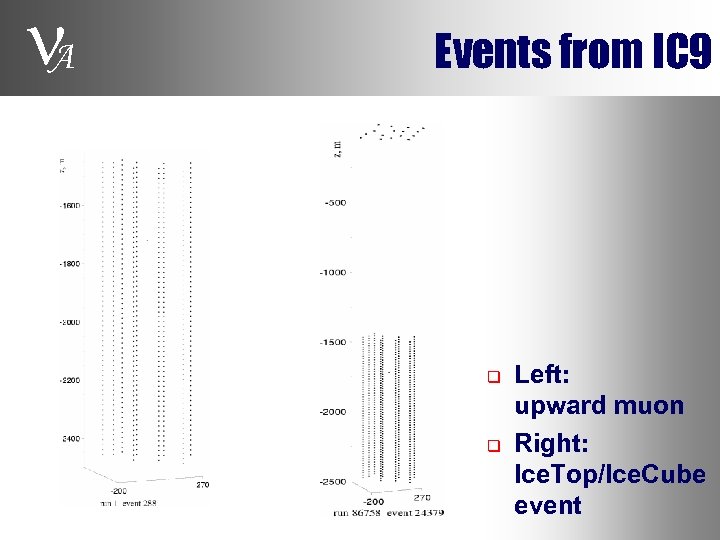 A Events from IC 9 q q Left: upward muon Right: Ice. Top/Ice. Cube event
 A Back-ups
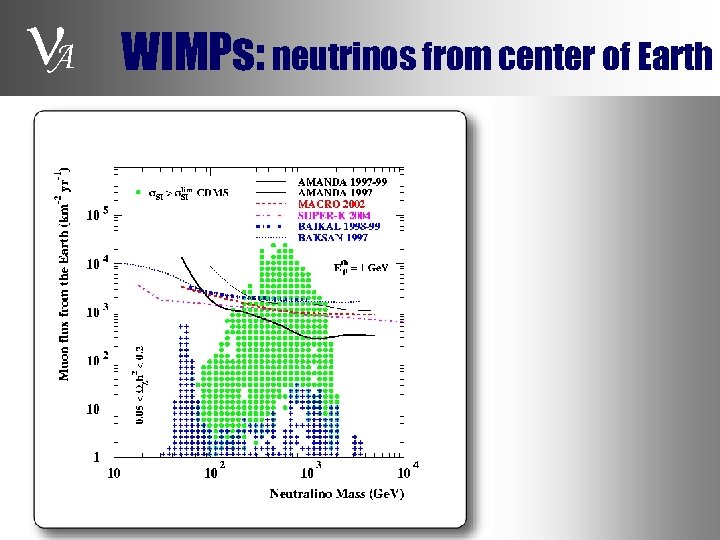
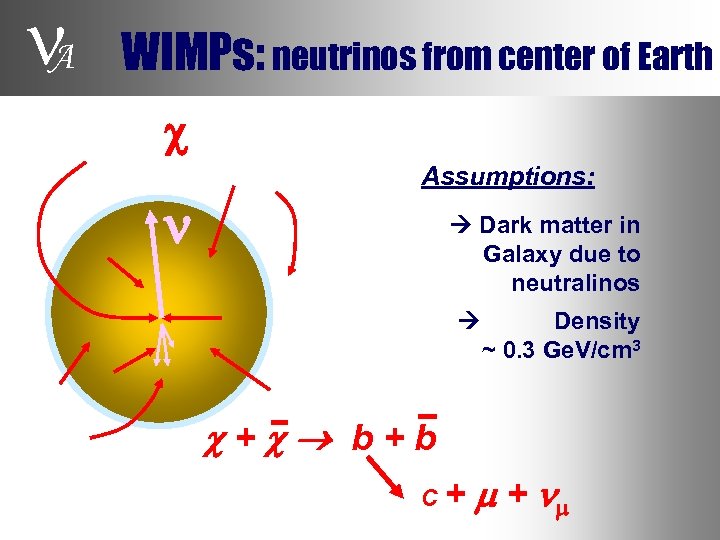 A WIMPs: neutrinos from center of Earth Assumptions: Dark matter in Galaxy due to neutralinos Density ~ 0. 3 Ge. V/cm 3 + b+b C+ +
 A WIMPs: neutrinos from center of Earth
 A WIMPs: neutrinos from Sun Amanda
 A WIMPs: neutrinos from Sun
 A upper limit (cm-2 s-1 sr-1) 10 -14 Relativistic Magnetic Monopoles Soudan KGF 10 -15 Amanda MACRO Cherenkov-Light n 2·(g/e)2 Orito 10 -16 10 -17 n = 1. 33 el Baikal (g/e) = 137/ 2 ectr ons 8300 Ice. Cube 10 -18 0. 50 0. 75 = v/c 1. 00
 A Icecube Performance: muons Angular resolution Effective Area for Muons Muon neutrino *Studies based on simpler reconstructions waveform information will improve Galactic center
 A Sensitivities Sensitivity (2π sr, 100% ontime): 3 years exposure, 5 sigma 90% U. L. AMANDA (neutrinos) Ice. Cube (neutrinos) 0. 01 0. 1 1 10 1000 Te. V q AMANDA, ANTARES: ~ 10 -10 / (cm² s) above 1 Te. V q Ice. Cube: ~ 10 -12 / (cm² s) above 1 Te. V
 A Flux * E² (Ge. V/ cm² sec sr) 10 -4 The big picture Rice AGASA Dumand Frejus Macro 10 -6 10 -8 10 -10 Rice GLUE Anita, Auger Baikal/Amanda Waxman-Bahcall limit 1 Ee. V Ice. Cube/ KM 3 Ne. T Sensitivity to HE diffuse neutrino fluxes 1980 1985 1990 1995 2000 2005 10 -1000 Te. V 2010 2015
 A q Methods for > 100 Pe. V Radio detection of showers at the moon q q q Radio detection of neutrinos in ice or salt q q q RICE, ANITA, Test array AURA (Ice. Cube) future: ARIANNA, SALSA Acoustic detection of neutrinos in water and ice q q GLUE, Kalyazhin in future: LOFAR, SKA test arrays SPATS (Ice. Cube) and AMADEUS (ANTARES) Detection of fluorescence signals in air q q from ground: AGASA, Auger from space: FORTE, in future – EUSO, OWL
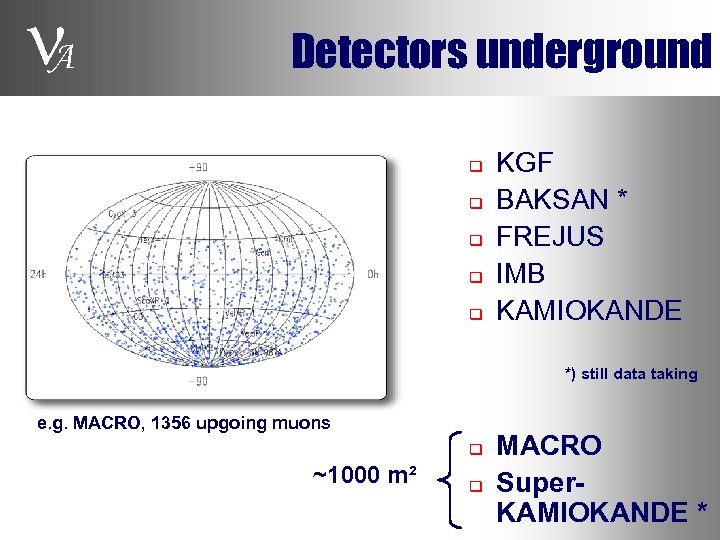 A Detectors underground q q q KGF BAKSAN * FREJUS IMB KAMIOKANDE *) still data taking e. g. MACRO, 1356 upgoing muons q ~1000 m² q MACRO Super. KAMIOKANDE *
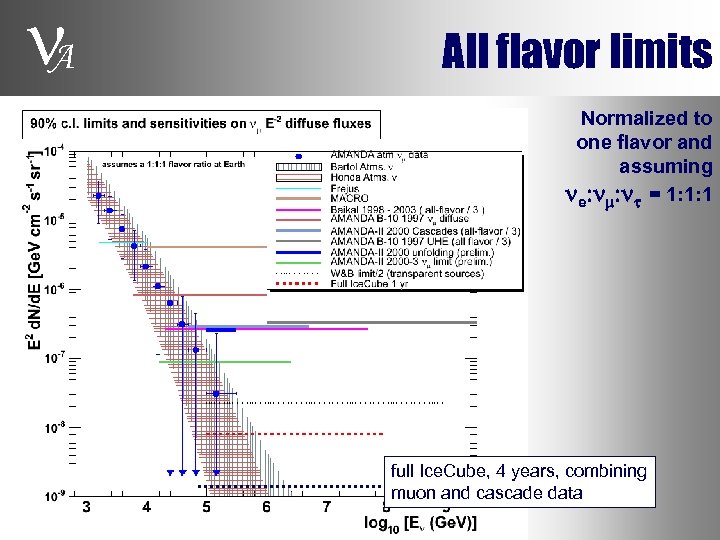 A All flavor limits Normalized to one flavor and assuming e: : t = 1: 1: 1 full Ice. Cube, 4 years, combining muon and cascade data
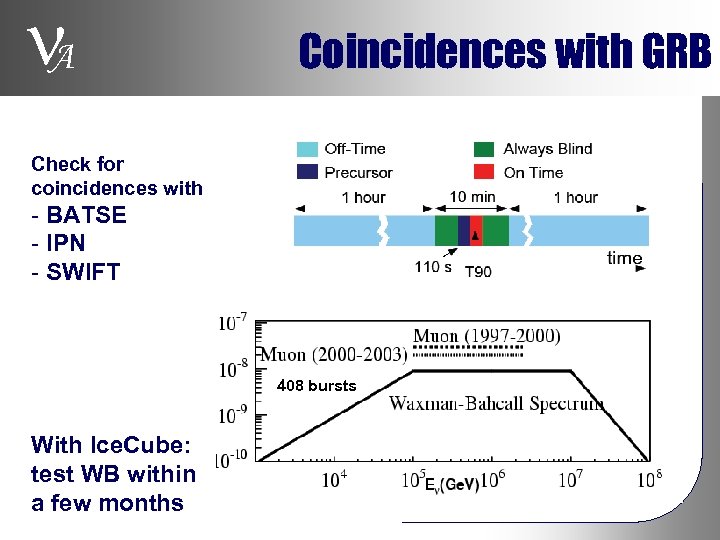
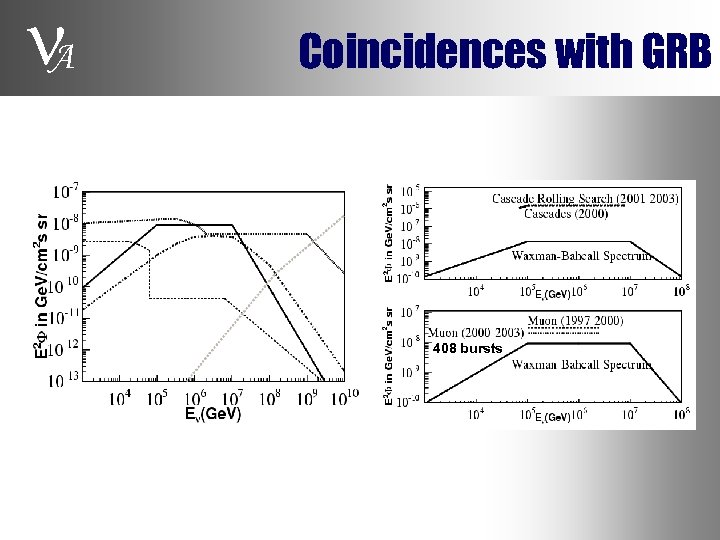 A Coincidences with GRB 408 bursts