


 Скачать презентацию A Healthy University Getting Started www healthyuniversities ac
346ad57ac6db55f6caedd6707225e1eb.ppt
- Количество слайдов: 21
 A Healthy University: Getting Started www. healthyuniversities. ac. uk
 What is a Healthy University? A Healthy University: “aspires to create a learning environment and organisational culture that enhances the health, well-being and sustainability of its community and enables people to achieve their full potential. ” www. healthyuniversities. ac. uk
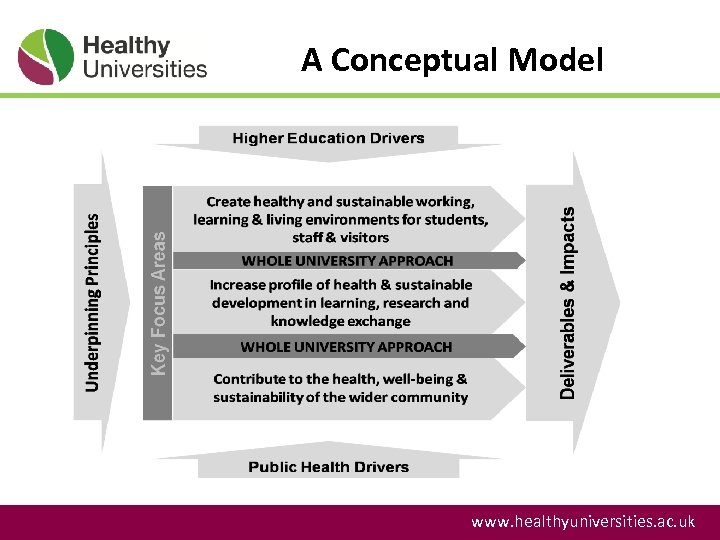 A Conceptual Model www. healthyuniversities. ac. uk
 Underpinning Principles The Healthy University approach is underpinned by a range of core principles, which derive from the values that characterise higher education and public health. The integrity of the approach will be ensured by applying the following principles: • • Equality and diversity Participation and empowerment Partnership Sustainability Holistic and whole system health Evidence-informed and innovative practice Evaluation, learning and knowledge exchange www. healthyuniversities. ac. uk
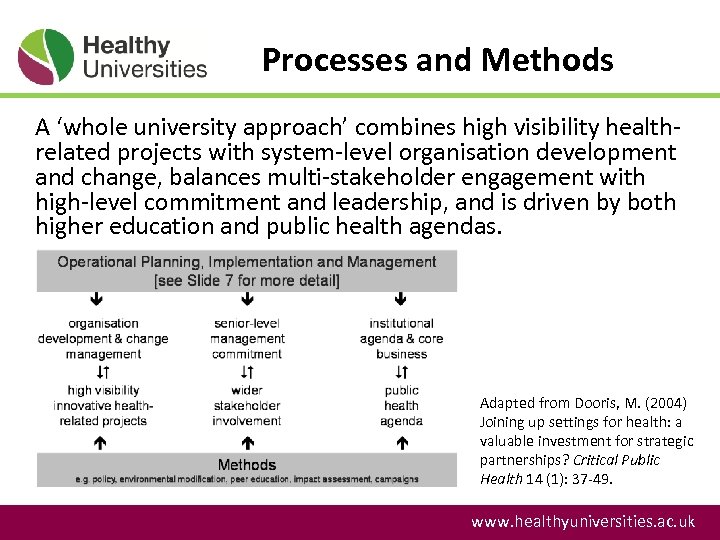 Processes and Methods A ‘whole university approach’ combines high visibility healthrelated projects with system-level organisation development and change, balances multi-stakeholder engagement with high-level commitment and leadership, and is driven by both higher education and public health agendas. Adapted from Dooris, M. (2004) Joining up settings for health: a valuable investment for strategic partnerships? Critical Public Health 14 (1): 37 -49. www. healthyuniversities. ac. uk
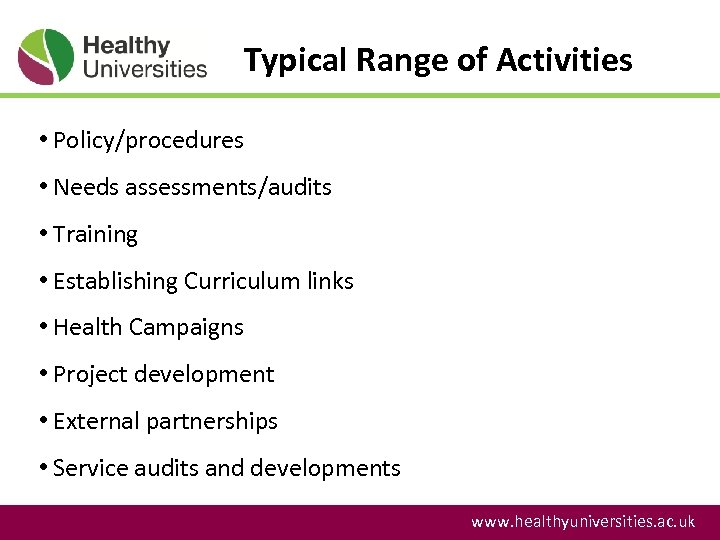 Typical Range of Activities • Policy/procedures • Needs assessments/audits • Training • Establishing Curriculum links • Health Campaigns • Project development • External partnerships • Service audits and developments www. healthyuniversities. ac. uk
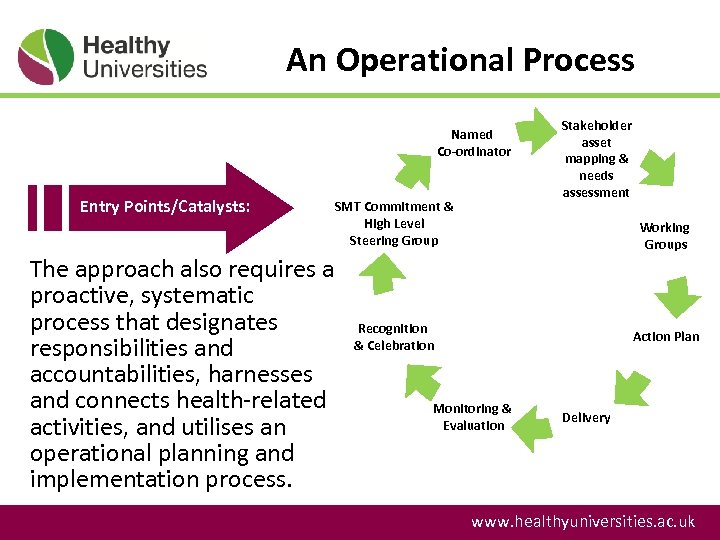 An Operational Process Named Co-ordinator Entry Points/Catalysts: The approach also requires a proactive, systematic process that designates responsibilities and accountabilities, harnesses and connects health-related activities, and utilises an operational planning and implementation process. SMT Commitment & High Level Steering Group Stakeholder asset mapping & needs assessment Working Groups Recognition & Celebration Action Plan Monitoring & Evaluation Delivery www. healthyuniversities. ac. uk
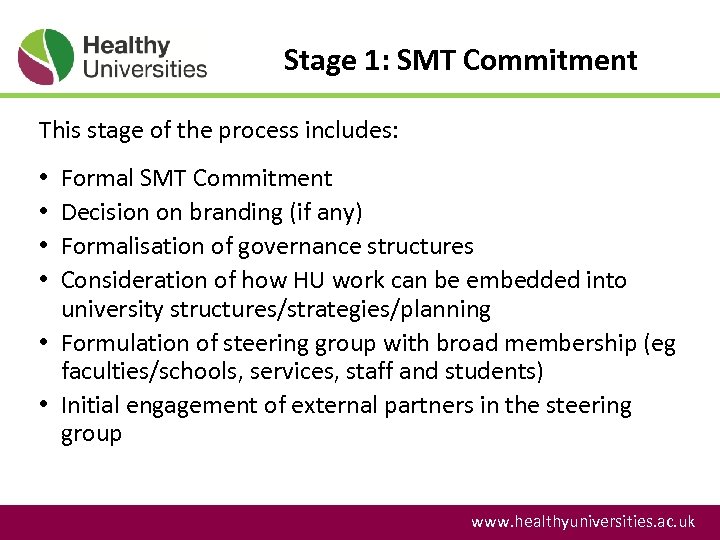 Stage 1: SMT Commitment This stage of the process includes: Formal SMT Commitment Decision on branding (if any) Formalisation of governance structures Consideration of how HU work can be embedded into university structures/strategies/planning • Formulation of steering group with broad membership (eg faculties/schools, services, staff and students) • Initial engagement of external partners in the steering group • • www. healthyuniversities. ac. uk
 Stage 2: Named Coordinator This stage of the process includes: • Consideration of where a Healthy University Coordinator would best be located within your organisation (see slides 17 -19 for examples of healthy university structures) • Decision about the level at which your coordinator will work, whether it is a full or part time role • Decision about whether a the coordinator post is a new role, or existing role(s) within the organisation could be changed to reflect Healthy University work www. healthyuniversities. ac. uk
 Stage 3: Assets & Needs Assessment This stage of the process includes: • Decision about methods, resources and time available for an audit eg Focus groups, Team meetings, Questionnaires • Identification any current audit information that relates to health • Identification of internal and external stakeholders/partners • Identification of current activity • Identification of need – staff, students and wider community • Securing buy-in and systems for on-going involvement www. healthyuniversities. ac. uk
 Stage 4: Working Groups This stage of the process includes: • Responding to mapping and audit by developing working group(s) that are action-focused groups determined by need – not ‘for own sake’ • Following normal protocol for working groups, eg terms of reference, membership, timing, agreeing action plan • Ensuring working groups are linked into governance structure(s) • Consideration of who should lead/be on groups- Often the HU co-ordinator will facilitate groups but key members of steering group could also have this role www. healthyuniversities. ac. uk
 Stage 5: Action Planning This stage of the process includes: • Development of an action plan that fits into the institution's planning cycle. Each working group usually develops their own action plan feeding into a larger HU action plan • Clarification of objectives, outcomes and evaluation • Anticipation and connection to internal/external drivers and forging of links to relevant expertise • Ensuring links to local and national targets • Ensuring plans addresses local/national/ international standards and accreditation criteria www. healthyuniversities. ac. uk
 Stage 6: Delivery This stage of the process includes: • Ensuring your action plan is robust enough to support delivery and demonstrate ‘deliverables’ within a set timescale • Identifying named leads and support/resources • Regular reporting on progress through working groups and HU Steering Groups www. healthyuniversities. ac. uk
 Stage 7: Monitoring & Evaluation This stage of the process includes: • Planning for monitoring and evaluation – not an afterthought. Evaluation can be linked to external standards, e. g. Fair Trade Status, Clean Air Award • Remembering the dual agendas – public health and ‘core business’ – and consideration of what counts as evidence in the setting • Consideration of types of evaluation – not only to demonstrate outcomes, but to understand what works in which situations and why www. healthyuniversities. ac. uk
 Stage 8: Recognition & Celebration This stage of the process includes: • Internal and external dissemination of Healthy University achievements • Inclusion of information into key university documents, prospectus, web pages, annual reports • Write up of work into Case Study for HU website • Write up of research/practice based work as journal articles www. healthyuniversities. ac. uk
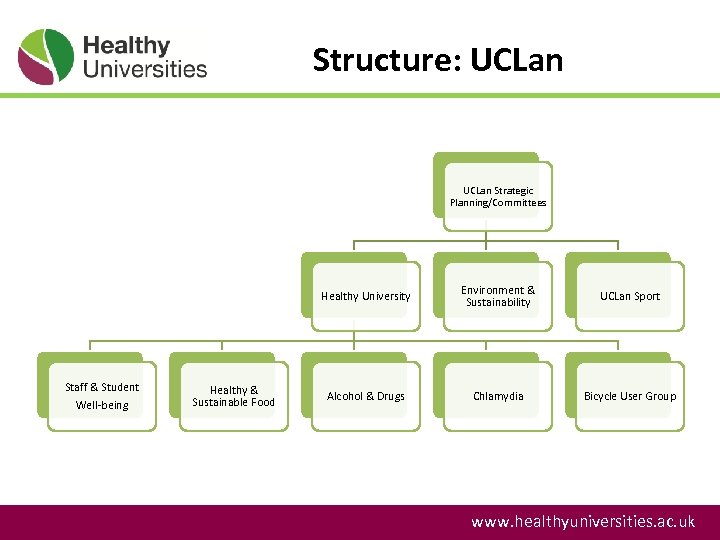 Structure: UCLan Strategic Planning/Committees Healthy University Staff & Student Well-being Healthy & Sustainable Food Environment & Sustainability UCLan Sport Alcohol & Drugs Chlamydia Bicycle User Group www. healthyuniversities. ac. uk
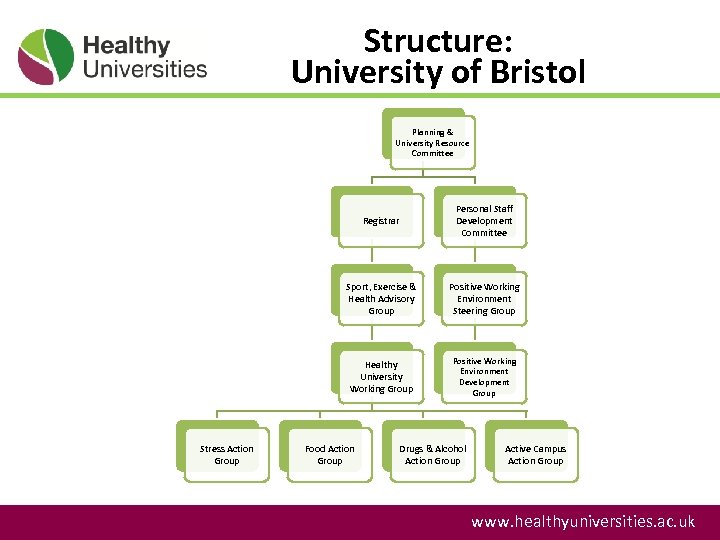 Structure: University of Bristol Planning & University Resource Committee Registrar Sport, Exercise & Health Advisory Group Positive Working Environment Steering Group Healthy University Working Group Stress Action Group Personal Staff Development Committee Positive Working Environment Development Group Food Action Group Drugs & Alcohol Action Group Active Campus Action Group www. healthyuniversities. ac. uk
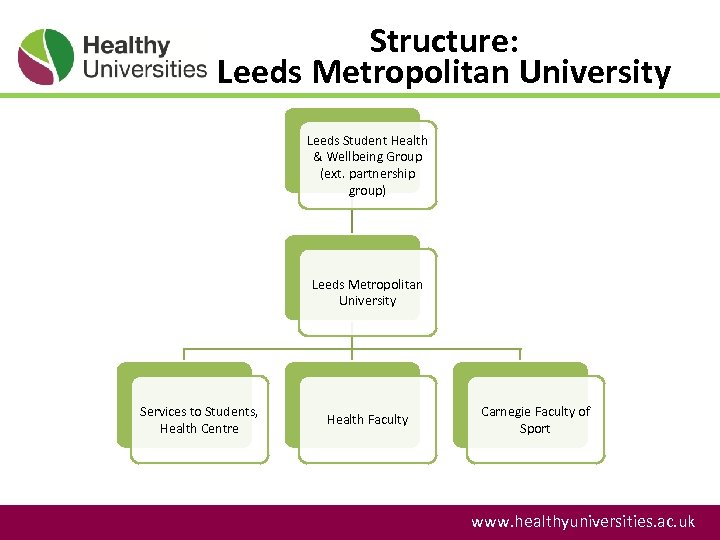 Structure: Leeds Metropolitan University Leeds Student Health & Wellbeing Group (ext. partnership group) Leeds Metropolitan University Services to Students, Health Centre Health Faculty Carnegie Faculty of Sport www. healthyuniversities. ac. uk
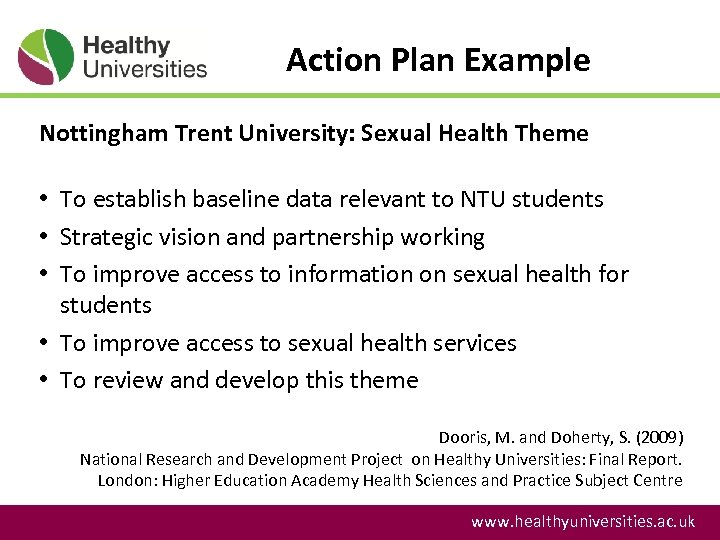 Action Plan Example Nottingham Trent University: Sexual Health Theme • To establish baseline data relevant to NTU students • Strategic vision and partnership working • To improve access to information on sexual health for students • To improve access to sexual health services • To review and develop this theme Dooris, M. and Doherty, S. (2009) National Research and Development Project on Healthy Universities: Final Report. London: Higher Education Academy Health Sciences and Practice Subject Centre www. healthyuniversities. ac. uk
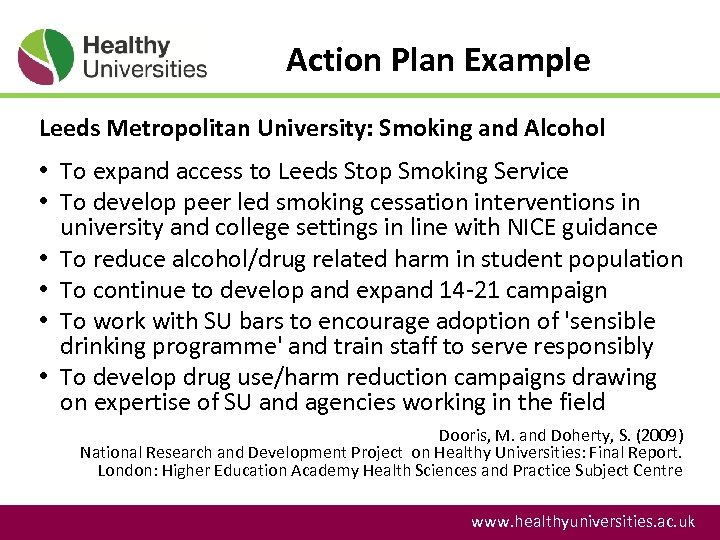 Action Plan Example Leeds Metropolitan University: Smoking and Alcohol • To expand access to Leeds Stop Smoking Service • To develop peer led smoking cessation interventions in university and college settings in line with NICE guidance • To reduce alcohol/drug related harm in student population • To continue to develop and expand 14 -21 campaign • To work with SU bars to encourage adoption of 'sensible drinking programme' and train staff to serve responsibly • To develop drug use/harm reduction campaigns drawing on expertise of SU and agencies working in the field Dooris, M. and Doherty, S. (2009) National Research and Development Project on Healthy Universities: Final Report. London: Higher Education Academy Health Sciences and Practice Subject Centre www. healthyuniversities. ac. uk
 References Dooris, M. and Doherty, S. (2009) National Research and Development Project on Healthy Universities: Final Report. London: Higher Education Academy Health Sciences and Practice Subject Centre. Dooris, M. (2004) Joining up settings for health: a valuable investment for strategic partnerships? Critical Public Health 14 (1) www. healthyuniversities. ac. uk