


 Скачать презентацию A Health Check on the Economy How Does
d060cddfa3e033f3b762cb8b6bf9dc37.ppt
- Количество слайдов: 84
 A Health Check on the Economy: How Does it Measure UP ? Roderick Deane Background material for an address to the NZ Retailers Association at Sky City Auckland on 2 September 2009 Dr Roderick Deane is Chairman of Fletcher Building Ltd & the NZ Seed Fund, & a Director of Woolworths Ltd in Sydney. He is also on the Advisory Board of Pacific Road Corporate Finance and Patron of IHC & Chairman of the IHC Foundation. He was previously Chairman of ANZ National Bank, Telecom Corporation of NZ Ltd, Te Papa Tongarewa (The Museum of NZ), City Gallery Wellington Foundation, & a Director of the ANZ Banking Group Ltd in Melbourne. At an earlier stage he was CEO of Telecom, Electricity Corporation of NZ Ltd, Chairman of the State Services Commission, & Deputy Governor of the Reserve Bank. He was also Professor of Economics and Management at Victoria University of Wellington & a Director of Trans. Alta Corporation in Canada for some years. Dr Deane is very appreciative of the assistance he was given in preparing this material by the Economics Group of the ANZ National Bank, particularly Khoon Goh, and by Bryce Wilkinson and Roger Kerr.
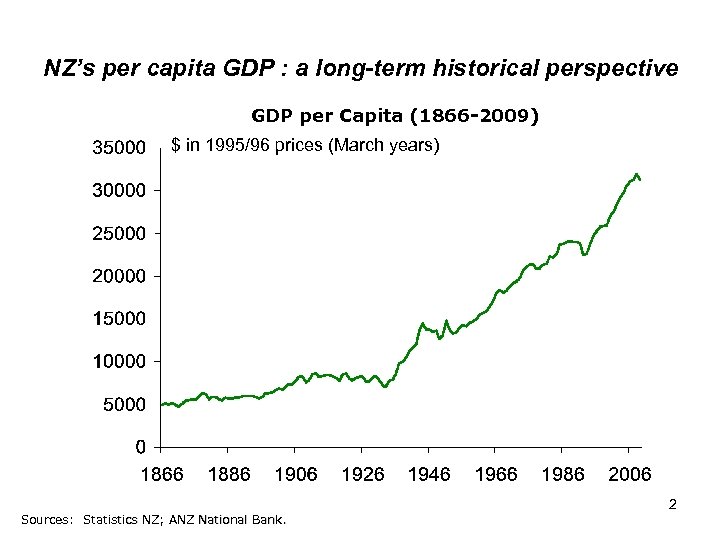 NZ’s per capita GDP : a long-term historical perspective GDP per Capita (1866 -2009) $ in 1995/96 prices (March years) Sources: Statistics NZ; ANZ National Bank. 2
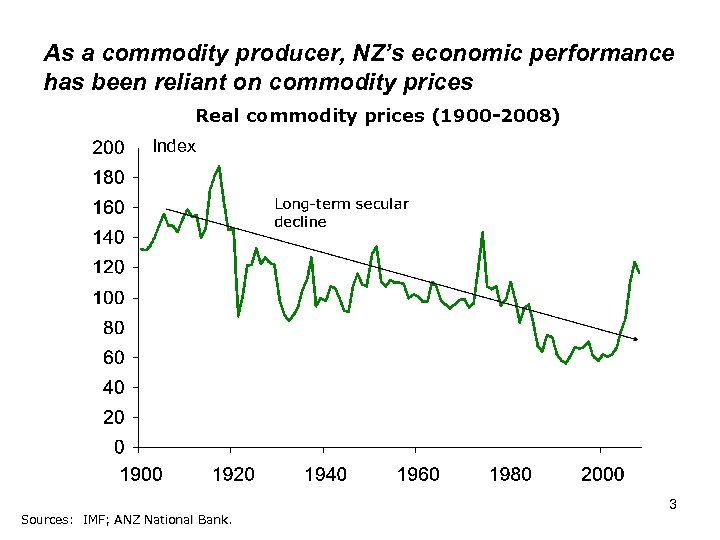 As a commodity producer, NZ’s economic performance has been reliant on commodity prices Real commodity prices (1900 -2008) Index Sources: IMF; ANZ National Bank. 3
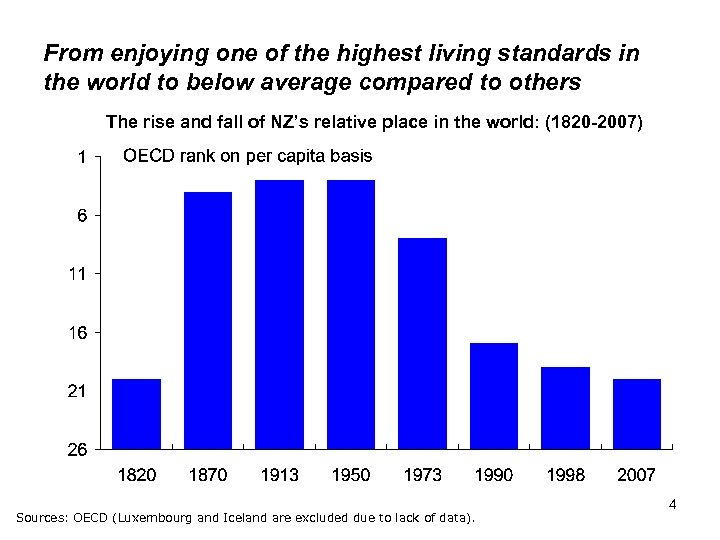 From enjoying one of the highest living standards in the world to below average compared to others The rise and fall of NZ’s relative place in the world: (1820 -2007) Sources: OECD (Luxembourg and Iceland are excluded due to lack of data). 4
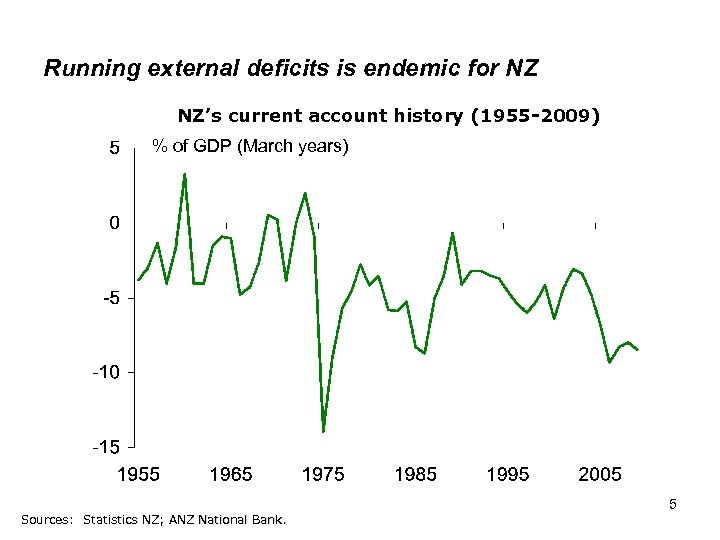 Running external deficits is endemic for NZ NZ’s current account history (1955 -2009) % of GDP (March years) Sources: Statistics NZ; ANZ National Bank. 5
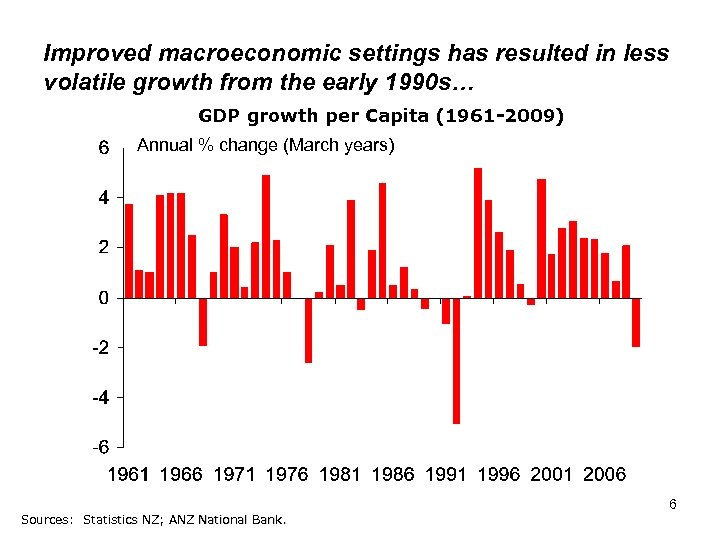 Improved macroeconomic settings has resulted in less volatile growth from the early 1990 s… GDP growth per Capita (1961 -2009) Annual % change (March years) Sources: Statistics NZ; ANZ National Bank. 6
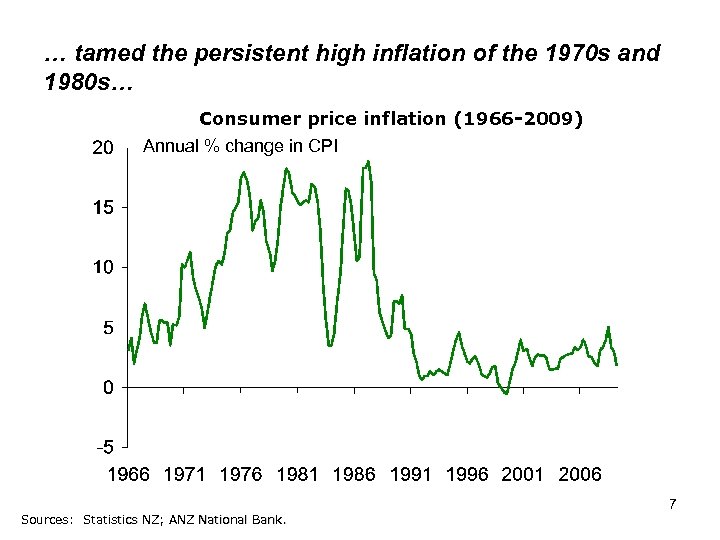 … tamed the persistent high inflation of the 1970 s and 1980 s… Consumer price inflation (1966 -2009) Annual % change in CPI Sources: Statistics NZ; ANZ National Bank. 7
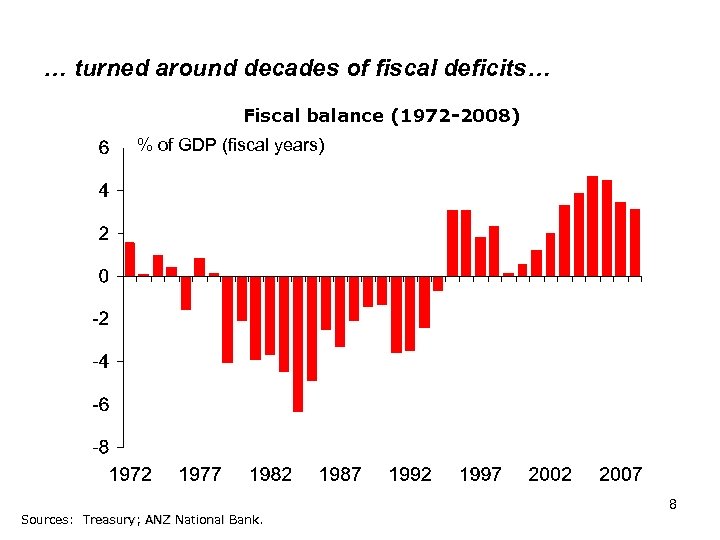 … turned around decades of fiscal deficits… Fiscal balance (1972 -2008) % of GDP (fiscal years) Sources: Treasury; ANZ National Bank. 8
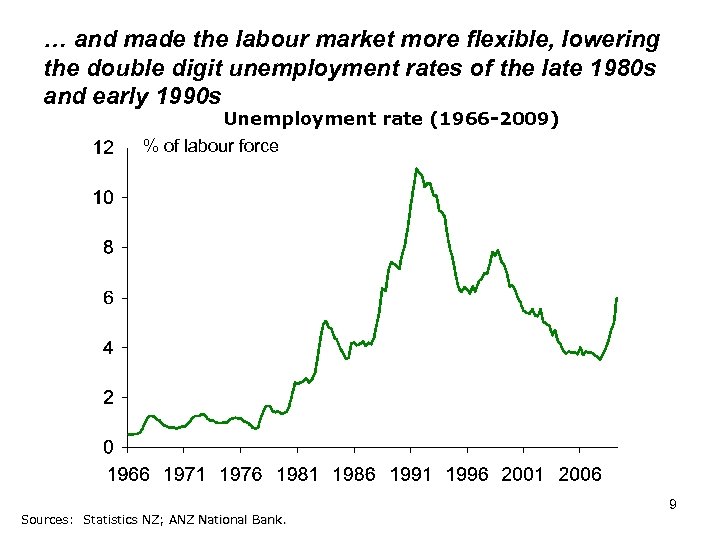 … and made the labour market more flexible, lowering the double digit unemployment rates of the late 1980 s and early 1990 s Unemployment rate (1966 -2009) % of labour force Sources: Statistics NZ; ANZ National Bank. 9
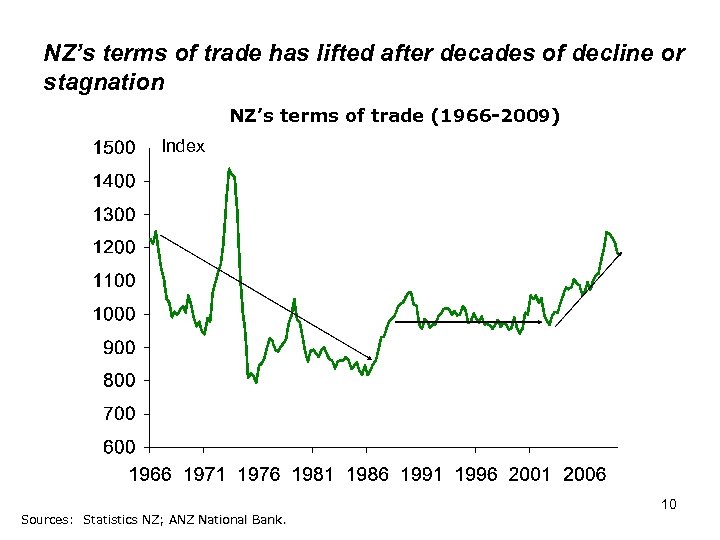 NZ’s terms of trade has lifted after decades of decline or stagnation NZ’s terms of trade (1966 -2009) Index Sources: Statistics NZ; ANZ National Bank. 10
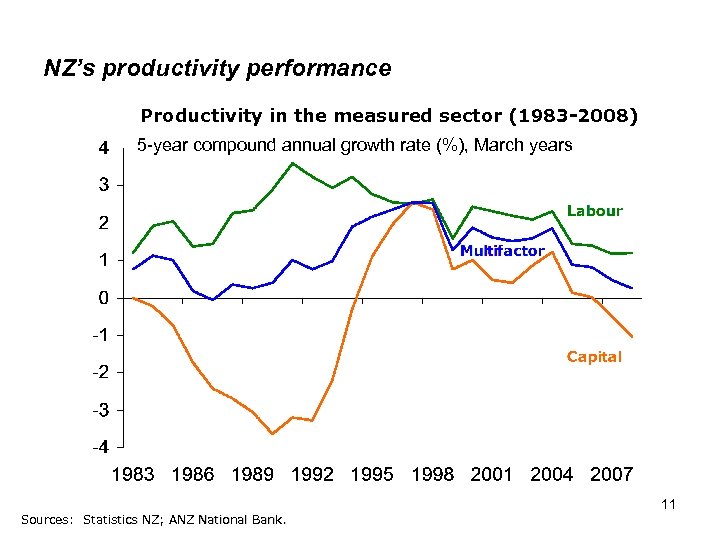 NZ’s productivity performance Productivity in the measured sector (1983 -2008) 5 -year compound annual growth rate (%), March years Sources: Statistics NZ; ANZ National Bank. 11
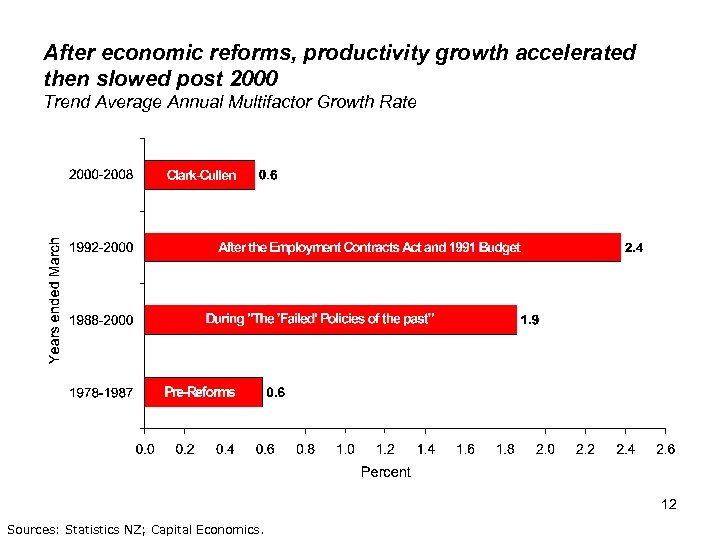 After economic reforms, productivity growth accelerated then slowed post 2000 Trend Average Annual Multifactor Growth Rate 12 Sources: Statistics NZ; Capital Economics.
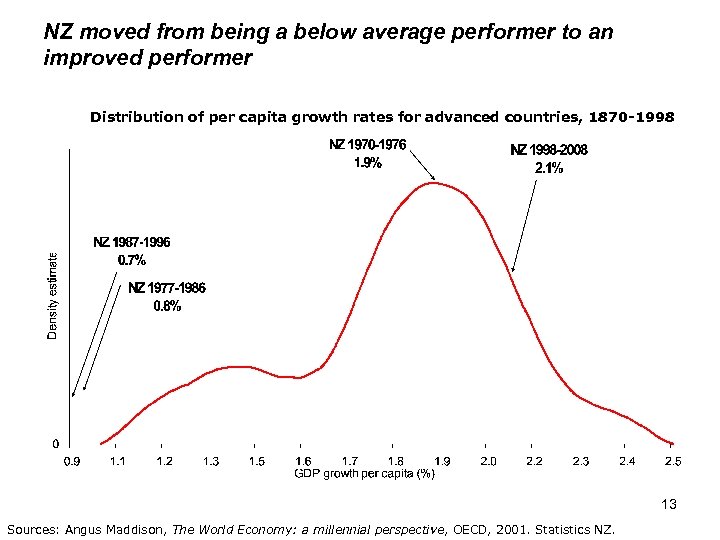 NZ moved from being a below average performer to an improved performer Distribution of per capita growth rates for advanced countries, 1870 -1998 13 Sources: Angus Maddison, The World Economy: a millennial perspective, OECD, 2001. Statistics NZ.
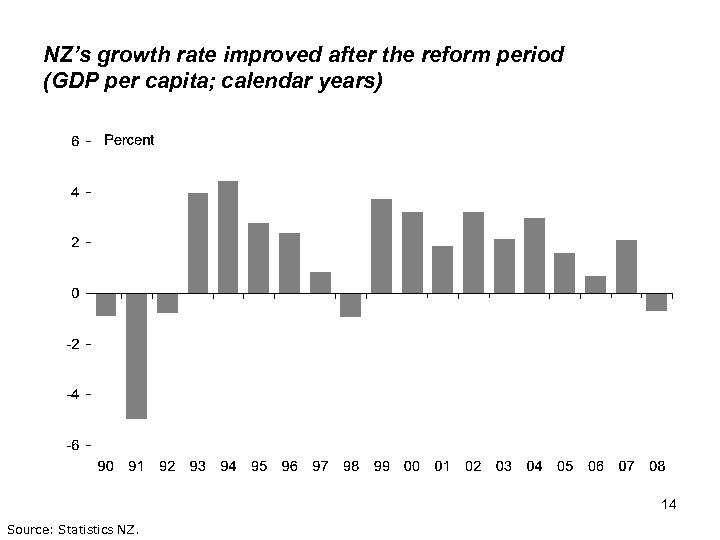 NZ’s growth rate improved after the reform period (GDP per capita; calendar years) 14 Source: Statistics NZ.
 NZ thus benefited substantially from the mid-80’s to mid 90’s economic reforms A reminder on the Reforms • • • • Monetary and fiscal policy vastly improved Dollar floated Low inflation achieved Labour market transformed Internal regulatory structures dismantled Income taxes reduced Size of government scaled back Government offshore debt eliminated Budget moved to surplus Corporatisation/privatisation delivered Exchange controls/import licensing abolished Tariffs greatly reduced Price, wage and dividend controls abolished Outcome: Business sector adaptability hugely increased 15
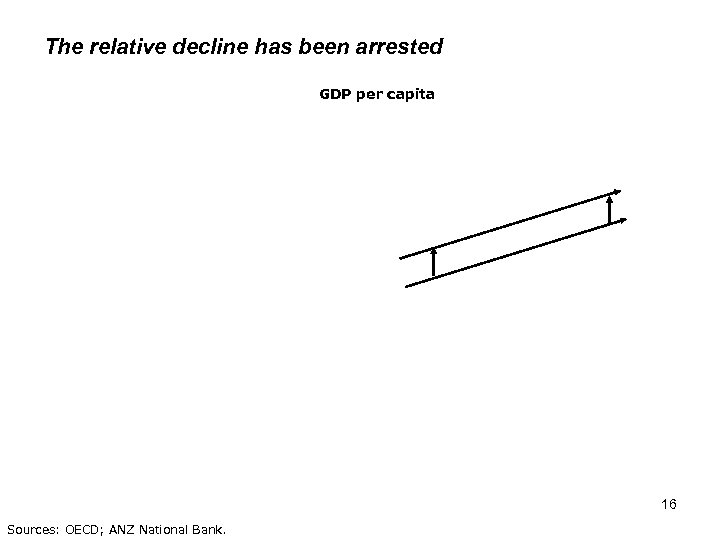 The relative decline has been arrested GDP per capita 16 Sources: OECD; ANZ National Bank.
 But closing the gap requires something a lot more It took us 20 years to fall down the ladder. Assuming OECD real GDP per capita growth of 2. 0 percent, NZ needs to grow at 2. 8 percent to close the gap by 2025 17 Sources: OECD; ANZ National Bank.
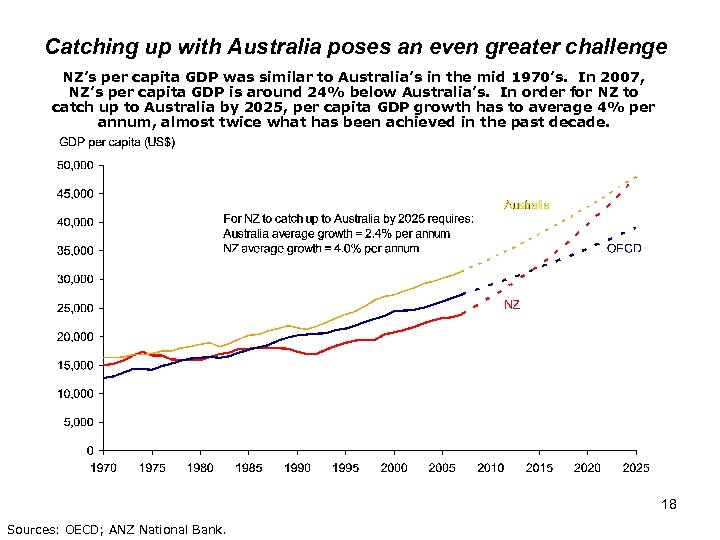 Catching up with Australia poses an even greater challenge NZ’s per capita GDP was similar to Australia’s in the mid 1970’s. In 2007, NZ’s per capita GDP is around 24% below Australia’s. In order for NZ to catch up to Australia by 2025, per capita GDP growth has to average 4% per annum, almost twice what has been achieved in the past decade. 18 Sources: OECD; ANZ National Bank.
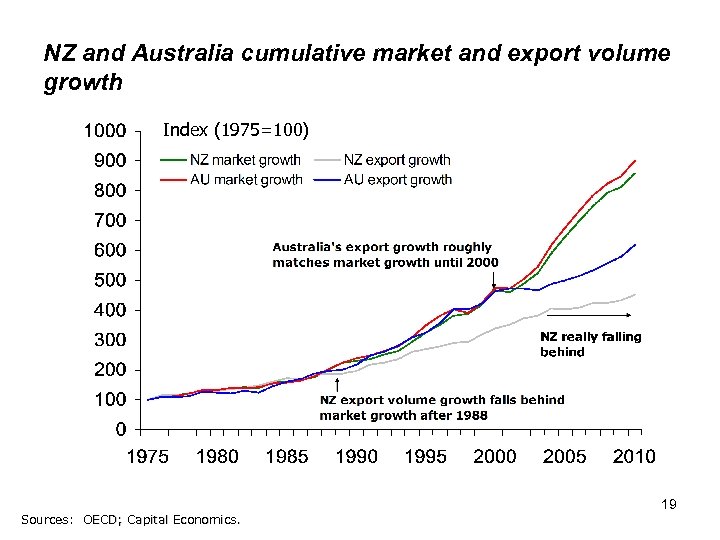 NZ and Australia cumulative market and export volume growth Index (1975=100) Sources: OECD; Capital Economics. 19
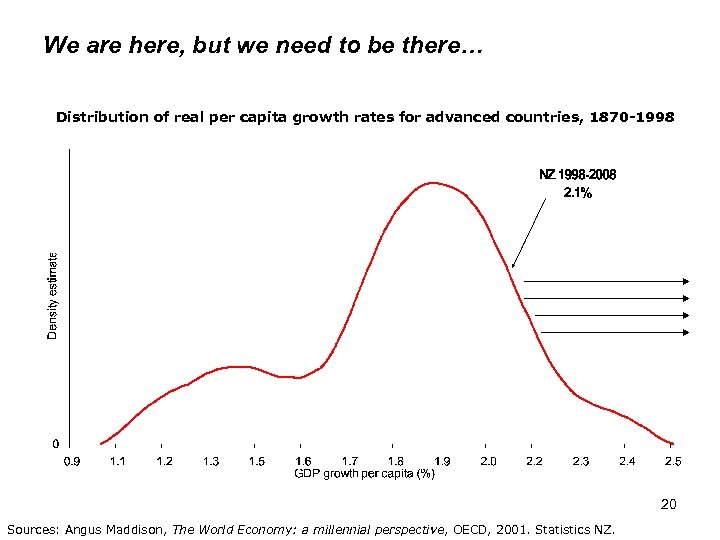 We are here, but we need to be there… Distribution of real per capita growth rates for advanced countries, 1870 -1998 20 Sources: Angus Maddison, The World Economy: a millennial perspective, OECD, 2001. Statistics NZ.
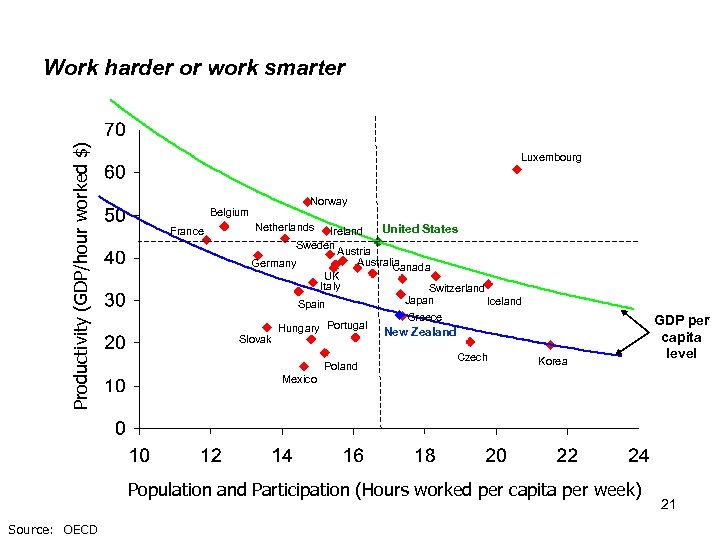 Productivity (GDP/hour worked $) Work harder or work smarter Luxembourg Belgium France Norway Netherlands United States Ireland Sweden Austria Australia Germany Canada UK Italy Switzerland Japan Iceland Spain Greece Hungary Portugal New Zealand Slovak Poland Czech Korea Mexico Population and Participation (Hours worked per capita per week) Source: OECD GDP per capita level 21
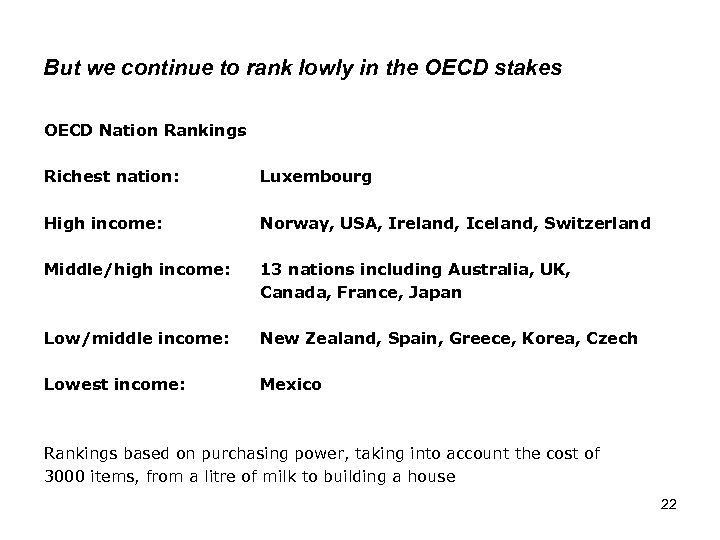 But we continue to rank lowly in the OECD stakes OECD Nation Rankings Richest nation: Luxembourg High income: Norway, USA, Ireland, Iceland, Switzerland Middle/high income: 13 nations including Australia, UK, Canada, France, Japan Low/middle income: New Zealand, Spain, Greece, Korea, Czech Lowest income: Mexico Rankings based on purchasing power, taking into account the cost of 3000 items, from a litre of milk to building a house 22
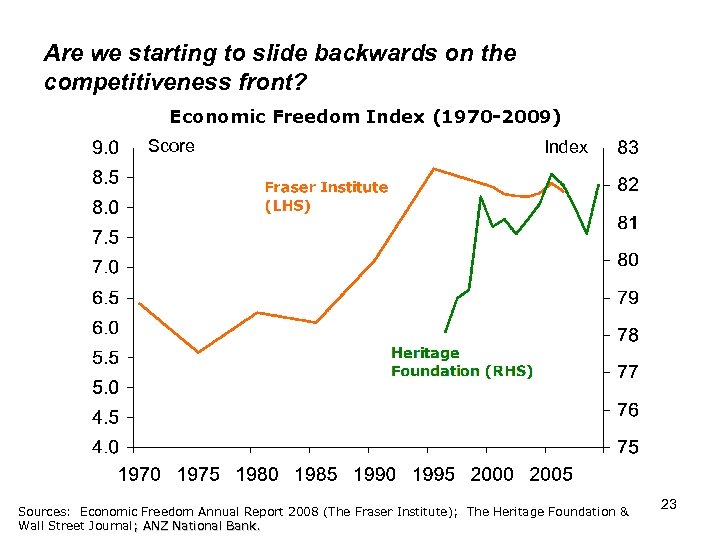 Are we starting to slide backwards on the competitiveness front? Economic Freedom Index (1970 -2009) Score Index Sources: Economic Freedom Annual Report 2008 (The Fraser Institute); The Heritage Foundation & Wall Street Journal; ANZ National Bank. 23
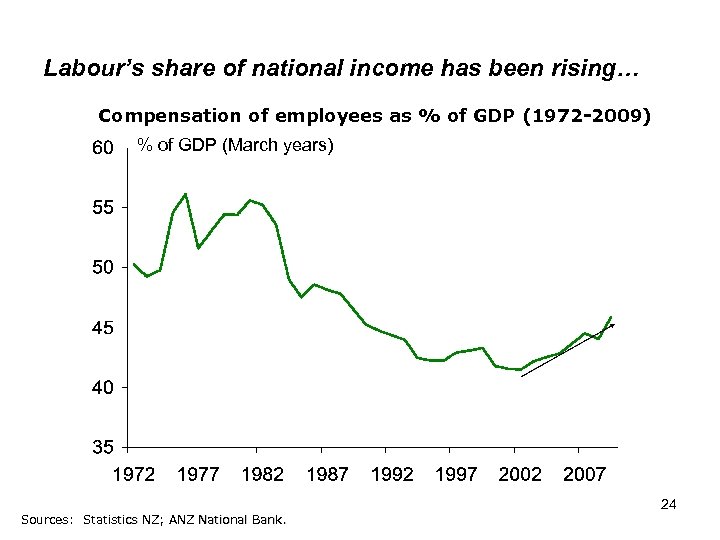 Labour’s share of national income has been rising… Compensation of employees as % of GDP (1972 -2009) % of GDP (March years) Sources: Statistics NZ; ANZ National Bank. 24
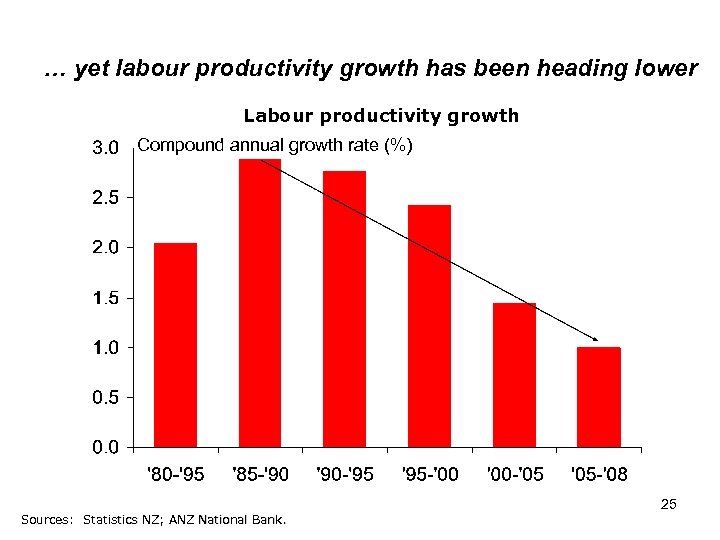 … yet labour productivity growth has been heading lower Labour productivity growth Compound annual growth rate (%) Sources: Statistics NZ; ANZ National Bank. 25
 And so has multifactor productivity growth Multifactor productivity growth Compound annual growth rate (%) Sources: Statistics NZ; ANZ National Bank. 26
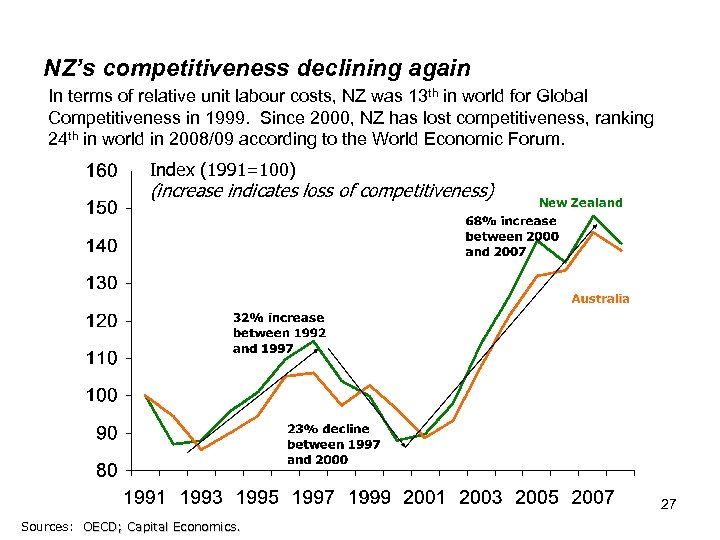 NZ’s competitiveness declining again In terms of relative unit labour costs, NZ was 13 th in world for Global Competitiveness in 1999. Since 2000, NZ has lost competitiveness, ranking 24 th in world in 2008/09 according to the World Economic Forum. Index (1991=100) (increase indicates loss of competitiveness) 27 Sources: OECD; Capital Economics.
 Core public service employment growth : down then up Core Public Service staff (June years) 28 Source: SSC
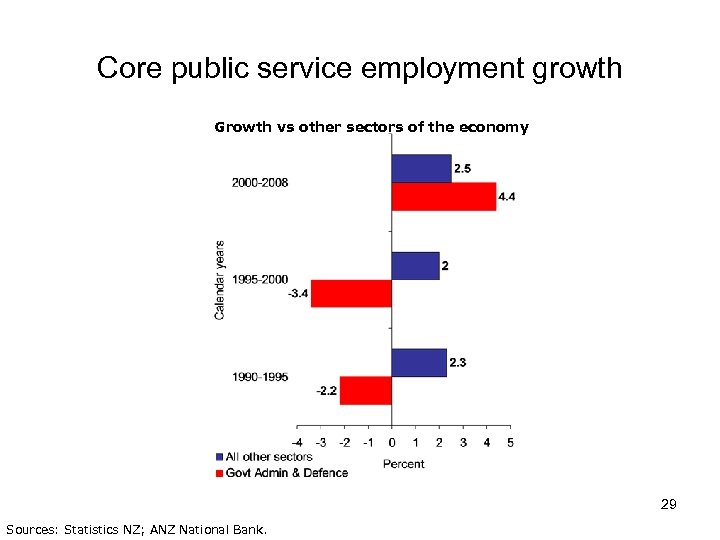 Core public service employment growth Growth vs other sectors of the economy 29 Sources: Statistics NZ; ANZ National Bank.
 Real unit labour cost: public sector rise in excess of private sector Sources: Statistics NZ; Capital Economics. 30
 Central government spending : down then up Real Core Crown Expenditure per capita (2009 dollars) 31 Sources: Statistics NZ; The Treasury; ANZ National Bank.
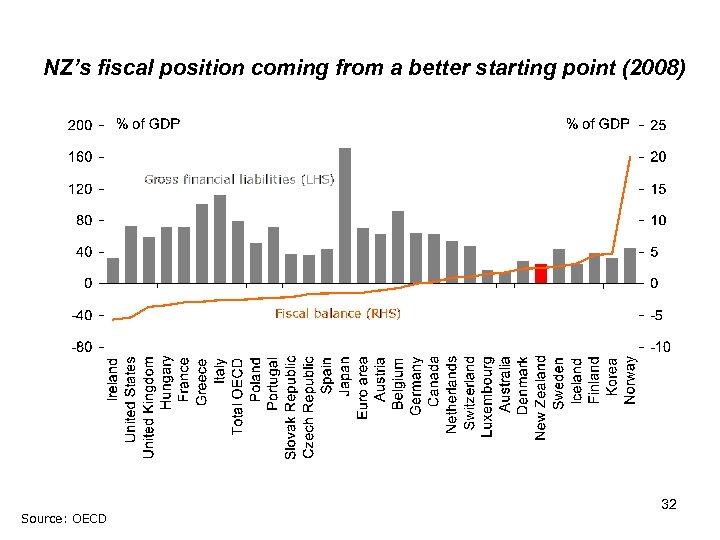 NZ’s fiscal position coming from a better starting point (2008) Source: OECD 32
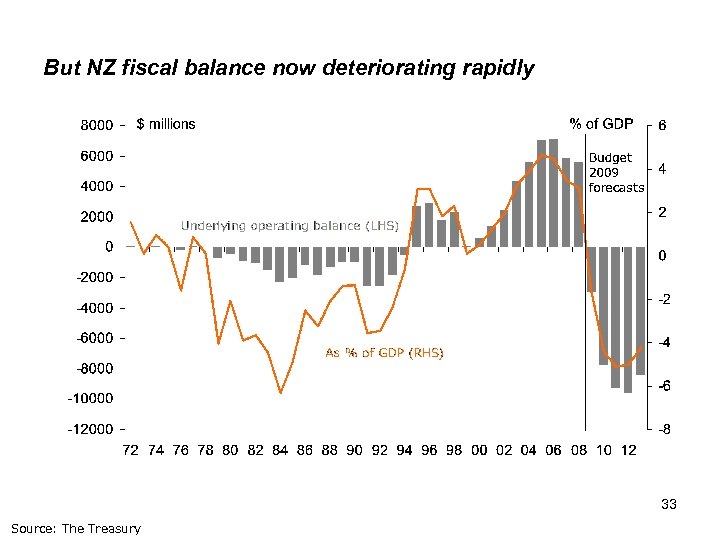 But NZ fiscal balance now deteriorating rapidly 33 Source: The Treasury
 NZ public debt forecast to rise rapidly 34 Source: The Treasury
 The Government sector is growing far too rapidly, squeezing out the private sector Total Govt. gross debt forecast to increase from 18% to 41% of GDP from 2008 to 2013, or $37 b. to $68 b. Investment in SOEs grew from 12% to 38% of GDP from 1999 to 2009, or $13 b. to $68 b. Total crown property assets grew from 40% to 60% of GDP from 1999 to 2009, or $42 b. to $106 b. Total Crown expenses forecast to be 46% of GDP by 2012/13 Source: NZ Treasury Fiscal Strategy Report 2009 35
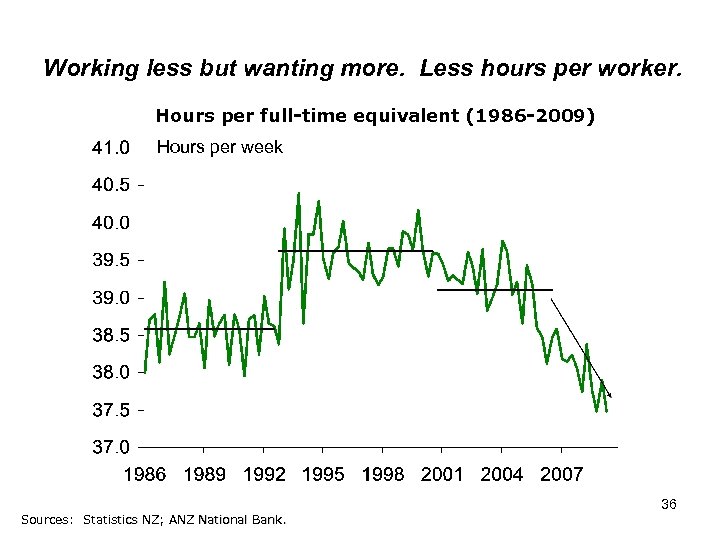 Working less but wanting more. Less hours per worker. Hours per full-time equivalent (1986 -2009) Hours per week Sources: Statistics NZ; ANZ National Bank. 36
 Increasing government spending Core Crown spending (1997 -2012) 37 Source: Treasury
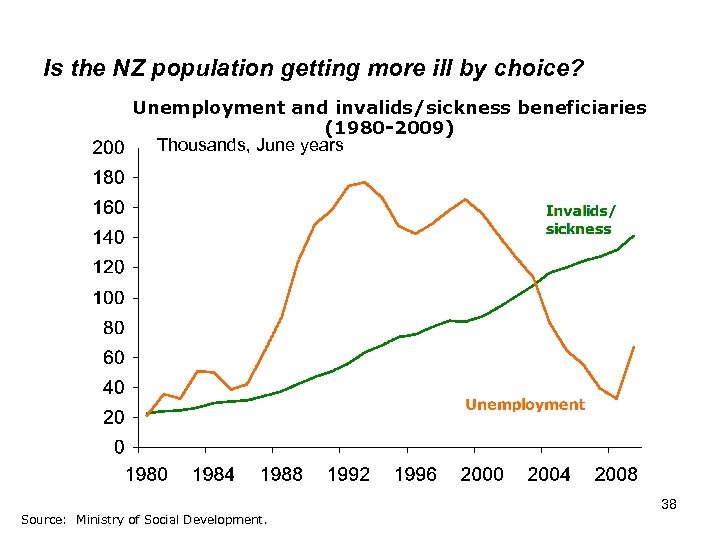 Is the NZ population getting more ill by choice? Unemployment and invalids/sickness beneficiaries (1980 -2009) Thousands, June years Source: Ministry of Social Development. 38
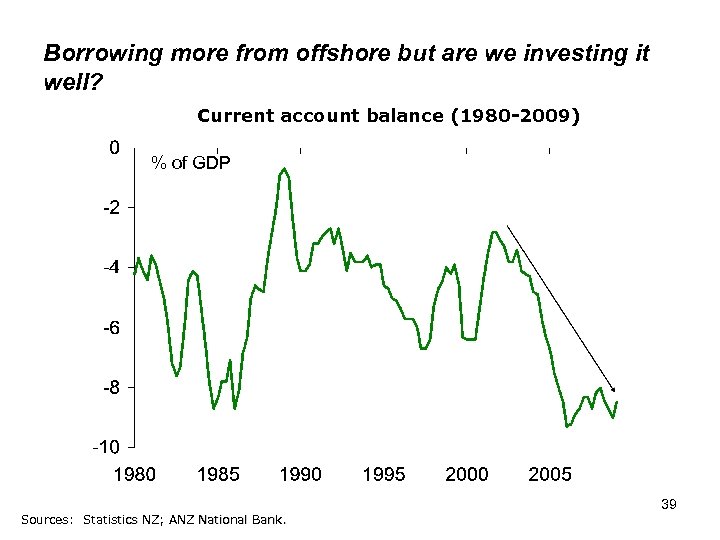 Borrowing more from offshore but are we investing it well? Current account balance (1980 -2009) % of GDP Sources: Statistics NZ; ANZ National Bank. 39
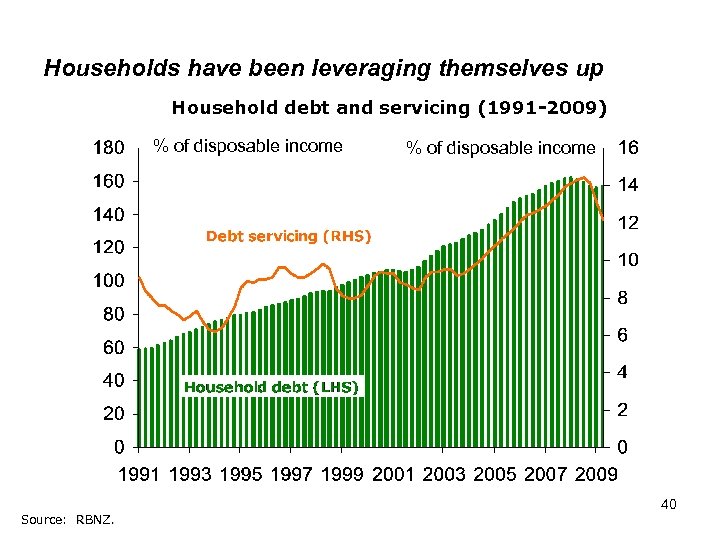 Households have been leveraging themselves up Household debt and servicing (1991 -2009) % of disposable income Source: RBNZ. % of disposable income 40
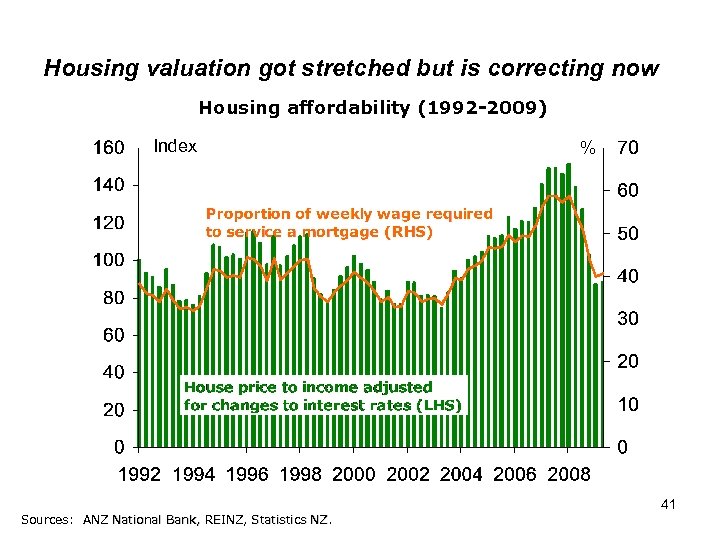 Housing valuation got stretched but is correcting now Housing affordability (1992 -2009) Index Sources: ANZ National Bank, REINZ, Statistics NZ. % 41
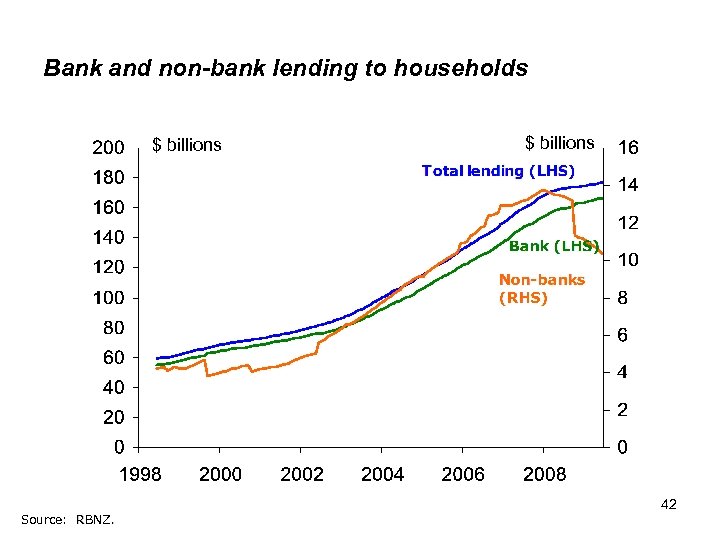 Bank and non-bank lending to households $ billions Source: RBNZ. $ billions 42
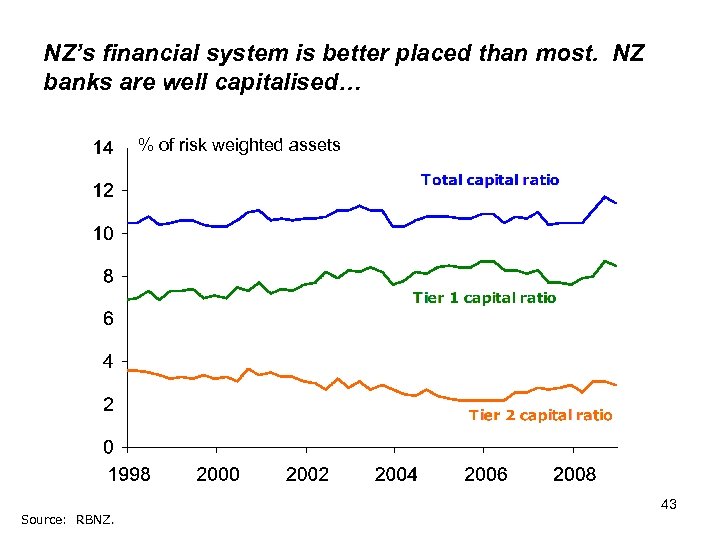 NZ’s financial system is better placed than most. NZ banks are well capitalised… % of risk weighted assets Source: RBNZ. 43
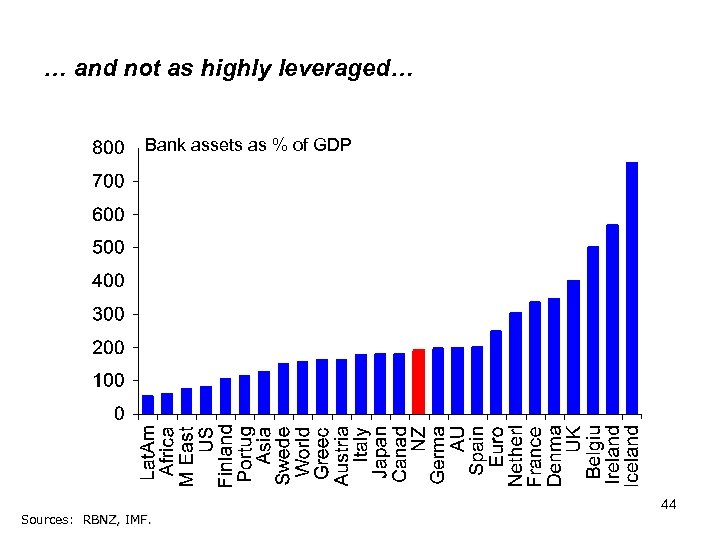 … and not as highly leveraged… Bank assets as % of GDP Sources: RBNZ, IMF. 44
 … banks have relatively low levels of credit losses… Impaired assets as % of lending Source: RBNZ. 45
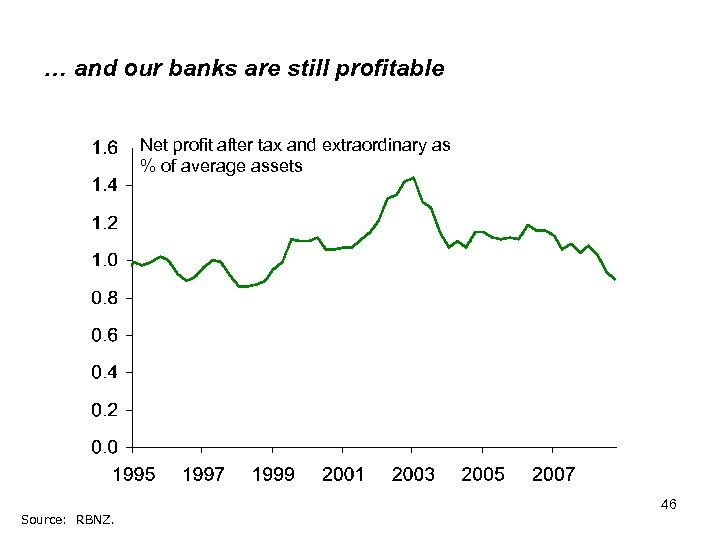 … and our banks are still profitable Net profit after tax and extraordinary as % of average assets Source: RBNZ. 46
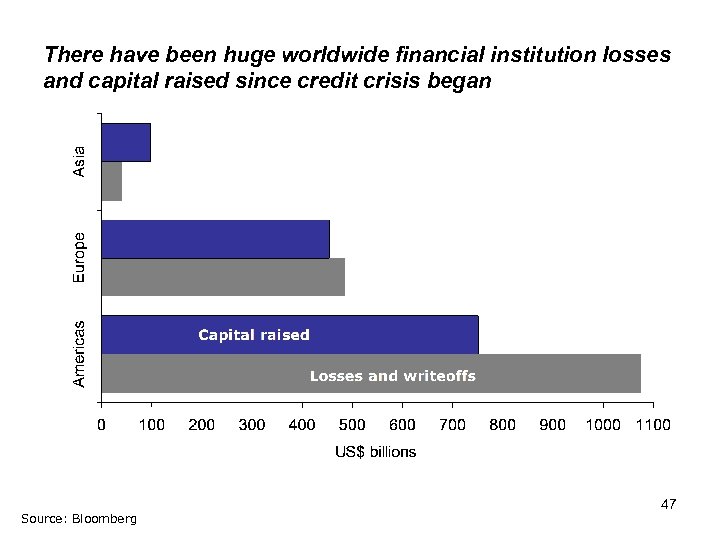 There have been huge worldwide financial institution losses and capital raised since credit crisis began Source: Bloomberg 47
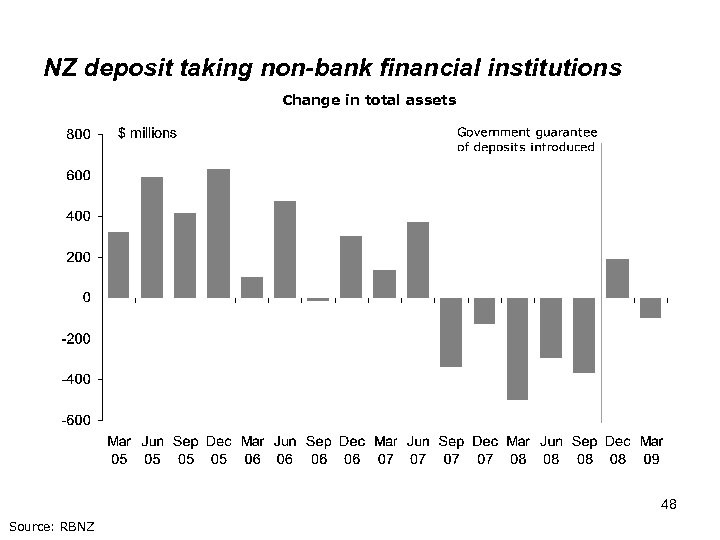 NZ deposit taking non-bank financial institutions Change in total assets 48 Source: RBNZ
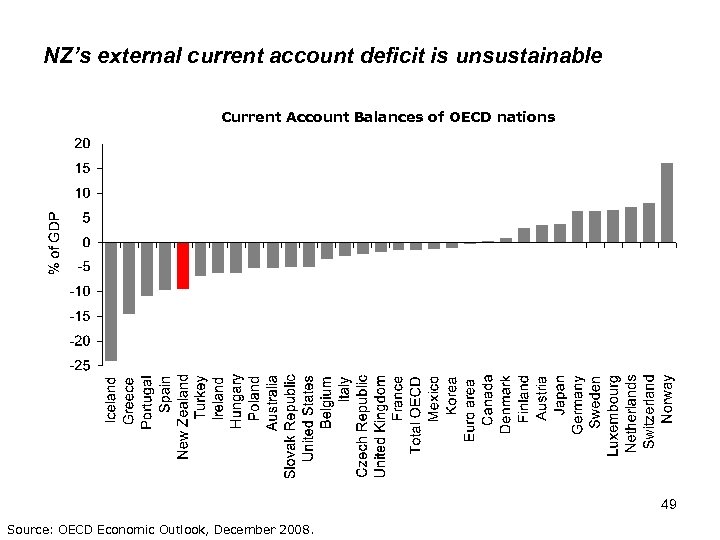 NZ’s external current account deficit is unsustainable Current Account Balances of OECD nations 49 Source: OECD Economic Outlook, December 2008.
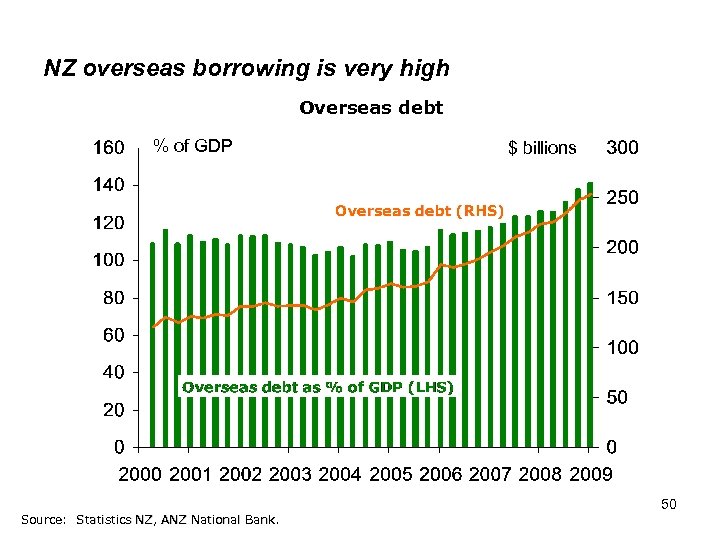 NZ overseas borrowing is very high Overseas debt % of GDP Source: Statistics NZ, ANZ National Bank. $ billions 50
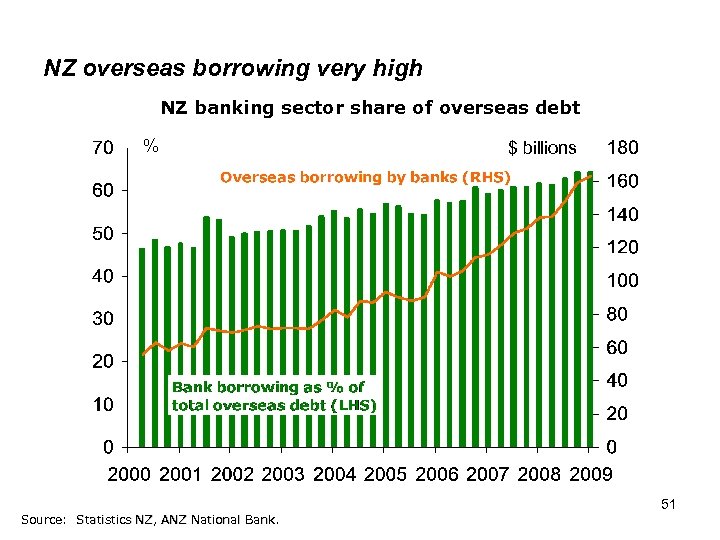 NZ overseas borrowing very high NZ banking sector share of overseas debt % Source: Statistics NZ, ANZ National Bank. $ billions 51
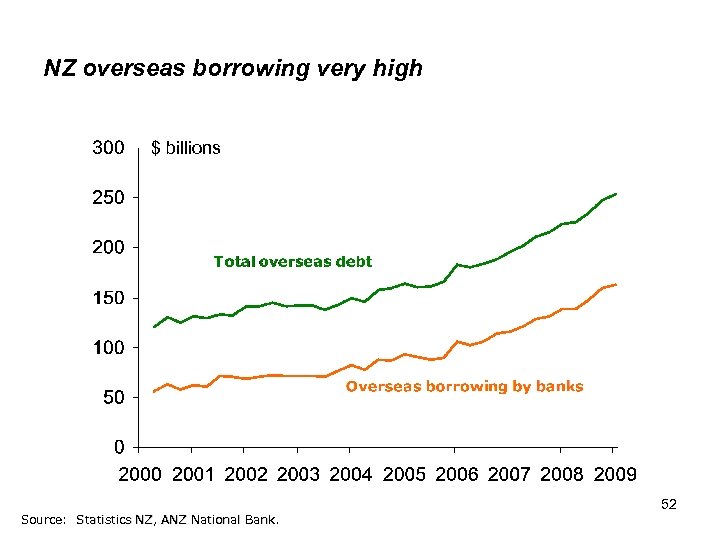 NZ overseas borrowing very high $ billions Source: Statistics NZ, ANZ National Bank. 52
 Comparison of gross foreign liabilities (2007) % of GDP Sources: RBNZ, IMF. 53
 Poor tradeable sector value added performance Index (June 1987=1000) Sources: Statistics NZ; ANZ National Bank. 54
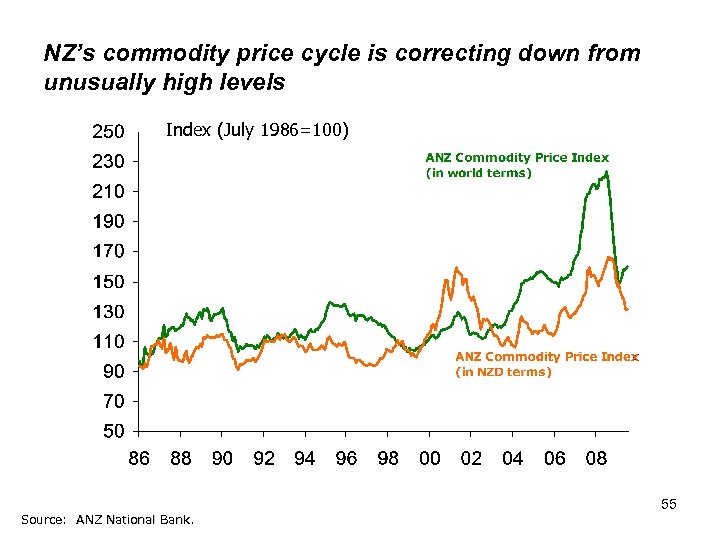 NZ’s commodity price cycle is correcting down from unusually high levels Index (July 1986=100) Source: ANZ National Bank. 55
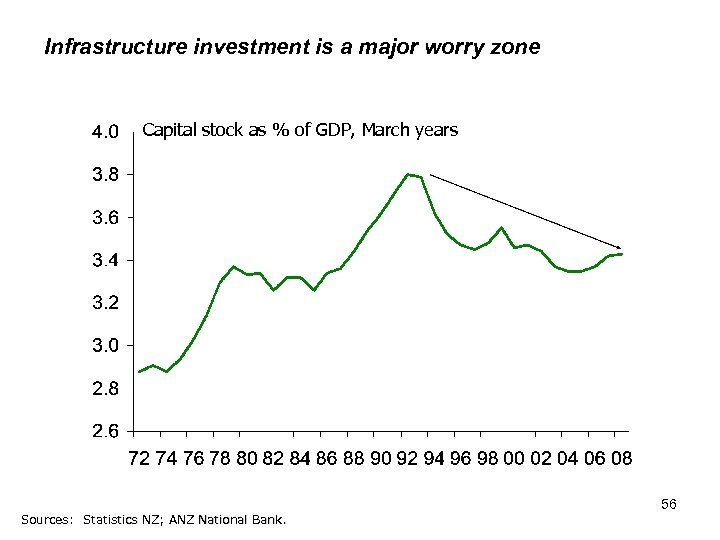 Infrastructure investment is a major worry zone Capital stock as % of GDP, March years Sources: Statistics NZ; ANZ National Bank. 56
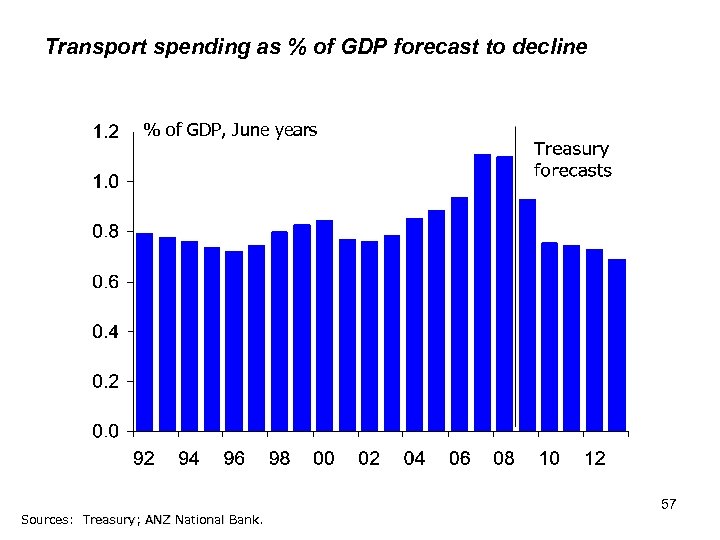 Transport spending as % of GDP forecast to decline % of GDP, June years Sources: Treasury; ANZ National Bank. 57
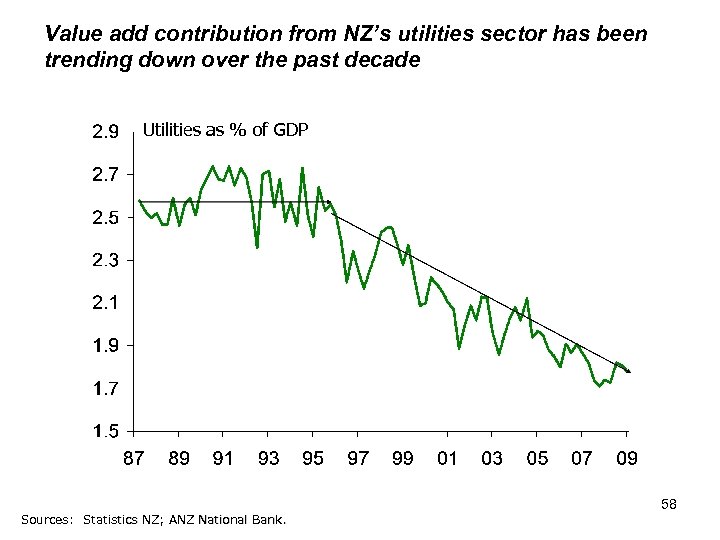 Value add contribution from NZ’s utilities sector has been trending down over the past decade Utilities as % of GDP Sources: Statistics NZ; ANZ National Bank. 58
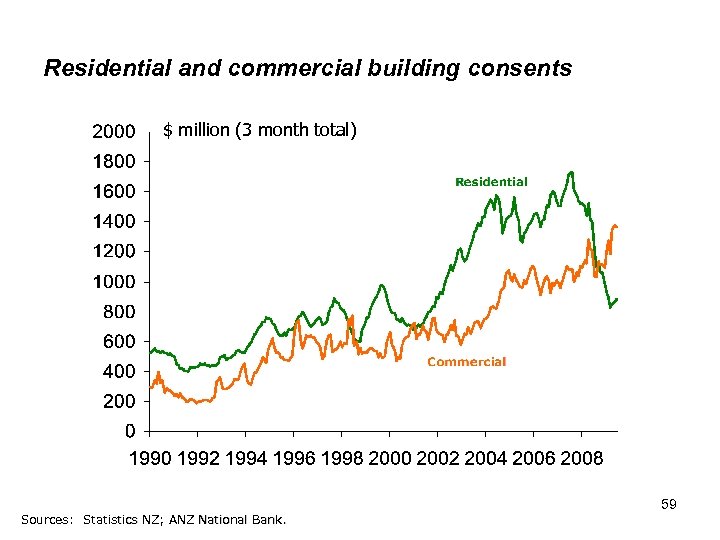 Residential and commercial building consents $ million (3 month total) Sources: Statistics NZ; ANZ National Bank. 59
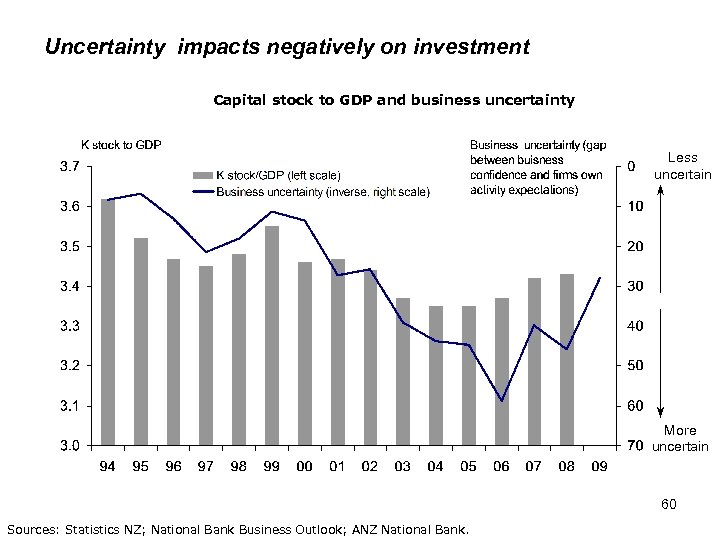 Uncertainty impacts negatively on investment Capital stock to GDP and business uncertainty Less uncertain More uncertain 60 Sources: Statistics NZ; National Bank Business Outlook; ANZ National Bank.
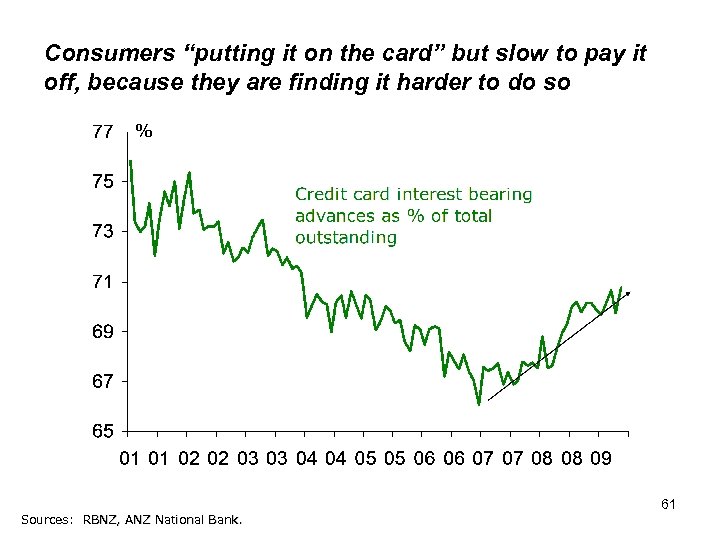 Consumers “putting it on the card” but slow to pay it off, because they are finding it harder to do so % Sources: RBNZ, ANZ National Bank. 61
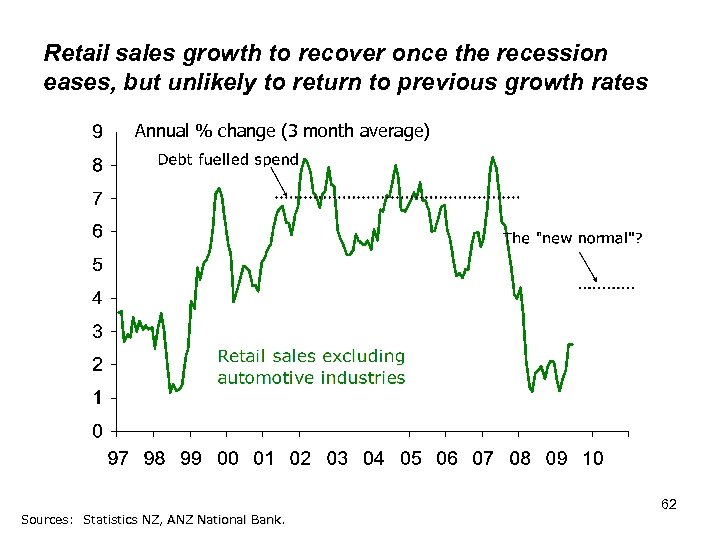 Retail sales growth to recover once the recession eases, but unlikely to return to previous growth rates Annual % change (3 month average) Sources: Statistics NZ, ANZ National Bank. 62
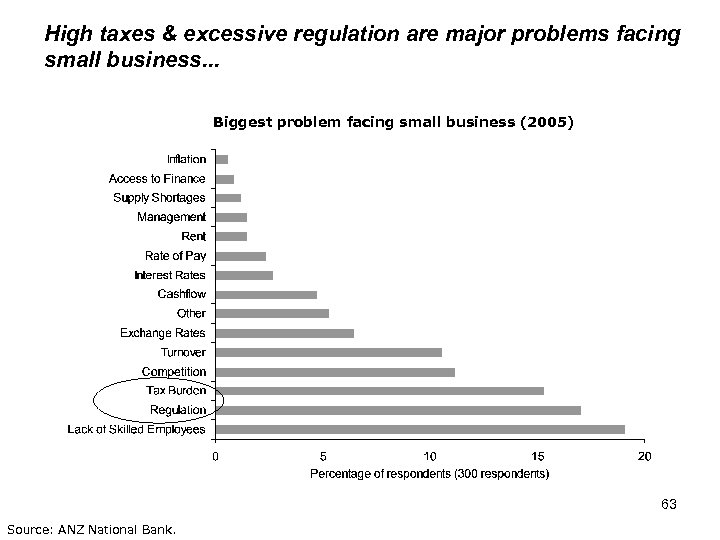 High taxes & excessive regulation are major problems facing small business. . . Biggest problem facing small business (2005) 63 Source: ANZ National Bank.
 … and businesses in general Main findings of Business New Zealand – KPMG Compliance Cost Survey: October 2008 • Tax is still the dominant cost priority with 70% of respondents seeing it as a priority for change. • Smaller firms continue to be harder hit by compliance costs than larger ones. • Compliance costs have risen in all areas: IRD, ACC, ERA, Kiwi. Saver, OSH, Holidays Act, RMA, local body consultation, building regulations, et al 64
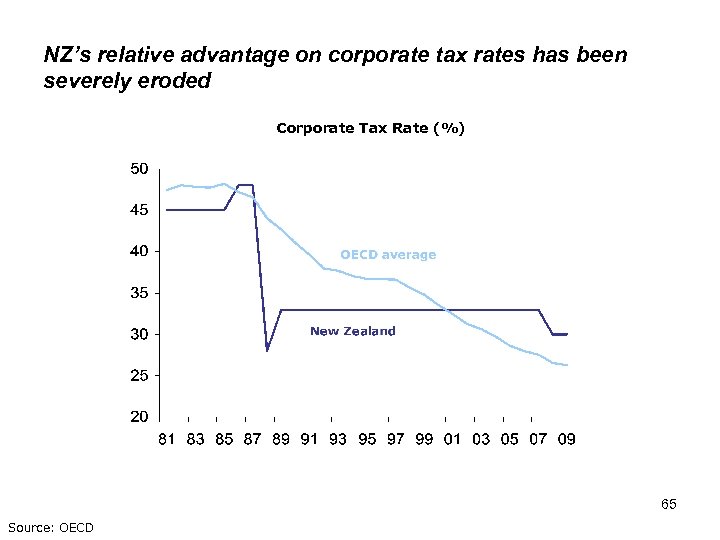 NZ’s relative advantage on corporate tax rates has been severely eroded Corporate Tax Rate (%) 65 Source: OECD
 And the same applies to personal tax rates Top Marginal Personal Tax Rate (%) 66 Source: OECD
 Regulatory creep has been an accumulating problem 67 Source: Parliamentary Library.
 From 2000 to 2008 economic negatives and government interventions became prevalent • • • Increase in top tax rate to 39 c Restoration of ACC monopoly Employment Relations Act Tariff freeze Re-nationalisation of Air NZ, Kiwibank, rail Takeover regulation Commerce Act more restrictive Re-regulation of telecommunications Re-regulation of electricity Energy efficiency regulation • More central control of health and education • More lenient welfare rules • Kyoto Protocol shambles • Re-regulation of banking • Privy Council appeals scrapped • Resource Management Act • Local authorities legislation • Securities legislation • Accounting standards • Corporate governance 68
 NZ has thin domestic capital markets • • • Lack of depth & breadth (said RBNZ Governor and others) This constrains economic growth Raises vulnerability to crises NZX small and declining in relative importance Marked contrast to Australia Private equity became more important Pushes companies to offshore funding Pushes companies to offshore expansion Off market transactions predominate Huge increase in regulation and compliance costs in NZ capital markets • Many parties now agree regulation needs improvement • Major review now under way (Cameron task force) 69
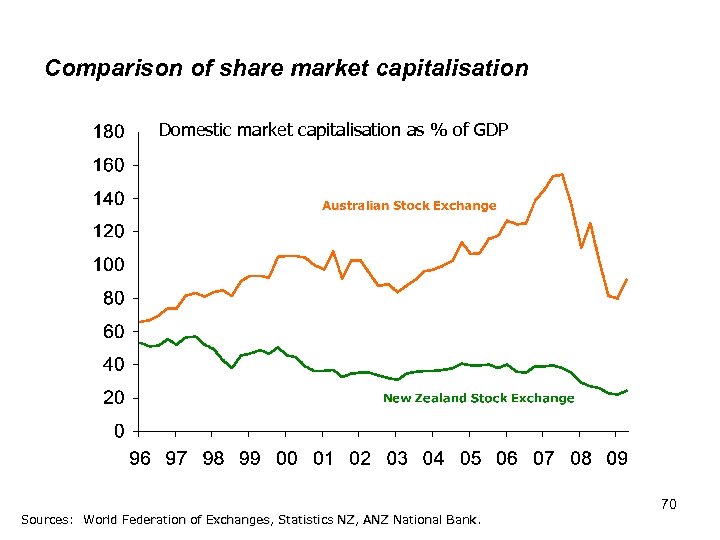 Comparison of share market capitalisation Domestic market capitalisation as % of GDP Sources: World Federation of Exchanges, Statistics NZ, ANZ National Bank. 70
 Labour market regulations constrain adaptability • • • Numerous re-litigations of legislation Harassment cases a nightmare for employers Work/life balance imbalance Fixed term contracts Union meetings and site visits at will Holidays Act … unintended consequences (review under way) Days off in lieu at will Discretionary payments double dipping Workplace stress Re-regulation of trading days Inequality of power Flexibility of labour markets eroded during 2000’s 71
 Kyoto and All That • • • Original estimate of carbon credits $300 million 2006 estimate over $600 debits Officials error $900 million Treasury reported carbon tax would be ineffective Carbon tax policy & NGA’s abandoned 30 months of negotiations wasted Another new Government policy announced Dec 2006 Emissions Trading Scheme (ETS) versus a carbon tax Huge disagreement over scale of problem Disagreement also over policy solutions All this has raised costs and uncertainty for business 72
 Banking regulation intrusive • • • RBNZ requires “standalone capability”, particularly when under stress Major systems were relocated to New Zealand Huge cost and inefficiency All third party contracts were renegotiated/separated All direct reports to CEO require RBNZ approval No analysis that benefits of all this might exceed costs Individual director attestations RBNZ claims this is “light handed” regulation Introduction of government guarantees for bank liabilities Guarantee applies also to non-banks Foreign funding is 42% of bank sector funding Australian and NZ banks came through international crisis as well as any banks and better than most 73
 Telecommunications regulation destroys value • • • Once the fastest growing industry in NZ Regulator over-ruled by Government (unbundling in 2006) Unbundling cost/benefit analysis ignored Regulation wiped $3 billion off Telecom value No compensation for Telecom shareholders Regulation now all encompassing, even over Telecom organizational structure Following same route as failed electricity reforms Mobile termination rates now following same course No evidence of any gain to consumers from regulation This is despite the huge costs and great uncertainties of regulation Taxpayers now to invest $1. 5 b. in broadband network Commercially odd joint venture, regional type model 74
 Electricity regulation a mess • • • Much regulation, numerous changes Industry largely Government owned Seriously conflicting numerous regulatory objectives Conflicting regulators (Govt. & CC & EC) Major transmission outages Lack of security of supply Uncertainty & underinvestment in some areas A disaster waiting to happen ? Review under way 75
 Research Study on Regulation • ANZ Bank study December 2006 showed poor regulation hinders economic performance • Study found evidence of distortionary effects of regulation • Recommended need for five policy changes 1. Quantitative cost/benefit analysis 2. Done by independent body 3. Articulate goals better 4. Ex post reviews essential 5. Negative impact of uncertainty needs policymakers attention 76
 Business adaptability has been severely eroded Regulatory Dilemmas • • • Regulation begets regulation Regulation overrides commercial solutions Regulation and changes induce uncertainty It imposes high transactions costs Diverts energy into rent seeking behaviour And away from focussing on winning in the market Regulation always has unintended consequences It concentrates on past issues rather than future growth Success ironically attracts regulation Regulation reduces flexibility It ultimately impedes the competition it pretends to promote Reduces attractiveness of New Zealand foreign direct investment 77
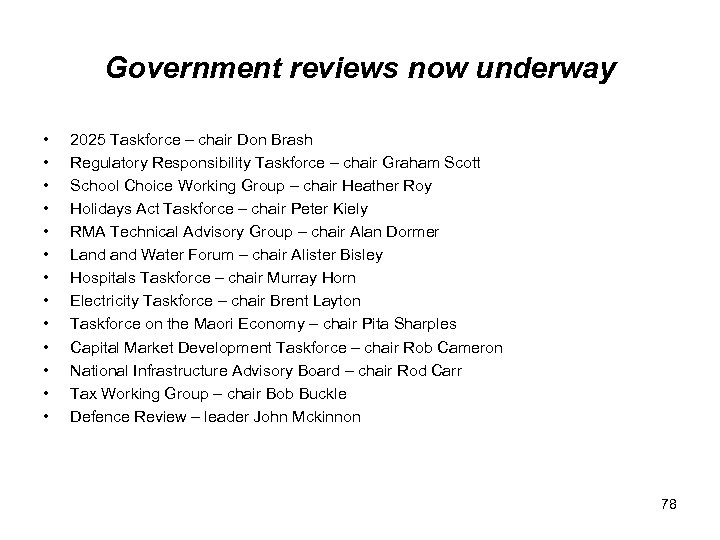 Government reviews now underway • • • • 2025 Taskforce – chair Don Brash Regulatory Responsibility Taskforce – chair Graham Scott School Choice Working Group – chair Heather Roy Holidays Act Taskforce – chair Peter Kiely RMA Technical Advisory Group – chair Alan Dormer Land Water Forum – chair Alister Bisley Hospitals Taskforce – chair Murray Horn Electricity Taskforce – chair Brent Layton Taskforce on the Maori Economy – chair Pita Sharples Capital Market Development Taskforce – chair Rob Cameron National Infrastructure Advisory Board – chair Rod Carr Tax Working Group – chair Bob Buckle Defence Review – leader John Mckinnon 78
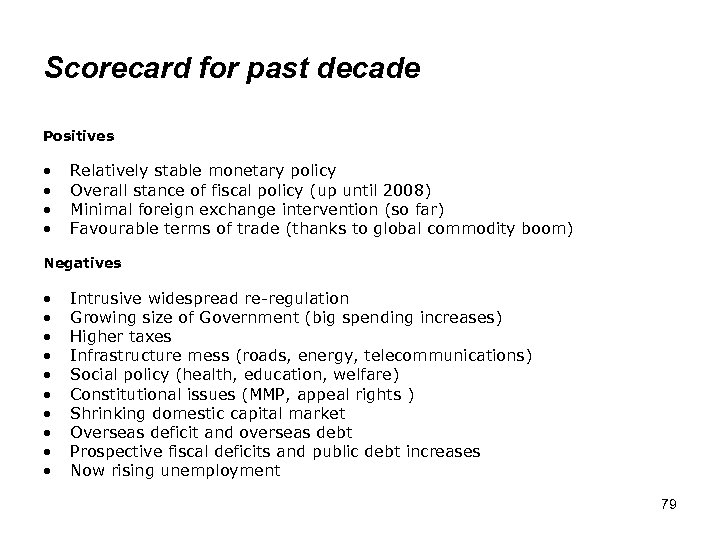 Scorecard for past decade Positives • • Relatively stable monetary policy Overall stance of fiscal policy (up until 2008) Minimal foreign exchange intervention (so far) Favourable terms of trade (thanks to global commodity boom) Negatives • • • Intrusive widespread re-regulation Growing size of Government (big spending increases) Higher taxes Infrastructure mess (roads, energy, telecommunications) Social policy (health, education, welfare) Constitutional issues (MMP, appeal rights ) Shrinking domestic capital market Overseas deficit and overseas debt Prospective fiscal deficits and public debt increases Now rising unemployment 79
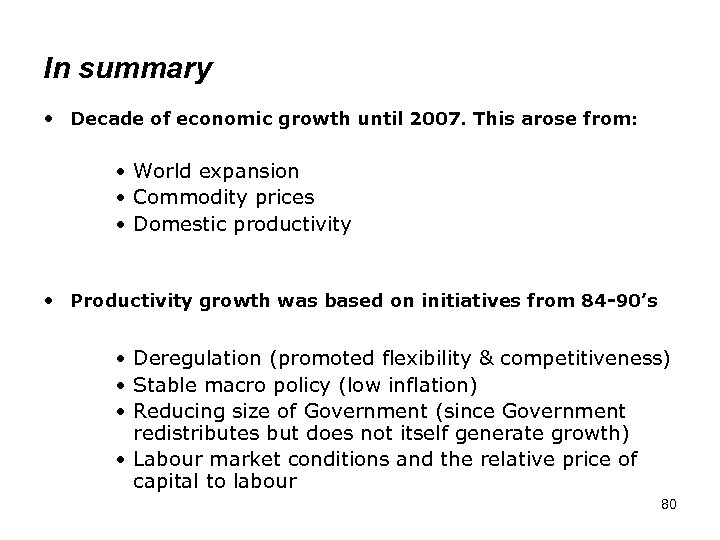 In summary • Decade of economic growth until 2007. This arose from: • World expansion • Commodity prices • Domestic productivity • Productivity growth was based on initiatives from 84 -90’s • Deregulation (promoted flexibility & competitiveness) • Stable macro policy (low inflation) • Reducing size of Government (since Government redistributes but does not itself generate growth) • Labour market conditions and the relative price of capital to labour 80
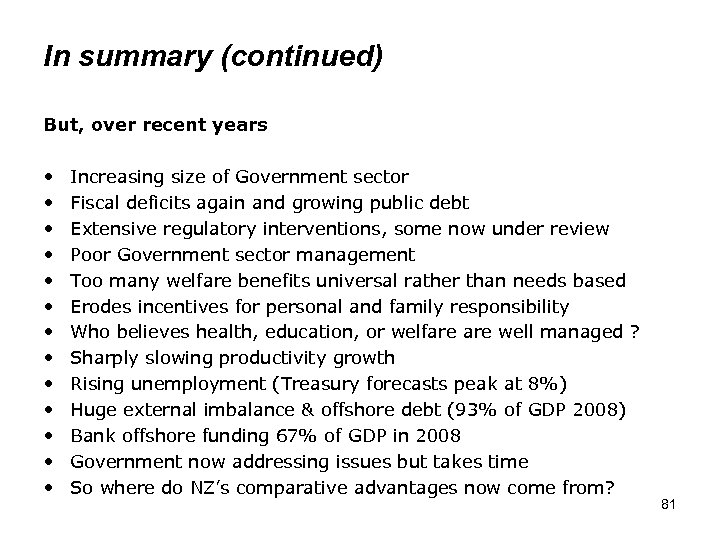 In summary (continued) But, over recent years • • • • Increasing size of Government sector Fiscal deficits again and growing public debt Extensive regulatory interventions, some now under review Poor Government sector management Too many welfare benefits universal rather than needs based Erodes incentives for personal and family responsibility Who believes health, education, or welfare well managed ? Sharply slowing productivity growth Rising unemployment (Treasury forecasts peak at 8%) Huge external imbalance & offshore debt (93% of GDP 2008) Bank offshore funding 67% of GDP in 2008 Government now addressing issues but takes time So where do NZ’s comparative advantages now come from? 81
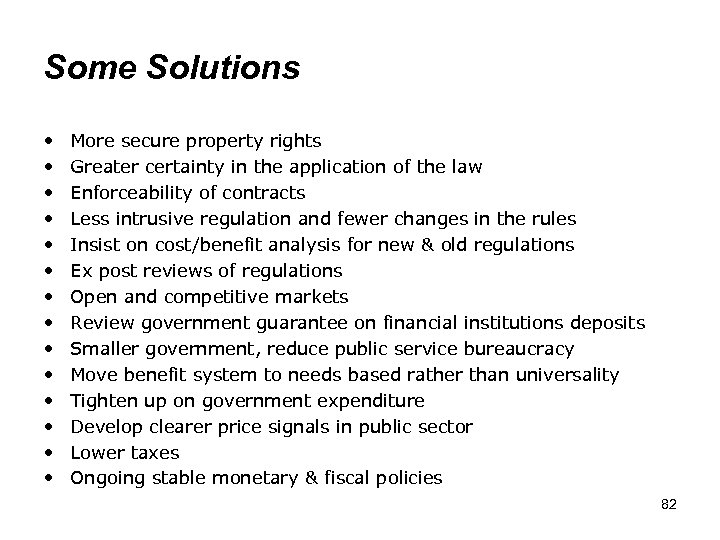 Some Solutions • • • • More secure property rights Greater certainty in the application of the law Enforceability of contracts Less intrusive regulation and fewer changes in the rules Insist on cost/benefit analysis for new & old regulations Ex post reviews of regulations Open and competitive markets Review government guarantee on financial institutions deposits Smaller government, reduce public service bureaucracy Move benefit system to needs based rather than universality Tighten up on government expenditure Develop clearer price signals in public sector Lower taxes Ongoing stable monetary & fiscal policies 82
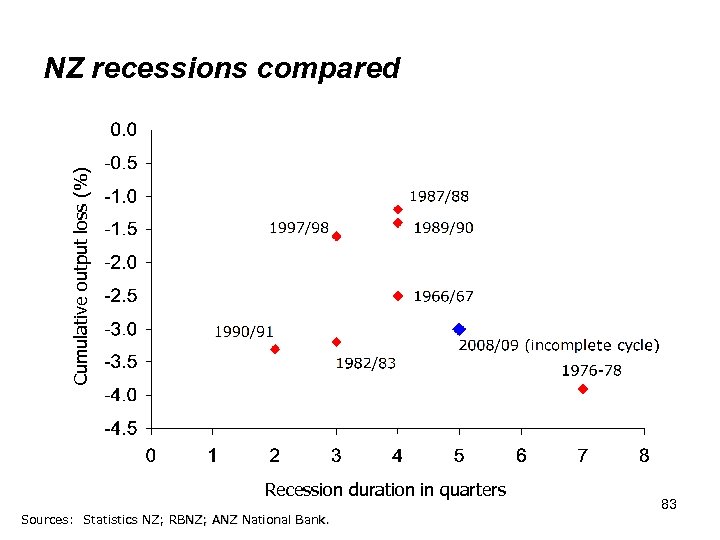 Cumulative output loss (%) NZ recessions compared Recession duration in quarters Sources: Statistics NZ; RBNZ; ANZ National Bank. 83
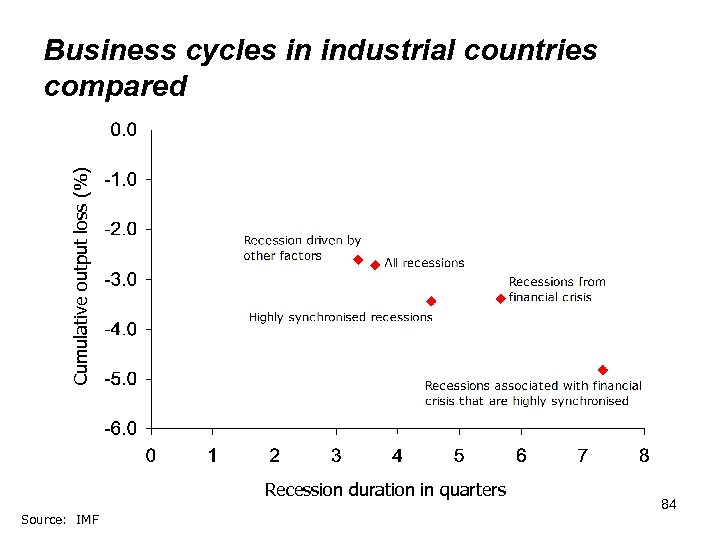 Cumulative output loss (%) Business cycles in industrial countries compared Recession duration in quarters Source: IMF 84