


 Скачать презентацию A Fantastic Language Adventure 18 MARVELLOUS TIPS TO
Let's study languages.pptx
- Количество слайдов: 50
 A Fantastic Language Adventure 18 MARVELLOUS TIPS TO YOUR EXCELLENT WAY OF SPEAKING DIFFERENT LANGUAGES!
 TIP 1. ❝Learning is a treasure that will follow its owner everywhere. ❞ Chinese Proverb The Start of the Journey – the motivational inspirational story Just imagine! Imagination is the best part of learning a language! Every time you start learning a language – read motivational stories, make inspiring pictures and always have them in your textbook.
 Paris! France
 Conversation in any French café in French can be really magnificent!










 French is the most BEAUTIFUL language in the WORLD!

 Barcelona!




 The most POPULAR language in the WORLD
 Rome Italy




 London England

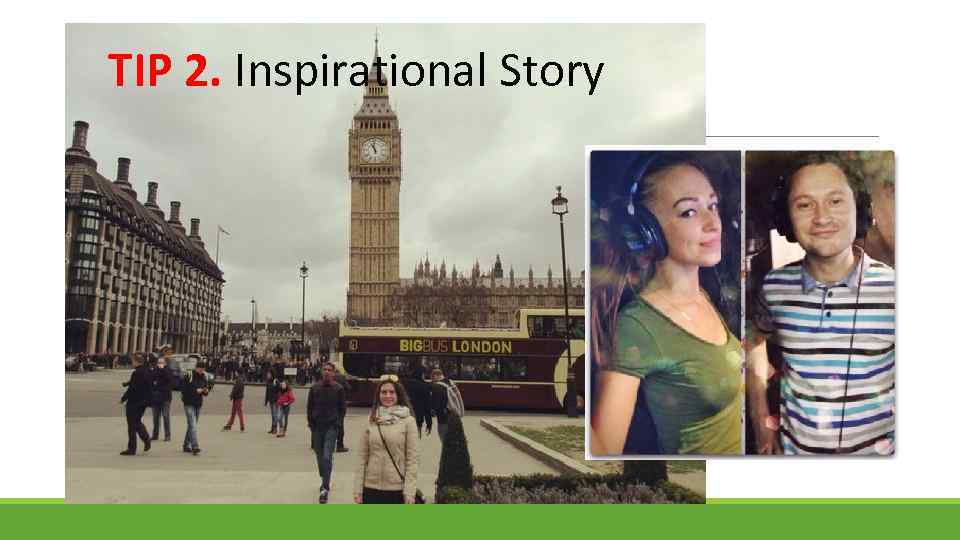 TIP 2. Inspirational Story
 I have just finished my conversation with my friend from Mexico. Oh, what a lovely guy! We were talking for 1 hour and it was magnificent! Eric, 28 In my own success story, I consider all the many friends that I have made around the world, thanks to learning new languages, to be the coolest part by far and the force that drives me to continue and try to share this wonderful experience with as many other learners as I can. John, 30
 TIP 3. Stop Arguing Against Yourself. Lots of people say something like the following to themselves: “I’d love to learn a foreign language, but I’m too old”, or “I’m just not good at languages” You need to stop arguing against yourself! In order to succeed at a goal, you have to believe that you’re capable of achieving it. While it’s true that some people are better at learning languages than others, with the right strategy and with dedication, anyone can learn another language.
 Interesting Fact The Best Age for Learning the Language is ADOLESCENCE! So what is the best age for a person to start learning a foreign language in situations where there is a choice, and where it is not critical that a native-speaker-like pronunciation is acquired? The answer, according to current research, is early adolescence, so about 11 -13. And the more motivated the child is to learn the new language, the more successful he will be!
 TIP 4. You need PASSION When you lose your temper, or when you are just tired, ask someone to help you. Remember about your PASSION!
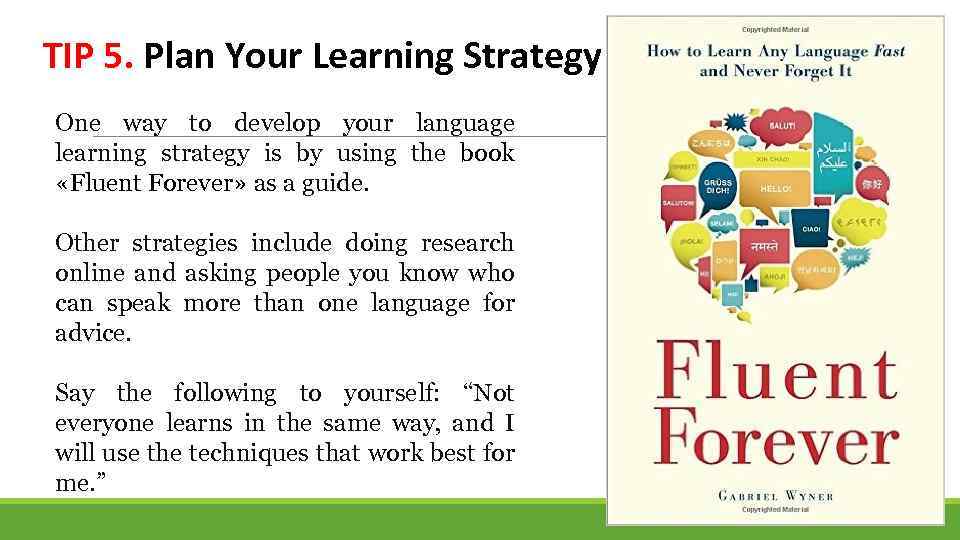 TIP 5. Plan Your Learning Strategy One way to develop your language learning strategy is by using the book «Fluent Forever» as a guide. Other strategies include doing research online and asking people you know who can speak more than one language for advice. Say the following to yourself: “Not everyone learns in the same way, and I will use the techniques that work best for me. ”
 TIP 6. Move and get a private tutor In order to learn a language you need to move to a country that speaks your target language for three months, and hire a private tutor for the first month that you’re there. Of course, this is the ideal language learning strategy. Unfortunately, most people can’t follow this strategy due to monetary and time constraints, as well as having other obligations. However, this doesn’t mean that you should give up on your goal of learning another language.
 TIP 7. Start With High Frequency Words and Phrases and Essential Grammar Start with the 100 most common words. Sometimes It turns out, much of the vocabulary you had been studying was for kitchen things, family members, clothing and rooms in a house. But if you wanted to ask someone which part of town they lived in, you had no idea what to say. Start with the 100 most common words and then make sentences with them over and over again. Learn just enough grammar to be able to do this and do it until you feel pretty comfortable with all of them.
 TIP 8. After the first 100 words, focus on becoming conversational. Studies have shown that the most common 100 words in any language account for 50% of all spoken communication. The most common 1, 000 words account for 80% of all spoken communication. The most common 3, 000 words account for 99% of communication. In other words, there are some serious diminishing returns from learning more vocabulary. You can probably only know 500 -1, 000 words in language and in most conversations you never have to stop and look a word up in the phone.
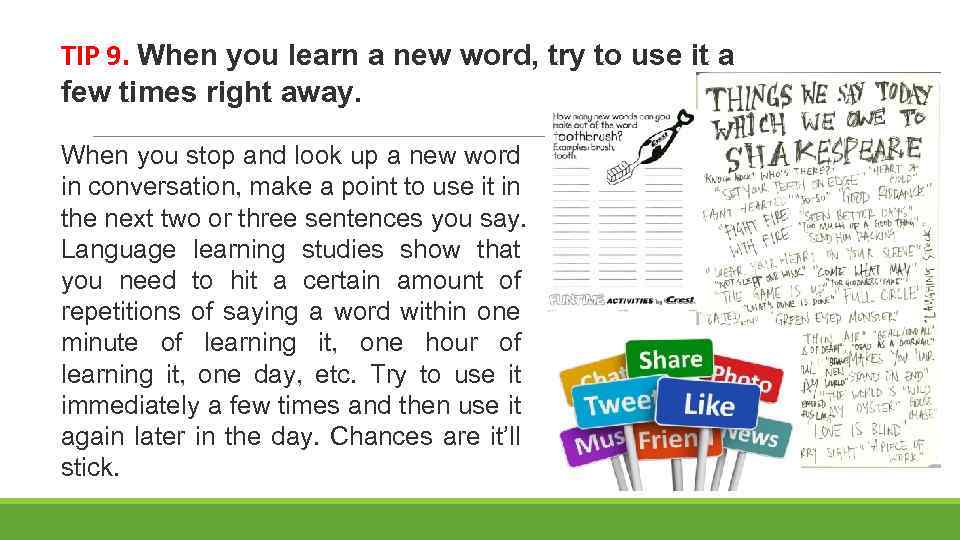 TIP 9. When you learn a new word, try to use it a few times right away. When you stop and look up a new word in conversation, make a point to use it in the next two or three sentences you say. Language learning studies show that you need to hit a certain amount of repetitions of saying a word within one minute of learning it, one hour of learning it, one day, etc. Try to use it immediately a few times and then use it again later in the day. Chances are it’ll stick.
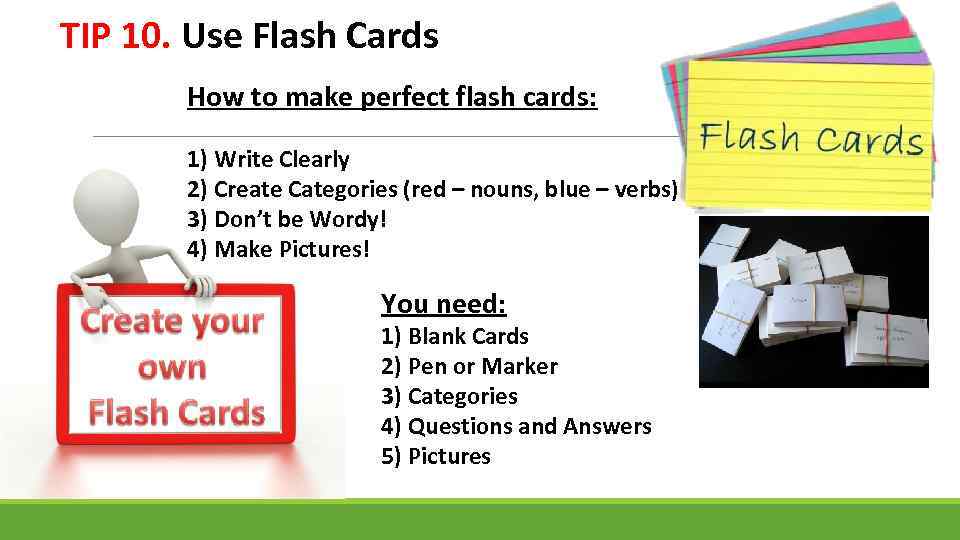 TIP 10. Use Flash Cards How to make perfect flash cards: 1) Write Clearly 2) Create Categories (red – nouns, blue – verbs) 3) Don’t be Wordy! 4) Make Pictures! You need: 1) Blank Cards 2) Pen or Marker 3) Categories 4) Questions and Answers 5) Pictures
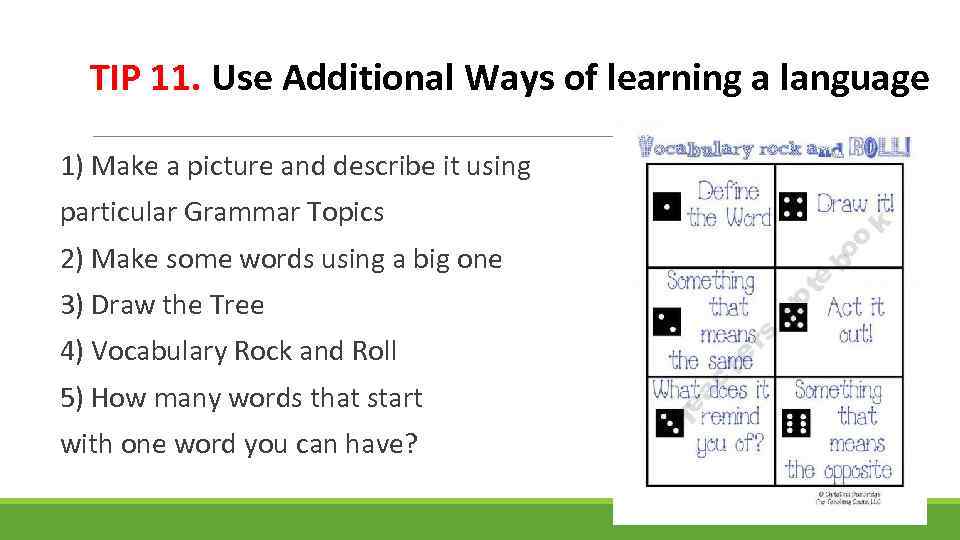 TIP 11. Use Additional Ways of learning a language 1) Make a picture and describe it using particular Grammar Topics 2) Make some words using a big one 3) Draw the Tree 4) Vocabulary Rock and Roll 5) How many words that start with one word you can have?
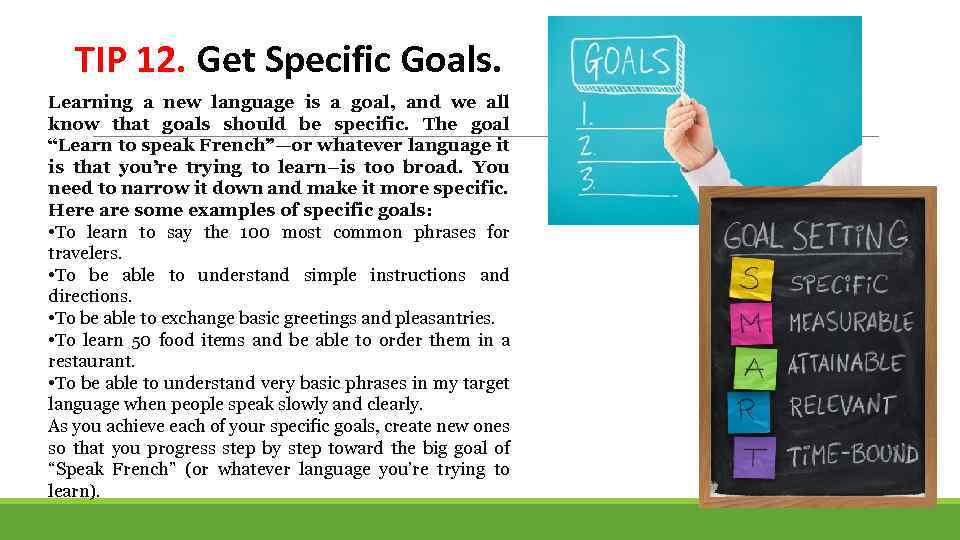 TIP 12. Get Specific Goals. Learning a new language is a goal, and we all know that goals should be specific. The goal “Learn to speak French”—or whatever language it is that you’re trying to learn–is too broad. You need to narrow it down and make it more specific. Here are some examples of specific goals: • To learn to say the 100 most common phrases for travelers. • To be able to understand simple instructions and directions. • To be able to exchange basic greetings and pleasantries. • To learn 50 food items and be able to order them in a restaurant. • To be able to understand very basic phrases in my target language when people speak slowly and clearly. As you achieve each of your specific goals, create new ones so that you progress step by step toward the big goal of “Speak French” (or whatever language you’re trying to learn).
 TIP 13. Listen more and more Chris Lonsdale is a psychologist from New Zealand who runs a company in Hong Kong. He gave a TED Talk in which he explains his approach to learning a new language. Lonsdale explains that one of the first steps to learn a new language is to listen, a lot. He calls this brain soaking. Lonsdale argues that it doesn’t matter if at first you don’t understand what you’re listening to. You’re listening to recognize patterns, words that repeat, and things that stand out. In addition, you’re listening to the rhythm of the language. You have to continually listen to the sounds of the language that you’re trying to learn in order to train your brain to let in the new sounds. You can start by looking for podcasts in your target language, as well as scouring You. Tube for interesting videos that will allow you to listen to the language that you’re trying to learn.
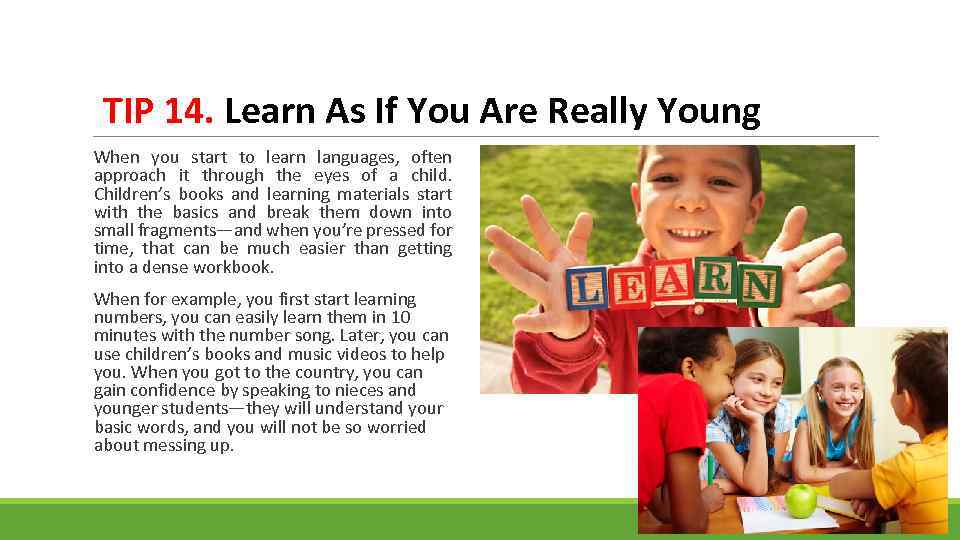 TIP 14. Learn As If You Are Really Young When you start to learn languages, often approach it through the eyes of a child. Children’s books and learning materials start with the basics and break them down into small fragments—and when you’re pressed for time, that can be much easier than getting into a dense workbook. When for example, you first start learning numbers, you can easily learn them in 10 minutes with the number song. Later, you can use children’s books and music videos to help you. When you got to the country, you can gain confidence by speaking to nieces and younger students—they will understand your basic words, and you will not be so worried about messing up.
 TIP 15. SING! You know that new American song that you can’t stop singing? Good — keep singing it! If you want to get even stronger, look up the lyrics and sing along with those. That way you’re not only practicing the pronunciation, but also maybe learning a few new words too.
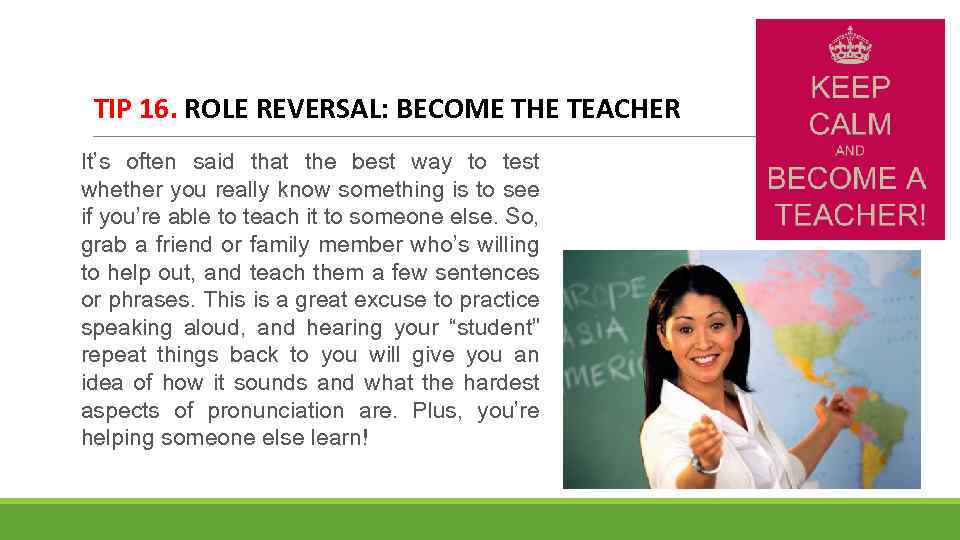 TIP 16. ROLE REVERSAL: BECOME THE TEACHER It’s often said that the best way to test whether you really know something is to see if you’re able to teach it to someone else. So, grab a friend or family member who’s willing to help out, and teach them a few sentences or phrases. This is a great excuse to practice speaking aloud, and hearing your “student” repeat things back to you will give you an idea of how it sounds and what the hardest aspects of pronunciation are. Plus, you’re helping someone else learn!
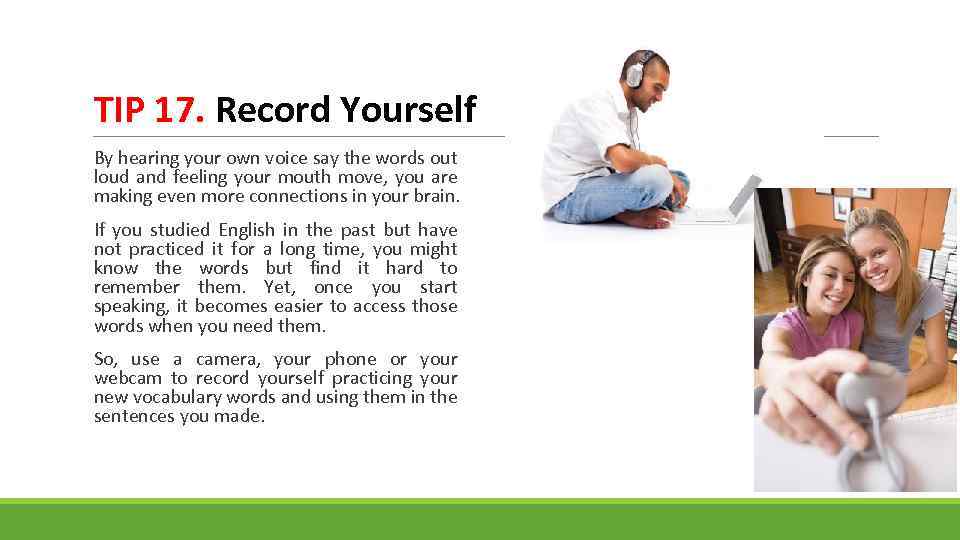 TIP 17. Record Yourself By hearing your own voice say the words out loud and feeling your mouth move, you are making even more connections in your brain. If you studied English in the past but have not practiced it for a long time, you might know the words but find it hard to remember them. Yet, once you start speaking, it becomes easier to access those words when you need them. So, use a camera, your phone or your webcam to record yourself practicing your new vocabulary words and using them in the sentences you made.
 TIP 18. Study Abroad!
 Have a Fantastic Language Adventure! And You Will Open a Whole New World! AND: