


 Скачать презентацию A Dynamic Reservation Protocol for Multi-Priority Multi-Rate Data
83eff098c082f86bd1fe583d8d05706e.ppt
- Количество слайдов: 17
 A Dynamic Reservation Protocol for Multi-Priority Multi-Rate Data Services on GSM Networks
 Introduction u On GSM networks most research works are based on integrating voice and data services together in one physical channel u Two major differences u voice traffic is subject to real time constraint but can tolerate some level of packet loss, while data services require error-free transmission but can tolerate some delay u voice traffic is generally symmetrical while data traffic is asymmetrical u Integrating data traffic onto TDMA channels designed for voice traffic may lead to poor channel utilization 2
 Advantages u Data terminals can access uplink channel without contention achieving very high channel utilization efficiency and improving the service performance under heavy traffic load u It can adapt to traffic variations by dynamically changing the transmission cycle lengths u It can accommodate different service priorities and different latency constraints of multimedia traffic u It can accommodate CBR, VBR and ABR services u Typical applications: wireless E-mail, web browsing, telemedicine, voice messaging, telemetry 3
 Frame Structure of GSM Traffic Channel u Traffic channels in GSM networks are TDMA slots that can support both data and voice traffic u Each TDMA slot can accommodate 48 bits user data u 8 slots are grouped into a frame u 26 frames are grouped into a multiframe u Duplex channels are assigned in GSM u This assignment however is very inefficient for asymmetric data traffic (browsing WWW pages, Road Traffic Information) 4
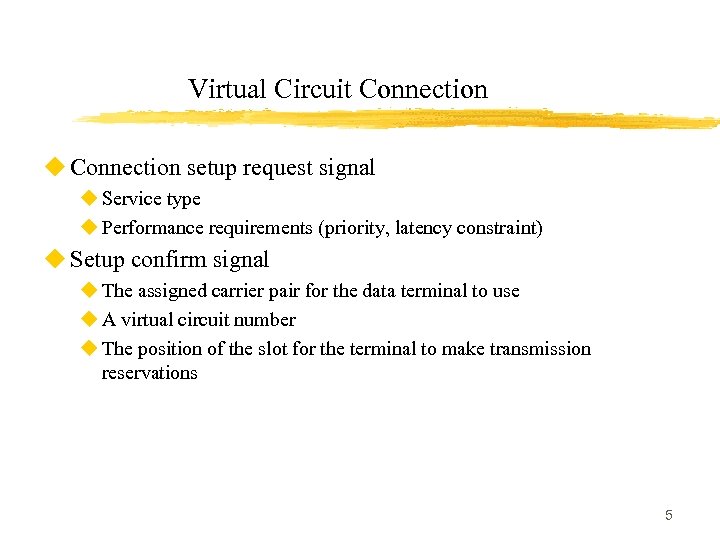 Virtual Circuit Connection u Connection setup request signal u Service type u Performance requirements (priority, latency constraint) u Setup confirm signal u The assigned carrier pair for the data terminal to use u A virtual circuit number u The position of the slot for the terminal to make transmission reservations 5
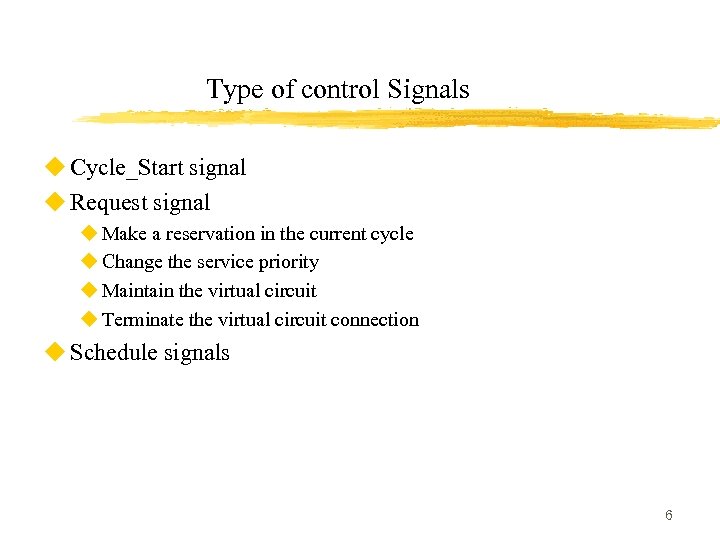 Type of control Signals u Cycle_Start signal u Request signal u Make a reservation in the current cycle u Change the service priority u Maintain the virtual circuit u Terminate the virtual circuit connection u Schedule signals 6
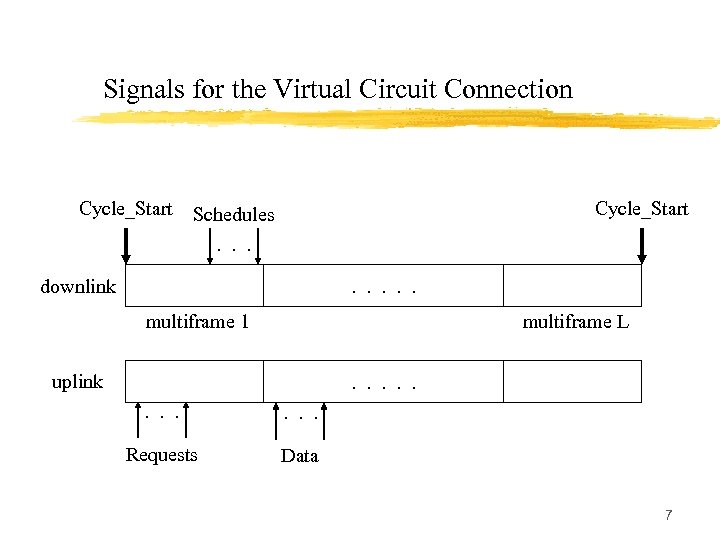 Signals for the Virtual Circuit Connection Cycle_Start Schedules. . . downlink . . . multiframe 1 multiframe L uplink . . . Requests Data 7
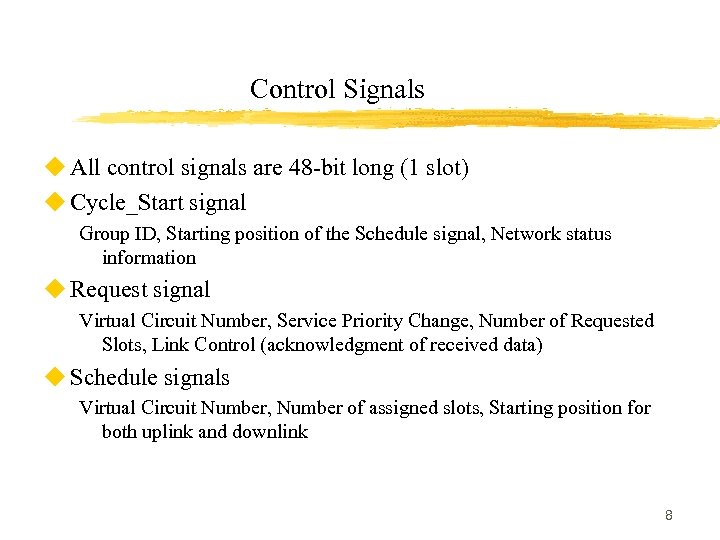 Control Signals u All control signals are 48 -bit long (1 slot) u Cycle_Start signal Group ID, Starting position of the Schedule signal, Network status information u Request signal Virtual Circuit Number, Service Priority Change, Number of Requested Slots, Link Control (acknowledgment of received data) u Schedule signals Virtual Circuit Number, Number of assigned slots, Starting position for both uplink and downlink 8
 Multi-priority u Assign different access rights to different priority classes u Let a two-class case with priority of class 1>priority of class 2 u Divide class 2 terminals into n equal groups u In each transmission cycle all class 1 terminals and one class 2 group are allowed to make reservation 9
 Assignment Algorithm u Let N 1 the number of class 1 terminals, N 2 the number of class 2 terminals u Reservation slots in each cycle N 1+(N 2/n) u Transmission slots in the uplink m 0=208 L - N 1 - (N 2/n) (208=26*8 is the number of slots in one multiframe) u Let ri the number of requested slots from terminal i and R=[r 1, r 2, …, r. N] a vector with at most N 1+(N 2/n) elements u Let αi the actual number of slots assigned to terminal i and A=[α 1, α 2, …, αΝ] 10
 Assignment Algorithm u If the total number of requested slots is no larger than m 0 A=R u Otherwise 1) Initialize A to 0 and total number of remaining slots m to m 0 2) Find the smallest ri denoted as rmin and update αi=αi+min(rmin, ri, m). Decrement ri and m accordingly 3) Repeat step 2 until m=0 u Transmission order: class 1 terminals transmit first following by class 2 terminals. Among those belonging to same class terminals with shorter messages transmit first 11
 Performance Evaluation u Number of logged terminals N u Each terminal generates messages according to a Poisson process with rate λ=0. 33 per second u The message length is geometrically distributed with a mean X=192 bytes u Message delay: time until the next transmission cycle, request, schedule, transmission 12
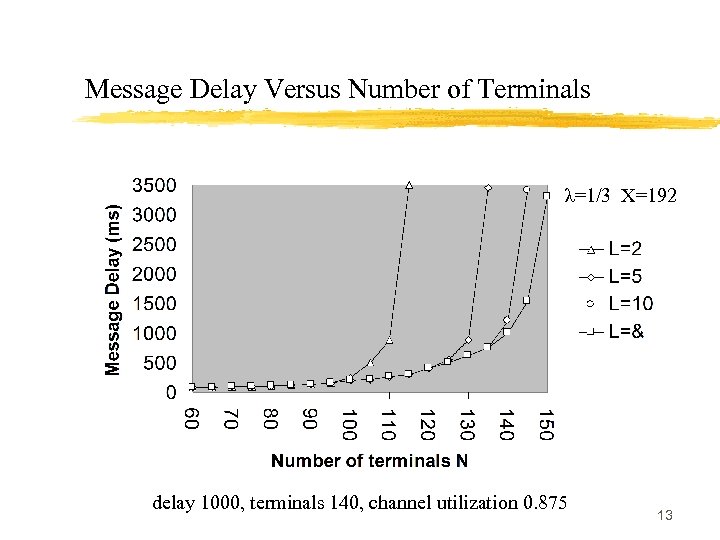 Message Delay Versus Number of Terminals λ=1/3 Χ=192 delay 1000, terminals 140, channel utilization 0. 875 13
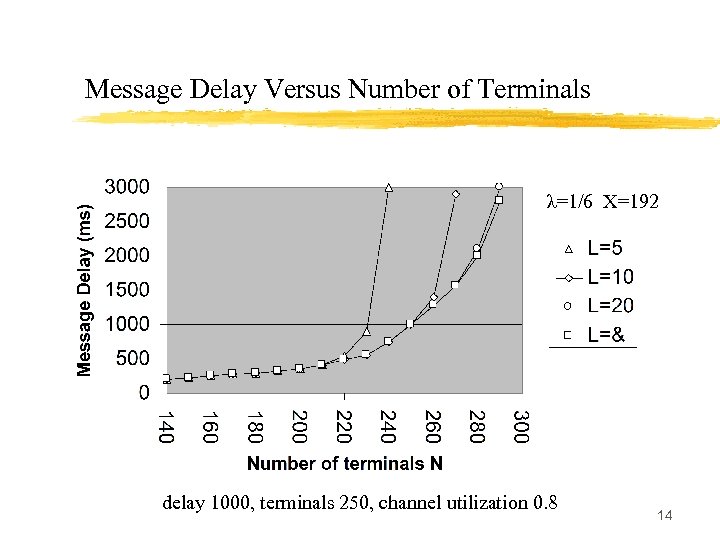 Message Delay Versus Number of Terminals λ=1/6 Χ=192 delay 1000, terminals 250, channel utilization 0. 8 14
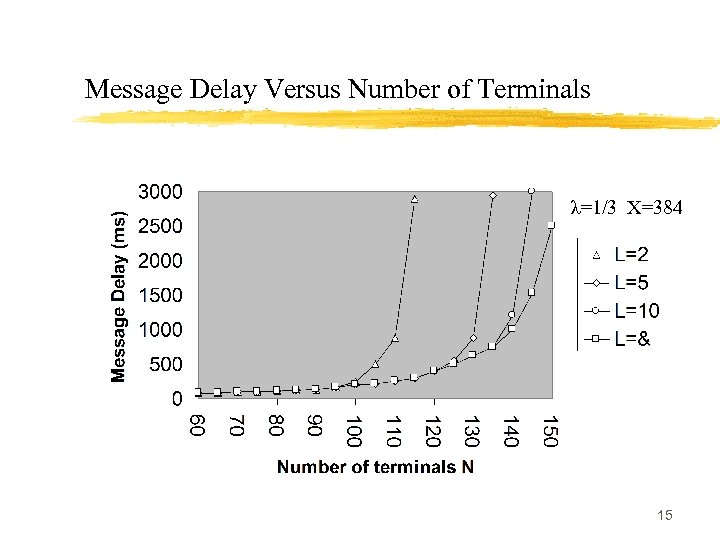 Message Delay Versus Number of Terminals λ=1/3 Χ=384 15
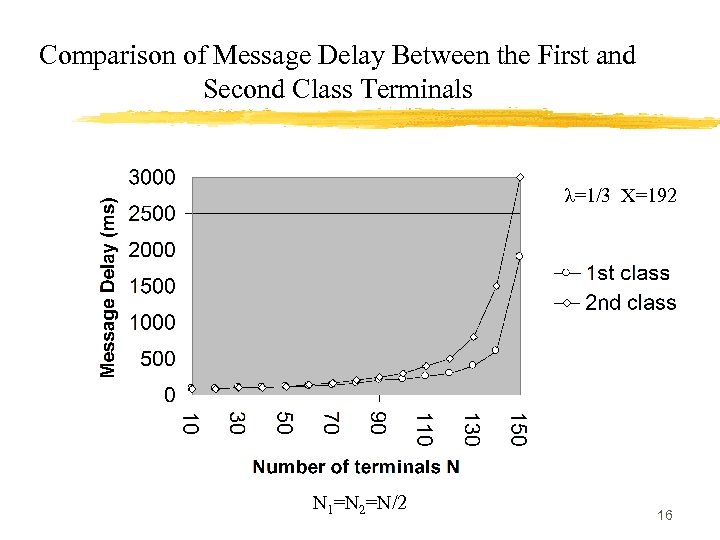 Comparison of Message Delay Between the First and Second Class Terminals λ=1/3 Χ=192 N 1=N 2=N/2 16
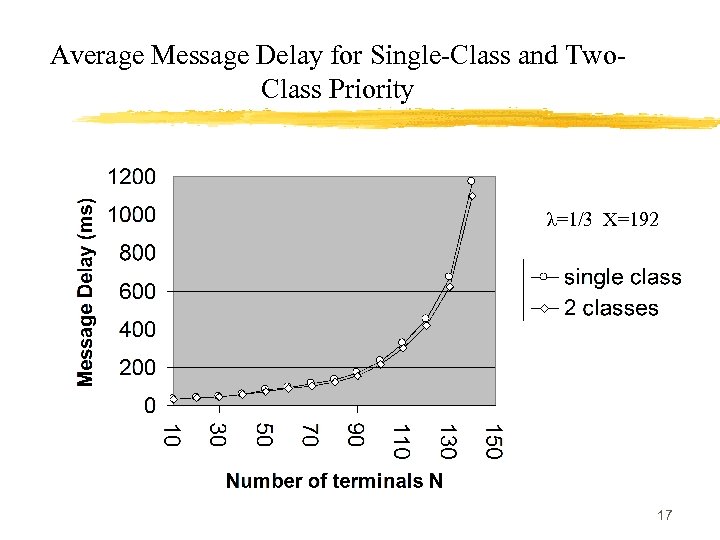 Average Message Delay for Single-Class and Two. Class Priority λ=1/3 Χ=192 17