 Скачать презентацию A DNA-Templated Carbon Nanotube Field Effect Transistor gold
cbc52f53b0a33169be0a969a019e11b1.ppt
- Количество слайдов: 36



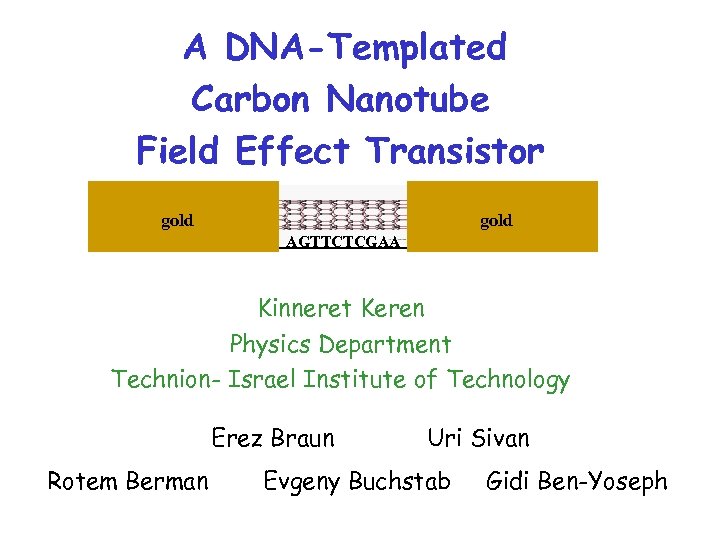
A DNA-Templated Carbon Nanotube Field Effect Transistor gold AGTTCTCGAA Kinneret Keren Physics Department Technion- Israel Institute of Technology Erez Braun Rotem Berman Uri Sivan Evgeny Buchstab Gidi Ben-Yoseph
Molecular Electronics One of the major challenges: Integration of a large number of molecular devices into functional circuits A possible route, Self assembly Bottom-up assembly based on recognition between molecular building blocks. All the information is encoded into the building blocks (no blue-prints, no supervisor) The assembly process proceeds autonomously ( no molecular-scale external manipulations)
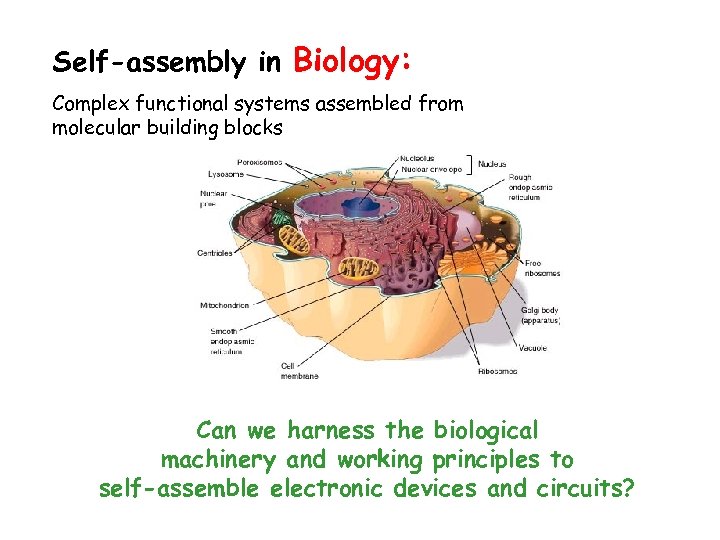
Self-assembly in Biology: Complex functional systems assembled from molecular building blocks Can we harness the biological machinery and working principles to self-assemble electronic devices and circuits?
Outline: • DNA-templated electronics • A biological framework. Homologous genetic recombination • Sequence-specific molecular lithography • Self-assembly of a DNA-templated transistor • Outlook
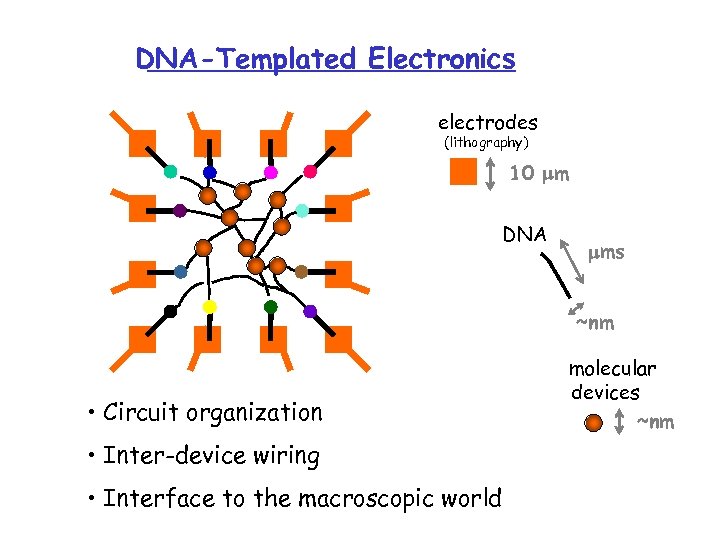
DNA-Templated Electronics electrodes (lithography) 10 m DNA ms ~nm • Circuit organization • Inter-device wiring • Interface to the macroscopic world molecular devices ~nm
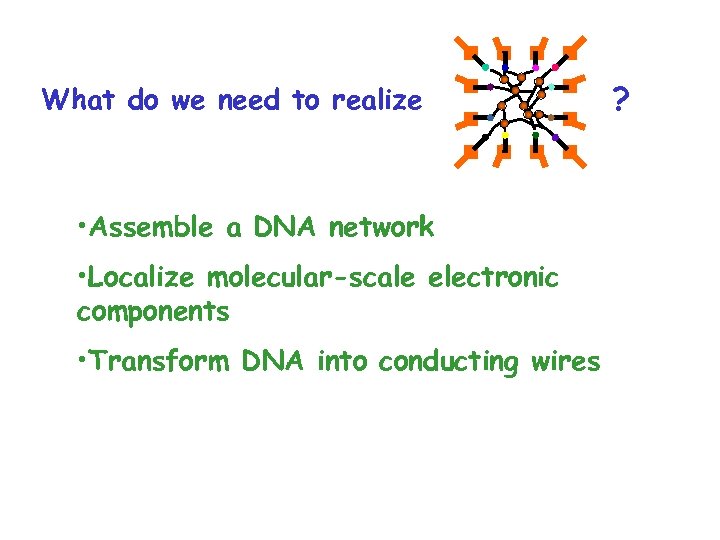
What do we need to realize • Assemble a DNA network • Localize molecular-scale electronic components • Transform DNA into conducting wires ?
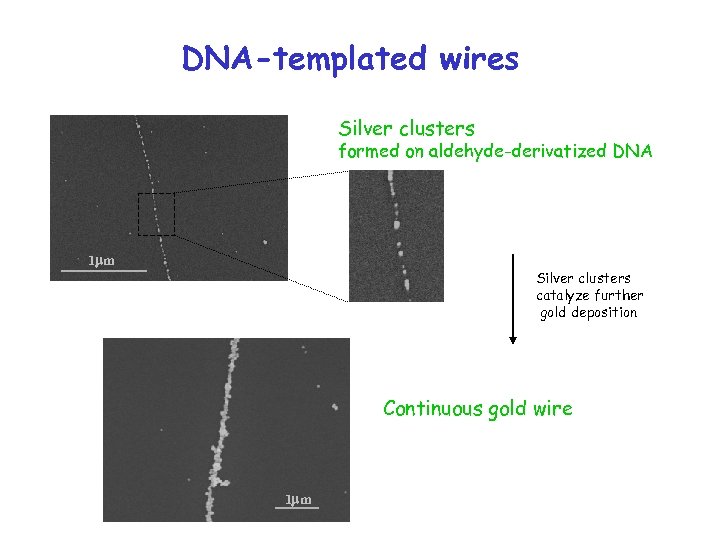
DNA-templated wires Silver clusters formed on aldehyde-derivatized DNA 1 m Silver clusters catalyze further gold deposition Continuous gold wire 1 m
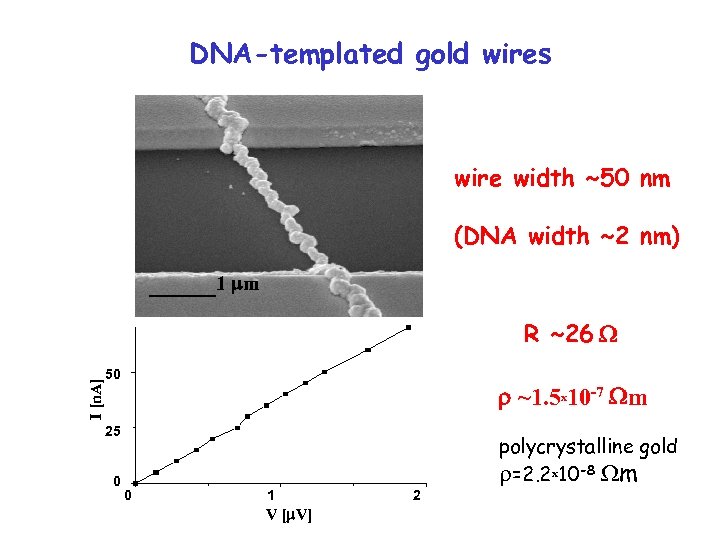
DNA-templated gold wires wire width ~50 nm (DNA width ~2 nm) 1 m I [n. A] R ~26 W 50 r ~1. 5 x 10 -7 Wm 25 0 polycrystalline gold r=2. 2 x 10 -8 Wm 0 1 V [ V] 2
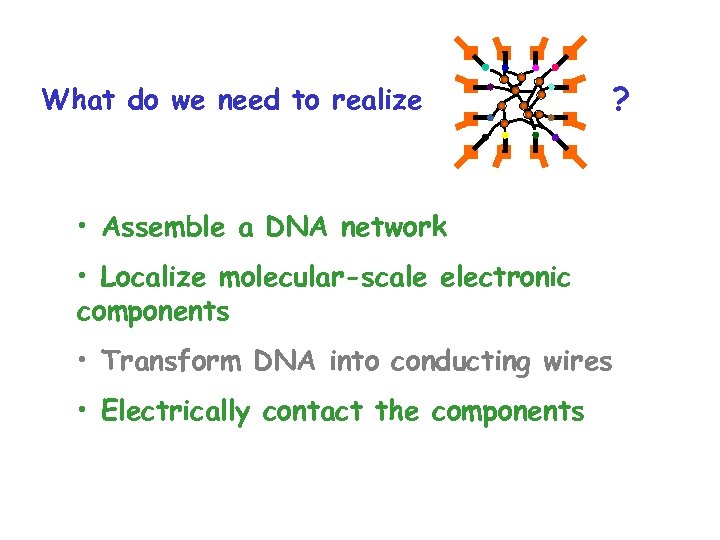
What do we need to realize ? • Assemble a DNA network • Localize molecular-scale electronic components • Transform DNA into conducting wires • Electrically contact the components
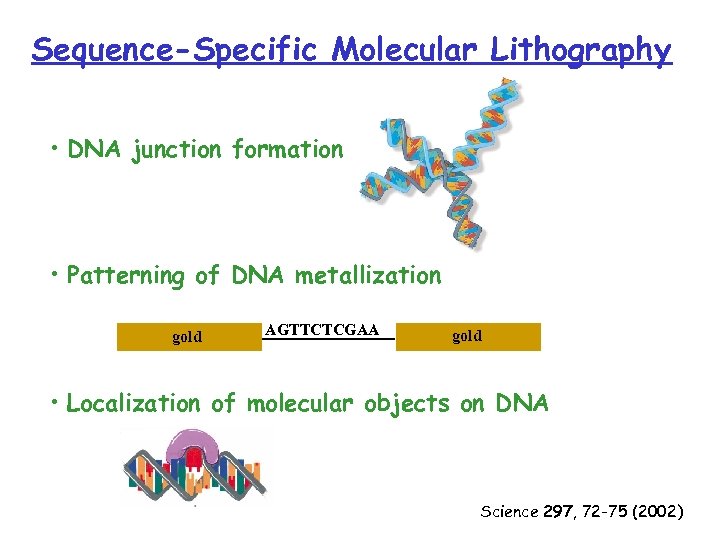
Sequence-Specific Molecular Lithography • DNA junction formation • Patterning of DNA metallization gold AGTTCTCGAA gold • Localization of molecular objects on DNA Science 297, 72 -75 (2002)
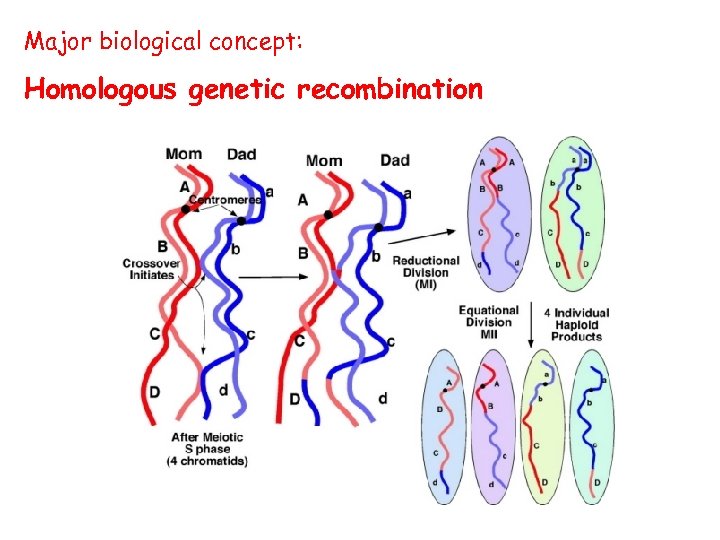
Major biological concept: Homologous genetic recombination
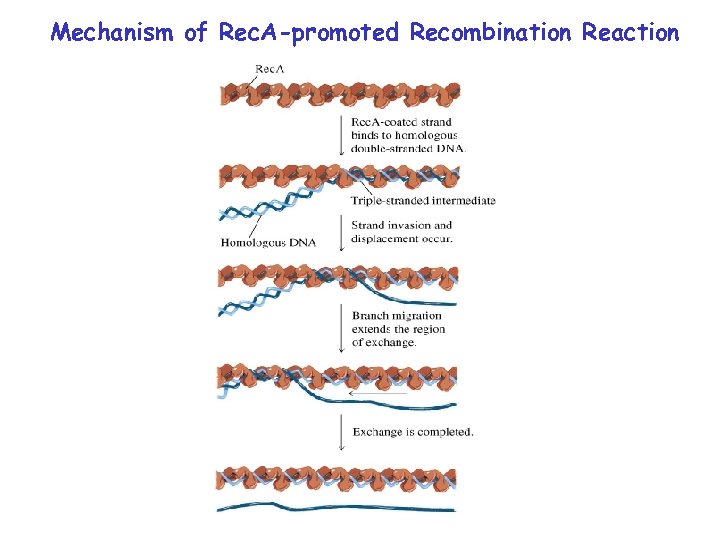
Mechanism of Rec. A-promoted Recombination Reaction
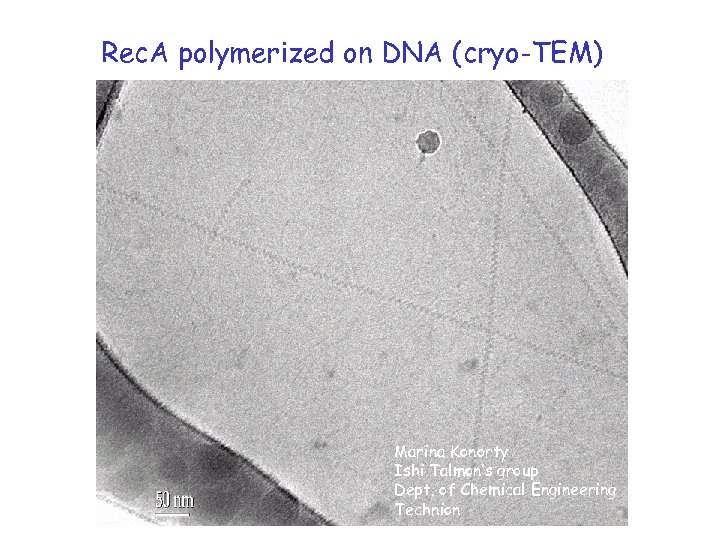
Rec. A polymerized on DNA (cryo-TEM) Marina Konorty Ishi Talmon’s group Dept. of Chemical Engineering Technion
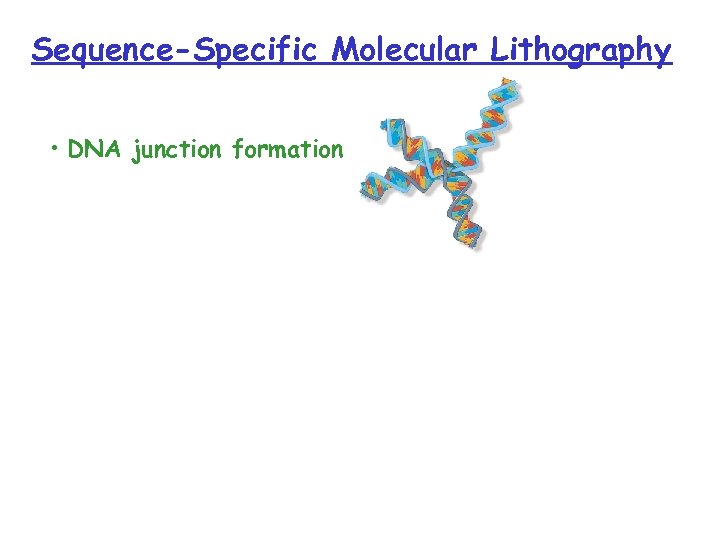
Sequence-Specific Molecular Lithography • DNA junction formation
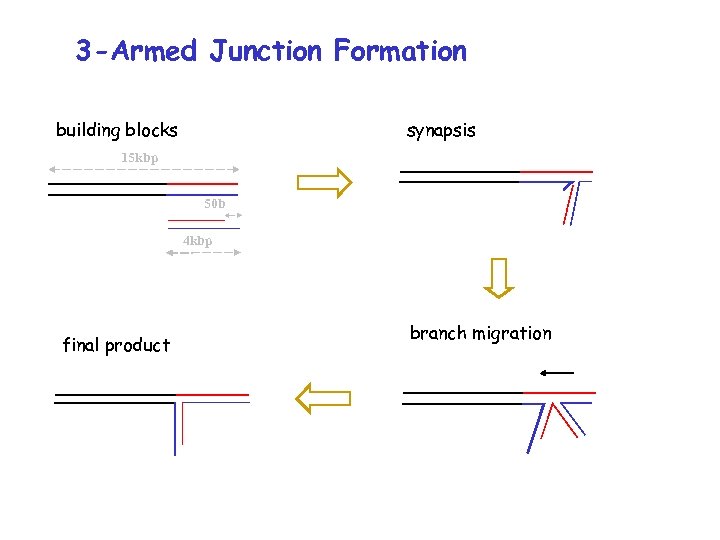
3 -Armed Junction Formation building blocks synapsis 15 kbp 50 b 4 kbp final product branch migration
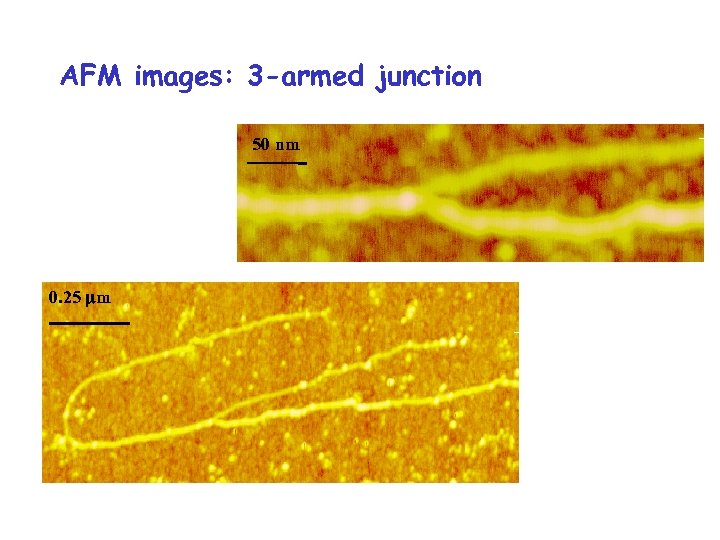
AFM images: 3 -armed junction 50 nm 0. 25 m
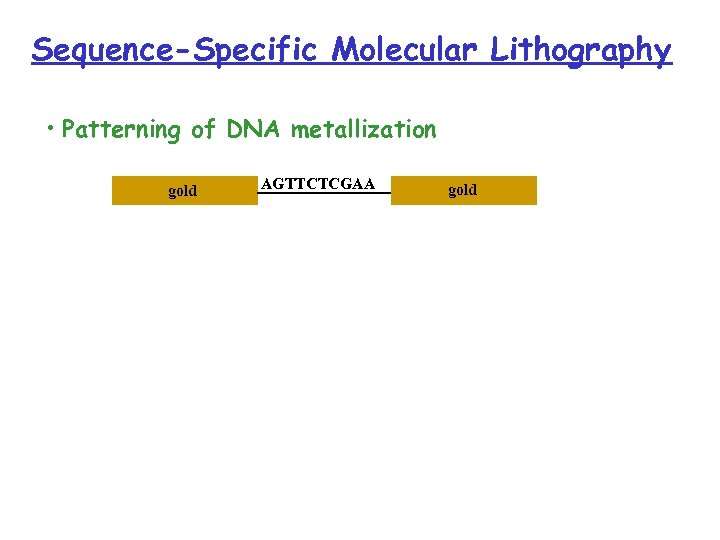
Sequence-Specific Molecular Lithography • Patterning of DNA metallization gold AGTTCTCGAA gold
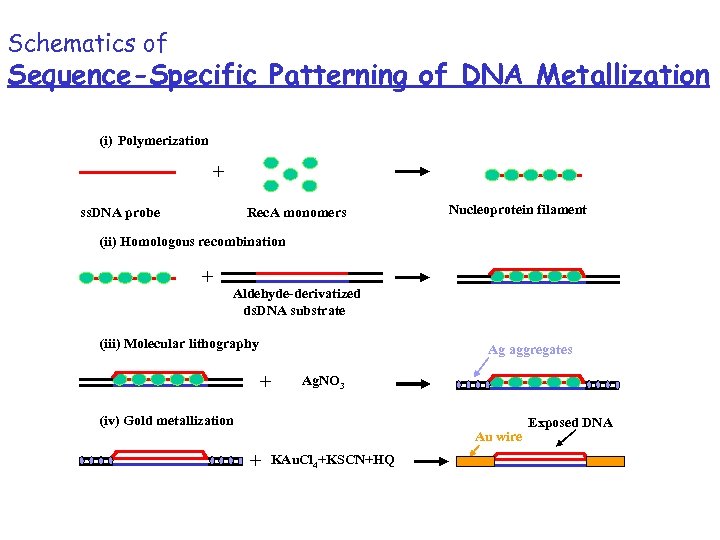
Schematics of Sequence-Specific Patterning of DNA Metallization (i) Polymerization + ss. DNA probe Rec. A monomers Nucleoprotein filament (ii) Homologous recombination + Aldehyde-derivatized ds. DNA substrate (iii) Molecular lithography Ag aggregates + Ag. NO 3 (iv) Gold metallization Au wire + KAu. Cl 4+KSCN+HQ Exposed DNA
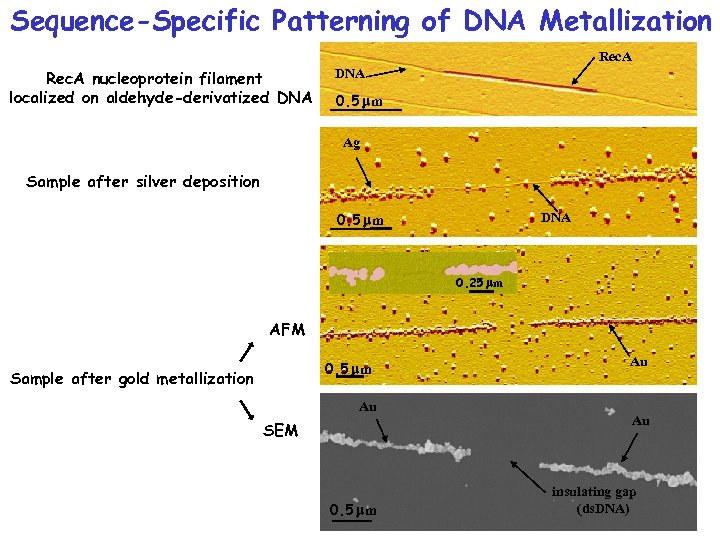
Sequence-Specific Patterning of DNA Metallization Rec. A nucleoprotein filament localized on aldehyde-derivatized DNA 0. 5 m Ag Sample after silver deposition 0. 5 m DNA 0. 25 m AFM 0. 5 m Sample after gold metallization Au SEM 0. 5 m Au Au insulating gap (ds. DNA)
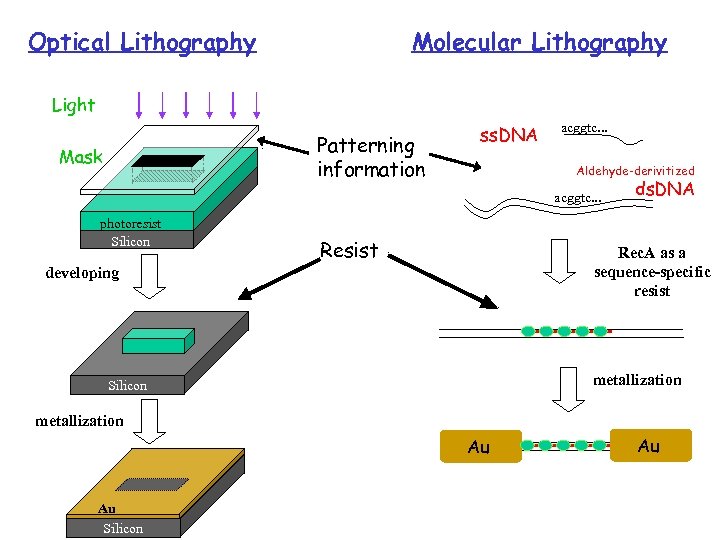
Optical Lithography Molecular Lithography Light Patterning information Mask ss. DNA acggtc. . . Aldehyde-derivitized acggtc. . . photoresist Silicon Resist ds. DNA Rec. A as a sequence-specific resist developing metallization Silicon metallization Au Au Silicon Au
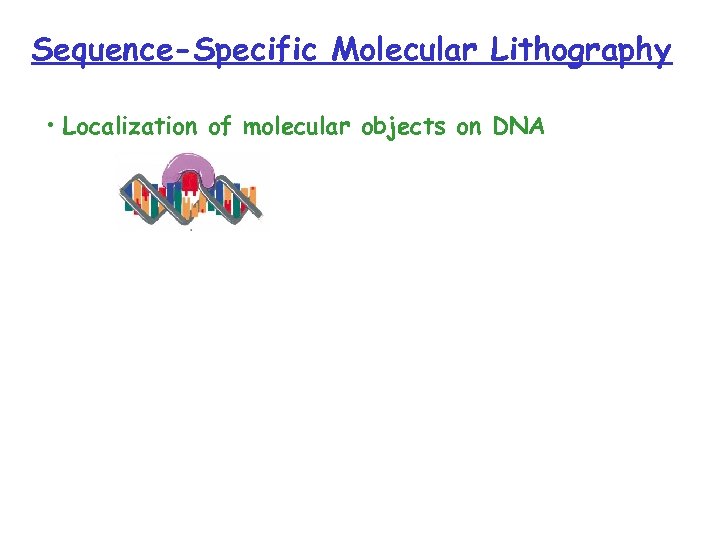
Sequence-Specific Molecular Lithography • Localization of molecular objects on DNA
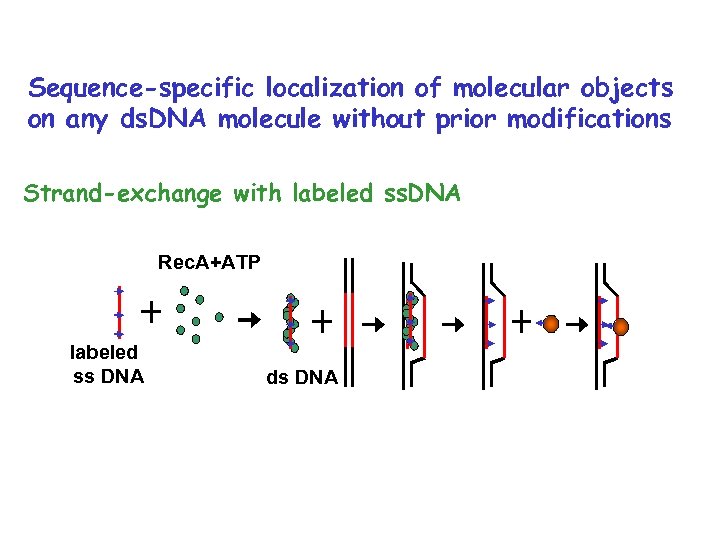
Sequence-specific localization of molecular objects on any ds. DNA molecule without prior modifications Strand-exchange with labeled ss. DNA Rec. A+ATP labeled ss DNA ds DNA
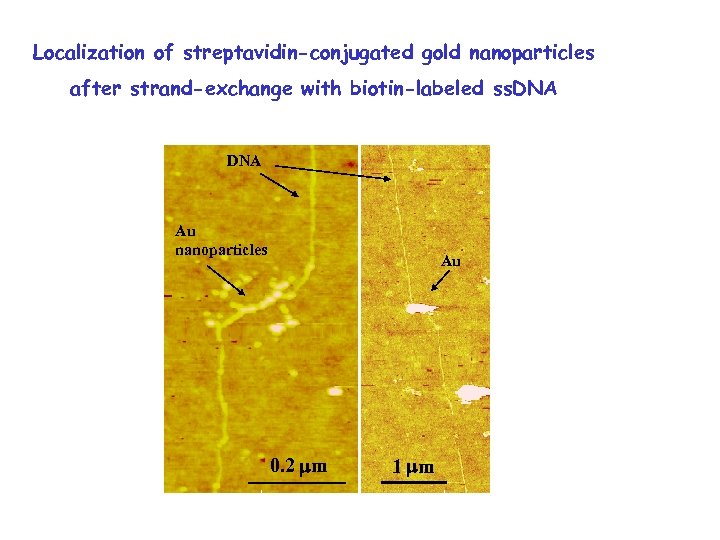
Localization of streptavidin-conjugated gold nanoparticles after strand-exchange with biotin-labeled ss. DNA Au nanoparticles Au 0. 2 m 1 m
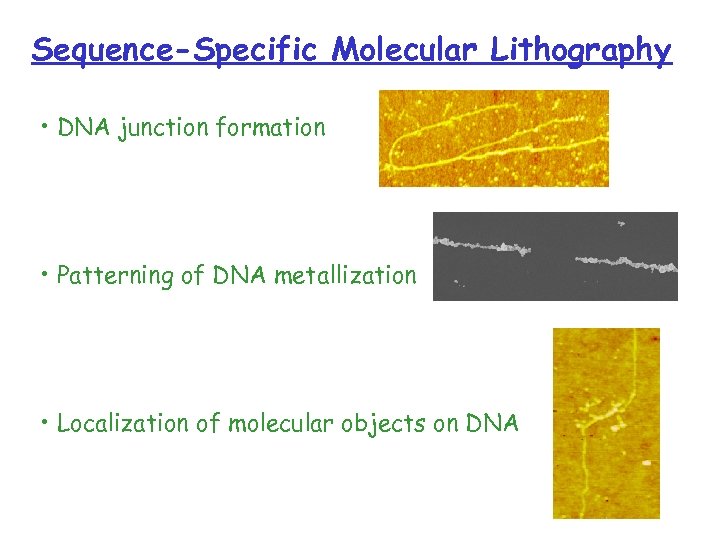
Sequence-Specific Molecular Lithography • DNA junction formation • Patterning of DNA metallization • Localization of molecular objects on DNA
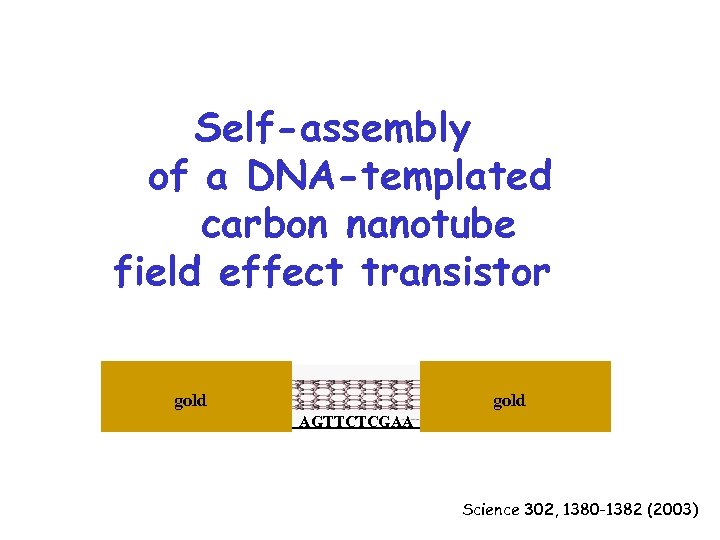
Self-assembly of a DNA-templated carbon nanotube field effect transistor gold AGTTCTCGAA Science 302, 1380 -1382 (2003)
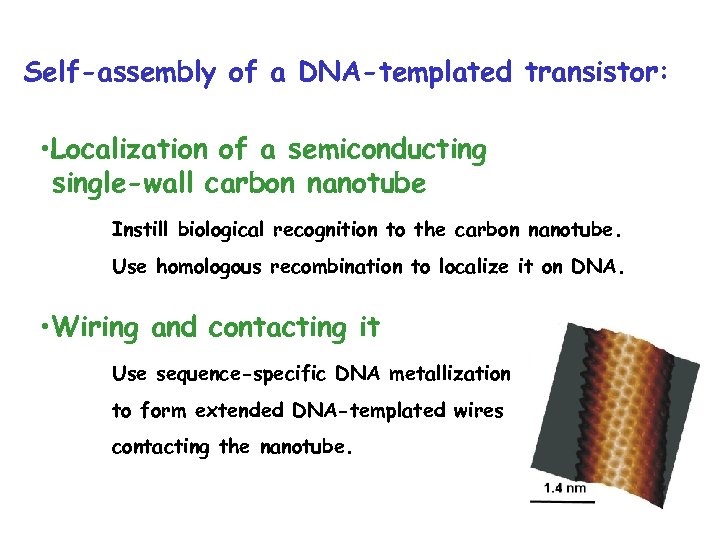
Self-assembly of a DNA-templated transistor: • Localization of a semiconducting single-wall carbon nanotube Instill biological recognition to the carbon nanotube. Use homologous recombination to localize it on DNA. • Wiring and contacting it Use sequence-specific DNA metallization to form extended DNA-templated wires contacting the nanotube.
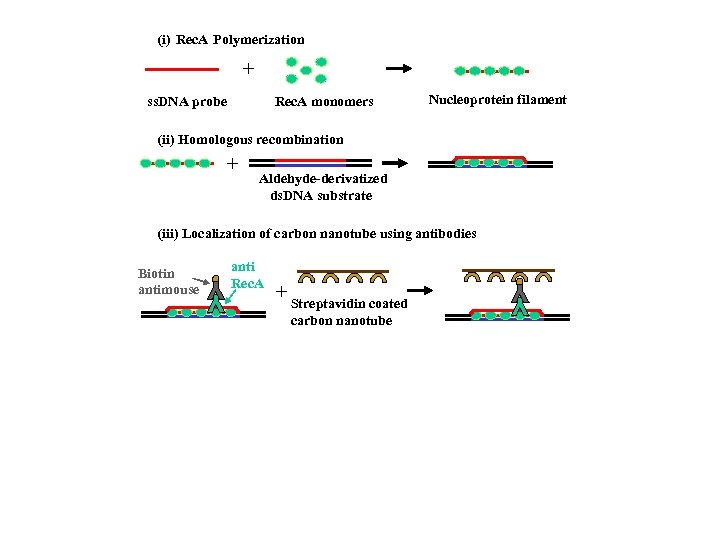
(i) Rec. A Polymerization + ss. DNA probe Rec. A monomers Nucleoprotein filament (ii) Homologous recombination + Aldehyde-derivatized ds. DNA substrate (iii) Localization of carbon nanotube using antibodies Biotin antimouse anti Rec. A + Streptavidin coated carbon nanotube
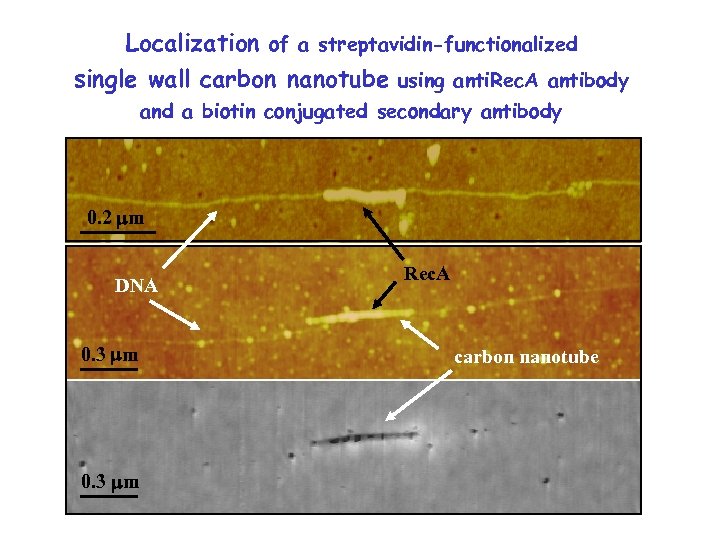
Localization of a streptavidin-functionalized single wall carbon nanotube using anti. Rec. A antibody and a biotin conjugated secondary antibody 0. 2 m DNA 0. 3 m Rec. A carbon nanotube
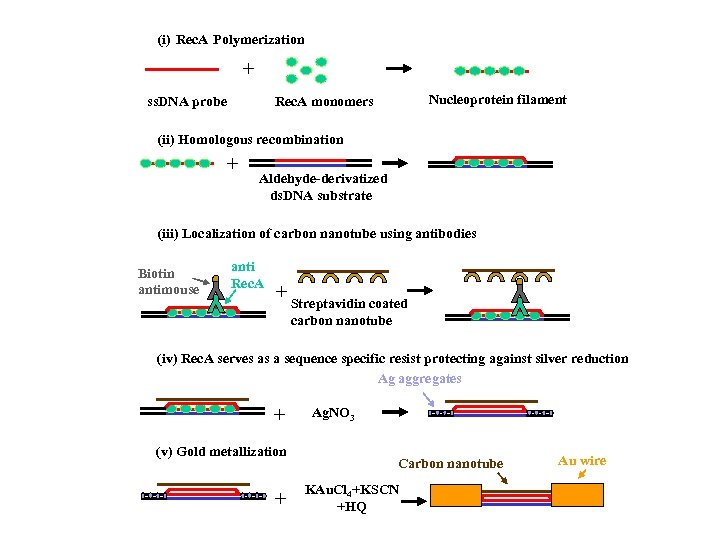
(i) Rec. A Polymerization + ss. DNA probe Nucleoprotein filament Rec. A monomers (ii) Homologous recombination + Aldehyde-derivatized ds. DNA substrate (iii) Localization of carbon nanotube using antibodies Biotin antimouse anti Rec. A + Streptavidin coated carbon nanotube (iv) Rec. A serves as a sequence specific resist protecting against silver reduction Ag aggregates + (v) Gold metallization + Ag. NO 3 Carbon nanotube KAu. Cl 4+KSCN +HQ Au wire
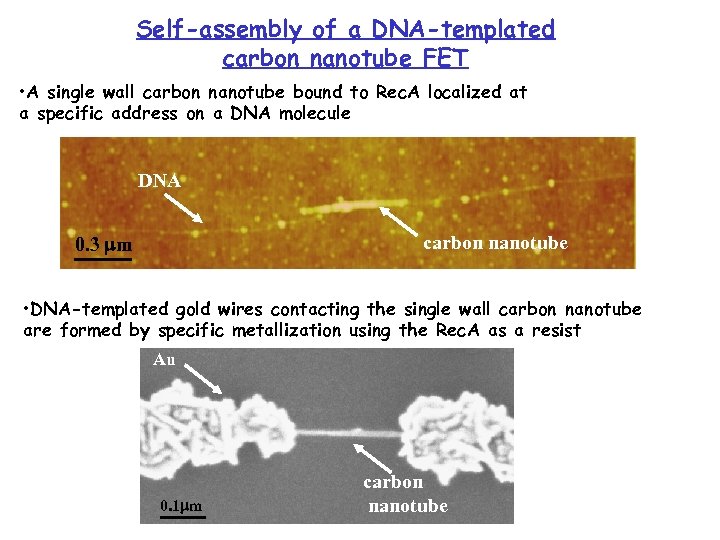
Self-assembly of a DNA-templated carbon nanotube FET • A single wall carbon nanotube bound to Rec. A localized at a specific address on a DNA molecule DNA 0. 3 m carbon nanotube • DNA-templated gold wires contacting the single wall carbon nanotube are formed by specific metallization using the Rec. A as a resist Au 0. 1 m carbon nanotube
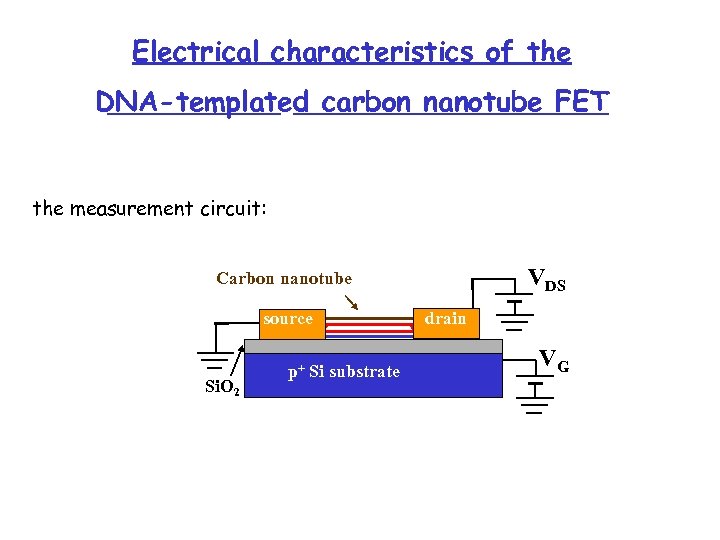
Electrical characteristics of the DNA-templated carbon nanotube FET the measurement circuit: VDS Carbon nanotube source Si. O 2 p+ Si substrate drain VG
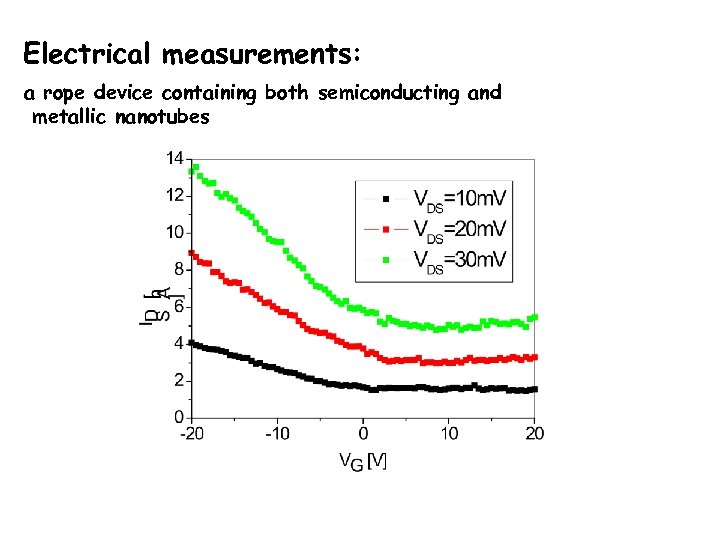
Electrical measurements: a rope device containing both semiconducting and metallic nanotubes
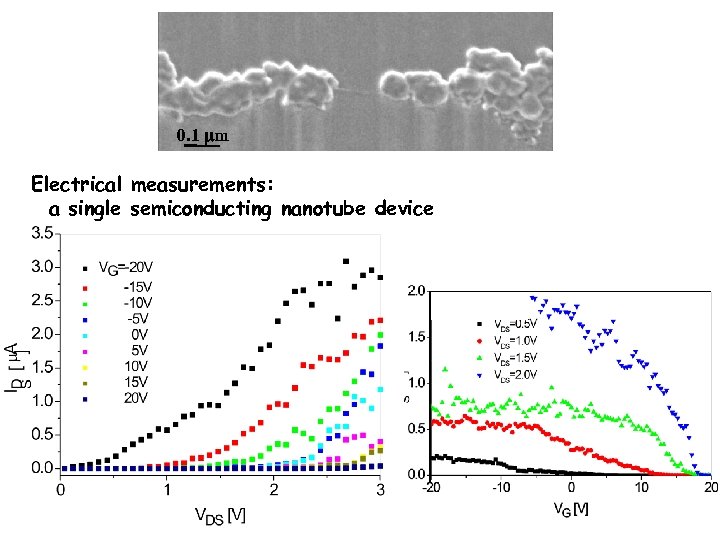
0. 1 m Electrical measurements: a single semiconducting nanotube device
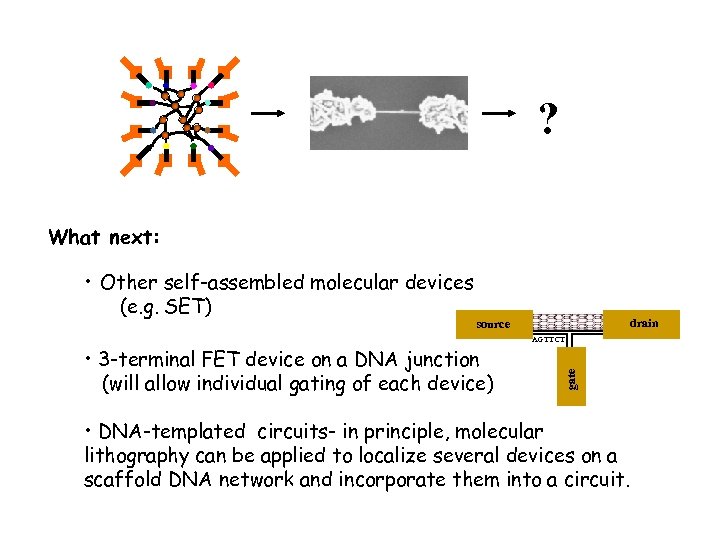
? What next: drain source • 3 -terminal FET device on a DNA junction (will allow individual gating of each device) AGTTCT gate • Other self-assembled molecular devices (e. g. SET) • DNA-templated circuits- in principle, molecular lithography can be applied to localize several devices on a scaffold DNA network and incorporate them into a circuit.
Can we realize complex DNA-templated electronics? As in biology, assembly of complex functional systems will probably require more than just “passive” self-assembly Can we introduce additional biological concepts: feedback from functionality to the assembly process, error correction, modularity, selection, replication, evolution …?
Thanks to: • • Erez Braun Uri Sivan Rotem Berman Marina Konorty Gidi Ben-Yoseph Evgeny Buchstab Michael Krueger Rachel Yechieli
Скачать презентацию A DNA-Templated Carbon Nanotube Field Effect Transistor gold
cbc52f53b0a33169be0a969a019e11b1.ppt