


 Скачать презентацию A Diversity of Academic Interests Dr Warren Toomey
e10e23fb96384f6a0025c08bf2a270e1.ppt
- Количество слайдов: 19
 A Diversity of Academic Interests Dr Warren Toomey School of Computer Science, ADFA wkt@cs. adfa. edu. au
 Bachelor's Degree § § § B. Sc (Hons) IIa at U. N. E 1984 - 1988, 1 year off Main interests: operating systems, compilers, program design, AI, Unix & Minix Early 1989 was spent as sysadmin for Dept’s Unix computers, desktop PCs, LAN and printers Keen to stay in academic system rather than being employed as a programmer in ‘real world’ ADFA offered a research position in distributed OS in September, 1989. . .
 RHODOS - Distributed Systems § § § RHODOS development: 1989 - 1992 An implementation of a distributed OS framework for research into this area Team of 6 -9 people, all creating ideas, some implementing them too A very fertile time for publications: conference & journal papers, technical reports Lead researcher moved to Deakin Uni, most of the team followed, I stayed on at ADFA
 Teaching Fellow § Persuaded to take a Teaching Fellow position § § half-time lecturing, full-time Ph. D study (ha!) Initial courses were related to the RHODOS research: operating systems, networks This expanded to 2 nd yr Data Structures and then 1 st yr courses for both Computer Science & Information Systems Teaching load did impede Ph. D progress somewhat: eventually switched to Assoc Lecturer
 Ph. D - Congestion Control § § My Ph. D topic was the area of network congestion in Internet-style wide-area networks TCP is one of the major causes of congestion: § § § Heuristics to detect congestion are admirable given end-to-end environment, but not great Sensitive to round-trip variation; packet loss is ambiguous; congestion- and flow-control are not separated Sliding window opening: short-term congestion
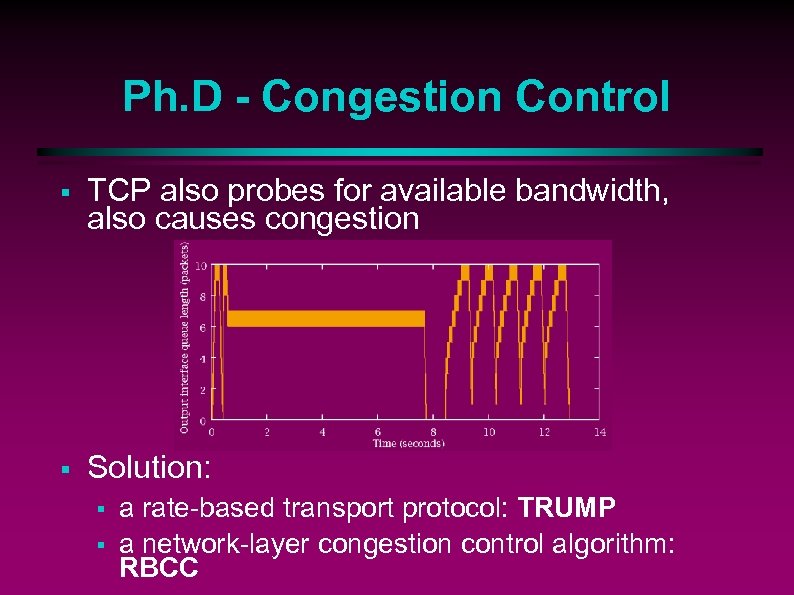 Ph. D - Congestion Control § TCP also probes for available bandwidth, also causes congestion § Solution: § § a rate-based transport protocol: TRUMP a network-layer congestion control algorithm: RBCC
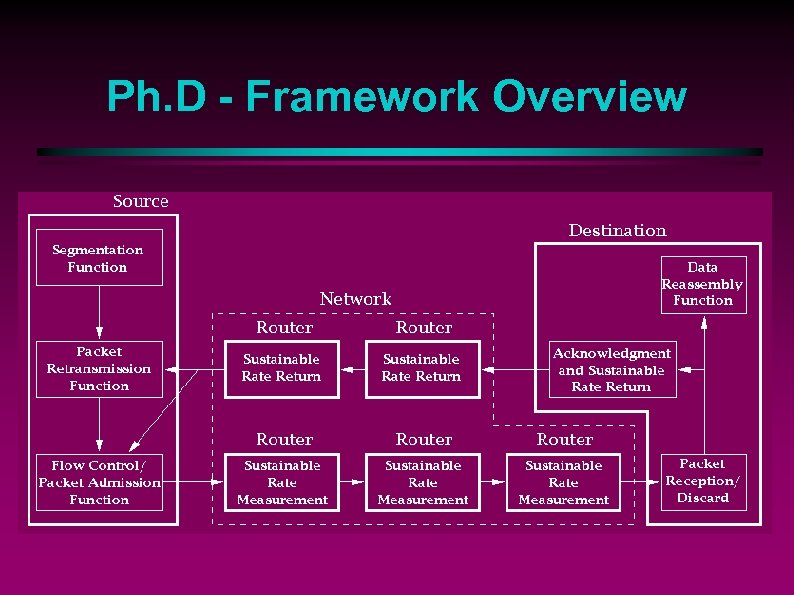 Ph. D - Framework Overview
 Ph. D - Framework Overview § § TRUMP in end-hosts, RBCC in routers TRUMP flows ask for a certain max bitrate, RBCC allocates rates fairly to flows through a node, given bandwidth on output interfaces § § Surprisingly simple algorithm, O(N) unfortunately NL headers communicate RBCC information: § § § Transmision rate desired by source Network node which is bottleneck, and rate chosen Rate returned from destination back to source
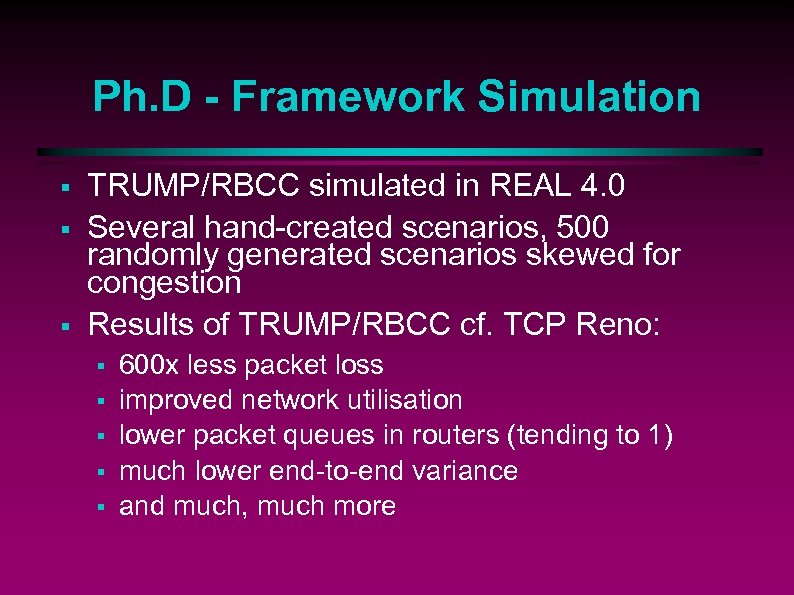 Ph. D - Framework Simulation § § § TRUMP/RBCC simulated in REAL 4. 0 Several hand-created scenarios, 500 randomly generated scenarios skewed for congestion Results of TRUMP/RBCC cf. TCP Reno: § § § 600 x less packet loss improved network utilisation lower packet queues in routers (tending to 1) much lower end-to-end variance and much, much more
 DUAL: Packet Radio Link Layer § § § Concurrently with Ph. D, development of new link layer frame format for Amateur Radio Existing frame format, AX. 25, is inefficient & does not support upper-level protocols Co-supervised an Honours student who implemented the DUAL link layer in Free. BSD I assisted with the implementation of the DUAL code For legal reasons, DUAL not adopted in Australia
 Computer Security § § My interest in network, OS & systems administration has led me to dabble in some Computer Security research Main thrust has been measures that can be taken to detect attacks and/or prevent them from happening Papers at several Oz conferences, notably Kuang. Plus in 2000 Also, local seminars reviewing the current status of Computer Security: technology & attacks
 Kuang. Plus § § § Both ‘white-hats’ and ‘black-hats’ find holes Details of holes published in human language Old tools (COPS, Kuang) to detect holes in a system, but database of tools never changed Kuang. Plus: inference engine, downloads hole description in ‘runnable’ format, detects holes and chains of vulnerabilities Many issues: sandboxes, digital signatures, trust in announcements, corruption of downloads etc.
 Research Supervision § § Supervisor of several 3 rd yr project teams in last 3 years: project client is always external to ADFA Supervision of a Masters project in 2000, an implementation of my Kuang. Plus concept Honours student in 2000: research into the feasibility of IPv 6 deployment in Defence 2000/2001: Co-supervision of Ph. D student: why PKI will fail to be adopted by industry
 Current Teaching § § Masters Operating Systems: architectural viewpoint, not a programming viewpoint Masters Data Networks: a look at current technologies, issues & research in this area Systems Administration (3 rd yr + Masters): a lot of fun, a lot of hard work, sink or swim, very hands-on, also good for systems managers Whatever else I'm given: 1 st yr CS/IS, 2 nd yr Data Comms, Software Eng, Computers in Society, Data Structures
 Cisco Networking Academy § 4 networking courses over 2 years § § fundamentals, routers, LAN design, WAN design Pedagogically excellent, best teaching practices § on-line study, kinesthetics, rubrics, exams, handson labs, case studies, as well as chalk'n'talk § Extremely popular, leads to the CCNA certificate § About 50%+ vendor-neutral, 50%- Cisco specific § End result: student can manage networking infrastructure in mid-sized organisation (up to 1, 000 stations, a handful of LANs & routers)
 Beowulf Cluster Research § § Recent deployment of 32 dual-CPU Beowulf cluster: PIII 650 MHz, 256 M, Red. Hat 6. 2 Used for research in genetic programming, data mining, speech processing, visualisation, agents My cluster interests: improving cluster performance (tuning, architectures), distributed processing & load balancing, OS design, SMP Also a good vehicle to demonstrate principles and practice of Systems Administration
 Computing History § § § This is becoming a burgeoning academic field My particular interest is the history & architectural development of UNIX and family I have set up and curate a large archive of UNIX software & documentation from 1972 onwards Issues: obtaining artefacts, data formats, construction of evolutionary tree, copyright and legal issues, maintenance & use of h/w and s/w An IEEE Annals of Computing History paper soon
 Minnie - Archive & Interactions § § § Minnie. cs. adfa. edu. au: web server, ftp archive, mailing list server Web area: research publications, pages used in course delivery, misc. hobby areas FTP area: the UNIX Archive, Free. BSD repository, mirrors of other popular sites Mailing lists: REAL network simulator, audio compression, Cisco lists, lists for courses Minnie has been on-line since 1992, a widelyused Internet resource
 Conclusion § § A diversity of academic interests & hobbies Research: operating systems, distributed systems, networking, security, clustering, computing history Teaching: operating systems, networks, systems administration, 1 st year courses, programming Communication and peer sharing is crucial for both. Minnie provides myself & others with a tool to interact and work