 Скачать презентацию A Design Envelope for Styles of Organizing Gibson
ff25ed87d11cc1d7b4cbbe25f90e0b01.ppt
- Количество слайдов: 47



A Design Envelope for Styles of Organizing? Gibson Burrell EGOS, Helsinki, 2012
In the Preface to the English edition of ‘The Order of Things’ Foucault argues that he was “attempting to uncover the deepest strata of Western culture”. What was common to the naturalists, the economists, the grammarians? His answer was they employed the same rules to define their objects of study, to build their theories and to form their concepts. They were subject to the same rules of formation which he attempted to uncover
That was an ambitious project An awfully big adventure Where are the big adventures in Organization Studies? Flirt more with Danger than with Safety A five year stuttering project -Where are the origins of Organization Theory?
Mesopotamian creation myths of a-voiding the void In Bible: “Now the earth was formless and empty” Genesis 1: 2 Form and content go hand in a laminated way Chaos is subdued by the creation of form (e. g. night and day; water and sky) And by the creation of content (e. g. vegetation, animals) A materialist paradise of matter in the right place- the Garden of Eden as God’s ‘rule of formation’
In the Germanic axis of Rhine-Danube the notion of Man’s rather than God’s role gathers momentum ‘the will to…. . ’ develops Schopenhauer’s ‘the will to live’ Nietzsche’s ‘the will to power’ Freud’s ‘the will to pleasure’ Frankl’s ‘the will to meaning’ These are the supposed ideational forces which drive human beings. There is little Edenic utopianism here amongst these survivalist wills, set deep in the human wilderness.
The ‘will to form’ Another ‘will’ In the face of the wilderness, there is the material and ideational ordering of things-in creating shelter, containment, security, boundedness and protection Edifices of various kinds (including the Garden of Eden) represent stabilising practices in the organizing of organization Our human constructions provide ‘safe houses’ from the rude wind’s wild lament and the bitter weather
For Marx, (Capital , Volume 1 1974: 174) the imaginative act of pre-designing the object to be worked upon is crucial in distinguishing the architect from the bee -Imaginization of the object -The meeting place of materiality and the ideational ( the search for a dialectical synthesis) - A parable of the meeting of politics, economics, arts, crafts and science - It is this pre-design of the architecture of systems that I have in mind as a key exemplar of the will to form
Politico- Economic Systems Architecture Organization Design They share a base definition concerning ‘rules of formation’: a deliberate plan and purpose that deals practically and functionally with the coordination of elements into an orderly structure that is in working order. This means hybridization is so easy e. g. as in ‘organizational design’; ‘system architecture ’ and so on. Tautologies. Emphasis then on ‘intra-actions’ rather than interactions
Other sheltering edifices in the ‘will to form’ : Di-visions Grids Records Maps Recipes Patterns ‘Intizam al-manzar’ Geometries
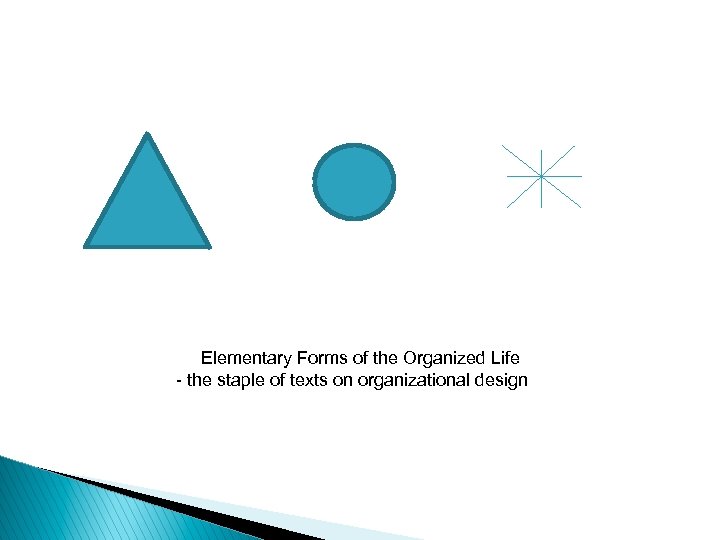
Elementary Forms of the Organized Life - the staple of texts on organizational design
Geometry in the style of organizing Deleuze and Guattari dichotomise between royal and nomadic geometry. The former emphasises the stopping of worlds in a plan using planes on paper in an office. The latter refers to the cutting of stone by hand on a building site using the method of squaring. The classic separation of conception from execution This presentation is more derivative of a royal science But use your hands if you want to
‘Significant forms’ and ‘structures of meaning’ arise, says Ching (1996) from the familiar notions in geometry of the point, line, plane and void He uses two dimensional drawings to suggest 3 D shapes This is the classic problem, dealt with by cubism, of the hidden face of the ‘other’ and the valorisation of the point of the viewer. Finlandia Hall reflects this problem Following Max Boisot, I intend to develop a 3 D perspective to styles of organizing as best as I can, using a cuboid conceptual space But first to ‘style’….
Styling in the West For Eco, style is a literary issue about forming an argument For Czarniawska, style is a way of executing a task, a technique of making a thing. But style may not be about adornment but is concerned with incision, a wounding, a cutting- with the stylus as nothing but a weapon. Thus, the pen is a sword de-forming via an ‘execution’ of a specific kind. Style then is driven by a sense of aesthetics BUT also by excavating a deep materiality
A concern for ‘Styles of Organizing’ involves three interrelated problems • Wounding, cutting, incising the material e. g. the set designs for ‘Moulin Rouge’ 1. The nature of what is meant by a body of ‘organizing’ 2. Suturing the disparately separate together
So what then is my suturology…. ‘commensuration’ (Espeland) The problematic nature of “a process of transforming disparate forms of value into homogenous units” thereby leading to “information reduction, uncertainty absorption, and simplification of decision making” e. g. ‘comparethemarket. com’ and Borges’ ‘certain Chinese encyclopaedia’ that Foucault begins with in ‘The Order of Things’
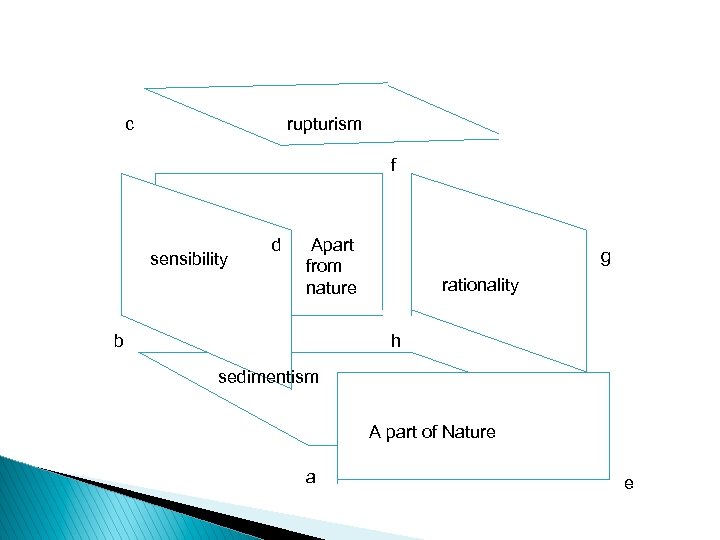
The parameters of a ‘design envelope’ 3 Lines 6 Faces 8 Points of Extremity A void to fill with content
The design cube (presented hereafter) concerns: An awfully big adventure-‘a grid of intelligibility’ a hurtful wounding of the material, making it groan uncertainty reduction through the use of common metrics, assuming commensuration a ‘Saming of the Other’ ( e. g. Economics into Organization Theory) what is common to the naturalists, the economists, the grammarians
Aims of the Design Envelope • Demonstrate the importance of the ‘will to form’ to Organization Theory 1. Show that the ‘will to form’ a safe material and ideational house may well be expressed differentially in distinct ‘styles of organizing’ 2. These styles operate across the human sciences and erupt from particular solutions to particular problems 2. They are connected rhizomatically- through their intraactions, not least of which is their tautological definitional base
Having looked back, let us now move on How one stands in relation to three issues, in turn affecting the humanities, the social sciences, and the natural sciences, governs location within the design envelope
Lines SENSIBILITY RATIONALITY SEDIMENTISM RUPTURISM A PART OF NATURE APART FROM NATURE Three lines, consisting of a myriad of points of possibility, produce a 3 dimensional space if placed at right angles to each other.
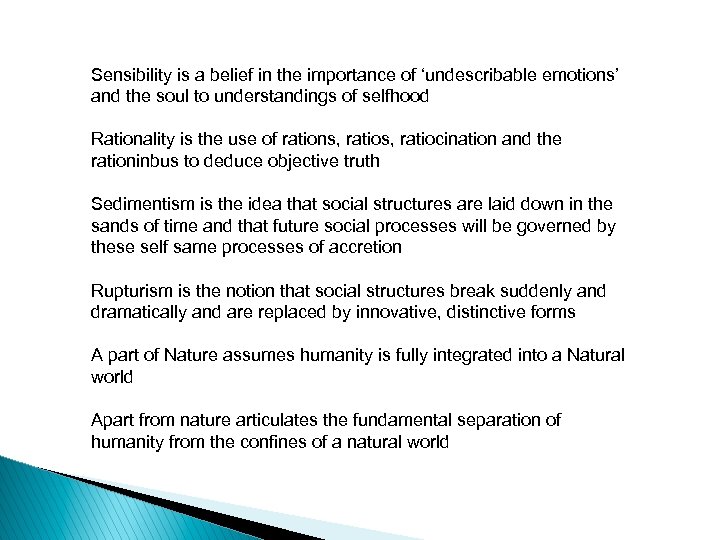
Sensibility is a belief in the importance of ‘undescribable emotions’ and the soul to understandings of selfhood Rationality is the use of rations, ratiocination and the rationinbus to deduce objective truth Sedimentism is the idea that social structures are laid down in the sands of time and that future social processes will be governed by these self same processes of accretion Rupturism is the notion that social structures break suddenly and dramatically and are replaced by innovative, distinctive forms A part of Nature assumes humanity is fully integrated into a Natural world Apart from nature articulates the fundamental separation of humanity from the confines of a natural world
c rupturism f sensibility d Apart from nature b g rationality h sedimentism A part of Nature a e
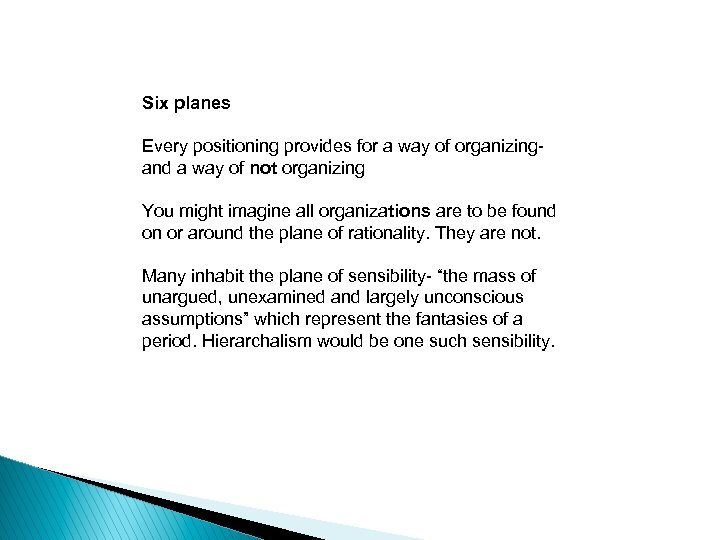
Six planes Every positioning provides for a way of organizing- and a way of not organizing You might imagine all organizations are to be found on or around the plane of rationality. They are not. Many inhabit the plane of sensibility- “the mass of unargued, unexamined and largely unconscious assumptions” which represent the fantasies of a period. Hierarchalism would be one such sensibility.
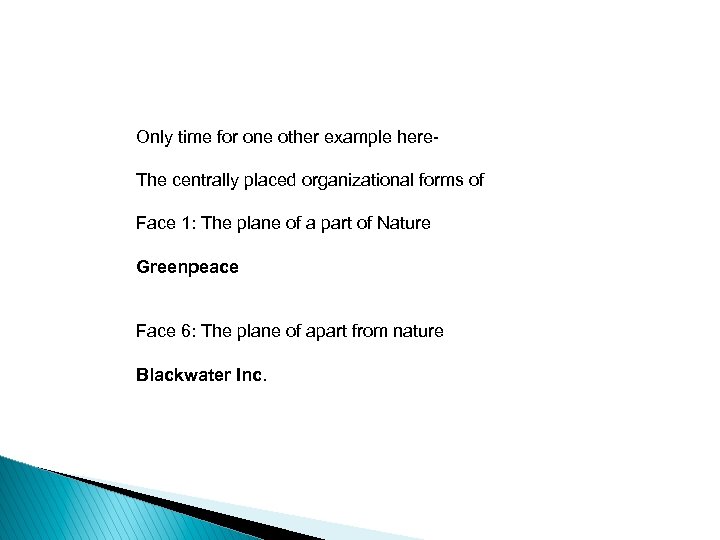
Only time for one other example here. The centrally placed organizational forms of Face 1: The plane of a part of Nature Greenpeace Face 6: The plane of apart from nature Blackwater Inc.

Greenpeace questioning server cooling costs
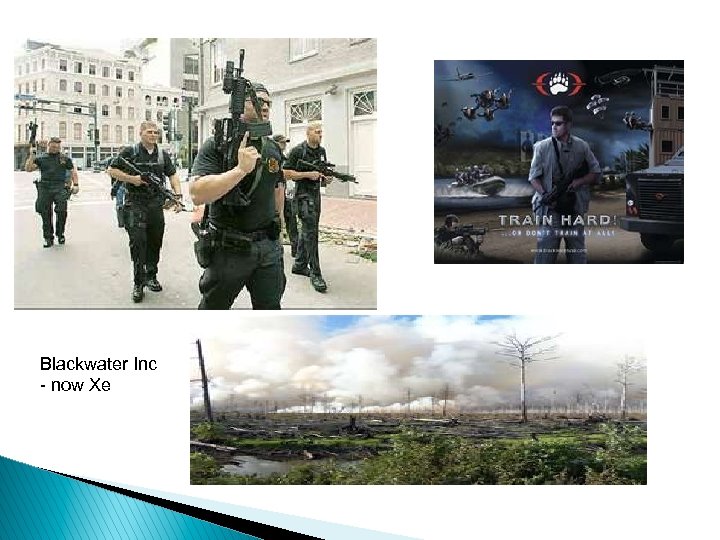
Blackwater Inc - now Xe
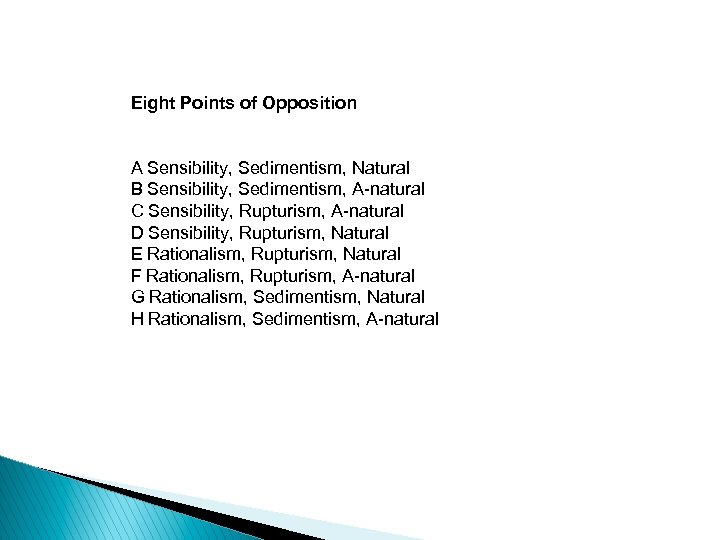
Eight Points of Opposition A Sensibility, Sedimentism, Natural B Sensibility, Sedimentism, A-natural C Sensibility, Rupturism, A-natural D Sensibility, Rupturism, Natural E Rationalism, Rupturism, Natural F Rationalism, Rupturism, A-natural G Rationalism, Sedimentism, Natural H Rationalism, Sedimentism, A-natural
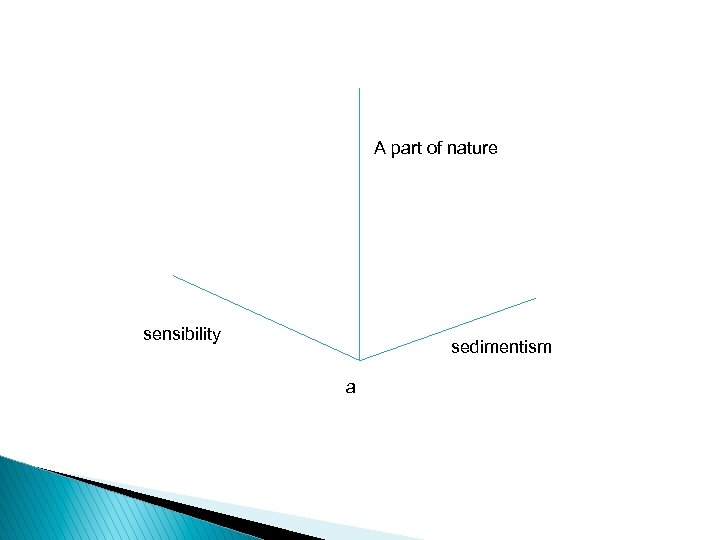
A part of nature sensibility sedimentism a
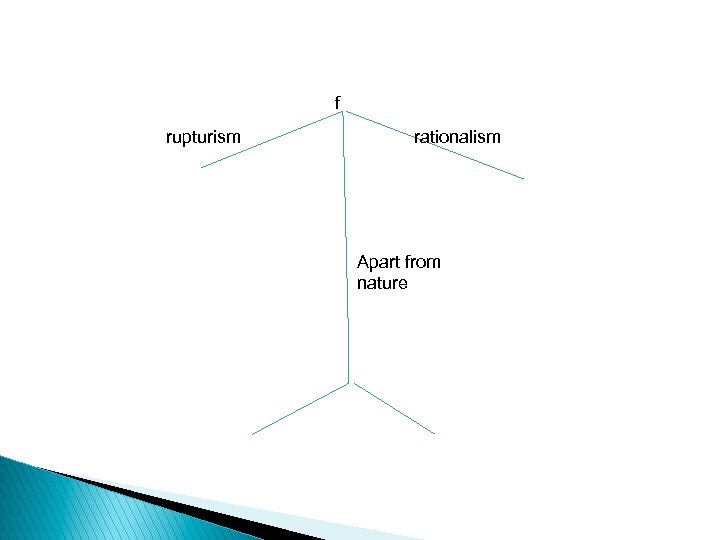
f rupturism rationalism Apart from nature
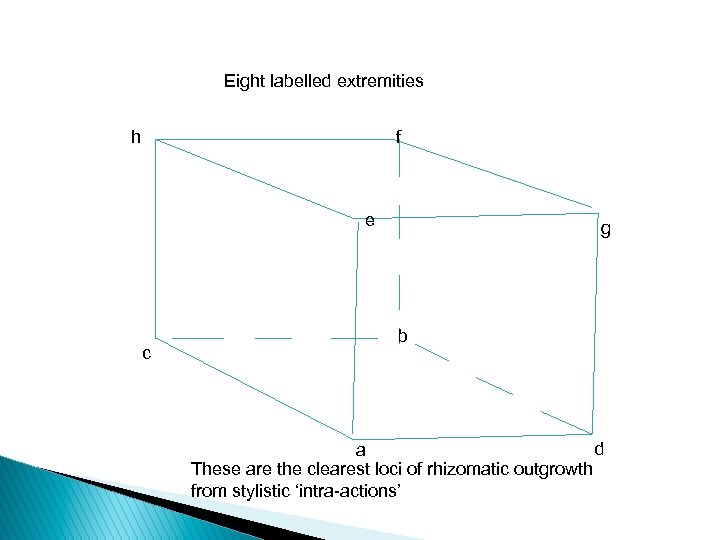
Eight labelled extremities h f e c g b d a These are the clearest loci of rhizomatic outgrowth from stylistic ‘intra-actions’
ELEMENTS OF ‘STYLE’ POLITICO-ECONOMIC SYSTEM PHILOSOPHICAL FRAMEWORK ARCHITECTURAL/DESIGN STYLE BUILDINGS EMBELLISHMENT/SYMBOL DESCRIPTOR ORGANIZATIONAL EXEMPLARS
Presentationally For each point, there will be a taster of what one might find there on all of these elements This is followed by a very brief focus on an image for each extremity after each pairing. Sometimes this image is of an organisation, sometimes a building, sometimes a design item. For each element, images are readily available - but time presses.
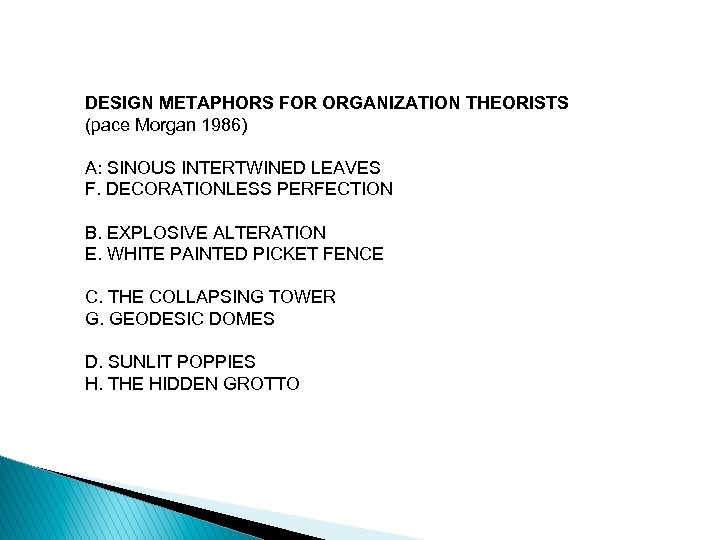
POINT A Sensibility, Sedimentism, Naturalism POLITICO-ECONOMICS green environmentalism PHILOSOPHICAL FRAMEWORK Romanticism ARCHITECTURAL/DESIGN STYLE Gaudi BUILDING Barcelona apartment block EMBELLISHMENT/SYMBOL sinuous intertwined leaves DESCRIPTOR ‘excessively imaginative adornment’ ORGANIZATIONAL EXEMPLAR The National Trust
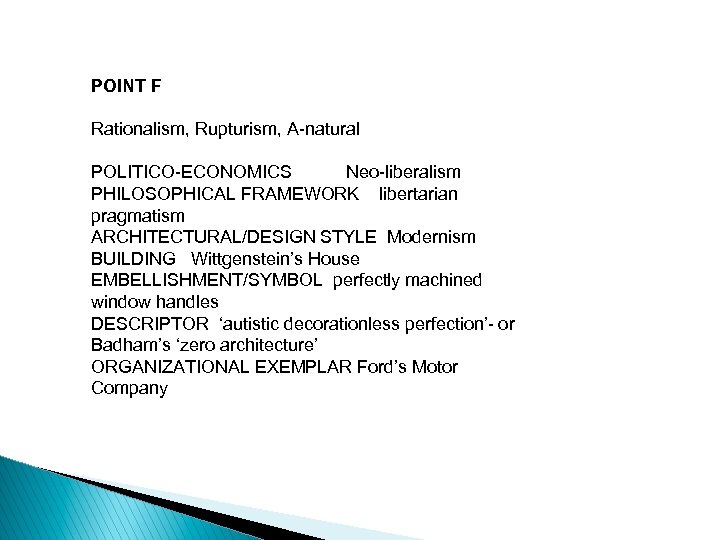
POINT F Rationalism, Rupturism, A-natural POLITICO-ECONOMICS Neo-liberalism PHILOSOPHICAL FRAMEWORK libertarian pragmatism ARCHITECTURAL/DESIGN STYLE Modernism BUILDING Wittgenstein’s House EMBELLISHMENT/SYMBOL perfectly machined window handles DESCRIPTOR ‘autistic decorationless perfection’- or Badham’s ‘zero architecture’ ORGANIZATIONAL EXEMPLAR Ford’s Motor Company
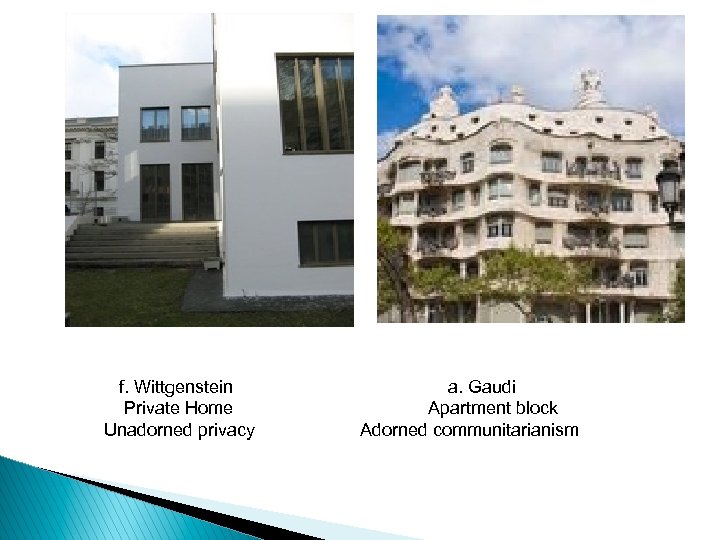
f. Wittgenstein a. Gaudi Private Home Apartment block Unadorned privacy Adorned communitarianism
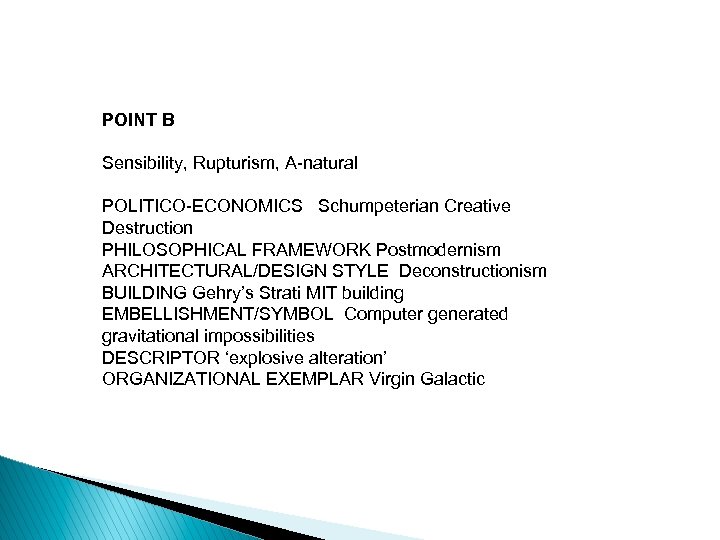
POINT B Sensibility, Rupturism, A-natural POLITICO-ECONOMICS Schumpeterian Creative Destruction PHILOSOPHICAL FRAMEWORK Postmodernism ARCHITECTURAL/DESIGN STYLE Deconstructionism BUILDING Gehry’s Strati MIT building EMBELLISHMENT/SYMBOL Computer generated gravitational impossibilities DESCRIPTOR ‘explosive alteration’ ORGANIZATIONAL EXEMPLAR Virgin Galactic
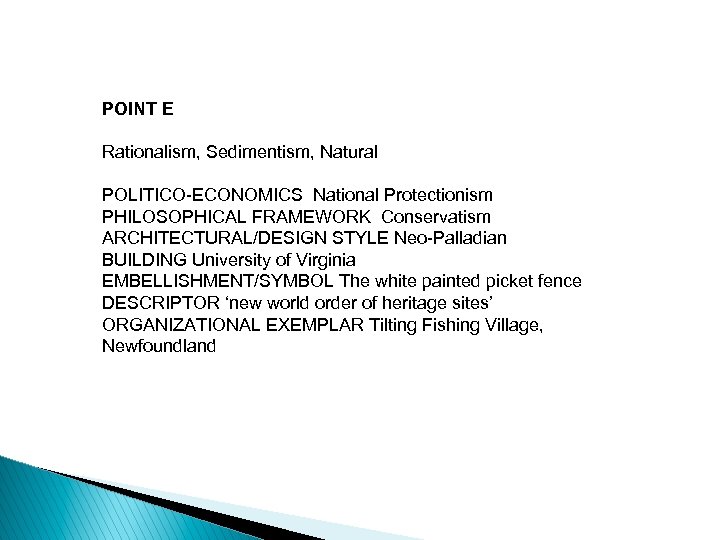
POINT E Rationalism, Sedimentism, Natural POLITICO-ECONOMICS National Protectionism PHILOSOPHICAL FRAMEWORK Conservatism ARCHITECTURAL/DESIGN STYLE Neo-Palladian BUILDING University of Virginia EMBELLISHMENT/SYMBOL The white painted picket fence DESCRIPTOR ‘new world order of heritage sites’ ORGANIZATIONAL EXEMPLAR Tilting Fishing Village, Newfoundland
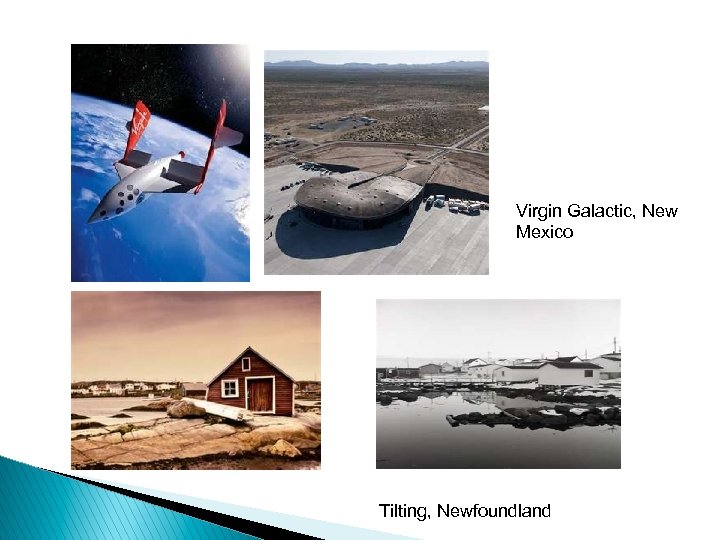
Virgin Galactic, New Mexico Tilting, Newfoundland
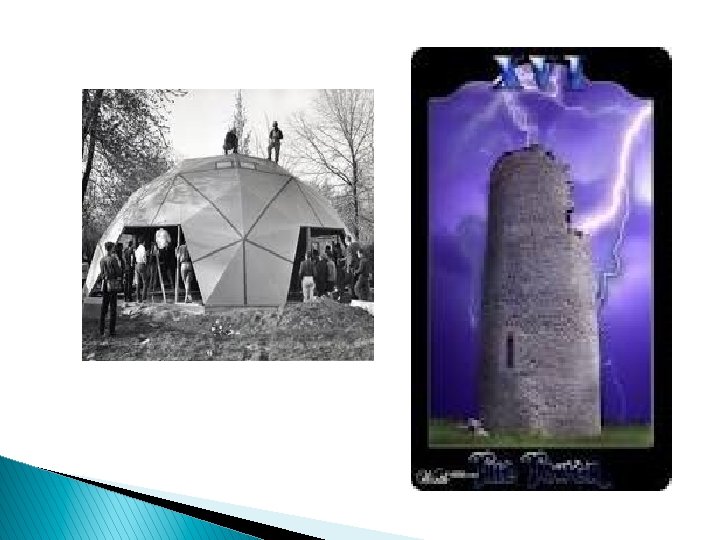
POINT C Sensibility, Sedimentism, A-natural POLITICO-ECONOMICS Potlatch Economics PHILOSOPHICAL FRAMEWORK Surrealism/ Magic Realism ARCHITECTURAL/DESIGN STYLE Gothic BUILDING Beauvais Cathedral EMBELLISHMENT/SYMBOL The Collapsing Tower Tarot Card DESCRIPTOR bonfire of the vanities ORGANIZATIONAL EXEMPLAR Freedom Tower, NY
POINT G Rationalism, Rupturism, Natural POLITICO-ECONOMICS Bright Green Environmentalism PHILOSOPHICAL FRAMEWORK Techno-pragmatism ARCHITECTURAL/DESIGN STYLE Buckminster Fuller’s work BUILDING Dymaxion EMBELLISHMENT/SYMBOL geodesic domes DESCRIPTOR ‘Doing more with less’ ORGANIZATIONAL EXEMPLAR Enval, Cambridge Science Park
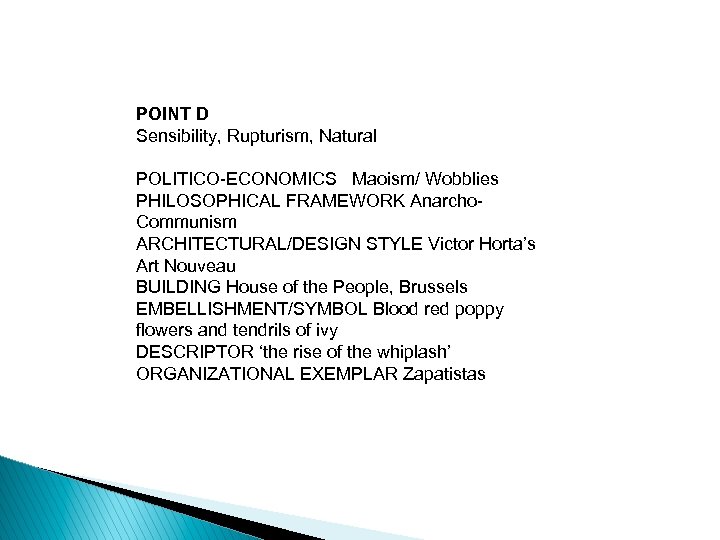
POINT D Sensibility, Rupturism, Natural POLITICO-ECONOMICS Maoism/ Wobblies PHILOSOPHICAL FRAMEWORK Anarcho. Communism ARCHITECTURAL/DESIGN STYLE Victor Horta’s Art Nouveau BUILDING House of the People, Brussels EMBELLISHMENT/SYMBOL Blood red poppy flowers and tendrils of ivy DESCRIPTOR ‘the rise of the whiplash’ ORGANIZATIONAL EXEMPLAR Zapatistas
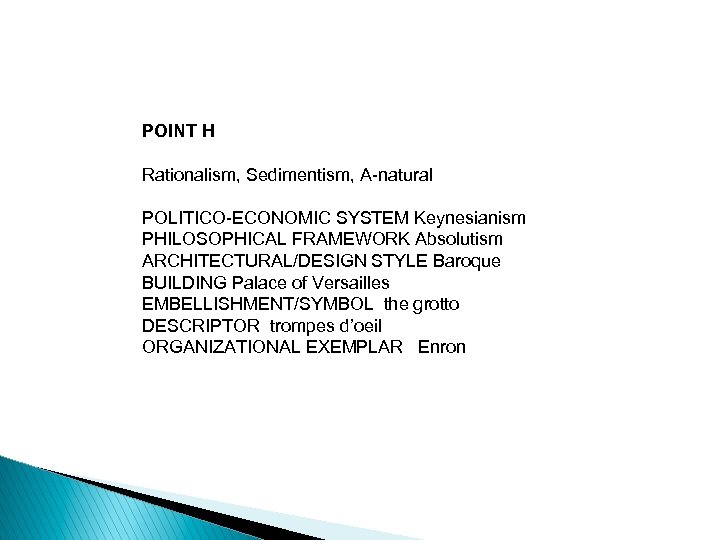
POINT H Rationalism, Sedimentism, A-natural POLITICO-ECONOMIC SYSTEM Keynesianism PHILOSOPHICAL FRAMEWORK Absolutism ARCHITECTURAL/DESIGN STYLE Baroque BUILDING Palace of Versailles EMBELLISHMENT/SYMBOL the grotto DESCRIPTOR trompes d’oeil ORGANIZATIONAL EXEMPLAR Enron
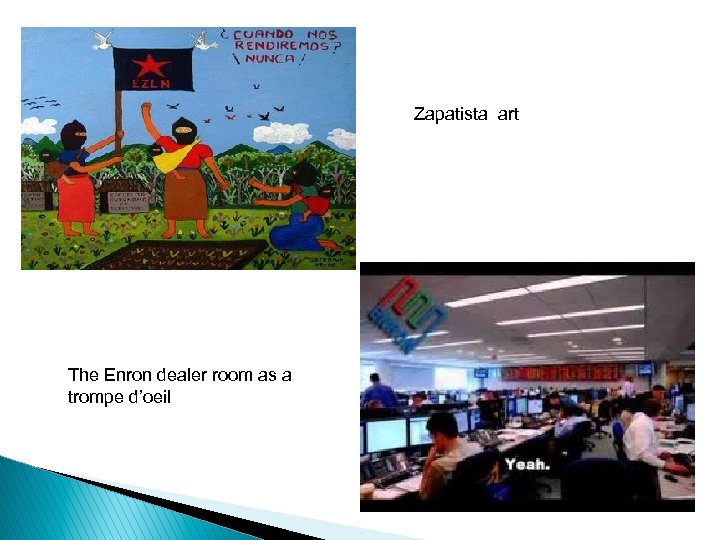
Zapatista art The Enron dealer room as a trompe d’oeil
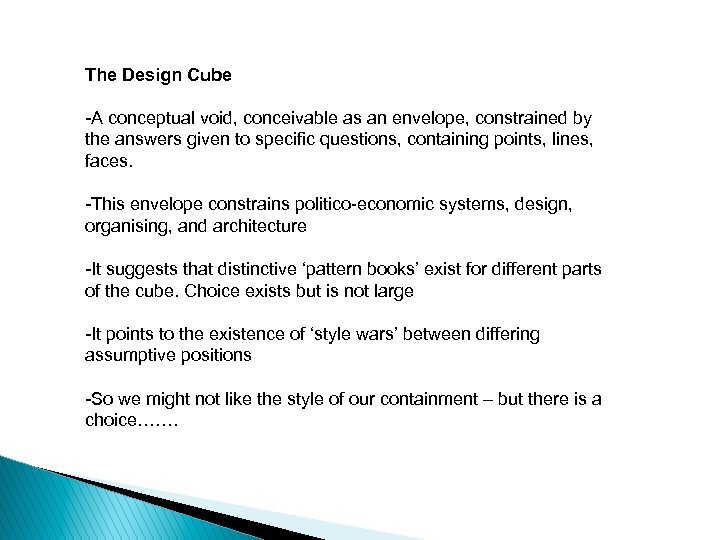
The Design Cube -A conceptual void, conceivable as an envelope, constrained by the answers given to specific questions, containing points, lines, faces. -This envelope constrains politico-economic systems, design, organising, and architecture -It suggests that distinctive ‘pattern books’ exist for different parts of the cube. Choice exists but is not large -It points to the existence of ‘style wars’ between differing assumptive positions -So we might not like the style of our containment – but there is a choice…….
DESIGN METAPHORS FOR ORGANIZATION THEORISTS (pace Morgan 1986) A: SINOUS INTERTWINED LEAVES F. DECORATIONLESS PERFECTION B. EXPLOSIVE ALTERATION E. WHITE PAINTED PICKET FENCE C. THE COLLAPSING TOWER G. GEODESIC DOMES D. SUNLIT POPPIES H. THE HIDDEN GROTTO
Your choice speaks of your preferred ‘style of organizing’ Of course, whilst design can be seen as contested, multiple, and ongoing, - as a matter of choice- it has but one true function: The organizing of organization is derivative of a will to form which produces a shelter in which we hide from Chaos. The will to form stops us – whether organization theorists or not - from peering into the fathomless abyss THE END
Скачать презентацию A Design Envelope for Styles of Organizing Gibson
ff25ed87d11cc1d7b4cbbe25f90e0b01.ppt