


 Скачать презентацию A DESIGN AND IMPLEMENTATION COURSE FRAMEWORK A CURRICULUM
0fbed410490eb0c0a659ca0b07afbd06.ppt
- Количество слайдов: 11
 A DESIGN AND IMPLEMENTATION COURSE FRAMEWORK: A CURRICULUM PROPOSAL FOR AN EXPERIENTIAL APPROACH TO THE SYSTEMS ANALYSIS AND DESIGN AND THE PROJECTS IN INFORMATION TECHNOLOGY COURSE SEQUENCE IN THE INFORMATION SYSTEMS MAJOR James Wynne, VCU Gerry Saunders, VCU Roland Weistroffer, VCU Harry Reif, JMU
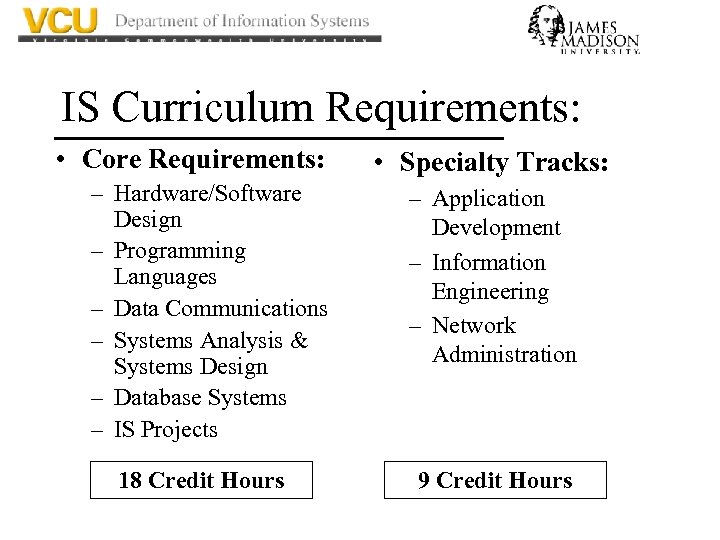 IS Curriculum Requirements: • Core Requirements: – Hardware/Software Design – Programming Languages – Data Communications – Systems Analysis & Systems Design – Database Systems – IS Projects 18 Credit Hours • Specialty Tracks: – Application Development – Information Engineering – Network Administration 9 Credit Hours
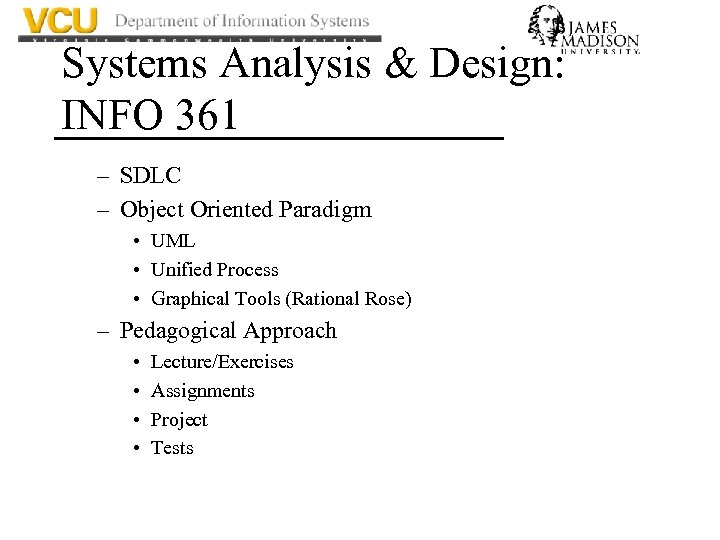 Systems Analysis & Design: INFO 361 – SDLC – Object Oriented Paradigm • UML • Unified Process • Graphical Tools (Rational Rose) – Pedagogical Approach • • Lecture/Exercises Assignments Project Tests
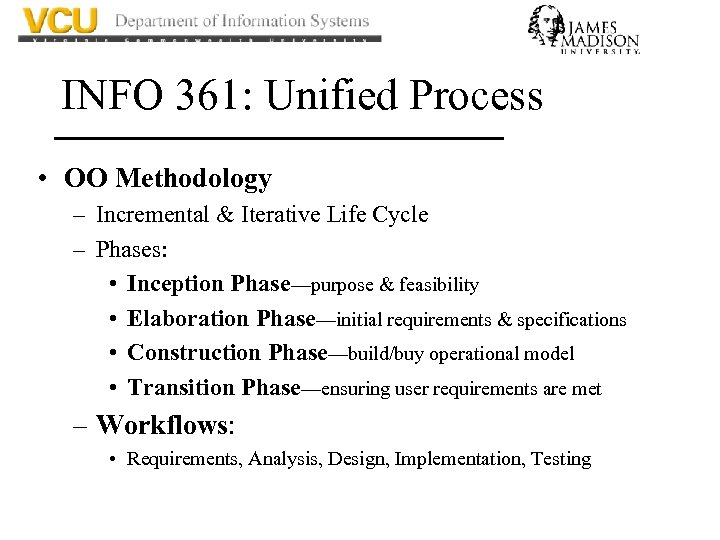 INFO 361: Unified Process • OO Methodology – Incremental & Iterative Life Cycle – Phases: • Inception Phase—purpose & feasibility • Elaboration Phase—initial requirements & specifications • Construction Phase—build/buy operational model • Transition Phase—ensuring user requirements are met – Workflows: • Requirements, Analysis, Design, Implementation, Testing
 INFO 361 • Primary Focus: Inception & Elaboration Phases – Iterative Refinements of Workflows • UML Modeling – Use Cases – Class Diagrams – Sequence & Collaboration Diagrams – Activity Diagrams – State Charts • Reinforcement of Concepts through Assignments
 Projects in Information Systems: INFO 465 • Primary Focus: • Elaboration & Construction Phases – Refining Analysis Workflow – Defining Design Specifications – Building Prototypes – Control Classes – Interface Classes – Boundary Classes – Testing
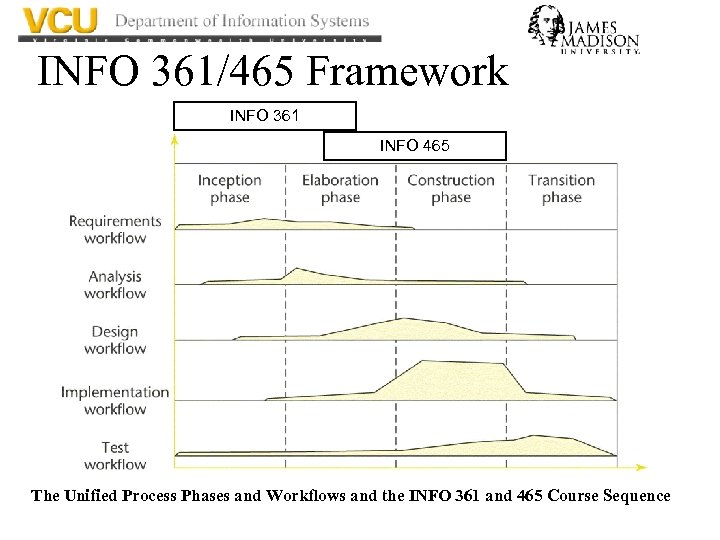 INFO 361/465 Framework INFO 361 INFO 465 The Unified Process Phases and Workflows and the INFO 361 and 465 Course Sequence
 Implementing Framework: • e-Business Framework • Project “Engine” – Predefined Core Classes (Entity, Boundary, Control, Interface) – Library of Working Class Objects Database • Prototyping – Visual Basic. NET • Incremental & Iterative Process
 Courseware Supports : • Basic Requirements Prototyping • Adding Order Entry, Accounting, & Reporting Functions • Creating Screen Interfaces to Provide EDI Trading Functions (ANSI AX. 12)—Catalog Sales, Invoicing, Purchasing, Payment • Various e-Business Enterprise Domains
 Framework Strengths: • Learn current systems development tools • Learn the UML system design paradigm • Experience the complete SDLC • Integrate real business process concepts • Learn e-business modeling concepts • Simulate real-world project team participation • Simulate the iterative process of SDLC • Learn Project Management skills and tools • Integrate programming, database management, data communications, & hardware/software skills
 FRAMEWORK LIMITATIONS & CONSTRAINTS: • • Hardware/software requirements Technical orientation New case development required each year Part-time students participation