 Скачать презентацию A database for water transitions from experiment and
505458b9bfe6d21204a13aeee84a9a44.ppt
- Количество слайдов: 45



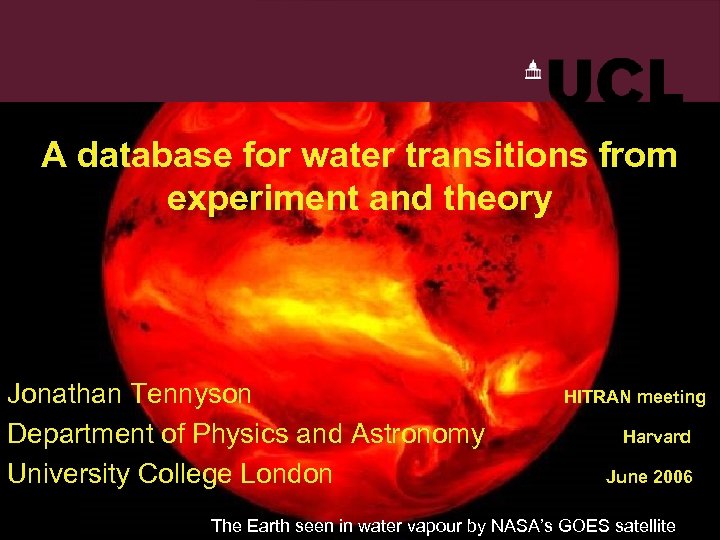
A database for water transitions from experiment and theory Jonathan Tennyson HITRAN meeting Department of Physics and Astronomy Harvard University College London June 2006 The Earth seen in water vapour by NASA’s GOES satellite
Why water vapour? • • Molecule number 1 in HITRAN Major (70%) atmospheric absorber of incoming sunlight Even H 218 O is fifth biggest absorber Largest (60%) greenhouse gas Atmospheres of cool stars Combustion Life !?
UCL strategy for a reliable, complete (300 K) linelist • Strong lines: water-air spectra, variable path-length • Weak lines: water vapour spectra, longest path-length & integration times possible • Isotopologues: Isotopically enhanced samples (Kitt Peak, CRDS) • Completeness/assignments: High quality variational calculations
IUPAC Task group A database of water transitions from experiment and theory • • • Water lines at room temperature (HITRAN) Hot water Isotopologues Line profiles Theory Validation • Database Meet room P 226 “Tea Room” Weds from 2. 30 pm Thurs until lunch
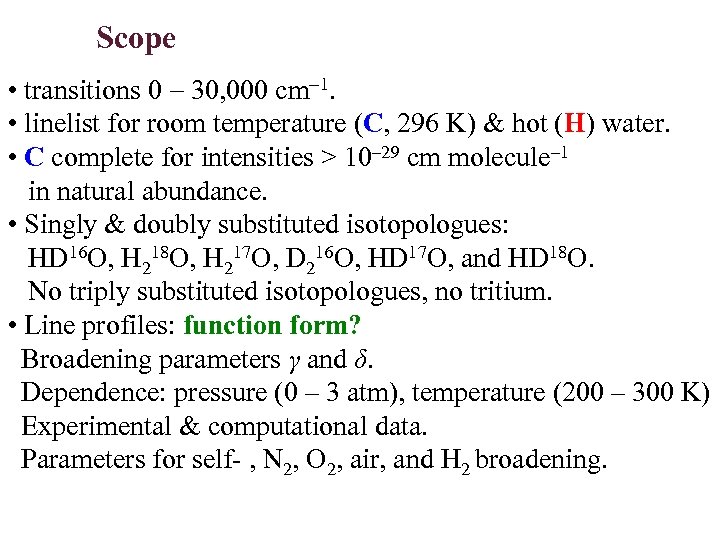
Scope • transitions 0 - 30, 000 cm-1. • linelist for room temperature (C, 296 K) & hot (H) water. • C complete for intensities > 10– 29 cm molecule– 1 in natural abundance. • Singly & doubly substituted isotopologues: HD 16 O, H 218 O, H 217 O, D 216 O, HD 17 O, and HD 18 O. No triply substituted isotopologues, no tritium. • Line profiles: function form? Broadening parameters γ and δ. Dependence: pressure (0 – 3 atm), temperature (200 – 300 K) Experimental & computational data. Parameters for self- , N 2, O 2, air, and H 2 broadening.
Database • Master database to be prepared for each isotopologue. • Should capture origin & time-dependence of measured and computed values. • Both ‘old’ and ‘new’ data archived and accessible. • Flexible in terms of data structures • HITRAN “button”
Master file strategy • Use most complete (not necessarily best) as Master file eg BT 2 • Augment with data from other sources: expt, other theory • Store all known data: use error analysis to combine • Clear data history • Files structured by function: levels, transitions (+ mixings? ) • Distributed data? • Some functionality in-built eg HITRAN button
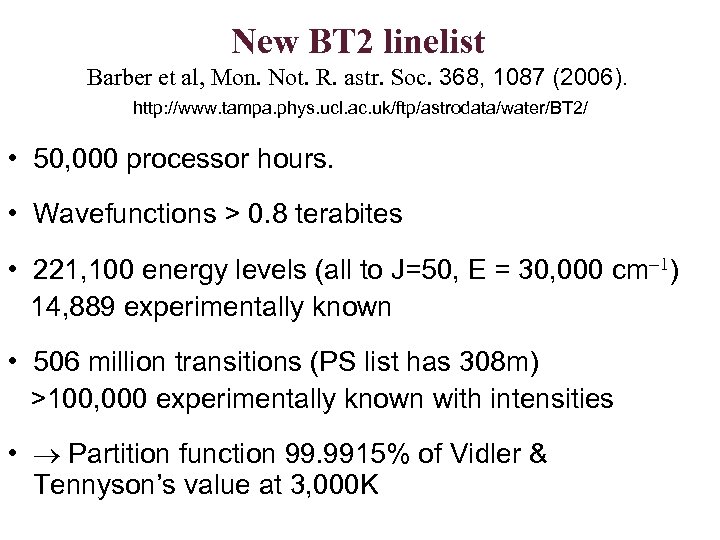
New BT 2 linelist Barber et al, Mon. Not. R. astr. Soc. 368, 1087 (2006). http: //www. tampa. phys. ucl. ac. uk/ftp/astrodata/water/BT 2/ • 50, 000 processor hours. • Wavefunctions > 0. 8 terabites • 221, 100 energy levels (all to J=50, E = 30, 000 cm-1) 14, 889 experimentally known • 506 million transitions (PS list has 308 m) >100, 000 experimentally known with intensities • Partition function 99. 9915% of Vidler & Tennyson’s value at 3, 000 K
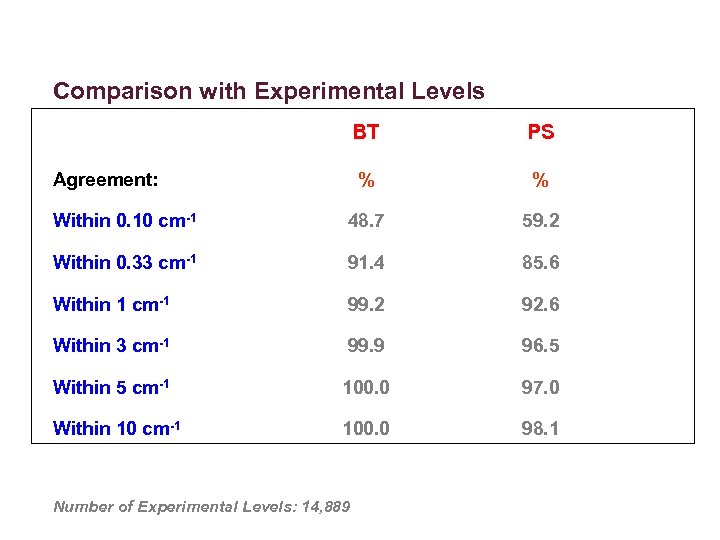
Comparison with Experimental Levels BT PS % % Within 0. 10 cm-1 48. 7 59. 2 Within 0. 33 cm-1 91. 4 85. 6 Within 1 cm-1 99. 2 92. 6 Within 3 cm-1 99. 9 96. 5 Within 5 cm-1 100. 0 97. 0 Within 10 cm-1 100. 0 98. 1 Agreement: Number of Experimental Levels: 14, 889
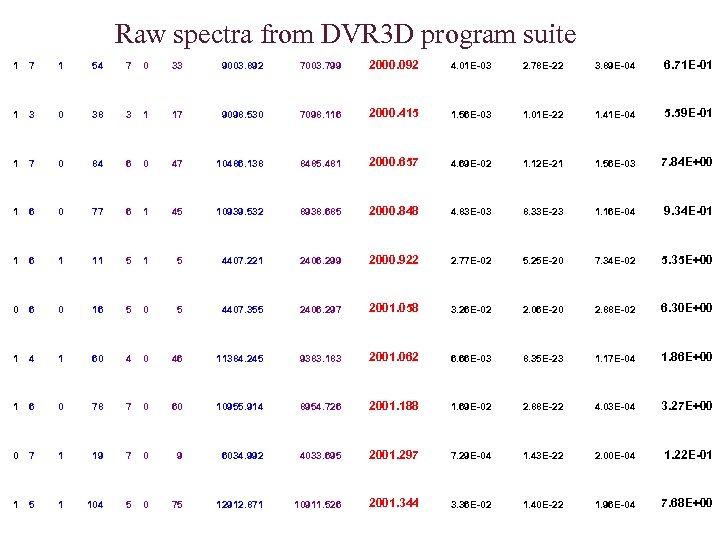
Raw spectra from DVR 3 D program suite 1 7 1 54 7 0 33 9003. 892 7003. 799 2000. 092 4. 01 E-03 2. 78 E-22 3. 89 E-04 6. 71 E-01 1 3 0 38 3 1 17 9098. 530 7098. 116 2000. 415 1. 56 E-03 1. 01 E-22 1. 41 E-04 5. 59 E-01 1 7 0 84 6 0 47 10486. 138 8485. 481 2000. 657 4. 69 E-02 1. 12 E-21 1. 56 E-03 7. 84 E+00 1 6 0 77 6 1 45 10939. 532 8938. 685 2000. 848 4. 83 E-03 8. 33 E-23 1. 16 E-04 9. 34 E-01 1 6 1 11 5 4407. 221 2406. 299 2000. 922 2. 77 E-02 5. 25 E-20 7. 34 E-02 5. 35 E+00 0 6 0 16 5 0 5 4407. 355 2406. 297 2001. 058 3. 26 E-02 2. 06 E-20 2. 88 E-02 6. 30 E+00 1 4 1 60 4 0 46 11384. 245 9383. 183 2001. 062 6. 66 E-03 8. 35 E-23 1. 17 E-04 1. 86 E+00 1 6 0 78 7 0 60 10955. 914 8954. 726 2001. 188 1. 69 E-02 2. 88 E-22 4. 03 E-04 3. 27 E+00 0 7 1 19 7 0 9 6034. 992 4033. 695 2001. 297 7. 29 E-04 1. 43 E-22 2. 00 E-04 1. 22 E-01 1 5 1 104 5 0 75 12912. 871 10911. 526 2001. 344 3. 36 E-02 1. 40 E-22 1. 96 E-04 7. 68 E+00
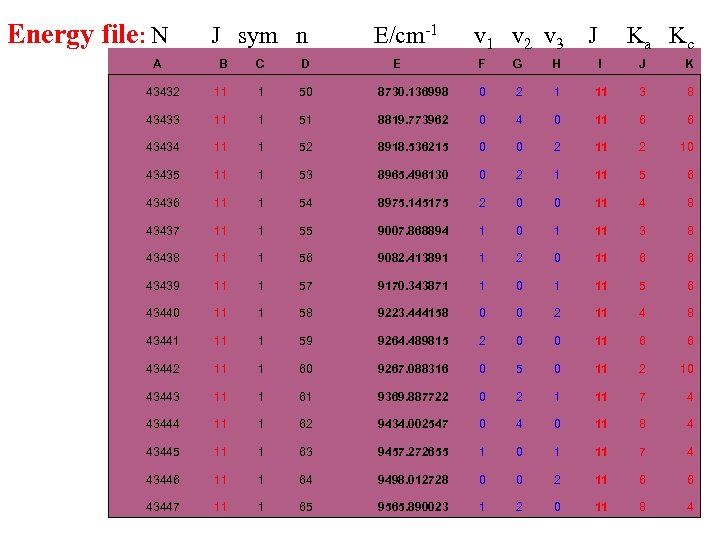
Energy file: N J sym n E/cm-1 v 1 v 2 v 3 J Ka Kc A B C D 43432 11 1 50 43433 11 1 43434 11 43435 E F G H 8730. 136998 0 2 1 51 8819. 773962 0 4 1 52 8918. 536215 0 11 1 53 8965. 496130 43436 11 1 54 43437 11 1 43438 11 43439 I J K 11 3 8 0 11 6 6 0 2 11 2 10 0 2 1 11 5 6 8975. 145175 2 0 0 11 4 8 55 9007. 868894 1 0 1 11 3 8 1 56 9082. 413891 1 2 0 11 6 6 11 1 57 9170. 343871 1 0 1 11 5 6 43440 11 1 58 9223. 444158 0 0 2 11 4 8 43441 11 1 59 9264. 489815 2 0 0 11 6 6 43442 11 1 60 9267. 088316 0 5 0 11 2 10 43443 11 1 61 9369. 887722 0 2 1 11 7 4 43444 11 1 62 9434. 002547 0 4 0 11 8 4 43445 11 1 63 9457. 272655 1 0 1 11 7 4 43446 11 1 64 9498. 012728 0 0 2 11 6 6 43447 11 1 65 9565. 890023 1 2 0 11 8 4
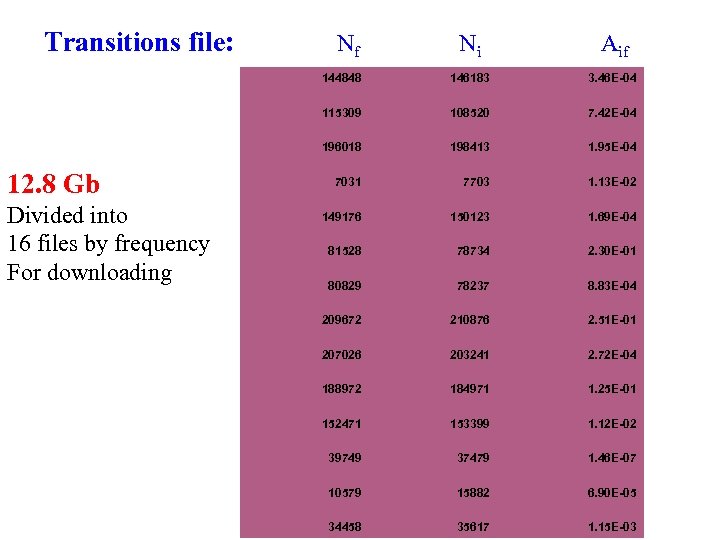
Transitions file: Nf Ni Aif 144848 108520 7. 42 E-04 196018 Divided into 16 files by frequency For downloading 3. 46 E-04 115309 12. 8 Gb 146183 198413 1. 95 E-04 7031 7703 1. 13 E-02 149176 150123 1. 69 E-04 81528 78734 2. 30 E-01 80829 78237 8. 83 E-04 209672 210876 2. 51 E-01 207026 203241 2. 72 E-04 188972 184971 1. 25 E-01 152471 153399 1. 12 E-02 39749 37479 1. 46 E-07 10579 15882 6. 90 E-05 34458 35617 1. 15 E-03
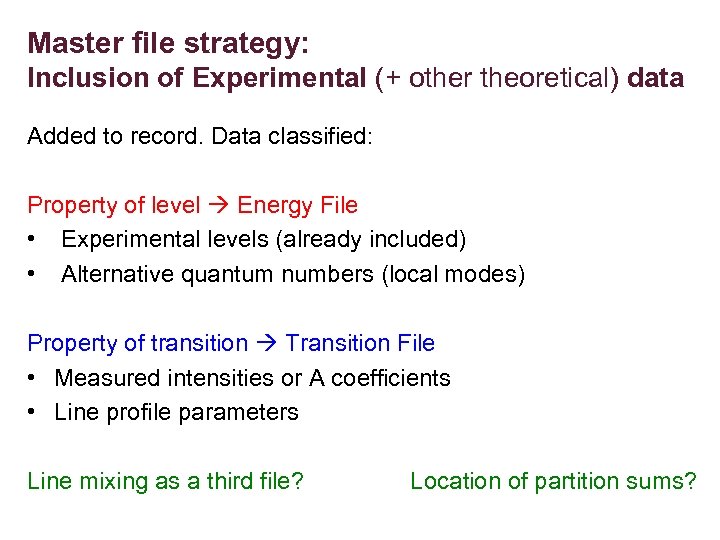
Master file strategy: Inclusion of Experimental (+ other theoretical) data Added to record. Data classified: Property of level Energy File • Experimental levels (already included) • Alternative quantum numbers (local modes) Property of transition Transition File • Measured intensities or A coefficients • Line profile parameters Line mixing as a third file? Location of partition sums?
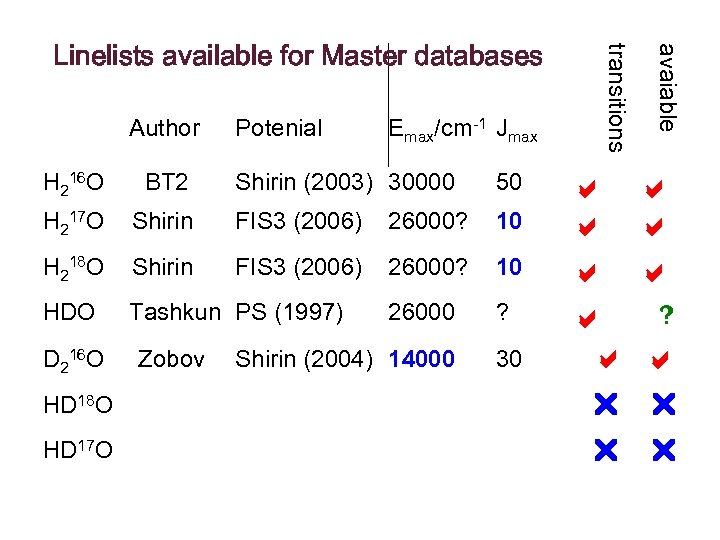
Potenial H 216 O BT 2 Shirin (2003) 30000 50 H 217 O Shirin FIS 3 (2006) 26000? 10 H 218 O Shirin FIS 3 (2006) 26000? 10 26000 ? HDO Tashkun PS (1997) D 216 O Zobov HD 18 O HD 17 O Emax/cm-1 Jmax Shirin (2004) 14000 30 avaiable Author transitions Linelists available for Master databases a a a a ? a a r r
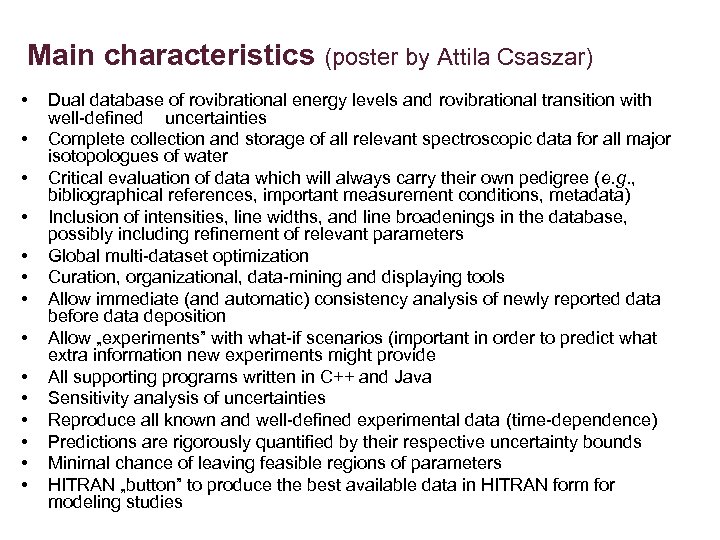
Main characteristics (poster by Attila Csaszar) • • • • Dual database of rovibrational energy levels and rovibrational transition with well-defined uncertainties Complete collection and storage of all relevant spectroscopic data for all major isotopologues of water Critical evaluation of data which will always carry their own pedigree (e. g. , bibliographical references, important measurement conditions, metadata) Inclusion of intensities, line widths, and line broadenings in the database, possibly including refinement of relevant parameters Global multi-dataset optimization Curation, organizational, data-mining and displaying tools Allow immediate (and automatic) consistency analysis of newly reported data before data deposition Allow „experiments” with what-if scenarios (important in order to predict what extra information new experiments might provide All supporting programs written in C++ and Java Sensitivity analysis of uncertainties Reproduce all known and well-defined experimental data (time-dependence) Predictions are rigorously quantified by their respective uncertainty bounds Minimal chance of leaving feasible regions of parameters HITRAN „button” to produce the best available data in HITRAN form for modeling studies
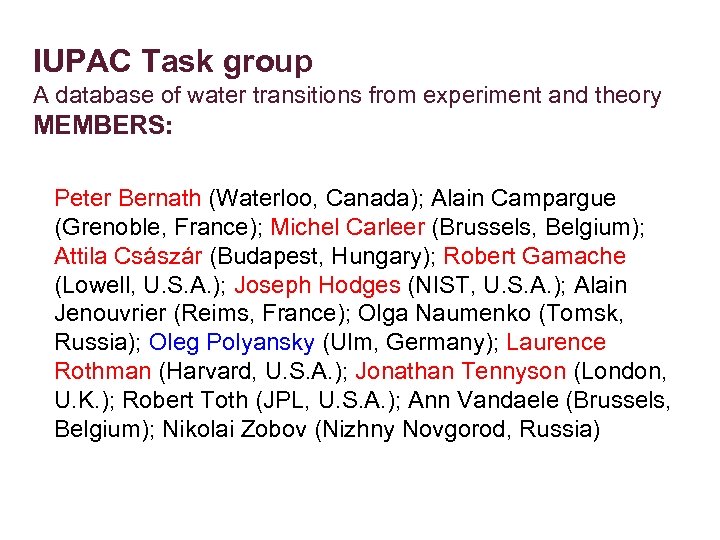
IUPAC Task group A database of water transitions from experiment and theory MEMBERS: Peter Bernath (Waterloo, Canada); Alain Campargue (Grenoble, France); Michel Carleer (Brussels, Belgium); Attila Császár (Budapest, Hungary); Robert Gamache (Lowell, U. S. A. ); Joseph Hodges (NIST, U. S. A. ); Alain Jenouvrier (Reims, France); Olga Naumenko (Tomsk, Russia); Oleg Polyansky (Ulm, Germany); Laurence Rothman (Harvard, U. S. A. ); Jonathan Tennyson (London, U. K. ); Robert Toth (JPL, U. S. A. ); Ann Vandaele (Brussels, Belgium); Nikolai Zobov (Nizhny Novgorod, Russia)
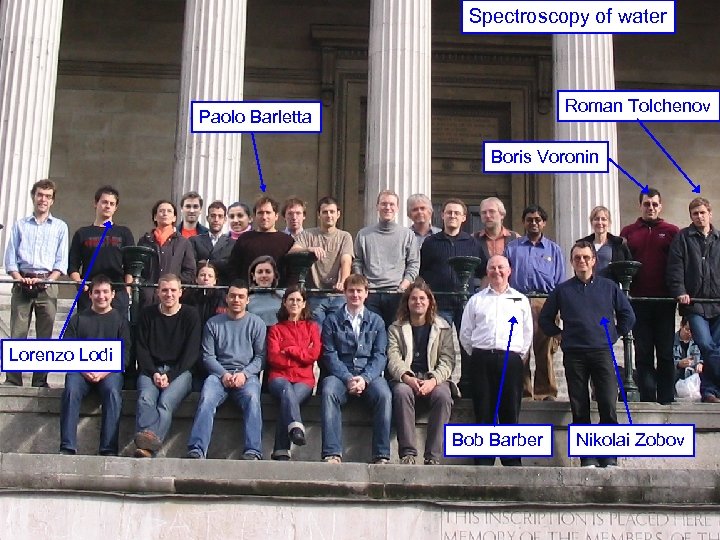
Spectroscopy of water Roman Tolchenov Paolo Barletta Boris Voronin Lorenzo Lodi Bob Barber Nikolai Zobov

www. worldscibooks. com/physics/p 371. html
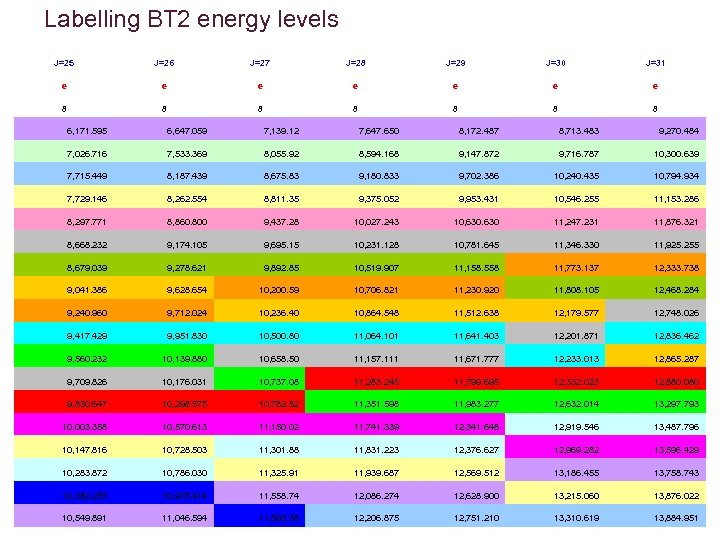
Labelling BT 2 energy levels J=25 J=26 J=27 J=28 J=29 J=30 J=31 e e e e 8 8 8 8 6, 171. 595 6, 647. 059 7, 139. 12 7, 647. 650 8, 172. 487 8, 713. 483 9, 270. 484 7, 026. 716 7, 533. 369 8, 055. 92 8, 594. 168 9, 147. 872 9, 716. 787 10, 300. 639 7, 715. 449 8, 187. 439 8, 675. 83 9, 180. 833 9, 702. 386 10, 240. 435 10, 794. 934 7, 729. 146 8, 262. 554 8, 811. 35 9, 375. 052 9, 953. 431 10, 546. 255 11, 153. 286 8, 297. 771 8, 860. 800 9, 437. 28 10, 027. 243 10, 630 11, 247. 231 11, 876. 321 8, 668. 232 9, 174. 105 9, 695. 15 10, 231. 128 10, 781. 645 11, 346. 330 11, 925. 255 8, 679. 039 9, 278. 621 9, 892. 85 10, 519. 907 11, 158. 558 11, 773. 137 12, 333. 738 9, 041. 386 9, 628. 654 10, 200. 59 10, 706. 821 11, 230. 920 11, 808. 105 12, 468. 284 9, 240. 960 9, 712. 024 10, 236. 40 10, 864. 548 11, 512. 638 12, 179. 577 12, 748. 026 9, 417. 429 9, 951. 830 10, 500. 80 11, 064. 101 11, 641. 403 12, 201. 871 12, 836. 462 9, 560. 232 10, 139. 880 10, 658. 50 11, 157. 111 11, 671. 777 12, 233. 013 12, 865. 287 9, 709. 826 10, 176. 031 10, 737. 08 11, 283. 245 11, 799. 695 12, 332. 023 12, 880. 080 9, 830. 647 10, 298. 575 10, 782. 82 11, 351. 598 11, 983. 277 12, 632. 014 13, 297. 793 10, 003. 358 10, 570. 613 11, 150. 02 11, 741. 339 12, 341. 648 12, 919. 546 13, 487. 796 10, 147. 816 10, 728. 503 11, 301. 88 11, 831. 223 12, 376. 627 12, 969. 282 13, 596. 429 10, 283. 872 10, 786. 030 11, 325. 91 11, 939. 687 12, 569. 512 13, 186. 455 13, 758. 743 10, 380. 255 10, 978. 414 11, 558. 74 12, 086. 274 12, 628. 900 13, 215. 060 13, 876. 022 10, 549. 891 11, 046. 594 11, 593. 38 12, 206. 875 12, 751. 210 13, 310. 619 13, 884. 951
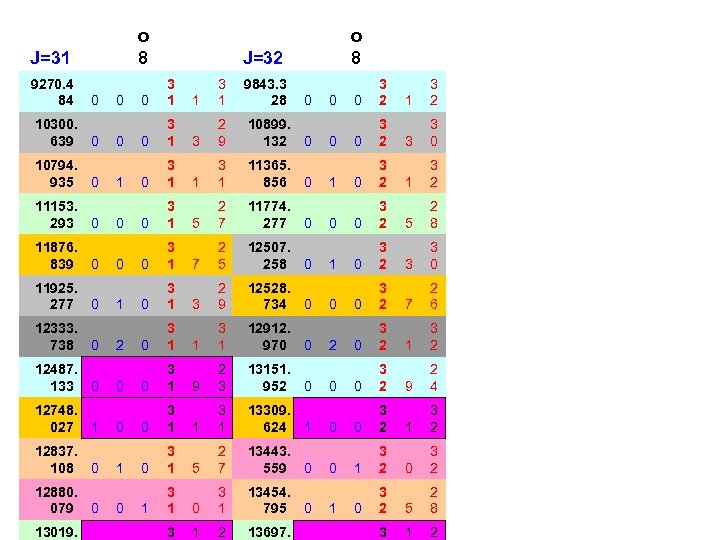
o 8 J=31 9270. 4 84 0 10300. 639 0 10794. 935 0 11153. 293 0 11876. 839 0 11925. 277 0 12333. 738 0 12487. 133 0 12748. 027 1 12837. 108 0 12880. 079 0 13019. 0 0 1 2 0 0 1 0 o 8 J=32 0 3 1 1 3 1 9843. 3 28 0 3 1 3 2 9 10899. 132 0 0 3 1 11365. 856 0 0 3 1 5 2 7 11774. 277 0 0 3 1 7 2 5 12507. 258 0 0 3 1 3 2 9 12528. 734 0 0 3 1 12912. 970 0 0 3 1 9 2 3 13151. 952 0 0 3 1 13309. 624 1 0 3 1 5 2 7 13443. 559 0 1 3 1 0 3 1 13454. 795 0 3 1 2 13697. 0 0 0 1 0 2 0 0 0 1 0 3 2 1 3 2 0 3 2 3 3 0 0 3 2 1 3 2 0 3 2 5 2 8 0 3 2 3 3 0 0 3 2 7 2 6 0 3 2 1 3 2 0 3 2 9 2 4 0 3 2 1 3 2 0 3 2 5 2 8 0 3 1 2
Room temperature H 216 O lines • Strong line data about 9000 cm-1 • Compatability between mid and near infrared intensities • Weak lines throughout whole spectrum • Far infrared? Solution strategy largely experimental plus careful analysis?
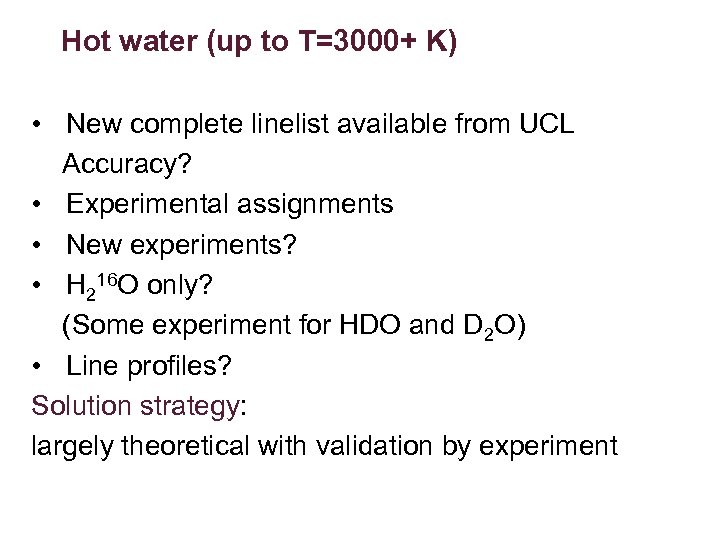
Hot water (up to T=3000+ K) • New complete linelist available from UCL Accuracy? • Experimental assignments • New experiments? • H 216 O only? (Some experiment for HDO and D 2 O) • Line profiles? Solution strategy: largely theoretical with validation by experiment
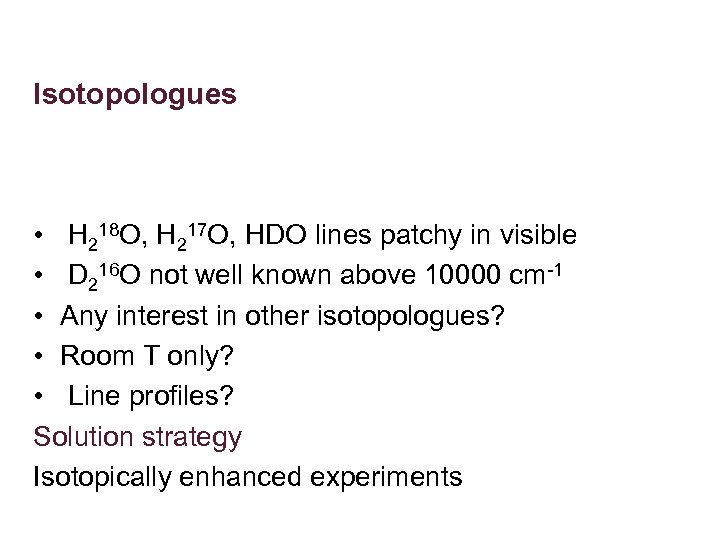
Isotopologues • H 218 O, H 217 O, HDO lines patchy in visible • D 216 O not well known above 10000 cm-1 • Any interest in other isotopologues? • Room T only? • Line profiles? Solution strategy Isotopically enhanced experiments
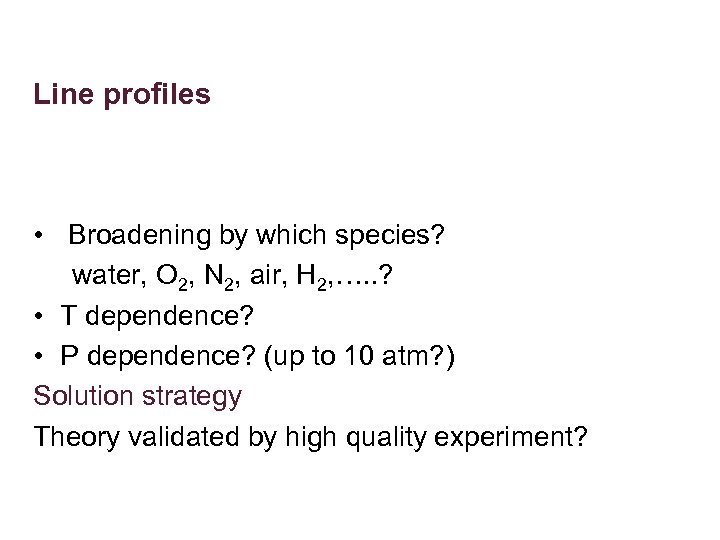
Line profiles • Broadening by which species? water, O 2, N 2, air, H 2, …. . ? • T dependence? • P dependence? (up to 10 atm? ) Solution strategy Theory validated by high quality experiment?
Validation • • between experiments atmospheric spectra Theory vs experiment other
Distribution and storage • HITRAN • Web database eg Spectroscopic databank at Tomsk • Publication or other means of distribution?
So what is the problem? Water is well studied (30, 000+ lines in HITRAN) But • • Water spectra have huge dynamic range Difficult to work with experimentally Spectra very dense: baseline hard to characterise Strong lines usually saturated (water-air spectra) Line profiles important (water-air & water-water) Weak lines can be significant (pure water spectra) Line assignment difficult (Variational Methods)

P. Macko, D. Romanini, S. N. Mikhailenko, O. V. Naumenko, S. Kassi, A. Jenouvrier, Vl. G. Tyuterev and A. Campargue, J. Molec. Spectrosc. (in press).
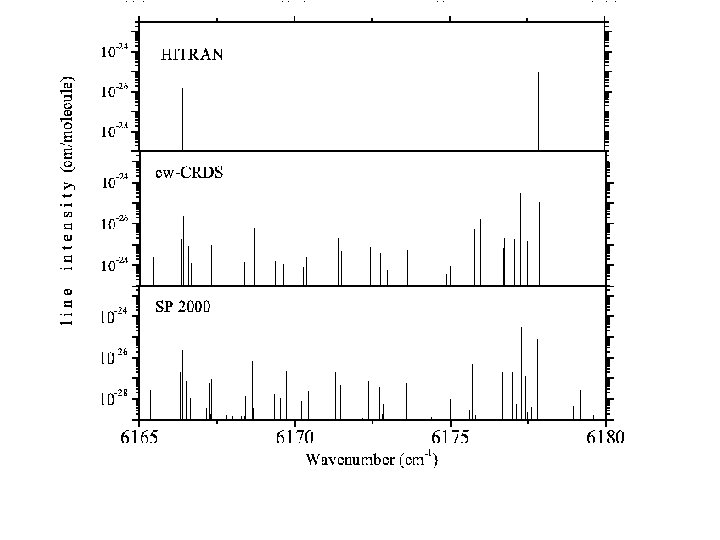
P. Macko, D. Romanini, S. N. Mikhailenko, O. V. Naumenko, S. Kassi, A. Jenouvrier, Vl. G. Tyuterev and A. Campargue, J. Molec. Spectrosc. (in press).
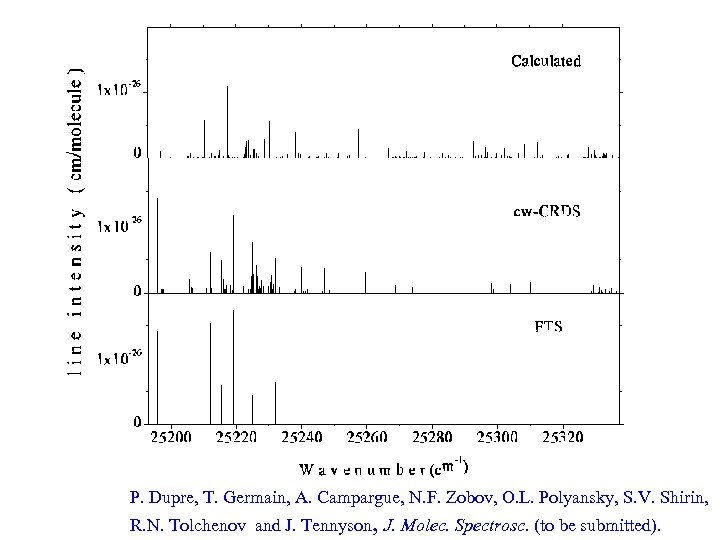
P. Dupre, T. Germain, A. Campargue, N. F. Zobov, O. L. Polyansky, S. V. Shirin, R. N. Tolchenov and J. Tennyson, J. Molec. Spectrosc. (to be submitted).
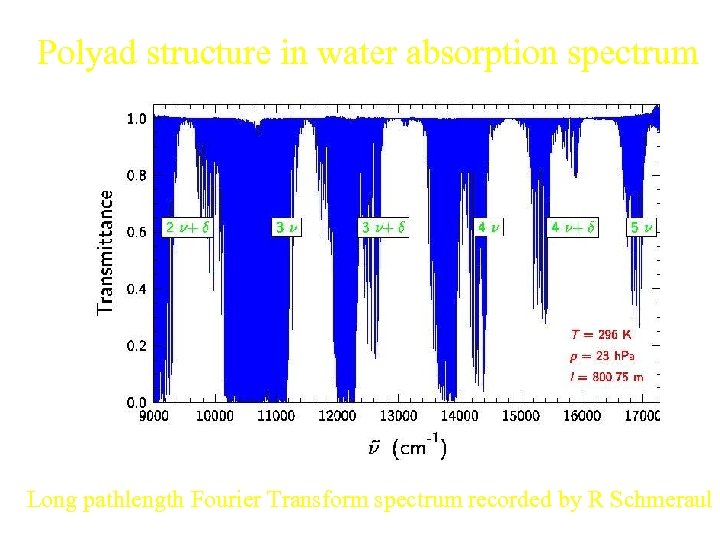
Polyad structure in water absorption spectrum Long pathlength Fourier Transform spectrum recorded by R Schmeraul
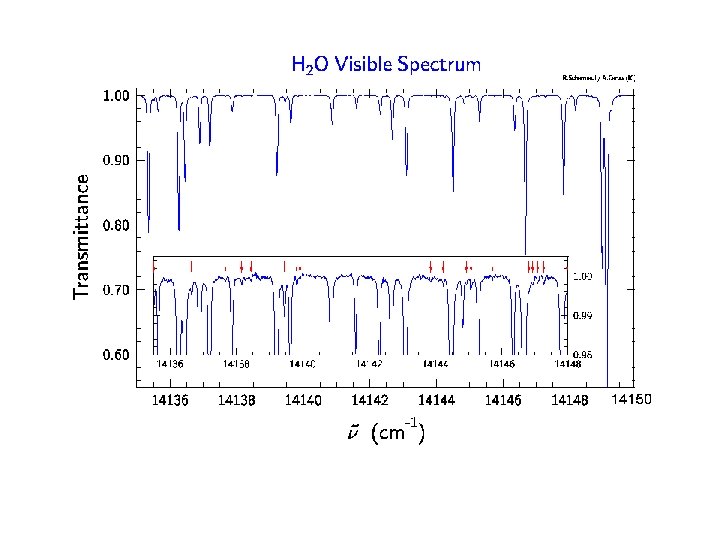
R. Schermaul, R. C. M. Learner, J. W. Brault, A. A. D. Canas, O. L. Polyansky, D. Belmiloud, N. F. Zobov and J. Tennyson J. Molec. Spectrosc. , 211, 169 (2002).
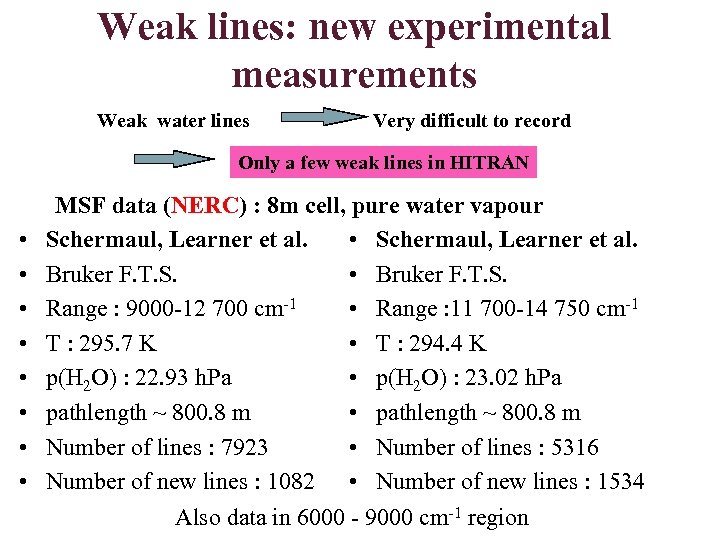
Weak lines: new experimental measurements Weak water lines Very difficult to record Only a few weak lines in HITRAN • • MSF data (NERC) : 8 m cell, pure water vapour Schermaul, Learner et al. • Schermaul, Learner et al. Bruker F. T. S. • Bruker F. T. S. Range : 9000 -12 700 cm-1 • Range : 11 700 -14 750 cm-1 T : 295. 7 K • T : 294. 4 K p(H 2 O) : 22. 93 h. Pa • p(H 2 O) : 23. 02 h. Pa pathlength ~ 800. 8 m • pathlength ~ 800. 8 m Number of lines : 7923 • Number of lines : 5316 Number of new lines : 1082 • Number of new lines : 1534 Also data in 6000 - 9000 cm-1 region
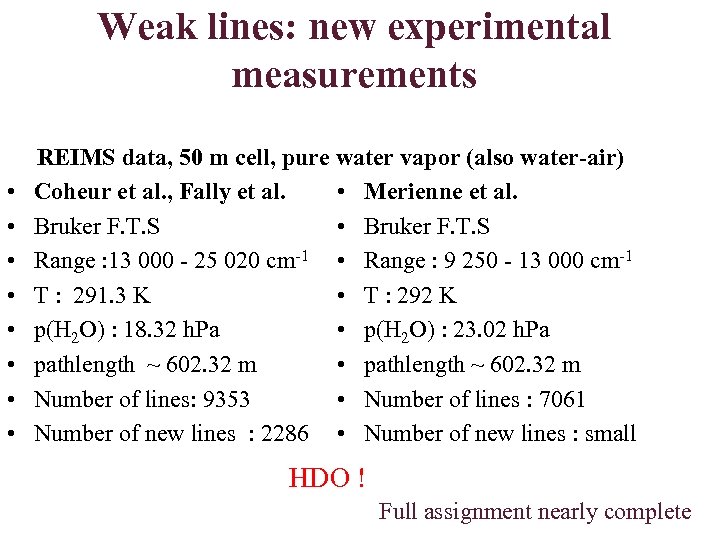
Weak lines: new experimental measurements • • REIMS data, 50 m cell, pure water vapor (also water-air) Coheur et al. , Fally et al. • Merienne et al. Bruker F. T. S • Bruker F. T. S Range : 13 000 - 25 020 cm-1 • Range : 9 250 - 13 000 cm-1 T : 291. 3 K • T : 292 K p(H 2 O) : 18. 32 h. Pa • p(H 2 O) : 23. 02 h. Pa pathlength ~ 602. 32 m • pathlength ~ 602. 32 m Number of lines: 9353 • Number of lines : 7061 Number of new lines : 2286 • Number of new lines : small HDO ! Full assignment nearly complete
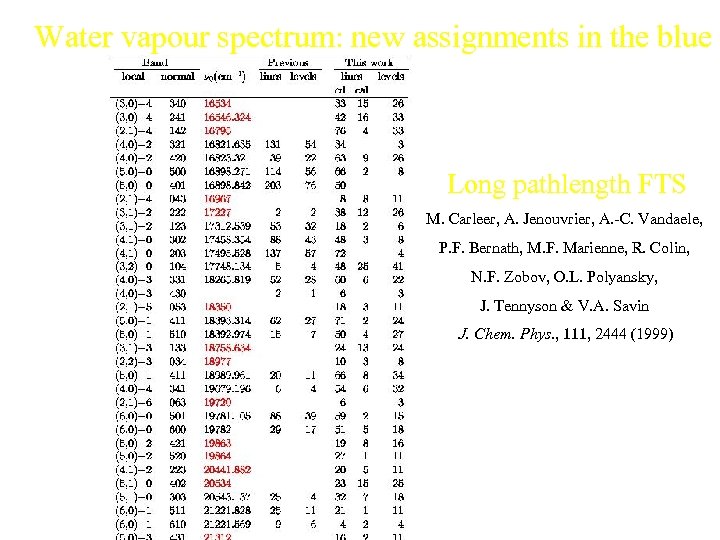
Water vapour spectrum: new assignments in the blue Long pathlength FTS M. Carleer, A. Jenouvrier, A. -C. Vandaele, P. F. Bernath, M. F. Marienne, R. Colin, N. F. Zobov, O. L. Polyansky, J. Tennyson & V. A. Savin J. Chem. Phys. , 111, 2444 (1999)
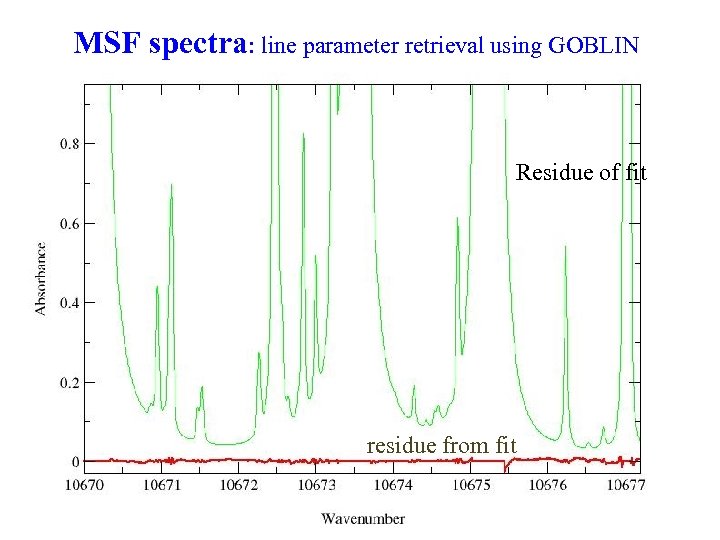
MSF spectra: line parameter retrieval using GOBLIN Residue of fit residue from fit
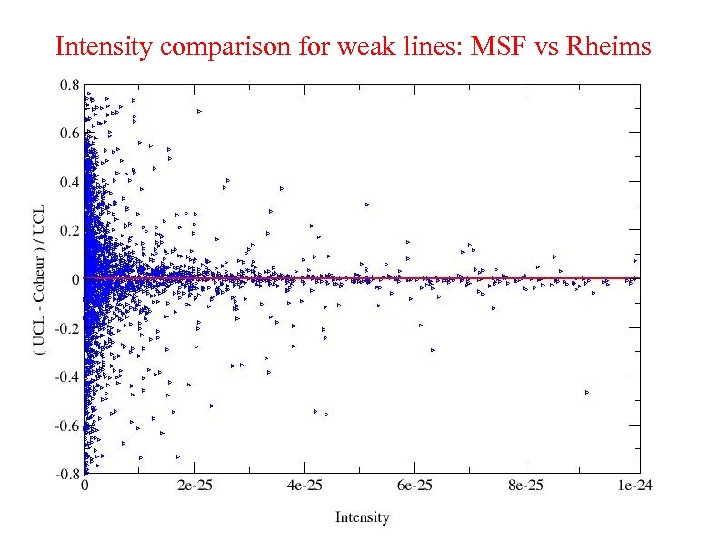
Intensity comparison for weak lines: MSF vs Rheims
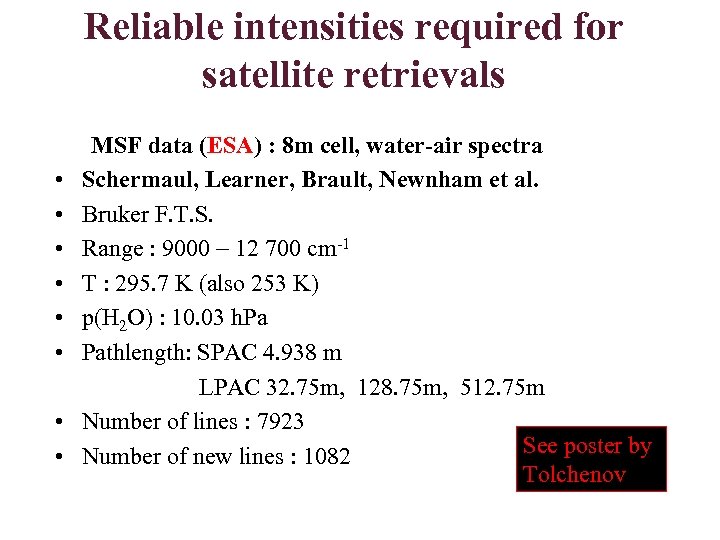
Reliable intensities required for satellite retrievals MSF data (ESA) : 8 m cell, water-air spectra • Schermaul, Learner, Brault, Newnham et al. • Bruker F. T. S. • Range : 9000 - 12 700 cm-1 • T : 295. 7 K (also 253 K) • p(H 2 O) : 10. 03 h. Pa • Pathlength: SPAC 4. 938 m LPAC 32. 75 m, 128. 75 m, 512. 75 m • Number of lines : 7923 See poster by • Number of new lines : 1082 Tolchenov
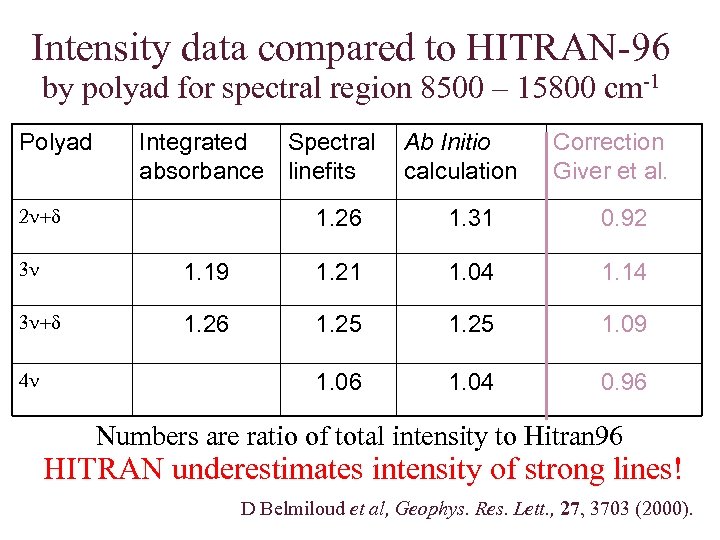
Intensity data compared to HITRAN-96 by polyad for spectral region 8500 – 15800 cm-1 Polyad Integrated Spectral Ab Initio absorbance linefits calculation 2 n+d Correction Giver et al. 1. 26 1. 31 0. 92 3 n 1. 19 1. 21 1. 04 1. 14 3 n+d 1. 26 1. 25 1. 09 1. 06 1. 04 0. 96 4 n Numbers are ratio of total intensity to Hitran 96 HITRAN underestimates intensity of strong lines! D Belmiloud et al, Geophys. Res. Lett. , 27, 3703 (2000).
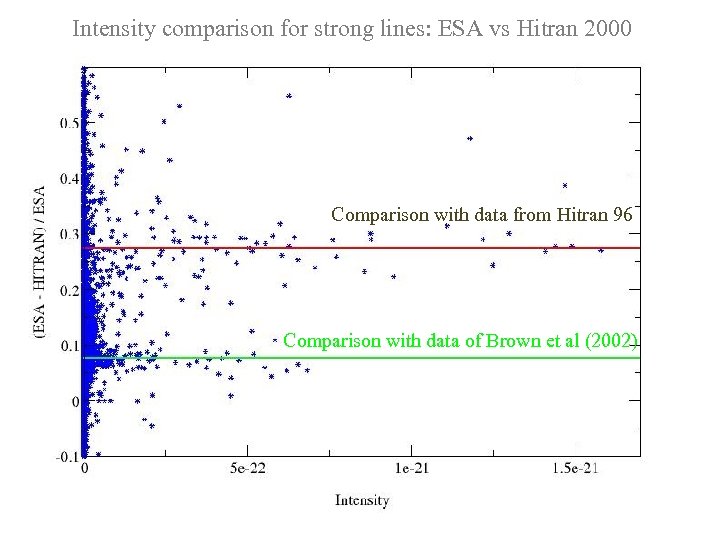
Intensity comparison for strong lines: ESA vs Hitran 2000 Comparison with data from Hitran 96 Comparison with data of Brown et al (2002)
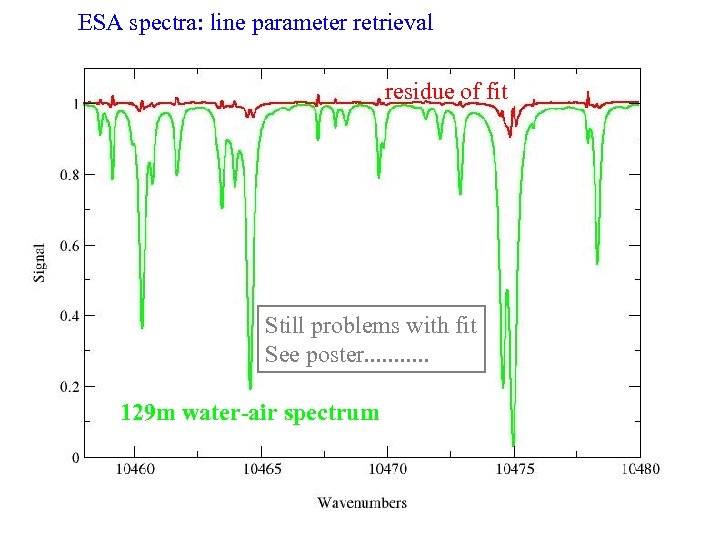
ESA spectra: line parameter retrieval residue of fit Still problems with fit See poster. . . 129 m water-air spectrum
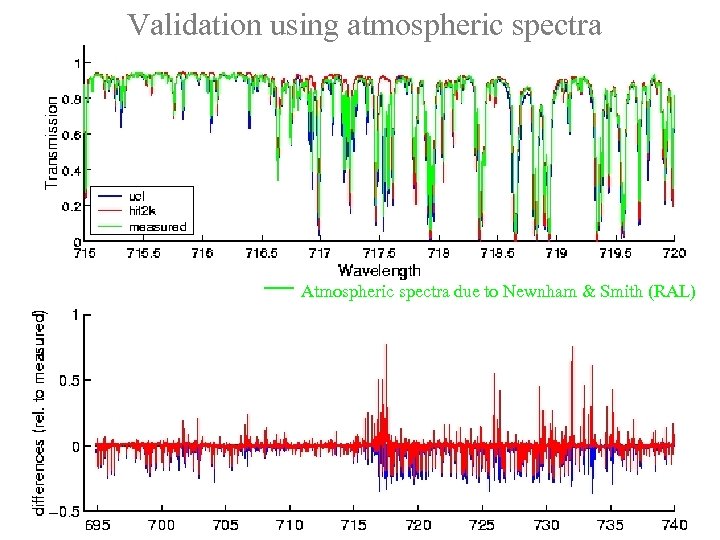
Validation using atmospheric spectra Atmospheric spectra due to Newnham & Smith (RAL)
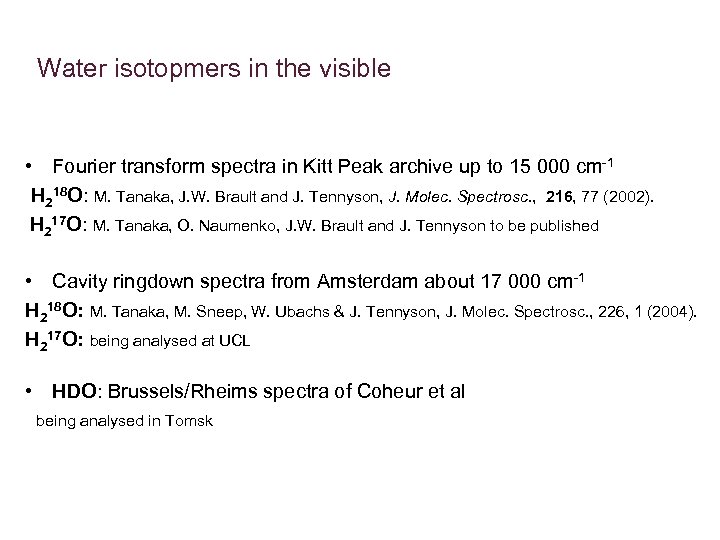
Water isotopmers in the visible • Fourier transform spectra in Kitt Peak archive up to 15 000 cm-1 H 218 O: M. Tanaka, J. W. Brault and J. Tennyson, J. Molec. Spectrosc. , 216, 77 (2002). H 217 O: M. Tanaka, O. Naumenko, J. W. Brault and J. Tennyson to be published • Cavity ringdown spectra from Amsterdam about 17 000 cm-1 H 218 O: M. Tanaka, M. Sneep, W. Ubachs & J. Tennyson, J. Molec. Spectrosc. , 226, 1 (2004). H 217 O: being analysed at UCL • HDO: Brussels/Rheims spectra of Coheur et al being analysed in Tomsk
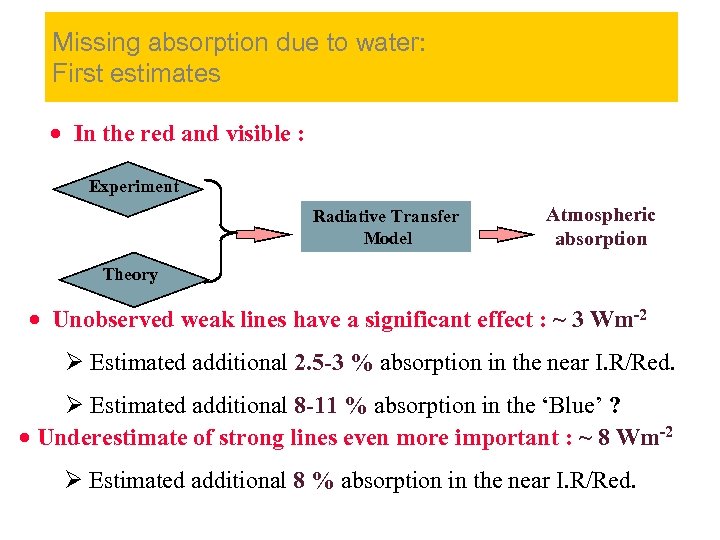
Missing absorption due to water: First estimates · In the red and visible : Experiment Radiative Transfer Model Atmospheric absorption Theory · Unobserved weak lines have a significant effect : ~ 3 Wm-2 Ø Estimated additional 2. 5 -3 % absorption in the near I. R/Red. Ø Estimated additional 8 -11 % absorption in the ‘Blue’ ? · Underestimate of strong lines even more important : ~ 8 Wm-2 Ø Estimated additional 8 % absorption in the near I. R/Red.
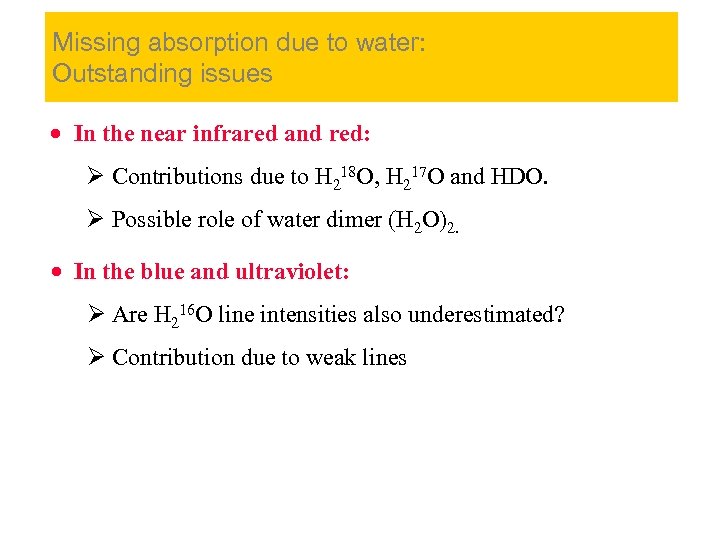
Missing absorption due to water: Outstanding issues · In the near infrared and red: Ø Contributions due to H 218 O, H 217 O and HDO. Ø Possible role of water dimer (H 2 O)2. · In the blue and ultraviolet: Ø Are H 216 O line intensities also underestimated? Ø Contribution due to weak lines
Скачать презентацию A database for water transitions from experiment and
505458b9bfe6d21204a13aeee84a9a44.ppt