


 Скачать презентацию A cross cultural perspective on children s understanding of
ab436cfcc1566e44be56af084ab3743c.ppt
- Количество слайдов: 27
 A cross cultural perspective on children’s understanding of commercial communications Kara Chan, Hong Kong Baptist U James U. Mc. Neal, Peking U Economic socialization conference July 11 -12, 2003 Exeter, UK exeter 1
 exeter 2
 Why study Chinese children? • 290 million Chinese children under 14 (population of UK: 59 million) • One child policy since 1979 • Children have great influence on family purchase decisions • China has rapid economic growth: 8% per year • Children in China is a huge market for global advertisers exeter 3
 Advertising in China • Modern advertising returned in 1979 • Advertising development highly uneven: Beijing, Shanghai and Guangdong accounted for 50% of advertising expenditure in 2001 • Children’s programme: About 8 hours per day, mainly in CCTV 1 and CCTV 7, few in regional channels • television programme sponsorship was very common, even in weather forecast exeter 4
 …Advertising in China • Many illegal ads (e. g. 66824 in 2000, among which 39% were illegal outdoor ads and 30% were illegal print ads) • Lack of specific regulation of advertising that targeted to children • Article 8 of advertising law, “Ad may not be harmful to the physical and mental health of minors and disabled persons” exeter 5
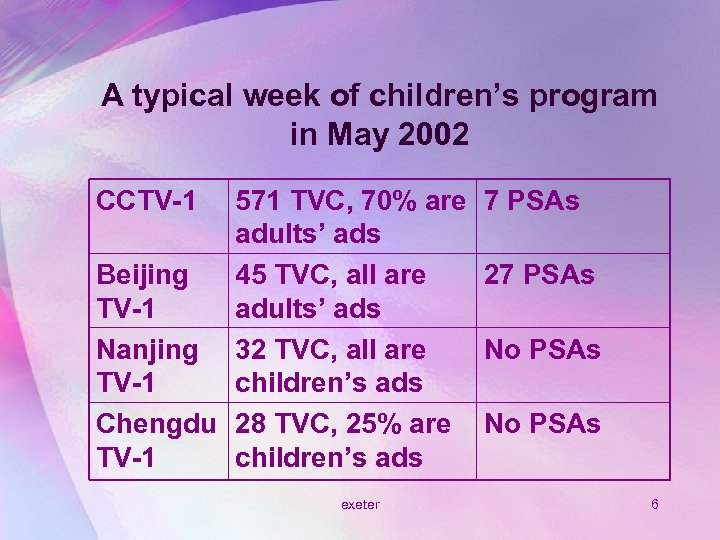 A typical week of children’s program in May 2002 CCTV-1 571 TVC, 70% are adults’ ads Beijing 45 TVC, all are TV-1 adults’ ads Nanjing 32 TVC, all are TV-1 children’s ads Chengdu 28 TVC, 25% are TV-1 children’s ads exeter 7 PSAs 27 PSAs No PSAs 6
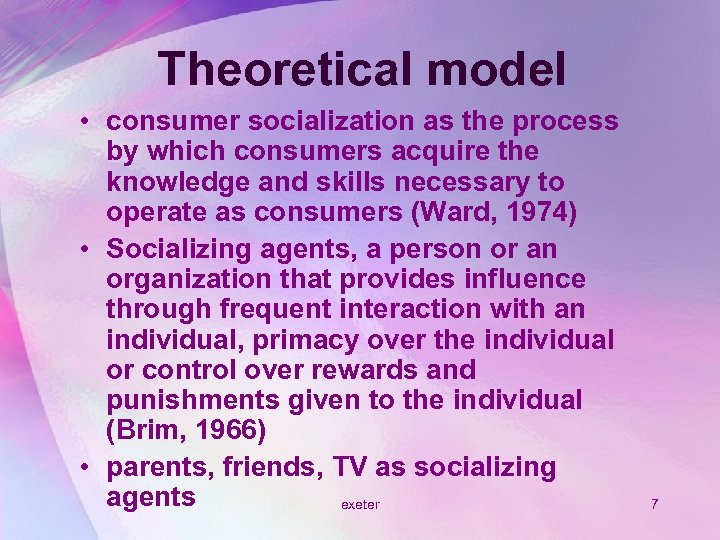 Theoretical model • consumer socialization as the process by which consumers acquire the knowledge and skills necessary to operate as consumers (Ward, 1974) • Socializing agents, a person or an organization that provides influence through frequent interaction with an individual, primacy over the individual or control over rewards and punishments given to the individual (Brim, 1966) • parents, friends, TV as socializing agents exeter 7
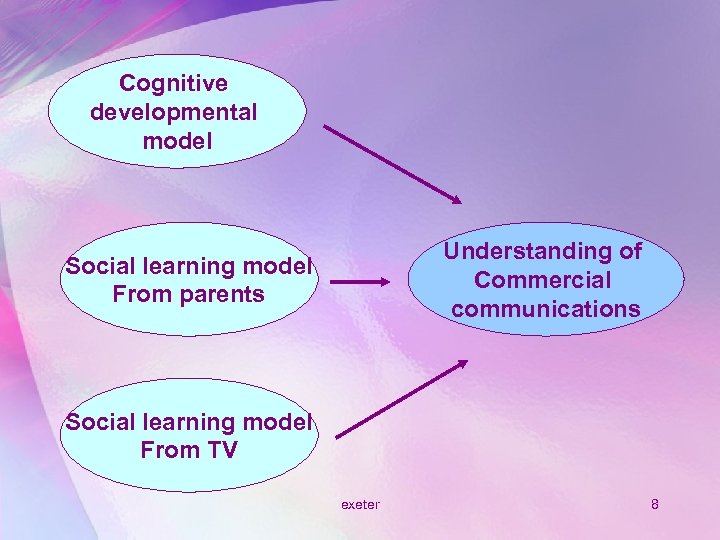 Cognitive developmental model Understanding of Commercial communications Social learning model From parents Social learning model From TV exeter 8
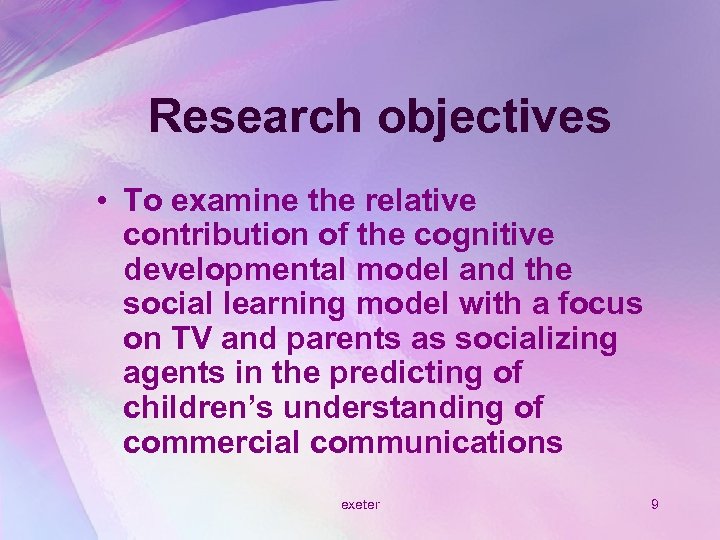 Research objectives • To examine the relative contribution of the cognitive developmental model and the social learning model with a focus on TV and parents as socializing agents in the predicting of children’s understanding of commercial communications exeter 9
 Cognitive developmental model • Age has positive impact on understanding exeter 10
 Social learning model from parents • Socio-oriented communication (-) • Concept-oriented communication (+) • Discussing TV commercials (+) • Co-viewing of TV (+) • Parents’ negative attitude (+) • Parents’ perceived influence (+) exeter 11
 Social learning model from TV • Level of TV viewing (+) • Attention to TV commercials (+) exeter 12
 additional variables • Gender (? ) • Social Economic status (+) • Level of advertising development (+) • Presence of PSAs (-) exeter 13
 Method • Survey of 1, 758 children in 3 urban cities Beijing, Nanjing and Chengdu representing high, medium and low levels of advertising development, respectively • Two schools for each city, randomly select one class in each grade (grade 1 to 6) • Close-ended questionnaire • Grade 1 -2, read Q&A to them by researchers • Sample: 1751 (response rate: 99. 6%) exeter 14
 Map of China exeter 15
 Method • Survey of their parents by asking children to bring home a questionnaire for mothers/fathers • Sample: 1665 (response rate: 94. 7%) • Matched pair with children exeter 16
 Procedure • When we watch TV, some messages occur before and after the television program that are not related to the program. They are called commercials • What are TV commercials? • What do TV commercials want you to do? • Why do TV stations broadcast commercials? exeter 17
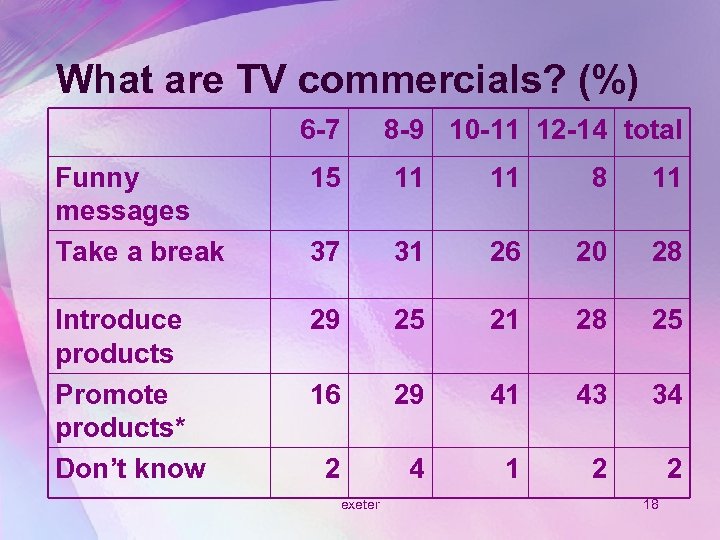 What are TV commercials? (%) 6 -7 8 -9 10 -11 12 -14 total Funny messages Take a break 15 11 11 8 11 37 31 26 20 28 Introduce products Promote products* Don’t know 29 25 21 28 25 16 29 41 43 34 2 4 1 2 2 exeter 18
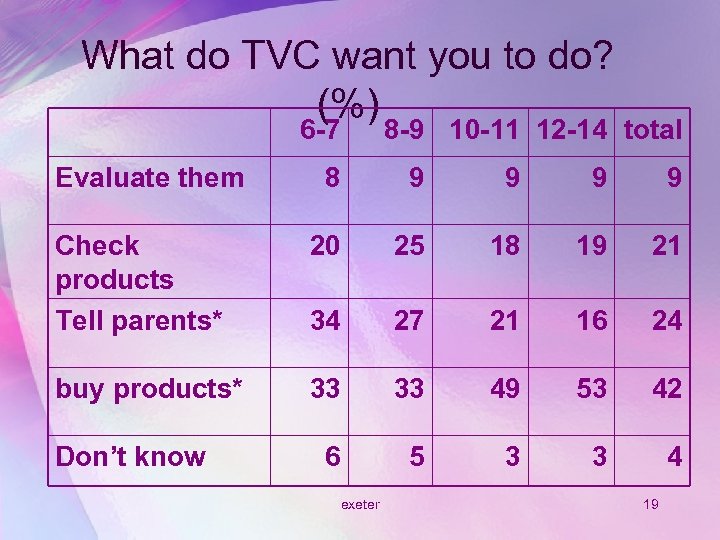 What do TVC want you to do? (%) 6 -7 Evaluate them 8 -9 10 -11 12 -14 total 8 9 9 Check products Tell parents* 20 25 18 19 21 34 27 21 16 24 buy products* 33 33 49 53 42 6 5 3 3 4 Don’t know exeter 19
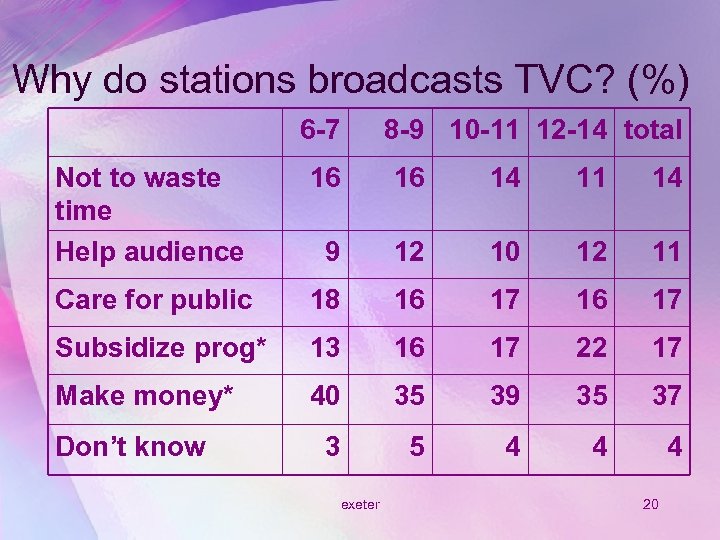 Why do stations broadcasts TVC? (%) 6 -7 8 -9 10 -11 12 -14 total Not to waste time Help audience 16 16 14 11 14 9 12 10 12 11 Care for public 18 16 17 Subsidize prog* 13 16 17 22 17 Make money* 40 35 39 35 37 3 5 4 4 4 Don’t know exeter 20
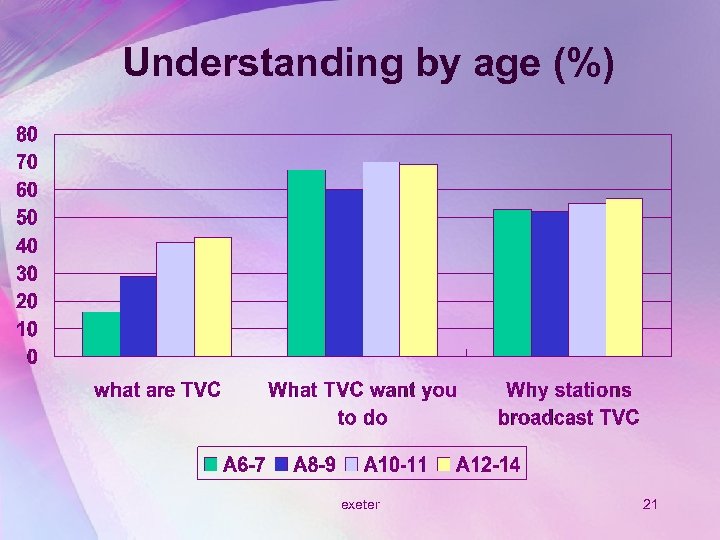 Understanding by age (%) exeter 21
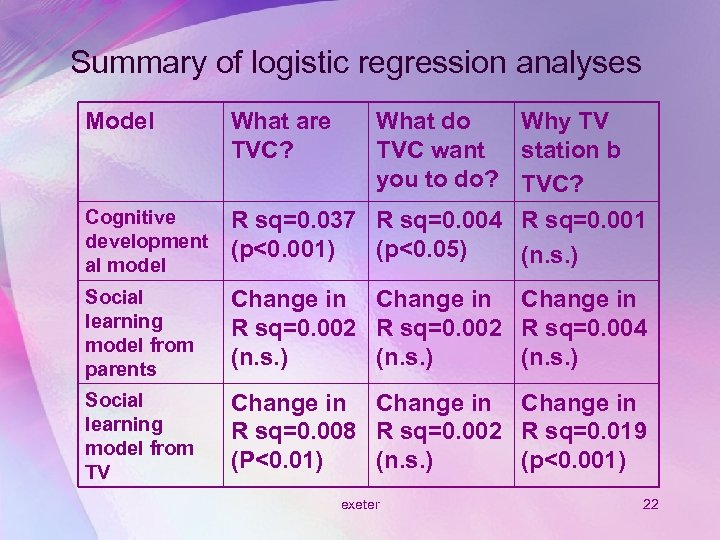 Summary of logistic regression analyses Model What are TVC? What do Why TV TVC want station b you to do? TVC? Cognitive R sq=0. 037 R sq=0. 004 R sq=0. 001 development (p<0. 001) (p<0. 05) (n. s. ) al model Social learning model from parents Change in R sq=0. 002 R sq=0. 004 (n. s. ) Social learning model from TV Change in R sq=0. 008 R sq=0. 002 R sq=0. 019 (P<0. 01) (n. s. ) (p<0. 001) exeter 22
 General findings • Cognitive developmental model contributes more than social learning model • Parents plays insignificant role in children’s understanding of commercial communication • Attention to TVC has negative impact on understanding exeter 23
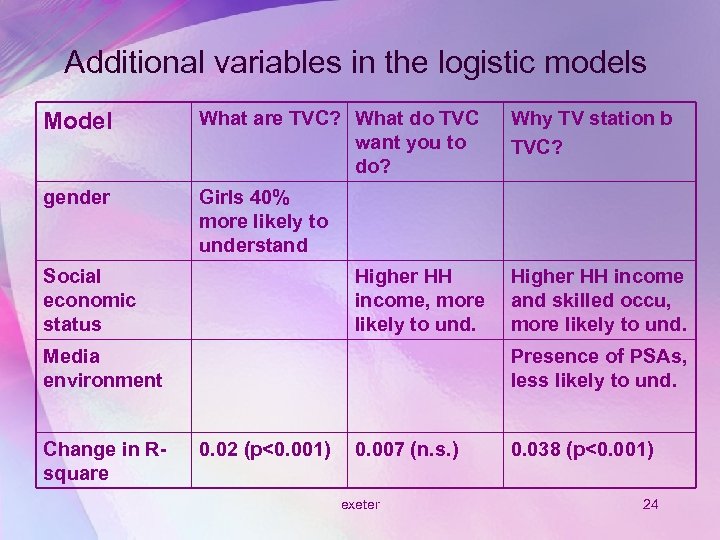 Additional variables in the logistic models Model What are TVC? What do TVC want you to do? gender Girls 40% more likely to understand Social economic status Higher HH income, more likely to und. Media environment Change in Rsquare Why TV station b TVC? Higher HH income and skilled occu, more likely to und. Presence of PSAs, less likely to und. 0. 02 (p<0. 001) 0. 007 (n. s. ) exeter 0. 038 (p<0. 001) 24
 Why parents do not play an important role in consumer socialization? • Parents grew up in period of material shortage and did not have abundant consumer experience, they are incompetent consumers • Parents not motivated to talk about consumption • Parents and children too busy • Discussion about TV commercials: emphasize on moral education exeter 25
 Future studies • Focus group interview about sources of knowledge about TV commercials • Experimental design to test the impact of PSAs on understanding of commercial and non-commercial communications • Why children’s understanding deviates from the cognitive developmental model? exeter 26
 Show some TV segments • Nanjing • Beijing exeter 27