


 Скачать презентацию A couple of approaches to modelling and analysis
cb293044db676bf80255a294452c7908.ppt
- Количество слайдов: 29
 A couple of approaches to modelling and analysis of biochemical networks ”Biomodelling” seminar, October 2006 more an inspiration for a discussion than a talk. . . Matúš Kalaš
 Contents 1. The variety of modelling paradigms 2. An example of systematic approach (M. Heiner & D. Gilbert) 3. Another example (GOALIE; B. Mishra, M. Antoniotti et al. ) 2
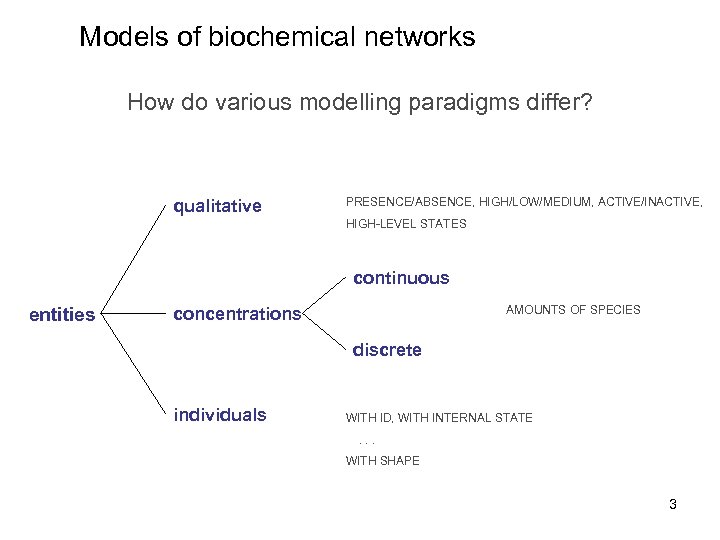 Models of biochemical networks How do various modelling paradigms differ? qualitative PRESENCE/ABSENCE, HIGH/LOW/MEDIUM, ACTIVE/INACTIVE, HIGH-LEVEL STATES continuous entities AMOUNTS OF SPECIES concentrations discrete individuals WITH ID, WITH INTERNAL STATE. . . WITH SHAPE 3
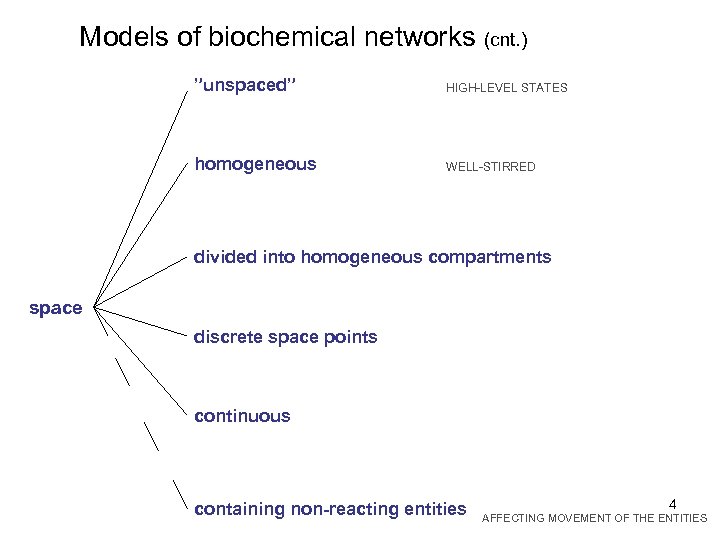 Models of biochemical networks (cnt. ) ”unspaced” HIGH-LEVEL STATES homogeneous WELL-STIRRED divided into homogeneous compartments space discrete space points continuous containing non-reacting entities 4 AFFECTING MOVEMENT OF THE ENTITIES
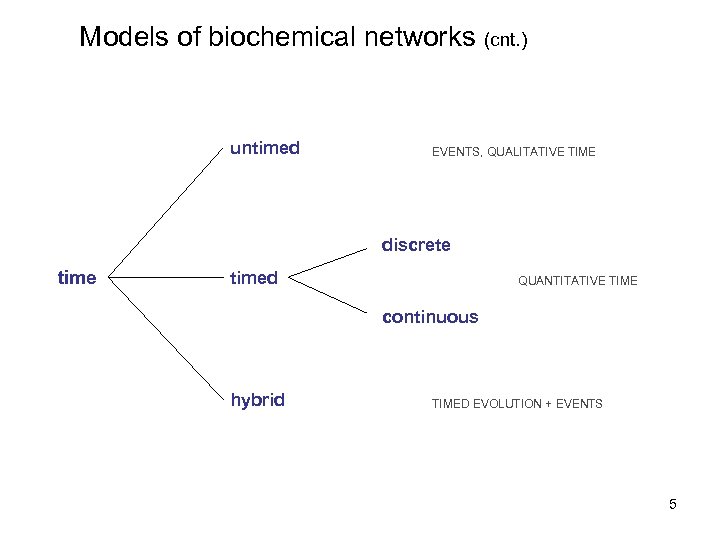 Models of biochemical networks (cnt. ) untimed EVENTS, QUALITATIVE TIME discrete timed QUANTITATIVE TIME continuous hybrid TIMED EVOLUTION + EVENTS 5
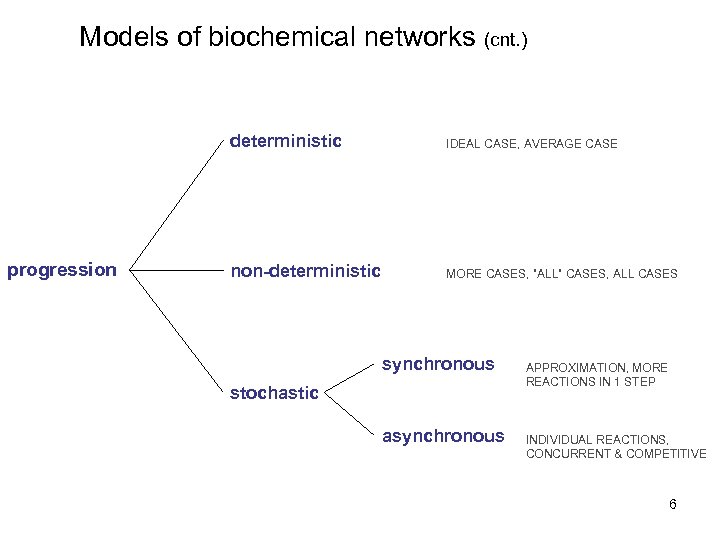 Models of biochemical networks (cnt. ) deterministic progression IDEAL CASE, AVERAGE CASE non-deterministic MORE CASES, ”ALL” CASES, ALL CASES synchronous stochastic asynchronous APPROXIMATION, MORE REACTIONS IN 1 STEP INDIVIDUAL REACTIONS, CONCURRENT & COMPETITIVE 6
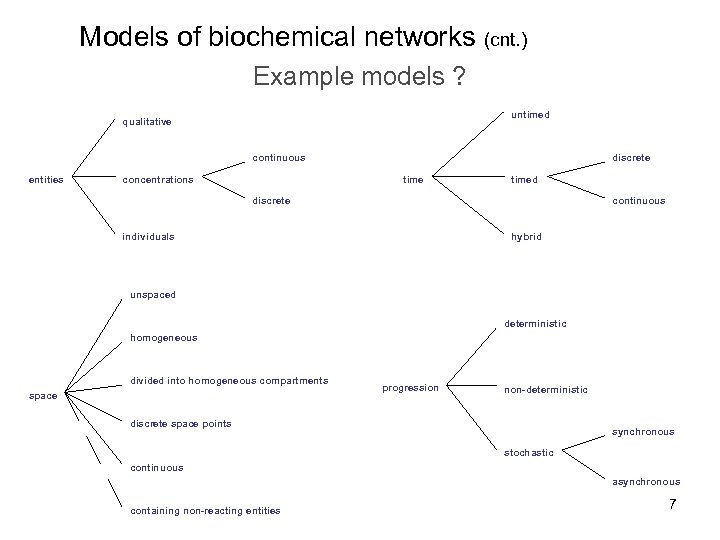 Models of biochemical networks (cnt. ) Example models ? untimed qualitative continuous entities concentrations discrete timed continuous discrete hybrid individuals unspaced deterministic homogeneous divided into homogeneous compartments space progression non-deterministic discrete space points synchronous stochastic continuous asynchronous containing non-reacting entities 7
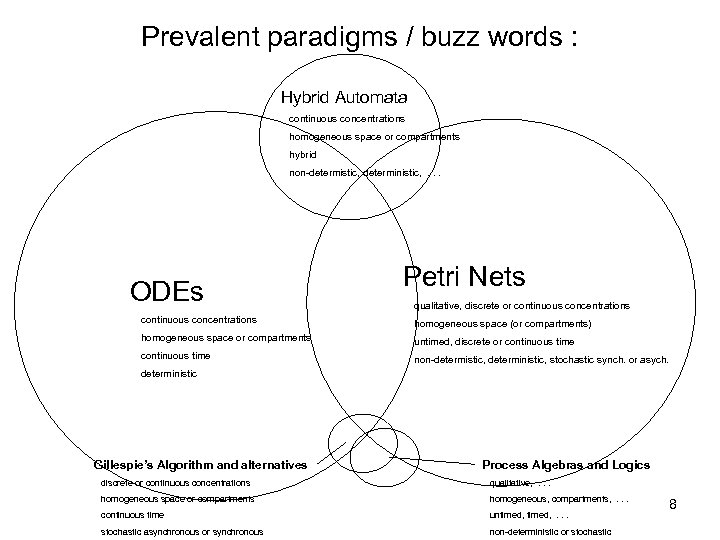 Prevalent paradigms / buzz words : Hybrid Automata continuous concentrations homogeneous space or compartments hybrid non-determistic, deterministic, . . . ODEs Petri Nets qualitative, discrete or continuous concentrations homogeneous space (or compartments) homogeneous space or compartments untimed, discrete or continuous time non-determistic, deterministic, stochastic synch. or asych. deterministic Gillespie’s Algorithm and alternatives Process Algebras and Logics discrete or continuous concentrations qualitative, . . . homogeneous space or compartments homogeneous, compartments, . . . continuous time untimed, . . . stochastic asynchronous or synchronous non-deterministic or stochastic 8
 Now an instant introduction to Petri Nets. . . 9
 An example of systematic modelling: Step-wise modelling David Gilbert, Monika Heiner: From Petri Nets to Differential Equations – An Integrative Approach for Biochemical Network Analysis ICATPN 2006, TR 2005 . . . a tutorial example of • different useful features of different modelling paradigms • step-wise modelling 10
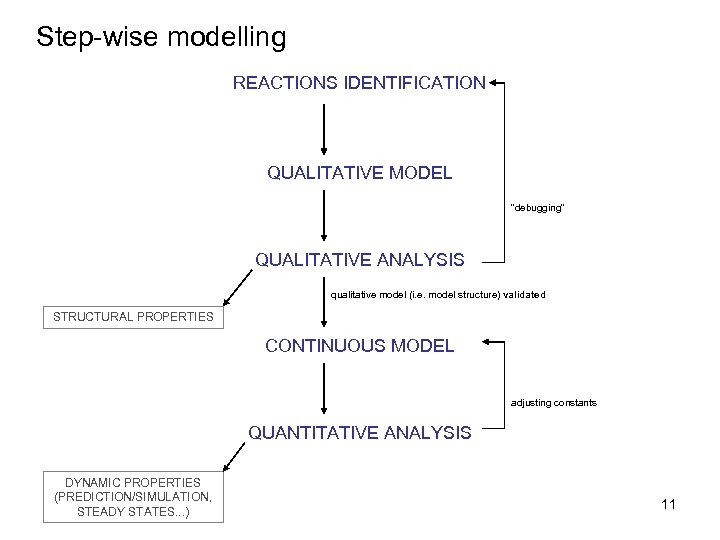 Step-wise modelling REACTIONS IDENTIFICATION QUALITATIVE MODEL ”debugging” QUALITATIVE ANALYSIS qualitative model (i. e. model structure) validated STRUCTURAL PROPERTIES CONTINUOUS MODEL adjusting constants QUANTITATIVE ANALYSIS DYNAMIC PROPERTIES (PREDICTION/SIMULATION, STEADY STATES. . . ) 11
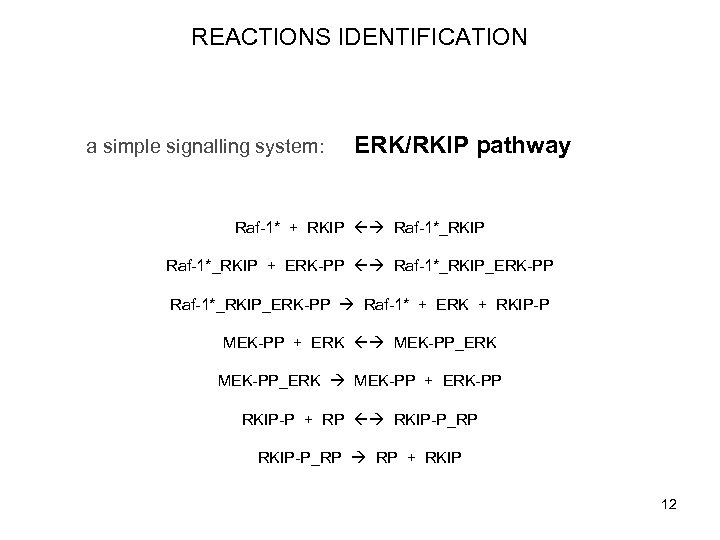 REACTIONS IDENTIFICATION a simple signalling system: ERK/RKIP pathway Raf-1* + RKIP Raf-1*_RKIP + ERK-PP Raf-1*_RKIP_ERK-PP Raf-1* + ERK + RKIP-P MEK-PP + ERK MEK-PP_ERK MEK-PP + ERK-PP RKIP-P + RP RKIP-P_RP RP + RKIP 12
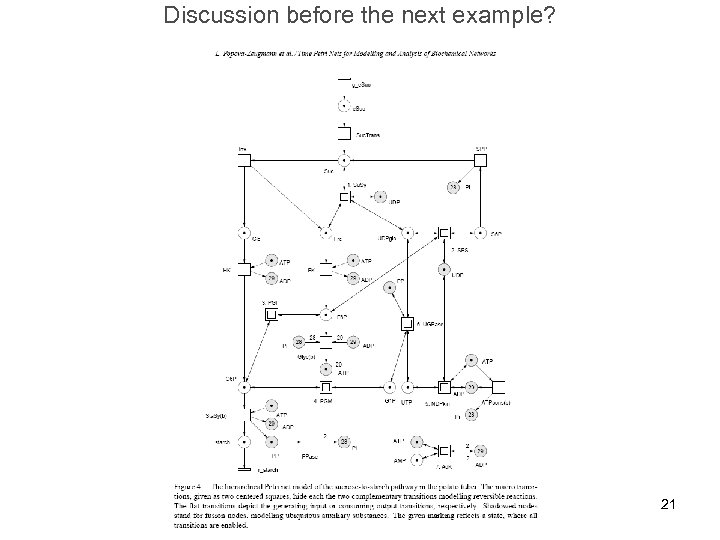
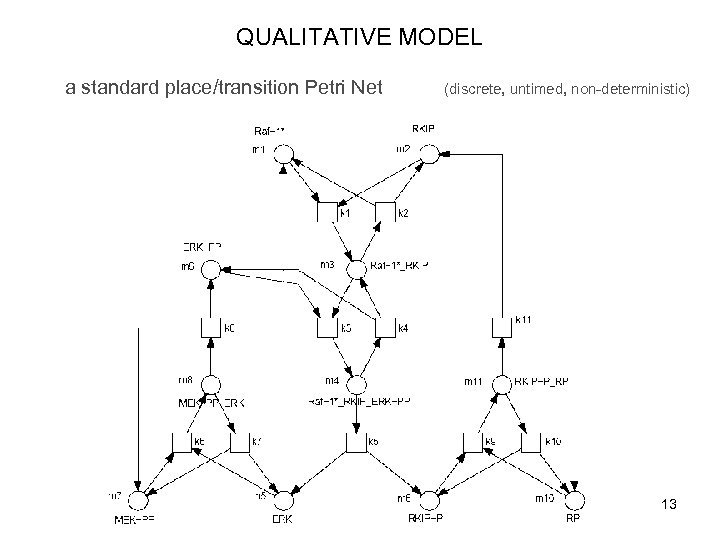 QUALITATIVE MODEL a standard place/transition Petri Net (discrete, untimed, non-deterministic) 13
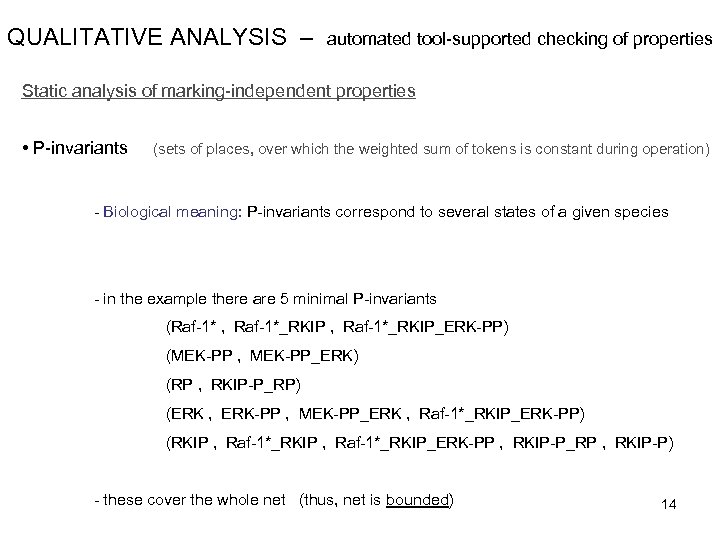 QUALITATIVE ANALYSIS – automated tool-supported checking of properties Static analysis of marking-independent properties • P-invariants (sets of places, over which the weighted sum of tokens is constant during operation) - Biological meaning: P-invariants correspond to several states of a given species - in the example there are 5 minimal P-invariants (Raf-1* , Raf-1*_RKIP_ERK-PP) (MEK-PP , MEK-PP_ERK) (RP , RKIP-P_RP) (ERK , ERK-PP , MEK-PP_ERK , Raf-1*_RKIP_ERK-PP) (RKIP , Raf-1*_RKIP_ERK-PP , RKIP-P_RP , RKIP-P) - these cover the whole net (thus, net is bounded) 14
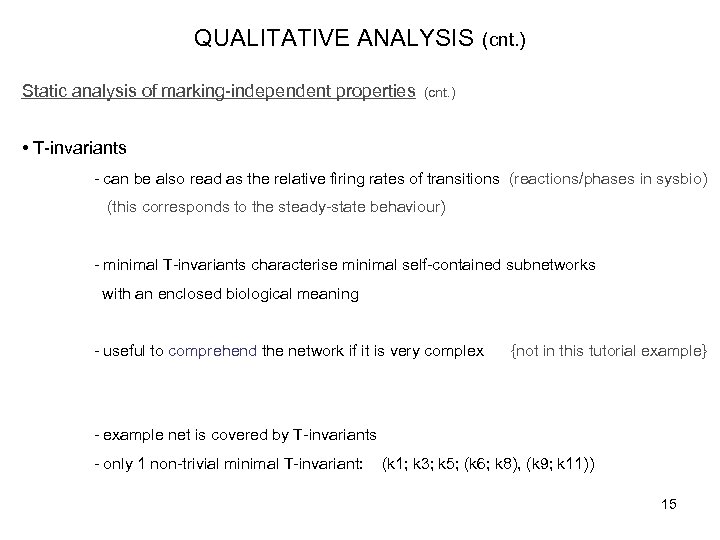 QUALITATIVE ANALYSIS Static analysis of marking-independent properties (cnt. ) • T-invariants - can be also read as the relative firing rates of transitions (reactions/phases in sysbio) (this corresponds to the steady-state behaviour) - minimal T-invariants characterise minimal self-contained subnetworks with an enclosed biological meaning - useful to comprehend the network if it is very complex {not in this tutorial example} - example net is covered by T-invariants - only 1 non-trivial minimal T-invariant: (k 1; k 3; k 5; (k 6; k 8), (k 9; k 11)) 15
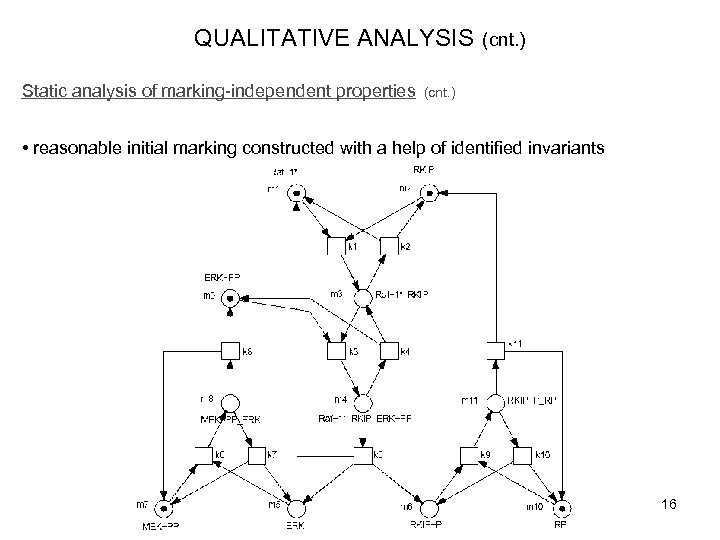 QUALITATIVE ANALYSIS Static analysis of marking-independent properties (cnt. ) • reasonable initial marking constructed with a help of identified invariants 16
 QUALITATIVE ANALYSIS (cnt. ) Static analysis of marking-dependent properties • example net is boolean / 1 -bounded / safe • the net is live Dynamic analysis of marking-dependent properties • example net is reversible • MODEL CHECKING of any interesting properties formulated in CTL (Computational Tree Logic) - e. g. : ”the phosphorylation of ERK does not depend on a phosphorylated state of RKIP” EG [ERK E (~(RKIP-P / RKIP-P_RP) U ERK-PP) ] 17
 QUALITATIVE ANALYSIS (cnt. ) VALIDATION OF THE QUALITATIVE MODEL (i. e. structure of the system) ü all expected structural and general behavioural properties hold ü covered by P-invariants ü no minimal P-invariant without biological interpretation ü covered by T-invariants ü no minimal T-invariant without biological interpretation ü no known biological behaviour without corresponding T-invariant ü all expected logic-formulated properties hold a break? 18
 CONTINUOUS QUANTITATIVE MODEL Continuous Petri Net - tokens: real numbers - transitions associated with a rate - semantics: a set of ODEs (e. g. reaction-rate equation) - thus a continuous, timed (continuously) and deterministic model - basically a set of ODEs enhanced with a graphical representation - within this step, all we need is to find suitable rate constants (e. g. to fit in-vivo or in-vitro quantitative experiments) 19
 QUANTITATIVE ANALYSIS • Prediction (easy) - both qualitative and quantitative • Steady-state properties, oscillations, sensibility, . . . (hard) (. . . you know better. . . ) 20
 Discussion before the next example? 21
 Another example: Automated modelling. . . building a model in order to understand very complex processes. . . Samantha Kleinberg, Marco Antoniotti, Satish Tadepalli, Naren Ramakrishnan, Bud Mishra: Remembrance of Experiments Past: A redescription based tool for discovery in complex systems ICCS 2006 Marco Antoniotti, Naren Ramakrishnan, Bud Mishra: GOALIE, A Common Lisp Application to Discover Kripke Models: Redescribing Biological Processes from Time-Course Data ILC 2005 22
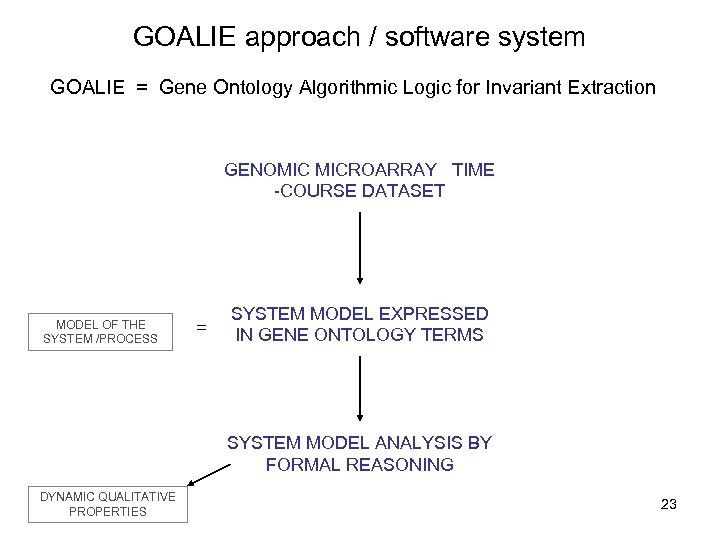 GOALIE approach / software system GOALIE = Gene Ontology Algorithmic Logic for Invariant Extraction GENOMIC MICROARRAY TIME -COURSE DATASET MODEL OF THE SYSTEM /PROCESS = SYSTEM MODEL EXPRESSED IN GENE ONTOLOGY TERMS SYSTEM MODEL ANALYSIS BY FORMAL REASONING DYNAMIC QUALITATIVE PROPERTIES 23
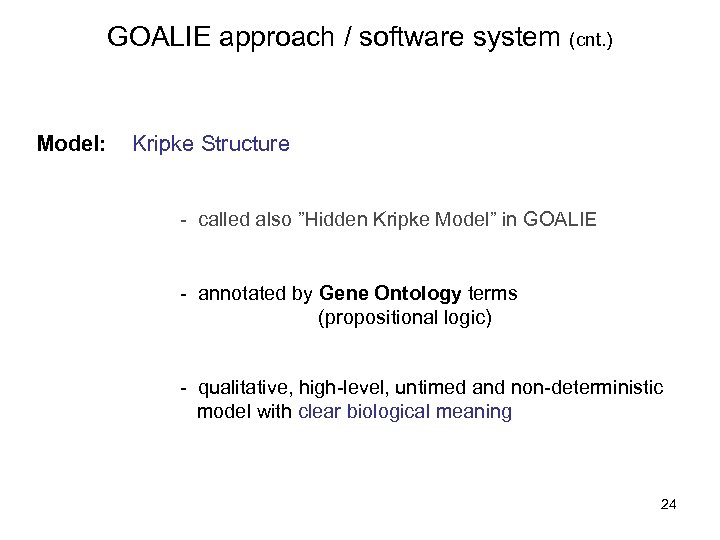 GOALIE approach / software system (cnt. ) Model: Kripke Structure - called also ”Hidden Kripke Model” in GOALIE - annotated by Gene Ontology terms (propositional logic) - qualitative, high-level, untimed and non-deterministic model with clear biological meaning 24
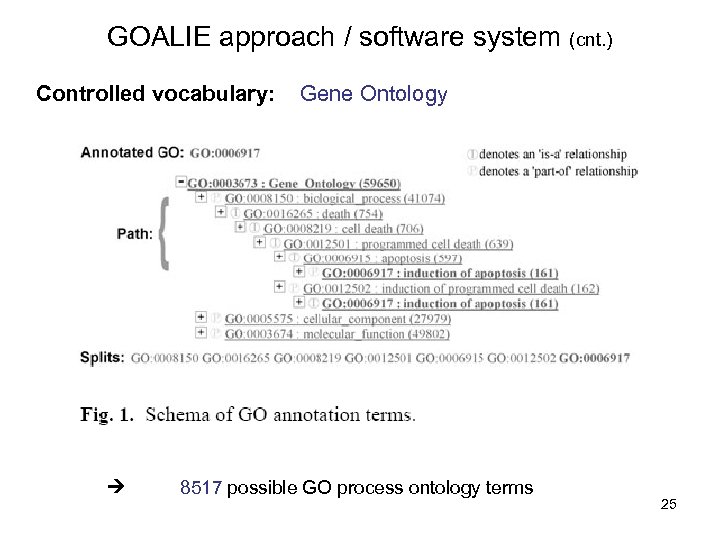 GOALIE approach / software system (cnt. ) Controlled vocabulary: Gene Ontology 8517 possible GO process ontology terms 25
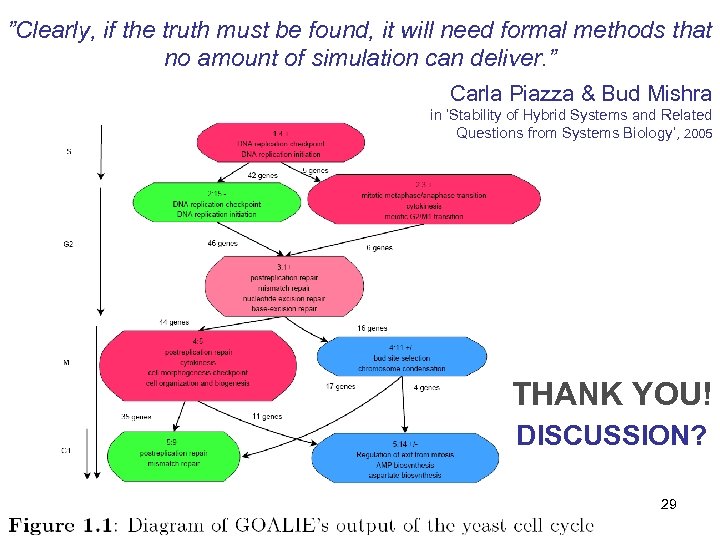
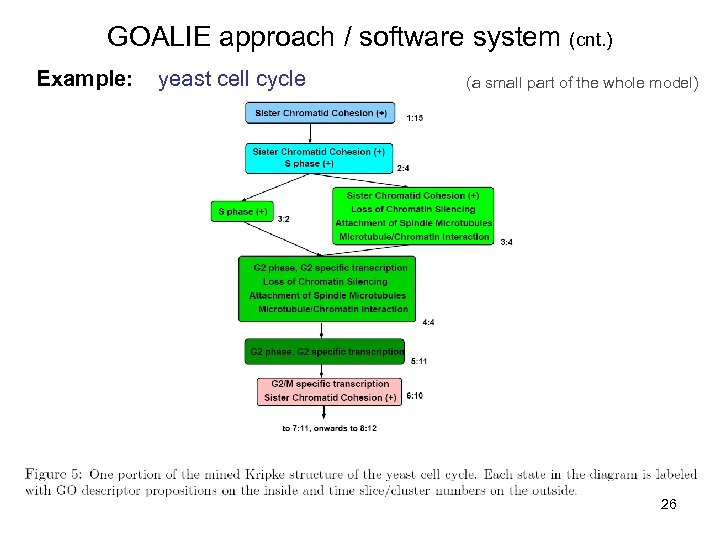 GOALIE approach / software system (cnt. ) Example: yeast cell cycle (a small part of the whole model) 26
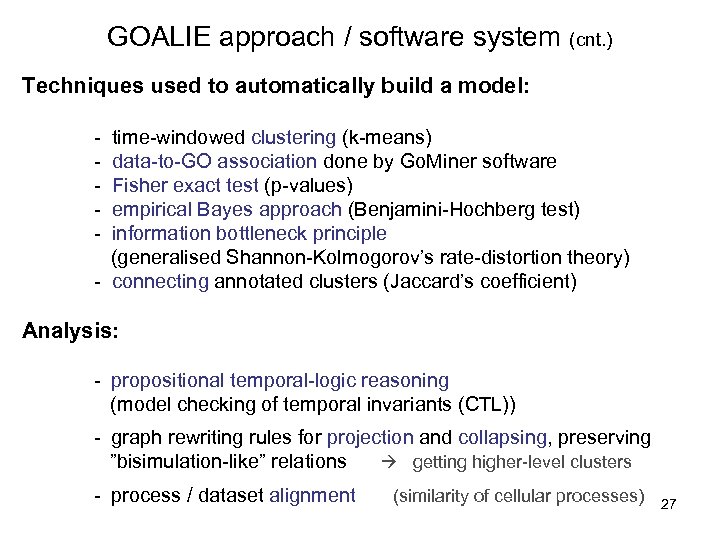 GOALIE approach / software system (cnt. ) Techniques used to automatically build a model: - time-windowed clustering (k-means) data-to-GO association done by Go. Miner software Fisher exact test (p-values) empirical Bayes approach (Benjamini-Hochberg test) information bottleneck principle (generalised Shannon-Kolmogorov’s rate-distortion theory) - connecting annotated clusters (Jaccard’s coefficient) Analysis: - propositional temporal-logic reasoning (model checking of temporal invariants (CTL)) - graph rewriting rules for projection and collapsing, preserving ”bisimulation-like” relations getting higher-level clusters - process / dataset alignment (similarity of cellular processes) 27
 A couple of diverse systematic approaches: • C. Wiggins, I. Nemenman: Process Pathway Inference via Time Series Analysis, 2006 • M. Calder, S. Gilmore, J. Hillston: Automatically deriving ODEs from process algebra models of signalling pathways, CMSB 2005 • N. Chabrier-Rivier, M. Chiaverini, V. Danos, F. Fages, V. Schächter: Modeling and Querying Biomolecular Interaction Networks, TCS 2004 • A. Arkin, P. Shen, J. Ross: A Test Case of Correlation Metric Construction of a Reaction Pathway from Measurements, Science 1997 • M. Chen, R. Hofestädt: A medical bioinformatics approach for metabolic disorders: Biomedical data prediction, modeling, and systematic analysis, JBMI 2006 28
 ”Clearly, if the truth must be found, it will need formal methods that no amount of simulation can deliver. ” Carla Piazza & Bud Mishra in ’Stability of Hybrid Systems and Related Questions from Systems Biology’, 2005 THANK YOU! DISCUSSION? 29